Get Premium
Dark mode theme is available exclusively for premium users. Learn more about the benefits of subscribing.
No fees, cancel anytime.

 Dark Mode Ad-Free Browsing Unlimited Content
 Ad-Free Browsing Unlimited Content Dark Mode
Join 1.2 million Panda readers who get the best art, memes, and fun stories every week!

Everyone says relationships should always be on equal footing: treat each other with respect, support each other equally, and share the load of having a life together.
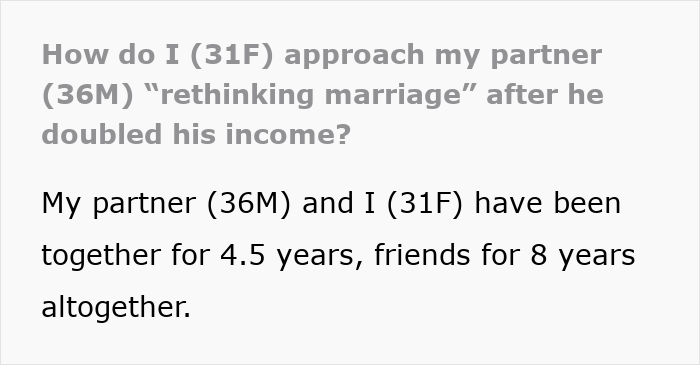
Realistically, though, imbalances happen, whether over household chores, parenting, or the hardest variable of all: money. That reality hit home for one woman on r/relationship_advice when her partner put their marriage plans on hold immediately after his salary tripled. She wanted some advice, and this is what readers had to say about the situation.


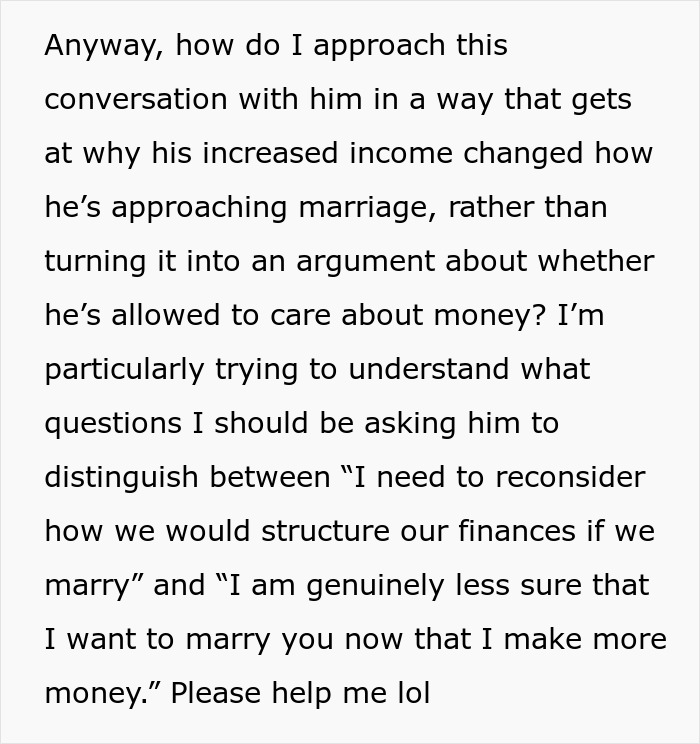
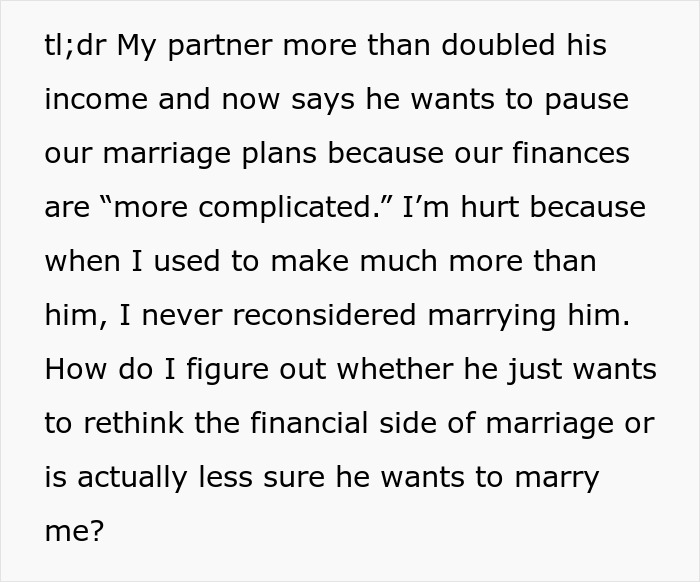
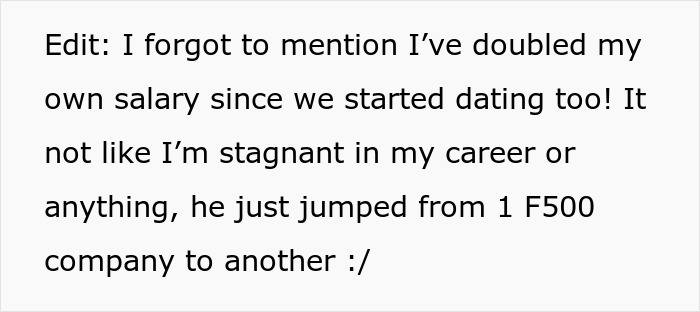
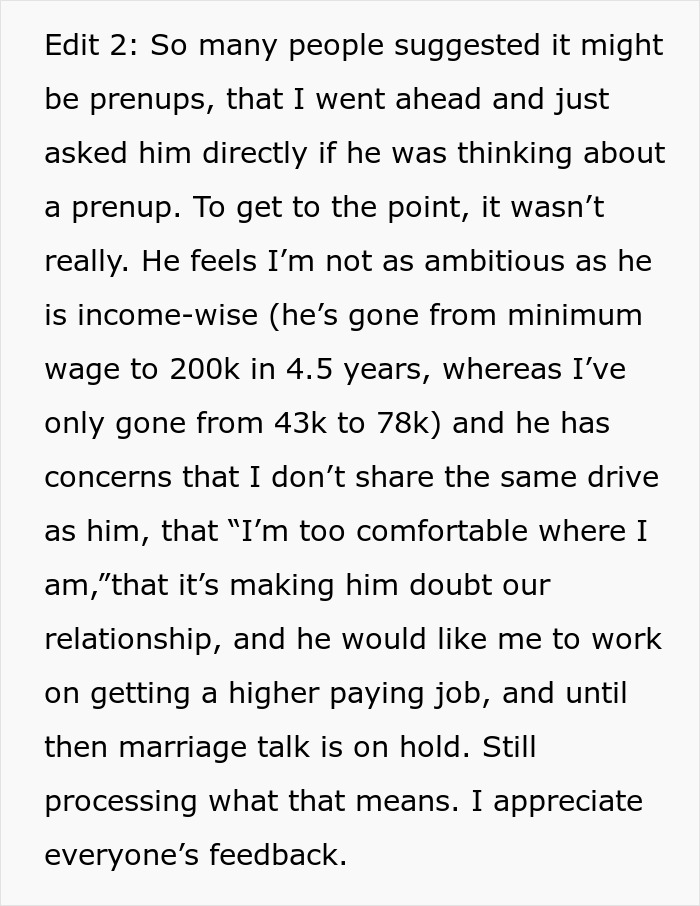
Unfortunately, the situation the woman finds herself in is far from uncommon. The Institute for Family Studies (IFS) and the Pew Research Center have found that, historically, marriages were most stable when the husband was the primary breadwinner, but modern data actually shows that a big jump in income can change how people perceive the value of marriage.
In economics, this is known as “marriage market value,” or a person’s perceived worth or desirability in the dating and mating marketplace. So, the problem isn’t the income itself, but how much it changed. Economists call this the “hyper-upward mobility effect.” Because the boyfriend jumped from minimum wage to $200,000 in under five years, his baseline for what is “normal” and “ambitious” shifted.
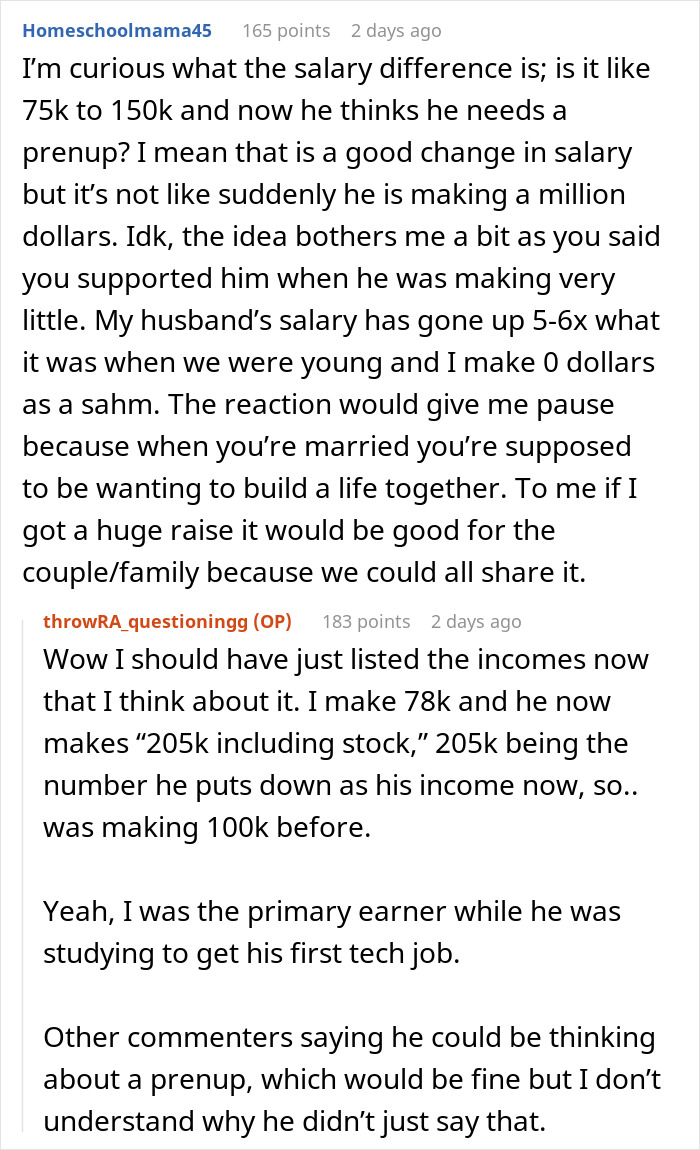
This also fundamentally changed his internal bias about wealth. Psychologists note that when someone’s income changes rapidly, they often project their new lifestyle values onto their partners. So, whereas he might have previously seen her income as stable, he now sees it as stagnant. Now, he sees her $78,000 income as proof of an internal trait, like a lack of ambition or being too comfortable, instead of the obvious structural explanation: she works in education.
Then, of course, there comes social exchange theory. Thibaut and Kelley created this theory to show that people measure relationships by balancing their costs and benefits. So, while she was earning $43k and he was making minimum wage, she still provided him with a safety net, despite his low economic value. But unfortunately, the reverse wasn’t mutual, and he now reassessed her value through a fully transactional lens.
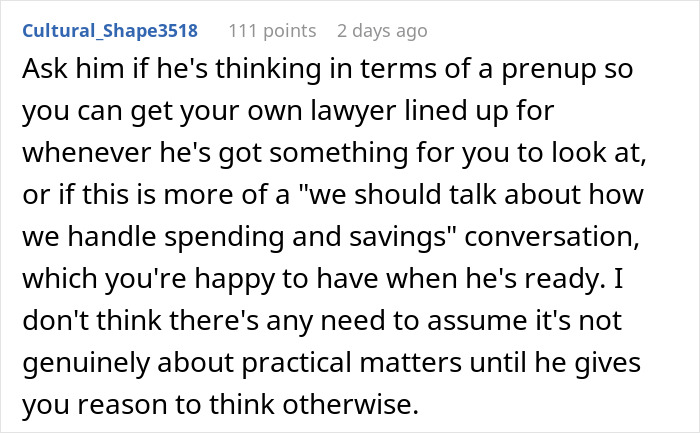
And if we’re looking at it from the perspective that a prenup only benefits the wealthier person, that couldn’t be more wrong. Research shows that prenuptial agreements can strengthen relationships by clarifying asset division, support expectations, and even debt allocation early on — but only when handled collaboratively. At the same time, he wasn’t even specifically asking for a prenup. Instead, it worked more as an ultimatum: earn more, or he won’t marry her.
So, what should she do? Only the narrator can make that decision, but experts advise against changing careers just to meet his demands, since ultimatums rarely solve financial conflict. Instead, if the boyfriend cannot see beyond financial value but still wants to pursue the relationship, they could seek a financial therapy association to learn how to move forward with financial decision-making. What would you have done? End the relationship, or try to solve it?












By entering your email and clicking Subscribe, you're agreeing to let us send you customized marketing messages about us and our advertising partners. You are also agreeing to our Privacy Policy.
Thank you! You've successfully subscribed to newsletters!

Girl, run in the other direction. He's a poser. Someone needs to break the news to him that it takes more than a $200k year salary to attract and afford the kind of trophy wife he seems to imagine is due him.

Reading this, all I could think of was Dee, Conor McGregor’s wife, who got with him when he was a plumber’s apprentice, and held on for dear life until he’d made hundreds of millions and FINALLY married her after they had four kids. Now I’m gonna go throw up because McGregor is either the possessor of a better character feature than this guy, or else he’s happy that Dee lets him asssault women so he’ll keep her. Yuck.
Load More Replies...
So she can spend several years paying 100% of their living costs and putting him through school, but now that he's finished school and his salary is high...she's a gold digger??? Yeah just like most men. Let me be a total labor digger and leach off you until I reach wealth using your support.Now I will ditch you and look for someone else.

I'm not even gonna read past the headline. This dude is gross. My wife and I got together when neither of us had anything. The first thing we each "had" was each other. If I had suddenly become well-paid back then, I would have rejoiced and married her sooner, not thought she was "less than." What a clown this boy is.

Gross was literally the first word that came to mind.
Load More Replies... Girl, run in the other direction. He's a poser. Someone needs to break the news to him that it takes more than a $200k year salary to attract and afford the kind of trophy wife he seems to imagine is due him.
Reading this, all I could think of was Dee, Conor McGregor’s wife, who got with him when he was a plumber’s apprentice, and held on for dear life until he’d made hundreds of millions and FINALLY married her after they had four kids. Now I’m gonna go throw up because McGregor is either the possessor of a better character feature than this guy, or else he’s happy that Dee lets him asssault women so he’ll keep her. Yuck.
Load More Replies... So she can spend several years paying 100% of their living costs and putting him through school, but now that he's finished school and his salary is high...she's a gold digger??? Yeah just like most men. Let me be a total labor digger and leach off you until I reach wealth using your support.Now I will ditch you and look for someone else.
I'm not even gonna read past the headline. This dude is gross. My wife and I got together when neither of us had anything. The first thing we each "had" was each other. If I had suddenly become well-paid back then, I would have rejoiced and married her sooner, not thought she was "less than." What a clown this boy is.
Gross was literally the first word that came to mind.
Load More Replies...

































 No fees, cancel anytime










36
17