Get Premium
Dark mode theme is available exclusively for premium users. Learn more about the benefits of subscribing.
No fees, cancel anytime.

 Dark Mode Ad-Free Browsing Unlimited Content
 Ad-Free Browsing Unlimited Content Dark Mode
Join 1.2 million Panda readers who get the best art, memes, and fun stories every week!
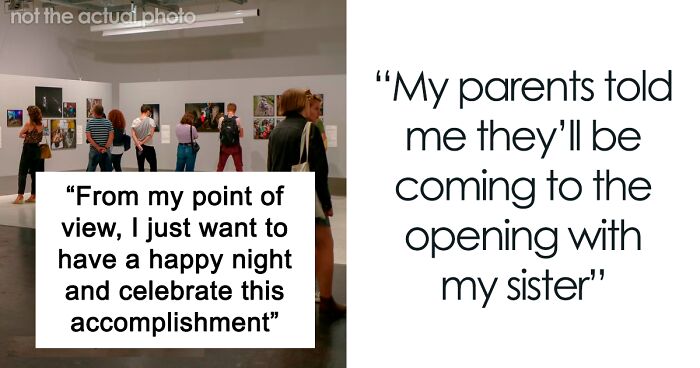
Being there for our loved ones with disabilities comes with many responsibilities. Of course, there are many ways to get through it, but they can put an extra set of demands and challenges on the relatives. So recently, Redditor Fabulous_Lychee_8469 took to the “Am I The A-Hole” (AITA) community to ask people for advice after she got into a heated dispute with her family.
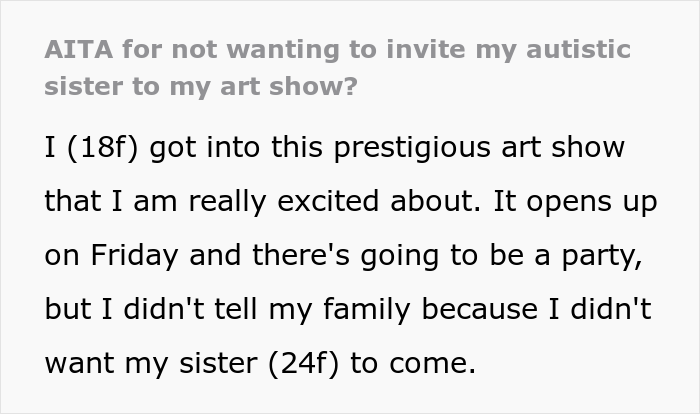
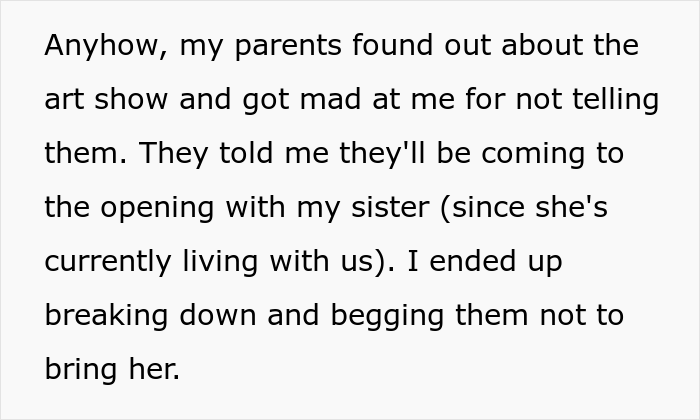
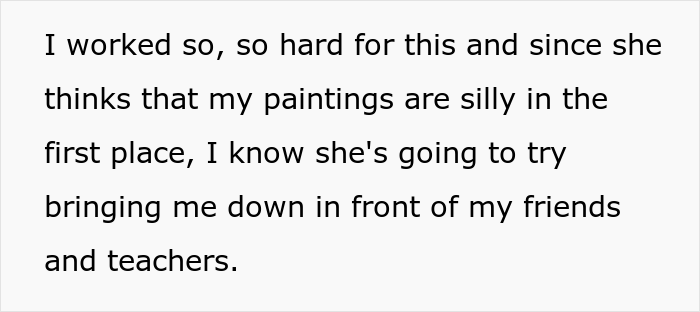
The 18-year-old woman recently got a spot in a prestigious art show she worked really hard for. But as much as she was excited about the opportunity to share her work with everyone around her, she refused to invite her parents and her autistic sister. As you can guess, this decision sparked tons of drama between her and other family members.
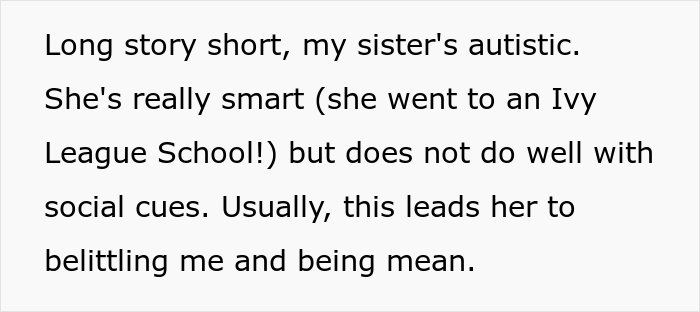
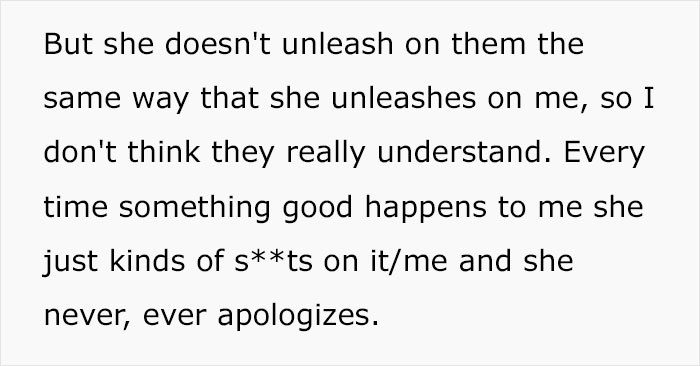
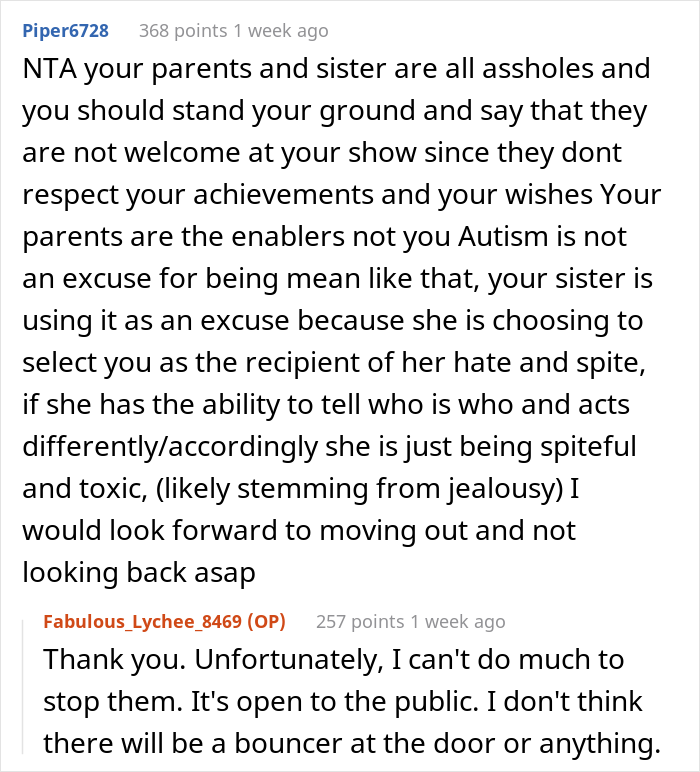
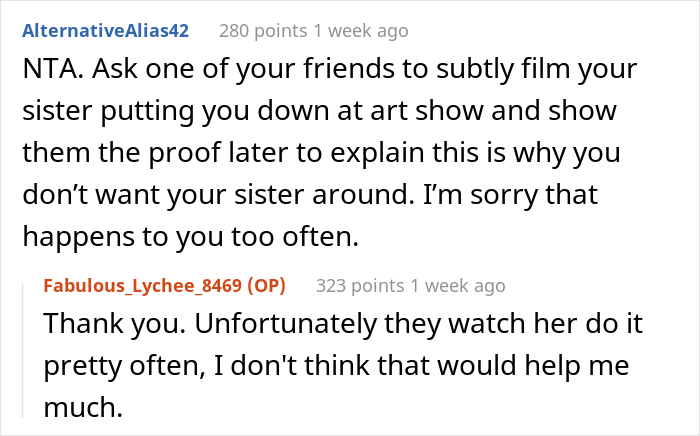
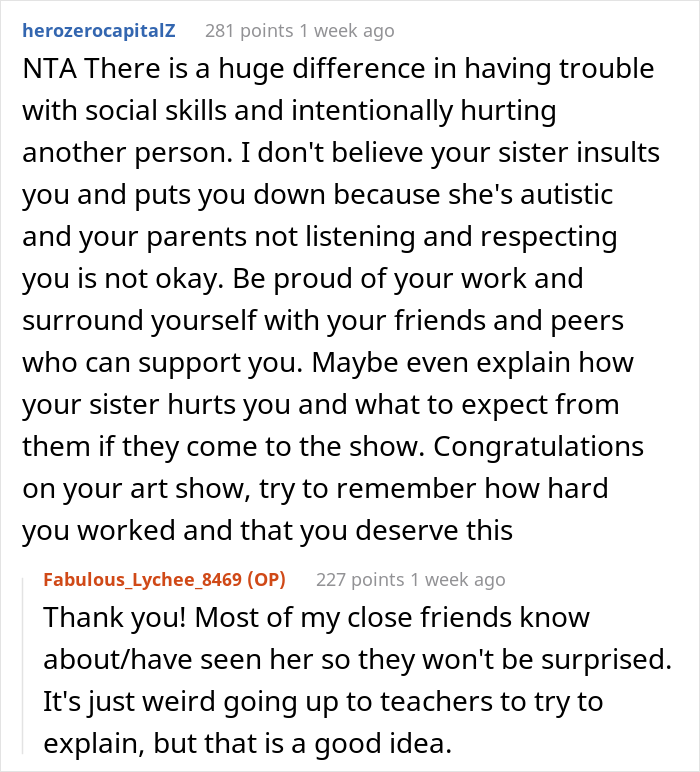
“[My sister’s] really smart (she went to an Ivy League School!) but does not do well with social cues,” the user wrote, immediately adding this often affects the way she treats her. Turns out, her sister consistently belittles her and looks for chances to say something mean. The post caused quite a fuss in the community, so be sure to read the whole story and let us know what you think about it in the comment section below.
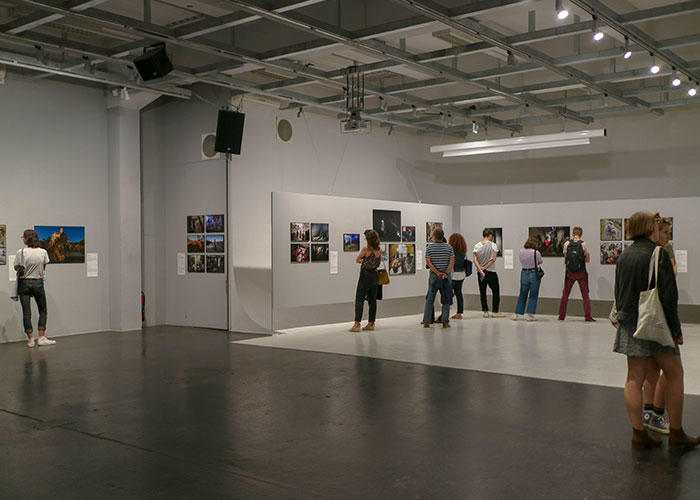
Image credits: yeonhee (not the actual photo)
Laura Cavanagh is a professor of psychology and behavioral sciences at Seneca College in Toronto and has extensive experience in clinical practice with individuals on the autism spectrum. She told Bored Panda that there are many commonly-held myths about autism.
“Many people think of someone locked in their own world or completely disconnected from others. And I think that many people have the misconception that people on the autism spectrum are nonverbal or have an intellectual disability,” she said.
According to Cavanagh, the core deficit in autism spectrum disorders is difficulty with social communication and social impairment. “But that does not mean that people with autism are ‘not social’, or don’t want social relationships, or don’t feel deeply connected to the people in their lives.”
It rather suggests that navigating social situations is difficult for them, so understanding and following the written and unwritten rules of social relationships and interactions is a challenge for people in the spectrum. “Using language for the purposes of social communication is difficult — even if the individual has a vocabulary range in the top percentile!”
“The other core characteristic of autism spectrum disorders is a restricted or repetitive repertoire of interests or behaviors. The commonly-held stereotype that many people picture is rocking or hand-flapping. But it could be an obsessive interest in an obscure or unusual topic. Sometimes individuals will insist on routine and sameness and may appear rigid and inflexible. Many are hypo- or hyper-reactive to sensory stimulation, so things in the environment may feel too loud, too bright — or too easy to ignore,” Cavanagh added.
Image credits: Keira Burton (not the actual photo)
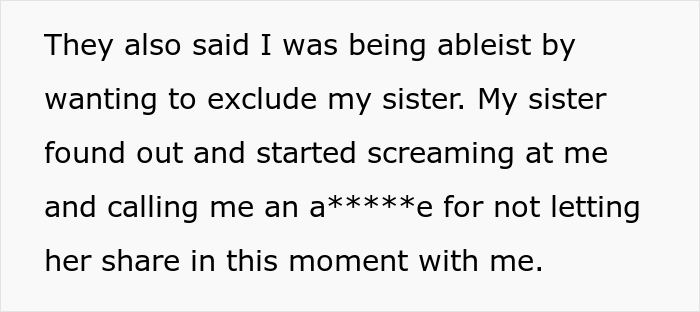
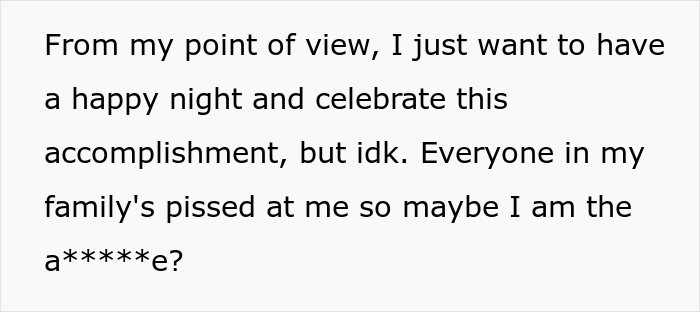
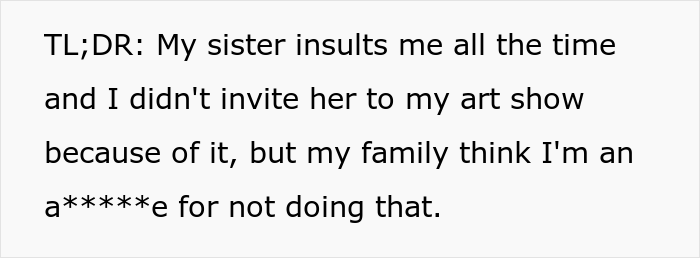
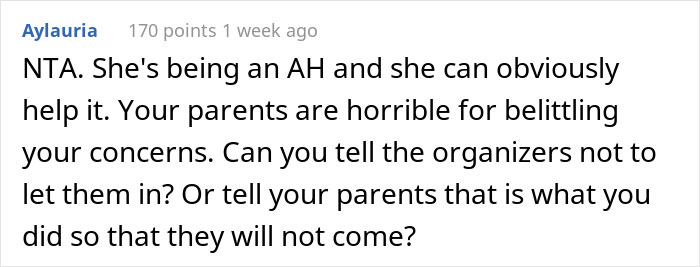
Image credits: Fabulous_Lychee_8469
It can be heartbreaking to know that celebration of your new milestone and achievements might be clouded by insensitive remarks from one of the closest people you have in the world. Professor Cavanagh is very well aware of the emotional toll that people on the spectrum can put on their loved ones, and the dilemma of comprehending it. “The social impairments in autism can sometimes make it difficult for individuals on the spectrum to maintain social relationships, and these social deficits can sometimes make their behavior difficult for others to understand,” she noted.
“It is not that individuals with autism don’t care about others, but their difficulty in following social rules may make it seem like that is the case,” she said and added that they may sometimes be blunt in their communication style. “Their restricted range of behaviors or activities may make it difficult for them to take an interest in things that are important to others.”
However, it’s important to remember that people on the autism spectrum are not defined by their disability. Cavanagh pointed out that they have all the complexities and range of traits that characterize the human experience.
“Like anyone else, someone might be extraverted or introverted, conscientious or free-spirited, reserved or playful, shy or bold. And so this woman’s sister, quite apart from her autism, may be a difficult person!” Well, if there’s one thing many of us know all too well — sibling relationships are complicated. It’s not that unusual for there to be strain between adult siblings, the therapist mentioned. “It is entirely possible that the sister is unkind and does belittle her — not because she has autism but because she is a person in the world and some people can be kind of mean!”
Trying to find a healthy solution to a family dispute when people are throwing accusations without a care in the world is far from an easy task. But while relationships between brothers and sisters can sometimes take a turn for the worse, Cavanagh said having a sibling with a disability has its own unique gifts and challenges. “Siblings of individuals with a disability have higher rates of emotional issues, anxiety, and stress. They often feel that their siblings’ needs’ take precedence over their own.”
“Unlike parents, siblings do not receive much support from professionals or family members,” the professor told us and stressed the importance of parents seeing the experience from every child’s perspective. “Siblings are often forgotten and may feel that they do not have a voice in family decisions. They may feel pressure to be perfect to avoid causing any further stress on their parents, or they may feel they have to act out to get any attention at all.”
“I think for parents, it is also important to understand that adult children get to make their own decisions, whether we agree with them or not,” Cavanagh explained. “A parent may disagree with their adult children’s choices, but they need to respect them. And while a parent may wish that the adult siblings’ relationship were different, it is truly out of their control. And attempts to manage it will likely backfire.”
Navigating family disputes, especially when they involve a loved one with a disability, can sometimes be overwhelming. Professor Cavanagh advised parents to put focus on their children’s feelings. “If they want to explain the perspective of each sister to the other, they can do so. As they are a little bit removed from the situation, they may be able to provide insight into the other sibling’s experience without it getting too heated or personal.”
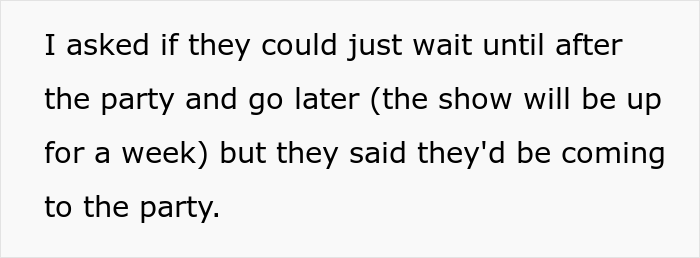
Moreover, she suggested paying more attention to the solutions. “If the artist has chosen not to have her family at the premiere, that is her decision to make,” she said and provided a few helpful questions to consider: “Could she arrange a private tour for the parents and sister at another time? A sneak preview of the event? Some other special time that they could go?”
“Finally, I would advise respecting the adult child’s decision. This story is as much about learning to respect our family member’s autonomy and boundaries, whether we agree with them or not,” Cavanagh concluded.
66Kviews
Share on Facebook

It would be awesome if people could stop using mental health issues as a get-out-of-jail-for-free card for abusive behaviour. Yes, when you are struggling it's hard to be nice. It's hard to regulate. It's hard to do anything at all. I know. I've been there. But still, at some point, you have to learn to behave and develop some coping mechanisms that don't involve being toxic to the core.

I agree with this to some degree. You do need to learn how to behave at one point, but if you aren't given the right tools, that can be impossible. I despise the fact that the parents tell her to "iGnOrE iT bEcAuSe sHeS aUtIsTiC" tho. You don't like the behaviour of your daughter? Then do something about it. Help her. And don't let her spoil her sisters special moment
Load More Replies...
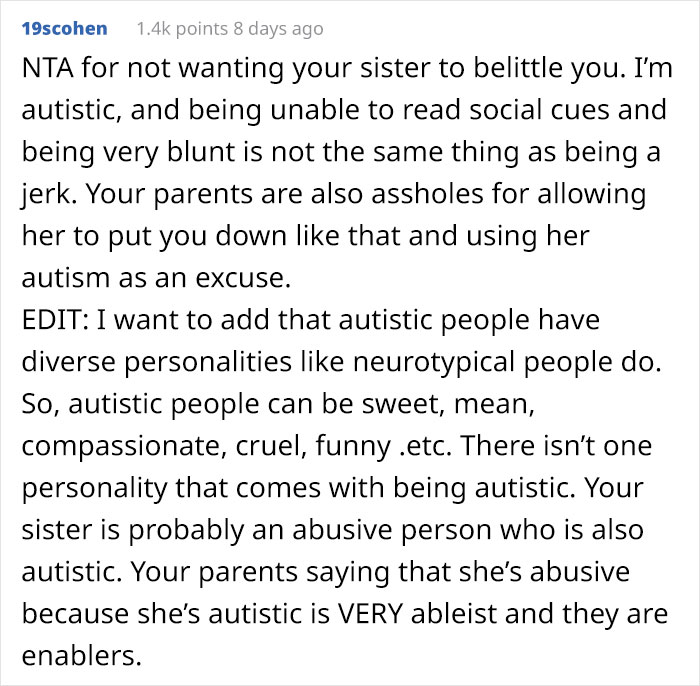
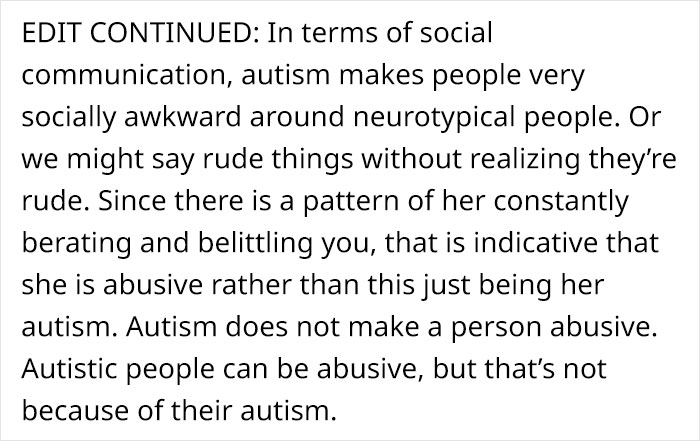
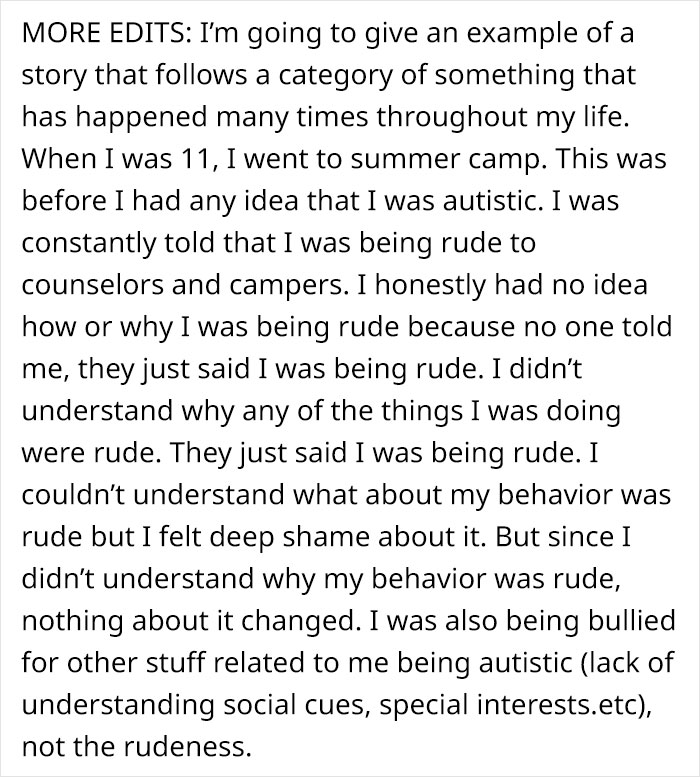
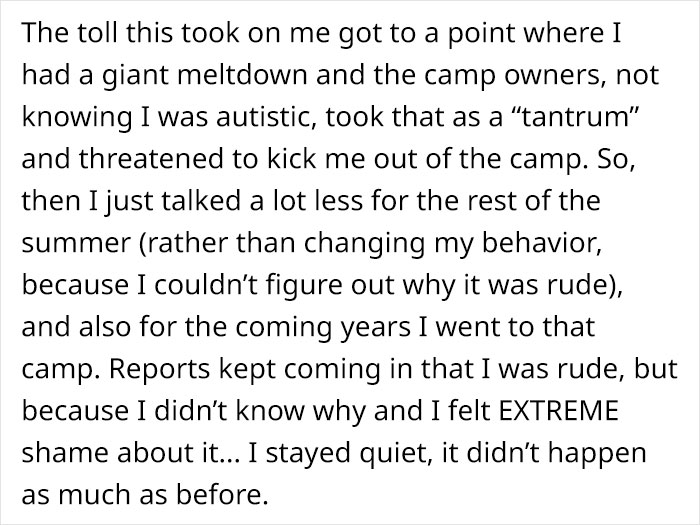
I'm autistic, and being an abusive bully to someone is NOT one of the symptoms. When we're rude because of our "condition" it's unintentional. Like that poor bugger who had the troubles at camp, when I was a kid I was called "rude" all the time but couldn't understand why or what I had done wrong, and I also felt a lot of shame and came to believe I was stupid. I hate hurting other peoples' feelings and when there is an argument I'm almost always the first to apologise even if it wasn't my fault. The sister in this story is just a horrible, cruel abuser who happens to be autistic, and the parents should be ashamed of themselves for enabling her bad behaviour and not teaching her to know better when they had the chance.

I think I avoided a lot of that because I was extremely quiet and shy as a young child. I've got this deep-rooted fear of 'bothering people', possibly due to, in a large part, just not really knowing how to interact with others and them seeming annoyed when I did. So I withdrew more and more. I've still got huge issues with this. I probably actually post less than half of what I write up. I also really detest hurting other people unintentionally, I'm almost painfully empathetic. I was ready to rage on this girl, but her sister bullying her has nothing to do with her being autistic. If the sister went to an Ivy League school, there's no way she doesn't know better. Hope that poor girl can move away soon and get away from that toxic environment.
Load More Replies...
NTA. It's bad enough that her sister keeps putting her down every time something good happens to her. It's worse if it's happening in front of her teachers and friends. She worked hard for this and this is an amazing opportunity to showcase her work as a young artist. This is not the day for her sister to say rude remarks about her work. So glad she's moving out.

Her show, so should be her choice who comes full stop. Have someone on the door checking and don't let them in!!! Keep the scene they will make outside. Though no doubt that will just cause massive problems for life!! OP can't win here. Families can be so toxic. I was bullied by my sibling and was always blamed as she was 'the baby'. Ended up with her being a spoiled adult who is still nasty to people, including her son. Too many parents don't see things clearly, too many push in situations where they should let it be and no one should use their mental health as an excuse to treat people nastily. Though those outside the family going to this will probably see the sister far more clearly and place the blame in the right place, she'll probably just make herself look bad. Fed up with families who think they have the right to force themselves on one member or won't consider their feelings.


I mean, of course you should be understanding about disabilities but understanding isn't just accepting to be treated badly. It's unfair that some people (like with autism) have to struggle more with some situations but that doesn't mean we should assume that they are incapable. She seems to be pretty high functioning so I doubt that she doesn't know what is expected, even if it's a challenge and uncomfortable in some situations. In this particular case I think the sister actually knows what she's doing and have the tools to do otherwise and it's more about sibling rivalry rather than autism. The parents don't help either of them by sort of believing that older sister is incapable of knowing right from wrong and not let younger sister have her moment.

To me, even if the sister was the most disabled person on the planet and literally couldn't fathom how to behave (which clearly isn't the case), the OP would still not be unreasonable to exclude her from some events. It's great to be inclusive, but sometimes everyone deserves a break, even parents of small children leave them at home sometimes – it doesn't mean that they love them any less. But really, the fact that the sister consider's OP's art silly is enough of a reason to not invite her.
Well I have never related to a post so much. I have an autistic brother and the exact same thing happens. He puts me down about everything, breaks and rips my stuff and my parents constantly say that i need to suck it up because he’s autistic

I'm autistic. I don't damage other people's things and I have a rule against insulting people. Unless he's really cognitively impaired, there's no excuse. Intentionally hurting people is not an autistic trait. Show your parents this article and you can show them my post. No, autism doesn't make you attack people. Autism doesn't mean you can't learn rules (in fact it's quite the opposite). Your brother may see you as breaking one or more of his rules though. Doesn't make bad behavior ok, but if you can figure out what's behind his bad behavior you might be able to help him grow out of it. People with autism grow socially when they have a guide to help them navigate.
Load More Replies... 
Sad that there appear to be so many toxic families out there. Parents who treat one child differently at the expense of the other are c**p parents. Full Stop. I really wish I could suggest something to help her keep her parents and sister at home, but I can't. I can only suggest that she invite enough friends that they surround her for the whole evening, not allowing her sister (or parents) to get close enough to run her down. And - if her sister does shove one aside to get in and start insulting, the whole group should tell her off before she gets into the third word, and shut her down.

NTA, your parents are, and I have to wonder if you can attribute the sister's behavior solely to autism. It sounds like autism in this case is used as a shield for her behavior.

easy answer: NTA. I'm autistic (as well as being schizophrenic and having DID) , I'm (well, I've been told) smart and high functioning. I don't belittle people for the fun of it. That's not part of Autism, that's just your sister being an absolute b***h, and your parents are enablers. Autism isn't a free pass to act up. My daughter is also autistic, I have helped teach her ways to cope and express things correctly the same way my parents helped me. I still have moments of coming across a bit blunt or something, because of the way I say things, but it's not belittling anyone. If I were OP i'd try talking to the security or whomever at this art show to ensure that should they turn up with OP's sister, they be turned away. OP deserves to enjoy herself. After all, despite what the b***h sister says, their work was good enough to be in the art show, and OP should be mega proud of that!
I've got three autistic kids and I don't think you're the a*****e . As my kids have grown into early adulthood they've had struggles with each other that have been pretty serious at times. If your sister can't stop behavior that is going to cause harm to you , then it's her fault she isn't invited. You're not wanting her to stay home because she's autistic , you're wanting her to stay home because she's mean to you. Perfectly reasonable . I would recommend going to therapy together though so you guys can learn how to communicate with each other in a healthier way. A lot of times you can get stuck in behavior cycles with an autistic person . They won't realize how they are acting or that they are hurting you ... they're just acting without thought. You guys are at an age now where siblings will usually start to like each other and become friends. You guys can be friends ... she just needs to learn to not insult you or bring you down . Sometimes it's an easy fix , sometimes it takes work

Not a fan of these "AITA" threads, since they can be a form of on-line bullying. (We never get the other side.) But how many of y'all are surprised to say, "NTA, actually!"
I agree, we don't have any idea if the behaviors are being described accurately. I often think the story would shift dramatically if there was a two sided account. Still, if true, then nta.
Load More Replies...
being an autistic person myself, based on what I read at the beginning I was starting to think the OP was the a*****e, but as I read more, I can definitely say that her autistic sister is the a*****e. Bullying someone is not an autistic trait; It's a HUMAN trait. I know from experience that there is a difference between unintentionally saying something rude and just being a jerk. I used to bully people in school. I knew what I was doing, and why I was doing it. And I knew there was no excuse for it, especially my autism. It's unfortunate, though, that I've only been able to find the socials of one person I wanted to apologize to.

As a number of others have already mentioned, being deliberately abusive is not a symptom of the autism spectrum, especially for someone who is higher functioning. She knows exactly what she's doing and is being facilitated by the parent's lack of action. Yes, people on the spectrum can be painfully blunt, we typically give very concise answers, both of which can be interpreted as being rude, and for most of us being in social settings can be extremely stressful to the point that we can have full on meltdowns, essentially as a result of being overstimulated. Some can also be extremely manipulative (as seems to be the case here) with a lack of empathy/lack of underestanding of emotions or the ability to regulate them adequately. People with autism often have great difficulty reading body language/social referencing cues which can result in inappropriate comments/responses/actions (eg: saying something in public that really should be said in private). #1
I don't have experience with autism but it's true with any kind neurological illness I've known people with down syndrome so sweet you can't help but like them. I've also met some people who have that who are so mean and parents making excuses. So autism is not the only thing that parents make excuses for the child. My hubby has cerebral palsy everyone treats him like he's stupid. So people can be negative either way. I'm sorry you're having such trouble break away as fast as you can.

I'm not a specialist, obviously, but I believe purposefully demeaning and belittling somebody isn't a result of bad social skills due to her being autistic. It seems like she absolutely understands what exactly she's doing.


So if it's a party, and the show will be up for a week after, surely that means it's invite-only? So OP just has to tell security or whatever that people will try come in and say that they're with her, but they're not

If the sister thinks the paintings are silly, wtf does she want to go to that art show?? NTA. There are a ton of events I barely invited my parents to, much less my sibling. Our relationship is ok, but not great adn sometimes I really just want to be surrounded by peoople who really love and support me, not some snippety family members.

There's a post down at the bottom of this thread by Susie Kamper. It's a good example of neurotypical people beating up on someone with autism. She's expressing a misunderstanding she had and has corrected but neurotypicals think she's advocating. Please upvote her comment, she's teaching you something about autism. If you don't like it, that's unfortunate. She's respectfully sharing her experience. It's rude to be downvoted for sharing and trying to be helpful.

Just have security at the entrance NOT let your parents and sister in. Then enjoy YOUR night. And by all means: move far away from Them. This is toxic for you.

I have an autistic daughter and if I ever caught her being mean like that to anyone I would honestly be pissed. It is hard to instill ethics and good manners into some autistic people but it is doable. And if she isn't like that to everyone then she is just being abusive to you in general. There is no reason for that whatsoever. You do you and I know it is hard, but don't let her bring you down. Maybe when you move out you should spend some quality time with quality people who treat you right. And shame on your parents for allowing this. By allowing her to be abusive toward you they are being abusive as well.
I don't think I've ever heard of autism making it hard to teach morals or ethics. I'm diagnosed and I worked for a large agency that houses people with disabilities. Usually if someone with autism has a hard time with picking up a moral or ethical behavior it's because they're seeing conflicting behavior in the people telling them to act morally. Autism usually means they're -more- inclined to follow rules.
Load More Replies...
Perhaps explaining the situation to the teacher and having the teacher contact the parents would persuade them that it's a bad idea to attend the event. Sometimes abusive family members alter their conduct when they realize someone outside the family is paying attention to it.

NTA This is Your big show. It's rude not to tell your loved ones about your hard-earned successes, but honestly if there will be a disruption, you could have invited them to attend at a different time than opening night. As an artist myself, I know just how hard you have had to work to get ready for this moment. It's Your moment to shine. My grandma always says it is easier to ask forgiveness than permission.
IN GENERAL, autistic people are often found to be rude because they are unaware of how they are perceived or misread social cues. They don't mean to be. (I'm hyperlexic which isn't autism, but makes me understanding of these difficulties.) I did know one person with Asperger's Syndrome who I strongly suspect treated women inappropriately because (1) he was that starved for any interaction with women, (2) resented that there seemed to be a separate set of social rules for "smooth" guys vs. for him, (3) figured he could use Asperger's as an excuse. (Lesson: there's always assholes who will use anything to their advantage.) However, I also know that emotional regulation can be very difficult for someone with autism. Pretty sure NTA no matter what, but is there any chance that there are no assholes here? (OK, that would make farting a problem, but I'll try not be overly literal.)

Tell the gallery to let them in but ask for a security person to be by your side discreetly. If she acts up they can escort her away from you an be witness. It's your night. Not one to be brought down. Make your next painting some emotion of how she brings you to tears. Call it a shadow pc. And maybe try filming her antics. She knows what she's doing. Trust me. Move ahead. Head high. One hater isn't much. I know being blood it's a b***h. But then if she's being one walk away. Drama ain't worth the stress.
If you ask if you're the a*****e, it means that your are indeed the a*****e.

It would be awesome if people could stop using mental health issues as a get-out-of-jail-for-free card for abusive behaviour. Yes, when you are struggling it's hard to be nice. It's hard to regulate. It's hard to do anything at all. I know. I've been there. But still, at some point, you have to learn to behave and develop some coping mechanisms that don't involve being toxic to the core.
I agree with this to some degree. You do need to learn how to behave at one point, but if you aren't given the right tools, that can be impossible. I despise the fact that the parents tell her to "iGnOrE iT bEcAuSe sHeS aUtIsTiC" tho. You don't like the behaviour of your daughter? Then do something about it. Help her. And don't let her spoil her sisters special moment
Load More Replies... I'm autistic, and being an abusive bully to someone is NOT one of the symptoms. When we're rude because of our "condition" it's unintentional. Like that poor bugger who had the troubles at camp, when I was a kid I was called "rude" all the time but couldn't understand why or what I had done wrong, and I also felt a lot of shame and came to believe I was stupid. I hate hurting other peoples' feelings and when there is an argument I'm almost always the first to apologise even if it wasn't my fault. The sister in this story is just a horrible, cruel abuser who happens to be autistic, and the parents should be ashamed of themselves for enabling her bad behaviour and not teaching her to know better when they had the chance.
I think I avoided a lot of that because I was extremely quiet and shy as a young child. I've got this deep-rooted fear of 'bothering people', possibly due to, in a large part, just not really knowing how to interact with others and them seeming annoyed when I did. So I withdrew more and more. I've still got huge issues with this. I probably actually post less than half of what I write up. I also really detest hurting other people unintentionally, I'm almost painfully empathetic. I was ready to rage on this girl, but her sister bullying her has nothing to do with her being autistic. If the sister went to an Ivy League school, there's no way she doesn't know better. Hope that poor girl can move away soon and get away from that toxic environment.
Load More Replies... NTA. It's bad enough that her sister keeps putting her down every time something good happens to her. It's worse if it's happening in front of her teachers and friends. She worked hard for this and this is an amazing opportunity to showcase her work as a young artist. This is not the day for her sister to say rude remarks about her work. So glad she's moving out.
Her show, so should be her choice who comes full stop. Have someone on the door checking and don't let them in!!! Keep the scene they will make outside. Though no doubt that will just cause massive problems for life!! OP can't win here. Families can be so toxic. I was bullied by my sibling and was always blamed as she was 'the baby'. Ended up with her being a spoiled adult who is still nasty to people, including her son. Too many parents don't see things clearly, too many push in situations where they should let it be and no one should use their mental health as an excuse to treat people nastily. Though those outside the family going to this will probably see the sister far more clearly and place the blame in the right place, she'll probably just make herself look bad. Fed up with families who think they have the right to force themselves on one member or won't consider their feelings.
I mean, of course you should be understanding about disabilities but understanding isn't just accepting to be treated badly. It's unfair that some people (like with autism) have to struggle more with some situations but that doesn't mean we should assume that they are incapable. She seems to be pretty high functioning so I doubt that she doesn't know what is expected, even if it's a challenge and uncomfortable in some situations. In this particular case I think the sister actually knows what she's doing and have the tools to do otherwise and it's more about sibling rivalry rather than autism. The parents don't help either of them by sort of believing that older sister is incapable of knowing right from wrong and not let younger sister have her moment.
To me, even if the sister was the most disabled person on the planet and literally couldn't fathom how to behave (which clearly isn't the case), the OP would still not be unreasonable to exclude her from some events. It's great to be inclusive, but sometimes everyone deserves a break, even parents of small children leave them at home sometimes – it doesn't mean that they love them any less. But really, the fact that the sister consider's OP's art silly is enough of a reason to not invite her.
Well I have never related to a post so much. I have an autistic brother and the exact same thing happens. He puts me down about everything, breaks and rips my stuff and my parents constantly say that i need to suck it up because he’s autistic
I'm autistic. I don't damage other people's things and I have a rule against insulting people. Unless he's really cognitively impaired, there's no excuse. Intentionally hurting people is not an autistic trait. Show your parents this article and you can show them my post. No, autism doesn't make you attack people. Autism doesn't mean you can't learn rules (in fact it's quite the opposite). Your brother may see you as breaking one or more of his rules though. Doesn't make bad behavior ok, but if you can figure out what's behind his bad behavior you might be able to help him grow out of it. People with autism grow socially when they have a guide to help them navigate.
Load More Replies... Sad that there appear to be so many toxic families out there. Parents who treat one child differently at the expense of the other are c**p parents. Full Stop. I really wish I could suggest something to help her keep her parents and sister at home, but I can't. I can only suggest that she invite enough friends that they surround her for the whole evening, not allowing her sister (or parents) to get close enough to run her down. And - if her sister does shove one aside to get in and start insulting, the whole group should tell her off before she gets into the third word, and shut her down.
NTA, your parents are, and I have to wonder if you can attribute the sister's behavior solely to autism. It sounds like autism in this case is used as a shield for her behavior.
easy answer: NTA. I'm autistic (as well as being schizophrenic and having DID) , I'm (well, I've been told) smart and high functioning. I don't belittle people for the fun of it. That's not part of Autism, that's just your sister being an absolute b***h, and your parents are enablers. Autism isn't a free pass to act up. My daughter is also autistic, I have helped teach her ways to cope and express things correctly the same way my parents helped me. I still have moments of coming across a bit blunt or something, because of the way I say things, but it's not belittling anyone. If I were OP i'd try talking to the security or whomever at this art show to ensure that should they turn up with OP's sister, they be turned away. OP deserves to enjoy herself. After all, despite what the b***h sister says, their work was good enough to be in the art show, and OP should be mega proud of that!
I've got three autistic kids and I don't think you're the a*****e . As my kids have grown into early adulthood they've had struggles with each other that have been pretty serious at times. If your sister can't stop behavior that is going to cause harm to you , then it's her fault she isn't invited. You're not wanting her to stay home because she's autistic , you're wanting her to stay home because she's mean to you. Perfectly reasonable . I would recommend going to therapy together though so you guys can learn how to communicate with each other in a healthier way. A lot of times you can get stuck in behavior cycles with an autistic person . They won't realize how they are acting or that they are hurting you ... they're just acting without thought. You guys are at an age now where siblings will usually start to like each other and become friends. You guys can be friends ... she just needs to learn to not insult you or bring you down . Sometimes it's an easy fix , sometimes it takes work
Not a fan of these "AITA" threads, since they can be a form of on-line bullying. (We never get the other side.) But how many of y'all are surprised to say, "NTA, actually!"
I agree, we don't have any idea if the behaviors are being described accurately. I often think the story would shift dramatically if there was a two sided account. Still, if true, then nta.
Load More Replies... being an autistic person myself, based on what I read at the beginning I was starting to think the OP was the a*****e, but as I read more, I can definitely say that her autistic sister is the a*****e. Bullying someone is not an autistic trait; It's a HUMAN trait. I know from experience that there is a difference between unintentionally saying something rude and just being a jerk. I used to bully people in school. I knew what I was doing, and why I was doing it. And I knew there was no excuse for it, especially my autism. It's unfortunate, though, that I've only been able to find the socials of one person I wanted to apologize to.
As a number of others have already mentioned, being deliberately abusive is not a symptom of the autism spectrum, especially for someone who is higher functioning. She knows exactly what she's doing and is being facilitated by the parent's lack of action. Yes, people on the spectrum can be painfully blunt, we typically give very concise answers, both of which can be interpreted as being rude, and for most of us being in social settings can be extremely stressful to the point that we can have full on meltdowns, essentially as a result of being overstimulated. Some can also be extremely manipulative (as seems to be the case here) with a lack of empathy/lack of underestanding of emotions or the ability to regulate them adequately. People with autism often have great difficulty reading body language/social referencing cues which can result in inappropriate comments/responses/actions (eg: saying something in public that really should be said in private). #1
I don't have experience with autism but it's true with any kind neurological illness I've known people with down syndrome so sweet you can't help but like them. I've also met some people who have that who are so mean and parents making excuses. So autism is not the only thing that parents make excuses for the child. My hubby has cerebral palsy everyone treats him like he's stupid. So people can be negative either way. I'm sorry you're having such trouble break away as fast as you can.
I'm not a specialist, obviously, but I believe purposefully demeaning and belittling somebody isn't a result of bad social skills due to her being autistic. It seems like she absolutely understands what exactly she's doing.
So if it's a party, and the show will be up for a week after, surely that means it's invite-only? So OP just has to tell security or whatever that people will try come in and say that they're with her, but they're not
If the sister thinks the paintings are silly, wtf does she want to go to that art show?? NTA. There are a ton of events I barely invited my parents to, much less my sibling. Our relationship is ok, but not great adn sometimes I really just want to be surrounded by peoople who really love and support me, not some snippety family members.
There's a post down at the bottom of this thread by Susie Kamper. It's a good example of neurotypical people beating up on someone with autism. She's expressing a misunderstanding she had and has corrected but neurotypicals think she's advocating. Please upvote her comment, she's teaching you something about autism. If you don't like it, that's unfortunate. She's respectfully sharing her experience. It's rude to be downvoted for sharing and trying to be helpful.
Just have security at the entrance NOT let your parents and sister in. Then enjoy YOUR night. And by all means: move far away from Them. This is toxic for you.
I have an autistic daughter and if I ever caught her being mean like that to anyone I would honestly be pissed. It is hard to instill ethics and good manners into some autistic people but it is doable. And if she isn't like that to everyone then she is just being abusive to you in general. There is no reason for that whatsoever. You do you and I know it is hard, but don't let her bring you down. Maybe when you move out you should spend some quality time with quality people who treat you right. And shame on your parents for allowing this. By allowing her to be abusive toward you they are being abusive as well.
I don't think I've ever heard of autism making it hard to teach morals or ethics. I'm diagnosed and I worked for a large agency that houses people with disabilities. Usually if someone with autism has a hard time with picking up a moral or ethical behavior it's because they're seeing conflicting behavior in the people telling them to act morally. Autism usually means they're -more- inclined to follow rules.
Load More Replies... Perhaps explaining the situation to the teacher and having the teacher contact the parents would persuade them that it's a bad idea to attend the event. Sometimes abusive family members alter their conduct when they realize someone outside the family is paying attention to it.
NTA This is Your big show. It's rude not to tell your loved ones about your hard-earned successes, but honestly if there will be a disruption, you could have invited them to attend at a different time than opening night. As an artist myself, I know just how hard you have had to work to get ready for this moment. It's Your moment to shine. My grandma always says it is easier to ask forgiveness than permission.
IN GENERAL, autistic people are often found to be rude because they are unaware of how they are perceived or misread social cues. They don't mean to be. (I'm hyperlexic which isn't autism, but makes me understanding of these difficulties.) I did know one person with Asperger's Syndrome who I strongly suspect treated women inappropriately because (1) he was that starved for any interaction with women, (2) resented that there seemed to be a separate set of social rules for "smooth" guys vs. for him, (3) figured he could use Asperger's as an excuse. (Lesson: there's always assholes who will use anything to their advantage.) However, I also know that emotional regulation can be very difficult for someone with autism. Pretty sure NTA no matter what, but is there any chance that there are no assholes here? (OK, that would make farting a problem, but I'll try not be overly literal.)
Tell the gallery to let them in but ask for a security person to be by your side discreetly. If she acts up they can escort her away from you an be witness. It's your night. Not one to be brought down. Make your next painting some emotion of how she brings you to tears. Call it a shadow pc. And maybe try filming her antics. She knows what she's doing. Trust me. Move ahead. Head high. One hater isn't much. I know being blood it's a b***h. But then if she's being one walk away. Drama ain't worth the stress.
If you ask if you're the a*****e, it means that your are indeed the a*****e.






 No fees, cancel anytime








131
56