Get Premium
Dark mode theme is available exclusively for premium users. Learn more about the benefits of subscribing.
No fees, cancel anytime.

 Dark Mode Ad-Free Browsing Unlimited Content
 Ad-Free Browsing Unlimited Content Dark Mode
Join 1.2 million Panda readers who get the best art, memes, and fun stories every week!
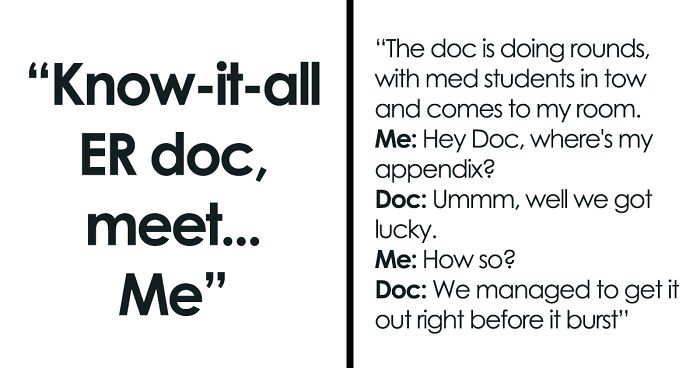
If you want to be a good doctor or surgeon, it’s not enough to be well-read and have dexterous hands. You also need a good bedside manner. In short, medical professionals need to instill trust and confidence in their patients. One way to do this is to actively listen to them to learn more about them and their bodies.
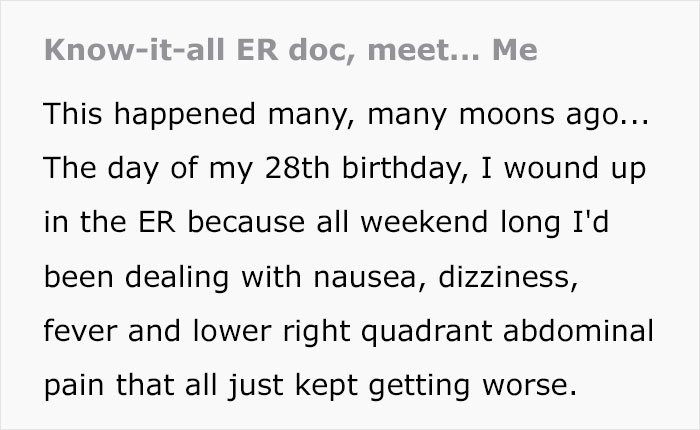
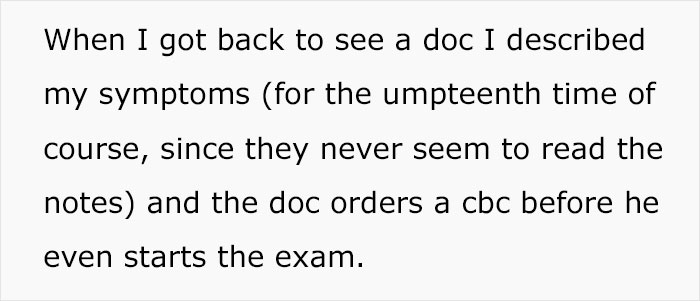
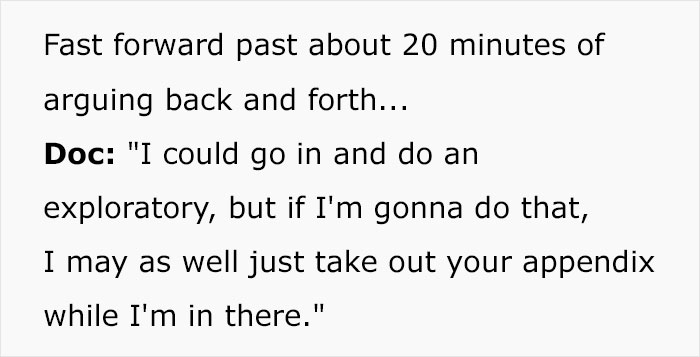
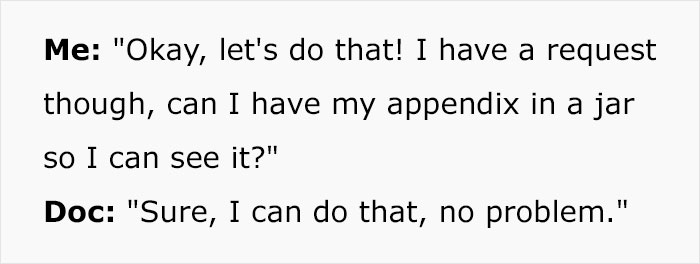
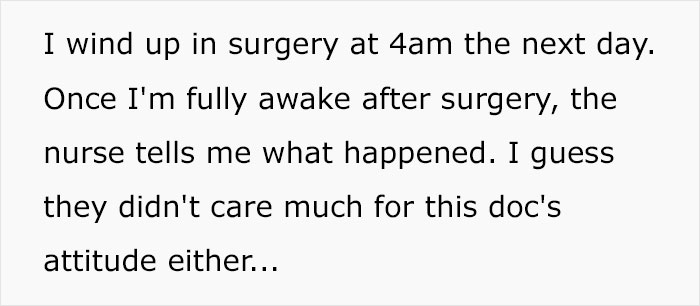
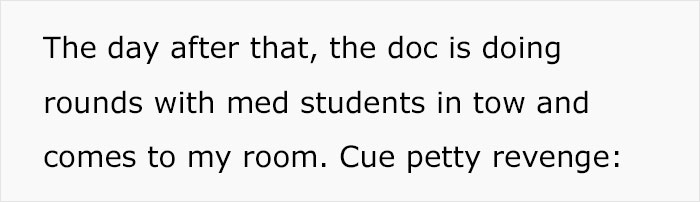
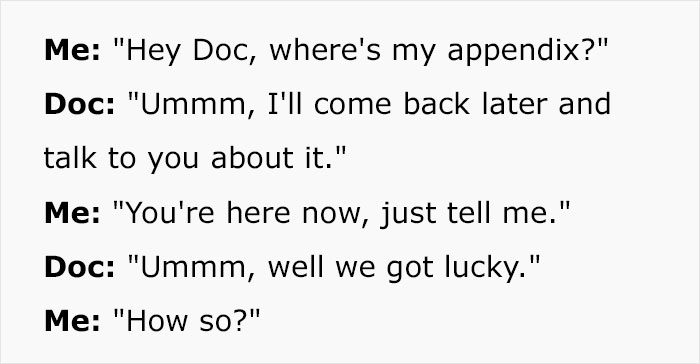
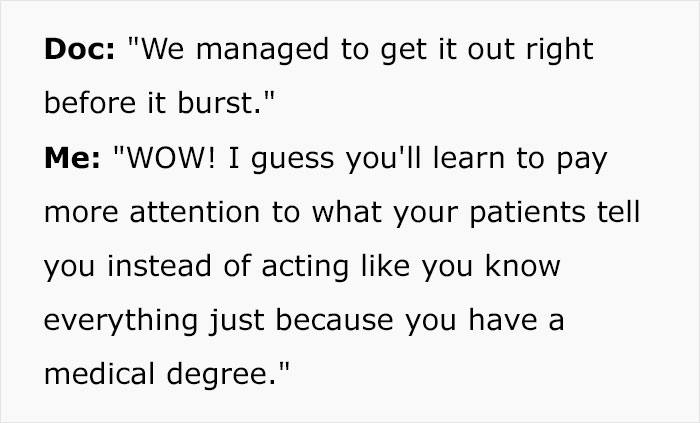
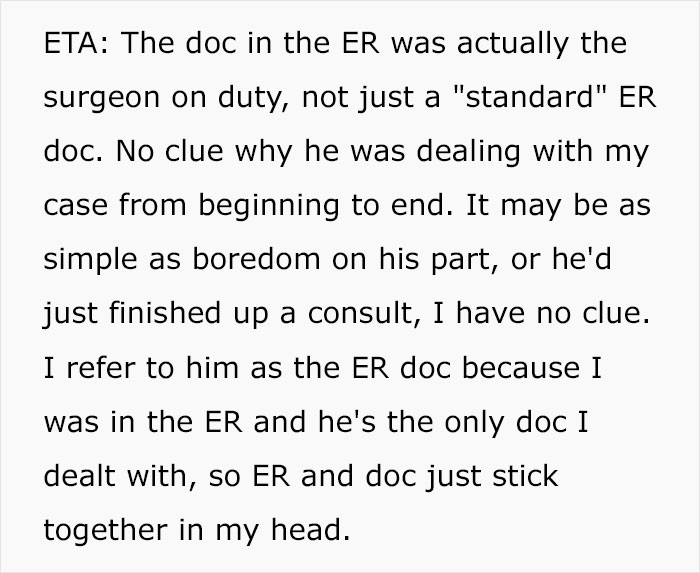
Failing to listen properly can have potentially devastating consequences, as one internet user’s story showed. Redditor u/Shadva revealed how her surgeon was unwilling to listen to her issues with her appendix, which nearly led to a health disaster. Read on for the full story. Bored Panda got in touch with the author of the story, redditor u/Shadva, and she was kind enough to share her thoughts about doctors’ (lack of) communication skills and why someone who is in pain might feel reluctant to go to the ER. You’ll find our full interview with the OP below.
Image credits: karrastock (not the actual photo)
Image credits: nodar77 (not the actual photo)
Image credits: Shadva
Bored Panda wanted to find out why the author thought her doctor was so unwilling to hear her out. “My personal thought was that he thought he was better than just about everyone because he was a surgeon. That opinion was backed up by both watching and hearing about his interactions with various staff,” u/Shadva shared with us.
“Before he came into my room, I actually heard him tell a nurse that their observations didn’t matter, that he was a surgeon and they were ‘just a nurse.’ Then he yelled at janitorial staff for not moving out of his way when he was coming down the hall, even though they were mopping the floor.”
Unfortunately, the OP doesn’t think that the doctor will have changed his behavior after the incident with her appendix. “I managed to show him that not everyone will tolerate bullying, even from a surgeon. I do know another doctor signed off on my discharge after a couple of days.”
According to u/Shadva, medical personnel who are unable to listen to their patients’ needs need to be made accountable for their behavior by the administrative staff. She suggested that these doctors may need a refresher course in proper communication, as well as a “stark reminder that they’re human and not a god, and in some cases may need therapy.”
The drawback is that some hospital administrators “generally ignore such behavior,” according to the OP. This means that the admins are allowing arrogant and rude behavior to go unchecked in some hospitals. However, it’s not just the medical staff that need to change how they approach things. It’s up to the patients to enforce some healthy boundaries as well.
Image credits: Karolina Grabowska (not the actual photo)
Though communication skills are paramount for anyone working in the medical field, some professionals completely ignore them. They prioritize know-how, technical skills, and dexterity, instead.
Now, don’t get us wrong, doctors absolutely need to be knowledgeable and capable in their field. Many of us want to be looked after by someone who’s intelligent, talented, capable, and who’s able to keep calm under pressure. But if the doctor is cold rather than empathetic, something’s gone terribly wrong.
The fact of the matter is that people’s physiologies are different. Some, like the OP, have a very high tolerance for pain. Others do not. It’s only by talking to patients to learn about their medical history and any quirks their bodies might have that docs can get the full picture.
The real world is very complicated. And your patients won’t all fit the mold. Having textbook knowledge is fine and dandy. But it won’t get you out of every bad situation. Case in point, the surgeon in redditor u/Shadva’s story realized how narrowly he avoided an actual disaster with the OP’s appendix. If he’d listened to her more attentively, he would have realized how serious everything was from the get-go.
Image credits: MART PRODUCTION (not the actual photo)
Dr. John Madden, an Emergency Physician and Director of the Office of Career Guidance and Student Development at St. George’s University School of Medicine, had this to say about the importance of communication: “Being a good listener is critical to being a good doctor. Patients will tell you what’s wrong if you just let them speak.”
Meanwhile, family physician Dr. Lisa Doggett said, “They [doctors] should answer questions using language that is clear without using too much medical terminology. They should be honest but also offer hope, even when a situation is difficult. And they should help their patients feel empowered to improve their own health.”
As of October 2023, the median salary for a surgeon working in the United States is $431,265. American surgeons typically earn between $364,710 and $511,847 per year, according to Salary.com. Generally, these medical professionals’ salaries will depend on their work experience, their education, as well as their skills.
Meanwhile, Indeed.com reveals that the average surgeon’s base salary is $298,418, generally falling between $268,377 and $331,822.
Image credits: Павел Сорокин (not the actual photo)
Not many people enjoy the prospect of being rushed to the ER. Some of them might hope that their symptoms will go away on their own or think that they’re overreacting. Others don’t want to ‘bother’ the medical staff with potentially ‘small’ issues.
Still, others freeze or run away from their problems because they’re simply scared of finding out the truth.
When it comes to appendicitis, an inflammation of the appendix, it’s vital that you seek immediate medical help if you feel intense abdominal pain.
According to Mayo Clinic, appendicitis causes pain in the lower right abdomen, however, the pain starts around the belly button and then moves.
Other symptoms to look out for include nausea and vomiting, loss of appetite, constipation or diarrhea, abdominal bloating, gas, fever, and pain that worsens when you walk or cough. If you suspect that you or a loved one may be dealing with appendicitis, contact your local hospital. It’s better to be safe than sorry.
“Patients also need to stop being afraid to advocate for themselves, both for how they’re treated as a person and how they’re treated medically.” The OP noted that many other women responded to her post and shared how often they’re either “totally ignored, or treated like their medical complaints just have to be related to our vaginas.”
Of course, not everyone feels comfortable being “brutally honest” with their doctors. Meanwhile, some patients exaggerate their symptoms. “However, too many providers just assume that almost everyone [lies] instead of working from the point of view of ‘believe, but verify.’”
Meanwhile, Bored Panda wanted to get the author’s thoughts on when somebody should go to the ER. “In a lot of cases, people don’t want to go to the ER because of cost and the only way to fix that is to either regulate it through legislation and oversight or offer universal healthcare,” she said.
“Don’t get me wrong, I don’t object to hospitals, pharma, or insurance companies making a profit, but it should be more about the patients and not completely about the bottom line. For example, without insurance, the brand name Lyrica costs between $266.38 and $1112.72, depending on the dosage and form of Lyrica you take,” she shared one example of just how expensive medicine can be.
“I know that they offer a generic version now, but even the price of pregabalin can vary depending on manufacturer, dosage, and place of purchase. Some people may be afraid of hospitals due to previous experience, such as a relative or friend going in for a ‘minor’ issue, and leaving the hospital through the morgue.”
Redditor u/Shadva continued: “For some people, it may come from being ignored or dismissed time, after time, after time. In my opinion, if they’re worried about something medically, getting advice from their primary care is a good idea, even if it’s just over the phone. If it’s an acute issue or the weekend, I’d honestly prefer that people not take chances with their lives and would just go to the ER right away.”

An ex of mine had excruciating pain 3 weeks out of every month, only relieved when she got her period (which, of course, came with its own issues). For years her doctor just kept giving her narcotic pain pills, refused to listen to her, wouldn't do any kind of tests. I finally convinced her to see my family gp, first thing he does is send her off for mri's, ct scans, bloodwork, everything he could think of. Turns out her gallbladder was stuffed full of stones and had been for years. He got her in for emergency surgery the same day the results came back, and she's been pain-free ever since.


If you ever have a serious allergy to medication, trust the pharmacist and not the doctor. I am deadly allergic to penicillin [it caused a kidney shutdown and nearly killed me] and have been told to avoid "all beta lactam antibiotics" as well because of similarities. Every time I am prescribed antibiotics I ask the doctor to confirm they are not that type because I cannot have them. Then I ask again at the pharmacist. TWICE now I have been give a prescription by a doctor who assures me it's fine and then gotten to the pharmacist and been told the doc messed up and this is beta lactam. One of the doctors when I told him: "What do you know about beta lactam?" "Not much, just that I can't have it." I guess he assumed I was making it up? I should have told him, "Just that my GP, allergist, and nephrologist have all told me it might kill me." Even then I'd need to check again with the pharmacist. :(

Yep. Not nearly as severe as your example, but my doc suggested I get the RSV (Respiratory Syncytial Virus) vaccine along with my usual flu shot. I'm 44. I asked my pharmacist and she refused. Turns out the FDA specifically warns against giving that shot to people under age 60. Not sure what would have happened, but I listened to her.
Load More Replies... I went to the ER once because my chest very very strange. There was almost no pain, but something felt WRONG. Fast forward 6 hours and various blood tests, ink tests, etc and I've been diagnosed with pulmonary embolism (blood clot in my lungs) and the specialist comes out to see me. We go through the whole list of symptoms again for him and he asks for level of pain on a 1-10 scale. I say 2. He incredulously says, "You came into the ER for a TWO?!?" and I say, "Well I was right, wasn't I?" Unsurprisingly he was a terrible doctor for several reasons and I later got my GP to find me a new specialist.

Had a heart attack and went to the er and the cardiologist that was going to do the stint if I needed one asked why I came to er. I start to tell him how my symptoms started and he kept cutting me off. Heart attacks in women are much different then men but he wouldn't listen just cut me off. Luck enough he left the practice he was with before my next outpatient spot. Got a wonderful cardiologist who listens and explains everything.
Load More Replies...
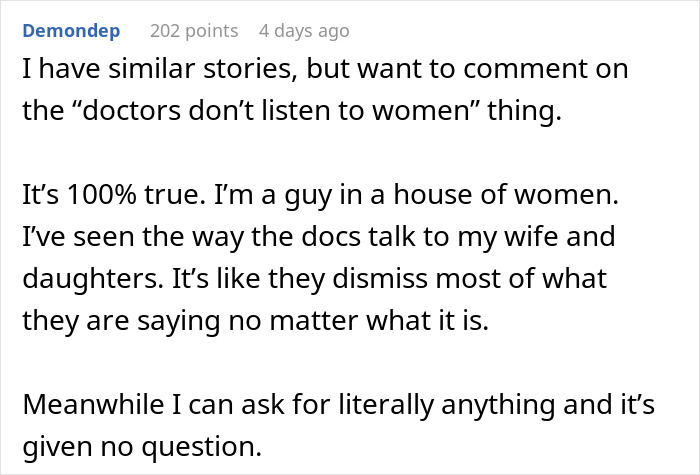
So many women get ignored by male doctors/medical professionals. It's funked up.

When i had appendicitis i had no fever (common for me with infection) but i almost fell off the gurney when they palpated my appendix. So they did an ultrasound and confirmed it was inflamed. Gave me a ton of antibiotics instead of surgery still good 15 years later

Once my mother had surgery and afterwards I noticed she seemed really out of it (long after the anesthesia had worn off), and she wasn't eating or drinking water. When I mentioned it to the surgeon, he turned around and asked my mother if she had been drinking water, and she said "Yes." He totally ignored my point that she was disoriented, so her word on that was suspect. He went ahead and discharged her. I wish I had pressed the doctor on it, because it turned out she had sepsis. She started hallucinating at home, so we took her to the ER. She ended up with both her pancreas and adrenal glands destroyed. A few years later, she died from pancreatic cancer, which we suspect may have been caused by the sepsis. Seriously, how HARD would it have been for this idiot doctor to take a few minutes out of his day to actually evaluate her condition, including her mental state?
In the '70's, I read a (true) story of a little girl with cystic fibrosis, written by her father after her death. Once, she was in severe pain, and told her parents her lung had collapsed (it had happened before). They took the child to the hospital, where the doctors refused to listen to the child or her parents, and forced her to go through an unnecessary 24 hours of suffering before they finally checked. Guess what? Her lung was collapsed.

The problem is that biological women are not part of most studies on medication or medical treatment. And that despite the fact that there are impactful differences between the biology of women and the biology of men. So in most cases the dosage of medication for women is far too low. And often symptoms of common illnesses differ greatly. Just read up on symptoms for cardiac arrest. Look specifically for the description for women. Researchers found that the most prominent symptom for women 24 hours before cardiac arrest was shortness of breath. For men, chest pain was the preeminent telltale symptom. The list goes on and on. Updating those often older research goes very slowly. The reason why this happens is that you need to change the study settings to accommodate different sexes, and as usual, that just costs too much. Also the research on those differences is very recent, and for a long time no one wanted to hear about it.
Those doing medical studies claim that its harder to test on women due to our fluctuating hormones, the changes in our bodies due to said hormones, and pregnancies etc. Imvho, that should mean that we should be studied more thoroughly. Simply because of how complex we are. We are not the same as men, in any way. Its insulting that so many of the medical field seem to think we are.
Load More Replies... Last year, I had a surgical advisor ask me how long my kidney had been upside down. This was news to me! I told him to check my surgical charts from 5 years back as they were fine then. Same unit same trip they confidently told me I had an infected gall bladder. Me: "But I don't have a gall bladder?! Have you guys seriously not even reviewed my notes yet?"(I'm extremely complex and no way to diagnose me without understanding my genetic disorders etc). Ugh. I have to monitor the meds they give me too, as I'm on quite a precise regimen and they often get it wrong.

I had a painful rash for over a year. Stubborn doctor misdiagnosed it as ringworm. Turns out I have both eczema and psoriasis that were flaring up at the same time.

In early 2007 I caught leptospirosis from a dog I groomed in southern California. I had a lot of Asian clients who frequently flew to third world countries with their pets and then would bring them to me to get cleaned up after long flights.... Long story short, the dog infection gave me a staph infection in my right kidney and my immune system had been compromised by the leptospira so they had to put me on malaria inhibitors so I didn't go into renal failure. In the process of this they gave me whatever the legally strongest antibiotics are and with my bad luck the leptospira went and hid in my brain and nervous system trying to hide from the antibiotics which normally are distributed through your bloodstream so your brain and nervous system are the last two places that would receive the medicine fighting off infections.....so the leptospira gave me a traumatic brain injury and damaged the myelin sheath that coats all the nerves in the nerve cluster in my brain. So basically my head
Short curcuited and I spent the next 5 years rewiring my brain to stop getting subjected to electric shock treatment to my face constantly.....
Load More Replies...
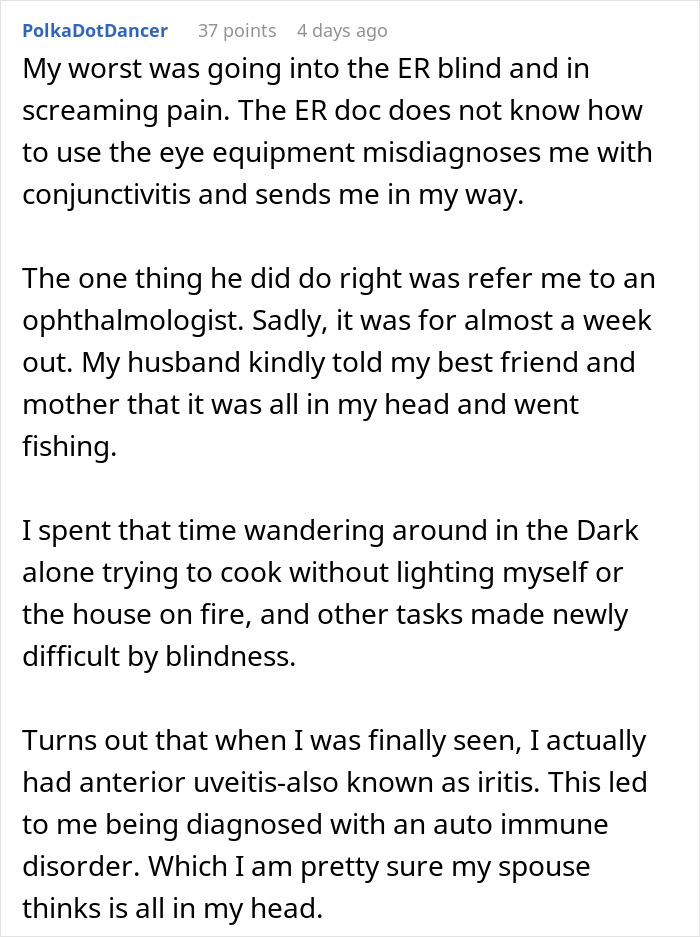
Reading the last comment I knew it was uveitis before I got to the end, because I also have it. The first doctor told me she thought it was conjunctivitis but on the off chance it might be uveitis, I should "Google it when I get home"! I wound up in ER because I lost my vision entirely within 24 hours. Untreated, it can cause permanent blindness...
Too many times doctors ignore women and just brush aside their symptoms. Guarantee if you'd been a man he wouldn't have gotten that bad of treatment. And yes after years of exams we learn to push thru it. But I had a nurse practioner do an exam once and she scratched me twice (once with the speculum and once doing the pap smear) it was bad enough I bled. I told her she scratched me and she denied it and the nurse just patted my shoulder saying I need to relax. I was 58 snd treated like a kid. No I wasnt having my period as I had a hysterectomy when I was 31. I walked out of that office with steam coming out my ears. Never went in that office again.

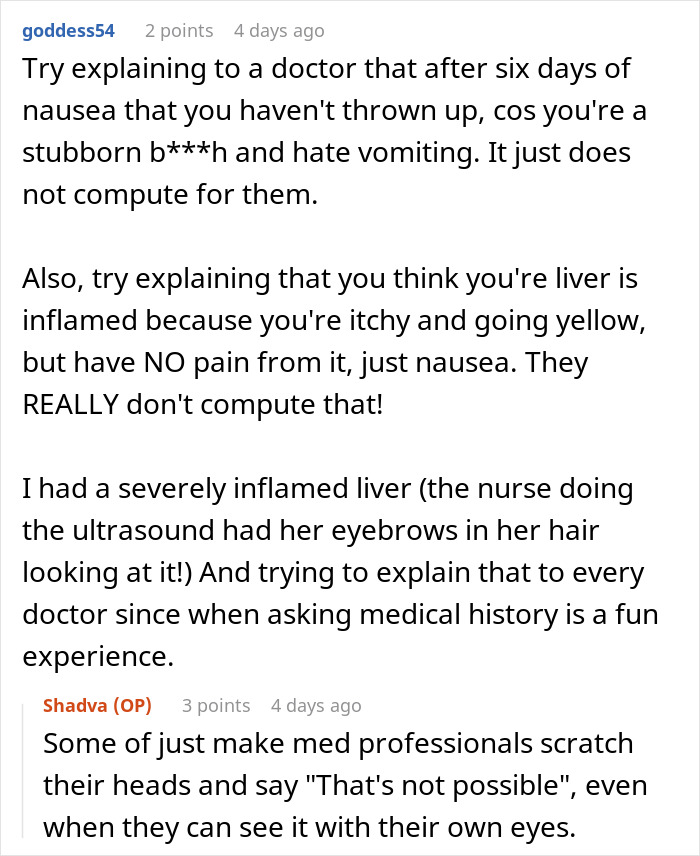
Went to GP because I was having probable bile malabsorption, obviously they needed to run their checks - says give me a stool sample. Give her back to container of yellow liquid. "NO, a STOOOOL sample". She had to get another more senior doctor. Him - it's your appendix. Me, it's not. Him - my medical training says it is. Me: my appendectomy scar says it isn't. Neither of them had seen or noted the scar. Turns out several tests later, it's bile malabsorption issues. Trust the person who has had IBS for more than 20 years to know what it isn't.

Want to know how to nip doctors arrogance right in the bud? Right when they enter the room, be an uncooperative a*****e and tell them EXACTLY what you will not do. I tell them right off, I will not be talked over, dismissed or patronized AND I will be standing over you're shoulder and scrutinizing EVERY word you put in my chart. Make them AFRAID of you and you will be treated with respect. Doctors don't care about you because they like you. They will care if they are afraid you will report them for their incompetence or poor treatment.

Please be kind to the doctors that listen, and the doctors that give you the benefit of the doubt.


I wasn't diagnosed with kidney stones (chronic) because I was young and a woman. Get told in my mid 30s it's kidney stones. No kidding you moron!
Bad doctors exist. If you haven't encountered one, you are lucky.
Load More Replies... An ex of mine had excruciating pain 3 weeks out of every month, only relieved when she got her period (which, of course, came with its own issues). For years her doctor just kept giving her narcotic pain pills, refused to listen to her, wouldn't do any kind of tests. I finally convinced her to see my family gp, first thing he does is send her off for mri's, ct scans, bloodwork, everything he could think of. Turns out her gallbladder was stuffed full of stones and had been for years. He got her in for emergency surgery the same day the results came back, and she's been pain-free ever since.
If you ever have a serious allergy to medication, trust the pharmacist and not the doctor. I am deadly allergic to penicillin [it caused a kidney shutdown and nearly killed me] and have been told to avoid "all beta lactam antibiotics" as well because of similarities. Every time I am prescribed antibiotics I ask the doctor to confirm they are not that type because I cannot have them. Then I ask again at the pharmacist. TWICE now I have been give a prescription by a doctor who assures me it's fine and then gotten to the pharmacist and been told the doc messed up and this is beta lactam. One of the doctors when I told him: "What do you know about beta lactam?" "Not much, just that I can't have it." I guess he assumed I was making it up? I should have told him, "Just that my GP, allergist, and nephrologist have all told me it might kill me." Even then I'd need to check again with the pharmacist. :(
Yep. Not nearly as severe as your example, but my doc suggested I get the RSV (Respiratory Syncytial Virus) vaccine along with my usual flu shot. I'm 44. I asked my pharmacist and she refused. Turns out the FDA specifically warns against giving that shot to people under age 60. Not sure what would have happened, but I listened to her.
Load More Replies... I went to the ER once because my chest very very strange. There was almost no pain, but something felt WRONG. Fast forward 6 hours and various blood tests, ink tests, etc and I've been diagnosed with pulmonary embolism (blood clot in my lungs) and the specialist comes out to see me. We go through the whole list of symptoms again for him and he asks for level of pain on a 1-10 scale. I say 2. He incredulously says, "You came into the ER for a TWO?!?" and I say, "Well I was right, wasn't I?" Unsurprisingly he was a terrible doctor for several reasons and I later got my GP to find me a new specialist.
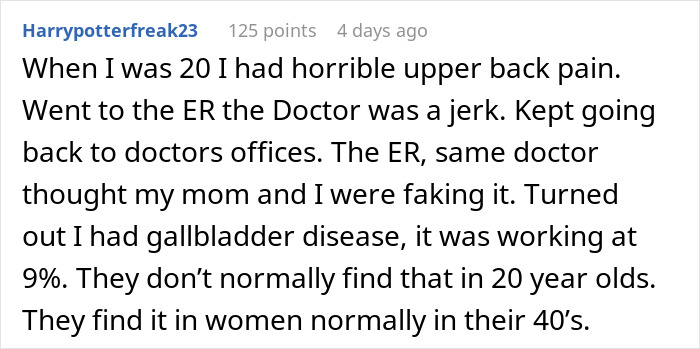
Had a heart attack and went to the er and the cardiologist that was going to do the stint if I needed one asked why I came to er. I start to tell him how my symptoms started and he kept cutting me off. Heart attacks in women are much different then men but he wouldn't listen just cut me off. Luck enough he left the practice he was with before my next outpatient spot. Got a wonderful cardiologist who listens and explains everything.
Load More Replies... So many women get ignored by male doctors/medical professionals. It's funked up.
When i had appendicitis i had no fever (common for me with infection) but i almost fell off the gurney when they palpated my appendix. So they did an ultrasound and confirmed it was inflamed. Gave me a ton of antibiotics instead of surgery still good 15 years later
Once my mother had surgery and afterwards I noticed she seemed really out of it (long after the anesthesia had worn off), and she wasn't eating or drinking water. When I mentioned it to the surgeon, he turned around and asked my mother if she had been drinking water, and she said "Yes." He totally ignored my point that she was disoriented, so her word on that was suspect. He went ahead and discharged her. I wish I had pressed the doctor on it, because it turned out she had sepsis. She started hallucinating at home, so we took her to the ER. She ended up with both her pancreas and adrenal glands destroyed. A few years later, she died from pancreatic cancer, which we suspect may have been caused by the sepsis. Seriously, how HARD would it have been for this idiot doctor to take a few minutes out of his day to actually evaluate her condition, including her mental state?
In the '70's, I read a (true) story of a little girl with cystic fibrosis, written by her father after her death. Once, she was in severe pain, and told her parents her lung had collapsed (it had happened before). They took the child to the hospital, where the doctors refused to listen to the child or her parents, and forced her to go through an unnecessary 24 hours of suffering before they finally checked. Guess what? Her lung was collapsed.
The problem is that biological women are not part of most studies on medication or medical treatment. And that despite the fact that there are impactful differences between the biology of women and the biology of men. So in most cases the dosage of medication for women is far too low. And often symptoms of common illnesses differ greatly. Just read up on symptoms for cardiac arrest. Look specifically for the description for women. Researchers found that the most prominent symptom for women 24 hours before cardiac arrest was shortness of breath. For men, chest pain was the preeminent telltale symptom. The list goes on and on. Updating those often older research goes very slowly. The reason why this happens is that you need to change the study settings to accommodate different sexes, and as usual, that just costs too much. Also the research on those differences is very recent, and for a long time no one wanted to hear about it.
Those doing medical studies claim that its harder to test on women due to our fluctuating hormones, the changes in our bodies due to said hormones, and pregnancies etc. Imvho, that should mean that we should be studied more thoroughly. Simply because of how complex we are. We are not the same as men, in any way. Its insulting that so many of the medical field seem to think we are.
Load More Replies... Last year, I had a surgical advisor ask me how long my kidney had been upside down. This was news to me! I told him to check my surgical charts from 5 years back as they were fine then. Same unit same trip they confidently told me I had an infected gall bladder. Me: "But I don't have a gall bladder?! Have you guys seriously not even reviewed my notes yet?"(I'm extremely complex and no way to diagnose me without understanding my genetic disorders etc). Ugh. I have to monitor the meds they give me too, as I'm on quite a precise regimen and they often get it wrong.
I had a painful rash for over a year. Stubborn doctor misdiagnosed it as ringworm. Turns out I have both eczema and psoriasis that were flaring up at the same time.
In early 2007 I caught leptospirosis from a dog I groomed in southern California. I had a lot of Asian clients who frequently flew to third world countries with their pets and then would bring them to me to get cleaned up after long flights.... Long story short, the dog infection gave me a staph infection in my right kidney and my immune system had been compromised by the leptospira so they had to put me on malaria inhibitors so I didn't go into renal failure. In the process of this they gave me whatever the legally strongest antibiotics are and with my bad luck the leptospira went and hid in my brain and nervous system trying to hide from the antibiotics which normally are distributed through your bloodstream so your brain and nervous system are the last two places that would receive the medicine fighting off infections.....so the leptospira gave me a traumatic brain injury and damaged the myelin sheath that coats all the nerves in the nerve cluster in my brain. So basically my head
Short curcuited and I spent the next 5 years rewiring my brain to stop getting subjected to electric shock treatment to my face constantly.....
Load More Replies... Reading the last comment I knew it was uveitis before I got to the end, because I also have it. The first doctor told me she thought it was conjunctivitis but on the off chance it might be uveitis, I should "Google it when I get home"! I wound up in ER because I lost my vision entirely within 24 hours. Untreated, it can cause permanent blindness...
Too many times doctors ignore women and just brush aside their symptoms. Guarantee if you'd been a man he wouldn't have gotten that bad of treatment. And yes after years of exams we learn to push thru it. But I had a nurse practioner do an exam once and she scratched me twice (once with the speculum and once doing the pap smear) it was bad enough I bled. I told her she scratched me and she denied it and the nurse just patted my shoulder saying I need to relax. I was 58 snd treated like a kid. No I wasnt having my period as I had a hysterectomy when I was 31. I walked out of that office with steam coming out my ears. Never went in that office again.
Went to GP because I was having probable bile malabsorption, obviously they needed to run their checks - says give me a stool sample. Give her back to container of yellow liquid. "NO, a STOOOOL sample". She had to get another more senior doctor. Him - it's your appendix. Me, it's not. Him - my medical training says it is. Me: my appendectomy scar says it isn't. Neither of them had seen or noted the scar. Turns out several tests later, it's bile malabsorption issues. Trust the person who has had IBS for more than 20 years to know what it isn't.
Want to know how to nip doctors arrogance right in the bud? Right when they enter the room, be an uncooperative a*****e and tell them EXACTLY what you will not do. I tell them right off, I will not be talked over, dismissed or patronized AND I will be standing over you're shoulder and scrutinizing EVERY word you put in my chart. Make them AFRAID of you and you will be treated with respect. Doctors don't care about you because they like you. They will care if they are afraid you will report them for their incompetence or poor treatment.
Please be kind to the doctors that listen, and the doctors that give you the benefit of the doubt.
I wasn't diagnosed with kidney stones (chronic) because I was young and a woman. Get told in my mid 30s it's kidney stones. No kidding you moron!
Bad doctors exist. If you haven't encountered one, you are lucky.
Load More Replies...































 No fees, cancel anytime













62
38