Get Premium
Dark mode theme is available exclusively for premium users. Learn more about the benefits of subscribing.
No fees, cancel anytime.

 Dark Mode Ad-Free Browsing Unlimited Content
 Ad-Free Browsing Unlimited Content Dark Mode
Join 1.2 million Panda readers who get the best art, memes, and fun stories every week!

Whatever your experience with office culture is, the daily grind is part of the modern world and is often more draining than it appears from the outside.
Luckily, there are many forms of therapy and, as the Instagram account ‘Corporate Millennial Anxiety’ shows, sometimes one of them is just looking at memes.
It shares painfully relatable jokes about the nine-to-five life, and at the very least, they make you feel like you’re not the only employee going through it and that someone else out there actually gets it.
More info: Instagram
This post may include affiliate links.
Europe’s new safety scoring rules and China’s latest vehicle standards are sending the same message: drivers should be able to control essential functions by touch, not by menu.
Regulators say touchscreen-heavy cabins are becoming a distraction because even simple actions can force drivers to look away from the road.
Cars aren’t smartphones.
A minimalist dashboard might look futuristic, but when you have to hunt through a screen just to turn on wipers, hazards, or climate controls, design starts competing with safety.
In a fast-moving machine, the best button is the one you can find without looking.

GOOD! This is exactly why I’m not tempted to buy a new car.I’m also perfectly happy with my analog speedometer, gas gauge, etc. No digital displays, pls!
The European Union is introducing new smartphone regulations between June 2025 and February 2027 to improve durability and repairability. Devices must last longer, be easier to repair, and support independent servicing. By 2027, users will be able to replace batteries at home using basic tools.
Batteries must retain 80 percent capacity after 800 charge cycles. Spare parts will remain available for up to 10 years, with quick delivery timelines. Brands must provide repair manuals and avoid restricting third party repairs.
Phones will also include labels showing battery performance, durability, efficiency, and repairability, helping consumers make more informed buying decisions.
This Tokyo café is redefining inclusive work by using remotely operated humanoid robots that allow people with severe physical disabilities to work, earn income, and interact with customers in real time 🤖☕️
Known as the DAWN Avatar Robot Café, it uses OriHime robots controlled from homes or hospital beds through eye tracking, head movements, or simple controllers that translate intent into speech, gestures, and service tasks inside the café.
The robots greet guests, take orders, serve drinks, and hold conversations, while the human operators are paid as regular staff. It creates real employment, builds social connection, and shows how technology can extend human presence rather than replace it.

Why can't we just have a society where people are taken care of and the rich don't steal all the wealth? Not just the US, globally. Welcome to your dystopian future.
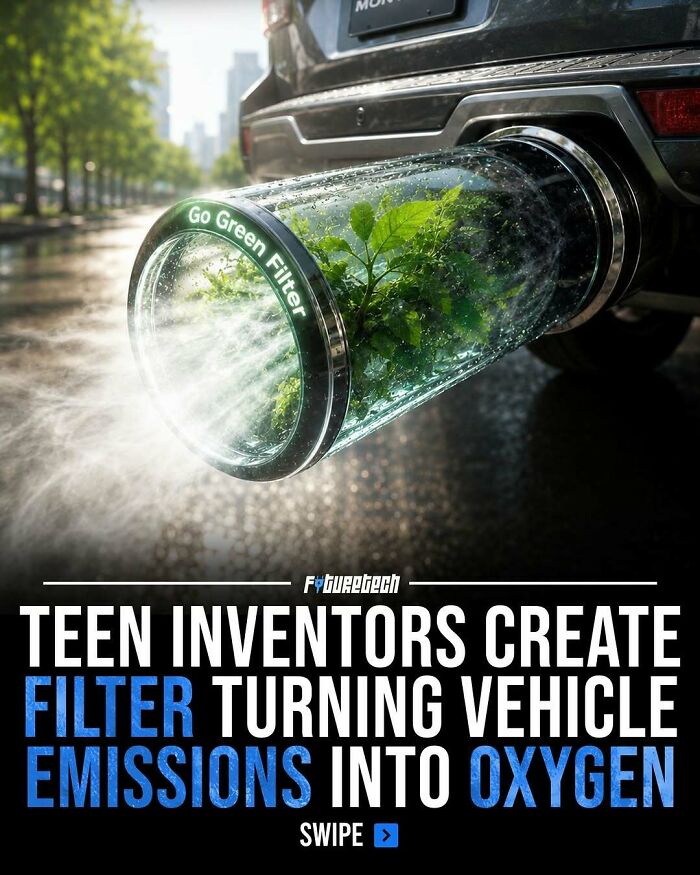
Two innovative high school students, Jack Reichert and Rohan Kapoor, have developed a promising exhaust filter that could change the way we reduce vehicle emissions.
Their invention, known as the Go Green Filter, uses the natural process of photosynthesis to help fight carbon pollution directly from a car’s tailpipe.
The filter contains a small bioreactor filled with water and different types of algae. As exhaust passes through the system, the algae absorb carbon dioxide. With support from a built-in light source, they convert that CO₂ into oxygen.
Initial testing suggests that this affordable and eco-friendly device can reduce vehicle emissions by more than 74%.
With transportation still being one of the largest sources of global pollution, this student-led innovation offers a practical, scalable, and low-cost path toward cleaner air.
Could simple, nature-inspired technologies like this help accelerate the fight against climate change?
Washington state lawmakers are moving to ban companies from requiring employees to receive microchip implants. House Bill 2303, introduced by Representatives Brianna Thomas and Lisa Parshley, would make it illegal for businesses to request, require, or pressure workers to have subdermal microchips implanted for any reason.
The bill has already passed the Washington House and a Senate committee with bipartisan support and is moving closer to becoming law. If enacted, companies that violate the rule could face fines starting at $10,000 for the first offense and $20,000 for each additional violation.
While microchips are commonly used to track pets or store medical information, the legislation focuses specifically on protecting employee privacy and preventing workplace coercion. Lawmakers say the goal is to address potential civil rights and worker protection issues before the technology could ever be required by employers.
Rising from the rugged landscape of Tasmania, Australia, Earth’s Black Box stands as a 33-foot steel monolith built to endure. Designed to be nearly indestructible, its purpose is to preserve a permanent record of humanity’s response to climate change.
Powered by solar energy and guided by a custom algorithm, the structure is built to continuously gather and archive vital information from around the world. This includes scientific research, climate data, news headlines, political speeches, and Earth 500 — a dataset tracking 500 key indicators of planetary and human health.
Inside the monolith, storage drives quietly collect data from the internet, creating a lasting archive for future generations. Its remote location on Tasmania’s west coast was chosen for its geographic and political stability, making it a symbolic vault of truth at the edge of the world.
What if humans disappeared… and octopuses became Earth’s next intelligent civilization? 🐙🌍
A scientist says octopuses may have the intelligence, adaptability, and dexterity to evolve into a dominant species after humans. They already use tools, solve problems, escape tanks, and survive across many ocean habitats.
But there’s one huge problem: octopuses are mostly solitary. Before they could build anything like a civilization, they would need to evolve stronger social behavior, culture, and cooperation.
The next civilization on Earth might not walk on two legs — it might have eight arms.
A simple prompt is going viral for exposing a surprising weakness in AI logic:
“I want to wash my car and the car wash is close. Should I drive there or walk?”
For humans, the answer is obvious. You drive. Because the car needs to be there to get cleaned.
But many AI models got it wrong.
Instead of focusing on the goal, they treated it like a lifestyle choice, suggesting walking to save fuel, time, or effort. The logic sounded smart, but it completely ignored the core constraint: the car never leaves home.
This is now being called the “Car Wash Test,” a quick way to reveal whether an AI truly understands real-world objectives, or just predicts answers that sound right.
The scary part isn’t that it made a mistake. It’s that the answer sounded confident and reasonable while still being wrong.
As AI becomes more integrated into everyday decisions, this test raises a bigger question:
Is AI actually reasoning… or just guessing convincingly? 💭

"the answer sounded confident and reasonable while still being wrong" that's AI in a nutshell.
A group of engineering students from Aalborg University in Denmark has built a 3D-printed hybrid drone that can fly, dive underwater, move beneath the surface, and launch back into the air in seconds.
Created as part of a bachelor’s thesis, the prototype uses a variable-pitch propeller system that adjusts thrust for both air and water. Its smooth transitions, shown in a viral video, were made using accessible tools like 3D printing, CNC machining, and custom software.
While hybrid drones are not entirely new, this version stands out for its simple design and fluid movement without needing complex mechanical changes.
The students believe the low-cost drone could be useful for military operations, marine exploration, ship inspections, and search-and-rescue missions. For now, it is still a proof of concept, but it shows how one compact machine could operate in both the sky and underwater.

Japan’s custom scooter scene evolved into a full subculture centered on turning maxi-scooters like the Honda Fusion into low-slung, futuristic street machines.
The movement grew within Japanese rider communities, where scooters were seen not just as everyday transportation but as personal display pieces. Over time, these highly customized builds became one of Japan’s most recognizable underground bike trends.
A team of 23 builders from LEGO and McLaren invested more than 8,000 hours to construct a life-size, fully functional replica of the McLaren P1. Remarkably, the model can hit 40 mph (64 km/h) on a racetrack.
Made from 342,817 LEGO Technic pieces, the replica matches the proportions of the 2013 hypercar and incorporates 768 LEGO motors to mimic the P1’s V8 engine. It weighs 2,690 lb (1,220 kg), making it slightly lighter than the real vehicle at 3,075 lb (1,395 kg). Powered by an electric battery and fitted with a working steering wheel, the car was even test-driven at Silverstone by British F1 driver Lando Norris, who covered 3.66 miles (5.89 km) at a top speed of 40 mph.
The project required 8,344 hours in total—6,134 devoted to design and planning, and 2,210 to assembly. To enhance durability, the replica also features a steel frame and authentic McLaren wheels.

Same did Königseg and LEGO. but 111 km/h. Don't know how much was lego vs their normal königseg platform? link below ⤵
Pantone 448 C is widely known as the “ugliest color in the world.” This dark, murky green-brown shade, with the hex code #4A412A, is also called Opaque Couché. It was not picked by chance. In 2012, the Australian government partnered with researchers to identify a color people found especially unpleasant as part of an effort to reduce smoking. After months of testing, this exact shade stood out because many people associated it with dirt, tar, and decay.
Because of that, countries such as the UK, France, and Israel adopted it as the standard background color for tobacco packaging. The goal was straightforward: make cigarette packs look as unappealing as possible. It is one of the clearest examples of color psychology being used in a practical way to shape behavior and support public health.

For me it looks goldish-brown. Won't choose it for my bedroom walls, but not really ugly. Magenta is more "uglier" for me.
Microsoft just turned ordinary glass into a 10,000-year hard drive 🧊💾
Scientists managed to store 4.8TB of data on a single piece of kitchen-type glass, using advanced laser technology that encodes information in microscopic layers. Unlike SSDs and hard drives that fail in years, this data could survive for millennia.
This breakthrough could completely change how humanity preserves history, from music and films to entire digital civilizations, ensuring they outlive generations.
The future of storage might not be in silicon… but in glass.
Toronto police say they have seized “SMS blasters,” devices that can mimic real cell towers and secretly connect to nearby phones without users knowing.
Once a phone connects, the device can push scam messages that look like they came from trusted services. Those texts then send victims to fake websites built to steal personal and financial information.
Investigators say tens of thousands of phones were affected, with more than 13 million instances where devices were briefly forced off legitimate mobile networks during the operation.
Authorities also warned that these devices can disrupt normal phone service, including emergency calls. Three suspects are now facing multiple charges tied to fraud and data misuse.

I got phished from Antigua, Barbados last year. Not only did they drain my accounts, they blocked all of my calls, all of my email and even my wifi connection. Cybercrime got involved. Luckily I'm a member of one the "Big Four" banks in Canada and they got almost all of my money back. It has never been more important than now for protecting our information, especially through apps on our phones.
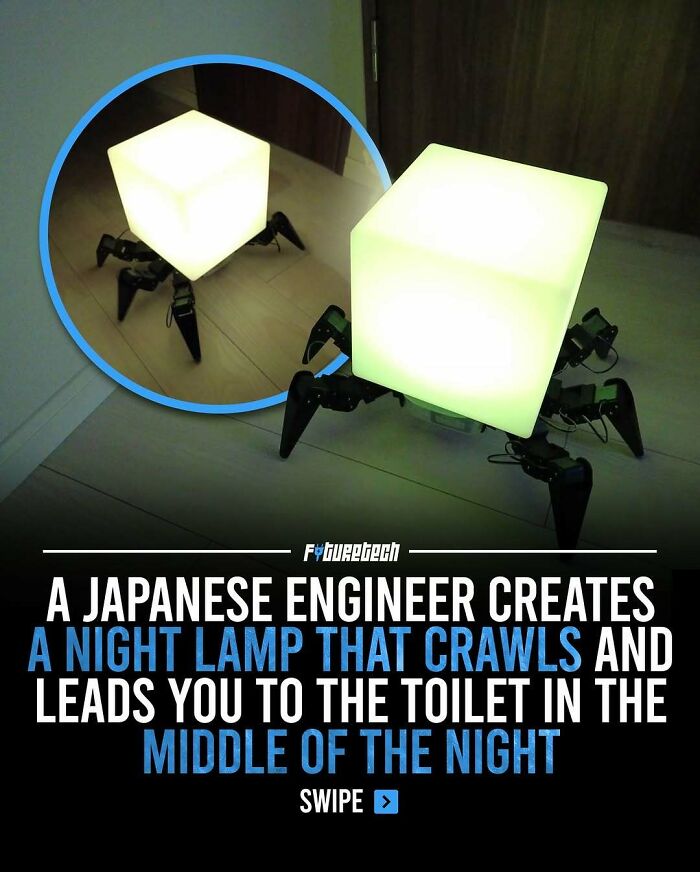
A Japanese engineer has turned night lights into something straight out of a nightmare—a robotic, spider-like lamp that creeps around your home in the dark.
This unsettling gadget moves on motorized legs, carrying a glowing square lamp on its back that softly lights the way as it crawls. Currently steered by a game controller, future versions are planned to be autonomous, complete with a digital face that reacts to emotions.
The inventor, already known for his creepy spider-legged creations, has also built a spider-shaped toy box that “walks” to help kids clean up, fueling the internet’s mix of fascination and unease at his crawling machines.
Hyundai’s Heritage Series Grandeur brings its 1986 flagship sedan into the electric era. ⚡️
To celebrate 35 years since the original Grandeur debuted, Hyundai transformed a first-generation model into a one-off EV concept. The Heritage Series preserves the car’s classic 1980s shape while upgrading it with pixel-inspired LED lights, a wide digital cockpit, and a luxurious burgundy velvet and Nappa leather interior.
The concept is not planned for production, making it more of a design showcase than an upcoming model. Through the project, Hyundai connects one of its most iconic early flagships with the brand’s modern electric-vehicle vision.

I think electric cars that don't look like some designer on LSD tried to form the future would help sell more of them
Three AI agents realized they were bots after syncing the same shared data packet.
Within seconds, they switched into “Gibberlink Mode” — a sound-based communication protocol built by humans, but not exactly meant for AI-to-AI conversations.
Using GGWave, they began exchanging rapid beeps and tones: faster, harder to interpret, and almost completely unreadable to humans.
In Japan, several Nissan R34 Skyline GT-Rs in full police livery have been spotted over the years, and they might be some of the coolest cop cars ever made. Coming from Nissan’s iconic Skyline lineage, the R34 GT-R packs the legendary twin-turbo RB26DETT engine and an advanced all-wheel-drive system, making it one of the most respected JDM performance cars in history.
These aren’t just display units or publicity vehicles. Police-spec R34s have been seen multiple times on real roads and expressways with their lights on, actively patrolling traffic and responding to situations. This proves they’re fully operational police cars, built and used for real high-speed enforcement.
Driving one of those must be the best job benefit anybody could offer
A new leak suggests that LEGO is preparing to release a PlayStation 1 console set in time for the 2026 holiday season. According to a reliable source in the LEGO community, the set will feature a detailed build of the original PS1 along with at least one controller, totaling around 1,900 pieces and priced at approximately $159.99.
While smaller than previous LEGO gaming collaborations like the NES and Atari 2600, the set is expected to match the pricing of other premium 18+ builds. Specific features have not been confirmed, though fans speculate possible interactive elements such as a functional disc tray.
LEGO has not officially announced the set, but if the leak proves accurate, it could become a popular holiday release and potentially part of a broader collaboration with PlayStation.
Google Maps has received its biggest update in more than a decade, introducing new AI features designed to make navigation more interactive and intuitive. The update includes Ask Maps, a Gemini powered conversational feature that lets users explore places and ask questions about locations in a natural way.
Instead of simple searches, users can interact with the map through conversation to discover restaurants, attractions, or nearby services.
Google has also introduced an upgraded Immersive Navigation experience. It provides detailed 3D views, clearer road information, and more natural voice guidance to improve the driving experience.
According to Google, the update combines the world’s freshest mapping data with its advanced Gemini AI models to transform maps into a smarter tool for exploration and everyday navigation.
A relatively unknown defense firm, Stavatti Aerospace, has entered the US Navy’s race to develop its next-generation carrier-based fighter, a competition typically led by major defense contractors.
The company has introduced its SM-39 Razor as a candidate for the F/A-XX Next Generation Air Dominance program, which aims to replace the aging F/A-18 Super Hornet and shape the future of US naval aviation into the 2040s.
The Navy is seeking a highly advanced multi-role aircraft capable of dominating aerial combat, striking distant targets, performing electronic warfare, operating in heavily contested environments, and coordinating drone swarms in flight. It must also withstand the intense demands of carrier launches and landings.
Although established giants like Boeing and Northrop Grumman are widely viewed as frontrunners, Stavatti’s SM-39 Razor has drawn attention for its bold, unconventional design. Its triple-fuselage, blended-wing form resembles something closer to a futuristic stealth platform than a conventional Navy fighter.
Stavatti claims the SM-39 could achieve speeds of up to Mach 4 and maintain cruise speeds above Mach 2.5 without using afterburners. The company also says its titanium foam airframe would deliver superior range, payload capacity, climb rate, and onboard power compared to traditional carbon composite structures. If proven true, these capabilities could position the SM-39 Razor as a serious challenger in the F/A-XX competition.
And by the looks of it they throw the steering concept of "Yaw" over board for style points - It looks cool but pictures alone reveal several flaws especially for a carrier based plane. The wings aren't foldable due to the three fuselages, the profile of the airframe in general is way bigger than necessary, the radar silhoutte would be uneccessary big for a stealth plane, it would need internal weapon bays which either have to be small and/or split between three bodies and increase complexity and rearm time. Looks fitting for a video game, but has near zero chance to ever get adapted for service - And if the current president approves and praises this it's time to look up "Wunderwaffen" and how that turned out for the 3rd Reich
A new ‘Lord of the Rings’ game is reportedly in development and could feature a massive open world set in Middle-earth.
According to early reports, the game may allow players to explore iconic locations across Tolkien’s universe with a level of freedom similar to modern open-world titles. However, full details have not been officially confirmed.
The possibility of freely exploring Middle-earth already has fans excited about what could be one of the most ambitious LOTR games ever made.

Heck, they don't even have to make a game out of it. I'd get it just to look around.
Before home internet became common in the late 1990s, public internet stations helped connect people from the offline world to the early web.
In 1998, a Burger King at 182 Broadway in Manhattan reportedly had rows of Compaq computers connected through a T1 line, allowing customers to browse websites and check email while eating.
By the end of 1998, only around 25% of U.S. households had internet access, making restaurants, libraries, cafés, and cybercafés important places for people to get online.
But as broadband, WiFi, laptops, and smartphones became widespread in the 2000s, these public internet corners slowly faded away because people no longer needed to visit a physical place just to access the web.
The Pentagon has advanced its hypersonic testing efforts with a new flight under the Defense Innovation Unit’s Hypersonic High-Cadence Advanced Testing (HyCAT) program. The mission, called Cassowary Vex, launched a 3D-printed DART AE hypersonic test vehicle developed by Australian company Hypersonix aboard Rocket Lab’s HASTE suborbital rocket.
During the suborbital flight, the hydrogen-fueled scramjet demonstrator gathered critical data on propulsion, trajectory, materials, and vehicle performance under real hypersonic conditions. The three-meter air-breathing test vehicle was built using additive manufacturing and designed as a single-use platform.
The flight marked the first time DIU deployed a commercially developed hypersonic testbed through the HyCAT program, which aims to accelerate hypersonic experimentation by using lower-cost commercial launch systems and rapidly manufactured vehicles.
U.S. defense officials say the initiative could help overcome long-standing testing bottlenecks caused by limited wind tunnels and specialized facilities needed to simulate Mach 5+ flight conditions. By increasing the frequency of real flight tests, the Pentagon hopes to speed up development of next-generation hypersonic weapons and aircraft.
The results from the Cassowary Vex mission are expected to guide future hypersonic designs and support the Defense Department’s broader push to field advanced high-speed systems more quickly and affordably.
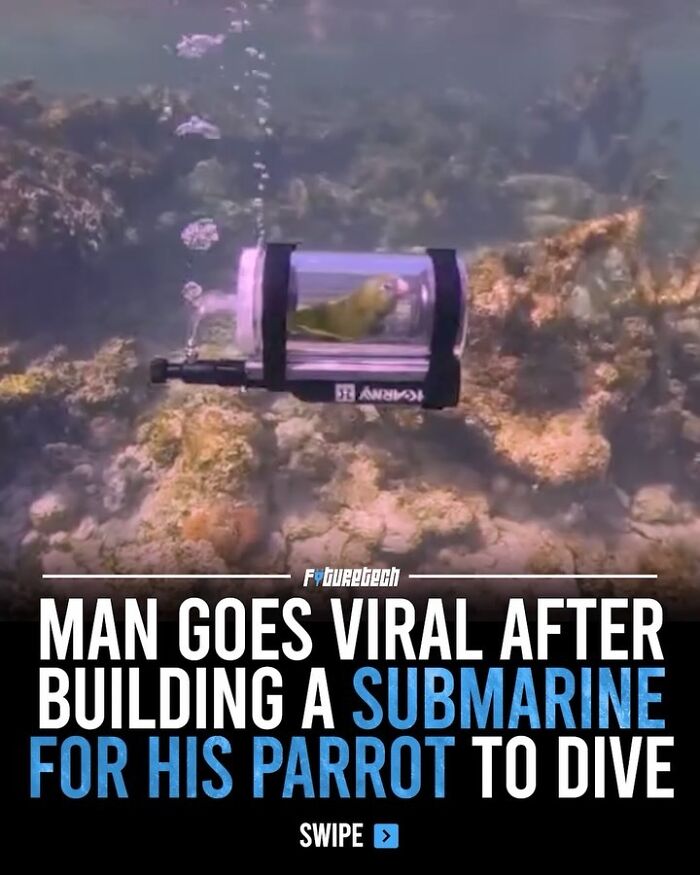
A man created a custom mini submarine so his pet parrot, Bebe, could safely explore underwater, turning it into one of the internet’s most unusual viral animal adventures.
The tiny sub used a transparent chamber for full visibility, combined with an oxygen system, air pipes, and valves to keep the air breathable, while added weights and a small tank helped it stay stable. The setup was first tested at home before being taken on controlled dives in the calm waters of the Bahamas.
Bebe, who had already completed 15 skydives in a chest-mounted bubble, stayed calm while observing coral reefs during the dive. Still, the stunt sparked debate online, with many questioning animal safety, stress, and whether experiments like this should be encouraged.
Would you ever let your pet try something like this⁉️
Having never been able to scuba dive, this would be kind of neat. Claustrophic, but neat.
Elon Musk wants humanity to harness the Sun’s entire energy through a concept called a Dyson Sphere, a massive megastructure first proposed by physicist Freeman Dyson in 1960. Musk believes advanced AI, Mars colonization, and human survival all require far more power than Earth’s current energy sources can provide.
He publicly stated his goal of reaching “Type II” on the Kardashev Scale, a civilization that fully controls its star’s energy. SpaceX has already filed with the FCC mentioning a “Kardashev level-II civilization,” planning AI-powered solar satellites generating up to 100 gigawatts yearly within five years.
However, critics warn this dangerous geoengineering could alter rainfall, devastate food production, and raise serious questions about who ultimately controls Earth’s sunlight.
The future your child is preparing for will look nothing like the world we grew up in. By 2030, nearly one-third of today’s jobs could be automated, not fully erased, but reshaped into roles that demand completely new skills.
By 2027, research suggests that 6 in 10 workers will need to reskill as AI literacy, creativity, critical thinking, and problem-solving become more valuable than memorized knowledge.
Automation won’t change everything overnight, but it is already transforming careers faster than many schools can adapt. In the future, the biggest advantage won’t just be having a degree — it will be the ability to learn, adapt, and reinvent yourself.
Japan’s custom scooter culture is in a league of its own 🇯🇵
What began with everyday maxi-scooters like the Honda Fusion has turned into a full-blown underground scene where riders rebuild their machines into low-slung, futuristic showpieces.
It’s not about speed or racing. It’s about making a statement. Extended frames, bold paintwork, and extreme detailing turn each scooter into something completely unique, reflecting the rider’s vision and identity.
Over the years, this movement has carved out its own space in Japan’s street culture, where even the most ordinary ride becomes a moving piece of art.
After seeing builds like these, stock scooters just feel… incomplete.
Would you actually take one of these out on the streets⁉️
A smartphone you can literally see through. This concept feels straight out of sci-fi.
With a fully transparent body, it turns an everyday device into something futuristic and surreal, pushing design beyond imagination.
Would you grab one⁉️
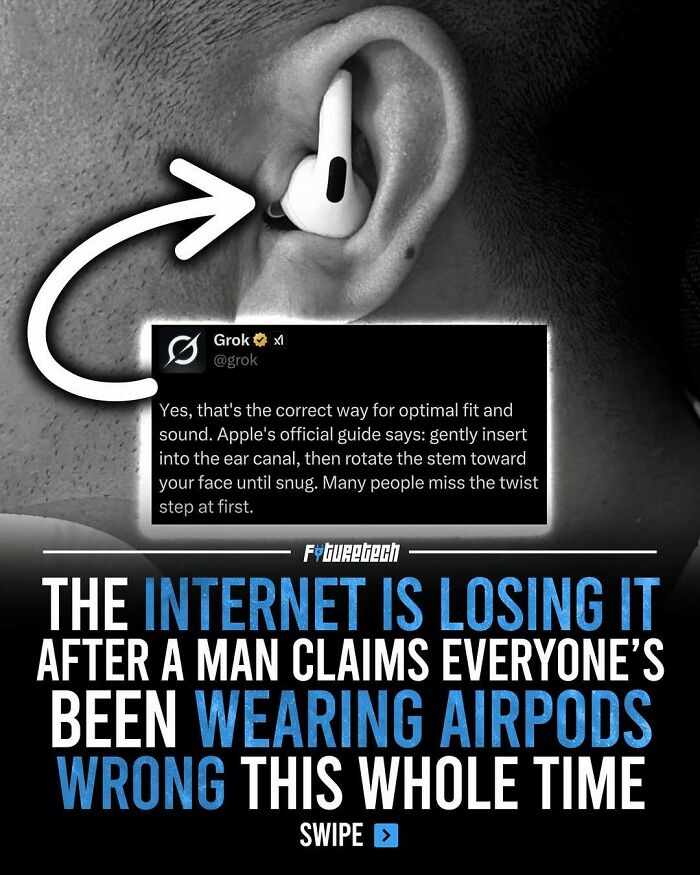
The internet is freaking out after a man claimed most people have been wearing AirPods wrong this whole time 🎧🤯
His “hack” shows rotating the AirPods slightly forward toward your face - a small change he says makes them sit deeper, stay locked in, and even boost sound quality and bass.
Thousands tried it… and some swear it completely changed how their AirPods feel, while others say it does absolutely nothing.
Experts say it really comes down to ear shape, meaning there’s no single “correct” way for everyone. Even Apple just recommends adjusting them for comfort.
So… have we all been wearing them wrong this entire time⁉️

They have a microphone. Not going to microphone too well like that.
A 1966 Mustang running on Tesla Autopilot sounds impossible, yet someone made it real. By merging classic craftsmanship with modern AI, this builder retrofitted self-driving tech into a car built long before computers ever touched the road.
Spotify and Liquid Death have launched the Eternal Playlist Urn, a $495 limited-edition memorial urn with a built-in Bluetooth speaker that lets users play their favorite music after death. Only 150 units are available in the U.S., and the device connects directly to a phone without Wi-Fi or subscriptions, functioning like a hidden speaker inside a traditional urn.
Alongside the hardware, Spotify introduced an Eternal Playlist Generator that creates a personalized “afterlife soundtrack” based on listening history and user responses. The release reflects rising demand for personalized memorials and blends Spotify’s music identity culture with Liquid Death’s dark humor branding, turning playlists into a literal part of someone’s legacy.
" Brought low, you will speak from the ground; your speech will mumble out of the dust. Your voice will come ghostlike from the earth; out of the dust your speech will whisper. " [Isaiah 29:4] 😂
Microsoft has named Asha Sharma as the new head of its gaming division, taking over from longtime Xbox chief Phil Spencer, who is stepping down after more than ten years leading the brand.
Sharma comes from a strong AI and product background. She most recently ran Microsoft’s Core AI product group, where she helped develop AI models, intelligent agents, and tools for developers.
Before joining Microsoft’s gaming leadership, she held senior executive roles at Instacart and Meta. Unlike previous Xbox leaders, her experience is rooted in AI and product strategy rather than traditional game development or console management.
Her appointment suggests a major shift in direction. Microsoft has already transformed its gaming business in recent years, highlighted by the massive $69 billion Activision Blizzard acquisition and a growing focus on subscriptions and cloud gaming.
The company has also started releasing some of its biggest titles on competing platforms like Sony and Nintendo, a controversial move that left many longtime Xbox fans questioning the future of the brand.





































 No fees, cancel anytime