Get Premium
Dark mode theme is available exclusively for premium users. Learn more about the benefits of subscribing.
No fees, cancel anytime.

 Dark Mode Ad-Free Browsing Unlimited Content

 Ad-Free Browsing Unlimited Content Dark Mode

Join 1.2 million Panda readers who get the best art, memes, and fun stories every week!
Every single one of us has probably wished they could be omnipresent at some point in their lives. Witnessing historical events unfold right before our eyes is exactly the kind of superpower many of us wish we had.
But some people have actually been there when history was made. Of course, cameras weren't as readily available back then, but against all odds, some people still captured historical moments that don't necessarily appear in our history books. So, we've gathered a few incredible pictures from Instagram to show that being in the right place at the right time really does pay off.
This post may include affiliate links.
 When Michael Jackson released Bad in 1987, expectations were almost impossibly high. His previous album, Thriller, had become a global phenomenon, but Bad proved that Jackson could follow it with another era defining success.
The album produced five No. 1 singles on the Billboard Hot 100, including “I Just Can’t Stop Loving You,” “Bad,” “The Way You Make Me Feel,” “Man in the Mirror,” and “Dirty Diana.”
Its music videos also helped transform pop promotion into something closer to cinema, with elaborate sets, choreography, costumes, and storytelling.
In 1988, “Weird Al” Yankovic released Even Worse, a title that jokingly suggested his album was one step beyond Bad. Its best known track, “Fat,” parodied Jackson’s “Bad” and recreated many details from the original video, including the subway setting, costumes, dancers, and choreography. Yankovic even wore a massive rubber suit and altered facial prosthetics for the performance.
The parody became one of the biggest hits of Yankovic’s career and won the Grammy Award for Best Concept Music Video.
Added fact: The title Even Worse was itself part of the joke, since the album cover directly imitated Jackson’s pose and outfit from Bad.
Additional Added fact: Michael Jackson granted Yankovic permission to use the same subway set where the original “Bad” video had been filmed.
 This photograph, taken during the Great Depression, captures a woman standing on a cobblestone street holding a sign that reads, “Our boss owns 77 houses. We can’t pay rent.” Her message reflected the deep frustration of millions of working-class Americans facing economic collapse, joblessness, and exploitation while industrialists and landlords maintained vast fortunes.
The 1930s were defined by widespread unemployment, with nearly one in four Americans out of work. In industrial towns across the South, where textile mills and factories dominated local economies, workers earned only a few dollars a week, barely enough to feed their families, let alone afford rent. Meanwhile, many business owners accumulated wealth through company housing systems, where employees were often required to live in employer-owned homes, effectively keeping them trapped in cycles of debt and dependence.
Protests like this one were part of a broader labor movement that grew throughout the decade, leading to the formation of unions, strikes, and the eventual passage of New Deal labor protections under Franklin D. Roosevelt. Workers demanded not just higher wages but dignity and fairness, ideas that reshaped American labor law for generations.
Added fact: During the Depression, over 250,000 tenant farmers and sharecroppers across the South were evicted from their land, leading to the rise of the Southern Tenant Farmers’ Union, one of the earliest interracial labor movements in the U.S.

Same as it ever was. And people still going to argue wealth inequality like we see today is somehow good?
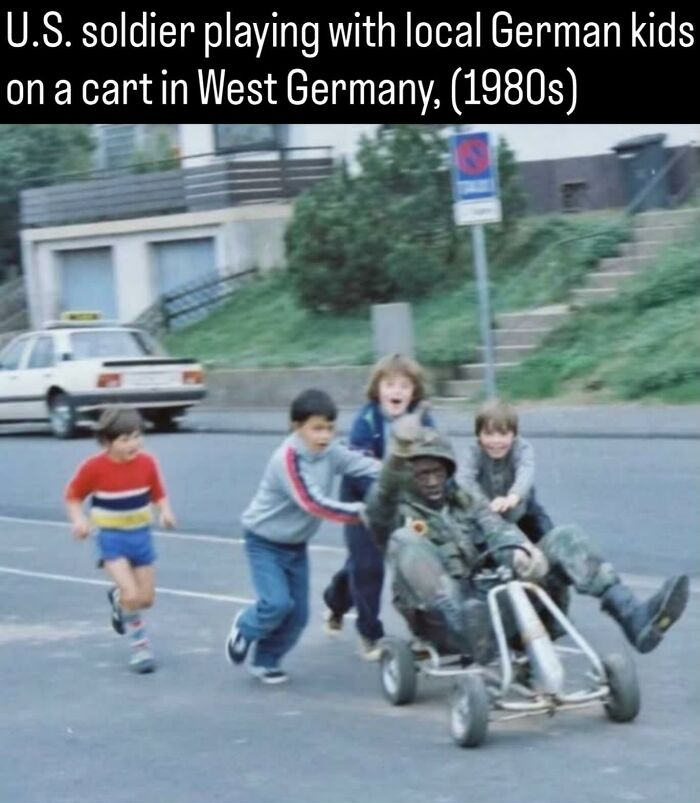 During the Cold War, West Germany became one of the most heavily militarized regions in the world. By the 1980s, approximately 250,000 U.S. troops were stationed there alongside hundreds of thousands of NATO personnel from Britain, France, Canada, Belgium, and the Netherlands. Their presence was intended to deter a potential Warsaw Pact invasion from Eastern Europe.
American military bases stretched across cities such as Frankfurt, Stuttgart, Ramstein, and West Berlin, creating long-term cultural ties between U.S. service members and German communities. Many soldiers lived in Germany for years with their families, and millions of Americans rotated through the country between 1945 and the end of the Cold War in 1991.
For many West German children during the era, American soldiers, vehicles, and bases became a normal part of everyday life, reflecting how closely civilian life and military presence overlapped in divided Germany.
Added fact: At the height of the Cold War, more than 1.3 million NATO and Warsaw Pact troops faced each other across the inner German border, making Central Europe the most likely flashpoint for a potential Third World War.
While many of these images are much darker, others are simply funny, showing that humans have always had a funny bone. A great example appears in the myths surrounding the Victorian era.
Many people believe people in the 1800s were always serious and proper, but photography created that illusion. Back then, cameras had long exposure times, making it nearly impossible to hold a natural smile for a photograph. So people often looked serious, making them seem far more serious than they actually were.
 Camels do not have true hooves like horses. They are even-toed ungulates, meaning each foot has two large toes resting on a broad, flexible pad. The small structures visible near the front are better described as toenails rather than hooves; most of the camel’s weight is supported by the wide, leathery sole beneath them.
When a camel places its foot on the ground, the two toes spread apart and the pad flattens, increasing the surface area touching the sand. This distributes the animal’s weight more evenly and prevents its feet from sinking deeply, essentially functioning like a natural snowshoe.
The thick pad also protects the foot against scorching desert ground, sharp stones and rough terrain.
A camel’s unusual feet are only one part of its desert survival system. Its long legs keep much of its body away from the intense heat radiating from the ground, while thick eyelashes and nostrils that can narrow help protect it during blowing sand. Despite their awkward appearance, camels can travel long distances over terrain that would quickly exhaust many other large mammals.
The scientific name for the camel family’s group, Tylopoda, comes from Greek words meaning “padded foot”, a direct reference to this defining feature.
Added fact: Unlike horses, camels walk by moving both legs on the same side of their body forward together, producing their distinctive swaying motion.
 Completed largely in the Gothic style, Cologne Cathedral dominates the city’s skyline not because the surrounding buildings are especially small, but because the cathedral itself is enormous.
Its twin towers rise approximately 157 meters, or 516 feet, making it one of the tallest churches in the world and the tallest cathedral with two matching spires.
Construction began in 1248 to create a monumental home for the Shrine of the Three Kings, which traditionally contains relics associated with the biblical Magi. Builders completed the choir in 1322, but work gradually slowed and eventually stopped during the 16th century. For more than 300 years, an unfinished medieval crane remained on the cathedral’s south tower and became a familiar part of Cologne’s skyline.
Construction resumed in 1842, using surviving medieval plans to preserve the original Gothic vision. The cathedral was finally completed in 1880—more than six centuries after the foundation stone was laid. At the time of its completion, it was the tallest building in the world.
The building’s scale becomes especially striking from above. Measuring roughly 144.5 meters long and 86 meters wide at the transept, the cathedral occupies an immense footprint in the center of a modern city, directly beside Cologne’s main railway station and only a short distance from the Rhine.
Added Fact: Cologne Cathedral was struck repeatedly during World War II and suffered serious damage, yet its main structure remained standing while much of the surrounding city was reduced to rubble.
 This map measures the gender balance within higher education. Blue countries have more women enrolled in universities and other tertiary institutions, while red countries have more men. The contrast reflects centuries of uneven access to education, and how differently that history has unfolded around the world.
For much of modern history, universities were overwhelmingly male institutions. Women were formally excluded from many European and American colleges until the 19th century, and even after admission became possible, social expectations, financial barriers and restrictions on professional employment kept female enrollment low.
That pattern changed dramatically during the 20th century. Expanded public education, women’s-rights movements, wartime employment and growing demand for educated workers opened universities to far more women. Across much of Europe, the Americas and parts of Asia, women eventually reached parity with men and then became the majority of students.
However, enrollment does not tell the entire story. Women may outnumber men overall while remaining underrepresented in engineering, computing and certain scientific fields. Likewise, greater enrollment does not necessarily translate into equal pay, employment opportunities or leadership positions after graduation.
The red regions reveal where poverty, early marriage, conflict, security concerns and traditional gender expectations can still restrict women’s educational opportunities.
Added fact: The map uses a measurement known as the Gender Parity Index. A value of 1 indicates equal enrollment; anything above 1 favors women, while anything below 1 favors men.
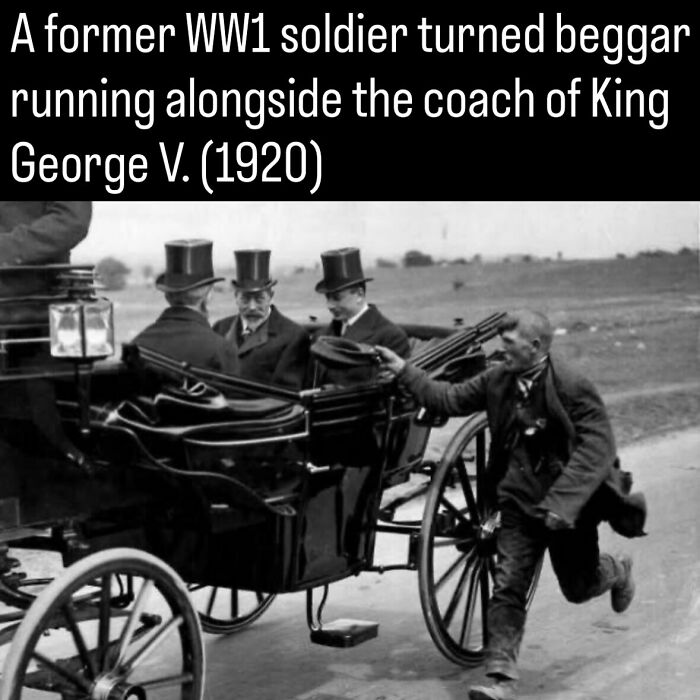 The scene came during a difficult period for Britain’s returning servicemen.
Millions had been demobilized after World War I and expected to return to stable jobs and homes. Instead, many encountered unemployment, poverty, physical disabilities and limited government assistance. Some veterans were forced to sell small goods or seek money in the streets to survive.
By 1921, approximately 2 million people were unemployed in Britain. The Imperial War Museums notes that the number reached 2 million again by 1922, including roughly half a million former servicemen.
The image’s contrast is unmistakable: a desperate man sprinting beside an open royal carriage, reaching toward passengers who remain seated only a few feet away. Whether he received anything is unknown.
Added fact: The British Legion was established in 1921 partly to unite veterans’ organizations and address the widespread unemployment, poverty and inadequate support experienced by former servicemen.
While many of these images are much darker, others are simply funny, showing that humans have always had a funny bone. A great example appears in the myths surrounding the Victorian era.
Many people believe people in the 1800s were always serious and proper, but photography actually created that illusion. Back then, cameras required long exposure times, making it nearly impossible to hold a natural smile for a photograph. And so, people often struck serious poses and carefully composed their looks, making them appear far more serious than they actually were.
 Some of the most surprising Roman coin discoveries have occurred thousands of miles beyond the empire’s borders.
Roman gold and silver coins have been found across southern India, including large hoards in modern Tamil Nadu and Kerala.
They likely arrived through maritime trade, as Roman merchants exchanged precious metals for pepper, gemstones, ivory and textiles.
Roman and Eastern Roman coins have also surfaced along ancient trade routes in Central Asia and China.
One tomb in China’s Shaanxi province contained two Eastern Roman gold coins alongside a Persian silver coin, evidence of how objects could travel across several interconnected trading networks without their original owners ever making the full journey.
Even Iceland has produced several Roman coins, despite never belonging to the empire. Their presence does not mean Roman soldiers reached the island. They may have been carried there centuries later by travelers, collectors or early settlers.
Perhaps the strangest discovery came from Katsuren Castle in Okinawa, Japan, where archaeologists identified several late Roman bronze coins.
Because the castle flourished roughly 1,000 years after the coins were minted, researchers believe they probably reached Japan through medieval Asian trade networks rather than direct contact with ancient Rome.
Added fact: Roman coins found outside the empire were not always treated as money. In some regions, they were pierced, mounted or copied and used as jewelry, ornaments or symbols of status.
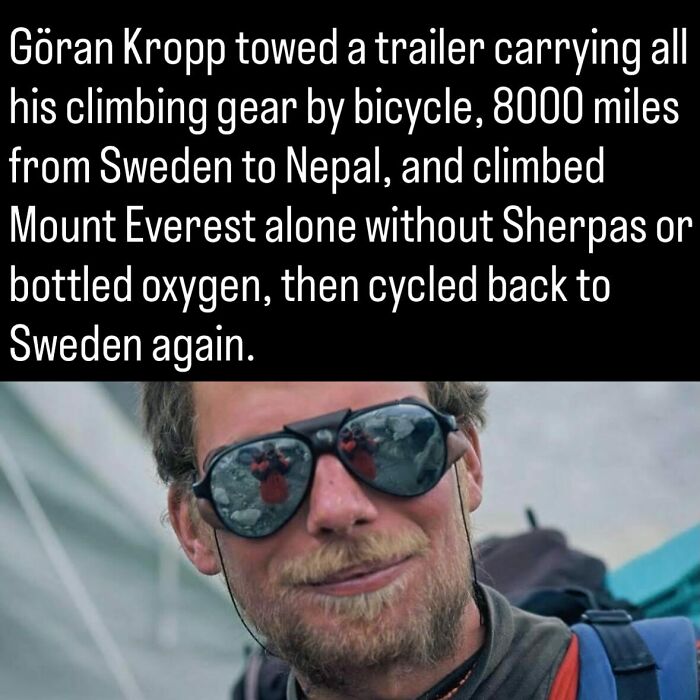 In 1996, Swedish mountaineer Göran Kropp set off on a bicycle from Sweden, hauling a heavy trailer with all of his climbing equipment. After riding more than 8,000 miles across Europe and Asia, he arrived in Nepal at the base of the world’s tallest mountain.
Unlike most climbers who depend on Sherpa teams and bottled oxygen, Kropp chose to face the mountain alone and unaided. His climb was an act of extraordinary endurance, testing the absolute limits of the human body at extreme altitude. When he finally stood atop Mount Everest, he had achieved one of the purest ascents in the history of the mountain.
Afterward, he did not rest or fly home. Instead, he mounted his bicycle once more and pedaled all the way back to Sweden. His expedition represented not only physical strength but also a philosophy of self-sufficiency that has rarely been matched in the world of exploration.
Added fact: Kropp later returned to Everest in 1999, this time with his fiancée, showing that his incredible determination was matched by a deep love of adventure and partnership.
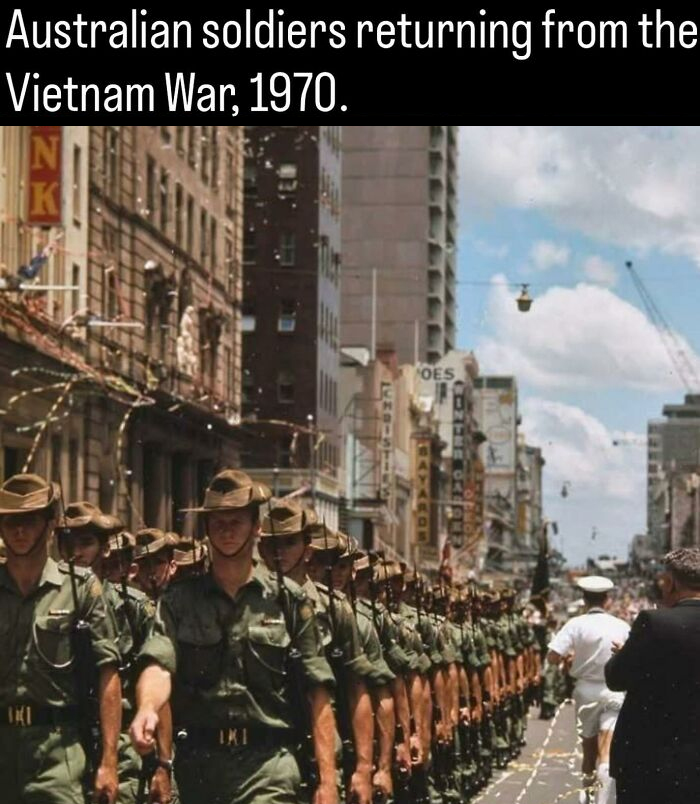 By 1970, Australia had been involved in the Vietnam War for nearly a decade, deploying more than 60,000 personnel between 1962 and 1973. Australian troops served primarily in Phuoc Tuy Province alongside American and South Vietnamese forces, conducting patrols, counterinsurgency operations, and village security missions.
Scenes like this homecoming parade were a complicated moment.
Early in the war, returning soldiers were often welcomed with public ceremonies and official recognition. But as the conflict grew more controversial, public opinion in Australia shifted sharply. Anti-war protests, especially after the introduction of conscription through the national service lottery, became widespread across major cities.
Many veterans returned to a country divided over the war they had fought. While some received parades and formal honors, others experienced indifference or hostility, and the long-term physical and psychological effects of the conflict were not widely understood at the time.
Added fact: Australia’s largest official Vietnam veterans welcome home parade did not take place until 1987, when over 20,000 veterans marched through Sydney—17 years after the war ended.
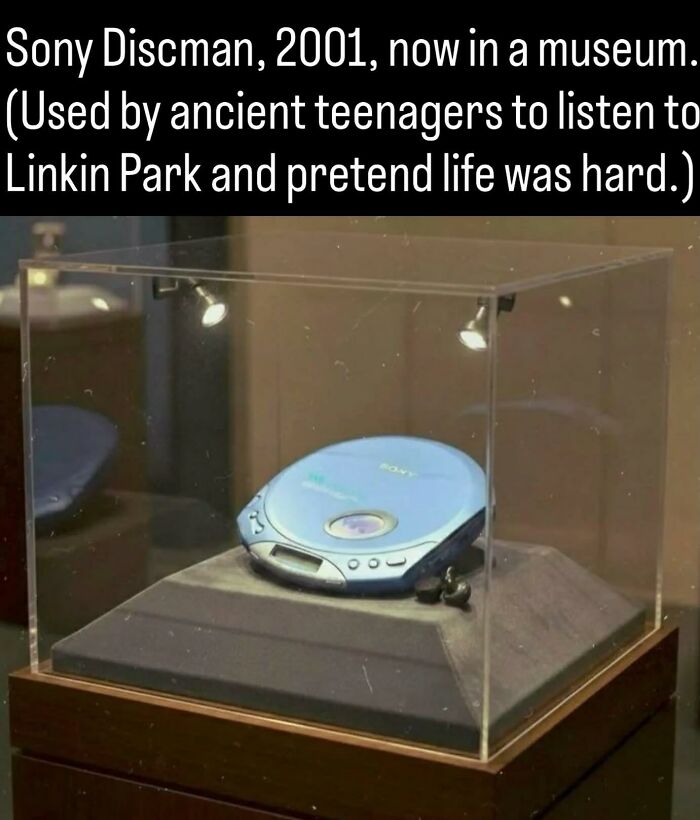 The Sony Discman was one of the defining pieces of consumer technology of the late 1990s and early 2000s.
Long before smartphones and streaming services put millions of songs in a pocket, music lovers carried their favorite albums on compact discs. A Discman could only hold one CD at a time, meaning listeners often left home with a backpack or binder filled with albums for the day.
By 2001, portable CD players had become common around the world. Models featured anti-skip technology that buffered a few seconds of music to prevent interruptions while walking, running, or riding in a car. Despite those improvements, many users still remember the frustration of a scratched CD or a player skipping at exactly the wrong moment.
The year 2001 also marked a major shift in music consumption. MP3 players were beginning to emerge, and Apple’s iPod would be released later that year. Within a decade, portable CD players had largely disappeared from everyday use, replaced by digital music libraries and eventually streaming platforms.
Today, devices like the Discman represent a brief but important era between the cassette tape and the digital age, when owning music meant physically carrying it with you.
Added fact: The original Sony Discman debuted in 1984 and was capable of playing standard CDs years before MP3 technology existed. At its peak, Sony sold millions of portable CD players annually, making the Discman one of the most successful portable music devices ever created.

For what it's worth, my "modern" 15-year-old still listens to Linkin Park, and is quite certain that life is hard. He just uses Spotify to do it.
And it wasn't just the time and effort involved. Historical records show that in the 1840s, a single daguerreotype portrait could cost around $2 to $5. That's equivalent to roughly $70 to $180 today, or nearly a week's wages for a laborer.
Today, people worldwide take over 2 trillion photos every year. In fact, we now snap more photos in just two minutes than were taken throughout the entire 19th century combined. If that isn't completely mind-boggling, I don't know what is!
 J.R.R. Tolkien never gave one single official mileage figure for Frodo and Sam’s entire journey to Mount Doom, but readers have spent decades reconstructing the route using the maps, dates and distances scattered throughout The Lord of the Rings.
Most estimates place Frodo’s journey from Bag End in the Shire to Mount Doom at roughly 1,700–1,800 miles, depending on exactly how the route is measured. And it was anything but a straight walk. Frodo and Sam crossed forests, marshes, mountains and ruined lands, frequently hiding from enemies or being forced onto indirect routes.
The map also helps explain something easy to miss in the films: Bilbo’s earlier adventure to the Lonely Mountain took him far to the northeast, while Frodo and Sam traveled primarily east and then south toward Mordor. Their paths overlapped through parts of the Shire and the lands around Rivendell, but eventually went in dramatically different directions.
Frodo left Bag End on Sept. 23, 3018 of the Third Age. Mount Doom was destroyed on March 25, 3019—meaning the larger quest unfolded across roughly six months.
And after everything they endured, Frodo and Sam still had to make the journey home.
Added fact: Tolkien was obsessive about geography and travel time. He maintained detailed calendars tracking where members of the Fellowship were on specific days so that separate storylines would remain synchronized.
 The North African campaign was fought across one of the most physically demanding battlefields of World War II. Soldiers endured scorching daytime temperatures, bitterly cold nights, violent sandstorms and enormous distances between reliable sources of food, fuel and water.
Germany sent the Afrika Korps to Libya in early 1941 to reinforce Italian forces struggling against the British. Under General Erwin Rommel, German and Italian troops launched a series of rapid offensives across Libya and into Egypt. The fighting repeatedly shifted east and west as each side captured territory, exhausted its supplies and was driven back again.
Away from combat, life in the desert required constant improvisation. Soldiers repaired vehicles with whatever materials were available, slept in shallow trenches and fashioned furniture from discarded equipment. Even a small seat offered relief from the heat, hard ground and exhausting routine of desert service.
The photograph captures an unusually quiet moment from a campaign remembered for its tanks and sweeping maneuvers. Yet the war in North Africa was ultimately governed as much by logistics as battlefield tactics. Every gallon of fuel, container of water and replacement part had to be transported across the Mediterranean and then carried hundreds of miles through the desert.
Added Fact: The North African campaign ended in May 1943, when roughly 250,000 Axis troops surrendered in Tunisia.
Yeah,nah. I'd rather rest my rear end on the hot, hard ground than a couple of grenades...
 Club Allegro Fortissimo opened in Paris during a period when beauty standards in fashion and entertainment overwhelmingly favored thinness. The venue offered something unusual for its time: a social space where plus-sized women could dance, meet friends, and enjoy nightlife without feeling judged for their appearance. The club also welcomed admirers of larger women, creating an environment that celebrated body diversity long before the body positivity movement became widely recognized.
The club became known for its lively dance floor, themed parties, and welcoming atmosphere. It attracted locals as well as curious visitors from across Europe, many of whom had never encountered a venue specifically designed around size inclusivity. Photographers and journalists occasionally documented the club, helping it gain international attention as an example of an alternative nightlife scene in Paris.
Although the fashion industry of the late 1980s and early 1990s was dominated by the “supermodel era,” spaces like Club Allegro Fortissimo reflected a parallel culture that rejected those narrow ideals. For many regulars, the club was less about making a statement and more about enjoying a night out without worrying about criticism or unrealistic expectations. It demonstrated that communities often create their own spaces when mainstream culture fails to make them feel welcome.
Added fact: Club Allegro Fortissimo was closely associated with the French organization Allegro Fortissimo, founded in 1989 to advocate against weight discrimination. The group organized social events, published newsletters, and campaigned for greater acceptance of people of all body sizes, making it one of France’s earliest body acceptance organizations.
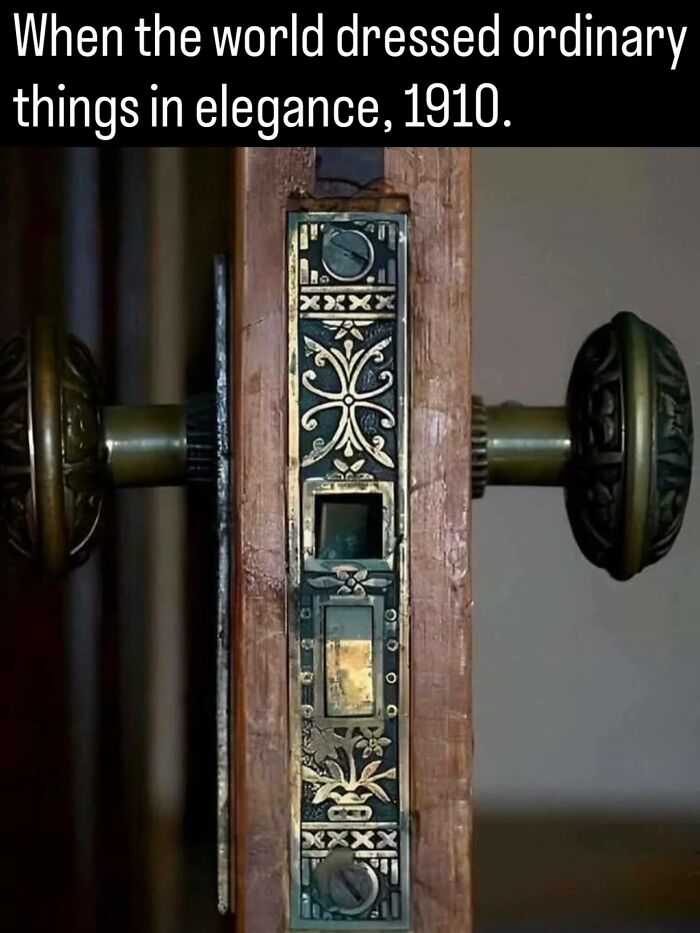 Around 1910, even ordinary household objects were often treated as small pieces of architecture. Door hardware was not just meant to function, it was meant to belong to the room. A lock plate, knob, hinge, or keyhole could be decorated with floral patterns, geometric borders, brass inlay, or dark enamel, turning something touched every day into part of the home’s overall design.
This was still the age when craftsmanship shaped domestic life. Many middle-class and upper-class homes used solid brass, bronze, or cast metal hardware because it was durable, repairable, and visually rich. Instead of hiding mechanical details, designers often celebrated them. A door was not just an entrance. It was a surface for woodwork, metalwork, and ornament.
The design here reflects the influence of late Victorian, Edwardian, and Art Nouveau taste, when even practical objects carried curves, symmetry, and decoration. Before mass-produced plastic fixtures became common, everyday materials had weight. They aged. They tarnished. They were polished by hand and worn smooth by use.
It is a reminder that beauty once lived in the smallest contact points of daily life.
Added fact: In the early 1900s, many decorative door plates were sold through hardware catalogs, meaning homeowners could choose ornate designs much like selecting furniture or wallpaper.
 More precisely, this photograph shows the sealed doors of one of the nested shrines surrounding Tutankhamun’s burial, rather than the original entrance to the tomb.
It was taken by excavation photographer Harry Burton as Howard Carter’s team worked through the burial chamber.
Tutankhamun had died more than 3,000 years earlier, around 1323 B.C. His tomb was discovered in Egypt’s Valley of the Kings by Carter’s team in November 1922. Although ancient thieves had entered portions of the tomb, they had not stripped it like so many other royal burials, leaving an extraordinary collection of objects behind.
The rope pictured here had been wrapped around the handles of the shrine doors and secured with a clay seal.
The seal featured imagery associated with Anubis, the jackal-headed god closely connected with embalming and the protection of the d**d. Its survival indicated that this inner barrier had remained undisturbed since antiquity.
The preservation of something as fragile as rope was possible largely because of the extraordinarily dry conditions inside the sealed Egyptian tomb.
Beyond those doors were further layers protecting Tutankhamun’s remains, eventually leading Carter and his team to the young pharaoh’s nested coffins and famous golden funerary mask.
Added fact: Carter discovered the tomb in 1922, but the excavation was extraordinarily slow. The team did not finally reach and examine Tutankhamun’s mummy until 1924, more than a year after the first chambers were opened.
 In the summer of 2020, the world was trying to figure out how to be social again.
After months of lockdowns during the first wave of COVID-19, many countries began reopening bars and restaurants with strict rules. Tables had to be spaced apart, groups were limited, and in many places people were told to keep about six feet away from anyone outside their household.
So people got creative.
This group appears to have built their own solution: a homemade table split into separate wooden booths. Each friend gets his own little compartment, with walls between them and openings in the middle so they can still see each other, talk and raise a glass.
Around the world, businesses tried similar ideas. Some restaurants in the Netherlands tested glass dining booths, while others put up plastic screens between tables.
Looking back, photos like this capture a strange moment in history, when even something as simple as grabbing a drink with friends required planning, partitions and a tape measure.
It’s also a reminder of how much people wanted to stay connected, even when they had to stay apart.
Added fact: In May 2020, a restaurant in Amsterdam tested small glass dining booths, nicknamed “quarantine greenhouses,” so diners could eat out while staying separated.
 In 1970s Britain, punk turned ordinary streets into theater. Against a backdrop of strikes, inflation, power cuts, and political frustration, young people began dressing like the country’s problems had finally taken physical form.
Spiked hair, torn clothes, leather jackets, safety pins, and heavy boots were not random choices. They were a public refusal to look respectable in a society many felt had failed them.
To older Britons, especially those raised through World War II and postwar rationing, punk could seem bizarre, rude, or even threatening. But photos like this are funny because the moment feels more curious than hostile.
An elderly woman studying a punk on the sidewalk says everything about the decade: tradition and rebellion standing inches apart, both trying to make sense of each other.
Punk’s raw first wave was brief, but its impact lasted. By the early 1980s, its DIY spirit had spread into music, fashion, graphic design, and youth culture around the world.
Added fact: In 1977, the S*x Pistols’ “God Save the Queen” was released during Queen Elizabeth II’s Silver Jubilee, turning punk into a national controversy almost overnight.
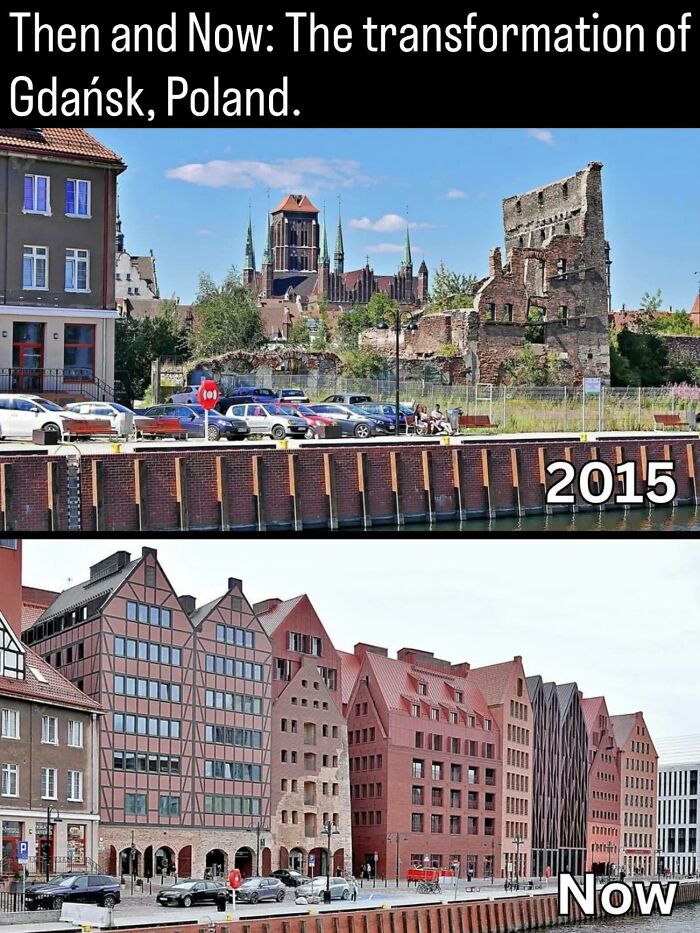 Gdańsk was one of the first major cities attacked in the Second World War, and by 1945 large parts of its historic center had been devastated by fighting, fires, and demolition.
Entire districts were left in ruins, including parts of the old waterfront and Granary Island, which had once been one of the richest trading zones in the Baltic.
For decades, some of these damaged areas remained empty lots, shattered walls, or partial ruins. Even in 2015, as the top image shows, fragments of old brick buildings still stood as reminders of the destruction.
The church towers in the background connected the modern city to its medieval past, but the foreground remained unfinished.
The newer image: the rebuilt waterfront uses architecture inspired by Gdańsk’s historic gabled merchant houses, blending modern construction with the city’s traditional silhouette.
This kind of redevelopment has been central to Gdańsk’s identity in the 21st century: not simply replacing what was lost, but trying to reconnect the city with its Hanseatic past while making the area livable again.
Added fact: Gdańsk was historically one of the most important ports in the Hanseatic League, a powerful medieval trade network that linked cities across northern Europe.
 Amazing photo here was taken during the launch of NASA’s Lunar Atmosphere and Dust Environment Explorer, better known as LADEE, from Wallops Flight Facility in Virginia on September 6, 2013.
As the Minotaur V rocket lifted away from Pad 0B, its exhaust and water-deluge system propelled a frog high into the air. A remotely operated camera captured the animal’s silhouette against the enormous cloud of smoke surrounding the launchpad.
The image initially looked so improbable that many people assumed it had been digitally altered. NASA’s photography team confirmed that the frog was real and appeared in a single frame taken by one of the remote cameras positioned near the rocket. NASA could not determine whether it survived.
Wallops Island contains extensive salt marshes, woodlands and wildlife habitat surrounding NASA’s relatively small operational area. Frogs and other animals are therefore commonly found near the facility. The frog may have been drawn toward the launchpad’s water-deluge pool, which stores water used to reduce acoustic energy and protect equipment during liftoff.
While the frog made the photograph famous, the rocket successfully delivered LADEE toward the Moon. The spacecraft later studied the Moon’s extremely thin atmosphere and examined how lunar dust behaves above its surface.
Added fact: Photographer Chris Perry’s camera was positioned roughly 150 feet from the rocket and activated automatically when a sound trigger detected the launch.
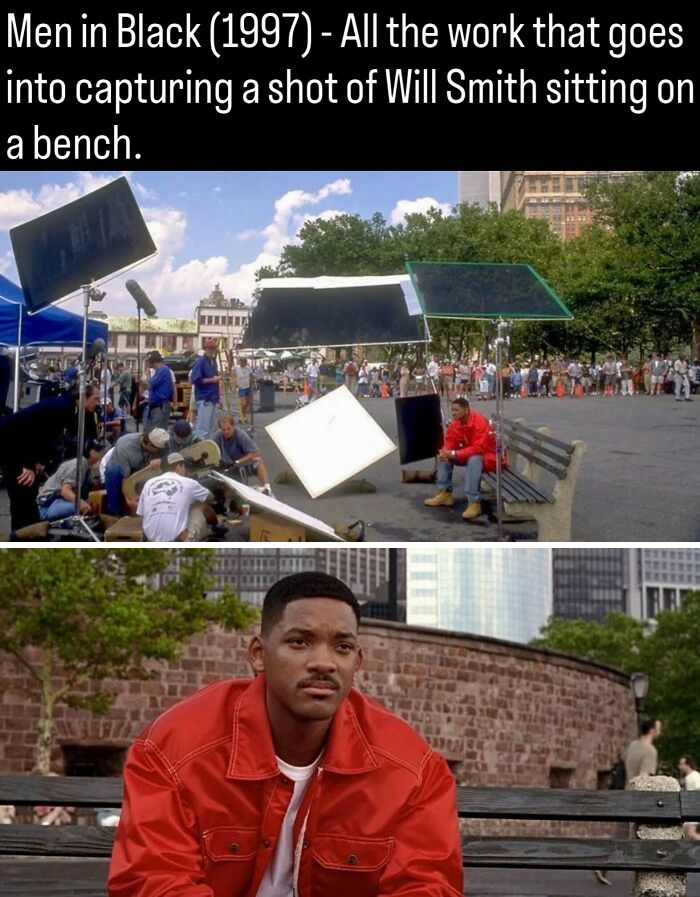 Director Barry Sonnenfeld specifically wanted the story set in New York because he joked that New Yorkers were uniquely capable of seeing something completely bizarre on the street and simply continuing with their day.
That attitude became part of the identity of Men in Black. The movie treats aliens, secret government agents and intergalactic disasters as if they are simply another layer of everyday New York life.
The finished shot looks almost effortless: Will Smith sitting alone on a park bench in New York. But pull the camera back and you see how much work went into making that “natural” image happen.
Around Smith are large bounce boards, reflectors, diffusion frames, flags and lighting equipment, with crew members positioned just outside the camera’s view. Instead of simply relying on the midday sun, the cinematography team could soften harsh overhead light, redirect sunlight onto Smith’s face and block unwanted reflections or shadows.
The goal wasn’t to make the scene look dramatically lit. It was to make carefully controlled lighting look like nothing had been done at all.
That illusion is one of the foundations of filmmaking. A few feet outside virtually any polished movie frame can be an organized mess of equipment, cables and dozens of people concentrating on details the audience is never supposed to notice.
Men in Black was filmed extensively around New York City, using recognizable locations throughout Manhattan while blending them with elaborate sets, practical effects and visual effects.
Added fact: Men in Black became one of the biggest films of 1997, earning nearly $590 million worldwide and winning the Academy Award for Best Makeup.
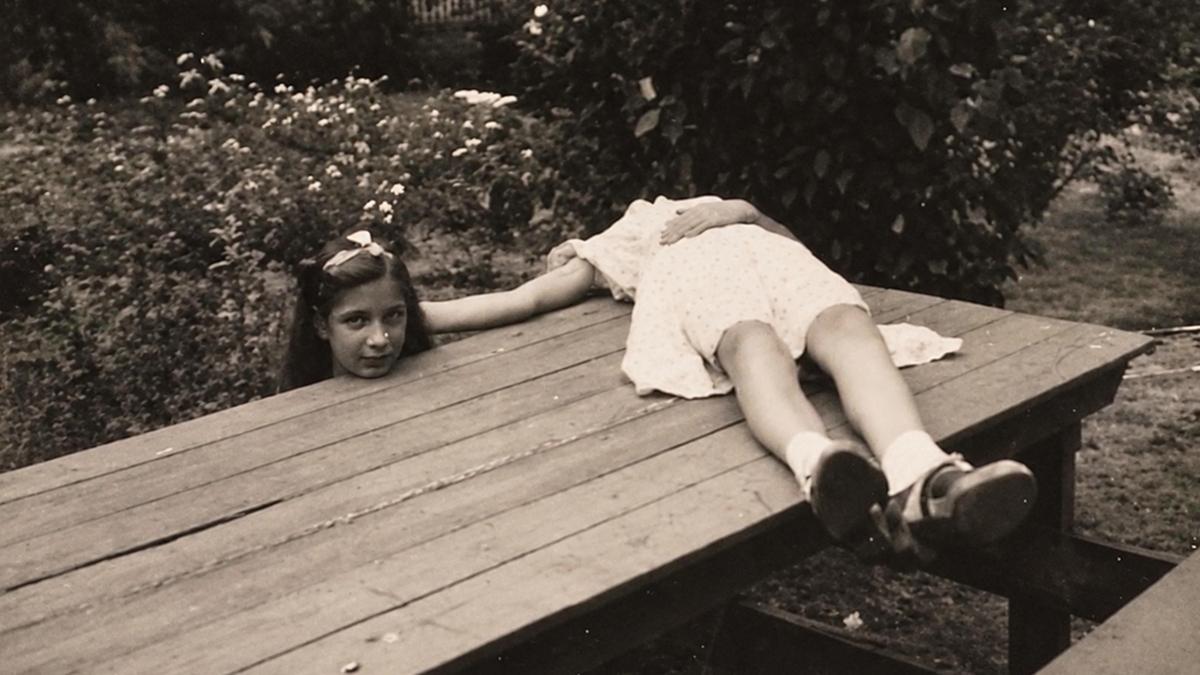
 Long before social media challenges, people were already coming up with bizarre ways to pose for photographs.
In the 1920s, one of them involved making it appear as though a person had been completely decapitated.
The trick usually required two people rather than photographic editing. One person positioned themselves so their head was hidden behind a table, bench, or other surface.
A second person concealed the rest of their body while leaving only their head visible nearby. From the camera’s fixed angle, the two people appeared to become a single person whose head had been removed and placed beside them.
What is especially interesting is that the idea of making people appear headless was already decades old.
Victorian photographers created elaborate “headless portraits” using darkroom techniques and combined negatives, sometimes showing people casually holding their own severed heads. The 1920s version essentially turned that elaborate photographic illusion into something ordinary people could recreate with friends and a camera.
There is also an important catch to the name. “Horsemaning” appears to be a later name applied to the old photographs, referencing the Headless Horseman in Washington Irving’s The Legend of Sleepy Hollow.
Added Fact: The Legend of Sleepy Hollow was published in 1820, meaning the character that eventually inspired the name was already roughly a century old when these photographs were being taken.
 Few automotive interiors capture the spirit of 1980s futurism quite like the 1985 Nissan 300ZX. At a time when digital technology was just beginning to shape everyday life, this cockpit felt like it had been pulled straight from a sci-fi film. The glowing green digital gauges, electronic voice warnings, and driver-focused layout weren’t just flashy, they represented a bold shift toward the idea that cars could be both performance machines and technological showcases.
The 300ZX, part of Nissan’s legendary Z-car lineage, was built during an era when manufacturers competed not only on speed and handling but on innovation. Its digital instrument cluster was considered cutting-edge, using LED and LCD technology to present speed, RPMs, fuel levels, and performance data in ways that felt revolutionary for drivers accustomed to analog dials.
Beyond style, the car helped redefine Japanese sports cars globally, proving they could rival European and American performance vehicles while offering reliability and advanced electronics.
Added fact: The Z31 generation 300ZX was one of the first production sports cars to offer a factory turbocharged engine paired with advanced onboard diagnostics, helping pave the way for the tech-heavy performance cars that dominate today’s automotive world.
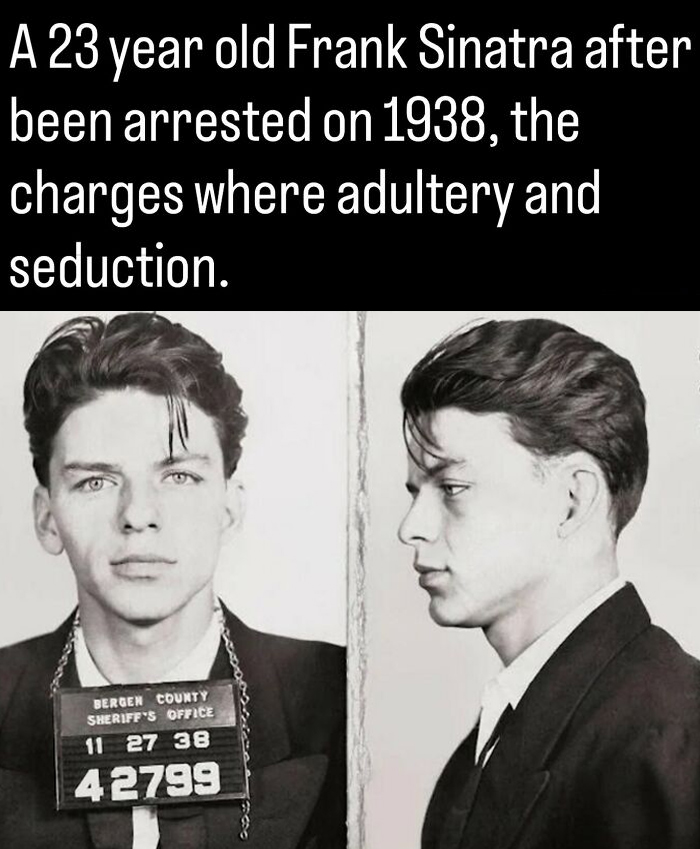 Sinatra was still an unknown local singer when this mugshot was taken by the Bergen County Sheriff’s Office in New Jersey on November 27, 1938. Technically, he was 22 and only two weeks away from his 23rd birthday.
The original charge was “seduction,” an offense that sounds bizarre today but existed under New Jersey law at the time.
Sinatra was accused of having a relationship with an unmarried woman “of good repute” after allegedly promising to marry her. In an era when a woman’s history could seriously affect her social standing and marriage prospects, some states treated obtaining consent through a false promise of marriage as a crime.
Sinatra was arrested and released after posting a $1,500 bond. The seduction charge could not stand after authorities learned that the woman was already married. Prosecutors then replaced it with an adultery charge, which was also eventually dismissed. Sinatra was never convicted in the case.
At the time, he was singing at small clubs and working to escape the limited opportunities of his hometown of Hoboken. Within a few years, he would become one of America’s first modern pop superstars, inspiring scenes of teenage hysteria long before Elvis Presley or the Beatles.
Added Fact: Less than four months after the adultery case was dismissed, bandleader Harry James hired Sinatra as a featured vocalist, giving him his first major break in the music industry.
 Known as “The Meteor,” this enormous mass was recovered from the ruins of the World Trade Center following the September 11, 2001, terrorist attacks. It consists of building materials and everyday objects crushed and fused together as the towers collapsed.
The description that it represents approximately four to five floors should not be interpreted as four complete floors preserved in their original order. Instead, the tremendous weight and force of the collapsing structures compacted sections of concrete, steel, reinforcing bars, office contents and other debris into a single dense mass.
Temperatures remained extremely high in portions of the debris pile for weeks after the attacks. Combined with pressure from hundreds of thousands of tons of wreckage, those conditions transformed recognizable parts of the buildings into formations unlike anything normally produced by a structural collapse.
Its rounded, rocklike appearance led recovery workers to compare it to an object that had fallen from space, earning it the nickname “The Meteor.” Seen up close, however, pieces of twisted metal and other materials remain visible throughout its surface.
Rather than representing one identifiable office or location, the mass preserves fragments of numerous spaces and objects that were violently brought together during the destruction of the towers.
Added Fact: Investigators and museum conservators often call formations like this “composites” because they contain multiple kinds of material—including steel, concrete, glass and objects from the offices—compressed into a single mass.
 Buffalo Central Terminal opened in 1929 as one of the grandest railroad stations in the United States. Its soaring 17-story office tower, enormous arched concourse and Art Deco interiors were designed to present Buffalo as a modern city with a prosperous future.
At its busiest during World War II, the terminal was filled with soldiers, families and workers traveling across the country. More than 150 trains reportedly passed through each day during the war years. The 1945 photograph captures that peak: a powerful New York Central locomotive approaching a station that served as one of the most important transportation hubs in the region.
But the terminal opened only months before the stock market crash of 1929. In the decades that followed, automobiles and commercial aviation steadily replaced long-distance passenger trains. The building was also several miles from downtown, making it less convenient as Buffalo’s population and travel patterns changed.
The final passenger train departed in 1979. Much of the complex was subsequently abandoned, stripped and exposed to decades of harsh Buffalo weather. Yet the terminal survived. Preservation groups eventually secured the property, and major stabilization and redevelopment work is now underway to give the landmark a new purpose.
Added fact: The terminal’s original concourse clock disappeared after the station closed but was recovered and returned to Buffalo in 2004.
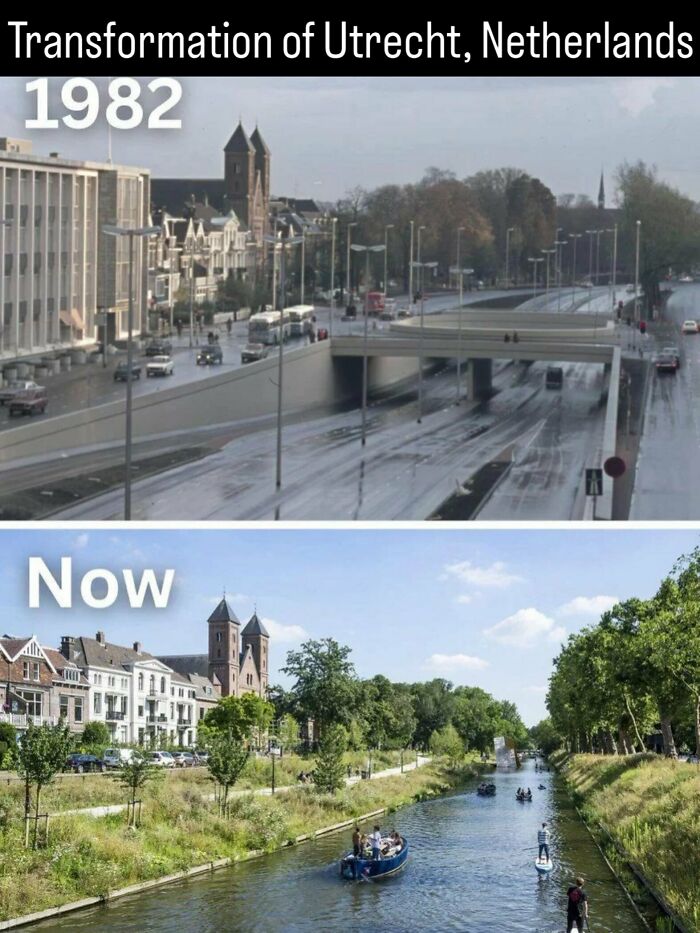 In 1982, this part of central Utrecht looked completely different.
A section of the city’s historic canal had been drained and replaced by a major roadway called the Catharijnebaan, reflecting a postwar planning philosophy that prioritized cars and traffic flow through city centers.
The waterway had a much older history. Utrecht’s defensive canal system dates back roughly 900 years, to around the time the city received its city rights in 1122.
By the 20th century, however, planners were considering turning much of the canal ring into roads. Beginning around 1969, part of the Catharijnesingel was drained, and by the 1970s cars were traveling where boats had once passed.
Eventually, Utrecht reversed course. Residents supported restoring the canal in a 2002 referendum, and over the following years the roadway was removed, the channel was excavated again and green public space was created along the water.
In September 2020, the final restored section officially reopened, allowing boats to travel around Utrecht’s historic canal ring again for the first time in roughly half a century.
Added fact: Plans drawn up in 1958 were even more dramatic and contemplated filling in much more of Utrecht’s canal system to create roads. The survival of much of the historic canal ring helped make the later restoration possible.
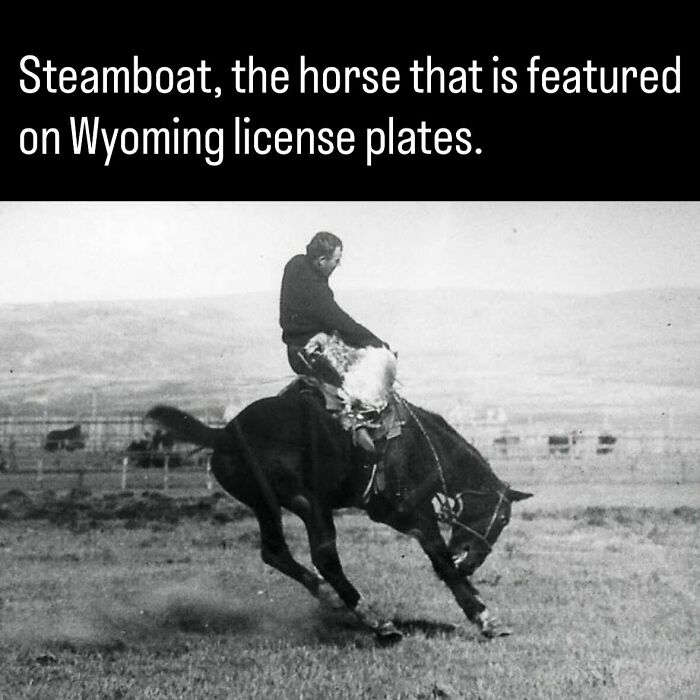 Steamboat was a celebrated bucking horse from the American West whose image would come to symbolize a regional ideal of untamed strength and independence.
Photographs of the animal in full motion capture more than a single animal at work. They preserve an era when the horse was central to ranch life and to a public imagination that prized rugged individualism.
The rider in this image is small against the animal’s energy and the open landscape. The visible fence and distant cattle remind us that this was not a staged studio scene but a working ranch where stock and people shared a daily rhythm shaped by weather and seasons. Over time Steamboat moved beyond lived reality to become an emblem. His silhouette was eventually stylized into an enduring state symbol.
That transformation from creature to icon shows how communities turn specific material experiences into myth. Photographs like this one helped fix a particular image of the West in national memory at a moment when modernity was reshaping rural life.
Added fact: The cowboy and bucking horse motif later became an officially recognized emblem on Wyoming license plates and is often called the most photographed horse in American history.
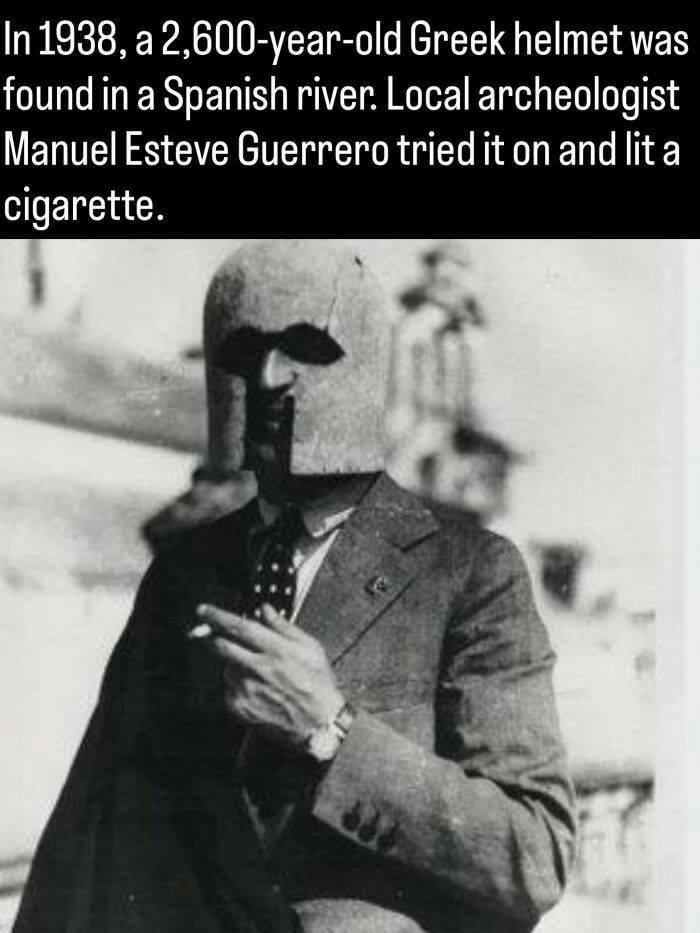 The helmet turned up near the Guadalete River outside Jerez de la Frontera in southern Spain. It was hammered from a single sheet of bronze and dates to around the 7th century BC, making it one of the oldest Greek objects ever found in Western Europe.
The name “Corinthian” describes the helmet’s style, not where it was made. This design covered almost the entire face, leaving only narrow openings for the eyes and mouth.
How it ended up so far from Greece is still a mystery. A hole in its side was once blamed on battle damage, but some researchers now think it may have been a ritual offering to river gods, much like helmets left at Greek temples.
Esteve, a young librarian who also served as the town’s archaeologist, made sure the find went into Jerez’s archaeological collection.
This photo was taken outside the town’s old library. It was clearly meant as a joke, and no archaeologist would be allowed to do something like this today.
It was never officially published and sat in the museum archives for decades.
Added fact: The helmet is now one of the highlights of the Archaeological Museum of Jerez de la Frontera.
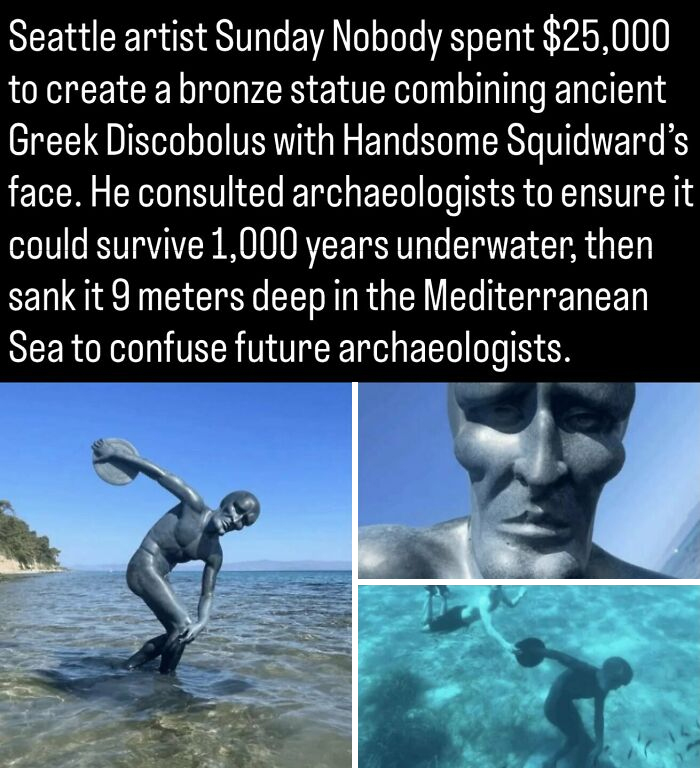 The project is one of the more unusual intersections of classical art, internet culture, and conceptual sculpture in recent years.
By blending the famous Discobolus (Discus Thrower), one of the best-known surviving examples of ancient Greek athletic sculpture, with the exaggerated facial features of “Handsome Squidward” from SpongeBob SquarePants, the artist intentionally blurred the line between serious archaeology and modern satire.
Rather than displaying the sculpture in a gallery, Sunday Nobody had it cast in bronze and deliberately placed it beneath the Mediterranean Sea.
Bronze was chosen because it has been used for monumental sculpture for thousands of years and can survive underwater for centuries, developing a natural patina that makes it resemble genuine ancient artifacts.
The idea was to create an object that, if discovered in the distant future without any surviving historical records, might raise fascinating questions about the civilization that created it.
Although the project was conceived as an artistic experiment rather than an actual attempt to deceive archaeologists, it highlights how much context matters in archaeology. Artifacts are rarely interpreted in isolation.
Their surrounding sediments, nearby objects, manufacturing techniques, and chemical composition all help researchers determine authenticity and age. Without that context, even experienced experts can be misled by appearances alone.
Added fact: The original Discobolus was sculpted by the Greek artist Myron around 450 BC, but the famous version seen in museums today is actually a Roman marble copy. The original bronze statue has been lost, making Roman copies invaluable for understanding one of the masterpieces of Classical Greek art.
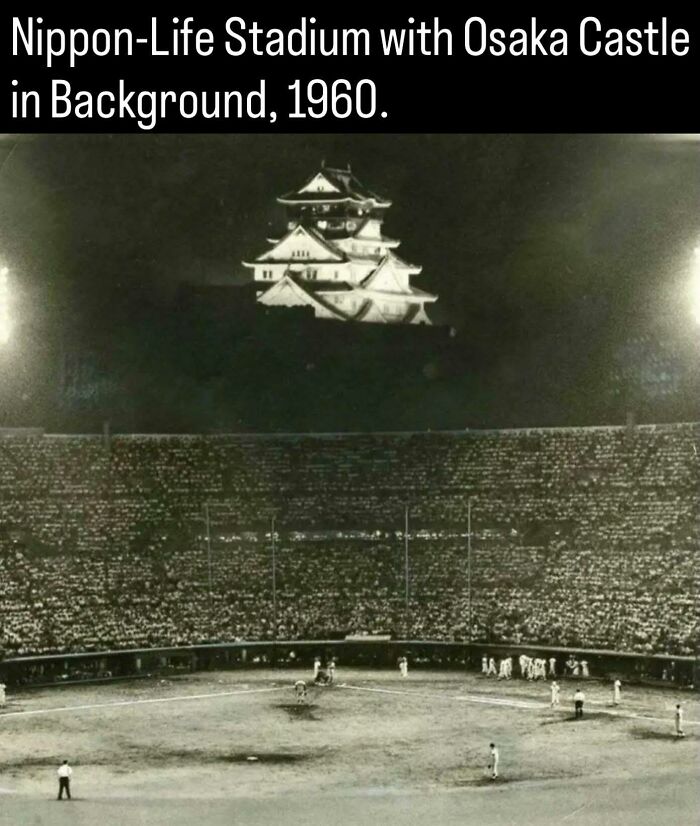 A stunning backdrop. Nippon Life Stadium opened in 1950 and became one of Osaka’s great postwar baseball venues.
For decades, it hosted the Kintetsu Buffaloes and put thousands of fans beneath one of the strangest backdrops in sports.
Above the outfield stood Osaka Castle. The original castle was built in the late 1500s by Toyotomi Hideyoshi, one of Japan’s great unifiers, though the tower seen today is a 1931 reconstruction.
That contrast is the whole (beautiful) image: postwar baseball under floodlights, framed by a symbol of samurai age power.
Added fact: Nippon Life Stadium was closed in 1997 and demolished soon after.
 Hidden inside a narrow compartment above the ship’s rudder, the four men began an extraordinary and extremely dangerous journey across the Atlantic Ocean. They had brought limited food and water, but their supplies reportedly ran out around the tenth day. For the final stretch, they survived by drinking seawater as powerful waves crashed only a few feet beneath them.
The men had no control over the ship’s destination and little sense of where it was taking them. They believed they were traveling toward Europe. Instead, after approximately two weeks and 3,500 miles, the Ken Wave reached the Brazilian port of Vitória.
Brazilian authorities discovered the men crouched above the rudder and carefully brought them to safety. Photographs of the rescue showed officials handing water to the exhausted stowaways from a nearby boat. All four were taken for medical treatment and were reported to be in stable condition.
Their survival was remarkable. Rudder compartments offer almost no protection from rough seas, mechanical movement, exposure or falls. Two of the men eventually returned to Nigeria, while the other two reportedly applied for asylum in Brazil.
Added fact: To keep themselves from being swept into the Atlantic, the men reportedly tied themselves to the ship and stretched netting around the rudder area.

There is a story of Australian Aboriginal men escaping from F***y Bay Gaol in Darwin by clinging to the rudder of a passing ship. On reaching the next port, the survivors (one didn't make it) were immediately acquitted on the grounds that the conditions they endured during their escape were far worse than if they had simply stayed out their sentences in gaol.
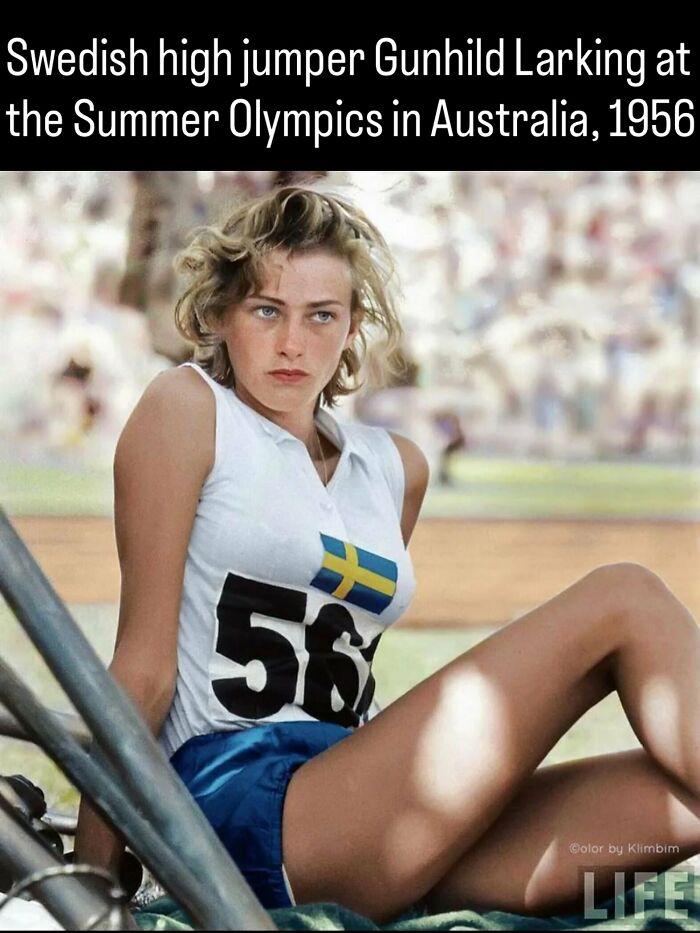 Gunhild Larking was only 20 years old when she represented Sweden at the 1956 Summer Olympics in Melbourne. The competition was already her second Olympic appearance: four years earlier, at just 16, she had finished ninth at the Helsinki Games.
In Melbourne, Larking advanced through the qualifying round by clearing 1.58 meters. During the final, she cleared 1.67 meters (approximately 5 feet 5¾ inches) matching the best jump of her career. She narrowly missed the podium and finished fourth based on the number of attempts required to clear the earlier heights. American athlete Mildred McDaniel won gold after clearing 1.76 meters and setting a new world record.
Larking was one of Sweden’s leading female athletes of the 1950s. She won five consecutive Swedish national high-jump championships between 1952 and 1956 and also finished fourth at the 1954 European Athletics Championships in Bern.
Athletes at the time competed on cinder tracks, and high jumpers landed in pits filled with sand or sawdust rather than the thick foam mats used today. Competitors also relied on techniques that predated the revolutionary Fosbury Flop.
Added Fact: LIFE magazine photographer George Silk photographed Larking throughout the Melbourne Olympics. One of his images became internationally famous after appearing in the magazine’s Christmas issue, and Larking subsequently received offers to work as a model.
 It looks like something from a horror movie, but there was a very practical problem behind early beekeeping protection: how do you work around thousands of defensive insects without getting stung repeatedly in the face?
Beekeeping was already an important part of European rural life during the Middle Ages. Honey was one of the major sweeteners available before refined sugar became widely accessible, while beeswax was especially valuable for candles, religious use and household work.
Medieval beekeepers commonly kept colonies in skeps, dome-shaped hives traditionally made from woven straw or similar materials. Unlike modern wooden hives with removable frames, inspecting and harvesting from a skep could put the beekeeper into extremely close contact with the colony. Smoke was therefore an important tool for calming bees, while clothing could provide additional protection.
The dramatic wicker-faced clothing seen here is a modern interpretation of historical protective gear rather than something we can confidently say every medieval beekeeper wore. Surviving medieval illustrations show that clothing and equipment varied considerably across centuries and regions.
Still, the basic concept behind the look makes perfect sense: heavy fabric protects the body, while a barrier keeps bees away from the eyes and face.
Added fact: Medieval beekeeping illustrations survive from as early as the 11th century, giving historians a surprisingly long visual record of how Europeans handled and harvested honeybee colonies.
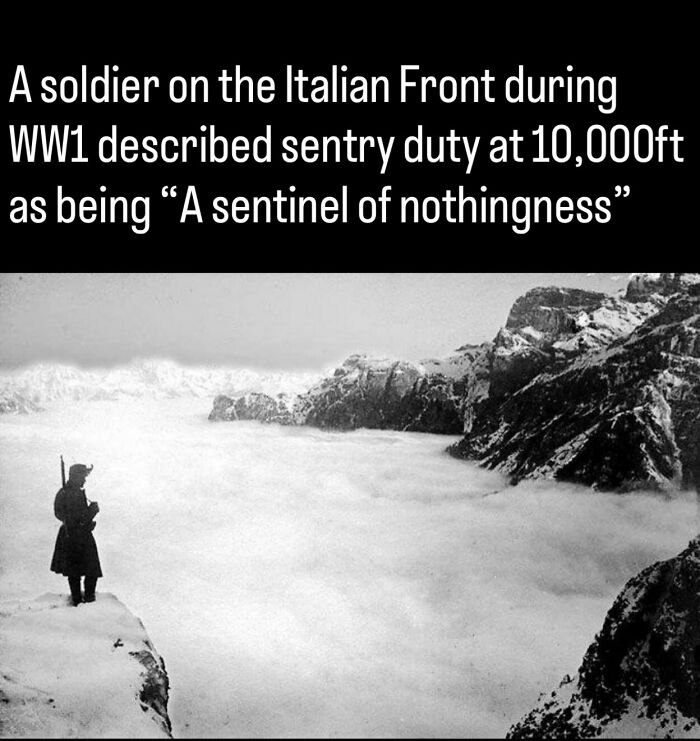 When Italy entered World War I in 1915, its front with Austria-Hungary ran through some of Europe’s harshest mountain terrain. In the Alps, troops fought and stood watch on ridges and passes thousands of meters above sea level. At those heights, the cold, storms, thin air and risk of avalanches could be as dangerous as enemy fire.
Armies built paths, shelters and supply lines across the mountains, hauling food, ammunition and artillery into positions that were difficult to reach even in good weather. Soldiers might spend long stretches isolated at exposed posts, watching a landscape where the weather could close in and movement could become impossible.
A diary entry from May 28, 1916, by a soldier identified as C.D. from Italy’s Trentino region describes a storm at Cercen Pass, snow on the highest peaks and the soldiers’ longing for peace. It gives a glimpse of the exhaustion behind the dramatic mountain scenery: the men were not only fighting an opposing army, but enduring a landscape that could make every day a struggle to survive.
Added fact: National Geographic reported that fighting in the “White War” reached elevations of about 12,000 feet (3,600 meters), with temperatures dropping as low as −22°F (−30°C).
 After 26 years of smoking, Ibrahim Yücel decided that willpower alone was no longer enough.
The 42-year-old from Kütahya, Turkey, had been smoking roughly two packs of cigarettes a day and said he had tried quitting dozens of times. He would stop on important occasions such as his wedding anniversary or his children’s birthdays, only to begin smoking again a few days later.
Then his father died from lung cancer.
The loss frightened Yücel enough that he came up with an extreme solution: he built a cage shaped roughly like a motorcycle helmet and locked it around his own head. The openings were reportedly small enough that he could drink through a straw, but not large enough to easily put a cigarette in his mouth.
Each morning, Yücel would lock the cage and hand the key to his wife, Kevser. She initially disliked the idea and found it embarrassing, but eventually agreed because she wanted him to stop smoking. She would unlock it when he needed to eat. His teenage daughter also supported the attempt after watching her grandfather d*e from lung cancer.
Added fact: Before putting on the cage, Yücel reportedly swore on the Quran that he was serious about giving up cigarettes, making the device part of a much larger personal commitment to quit.
 The growth of remote astronomy has transformed amateur astrophotography. Facilities like these are typically located in areas with very dark skies, dry air and lots of clear nights, far from the glow of any city.
This one appears to be Starfront Observatories in Coleman County, Texas, which opened in 2024. Customers ship their telescopes to the site, and the staff installs them on fixed mounts inside long buildings with roll-off roofs. When it gets dark, the roofs slide open automatically. At dawn or when bad weather moves in, they close again.
Owners control everything over the internet. From a laptop at home, they can point the telescope, run the camera all night and download the images the next morning. The site handles power, security, repairs and a fast fiber connection, since a single telescope can produce hundreds of gigabytes of images in one night.
It has grown fast. The site reportedly gets more than 220 clear nights a year and now hosts over 600 telescopes, with prices starting at around $99 a month. Not long ago, remote hosting like this could cost thousands.
Added fact: Light pollution is the reason places like this exist. A 2016 study found that nearly 80% of people in North America can no longer see the Milky Way from where they live.
Wow. I've seen pictures of groups of remotely operated reasonably large optical telescopes for hire, but nothing even remotely like this. Users can download their results to the AAVSO website, which does good work that professional astronomers can use. PS. Even with major light pollution, some results are possible (using stacking), my nephew managed to photograph an asteroid with a telescope set up in Times Square.
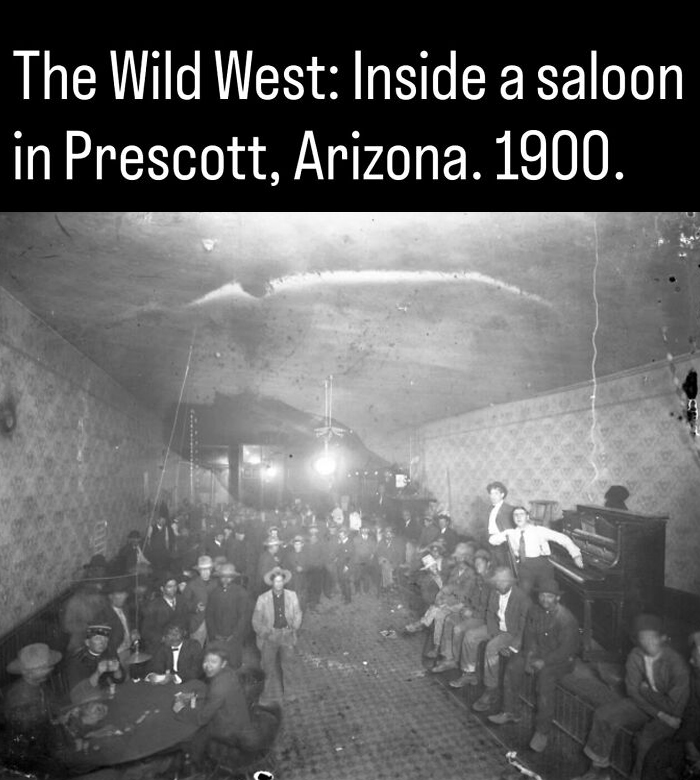 By 1900, Prescott was one of the most established towns in the Arizona Territory. Founded in 1864, it had served as the territorial capital and developed into an important center for mining, ranching, government and trade.
Its most famous entertainment district was Whiskey Row, a stretch of Montezuma Street packed with saloons, gambling rooms, hotels and other businesses. At its height, the district reportedly contained more than 40 saloons standing near one another.
The crowded room in this photograph offers a less romanticized view of saloon life than Hollywood later created. Patrons sit shoulder to shoulder beneath electric lights, while card games, drinking and conversation fill the narrow interior. A pianist stands against the wall, providing entertainment in an era before radio or recorded music became common.
Saloons functioned as more than places to drink. In Western towns, they could serve as informal meeting halls, gambling establishments, employment exchanges and gathering places where miners, ranchers, railroad workers, businessmen and travelers mixed.
Yet this world was also changing rapidly. Prescott already had rail connections, electric lighting and an increasingly permanent downtown. The frontier was not vanishing overnight, but it was steadily becoming part of modern America.
Added Fact: On July 14, 1900, a massive fire destroyed five blocks of Prescott, including most of Whiskey Row. Patrons reportedly carried the Palace Saloon’s wooden bar and liquor across the street before the flames reached it.
 Long before curved ultrawide displays and virtual-reality headsets became widely available, serious flight-simulation enthusiasts built elaborate home cockpits using multiple computers and bulky CRT monitors.
This photograph, dated March 2, 2002, shows an especially ambitious setup designed to surround its operator with outside views, cockpit instruments, navigation displays, and aircraft controls.
Each monitor appears to perform a different role. The larger screens provide views through the aircraft’s windows, while the smaller central displays show instruments and control panels. Several computer towers beneath the desk were likely needed because one consumer PC of the era could not smoothly render all those independent views at once. Specialized programs such as WidevieW allowed separate computers running Microsoft Flight Simulator to communicate over a local network and remain synchronized. Similar installations from this period used numerous monitors and networked PCs to create a panoramic field of vision.
The system would have required considerable patience, technical knowledge, wiring, desk space, and electricity. Every CRT was deep, heavy, and capable of producing a substantial amount of heat. Despite its improvised appearance, the basic concept remains familiar today: dedicate different screens to the scenery, flight instruments, navigation systems, and aircraft controls to make a home simulator feel more like a genuine cockpit.
Added fact: The setup was later expanded. A surviving 2003 discussion described an upgraded version containing 13 monitors and nine networked computers, showing how quickly this already enormous simulator continued to grow.
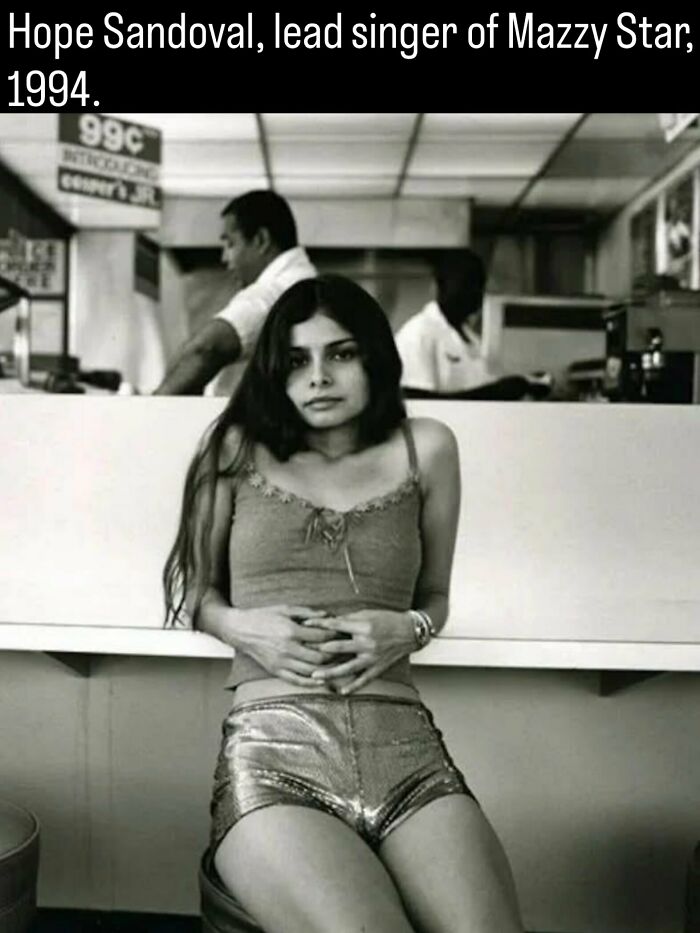 By 1994, Hope Sandoval had become one of alternative rock’s most recognizable voices, though she rarely sought the spotlight. As the lead singer of Mazzy Star, her haunting vocals and understated stage presence helped define the dream pop and psychedelic folk sound that emerged in the early 1990s. Unlike many artists of the era, Sandoval avoided celebrity culture, granting few interviews and often performing with dim lighting that kept much of the band’s attention on the music rather than the performers.
Mazzy Star’s breakthrough came with the release of “Fade Into You” in 1993. The song became an international hit, reaching the Billboard Hot 100 and introducing the band’s atmospheric style to mainstream audiences. Although the group released relatively few albums, its music has remained influential, inspiring generations of indie, shoegaze, and alternative musicians.
Sandoval has continued recording with Mazzy Star and other musical projects while maintaining the privacy that has become one of her defining characteristics.
Added Fact: Despite “Fade Into You” becoming one of the most enduring alternative songs of the 1990s, Mazzy Star never won a Grammy Award. The song has continued to gain new audiences through film, television, streaming platforms, and social media, making it the band’s signature recording more than three decades after its release.
I heard a radio announcer say "and that is Fade into You by Mazzy Star isn't she a wonderful singer" (or words to that effect) Wound me right up...
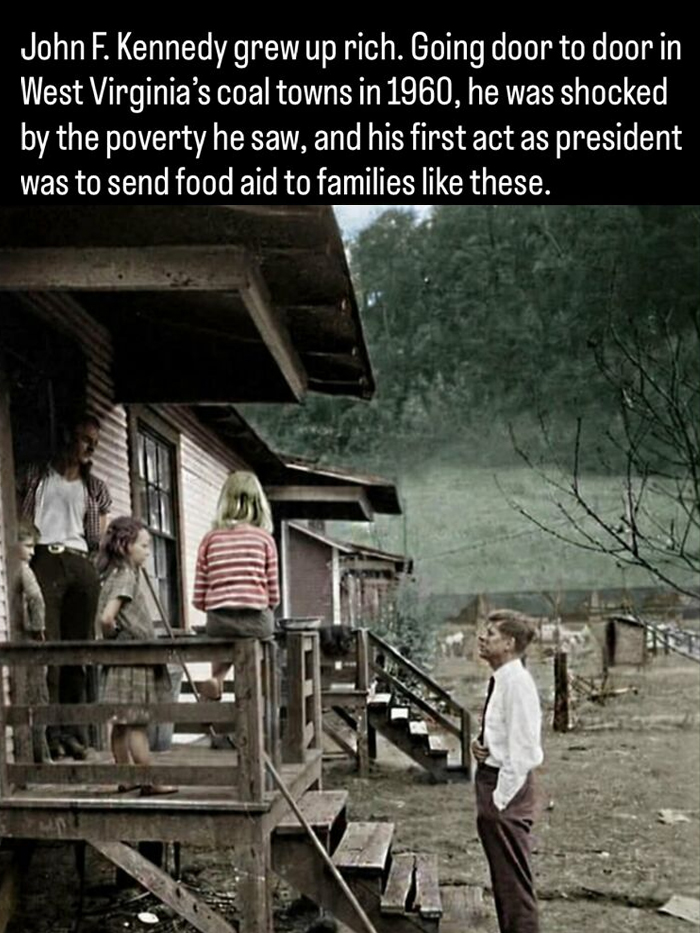 The West Virginia primary on May 10, 1960, was one of the most important moments of Kennedy’s run for president. No Catholic had ever been elected to the White House, and many Democratic leaders doubted one could win. West Virginia was about 95% Protestant, so it became the test.
Kennedy spent weeks traveling through the state’s small towns and coal camps, shaking hands at mine entrances, talking to families on their porches and going down into a mine himself. He took the religion question head on, telling voters that nobody had asked about his faith when he served in the Navy during World War II.
The trip also changed him. He saw unemployed miners, hungry children and families living on government surplus food like flour and cornmeal. Journalist Theodore White, who followed the campaign, wrote that Kennedy told an aide one night, “Imagine, just imagine kids who never drink milk.”
He won the primary in a landslide, taking about 61% of the vote over Senator Hubert Humphrey, who dropped out of the race that night. On his second day as president, Kennedy signed his first executive order, expanding food aid for needy families. A few months later, the first food stamps of the new program went to an unemployed miner with 13 children in McDowell County, West Virginia.
Added fact: Kennedy returned to West Virginia in June 1963 for the state’s 100th birthday. Speaking in the pouring rain in Charleston, he told the crowd, “The sun does not always shine in West Virginia, but the people always do.”
 In the late 1880s, rural Ireland was gripped by the Irish Land War, a bitter struggle between tenant farmers and landlords. Families like the O’Hallorans lived on land they did not own, paying rent to absentee landlords, often English, while surviving on marginal incomes. When crops failed or rents rose, eviction followed swiftly. In 1887, the O’Halloran family faced removal after falling behind on rent, a fate shared by tens of thousands of Irish tenants during that decade.
What made this case remarkable was the response. When officers arrived to carry out the eviction, the O’Halloran sisters physically resisted. They blocked doorways, confronted bailiffs, and used whatever was at hand, sticks, stones, and sheer determination, to delay the process and draw attention to their cause. Their defiance became a local symbol of resistance, echoing tactics encouraged by land reform activists who believed public confrontation could shame landlords and halt evictions.
Colorized by: @sannadullaway
Added fact: During the height of the Irish Land War, over 15,000 evictions were carried out between 1879 and 1889. Acts like the O’Halloran sisters’ resistance helped build momentum that eventually led to the Land Purchase Acts, which allowed many tenant families to buy the land they worked, fundamentally reshaping rural Ireland.
 When Raiders of the Lost Ark came out in 1981, it was already designed to feel like a throwback.
The film is set in 1936, with Indiana Jones chasing ancient relics in a world of old airplanes, desert dig sites, military uniforms, secret maps, and prewar danger. To audiences at the time, 1936 felt like deep cinematic history.
But now the distance has flipped.
The gap between 1936 and 1981 is the same as the gap between 1981 and 2026. That means Raiders is now as old to us as the world it was recreating was to the people who first saw it in theaters.
That is what makes this so strange. The movie still feels modern in the way blockbusters do. It moves fast, looks huge, and basically created the template for decades of adventure films.
But on the calendar, it has crossed into the same kind of nostalgic distance it was originally built to imitate.
Indiana Jones was chasing lost history. Now Raiders is becoming part of it.
Added fact: Harrison Ford was about 38 when Raiders of the Lost Ark was filmed, while the character Indiana Jones is generally treated as being in his late 30s during the events of the movie.
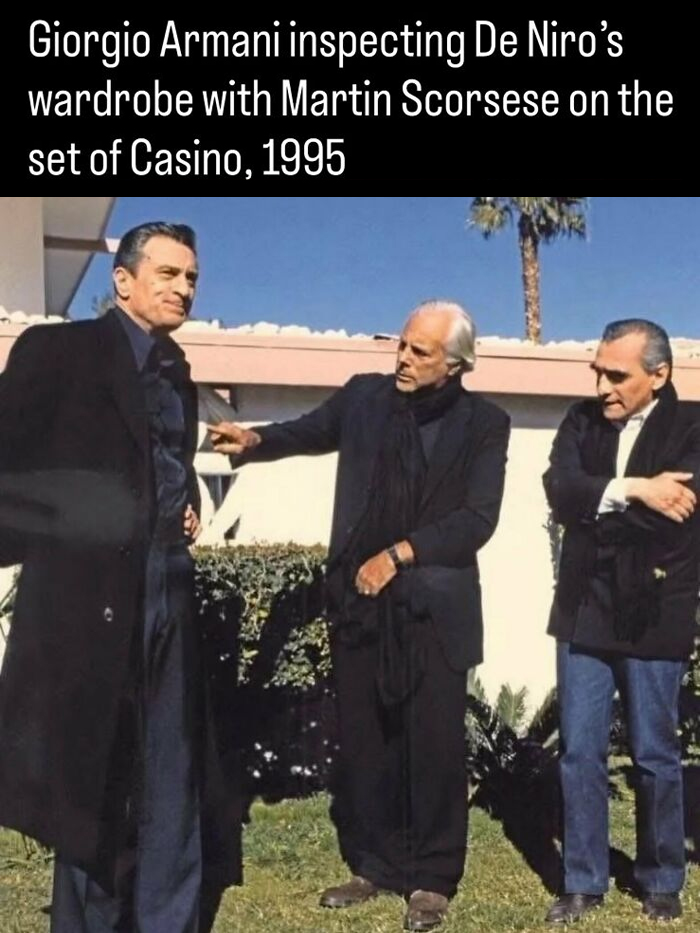 One of the reasons Casino looks so polished is that the clothing was treated almost like another character in the film.
Robert De Niro’s Sam “Ace” Rothstein moves through Las Vegas in a series of carefully coordinated suits, shirts, ties, and accessories that reflect both his wealth and his obsession with control.
Giorgio Armani was closely associated with the film’s wardrobe, and his influence fit perfectly with the world Scorsese was recreating. The clothes needed to feel expensive, precise, and unmistakably tied to the flashy Las Vegas of the 1970s and early 1980s.
De Niro reportedly wore dozens of different outfits throughout the movie, many of them built around bold color combinations that would look excessive almost anywhere else. In Casino, that excess is the point.
Rothstein is a man who wants every detail managed, from the casino floor to the way he dresses.
Scorsese also used wardrobe to separate his characters visually. De Niro’s clothing is controlled and immaculate, while Joe Pesci’s Nicky Santoro gradually becomes more aggressive and less refined as the film progresses.
Added Fact: Costume designers Rita Ryack and John Dunn created hundreds of costumes for Casino, and De Niro alone reportedly had around 70 different costume changes during the film.
 The Vietnam War was not only fought against an enemy. It was fought against the jungle itself.
American soldiers moved through heat, monsoon rain, mud, leeches, mosquitoes, snakes, spiders, and insects that seemed almost unreal to men who had grown up far from Southeast Asia.
Photos like this became part of the unofficial record of the war because they showed the daily environment in a way combat reports could not.
The centipede in the image was likely a giant tropical centipede, the kind found across Southeast Asia.
These animals can grow more than a foot long, move quickly, and deliver a painful venomous bite. For troops sleeping on the ground, marching through dense vegetation, or digging into wet terrain, creatures like this were not curiosities. They were part of the constant stress of jungle warfare.
That is what makes the photo so striking. It is not a battlefield scene, but it still explains something about the war. Even when no one was shooting, the jungle never really left soldiers alone.
Added fact: During the Vietnam War, disease and environmental hazards were a major problem for troops. Malaria, jungle rot, infected wounds, leeches, and venomous animals were constant threats in the field.
 For more than fifteen centuries, the papacy in Rome and Japan’s imperial institution developed at opposite ends of Eurasia without a reigning pope ever meeting a reigning Japanese emperor. That changed on February 24, 1981, when Pope John Paul II met Emperor Hirohito at the Imperial Palace in Tokyo during the first papal visit to Japan.
The striking “1,528 years” figure comes from counting the historically documented Japanese imperial line from roughly 453, during the reign traditionally attributed to Emperor Ankō, until the 1981 meeting. The precise number depends on where historians begin the reliably recorded imperial succession. Japan’s traditional chronology stretches much further back, to the legendary Emperor Jimmu in 660 B.C., while the papacy traces its origins to Saint Peter in the first century. For that reason, the figure is best understood as a fascinating historical calculation rather than an exact, universally accepted measurement.
John Paul II’s four-day journey carried enormous symbolic weight. Christianity had reached Japan through Jesuit missionary Francis Xavier in 1549, but later rulers outlawed the faith and subjected Japanese Christians to centuries of persecution. Diplomatic relations between Japan and the Holy See were eventually established in the 20th century. The 1981 encounter therefore represented not merely two leaders meeting, but the convergence of two institutions whose histories stretched back across vastly different cultures and civilizations.
Added fact:
Hirohito had previously met Pope Benedict XV at the Vatican in 1921, but he was still Japan’s crown prince rather than its reigning emperor.
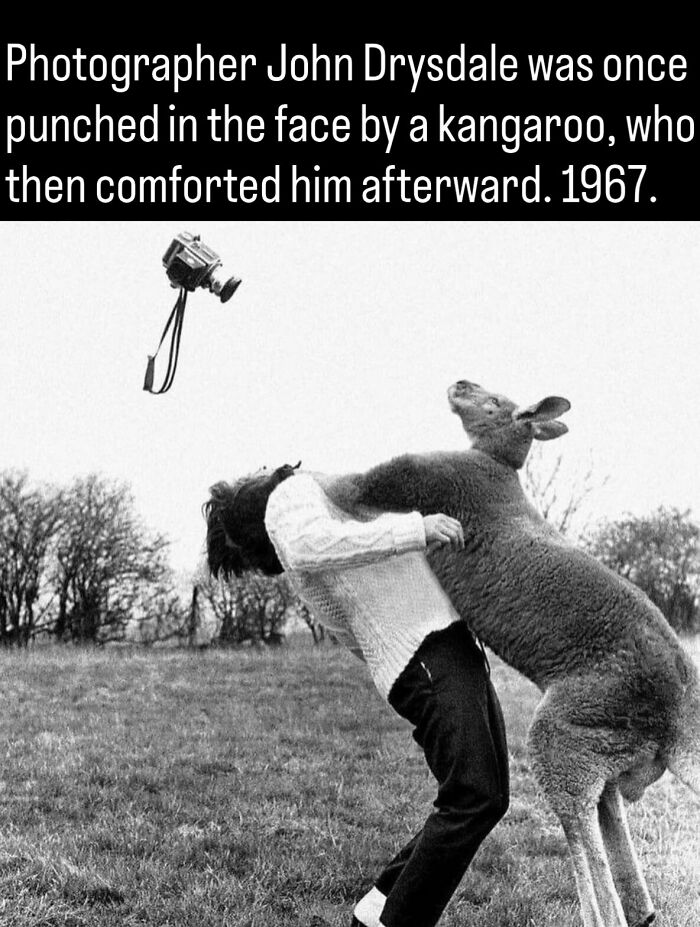 British photographer John Drysdale became known for capturing wonderfully strange moments between people and animals, and this sequence remains one of his most memorable. While photographing a kangaroo in England, Drysdale moved close enough for the animal to rise on its hind legs and lunge toward him. One image catches the instant of impact, with Drysdale bending backward as his camera flies from his hands.
What happened next transformed an amusing action photograph into something far more endearing. In the following images, the kangaroo appears to calm down, approach the fallen photographer and place its paws around him as though offering an apology. The sequence looks almost too perfectly timed to be real, resembling a scene from a silent comedy.
Drysdale specialized in photographing animals in playful, unexpectedly human situations. Rather than concentrating only on wildlife in its natural habitat, he often created images that emphasized affection, curiosity and humor. His photographs featured children interacting with elephants, dogs, chimpanzees, donkeys and other animals, frequently making the animals appear like characters with personalities of their own.
Whether the “comforting” gesture was genuine affection or simply another moment of animal curiosity, Drysdale’s camera turned the encounter into an unforgettable visual story.
Added Fact: Drysdale was born in Uganda and later received recognition from both the British Press Pictures of the Year and World Press Photo.
Comment. That's a male red kangaroo. Funny that this photo was taken in England.
 Suspended from the ceiling like a metallic rainstorm, tens of thousands of small steel tags glint in the light, each one etched with a name, a number, and a date that marks a life cut short. This installation is made up of replica dog tags, one for every American soldier who never made it home from the Vietnam War.
Seen from below, the display forms a heavy, rippling canopy, an ocean of memory frozen midair. Visitors describe hearing the faint sound of the tags brushing against one another, like distant wind chimes. That sound, gentle yet constant, mirrors the endless echo of a conflict that left deep scars on both sides of the Pacific.
Each tag represents more than data; it’s a story that ended far from home. The installation transforms the language of war (serial numbers, metal, uniformity) into a chorus of remembrance. In their silence, the tags speak of sacrifice, confusion, and the long shadow of a generation’s loss.
Added Fact: The installation, titled Above and Beyond, hangs in the National Veterans Art Museum in Chicago. It includes over 58,000 replica tags, one for each American soldier k****d or missing in action during the Vietnam War. When the museum first opened, visitors were greeted by the soft, echoing ring of metal, a sound that made many pause before taking their next step.
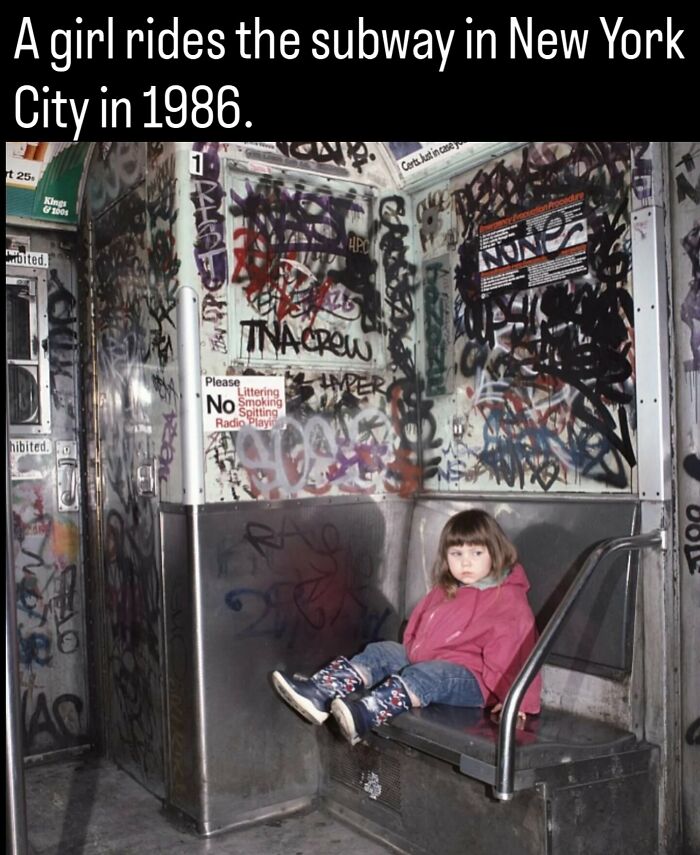 Photographer Camilo José Vergara captured this image of a young girl named Virginia sitting inside a graffiti-covered No. 1 subway car in Manhattan.
By 1986, New York’s subway system had endured years of financial neglect, deteriorating equipment and widespread vandalism. Graffiti covered nearly every available surface in some cars, from doors and windows to advertisements and interior walls. Mechanical failures were common, stations were poorly maintained and many passengers viewed the system as unpredictable and unsafe.
Yet this was also an ordinary part of life for millions of New Yorkers. Virginia’s calm expression amid the chaotic layers of paint creates a striking contrast: childhood innocence surrounded by a transit system that appeared to be collapsing around its passengers.
The graffiti itself represented different things to different people. City officials and many commuters regarded it as evidence that public order had broken down. The young writers who risked arrest to paint trains saw the subway as a moving canvas capable of carrying their names and artwork across all five boroughs.
This photograph was taken as the city began reclaiming the system. Trains were cleaned more aggressively, vulnerable rail yards were secured and freshly painted cars were quickly removed from service if they were vandalized.
Added fact: In May 1989, New York transit officials declared that every subway car in regular service was graffiti-free, effectively ending the era documented in this photograph.
Photograph by Camilo José Vergara.
 The Sopranos pilot was filmed in 1997, nearly two years before the series officially premiered on HBO in January 1999.
James Gandolfini, who played Tony Soprano, was born in 1961 and was about 36 when the pilot was filmed. If someone the same age were filming that role today, they would have been born around 1990.
Edie Falco, who played Carmela, was born in 1963 and was about 34 during filming. Her modern equivalent would have been born around 1992.
Jamie-Lynn Sigler, who played Meadow, was born in 1981 and was roughly 15 or 16 when the pilot was shot, putting a present-day equivalent around 2010.
Robert Iler, who played A.J., was born in 1985 and was about 12 during filming, meaning an actor the same age today would have been born around 2014.
Added fact: The pilot was originally titled The Sopranos, but HBO initially passed on ordering a full series. Creator David Chase reportedly considered expanding it into a feature film before HBO eventually came back and ordered the show to series.
 When Thriller was released in November 1982, the musical world it entered was dramatically different from the one that exists today.
Looking backward 43 years from 1982 lands in 1939, an era dominated by big band orchestras, swing, early jazz standards, and crooners rather than modern pop production.
Yet unlike much music from 1939, Thriller does not often feel “old” to modern listeners.
Produced by Quincy Jones, the album blended pop, rock, R&B, funk, and cutting edge studio techniques in ways that reshaped popular music. Songs like Billie Jean, Beat It, and Thriller remain instantly recognizable across generations.
The album’s influence extended beyond sound alone. Its music videos transformed MTV and helped establish the music video as a major artistic and commercial force.
The nearly 14 minute Thriller short film, directed by John Landis, blurred the line between music video and cinematic storytelling.
Added fact:
Thriller remains the best selling album in history, with estimated worldwide sales exceeding 70 million copies.
 Before Bluetooth speakers and in-car infotainment systems, the 1990s saw the rise of the removable faceplate car stereo. These devices, like the Sony model pictured, became both a status symbol and a necessity in an era of rampant car stereo theft. Automakers of the time offered basic factory radios, so music lovers often upgraded to aftermarket systems that offered better sound, CD compatibility, and features like “Mega Bass” or equalizer controls. The detachable faceplate was a simple but clever deterrent. Thieves could not easily sell or use a stereo without its control panel, so owners would pop it off and carry it with them, often in a branded hard case like the one shown.
The act of slipping a stereo face into your jacket pocket or carrying it into a restaurant became an almost comical yet iconic ritual. It was a visual cue of the late 90s car culture, where technology, music, and personal style intersected. Brands like Sony, Pioneer, and Kenwood led the way, offering increasingly sleek models with digital displays, flashing LEDs, and anti-shock CD playback. For many, investing in such a system was about more than just sound, it was about identity and control in a pre-digital age when car interiors became an extension of personal expression.
Added Fact: Some detachable stereos evolved into “motorized face” designs in the early 2000s, where the front panel would automatically tilt or retract to conceal the slot—another inventive step in the ongoing battle against car break-ins.
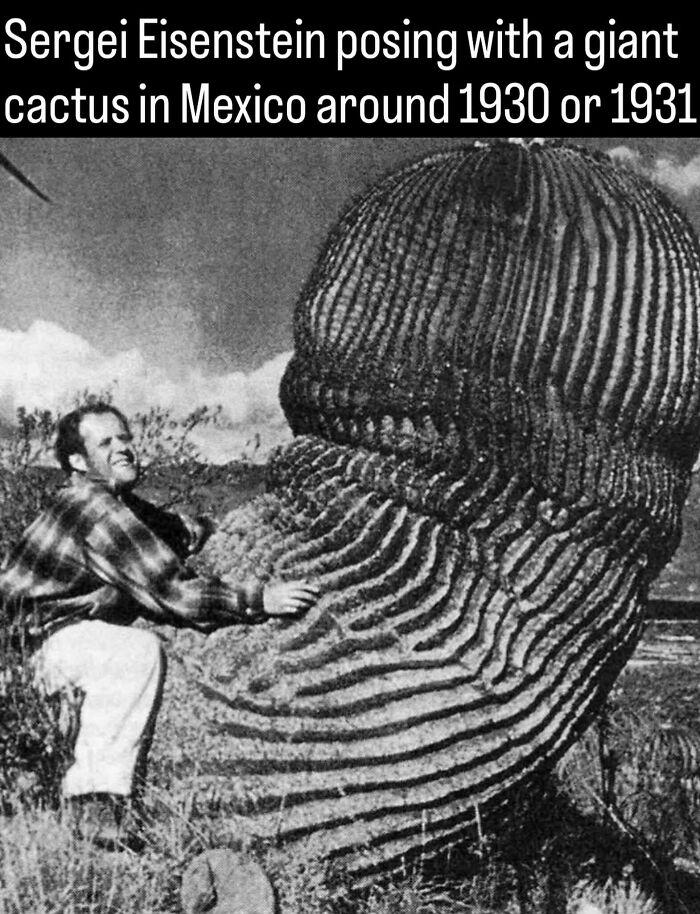 By the early 1930s, Eisenstein was already one of cinema’s most influential directors, but his time in Mexico came during an uncertain and complicated period in his life.
After transforming filmmaking with works such as Battleship Potemkin, Eisenstein became famous for his theory of montage, the idea that meaning could be created by placing contrasting images together rather than relying on a straightforward narrative. In 1930, he traveled to Mexico to begin an independently financed film project that would eventually become known as ¡Que Viva México!
The film was intended as a sweeping portrait of Mexican history, religion, landscape, tradition, and social inequality. Eisenstein filmed enormous amounts of footage, but the production gradually collapsed under financial disputes, political pressure from the Soviet Union, delays, and disagreements with his American backers.
He was ultimately forced to leave Mexico without completing or editing the film. Other filmmakers later assembled portions of the footage, but none of those versions fully represented Eisenstein’s original plan.
The experience nevertheless had a lasting influence on him.
Added fact: Eisenstein was also a prolific artist who filled sketchbooks with thousands of drawings, often planning scenes visually before filming and approaching cinema almost like architecture in motion.




































 No fees, cancel anytime