Get Premium
Dark mode theme is available exclusively for premium users. Learn more about the benefits of subscribing.
No fees, cancel anytime.

 Dark Mode Ad-Free Browsing Unlimited Content
 Ad-Free Browsing Unlimited Content Dark Mode
Join 1.2 million Panda readers who get the best art, memes, and fun stories every week!

When a month ends, we all have our own little ways of taking stock. Maybe you check where all your money disappeared, restock your favorite beauty products, or simply wonder how the month managed to fly by so quickly. For us, it means heading online and digging through the chaos to find the funniest posts people shared along the way.
And that’s exactly what today’s collection is all about. We’ve rounded up some of the funniest tweets from X to give you a much-needed dose of end-of-month entertainment. So sit back, scroll through, have a laugh, and see if any of these posts remind you of the kind of month you’ve had. Because sometimes, the best way to wrap up August is with a good laugh.
This post may include affiliate links.
August 2026 has certainly given us plenty to talk about. From major medical breakthroughs and new clean-energy projects to a spectacular solar eclipse and devastating natural disasters, the month brought a little bit of everything. And while today’s memes are here to keep things light, it’s worth taking a moment to look around the world and remember some of the bigger events that shaped the past few weeks.
One of the biggest medical developments of the month came from the U.S., where the Food and Drug Administration approved daraxonrasib (Rasonque) on August 26 for adults with metastatic pancreatic adenocarcinoma who had already received at least one systemic treatment. The once-daily pill targets RAS proteins, which play a major role in driving tumor growth. In the clinical trial used for the approval, patients taking daraxonrasib had a median overall survival of 13.2 months, compared with 6.7 months for those receiving standard chemotherapy. The drug isn't a cure, but doctors see the approval as an important new option for a cancer that has historically been extremely difficult to treat.

Some had town and country horns, different ones for for locations so....

People have to stop believing that taxes are evil. You want roads? You want schools? You want healthcare? Where do you think that money comes from - the fairies?
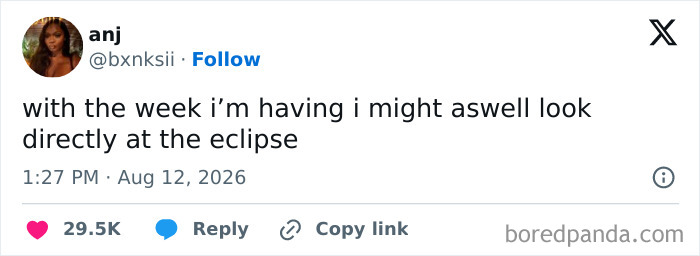
August also brought a spectacular celestial event as a total solar eclipse swept across Greenland, Iceland, northern Russia, the Atlantic Ocean, Spain and a small part of Portugal on August 12. During totality, the Moon completely covered the Sun, briefly turning daytime skies dark along the narrow path of totality. Much of Europe and parts of North America also experienced a partial eclipse. NASA noted that people in parts of mainland Europe and Africa even had the unusual opportunity to see the Sun setting while still partially eclipsed.

Oh, I see what you did there. I'm slow, I need to stop doom scrolling 😴
Eclipses are spectacular partly because of an extraordinary coincidence: the Sun is about 400 times wider than the Moon, but it is also roughly 400 times farther away from Earth, making the two appear almost exactly the same size in our sky. In Sun Moon Earth, astronomer and physicist Tyler Nordgren explores how solar eclipses went from being feared as terrifying omens to becoming valuable tools for understanding our place in the cosmos. He also points out that total solar eclipses are not a permanent feature of Earth's skies. The Moon is slowly drifting away from Earth because of tidal interactions, at roughly 3.8 centimeters (1.5 inches) per year. Eventually, the Moon will appear too small to completely cover the Sun. In roughly 600 million years, Earth is expected to experience its final total solar eclipse, after which observers will only see partial and annular eclipses—the famous "ring of fire."
While the eclipse offered a glimpse of the wonders happening above us, some of August’s biggest developments were much closer to home. India took a major step toward cleaner transportation with the launch of its first domestically developed hydrogen-powered passenger train. Flagged off in Haryana on July 17, the 10-coach train operates on the 89-kilometer Jind–Sonipat route and can carry around 2,600 passengers, with an approved operating speed of up to 75 km/h. By the end of August, the train had already clocked roughly 6,000 kilometers in service, marking an encouraging early milestone for the project.
Unlike conventional diesel trains, the hydrogen train uses fuel cells to generate electricity through an electrochemical reaction between hydrogen and oxygen. The process produces water vapor and heat as its direct byproducts, rather than the exhaust emissions associated with diesel combustion. Indian Railways describes the project as a pilot initiative designed to demonstrate the feasibility of hydrogen-powered rail travel and gather operational experience before considering the technology for other non-electrified routes.
Not every major event was something to celebrate. On August 10, a magnitude 7.4 earthquake struck western Colombia, becoming the strongest earthquake recorded in the country this century. The epicenter was near San José del Palmar in Chocó, while major damage was reported across cities including Pereira and Cali. Buildings collapsed, hospitals and other infrastructure were damaged, and rescue teams searched through rubble for survivors. The death toll continued to rise in the days that followed, eventually passing 200, while thousands were injured and hundreds remained missing.
The final days of August brought one of the month's most devastating disasters. On August 26, a huge section of a glacier near the Nepal-Tibet border broke away and plunged roughly 1,200 meters toward the valley below, creating an ice-and-rock avalanche that helped trigger catastrophic flash flooding. Water levels in the Trishuli River reportedly rose by as much as nine meters in just 30 minutes, sweeping away homes, roads, bridges and hydropower infrastructure. As rescue efforts continued, the death toll and number of missing people climbed dramatically, with authorities warning about further hazards from unstable glaciers and newly formed flood lakes.
August has certainly been a month of contrasts. There were breakthroughs in medicine, experiments with cleaner transportation, major renewable-energy projects and a spectacular eclipse—but there were also devastating earthquakes and floods that left communities facing enormous loss. In many ways, the month's biggest stories reflected just how unpredictable the world can be: one moment we're looking toward the future, and the next we're reminded of nature's immense power. And coming back to today's memes, perhaps that's what makes them such a welcome break—they give us a chance to pause, smile and enjoy a little lighter side of a very eventful month.

My sister, brother and I used to go around the house collecting random items, placing them on the dining table and pretend it was a store and check out on an imaginary register.

What's that for the tails? I may have to make some of these.

Not every kids show needs to be a hill adults have to d*e on. Pretty d**n simple.
































 No fees, cancel anytime