Get Premium
Dark mode theme is available exclusively for premium users. Learn more about the benefits of subscribing.
No fees, cancel anytime.

 Dark Mode Ad-Free Browsing Unlimited Content
 Ad-Free Browsing Unlimited Content Dark Mode
Join 1.2 million Panda readers who get the best art, memes, and fun stories every week!
Historical photos are way more than just subject matter in school. They are also time capsules of a bygone era, giving us a glimpse of what life was like when many of us weren’t even born yet.
Just take a look at these photos from the History Feels Instagram page. Each one provides a palpable sense of nostalgia, which is always welcome. At the same time, each image's backstory is compelling enough to make you want to go down a rabbit hole.
The account has a million followers and counting, and scrolling through should explain why.
This post may include affiliate links.

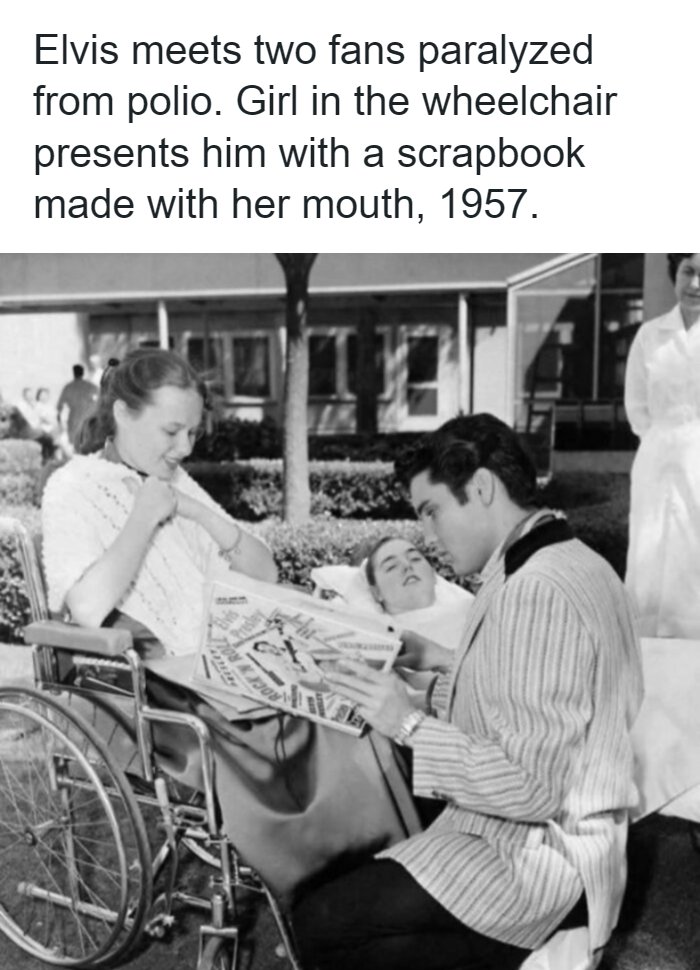
Publicity photos were released of Elvis receiving the polio vaccination to help convince those who were hesitant to get the vaccine. I’m guessing there’s at least couple people on here that will accuse him of being in cahoots with Big Pharma or some other nonsense 🙄
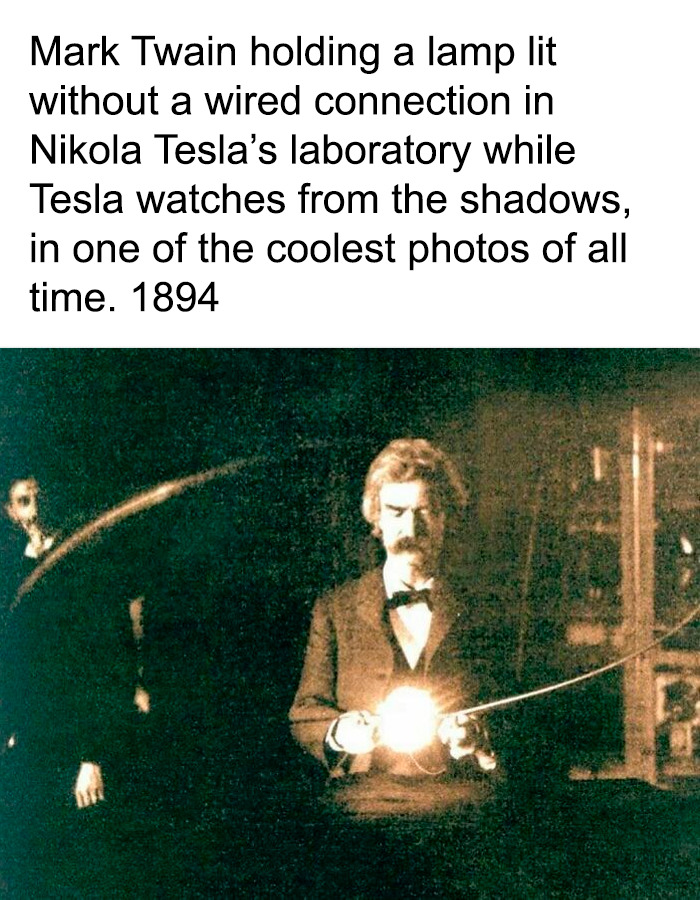
Taken in the spring of 1894, you have two of America’s most recognizable minds sharing a remarkable experiment.
Twain (whose real name was Samuel Clemens) stands in Nikola Tesla’s New York laboratory holding an experimental vacuum lamp, while Tesla’s face appears from the darkness behind him.
Although the lamp had no conventional connection to a wall socket, it was not operating entirely without wires. It was attached to a loop of wire that received electromagnetic energy from Tesla’s high-frequency equipment elsewhere in the laboratory.
The electrical field induced a current in the loop, causing the lamp to glow without a direct connection to its power source.
To people living in the 1890s, demonstrations like this could appear almost supernatural.
Tesla regularly used dramatic displays to show how alternating current and electromagnetic fields could transmit energy. Twain, who was fascinated by science and new technology, became a frequent visitor to Tesla’s laboratory.
The two men developed a friendship based on mutual admiration: Tesla had reportedly enjoyed Twain’s writing since his youth, while Twain eagerly participated in the inventor’s experiments.
The photograph was later published in an April 1895 Century Magazine article examining Tesla’s oscillators, lighting systems and electrical inventions.
Added fact: Tesla reportedly attempted to photograph Twain using an early gas-discharge tube during his experiments with radiation, but the resulting image captured only a metal screw inside the camera.
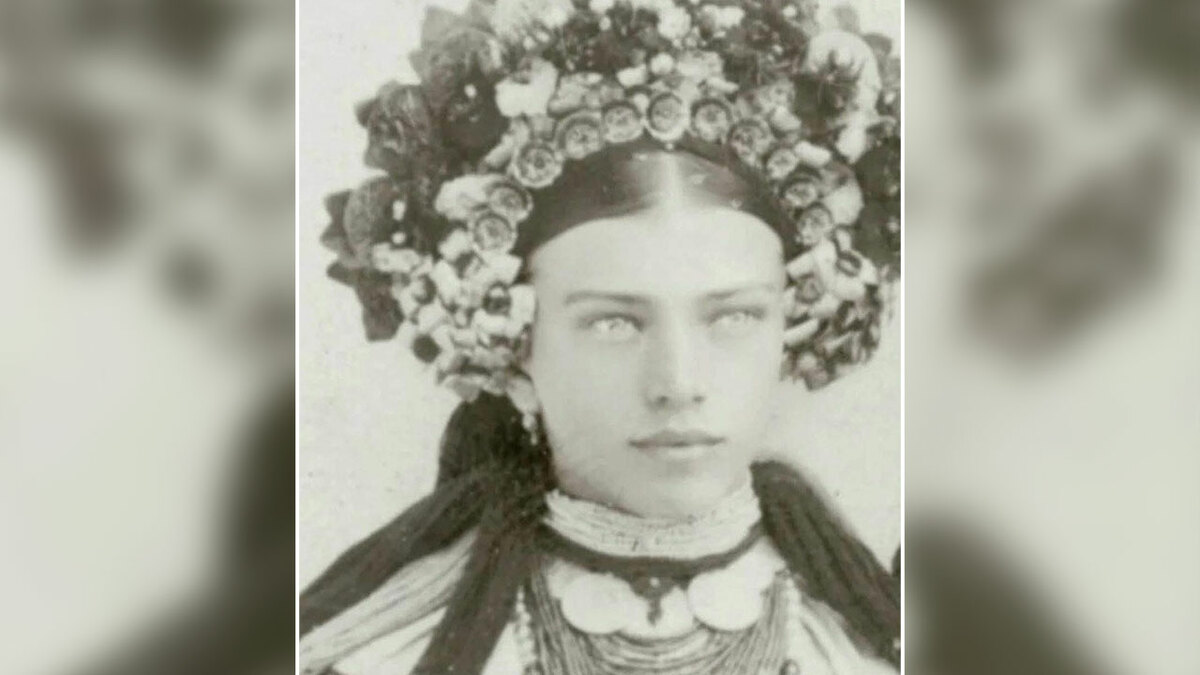
At the time the photograph of this stunning woman was taken, Yabluniv was part of Austria-Hungary, in the historic region of Galicia. Today, the village lies in western Ukraine’s Ivano-Frankivsk region, near the foothills of the Carpathian Mountains.
The woman’s elaborate clothing reflects the extraordinary textile traditions of western Ukraine. Traditional dress in this part of the country could communicate where a person came from. Embroidery, jewelry, fabrics and styles of headdress often differed from one community to another.
The area around Kosiv became particularly famous for its craftsmanship, including embroidery, woven textiles, ceramics, carved wood, leatherwork and metal jewelry. Many of these traditions were passed down through generations.
The layers of jewelry around her neck were also more than decoration. In communities across the Carpathian region, jewelry could reflect wealth, family background and local tradition, and valuable pieces were often passed from one generation to the next.
What we apparently do not know is her name. Surviving descriptions of the photograph identify her simply as a woman from Yabluniv. More than a century later, her face has survived in remarkable detail even though her story will have to be lost to time.
Added fact: The photograph is credited to J. Dutkevych, whose name is also transliterated as Yu. Dutkevych in some surviving references.
History Feels has a considerable following across different mediums, with over 100,000 subscribers on YouTube and over 920,000 followers on TikTok. While history can be compelling, what makes History Feels stand out is the stories they focus on.
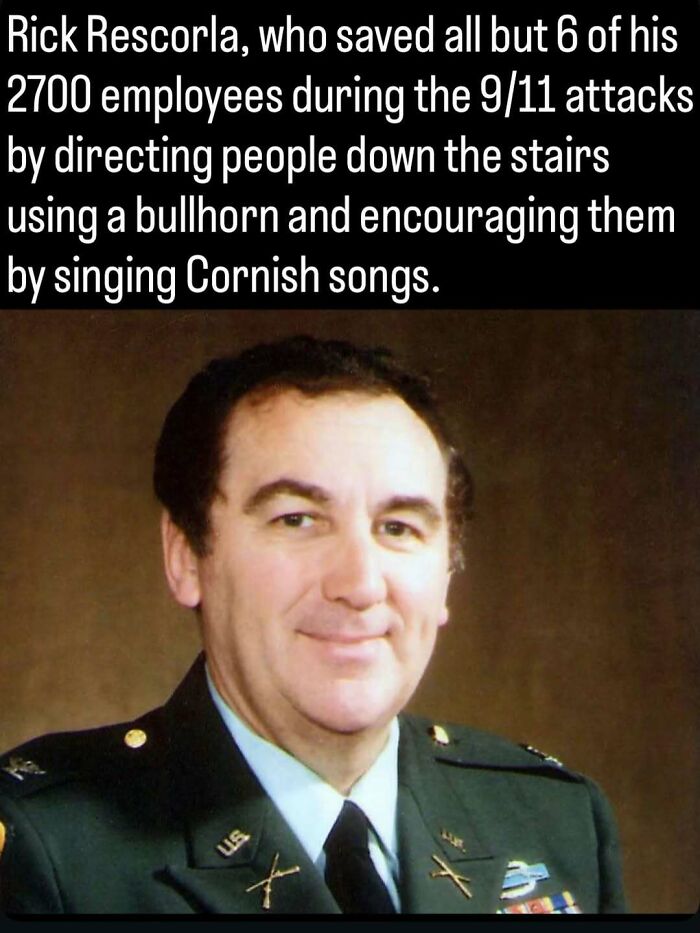
One of their most captivating posts was about Rick Rescorla, the Morgan Stanley security director who evacuated employees from the South Tower during the tragic events of September 11, 2001. Rescorla, who lost his life in the attacks, is widely regarded as one of the heroes of that day.
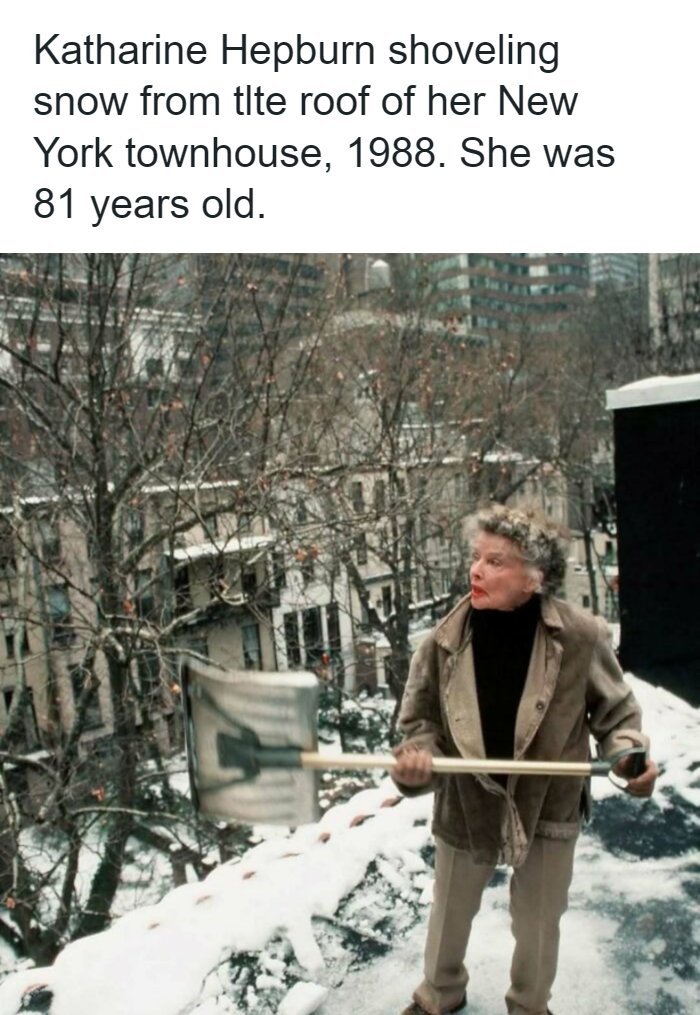
By 1988, Katharine Hepburn had already spent more than half a century defying expectations, both on screen and off.
She purchased her Manhattan townhouse in the Turtle Bay neighborhood in 1931 and made it her New York home for decades. Hepburn was famously independent and intensely private, preferring a relatively ordinary neighborhood life despite being one of Hollywood’s biggest stars.
Her career was anything but ordinary. Hepburn won four Academy Awards for Best Actress, a record that still stands, for Morning Glory, Guess Who’s Coming to Dinner, The Lion in Winter and On Golden Pond. She received 12 acting nominations over a career spanning more than 60 years.
She also rejected many of Hollywood’s expectations for women, wearing trousers when they were still considered unconventional and cultivating an image based more on intelligence and independence than glamour.
Added Fact: Hepburn remained in her Turtle Bay townhouse until the final years of her life. After her death in 2003 at age 96, the intersection of East 49th Street and Second Avenue was named Katharine Hepburn Place in her honor.
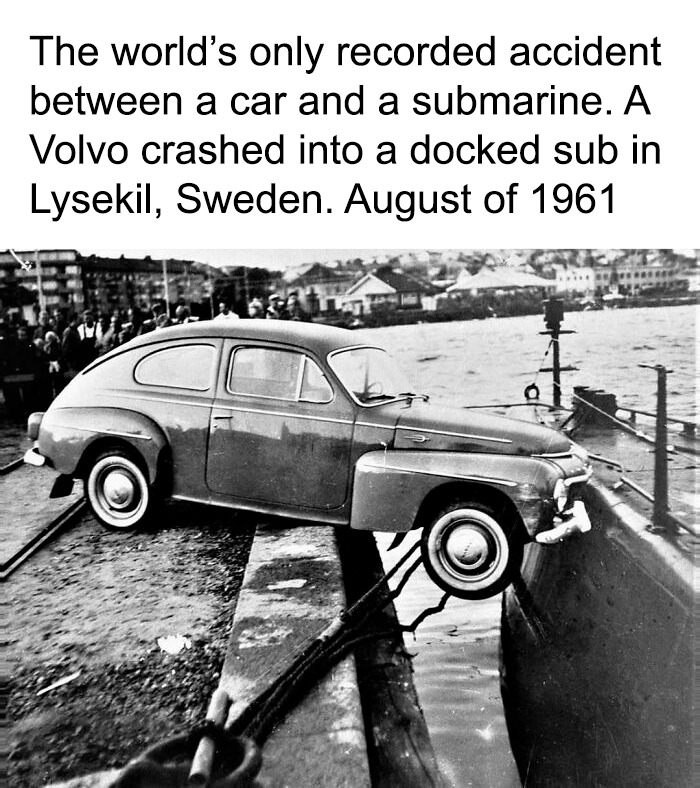
On August 19th of that year someone parked a Volvo near the harbor in Lysekil, Sweden, stepped away from the car, and unknowingly set one of the strangest accidents in motion.
The handbrake hadn’t been properly secured.
With the road sloping toward the water, the empty Volvo PV544 began to roll. There was nobody behind the wheel to stop it. It crossed the harbor road, picked up momentum, and headed directly toward the edge of the pier.
Normally, the story would have ended with a car sinking into the harbor.
But there happened to be a Swedish Navy submarine tied up exactly where the Volvo was headed.
The submarine was HMS Bävern.
The runaway car slammed into its bow and became wedged between the pier and the submarine, leaving its front wheels hanging over the water. By the time people gathered around, the scene looked almost staged: a family car seemingly involved in a collision with a military submarine.
Nobody was injured. The Volvo took most of the damage, while Bävern reportedly suffered only minor damage to its railing. The submarine went right back to doing what submarines do, remaining in Swedish naval service until 1980.
Photographer Hans Johansson captured the aftermath, preserving what has become one of Sweden’s most unusual traffic photographs.
Added fact: The coincidence gets even better. Both the Volvo and HMS Bävern dated to 1958, meaning a three-year-old car had somehow managed to crash into a three-year-old submarine.
Another post that stood out from the History Feels archive was a photograph of a receipt showing what appeared to be the last sale ever made at the World Trade Center during the attacks.
It was a purchase of two magnets made at the Lechters Housewares on the shopping concourse beneath the North Tower. The transaction happened nine minutes after the first plane hit.
Located in the heart of York, England, the Shambles is one of Europe’s finest surviving examples of a medieval shopping street. Some of its timber-framed buildings date to the 14th and 15th centuries, when York was a wealthy center of trade and religion.
The street’s narrow design and dramatically overhanging upper floors were practical. Expanding a building outward created additional living space without occupying more valuable ground. In some places, the upper stories extend so far that neighbors could nearly reach across the street and touch one another’s houses.
For centuries, the Shambles was dominated by butchers.
Many shops had slaughterhouses behind them, while cuts of meat were displayed on shelves and hooks outside. The word “Shambles” comes from an old term for a market bench or stall, which eventually became associated specifically with meat markets.
Waste from the butchers flowed into channels along the street before being washed away. The closely packed buildings also helped block direct sunlight, keeping displayed meat cooler before refrigeration existed.
By 1885, the Shambles still contained 31 butcher shops. None remain today, and the historic buildings now house cafés, boutiques, bakeries and souvenir stores.
Added Fact: Several storefronts still preserve their original outdoor meat hooks and shelves, providing visible reminders of the street’s centuries as York’s main butchering district.
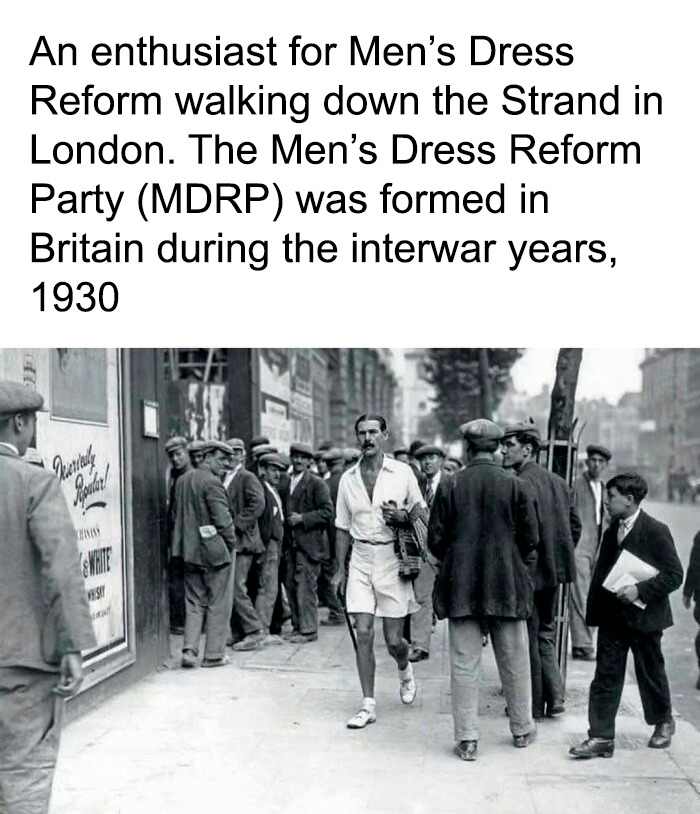
Founded in 1929, the Men’s Dress Reform Party challenged what its members considered impractical and unhealthy conventions of men’s clothing. They argued that heavy wool suits, stiff collars, multiple layers, and long trousers restricted movement, trapped heat, and reflected outdated Victorian ideas rather than modern life. The organization advocated lighter fabrics, colorful clothing, open necklines, shorts, sandals, and even skirt-like garments for men, believing clothing should be designed for comfort and function rather than rigid social expectations.
The movement attracted doctors, artists, architects, and progressive thinkers who viewed clothing reform as part of a broader effort to improve public health and modernize society. While newspapers often treated the campaign with amusement, the MDRP published pamphlets, organized public demonstrations, and staged highly visible walks through London to challenge public perceptions of masculinity and fashion.
Although the organization remained small and never transformed British menswear, many of its ideas anticipated later changes. Open-collar shirts, shorts, sportswear, and lightweight summer clothing became increasingly accepted after the Second World War.
Added Fact: Similar dress reform movements emerged across Europe during the early 20th century. Many promoted sunlight, fresh air, and freedom of movement, believing that restrictive clothing contributed to poor health, reduced physical fitness, and unnecessary social conformity.
In 1958, they were arrested in their bedroom and exiled from Virginia just for being married. Nine years later, Richard and Mildred Loving relaxed on their porch after winning the Supreme Court case that legalized interracial marriage across America.
Richard Loving, a white man, and Mildred Jeter, a woman of Black and Native American ancestry, married in Washington, D.C., in June 1958 because interracial marriage was illegal in their home state of Virginia. After returning home to Caroline County, police entered their house during the night and arrested them for violating Virginia’s Racial Integrity Act.
The Lovings pleaded guilty in 1959. Rather than sending them to prison, the judge suspended their one-year sentences on the condition that they leave Virginia and not return together for 25 years. They moved to Washington, D.C., but desperately missed their families and rural Virginia home.
Eventually, Mildred wrote seeking help, and attorneys took up their case. It reached the U.S. Supreme Court as Loving v. Virginia.
On June 12, 1967, the Court ruled unanimously that laws banning interracial marriage violated the Fourteenth Amendment. The decision invalidated remaining state bans on interracial marriage and allowed Richard and Mildred to return home legally as husband and wife.
Added fact: Richard reportedly never attended the Supreme Court arguments. His message to his attorney was simple: tell the justices that he loved his wife and that it was unfair they could not live together in Virginia.
Some posts on the History Feels social media sites also draw enough attention to get people talking. Take this one example featuring the 1977 mugshot of tycoon Bill Gates.
As the story goes, Gates was pulled over for a traffic violation in New Mexico. The image then went on to be one of the most infamous in tech history, so much so that Microsoft used it as the default profile pic for Outlook 2010.
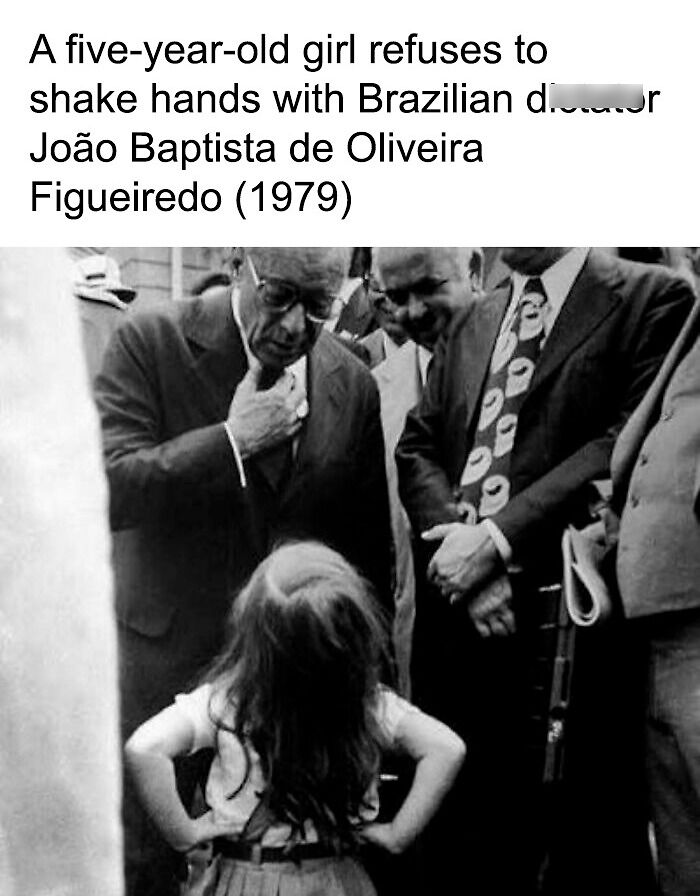
The girl in this famous photograph was five-year-old Rachel Coelho Menezes de Souza, later known as Rachel Clemens.
The encounter occurred on Sept. 5, 1979, at the Palácio da Liberdade in Belo Horizonte, only months after General João Figueiredo became Brazil’s president.
As Figueiredo leaned forward and extended his hand, Rachel planted her hands firmly on her hips and refused to respond.
Photographer Guinaldo Nicolaevsky captured the perfectly timed moment.
Newspapers and magazines around the world soon published the image, which became a powerful symbol of resistance to Brazil’s military dictatorship.
The photograph appeared especially meaningful because Figueiredo had promised to extend his hand in reconciliation as Brazil slowly moved toward democracy.
Here, however, a small child seemed to reject that hand completely.
Rachel later explained that her refusal had not been a planned political protest. She was simply irritated, behaving stubbornly and resisting the adults around her.
Yet photographs can take on meanings far beyond the intentions of the people inside them. To many Brazilians, Rachel’s defiant pose represented an exhausted public standing up to military authority.
Figueiredo remained in power until 1985 and became the final president of Brazil’s 21-year military dictatorship.
Added fact: Rachel was not publicly identified as the girl in the photograph until decades later. She died in Belo Horizonte in 2015 at the age of 40.

D I C T A T O R is a bad word now, really? It's a bad thing to be, certainly, a bad thing to live under, but not a bad word to say. In fact, it is often a very necessary thing to say.
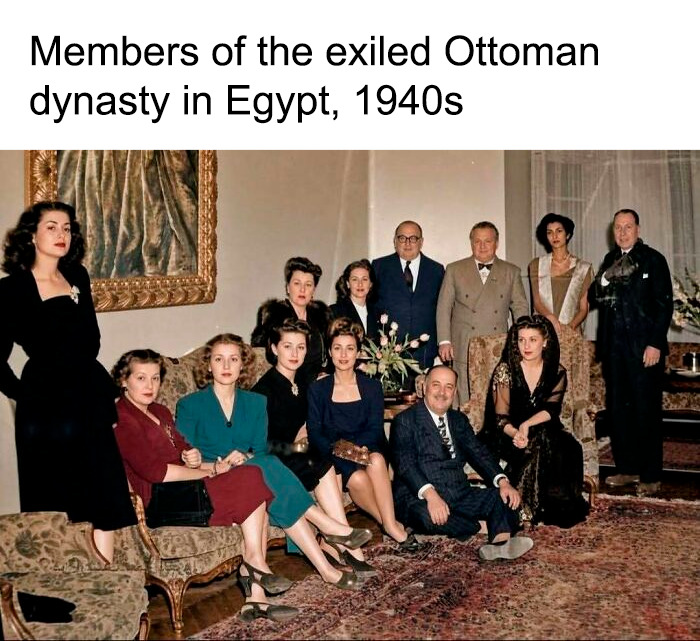
The collapse happened remarkably quickly, especially for a dynasty that had ruled 623 years. After the Ottoman Empire was defeated in World War I, Allied powers occupied parts of its territory, including Constantinople. Sultan Mehmed VI remained on the throne, but his government was increasingly seen as powerless and too willing to cooperate with the occupying powers.
At the same time, Mustafa Kemal (later known as Atatürk) built a rival nationalist government in Ankara and led the Turkish War of Independence from 1919 to 1922. After nationalist forces defeated their opponents and regained control of much of Anatolia, the political future of the sultanate was effectively decided.
On Nov. 1, 1922, the Grand National Assembly abolished the Ottoman sultanate, declaring that sovereignty belonged to the Turkish nation rather than the monarch. Mehmed VI left Constantinople aboard a British warship later that month. The Republic of Turkey was formally declared in 1923.
The dynasty itself was not expelled immediately. The religious office of caliph survived briefly under Abdülmecid II, but on March 3, 1924, Turkey abolished the caliphate as well and ordered members of the Ottoman imperial family into exile.
The family scattered across Europe and the Middle East, with several members eventually settling in Egypt. Ottoman princesses also married into the Egyptian royal house, strengthening ties between two dynasties whose histories had been intertwined for centuries.
Neslişah Sultan, a granddaughter of the last Ottoman sultan Mehmed VI, married Egyptian Prince Muhammad Abdel Moneim in 1940. In a remarkable twist, after Egypt’s monarchy was overthrown in 1952, she and her husband were eventually forced into exile too, meaning she lived through the collapse of two royal worlds in a single lifetime.
Added fact: Turkey allowed female members of the Ottoman dynasty to return beginning in 1952, while male members remained barred until 1974.
History Feels and other similar platforms with huge followings prove that humans are inherently fascinated, even preoccupied, with the past. According to research by Dartmouth College cognitive neuroscientist Jeremy Manning, people are more fixated on past events than the future.
Manning shared his findings in an article for Scientific American, noting one distinct reason why people fixate on the past: we stick to what we know.
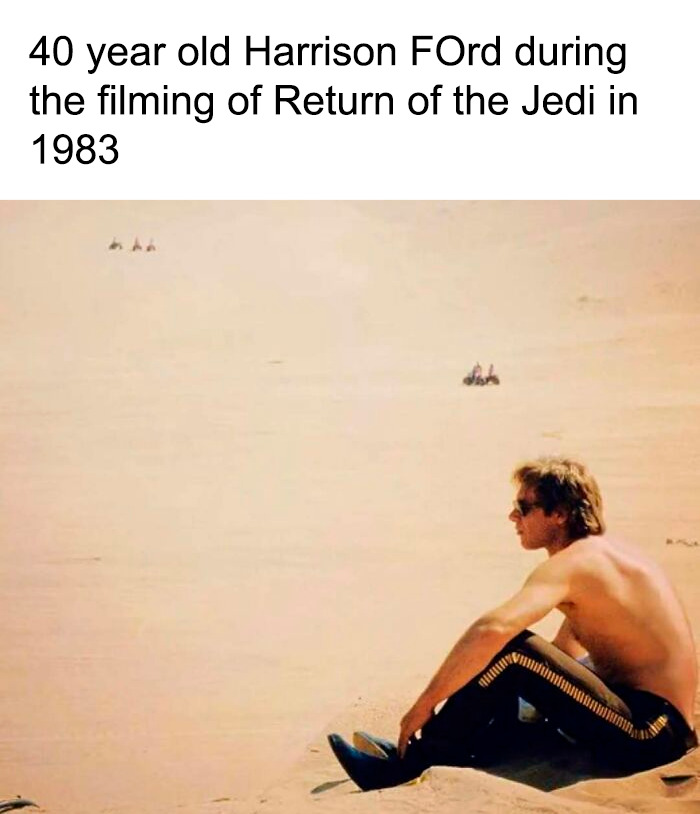
Ford is pictured taking a break in the desert during production of Return of the Jedi, the final film in the original Star Wars trilogy.
He had turned 40 in July 1982, when much of the movie was actually being filmed, before its theatrical release in May 1983.
The desert sequences involving Jabba the Hutt’s sail barge and the Sarlacc were filmed among the Imperial Sand Dunes near Yuma, along the Arizona California border.
The enormous dunes doubled for the desert planet Tatooine, where Han Solo, Luke Skywalker and Chewbacca are sentenced to be thrown into the Sarlacc pit.
Filming there was a major undertaking. A huge full scale exterior representing Jabba’s sail barge was constructed in the dunes, while hundreds of cast and crew members worked in intense desert conditions.
Ford had already become one of Hollywood’s biggest stars by this point, playing both Han Solo and Indiana Jones within the span of just a few years.
Added fact: To keep the production secret, Return of the Jedi was filmed under the deliberately misleading working title “Blue Harvest,” complete with fake signage describing it as a horror movie.
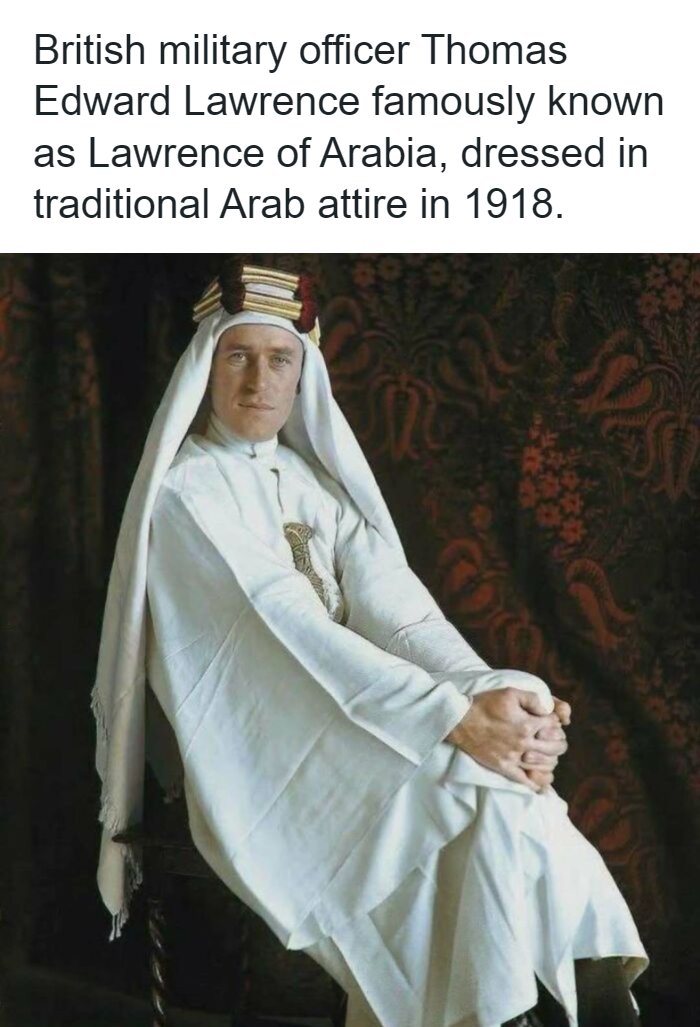
Few British officers became as legendary as T. E. Lawrence. During World War I, he served as a liaison between Britain and Arab leaders fighting against the Ottoman Empire. Rather than remaining behind the front lines, Lawrence traveled thousands of miles across the desert alongside Arab forces, participating in raids on railways, supply lines, and military outposts that disrupted Ottoman control.
The white robes and headdress seen here were not a costume for publicity. They were presented to Lawrence by Emir Faisal, later King Faisal I of Iraq, as a mark of respect and alliance. The clothing was practical for desert travel and also symbolized Lawrence’s acceptance among many of the Arab fighters with whom he lived and campaigned.
After the war, Lawrence became an international celebrity through newspaper coverage and the writings of American journalist Lowell Thomas. Despite the fame, he disliked public attention and later enlisted in the Royal Air Force under an assumed name.
Added Fact: Lawrence’s autobiography, Seven Pillars of Wisdom, is considered one of the greatest memoirs of the twentieth century and remains a classic account of the Arab Revolt.

After the war, he stood up to the British monarchy and publicly criticised their treatment of his Arab allies to their face. This caused the monarchy to change its Arabian policy.
NASA wanted to know what actually happens to spacecraft materials when you leave them exposed to space for years, so they attached an enormous materials experiment directly to the outside of the International Space Station.
This particular experiment contained 41 different types of polymers. Because many were stacked several layers deep, there were 205 individual pieces of material in total.
They remained outside the ISS for nearly four years.
During that time, the samples endured radiation, thousands of hours of sunlight and roughly 22,800 cycles of heating and cooling.
But one of the biggest threats was something that sounds surprisingly harmless: oxygen.
In low-Earth orbit, ultraviolet light breaks oxygen molecules apart, creating highly reactive individual oxygen atoms.
As the ISS travels around Earth at roughly 17,000 mph, exposed surfaces repeatedly slam into these atoms. Over years, the effect can literally erode certain materials away.
The difference in the before-and-after photographs shows just how severe that damage could become. Six of the 41 polymers were partially or completely eroded through.
Added fact: One material performed particularly badly. NASA reported that all four layers of its polybenzimidazole, or PBI, sample were completely eroded away during the experiment.
That is brilliant. I did not realise that this was part of the ISS experiments. It's vital research. Only 4 of the 11 samples on the top row survived. Edit, looking up research article, the first 5 on that row were not expected to survive. Web link below.
Manning pointed out that while being more inclined towards past events may lead to negative biases, rewinding from the present also has a practical purpose.
“When something people are experiencing in the present shares some aspect of their past, it can cause them to spontaneously relive those earlier moments,” Manning wrote. “These reminders of times past influence behaviors, helping people to navigate complex situations or environments using cues that were useful in the past.”
When Walt Disney World opened on October 1, 1971, an adult admission ticket to the Magic Kingdom cost $3.50. However, that ticket worked differently from today’s admission. It allowed guests to enter the park, but most rides required separate coupons.
Disney used a lettered ticket system inherited from Disneyland. Attractions were classified from “A” through “E.” A-tickets covered smaller experiences such as the Main Street vehicles, while E-tickets were reserved for the park’s biggest attractions, including the Haunted Mansion, Jungle Cruise and 20,000 Leagues Under the Sea.
Guests could purchase individual coupons or ticket books containing a selection of rides.
That system produced the expression “an E-ticket ride,” which became shorthand for any especially exciting experience. Disney gradually moved away from ride coupons as its parks expanded. On October 1, 1982—the day EPCOT opened—the company introduced an all-inclusive passport covering admission and nearly every attraction. The old ticket books disappeared, although the “E-ticket” phrase survived.
Modern Disney tickets operate differently again. Prices now vary according to the park and date, with the most popular days costing more. The $189 ticket shown here includes standard attractions, although services such as Lightning Lane can cost extra.
Added fact: Unused vintage Disney ride coupons never technically expired, and Disney reportedly continued accepting them at face value toward admission purchases for decades after the ticket-book system ended.
Yep. Our junk drawer had partially used ticket books with A and B tickets in it (maybe a spare C) because we never used those. E tickets would run out first and then you’d have to buy another whole ticket book to get more.
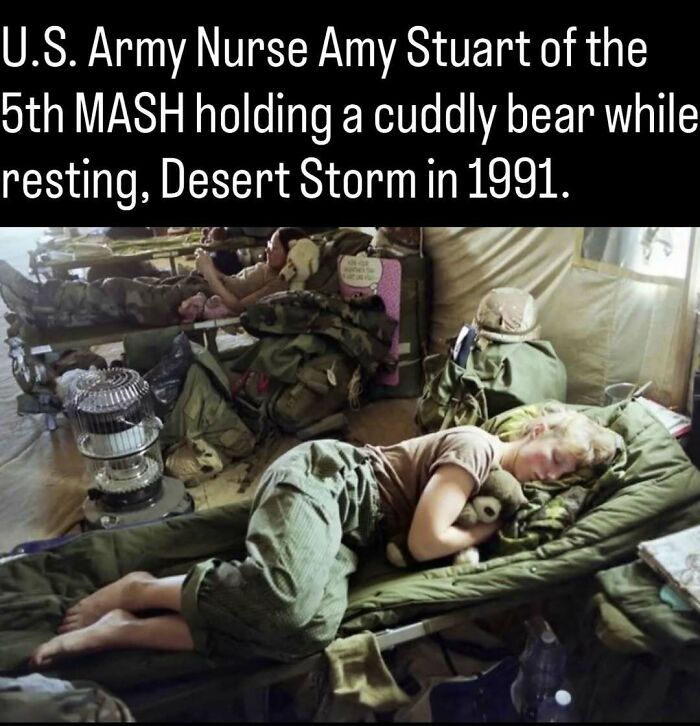
Photographer David Turnley captured this quiet moment at King Abdulaziz Air Base in Dhahran, Saudi Arabia. Amy Stuart, a nurse with the 5th Mobile Army Surgical Hospital, had fallen asleep on a cot while hugging a teddy bear sent to her by her family.
Around her are the everyday realities of deployment: military packs, helmets, blankets, a portable heater and rows of tightly arranged cots. The bear offered a small reminder of home in a place where Stuart and her fellow medical personnel lived under the constant expectation that wounded soldiers could arrive at any moment.
The 5th MASH had deployed from Fort Bragg, North Carolina, and became the first fully operational U.S. Army hospital established in Saudi Arabia during the crisis.
Designed to move with advancing forces, the hospital provided emergency surgery and stabilized critically wounded patients before they could be transported to larger medical facilities.
The photograph was taken on February 22, 1991, near the end of the Gulf War’s weeks-long aerial campaign. Just two days later, coalition forces launched the massive ground offensive to drive Iraqi troops from Kuwait.
Added Fact: During the offensive, the 5th MASH moved forward with the U.S. Army’s 24th Infantry Division, setting up surgical facilities close to the advancing front lines.
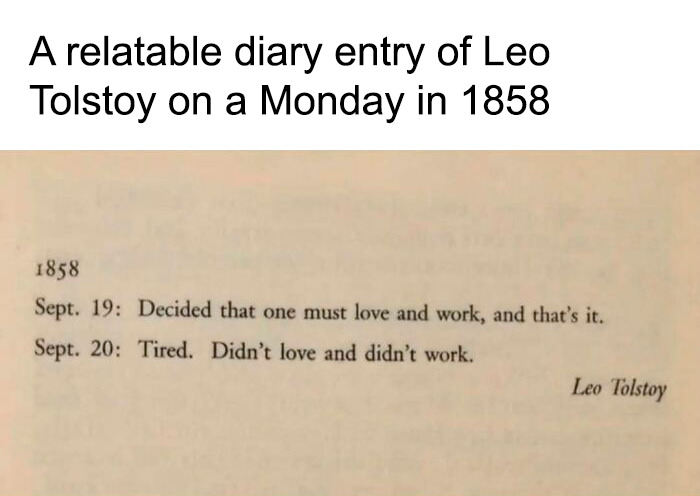
At 30 years old, Leo Tolstoy was still years away from writing War and Peace and Anna Karenina when he wrote this in September 1858.
By then, he had already served in the Caucasus and during the Crimean War, published several early works, and developed the habit of keeping detailed diaries about his behavior, goals and failures. He frequently recorded rules for himself involving work, discipline, gambling, sex, drinking and morality.
That makes these two entries especially characteristic of Tolstoy. On September 19, he reduced life to a simple rule: “one must love and work.” The next day, he admitted he had done neither.
His journals repeatedly show this cycle of strict self-improvement followed by frustration when he failed to meet his own standards.
Decades before his later religious writings, Tolstoy was already obsessed with the question of how a person should live.
Just like many of us.
We tend to remember history as individual moments, whether it’s a political upheaval, technological breakthrough, or a disaster that left a mark on society. A photograph freezes those moments and makes them tangible.
That’s why these photos from History Feels draw so much curiosity. They help us discover a much bigger story that isn’t visible on the surface.
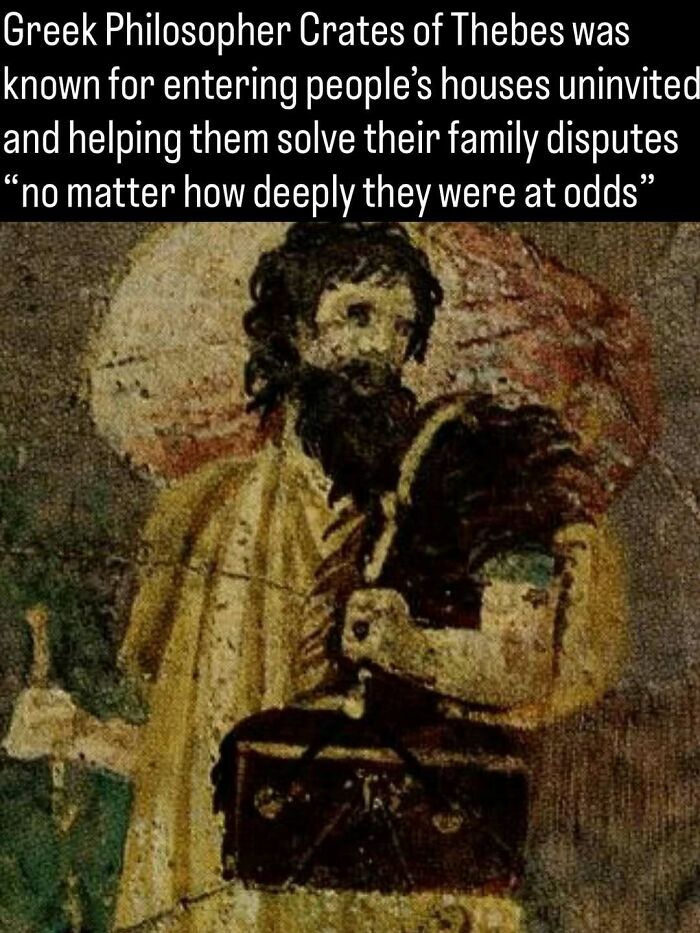
Crates of Thebes was one of the strangest and most beloved philosophers of ancient Athens.
Born into a wealthy family around 365 BC, Crates eventually gave away his fortune and embraced the radical simplicity of Cynic philosophy.
He became a follower of Diogenes of Sinope, living with few possessions and openly rejecting wealth, status and many of the social conventions of Greek society.
But Crates developed a reputation that went beyond philosophy. Ancient accounts say he became known as the “Door-Opener” because he had a habit of walking directly into people’s homes, often without being invited, and offering advice. Somehow, instead of resenting the intrusion, Athenians reportedly welcomed him. Later traditions describe him helping settle arguments and family disputes before simply moving on to the next house.
His cheerful personality was a major reason. Unlike the famously abrasive Diogenes, Crates seems to have practiced Cynicism with humor and warmth, using his own poverty as an example rather than merely attacking others.
Added fact: Crates became the teacher of Zeno of Citium, who went on to found Stoicism. That makes this eccentric philosopher who wandered into strangers’ homes one of the important links between Cynicism and one of the most influential philosophical schools in Western history.
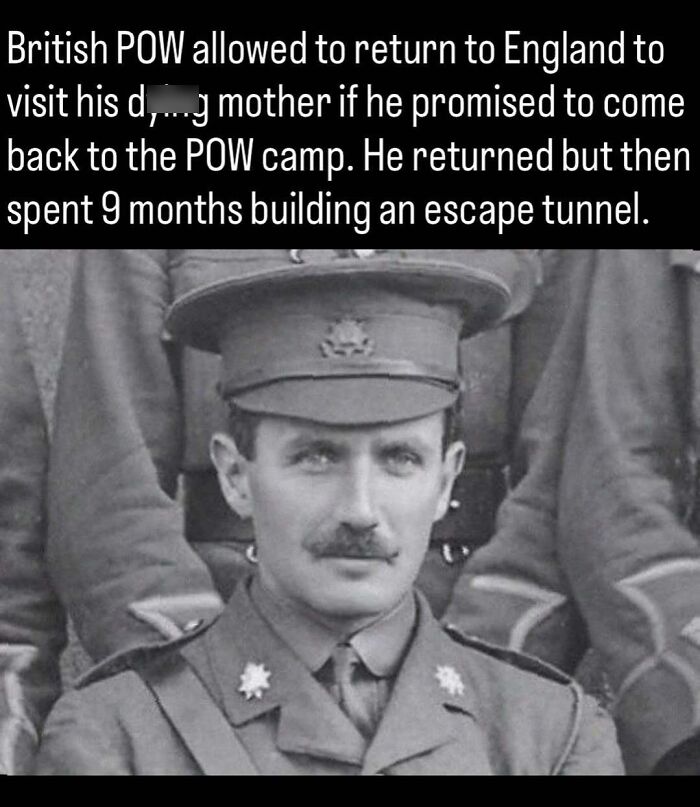
The prisoner was Captain Robert Campbell, a British Army officer captured by German forces during the opening weeks of World War I. Seriously wounded near Mons in August 1914, Campbell was treated at a military hospital before being imprisoned in Germany.
After two years in captivity, Campbell learned that his mother, Louise, was dying of cancer at her home in England. Desperate to see her one final time, he wrote directly to Kaiser Wilhelm II requesting compassionate leave.
Remarkably, the Kaiser granted him two weeks away from captivity on one condition: Campbell had to give his word as a British officer that he would return. Campbell traveled through the neutral Netherlands and reached England in November 1916. He spent approximately one week with his mother before voluntarily returning to Germany, despite having safely reached his own country. His mother died several months later.
The most fascinating part is what happened next. Although Campbell believed honor required him to keep his promise and return, that promise did not prevent him from trying to escape afterward.
He and several other prisoners reportedly spent nine months digging a tunnel out of the camp. They escaped and traveled toward the neutral Netherlands but were recaptured near the Dutch border.
Campbell remained a prisoner until the war ended in 1918.
Added fact: Campbell later returned to military service during World War II, serving as a chief observer in the Royal Observer Corps on the Isle of Wight.
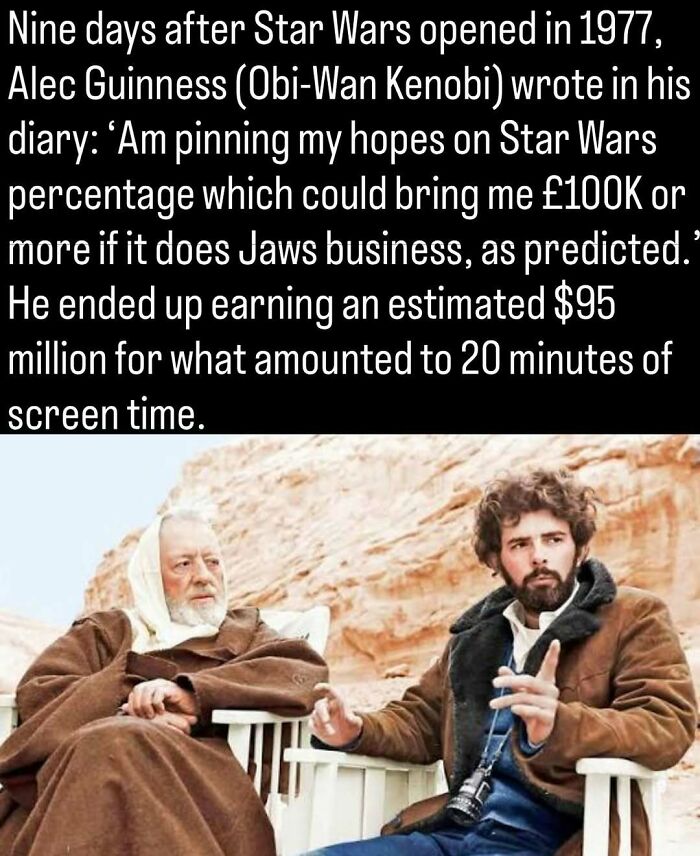
Guinness was already one of Britain’s most respected actors when George Lucas approached him to play Obi-Wan Kenobi.
An Academy Award winner for The Bridge on the River Kwai, he initially viewed Star Wars as little more than a strange children’s fantasy. In private letters, he criticized its dialogue and admitted that he struggled to understand the story’s terminology.
Still, Guinness recognized the film’s potential. Instead of accepting only a conventional salary, he negotiated a percentage connected to George Lucas’ share of the profits. That decision became extraordinarily lucrative when Star Wars grew from a risky science-fiction production into one of the most commercially successful franchises in history.
His performance also gave the unfamiliar film a sense of authority. Surrounded by younger actors, invented planets and groundbreaking special effects, Guinness played Obi-Wan with the gravity of a classical stage character. Although he later became frustrated that younger audiences associated him almost exclusively with Star Wars, the role introduced him to an entirely new generation.
The precise total Guinness earned remains disputed, but estimates commonly run into the tens of millions of dollars—far beyond the £100,000 he cautiously hoped to receive in 1977.
Added fact: Guinness received an Academy Award nomination for Best Supporting Actor for playing Obi-Wan, making him the franchise’s first acting nominee. His June 3 diary entry contains the quoted prediction. The Hollywood Reporter

I don't understand that "20 minutes of screen time" bit at the end of the first paragraph.
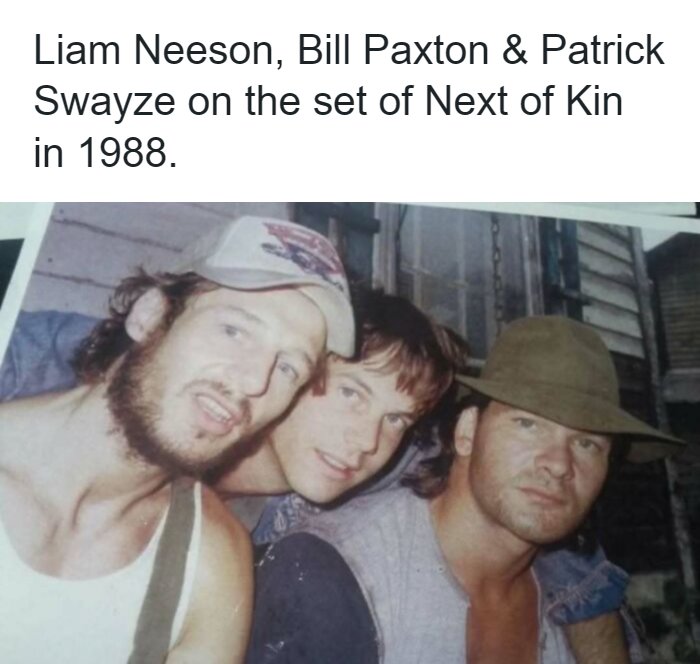
These three legends here are at very different stages of their careers while filming Next of Kin, an action thriller released the following year in 1989.
Swayze was already becoming one of Hollywood’s biggest stars. He had recently exploded into worldwide fame with Dirty Dancing and would release both Road House and Next of Kin in 1989.
In the film, Swayze plays Truman Gates, a Kentucky-born Chicago police officer whose younger brother Gerald, played by Bill Paxton, is murdered by members of organized crime.
Neeson plays their older brother Briar, who leaves rural Kentucky and heads to Chicago determined to avenge Gerald’s death.
It was years before Neeson became internationally associated with action films through movies like Taken. At this point, he was still largely known for dramatic roles and was building his career in American cinema.
The movie also featured Helen Hunt, Adam Baldwin and a young Ben Stiller, giving it a surprisingly stacked cast in retrospect.
Parts of the production were filmed in Kentucky, including communities in Perry and Letcher counties, while the story largely unfolds in Chicago.
Added fact: Next of Kin arrived during an extraordinary year for Patrick Swayze. Just months earlier, he had starred as James Dalton in Road House, meaning two of the films that helped establish his late-1980s screen persona were released in the same year.
Diana died in Paris on August 31, 1997, from injuries sustained in a car crash inside the Pont de l’Alma tunnel. She was 36 years old.
Her companion, Dodi Fayed, and the car’s driver, Henri Paul, were also killed.
News of her death triggered an extraordinary public response across Britain.
Mourners gathered outside Buckingham Palace, Kensington Palace and St. James’s Palace, carrying flowers, photographs, candles and handwritten messages. The tributes soon covered enormous sections of pavement and fencing.
This photograph captures a British punk carrying a large floral arrangement toward Buckingham Palace. The image stood out because punk culture had emerged partly in opposition to Britain’s class system, traditional institutions and royal pageantry. Yet Diana’s appeal often crossed those boundaries.
Her public work with AIDS patients, people experiencing homelessness and landmine survivors had given her a reputation for approaching people whom society frequently ignored. Many mourners felt a personal connection to her despite never having met her.
Diana’s funeral was held at Westminster Abbey on September 6. As her coffin passed through London, people threw flowers into the road and filled the route in near silence. The scale of the mourning revealed how deeply her death had affected people from vastly different generations, backgrounds and subcultures.
Added Fact: More than one million bouquets were reportedly left outside Britain’s royal residences in the days following Diana’s death.
Samantha wrote the letter in November 1982 from her home in Manchester, Maine. Frightened by escalating Cold War tensions, she asked Andropov why the Soviet Union wanted war and whether he would help prevent one.
To almost everyone’s surprise, Andropov answered personally. He assured her that Soviet citizens wanted peace and invited Samantha and her family to visit the USSR. In July 1983, she spent two weeks touring Moscow, Leningrad and the Artek children’s camp in Crimea.
Her simple questions made her an international symbol of citizen diplomacy at a time when nuclear tensions between the superpowers were extremely high.
Tragically, on August 25, 1985, Samantha and her father were among eight people killed when their commuter plane crashed in Maine. Investigators primarily attributed the accident to pilot error.
Added Fact: Samantha never actually met Andropov. His declining health prevented a meeting during her Soviet visit, and he died the following year.

This is like the episode of the Golden Girls when Rose writes to the prime minister of Russia
The man wearing the novelty sailor’s hat is Robert Francis Prevost, photographed celebrating his 40th birthday in 1995, three decades before he would become Pope Leo XIV.
At the time, Prevost was an Augustinian priest living and working in Peru. Born in Chicago on Sept. 14, 1955, he had first traveled to Peru as a missionary during the 1980s before returning for a longer assignment in Trujillo.
There, he helped train future priests, taught canon law and served in several administrative and pastoral roles.
Prevost later became head of the worldwide Augustinian order, bishop of Chiclayo in Peru and prefect of the Vatican office responsible for advising the pope on the appointment of bishops. He was elevated to the College of Cardinals by Pope Francis in 2023.
On May 8, 2025, the papal conclave elected Prevost as pope. He chose the name Leo XIV, becoming the first American-born pontiff in the Church’s history.
Added Fact: Pope Leo XIV also holds Peruvian citizenship, which he received in 2015 after spending much of his religious life serving communities in Peru.
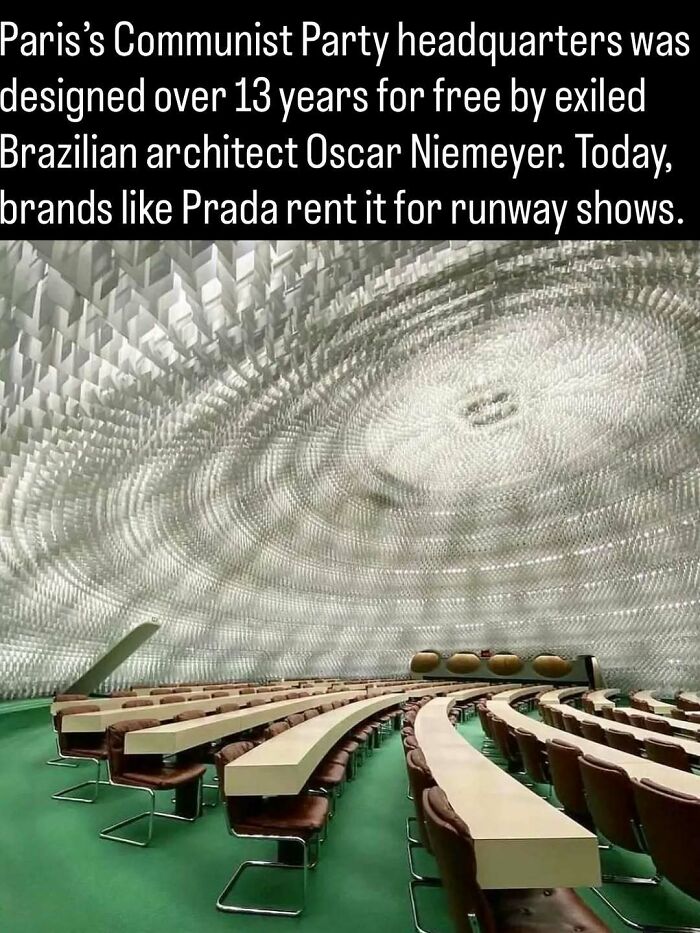
Oscar Niemeyer was already internationally famous for designing many of the futuristic government buildings in Brasília when Brazil’s military dictatorship forced him into exile during the 1960s.
A committed communist since 1945, he settled in Paris and agreed to design a new headquarters for the French Communist Party as an act of political solidarity. He accepted no architectural fee for the work.
Construction began in 1968. The curved, glass-fronted office block opened in 1971, while the underground entrance hall, plaza and distinctive white dome were completed in 1980.
That phased construction accounts for the project’s 13-year timeline.
The building rejected the heavy, rigid appearance commonly associated with communist architecture. Its offices rise on only five concrete supports, making the enormous S-shaped structure appear to float above the ground. Beneath it lies a sweeping underground hall with flowing white walls and almost no sharp corners.
As the French Communist Party declined in membership and revenue, it began renting portions of the building to private companies and event organizers. Prada held a fashion show there in 2000, followed by designers including Thom Browne, Jean Paul Gaultier, Stella McCartney and Yeezy.
Added fact: Niemeyer said the building’s white dome, which covers the party’s main council chamber, was shaped to resemble the belly of a pregnant woman. The complex was officially designated a French historic monument in 2007.
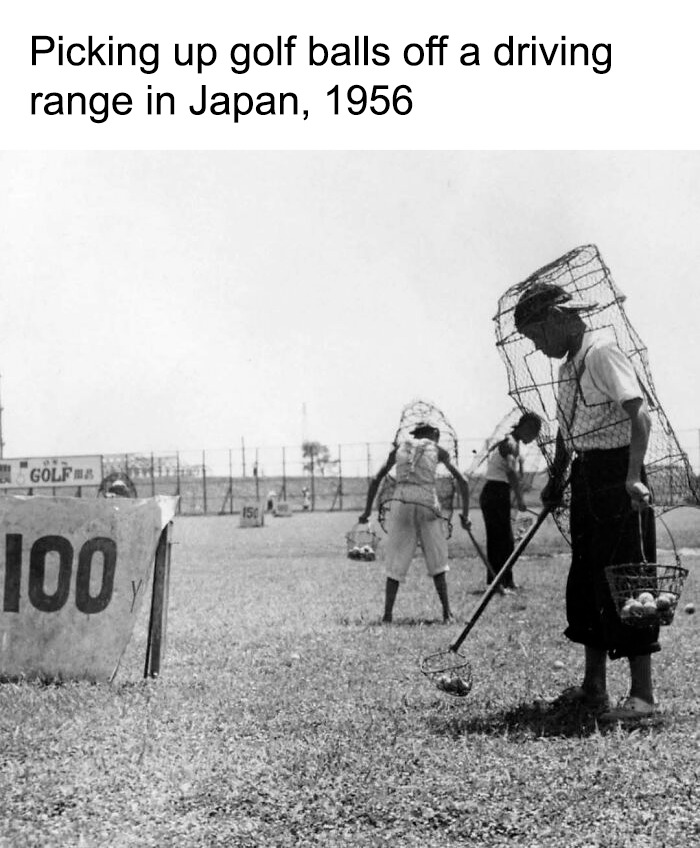
Imagine the stingers off the shin here. Before automated range-picking machines became common, collecting golf balls from a busy driving range could be a surprisingly dangerous job.
Workers had to walk directly onto the range while golfers continued hitting, leaving them exposed to balls traveling at high speed from dozens of different directions.
The solution seen in this photograph was simple: protective wire cages worn over the head and upper body.
The cages acted as crude shields, allowing workers to bend down and retrieve balls while absorbing or deflecting shots that came their way. Using long-handled baskets and scoops, they could gather hundreds of balls without forcing the entire range to shut down.
Golf had already been played in Japan for decades by the time this photograph was taken, but the sport expanded rapidly during the postwar economic boom. Driving ranges became particularly useful in crowded Japanese cities, where finding enough land for a full 18-hole course was difficult.
Eventually, many urban ranges began building the enormous nets and multi-level hitting bays that are now closely associated with golf in Japan.
Mechanical ball collectors gradually eliminated jobs like the one pictured, using rotating discs or rollers to sweep balls from the turf while protected inside a small vehicle.
Added fact: Japan’s first golf course opened at Kobe Golf Club in 1903, more than half a century before this photograph was taken.
The bird had apparently taken shelter inside the wheel well of an F/A-18 Hornet, one of the carrier’s strike fighters. On a warship packed with machinery, jet noise, and constant flight operations, the discovery stood out as one of those strange moments that sailors never forget.
The nickname “Fod” was especially fitting. In naval aviation, “foreign object debris,” or FOD, is taken very seriously because even a small loose object can damage aircraft, engines, or equipment. In this case, though, the “debris” turned out to be a living stowaway.
The stranger part was simply where the owl had managed to hide. An F/A-18’s landing gear compartment is surrounded by hydraulic lines, wiring, structural components and moving machinery, and it is not somewhere a bird would be expected to survive for long.
Before carrier aircraft launch, sailors perform detailed inspections specifically looking for anything that could interfere with the aircraft or become hazardous during flight.
That routine inspection is what makes the photograph so memorable: instead of finding a loose bolt, tool or piece of debris, the sailors discovered an owl tucked inside one of the Navy’s frontline combat aircraft.
Fod was removed safely, giving the crew one of the more unusual maintenance stories to come out of a carrier deployment.
Added fact: Carrier flight decks are routinely walked by crews searching for tiny pieces of FOD because even something as small as a nut, stone or fragment of metal can be sucked into a jet engine and cause serious damage.
Made-up added fact re: "Carrier flight decks are routinely walked by crews searching for tiny pieces of FOD." Since this incident, Eurasian screech owls have been added to the training syllabus.
In May 2010, an unidentified man from Wollaston Lake became stranded while boating in the remote wilderness of northern Saskatchewan.
Rough weather prevented him from returning home, leaving him trapped for several days without food or any reliable way to contact rescuers.
Realizing that a nearby electrical line was his best chance of attracting attention, he began chopping through its wooden poles with an axe. Four poles eventually fell, cutting the only electrical connection serving Wollaston Lake and plunging the isolated community into darkness.
The plan worked. SaskPower knew that a major failure had occurred somewhere along the remote line and sent a crew by helicopter to locate the damage. When the workers arrived, they discovered the four fallen poles—and the exhausted man sheltering beneath his overturned boat.
The repair crew escorted him to safety, and police later confirmed that he had returned home unharmed. SaskPower acknowledged that his actions were driven by desperation but strongly warned others against attempting anything similar. Downed electrical lines may remain energized and can kill anyone who approaches or touches them.
It was an extraordinarily dangerous decision, but also one built on a remarkably accurate prediction of how the utility company would respond.
Added Fact: The outage reportedly cut electricity to roughly 1,200 people in Wollaston Lake, and the community remained without power for approximately 30 hours.
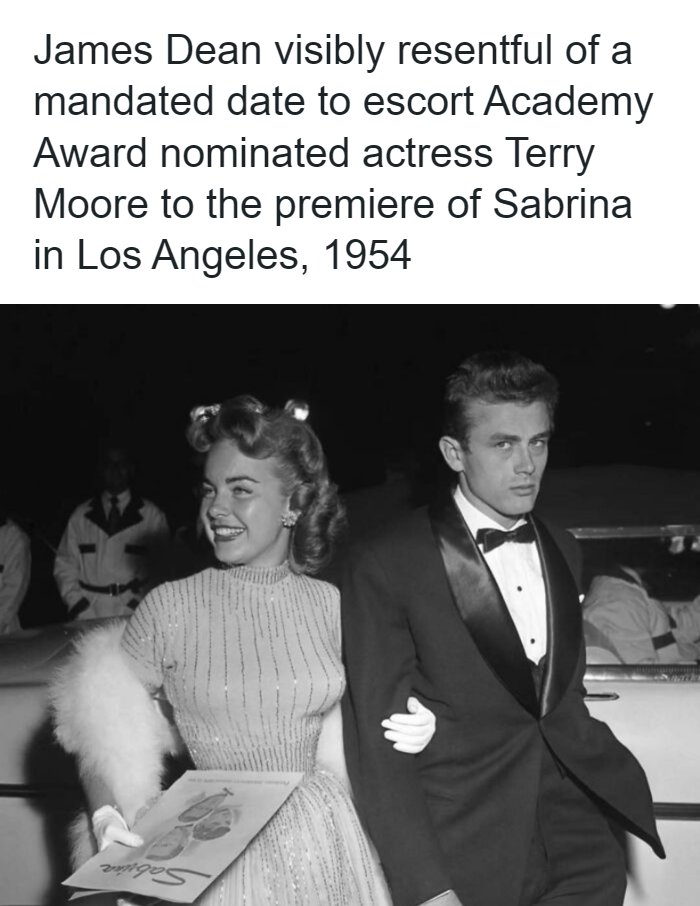
James Dean and Terry Moore arrived together at the Los Angeles premiere of Sabrina on Sept. 22, 1954. Their appearance was reportedly an arranged publicity date rather than a genuine romantic outing, a routine practice during Hollywood’s studio era.
Studios and publicists regularly paired actors at premieres, restaurants and nightclubs to generate photographs and magazine coverage. Moore was already an established star who had received an Academy Award nomination for her performance in Come Back, Little Sheba. Dean, meanwhile, was still an emerging actor whose first leading film had not yet reached theaters.
Moore later recalled taking Dean to the premiere and getting him into a tuxedo. In this particular photograph, she appears delighted by the attention while Dean looks conspicuously tense and uncomfortable.
However, describing him as “resentful” remains an interpretation. A photograph captures only a fraction of a second, and other images from the evening show the pair conversing with fellow guests more normally.
Dean was known for disliking Hollywood formality and carefully manufactured publicity. His visible discomfort therefore fits his reputation, even if nobody can determine his precise thoughts from this image alone.
Added fact: When this photograph was taken, Dean had recently completed filming East of Eden. The movie was released in March 1955, giving him only about six months of major public fame before his death that September.
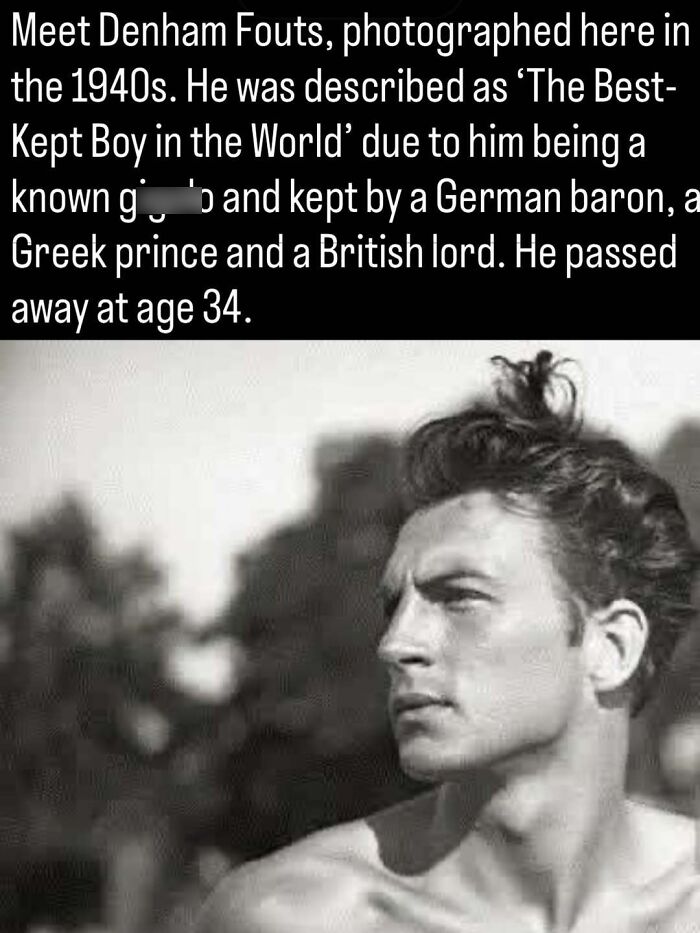
Born Louis Denham Fouts in Jacksonville, Florida, in 1914, “Denny” left an ordinary upbringing for a remarkable life among Europe’s wealthy, royal and literary circles. By his twenties, he had become one of the era’s most famous male escorts. Christopher Isherwood called him “the most expensive male prostitute in the world,” while Truman Capote dubbed him the “Best-Kept Boy in the World.”
Among those linked romantically to Fouts were Evan Morgan, 2nd Viscount Tredegar, wealthy art patron Peter Watson, and Prince Paul of Greece, who became King Paul in 1947. His circle included Capote, Isherwood, Gore Vidal, Jane and Paul Bowles and photographer George Platt Lynes.
His later years were marked by opium addiction. Fouts died in Rome on December 16, 1948, from a congenital heart abnormality involving a hypoplastic aorta and enlarged left ventricle. He was only 34.
Added Fact: Fouts claimed that he and Prince Paul of Greece, the future King Paul, once went together to a tattooist in Vienna and had matching small blue symbols tattooed above their hearts. Truman Capote later repeated the story. Fouts was notorious for embellishing his adventures, so historians cannot confirm it, but the alleged relationship between the American hustler and the future king became one of the most extraordinary stories attached to his life.
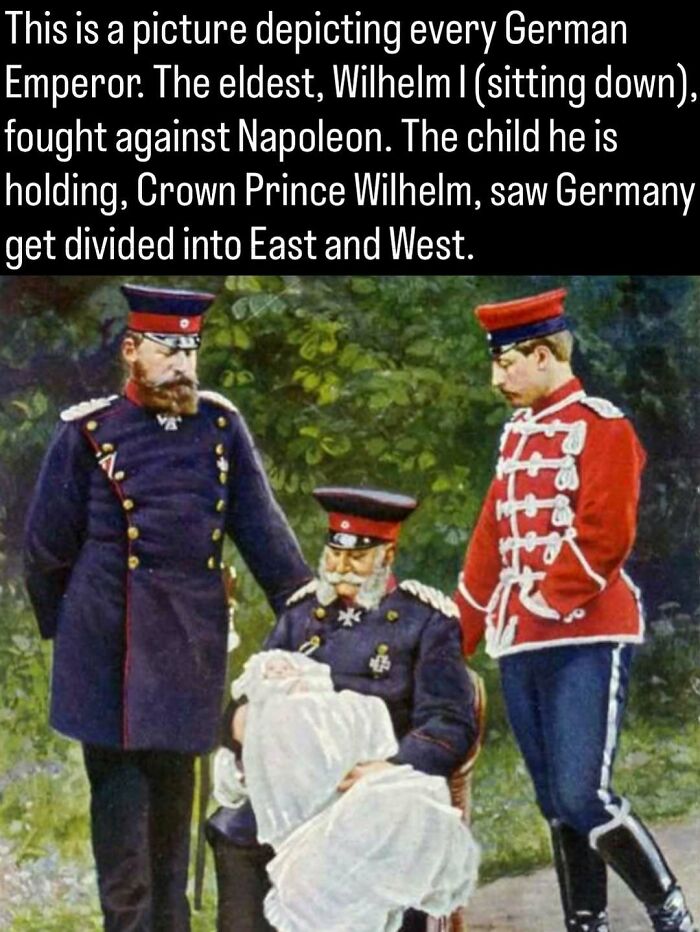
Taken in Potsdam in 1882, it captures four generations of the House of Hohenzollern. Seated at the center is Wilhelm I, the first emperor of a unified Germany.
As a young Prussian prince, he served during the Napoleonic Wars and received the Iron Cross for his actions during the 1814 campaign in France. Decades later, he became German emperor following unification in 1871.
Standing on the left is Wilhelm’s son, Crown Prince Frederick, who eventually became Emperor Frederick III. By the time he inherited the throne in 1888, Frederick was suffering from throat cancer and reigned for only 99 days.
On the right is Frederick’s son, the future Wilhelm II. He succeeded his father in 1888 and became the final German emperor.
His reign included Germany’s rapid industrial and military expansion, but ended with defeat in World War I and the collapse of the monarchy in 1918.
The infant is Wilhelm II’s eldest son and future heir, Crown Prince Wilhelm. He never became emperor. Born during the German Empire, he lived through two world wars, the Nazi era and Germany’s 1949 division into East and West before dying in 1951.
Added fact: Because Wilhelm I, Frederick III and Wilhelm II all occupied the throne during 1888, Germans remembered it as the “Year of the Three Emperors.”
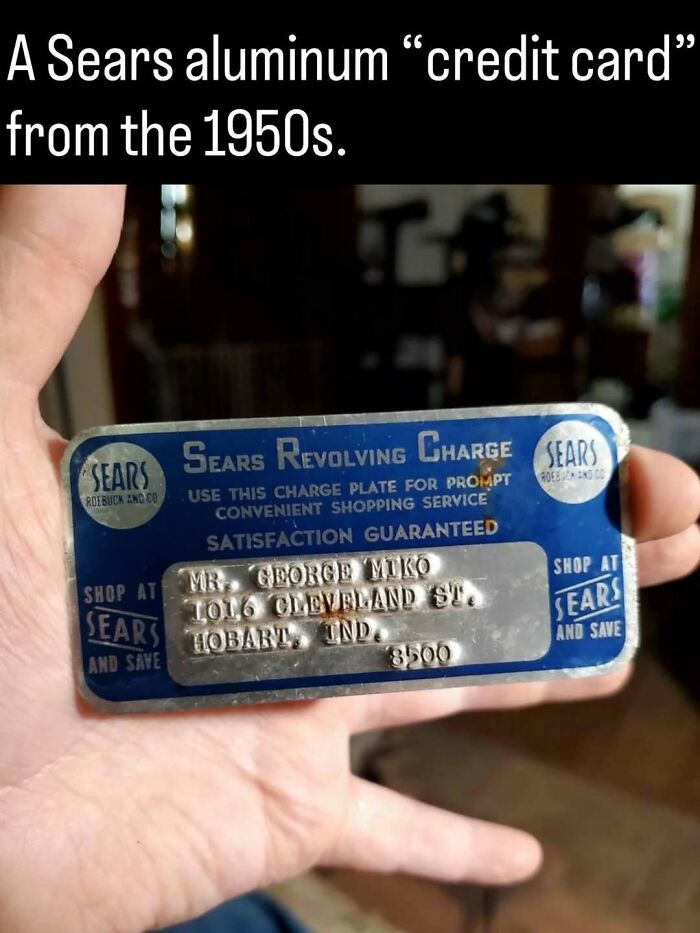
Before magnetic strips, computer chips and contactless payments, many shoppers carried metal charge plates containing their names, addresses and account numbers in raised lettering.
At checkout, a Sears employee placed the plate inside a manual imprinting machine and covered it with a multipart sales slip separated by carbon paper. Sliding a heavy roller across the device pressed the raised information onto every copy, producing a record for the customer, the store and Sears’ accounting department.
The familiar “ka-chunk” sound later associated with plastic credit-card imprinters came from essentially the same process.
This plate advertised Sears’ “Revolving Charge” program. Unlike older store accounts that generally required customers to pay their entire balance each month, revolving credit allowed shoppers to carry part of the debt forward while continuing to make purchases, usually in exchange for interest or finance charges.
It was not a universal credit card. The plate was connected to a Sears account and could normally be used only for purchases from Sears. Nevertheless, it offered many of the basic features modern credit-card users would recognize.
The exact year of this particular plate is uncertain, so “1950s” is safer than 1950. Its address lacks a ZIP Code, indicating that it was likely issued before the nationwide ZIP Code system began in 1963.
Added fact: Sears later entered the general-purpose credit-card industry by launching Discover in 1985, allowing customers to make purchases far beyond Sears stores.
My Amex card still used the same system (in plastic rather than aluminum) in the late 1970s.
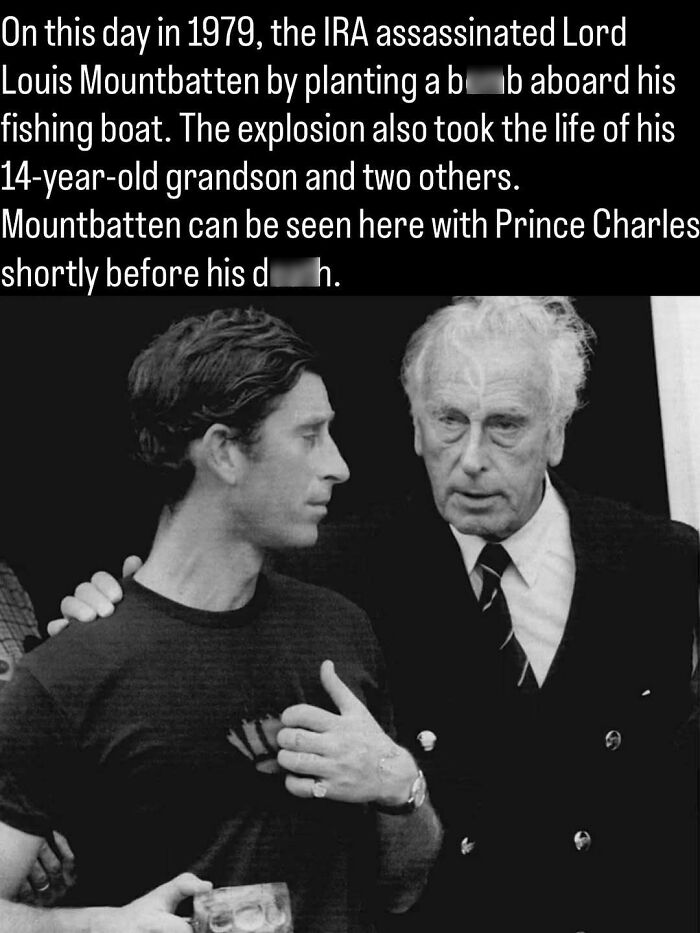
On August 27, 1979, Lord Louis Mountbatten boarded his fishing boat, Shadow V, near his vacation home in Mullaghmore. Members of the Provisional Irish Republican Army had secretly placed a remotely operated bomb aboard the vessel. It exploded after the boat traveled into Donegal Bay.
Mountbatten, 79, was pulled from the water but died from his injuries. Three others were also killed: his 14-year-old grandson Nicholas Knatchbull; 15-year-old crew member Paul Maxwell; and 83-year-old Doreen Knatchbull, the Dowager Lady Brabourne. Several surviving passengers suffered serious injuries.
One geographical detail in the original caption is incorrect: the bombing occurred off County Sligo in the Republic of Ireland, not Northern Ireland.
Mountbatten had served as Britain’s final viceroy of India, overseeing the transition to independence and partition in 1947. He was also a senior Royal Navy commander and an influential mentor to the future King Charles III, who regarded him as an honorary grandfather.
The IRA claimed responsibility, presenting the assassination as an attack on a prominent representative of the British establishment. Hours later, another IRA attack at Warrenpoint killed 18 British soldiers, making August 27, 1979, one of the deadliest days of the Troubles.
Added fact: Thomas McMahon was convicted of murdering Mountbatten and sentenced to life imprisonment, but was released in 1998 under the Good Friday Agreement.
Kierkegaard, the 19th-century Danish philosopher often regarded as one of the founders of existentialism.
This quote appears in Either/Or, published in 1843, in a passage built around the seemingly unavoidable nature of regret.
Kierkegaard writes that whether you marry or remain unmarried, laugh at the world or weep over it, you will regret either choice.
His point was not simply that every decision ends badly. Instead, he was exposing the frustrating structure of human choice: choosing one path means permanently surrendering another.
Even a good decision can leave a person wondering what might have happened if they had chosen differently.
Refusing to decide offers no escape, because inaction is itself a decision with consequences.
The line captures the anxiety created by freedom, the knowledge that we must make choices without ever knowing exactly where the alternatives would have led.
There is also a layer of irony. The passage is deliberately exaggerated and written from the perspective of an “aesthetic” personality who avoids commitment by endlessly analyzing every possibility. Kierkegaard ultimately believed that a meaningful life required choosing and committing, despite uncertainty.
Added Fact: Kierkegaard published Either/Or under the pseudonym Victor Eremita, Latin for “victorious hermit,” and presented himself as the editor of writings supposedly discovered inside a secret drawer.
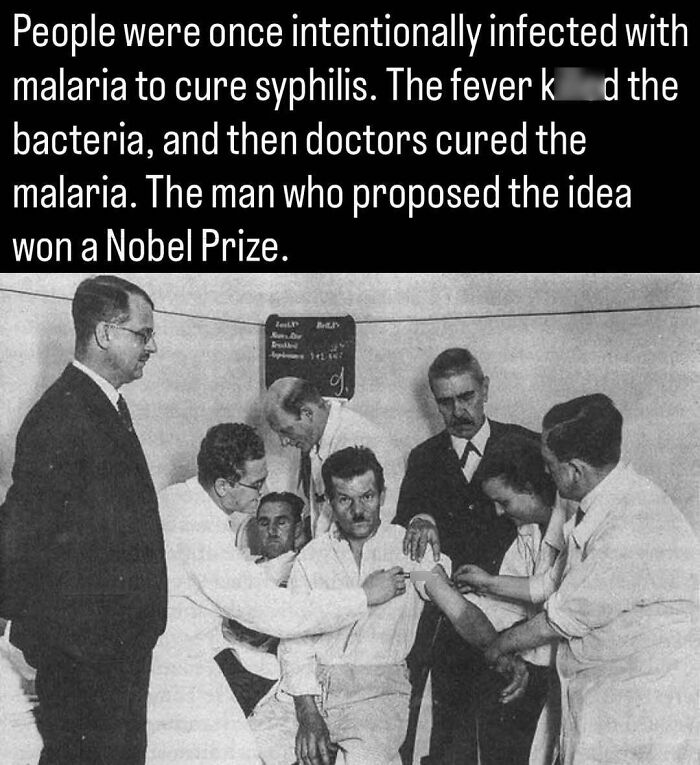
Before antibiotics, a syphilis infection could become a devastating and sometimes fatal disease. In its later stages, the infection could attack the brain and nervous system, causing paralysis, seizures, personality changes, dementia and eventually death. Doctors had few reliable options for patients who reached this point.
In 1917, Austrian psychiatrist Julius Wagner-Jauregg introduced a treatment that sounds almost unthinkable today: deliberately infecting patients suffering from neurosyphilis with malaria.
His reasoning was based on an observation that high fevers sometimes seemed to improve psychiatric conditions. Malaria could repeatedly push a patient’s body temperature above 104°F, and the heat could damage the Treponema pallidum bacteria responsible for syphilis. Doctors would allow several cycles of malarial fever before treating the malaria, typically with quinine.
Known as malariotherapy, the procedure was dangerous and some patients died from the treatment itself. But before penicillin existed, it offered hope against a disease for which doctors had very few effective treatments.
Wagner-Jauregg received the 1927 Nobel Prize in Physiology or Medicine for developing the therapy. Malariotherapy largely disappeared after penicillin became widely available in the 1940s.
Added Fact: Wagner-Jauregg remains the only psychiatrist to have received the Nobel Prize in Physiology or Medicine for a treatment developed specifically for a psychiatric condition.
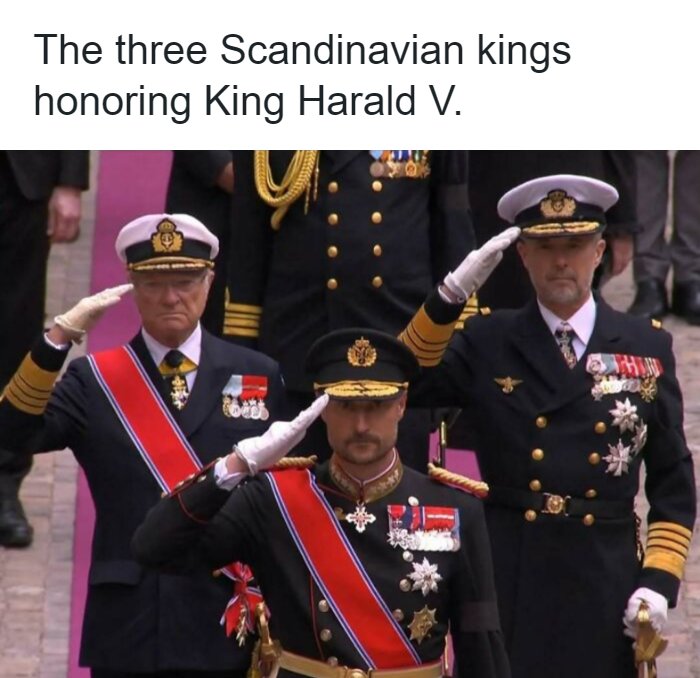
On the left is King Carl XVI Gustaf of Sweden, who has reigned since 1973. In the center is Harald’s son and successor, the newly ascended King Haakon VIII of Norway. On the right is King Frederik X of Denmark, who became king following the abdication of his mother, Queen Margrethe II, in 2024.
The three kings were photographed as Norway honored Harald after his death at age 89. A 21-gun salute marked the beginning of the funeral procession, which carried his coffin from the Royal Palace to Oslo Cathedral. Members of the Norwegian royal family walked behind it as tens of thousands of people filled the streets of the capital.
Harald had occupied the Norwegian throne for 35 years, beginning his reign in 1991 after the death of his father, King Olav V. He became widely respected for modernizing the monarchy while remaining a stable and unifying presence during periods of national celebration and tragedy.
Following the cathedral service, Harald was laid to rest during a private ceremony at the Royal Mausoleum inside Akershus Fortress.
Added Fact: Harald V was the first prince born in Norway in 567 years, arriving in 1937 after generations of Norwegian monarchs and heirs had been born abroad.
On Sept. 4, 2026, the United Nations General Assembly overwhelmingly endorsed a resolution encouraging wider use of the Equal Earth projection. The resolution received support from 164 countries, with six abstentions and the United States casting the only opposing vote.
The familiar Mercator projection was created by Flemish cartographer Gerardus Mercator in 1569. It was designed primarily for maritime navigation because it preserves compass directions, allowing sailors to plot straight courses across the ocean. However, stretching the curved surface of Earth onto a rectangle severely enlarges land near the poles.
This distortion makes Greenland appear roughly comparable in size to Africa, even though Africa is approximately 14 times larger. Russia, Canada, Europe and North America are also shown much larger relative to regions near the equator, including Africa and South America.
Created by cartographers Bojan Šavrič, Tom Patterson and Bernhard Jenny in 2018, Equal Earth is an “equal-area” projection. This means countries and continents retain their correct sizes relative to one another, although their shapes, angles and distances are still distorted.
The UN resolution is nonbinding, so it does not ban Mercator maps or require governments, schools and technology companies to replace them. Instead, it encourages organizations to use equal-area maps whenever accurately comparing the sizes of countries and continents is important.
Added Fact: No flat world map can perfectly preserve size, shape, distance and direction simultaneously. Every map projection must distort at least one of those features because Earth is curved.
National Geographic in the USA gave up on the awful Mercator projection in the year 1922, replacing it in turn by three better map projections. I rate the Mercator projection as the third worst map projection ever invented. Outdone for awfulness only by Gall-Peters and Dymaxion.
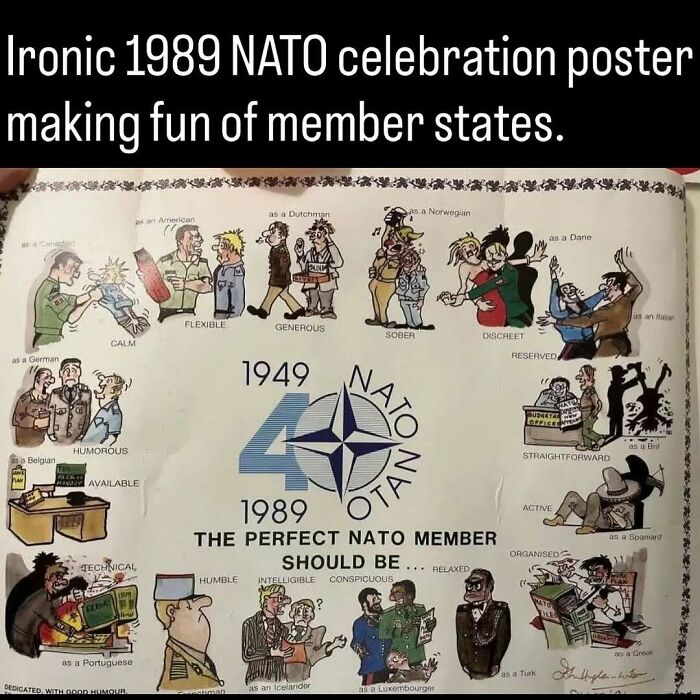
Created for NATO’s 40th anniversary, this poster imagined the “perfect NATO member” by assigning every country a quality that humorously contradicted a familiar national stereotype.
The ideal member would be “calm as a Canadian,” “flexible as an American,” “generous as a Dutchman,” “sober as a Norwegian” and “discreet as a Dane.” The jokes continue around the poster: reserved as an Italian, straightforward as a Briton, active as a Spaniard, organized as a Greek, relaxed as a Turk, conspicuous as a Luxembourger, intelligible as an Icelander, humble as a Frenchman, technical as a Portuguese, available as a Belgian and humorous as a German.
The illustrations make the sarcasm unmistakable. The “sober” Norwegian appears intoxicated, the “discreet” Dane embraces a woman, the “organized” Greek is buried beneath papers and the “straightforward” British figure appears to be concealing questionable activities.
Although built around exaggerated and sometimes outdated stereotypes, the poster was presented as affectionate military humor. A message along the bottom states that it was “dedicated, with good humour,” suggesting that the alliance was comfortable enough to laugh at the cultural differences within its own ranks.
Its timing was remarkable: NATO marked its anniversary in 1989, the same year communist governments began collapsing across Eastern Europe and the Berlin Wall fell.
Added fact: NATO had 16 members in 1989. Spain, represented here as “active,” was the newest, having joined the alliance in 1982.
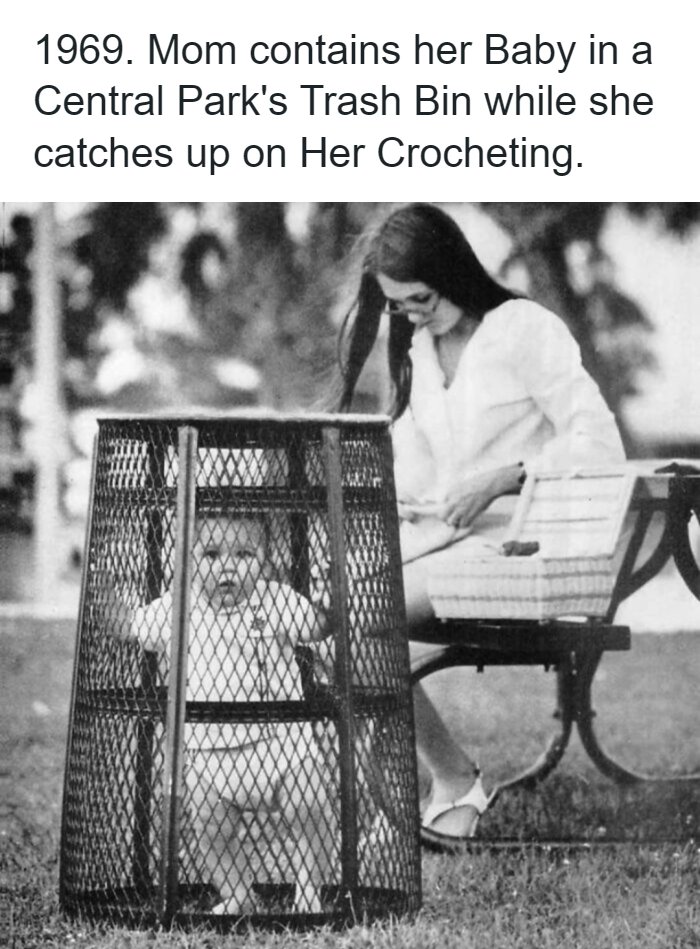
The photograph captures a mother calmly working on her crocheting while her baby sits beneath an overturned metal trash basket being used as an improvised playpen.
Although the scene looks alarming by modern standards, the open metal framework allowed the child to see outside and receive fresh air while preventing the baby from crawling away. The mother remained seated only a few feet behind the child.
The image appeared in the May 30, 1969, issue of LIFE magazine, which regularly devoted its final page to photographs considered unusual, humorous or thought-provoking. LIFE reportedly presented the picture beneath the joking title, “Lady, Is This Your Litter?”
The photograph reflects a period when attitudes toward supervision, public safety and parenting differed considerably from those of today. Children commonly experienced levels of independence that would now be considered unusual, while improvised solutions frequently took the place of specialized products.
By 1969, portable playpens were already available, but they were often made from wood or metal and could be heavy and inconvenient to transport. Faced with an energetic baby and a quiet afternoon in the park, this mother apparently used what was immediately available.
Added fact: The photograph was taken by Ricardo Ferro, a staff photographer associated with Florida’s St. Petersburg Times and Evening Independent newspapers.

Has nobody thought of the hygiene issue? The baby is holding the sides of the bin and being a baby will very likely put his/her hand in their mouth. I have seen this picture often and can't help wondering what the mother was thinking. Heaven knows what has been in that bin.
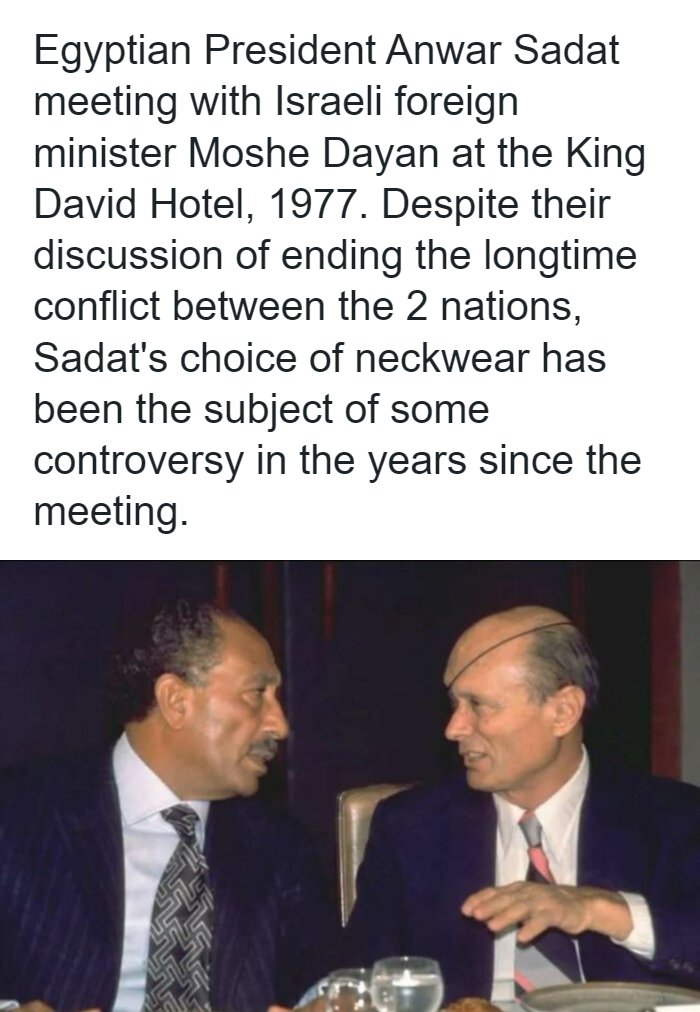
Anwar Sadat meeting Israeli Foreign Minister Moshe Dayan in Jerusalem, November 1977. Look closely at Sadat’s tie.
Its repeating geometric pattern bears an unmistakable resemblance to swastikas — an extraordinary visual detail considering where he was and whom he was meeting.
But there is an important distinction: while claims have circulated for years that Sadat deliberately wore the tie as a provocation, there does not appear to be reliable historical evidence proving that was his intention.
The larger story surrounding the photograph was remarkable enough.
On November 19, 1977, Sadat landed in Israel, becoming the first Arab head of state to officially visit the country. Only four years earlier, Egypt and Israel had been fighting each other in the Yom Kippur War.
The trip was so unexpected that even some Israeli military leaders initially questioned whether Sadat’s peace initiative could somehow be a deception.
Sadat stayed at Jerusalem’s King David Hotel and met Israeli Prime Minister Menachem Begin, Foreign Minister Moshe Dayan and other officials. The following day, he addressed the Knesset, telling Israelis directly that he was prepared to pursue peace while also demanding Israeli withdrawal from territories captured in 1967 and recognition of Palestinian rights.
Perhaps the most remarkable contrast with the tie came elsewhere during the same trip.
Sadat visited Yad Vashem, Israel’s Holocaust memorial, where he viewed exhibits documenting the murder of six million Jews under Nazi Germany.
His visit helped break a psychological barrier that had existed between Egypt and Israel for decades and eventually contributed to the 1978 Camp David Accords and the Egyptian-Israeli peace treaty signed in 1979.
Added Fact: Before Sadat made the trip, the idea seemed so improbable that his own foreign minister resigned in protest. Syria opposed the visit, Libya threatened to sever relations with Egypt, and protests erupted elsewhere in the Arab world. Sadat went anyway.
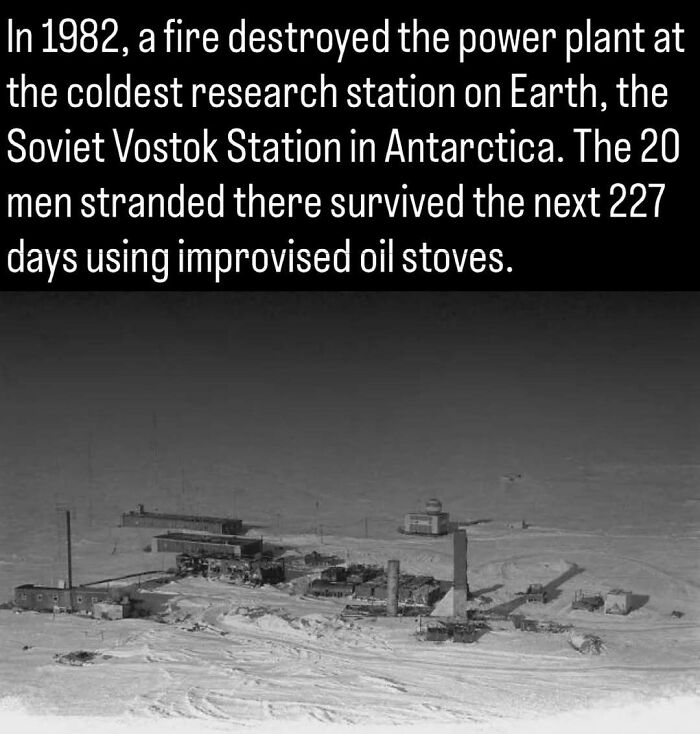
The fire broke out on April 12, just as Antarctica was entering its long, sunless winter. Vostok’s chief mechanic, Aleksei Karpenko, died while attempting to fight the flames, and the station’s main diesel generators were destroyed.
The remaining expedition members were suddenly left without the electricity required for normal heating, lighting and melting ice for water. Evacuation was impossible. Vostok sits deep within the Antarctic interior, more than 800 miles from the geographic South Pole, and aircraft could not safely reach the station during the winter.
The men recovered an old backup generator, but it could provide only enough electricity for limited lighting and radio communication. To conserve warmth, they abandoned much of the station and crowded together inside a few small rooms.
They constructed basic stoves using wicks soaked in diesel fuel, leaving their living quarters cold and filled with soot.
For 227 days, the crew endured extreme temperatures, constant darkness and almost complete physical isolation. Their ordeal finally ended in November, when an overland tractor convoy reached Vostok with replacement equipment and supplies.
Added fact: In July 1983, Vostok recorded a temperature of −128.6 degrees Fahrenheit—the lowest air temperature ever directly measured at Earth’s surface.
So they had not yet invented cameras that could take a sharp image yet?
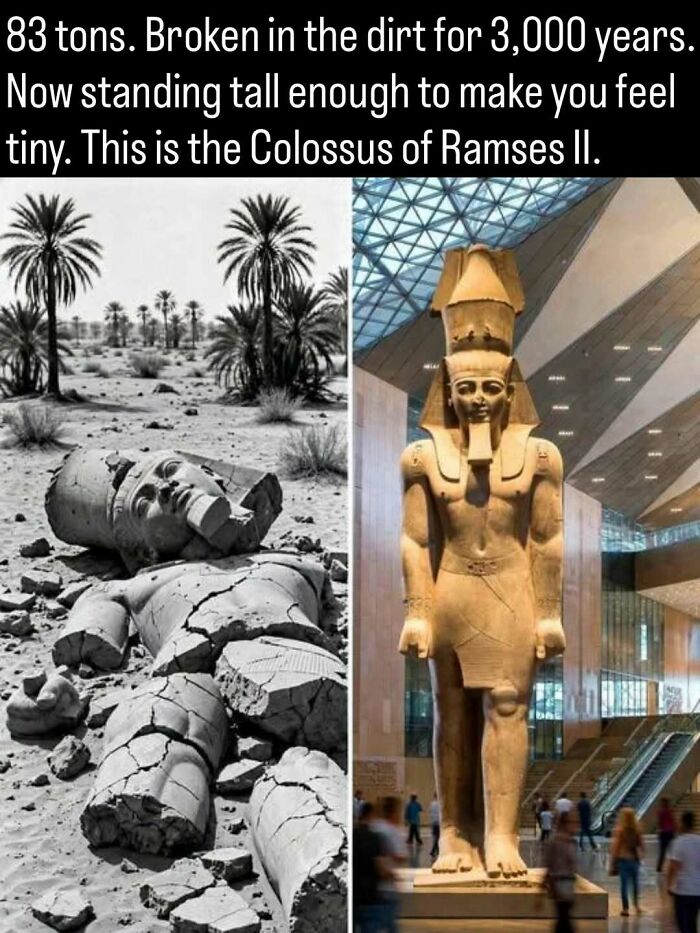
The colossal statue was discovered in 1820 at Mit Rahina, the site of ancient Memphis, by Italian explorer Giovanni Battista Caviglia. Carved from red granite more than 3,000 years ago, it had broken into several large pieces near the ruins of the great temple of Ptah.
Moving it initially proved so difficult and expensive that the statue remained at Memphis for more than a century. In 1955, its fragments were transported to Cairo, reassembled and erected outside the city’s main railway station. The surrounding plaza soon became known as Ramses Square.
For roughly 50 years, the pharaoh stood above one of Cairo’s busiest intersections. Traffic vibrations, exhaust fumes and pollution, however, threatened the ancient granite. In August 2006, engineers moved the 83-ton statue through Cairo during an elaborate nighttime operation watched by thousands of people.
It was placed temporarily near the Giza pyramids while the Grand Egyptian Museum was being constructed. In January 2018, the statue made its final journey into the museum’s enormous entrance atrium, where it now greets visitors.
Ramses II ruled Egypt for approximately 66 years and commissioned statues, temples and monuments across the kingdom, ensuring that his image would survive for millennia.
Added Fact: The statue originally formed part of a pair that stood near the eastern entrance of the temple of Ptah at Memphis. Its companion remains displayed lying down at the open-air museum in Mit Rahina.
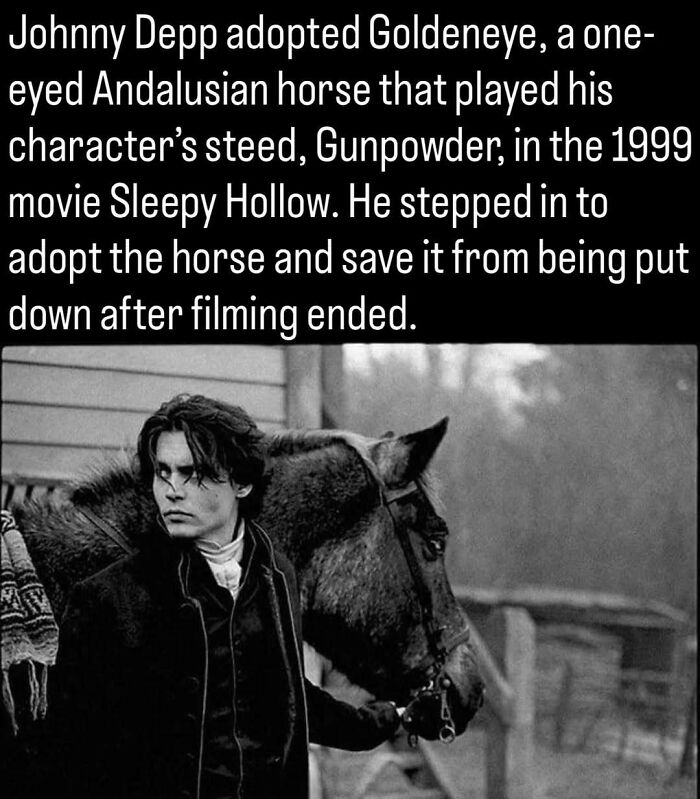
Tim Burton’s Sleepy Hollow was released in 1999 and starred Johnny Depp as Ichabod Crane, a New York constable sent to investigate a series of mysterious murders in the isolated village of Sleepy Hollow.
Because the film is set in 1799, horses were essential to creating the period setting. Depp’s character spends much of the story traveling on horseback, with Gunpowder becoming one of the most recognizable animals in the movie.
Goldeneye reportedly had only one eye and had already worked as a trained movie horse by the time filming began. After production wrapped, Depp learned that the horse’s future was uncertain and decided to take responsibility for him rather than allow him to be euthanized.
It became one of those unusual cases in which the relationship between an actor and an animal used on set continued long after the cameras stopped rolling.
Sleepy Hollow itself became a major success, earning more than $200 million worldwide and winning the Academy Award for Best Art Direction.
Added fact: Much of Sleepy Hollow was filmed on elaborate sets constructed in England, including an entire artificial village built specifically to give Tim Burton complete control over the movie’s eerie, late-18th-century appearance.
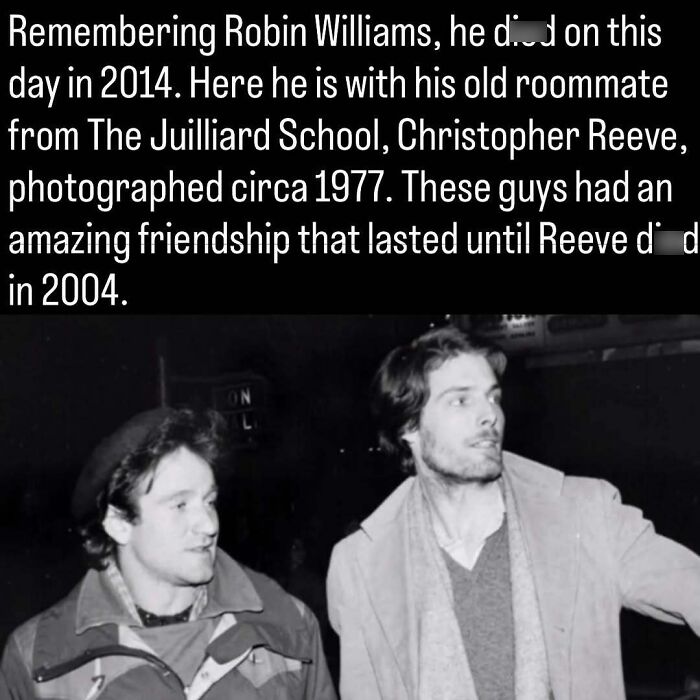
Robin Williams and Christopher Reeve met as students at Juilliard in New York in the early 1970s, where they became close friends long before either was famous. Their personalities were almost opposites. Reeve was disciplined and classically trained, while Williams was already known for the unpredictable humor and improvisation that would eventually make him one of the most recognizable comedians in the world.
Their friendship continued as their careers exploded. Reeve became Superman, while Williams broke through with Mork & Mindy before building an extraordinary career in comedy and film.
Their bond became especially important after Reeve was paralyzed in a 1995 horseback-riding accident. While Reeve was hospitalized and facing an uncertain future, Williams arrived pretending to be an eccentric Russian doctor preparing to perform a rectal examination. Reeve later recalled that it was the first time after his accident that he truly laughed, and the visit helped remind him that life could still contain joy.
Reeve died in 2004 at 52. Williams died ten years later, on August 11, 2014, at 63.
Added Fact: Reeve and Williams became so close that they reportedly referred to one another as “brother,” and their families remained closely connected long after their Juilliard years.
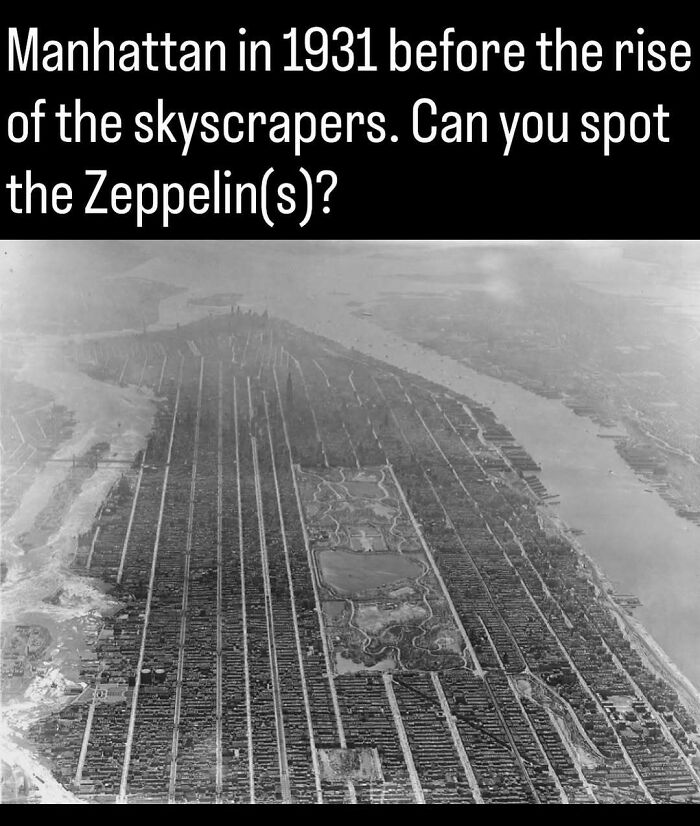
This remarkable aerial view shows Manhattan in 1931, with Central Park cutting a huge rectangular opening through an otherwise densely packed island.
Look closely above the city and you can make out an airship, a sight that was far less unusual in the skies of the early 20th century than it would be today.
Manhattan was already kind of in the middle of its great skyscraper boom by 1931.
The Chrysler Building had opened the previous year, while the Empire State Building was completed in 1931 and immediately became the tallest building in the world.
There were a few earlier landmarks such as the Woolworth Building had already been reshaping the skyline for decades.
Airships were part of that same futuristic atmosphere.
They were enormous lighter-than-air craft used for military purposes, passenger travel and publicity flights.
The Library of Congress photograph actually shows two airships flying above Manhattan with Central Park below, demonstrating just how surreal the city’s skies could look during this period.
One of the most amazing things about New York City, in my opinion, is the fact that Central Park, which opened in the 19th century, has been able to remain in fact, a park.
Added Fact: The Empire State Building originally included a mooring mast at its summit that was promoted as a potential docking point for airships, although the idea proved impractical and was quickly abandoned.
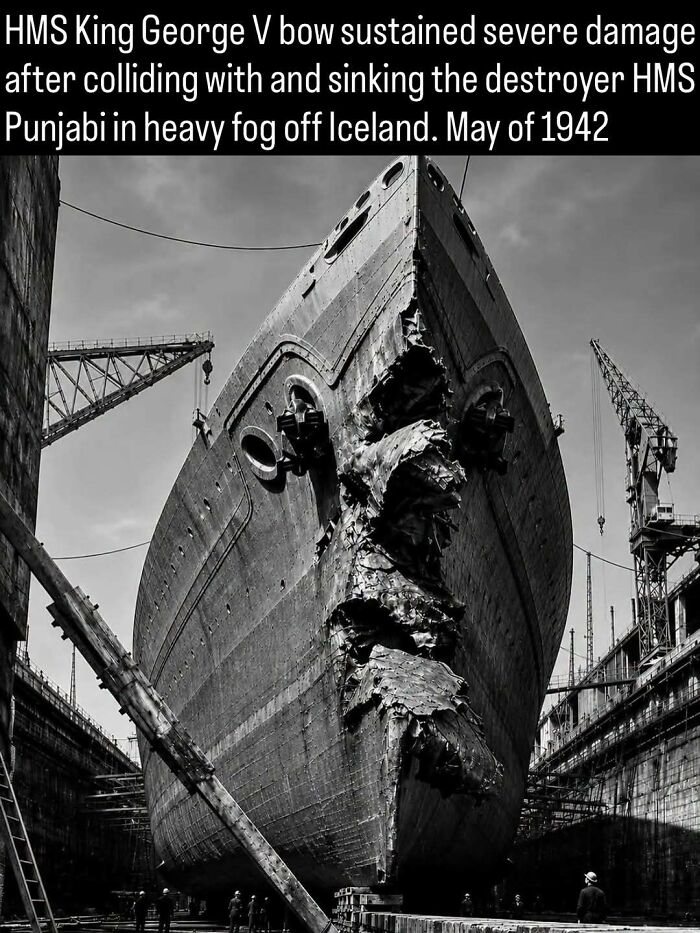
The accident occurred while the two Royal Navy warships were escorting Arctic Convoy PQ 15 to the Soviet Union.
Thick fog reduced visibility to almost nothing when HMS Punjabi unexpectedly crossed the battleship’s path.
Despite attempts to avoid a collision, the 42,000 ton King George V struck the much smaller destroyer with tremendous force, cutting deeply into her hull.
Punjabi sank within minutes. Of her crew of 219 officers and sailors, 49 lost their lives, while the survivors were rescued by nearby escort vessels. King George V suffered extensive damage to her bow but remained seaworthy. After temporary repairs in Iceland, she returned to Britain, where a completely new bow section was fitted before rejoining the fleet.
The loss of Punjabi was a sobering reminder that even outside enemy action, the Arctic convoys were extraordinarily dangerous. Crews faced freezing temperatures, violent seas, drifting ice, and poor visibility while protecting vital supplies destined for the Soviet Union.
Added Fact: After her repairs, HMS King George V went on to serve in the Mediterranean and Pacific. On September 2, 1945, she was present in Tokyo Bay for the formal Japanese surrender that ended the Second World War.
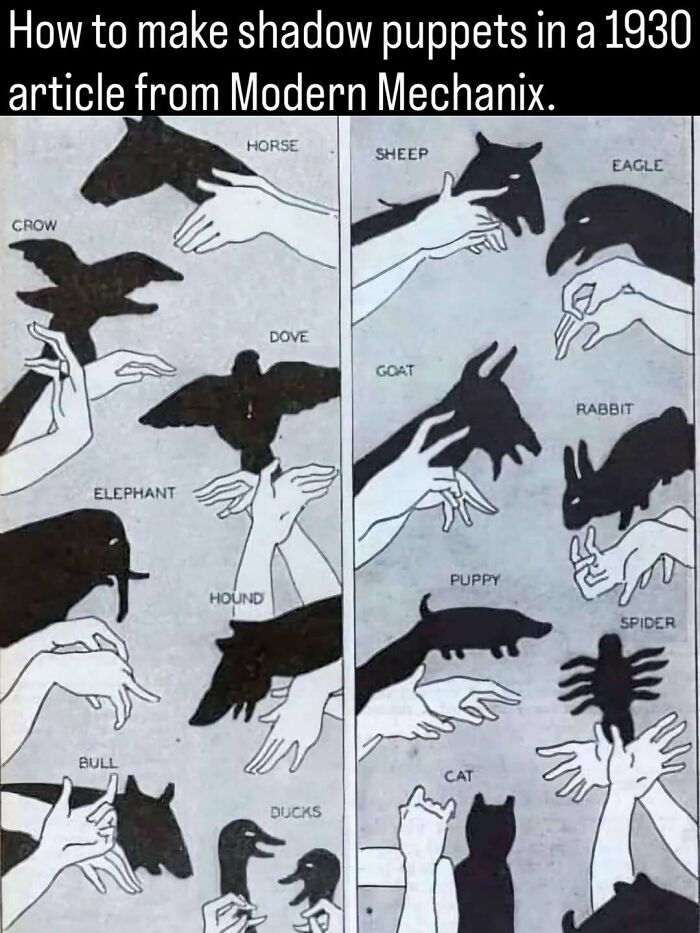
Long before televisions became common household fixtures, shadow puppets offered an easy form of entertainment requiring nothing more than a pair of hands, a light and a blank wall.
This illustrated guide showed readers how to position their fingers and arms to create recognizable silhouettes of animals.
The designs ranged from familiar creatures such as a horse, rabbit and cat to more complicated figures, including an elephant, eagle and spider. Some required only one person’s hands, while others depended on two people coordinating their movements to complete the illusion.
When placed between a bright lamp and a wall or sheet, the hands blocked the light and transformed into enlarged animal shadows.
The spirit of early popular mechanics magazines was to teach readers how to build household gadgets, perform tricks, conduct experiments and create inexpensive entertainment.
During the early years of the Great Depression, activities that required little or no money would have been especially appealing to families looking for ways to entertain themselves at home.
Added Fact: Shadow puppetry is far older than this 1930 guide. Elaborate traditions using carved figures developed centuries ago in parts of Asia, particularly China, India and Indonesia. The Indonesian form known as wayang kulit uses intricately decorated leather puppets positioned behind a screen and illuminated from behind.
When construction of the Typhoon class began in the late 1970s, it represented the Soviet Union’s most ambitious submarine program of the Cold War. Built at the Sevmash shipyard in Severodvinsk, the massive vessels were designed to carry 20 R-39 intercontinental ballistic missiles, each equipped with multiple nuclear warheads capable of striking targets thousands of miles away.
At nearly 576 feet (175 meters) long and displacing about 48,000 tons submerged, the Typhoon remains the largest class of submarines ever built. Its unusual twin pressure hull design provided greater buoyancy and survivability while allowing it to operate beneath thick Arctic ice, where it could remain hidden and launch missiles if nuclear war erupted.
Only six Typhoon class submarines were completed between 1981 and 1989. Following the collapse of the Soviet Union, most were retired and dismantled under international arms reduction agreements.
Added Fact: The Typhoon class inspired the fictional submarine Red October in Tom Clancy’s 1984 novel The Hunt for Red October, although the book’s nearly silent propulsion system, known as the “caterpillar drive,” was entirely fictional.
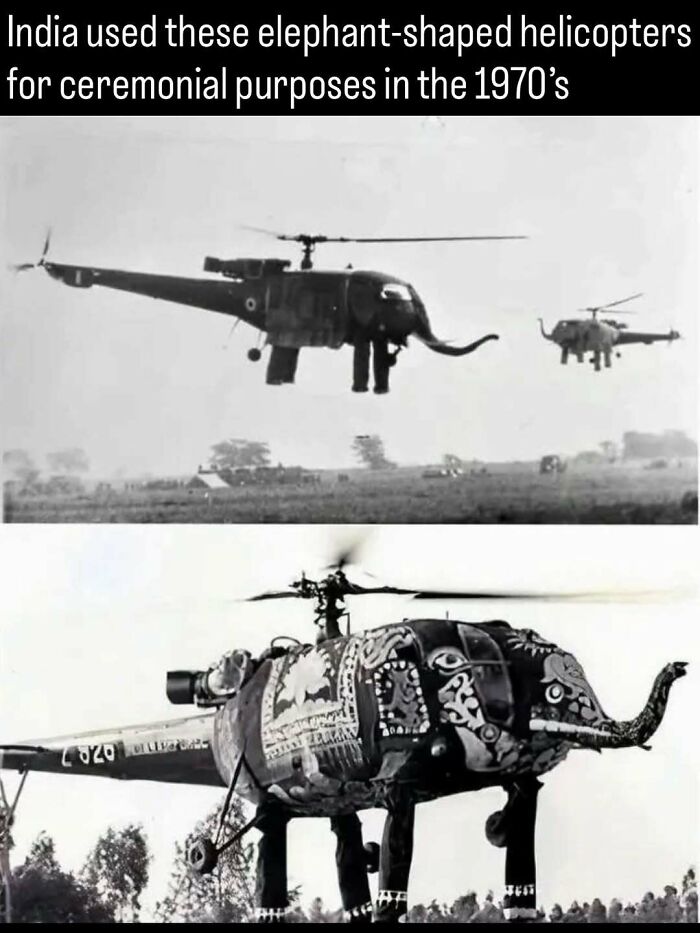
These were Indian Air Force Chetak helicopters, Indian-built versions of the French Aérospatiale Alouette III. During Republic Day celebrations, helicopters from No. 116 Helicopter Unit were transformed into enormous flying elephants for displays over New Delhi.
The transformation was surprisingly low-tech. A tailor was brought to the air base weeks before the event and created fabric panels forming the elephant’s body, ears, legs, trunk and decorative coverings. Much of the helicopter’s cockpit was concealed, leaving narrow openings through which the pilot could see.
Flying the aircraft required unusual precautions. Pilots generally kept speeds around 40–45 knots because higher speeds risked tearing away the fabric or allowing it to become entangled in the tail rotor. During displays, the “elephant” descended to roughly 910 feet over Rajpath and performed a short aerial “dance” before climbing away.
The Indian Air Force used the elephant display during several Republic Day flypasts between 1970–73 and again from 1979–85.
Added Fact: The elephant wasn’t the only disguise. Chetak helicopters were also transformed into a giant flying fish, and in 1993 one was dressed as a dodo for Mauritius’s Independence Day celebrations.
Before microprocessors, making a missile guide itself required an extraordinary amount of dedicated hardware.
Engineers had to perform navigation, stabilization and control functions using combinations of transistors, diodes, resistors, capacitors, gyroscopes, amplifiers and electromechanical components, all connected by dense bundles of wiring.
The electronics had to continually determine the missile’s orientation and movement, compare that information with its intended flight path, and send corrections to the control surfaces or steering system.
Modern processors can perform enormous numbers of these calculations on a tiny chip, but early guidance systems often divided those tasks among numerous individual circuits.
Reliability was an equally difficult problem. Missile electronics had to survive intense vibration, acceleration and rapid changes in temperature while still functioning accurately.
Components were therefore carefully secured, protected and tested because a single failure could make the entire weapon useless.
The first commercial microprocessor, Intel’s 4004, would not appear until 1971. By then, military and aerospace engineers had already spent years developing increasingly compact digital guidance computers using discrete electronic components and early integrated circuits.
Added fact: The guidance computer used in the early Minuteman I missile contained more than 1,500 transistors, 6,000 diodes, 5,000 resistors and 1,100 capacitors, yet the entire computer still had to fit inside the missile.
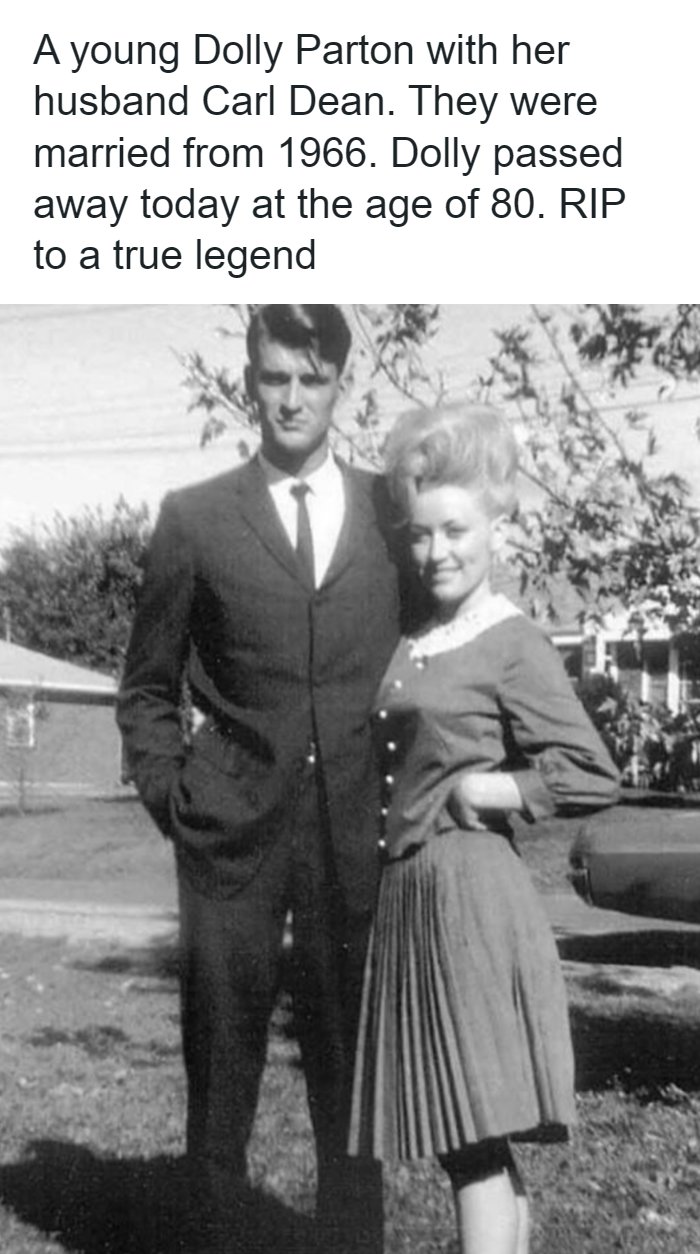
Dolly met Carl outside the Wishy Washy Laundromat in Nashville in 1964, on the first day she arrived in the city to pursue a career in music. She was 18, and he was 21. Two years later, they married in a small ceremony in Ringgold, Georgia, attended only by Dolly’s mother, the minister and the minister’s wife.
Their marriage endured for nearly six decades, even as Dolly became one of the most recognizable entertainers in the world. Carl avoided the spotlight, rarely attended public events and largely declined interviews. Dolly often joked that his privacy led some people to question whether he existed at all.
Behind her glamorous public persona, their relationship remained one of the most private and enduring marriages in entertainment. They never had children, but Dolly helped raise several of her younger siblings and became affectionately known as “Aunt Granny” within her family.
Carl died on March 3, 2025, at age 82. Dolly later spoke openly about the physical and emotional toll of losing the man who had been beside her since before she became famous.
On August 25, 2026, Dolly Parton’s family announced that the country music legend had died at age 80.
Added fact: Dolly wrote “Jolene” after a young bank teller began paying unusually close attention to Carl. She borrowed the name from a little girl she met after a concert because she loved the way it sounded.
By the late 1950s, New York police were confronting a rapidly changing city. Puerto Rican migration had transformed neighborhoods across Manhattan, Brooklyn and the Bronx, creating an obvious practical problem for thousands of officers who spoke only English.
Training sometimes focused on the phrases an officer would need immediately on the street. Instead of beginning with Spanish grammar, English speaking officers could memorize phonetic approximations such as “COH MOH” for cómo and “OO STEHD” for usted.
The effort coincided with broader changes inside the department. The NYPD Hispanic Society had been incorporated in 1957 to support officers of Spanish descent and improve relations between police and New York’s growing Latino population.
Police training itself was becoming increasingly professionalized. In September 1958, the NYPD hosted an international training institute attended by 170 law enforcement officials from the United States and abroad.
Added Fact: In the mid 1950s, the entire NYPD reportedly had fewer than 40 Hispanic officers. Four decades later, it had nearly 5,000.
This photograph was taken on November 4, 1995, as National Security Adviser Anthony Lake informed President Bill Clinton that Israeli Prime Minister Yitzhak Rabin had been assassinated.
Rabin had just attended a massive peace rally in Tel Aviv supporting the Oslo Accords, the controversial agreements intended to establish a path toward peace between Israel and the Palestinians. As Rabin left the rally and approached his car, he was shot by Yigal Amir, a Jewish Israeli extremist fiercely opposed to surrendering territory or negotiating with the Palestine Liberation Organization.
Rabin’s death was personal for Clinton. The two men had developed a close political partnership during the peace process. In September 1993, Clinton had stood between Rabin and PLO Chairman Yasser Arafat on the White House lawn as the two leaders exchanged their historic handshake following the first Oslo agreement.
After learning that Rabin had been shot, Clinton initially released a statement condemning the attack. Once Rabin’s death was confirmed, he addressed the American people and described him as a friend and a courageous leader for peace.
Two days later, Clinton traveled to Jerusalem for Rabin’s funeral, joining leaders from across the world. He delivered an emotional eulogy honoring Rabin’s transformation from soldier to peacemaker.
Added Fact: Clinton ended his funeral remarks with the Hebrew words “Shalom, haver”—“Goodbye, friend.” The phrase became one of the most enduring public tribute
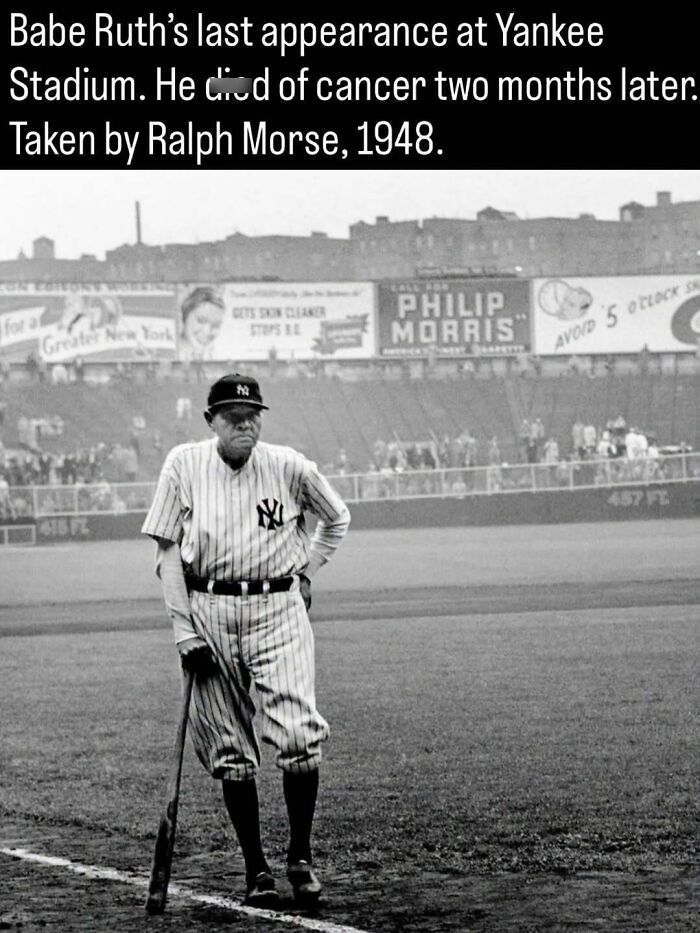
Ruth returned to Yankee Stadium on June 13, 1948, for a ceremony celebrating the ballpark’s 25th anniversary and officially retiring his famous No. 3.
By then, the once-powerful athlete had been severely weakened by cancer.
Wearing his Yankees uniform for the final time, Ruth walked onto the field using a bat borrowed from Cleveland pitcher Bob Feller as a cane.
The contrast was heartbreaking. Ruth had helped transform the Yankees into baseball’s most famous franchise and had hit hundreds of towering home runs before enormous crowds.
Now, at 53, he appeared thin, tired and barely able to speak. Nevertheless, thousands of fans rose to honor the man whose popularity had helped make Yankee Stadium “The House That Ruth Built.”
Ruth had retired as a player in 1935 with 714 career home runs, a record that remained unbroken until Hank Aaron surpassed it in 1974. He died on Aug. 16, 1948, almost exactly two months after this final appearance. Tens of thousands of people later filed past his coffin as it lay in state at Yankee Stadium.
Added fact: Another photograph taken that day, Nat Fein’s famous rear-view image “The Babe Bows Out,” became the first sports photograph to win a Pulitzer Prize.
While the cast-iron columns heated the room, the enclosed cabinet captured some of that warmth and used it to keep bread, plates and prepared food warm until they were needed.
Often called dining-room radiators, designs like this appeared during the late 19th and early 20th centuries, when central heating was becoming increasingly common in middle- and upper-class homes.
Hot water or steam circulated through the heavy iron sections, which slowly released heat into the surrounding room. Inside the ventilated cabinet, perforated shelves allowed warm air to circulate without placing food directly against the hottest metal.
The compartment was especially useful when meals were served in several courses or when members of a household arrived at different times. Instead of letting bread and dishes grow cold, servants or family members could place them inside the radiator until the table was ready.
Its decorative ironwork also reflects an era when manufacturers treated household machinery as furniture. Even practical heating equipment was often covered with floral patterns, scrollwork and ornamental details intended to complement the room.
Added fact: Cast-iron radiators remained warm long after a boiler stopped running because the dense metal retained and gradually released heat. This made warming compartments particularly effective, even as the fire or steam pressure began to fall.
Long before Robert De Niro became one of the most celebrated actors of his generation, he was growing up in a deeply artistic household in New York City.
De Niro was born in Manhattan in August 1943 to two accomplished painters, Virginia Admiral and Robert De Niro Sr. Both had immersed themselves in New York’s emerging modern art scene, surrounding their son with artists, writers and other creative figures from an early age. His father eventually became particularly respected for his expressive figurative paintings and is now represented in the collections of several major American museums.
De Niro’s parents separated when he was still very young, and he was primarily raised by his mother in Manhattan’s Greenwich Village and Little Italy neighborhoods. His father remained nearby, however, and continued to be part of his life.
Growing up around the theaters, cinemas and artistic culture of downtown Manhattan helped shape De Niro’s own creative interests. He began acting as a child and later studied under legendary acting teacher Stella Adler before developing the intense, immersive approach that became his trademark.
Within three decades of this photograph, the baby pictured here would be starring in films such as Mean Streets, The Godfather Part II and Taxi Driver.
Added fact: Robert De Niro won his first Academy Award at just 31 years old for playing the young Vito Corleone in The Godfather Part II.
"Someday a real rain will come and wash all this scum off the streets."
The mill’s illuminated windows reveal an industry that once shaped nearly every aspect of life in New Bedford. Although the city had first grown wealthy through whaling, textile manufacturing became increasingly important after the Civil War. By the early 20th century, enormous brick mills filled with spinning frames and power looms employed thousands of local residents, including large numbers of immigrants from Portugal, French Canada, Poland and other parts of Europe.
Working conditions could be punishing. Mill employees endured deafening machinery, airborne cotton dust and long hours governed by the relentless pace of production. Night shifts allowed factories to keep their expensive equipment running nearly continuously. The small house beside the glowing mill shows just how closely industrial and domestic life existed: families often lived within sight and sound of the factories where they worked.
By January 1941, however, New Bedford’s textile industry had already entered a long decline. Southern mills offered lower operating costs, while the Great Depression had weakened many northern manufacturers. America’s approaching entry into World War II would temporarily revive demand for cloth and industrial production, but it could not permanently reverse the movement of textile manufacturing away from New England.
Added fact: The photograph was taken by Jack Delano for the Farm Security Administration, whose photographers documented American life during the final years of the Great Depression.

...you mean gone in Western world. Shein workers don't clock out at 5pm...
Putin’s Dresden assignment appears to have involved relatively ordinary intelligence work rather than an illustrious career as an elite super-spy.
But he was still a genuine KGB officer involved in intelligence collection, liaison work and attempted recruitment—not simply a secretary, as some like to argue.
Putin joined the KGB in 1975 after graduating from Leningrad State University with a law degree. He initially worked in counterintelligence before moving into foreign intelligence and receiving additional training in Moscow.
In 1985, he was assigned to Dresden in communist East Germany. Working from a KGB office located near the regional headquarters of the Stasi, Putin helped maintain relations between the two intelligence services.
His responsibilities reportedly included identifying East Germans who could travel to Western countries under believable cover stories and potentially provide information to the Soviet Union.
Much of this work appears to have been bureaucratic and methodical rather than cinematic. There is no publicly documented evidence that Putin carried out daring missions or achieved a major intelligence breakthrough while stationed in Dresden. Nevertheless, he was a trained intelligence officer serving within one of the Cold War’s most powerful security organizations.
Putin remained in Dresden until early 1990, returning to the Soviet Union as East Germany collapsed and German reunification approached. Less than a decade later, he became Russia’s prime minister—and then its president.
Added fact: An East German Stasi identification card issued to Putin was discovered in a Dresden archive in 2018. It allowed him to enter Stasi offices without repeatedly identifying himself as a KGB officer.
On the evening of August 8, 1974, Richard Nixon addressed the nation from the Oval Office and announced that he would resign the presidency at noon the following day.
Outside the White House, crowds gathered as the historic announcement was broadcast, with people cheering, waving signs and celebrating in the streets.
Nixon’s resignation brought the Watergate scandal to its dramatic conclusion.
The scandal had begun with the 1972 break-in at Democratic National Committee headquarters in the Watergate complex, but the subsequent investigation uncovered a much broader campaign of political espionage, abuse of power and efforts by members of the Nixon administration to obstruct the investigation.
By the summer of 1974, Nixon’s political support in Congress had collapsed. Facing almost certain impeachment in the House and the likelihood of conviction in the Senate, he decided to leave office.
Many of the people outside the White House were celebrating because Nixon’s resignation felt like the end of a long and exhausting political crisis.
Watergate had dominated American life for more than two years, steadily revealing illegal activity, political espionage, secret recordings and attempts to obstruct the investigation. As more evidence emerged, public trust in Nixon collapsed.
For his opponents, the resignation was not simply the fall of a president they disliked; it was proof that even the most powerful person in the country could be held accountable. The cheering reflected a sense of relief that the scandal was finally ending and, for many, a belief that the constitutional system had ultimately worked.
Added fact: Nixon officially left office at noon on August 9, 1974. Gerald Ford was sworn in shortly afterward as the 38th president of the United States, becoming the only person to become president without having been elected president or vice president.

What are the chances of something like this happening today?
Prince Charles was 21 years old and making his first visit to the United States when he attended a Washington Senators game at RFK Stadium with President Richard Nixon’s daughter Tricia.
Charles had come to Washington with his younger sister, Princess Anne, for an official visit that included stops at the White House, Capitol Hill, Camp David and several museums. The baseball outing was arranged in part by David Eisenhower, President Dwight Eisenhower’s grandson and the husband of Nixon’s other daughter, Julie, who was working for the Senators that summer.
The game itself was Washington against the California Angels. The Senators won 4-0 in front of only about 8,000 fans, and Charles apparently had almost no idea how baseball worked.
When Washington’s Mike Epstein hit a foul ball into the stands, Charles reportedly could not understand why it was not considered a home run. David Eisenhower had to point out the foul poles and explain the rule.
The July heat did not help. The group initially sat in the sun before moving to covered seats and eventually leaving early.
The most interesting part, though, was the attention surrounding Charles and Tricia. They had danced together three times at a White House event the previous evening, fueling press speculation that the Nixons might be trying to play matchmaker.
Added fact: Charles later joked about the visit himself, saying, “That was the time when they were trying to marry me off to Tricia Nixon.”
Irwin died on Sept. 4, 2006, while filming a documentary called Ocean’s Deadliest near Australia’s Great Barrier Reef. During a break in production, Irwin and cameraman Justin Lyons entered shallow water to film a large stingray for a separate television program featuring Irwin’s daughter, Bindi.
As Irwin approached, the stingray suddenly raised its tail and struck him repeatedly in the chest. Lyons continued recording because the crew had been instructed to keep filming whenever someone was in danger. Once Irwin was returned to the boat, the camera was finally turned off. Despite attempts to save him, the injuries proved fatal.
The footage was provided to the authorities as part of the official investigation. John Stainton, Irwin’s close friend and longtime producer, strongly opposed it ever being shown publicly, describing it as deeply disturbing. Reports concerning what eventually happened to every copy have varied, although Terri Irwin later said the footage had been destroyed after the investigation.
It has never been released to the public—a decision that protected Irwin’s dignity and allowed the world to remember him for his extraordinary life rather than his death.
Added fact: According to Lyons, Steve Irwin’s final words were, “I’m dying.”
Long before he became Apollo Creed, Carl Weathers was a professional football player. After playing at San Diego State, he went undrafted in 1970 but earned a roster spot with the Oakland Raiders as a free agent linebacker.
Weathers appeared in seven regular season games that year as Oakland won the AFC West and advanced to the first AFC Championship Game. He returned in 1971 but was released after one game. His NFL career totaled just eight regular season appearances.
He then joined the BC Lions of the Canadian Football League and continued playing while studying drama during the offseason. By 1974, he had earned his degree and left professional football to pursue acting full time. Two years later, he landed the role that transformed his life, heavyweight champion Apollo Creed in Rocky.
Weathers later starred in Predator, Action Jackson, Happy Gilmore and The Mandalorian, earning an Emmy nomination for the latter.
Added Fact: Weathers once said Raiders coach John Madden cut him because he was “too sensitive.” Decades later, Weathers said that same sensitivity was exactly what he needed to become a successful actor.
Although not every neighborhood looked like this, sections of New York, especially the South Bronx, experienced extraordinary destruction during these decades. Entire blocks were scarred by abandoned buildings, rubble-filled lots and burned-out apartments.
The crisis had developed over many years. Manufacturing jobs disappeared, discriminatory lending practices restricted investment, and middle-class residents increasingly moved to the suburbs.
Aging buildings deteriorated as landlords stopped making repairs, while some owners abandoned properties that no longer generated a profit. Others deliberately burned buildings to collect insurance money.
New York City’s near-bankruptcy in 1975 made conditions even worse. Thousands of municipal employees were laid off, public services were reduced and several fire companies closed. With fewer fewer firefighters covering neighborhoods already filled with neglected buildings, fires spread rapidly and sometimes consumed several adjoining properties.
By the 1980s, the crack epidemic, violent crime and homelessness placed additional pressure on struggling communities.
Yet this was also when residents, nonprofit organizations and local activists began reclaiming abandoned buildings and rebuilding devastated blocks.
Their work, combined with billions of dollars in later public investment, helped create one of the largest urban housing recoveries in American history.
Added fact: President Jimmy Carter visited the ruined Charlotte Street area of the South Bronx in 1977. Ronald Reagan returned to the same neighborhood during his 1980 presidential campaign, turning it into a national symbol of urban collapse.
For decades, streets, parking lots and highways were illuminated by sodium-vapor lamps, which produced the unmistakable orange glow seen in the lower photograph. These lights became widely used because they were efficient, long-lasting and relatively inexpensive compared with earlier forms of street lighting.
Their unusual color came from electricity passing through vaporized sodium inside the bulb. Sodium naturally emits light concentrated around a yellow-orange wavelength, bathing nearly everything beneath it in the same warm color.
Under the strongest low-pressure sodium lamps, distinguishing colors could be surprisingly difficult. A blue car, red coat or green street sign might all appear as different shades of gray or brown.
Beginning in the 2010s, cities increasingly replaced sodium lamps with LEDs. The newer lights consumed less electricity, lasted longer and produced clearer white light that made colors, road markings and faces easier to recognize. Cities could also dim or remotely monitor them, reducing maintenance costs.
Yet the transition quietly transformed how nighttime looked and felt. The soft amber glow associated with late-night bus stops, empty parking lots and long highway drives largely disappeared, replaced by the sharper white or bluish light now common across modern cities.
Added fact: On cloudy nights, orange streetlight reflected from low clouds could make the entire sky above a city glow orange, not merely the streets beneath it.
"Under the strongest low-pressure sodium lamps, distinguishing colors could be surprisingly difficult. A blue car, red coat or green street sign might all appear as different shades of gray or brown." Correct. It became particularly difficult for colourblind people like myself to distinguish between traffic lights and street lights. Starting in the 1970s, high pressure sodium lamps began to replace low pressure sodium. The high pressure sodium was more electrically efficient and had a much paler yellow colour that interfered much less with colour vision. There are still some high pressure sodium lamps around.
This family visit came just one year after Dodger Stadium officially opened in Los Angeles in 1962.
At the time, it was one of the newest and most modern ballparks in Major League Baseball, built into the hills of Chavez Ravine overlooking downtown Los Angeles.
The Dodgers had only moved west from Brooklyn a few years earlier, arriving in Los Angeles for the 1958 season.
For their first four seasons in California, they played at the Los Angeles Memorial Coliseum while their permanent stadium was being constructed. By 1963, Dodger Stadium was already becoming one of the city’s defining landmarks.
The photographs also capture how new the entire complex still looked. The parking areas, roadways and landscaping surrounding the stadium were far less developed than they are today, while inside, the distinctive pastel-colored seating gave the ballpark a look that became closely associated with early 1960s Los Angeles.
And 1963 turned out to be an incredible year to visit. Led by Sandy Koufax, Don Drysdale and Maury Wills, the Dodgers won the National League pennant before facing the New York Yankees in the World Series.
via r/user dittidot
Added fact: The Dodgers swept the Yankees four games to none in the 1963 World Series, with Koufax winning two games and being named World Series MVP.
The last time this happened was when Franklin Pierce left office and James Buchanan was inaugurated on March 4, 1857.
Both men were Democrats, and Pierce was very much alive when his successor took office.
Since then, Democrats have certainly succeeded other Democrats, but never under those exact circumstances.
Andrew Johnson succeeded Abraham Lincoln after Lincoln’s assassination, but Lincoln was a Republican and Johnson had been a Democrat running on the National Union ticket. Harry Truman succeeded Franklin D. Roosevelt after Roosevelt died in office. Lyndon B. Johnson succeeded John F. Kennedy following Kennedy’s assassination.
When Democrats have completed their terms alive, their party has repeatedly failed to retain the presidency. Woodrow Wilson was followed by Republican Warren G. Harding. Truman was followed by Dwight Eisenhower. Jimmy Carter lost to Ronald Reagan. Bill Clinton was followed by George W. Bush. Barack Obama was followed by Donald Trump. Joe Biden was then followed by Trump in 2025 after Kamala Harris lost the 2024 election.
That makes the Pierce-to-Buchanan transition an extraordinary political streak stretching back nearly 170 years.
Added Fact: Pierce actually sought another term in 1856, but his own party declined to renominate him. Democrats instead selected Buchanan, who had been serving as U.S. minister to Britain and was therefore relatively removed from the increasingly explosive domestic battle over slavery.
The Mount Willard Section House once stood beside the railroad tracks running through Crawford Notch, one of the most dramatic mountain passes in New Hampshire’s White Mountains.
Built in 1887, the house provided living quarters for the railroad foreman, his family and members of the maintenance crew. They were responsible for inspecting the rails, replacing damaged ties, clearing snow and rockfalls, and keeping trains moving safely through the notch.
It was an especially demanding place to maintain a railroad. The tracks followed a narrow shelf cut into the side of Mount Willard, with steep slopes rising above the line and the valley dropping away below it. During winter, crews faced heavy snow, freezing temperatures and the constant danger of falling rocks and avalanches. Living beside the tracks allowed workers to respond quickly whenever the line became blocked or damaged.
The house remained occupied by railroad families into the 1960s. By roughly 1967, changing maintenance practices had made it unnecessary, and its final residents moved away. The abandoned building soon deteriorated and became a repeated target for vandalism.
Rather than continue maintaining the empty structure, the Maine Central Railroad deliberately burned it to the ground on December 13, 1972. More than half a century later, sections of its stone foundation remain beside the tracks—the last physical evidence of the families who once lived and worked in this isolated location.
Added fact: The railway through Crawford Notch opened in 1875, conquering terrain that had once been considered nearly impossible for a railroad to cross.
Band of Brothers was one of the most ambitious television productions ever attempted when it was created by HBO, Tom Hanks and Steven Spielberg.
The 10-part miniseries followed Easy Company of the 506th Parachute Infantry Regiment from its training in Georgia through D-Day, Operation Market Garden, the Battle of the Bulge and the occupation of Germany.
The series cost approximately $125 million to produce, with millions more devoted to its promotion. In June 2001, HBO brought 47 surviving Easy Company veterans, their relatives and members of the cast to Normandy. They traveled to Utah Beach for an emotional outdoor premiere near the ground where American troops had landed in 1944.
Michael Fassbender, then largely unknown to audiences, portrayed Technical Sgt. Burton “Pat” Christenson. The production became Fassbender’s first major screen role, years before he achieved international fame through films including Hunger, Inglourious Basterds, Shame and X-Men: First Class.
Christenson had served with Easy Company throughout its European campaign before returning home and working for a telephone company until his retirement. He died in 1998, before the miniseries was completed, meaning he never saw Fassbender portray him. His sons, however, met the young actor during the Normandy gathering and remembered him as respectful and generous toward their family.
Added fact: Band of Brothers premiered on HBO on Sept. 9, 2001, just two days before the 9/11 attacks caused the network to suspend its promotional campaign.




































 No fees, cancel anytime