Get Premium
Dark mode theme is available exclusively for premium users. Learn more about the benefits of subscribing.
No fees, cancel anytime.

 Dark Mode Ad-Free Browsing Unlimited Content
 Ad-Free Browsing Unlimited Content Dark Mode
Join 1.2 million Panda readers who get the best art, memes, and fun stories every week!
Most of us avoid thinking about death, and for good reason—it's uncomfortable and emotionally overwhelming. However, running away from the subject doesn't make it any less inevitable.
From freak accidents to unsolved medical mysteries, the social media magazine 'Morbid Knowledge' shares chilling stories that explore the dark side of our existence.
They prove that everything can change in an instant, and that some of life's most tragic chapters are impossible to forget. But most importantly, they also remind us to appreciate the time we have left.
This post may include affiliate links.
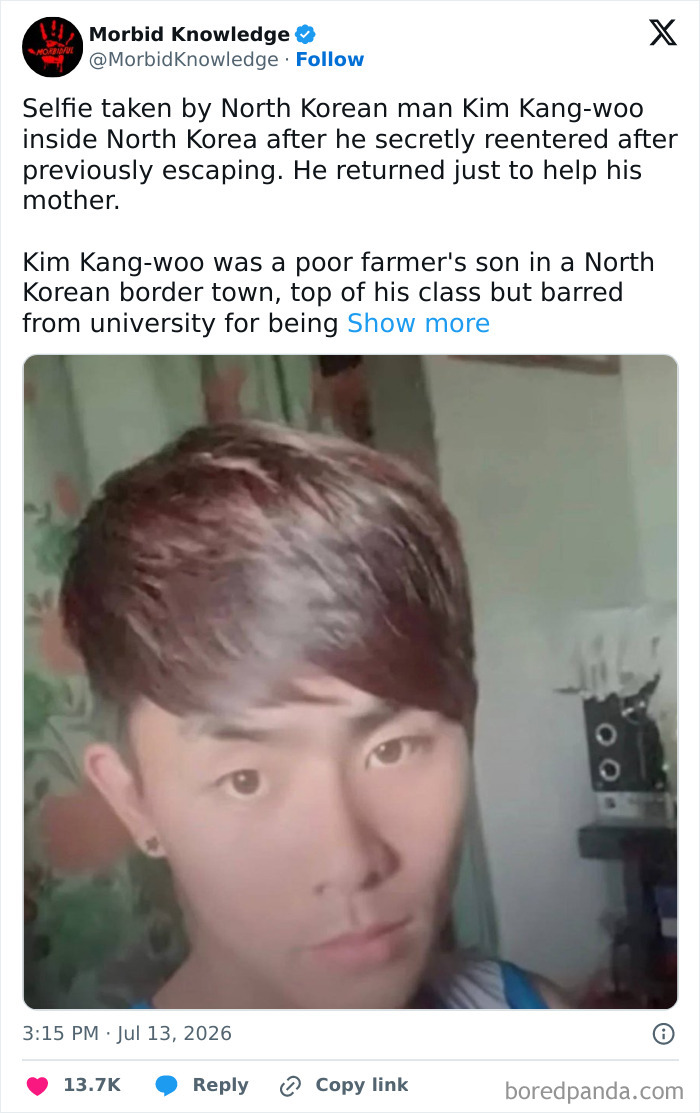
Kim Kang-woo was a poor farmer's son in a North Korean border town, top of his class but barred from university for being the wrong social class. He and his mother sometimes didn't have enough to eat.
His father had already died attempting the same escape Kim was about to make.
It was pouring rain the night in May 2016 when Kim crossed the Yalu River alone. His mother gave him a boiled egg as he left, he pressed it back into her hands.
She couldn't risk seeing him off, and cried silently for nights after. He reached Seoul after a five-month journey through China, Laos and Thailand.
Then he worked. Construction sites, a mattress store, a cellphone store, every job he could land, thinking of his mother each night on the walk home.
By 2019 he had saved enough and found a broker he trusted, and flew to China to oversee her escape himself.
It fell apart in a single dropped phone call. His mother called from a borrowed phone, frightened, saying she couldn't find him on the Chinese side and maybe they should try another time. Then the line went dead.
His money was nearly gone, his visa almost expired.
So he made his choice. "There was really only one path," he said. "I had to go back. And if I got caught crossing back in, I was ready to die."
He spent two days watching the border guards from the Chinese side, and the moment they broke for dinner, he crossed back in and ran for the woods.
He knocked on his mother's door. She was stunned, they held each other in silence and cried and then she was terrified.
“If he's caught, he would be immediately exec*ted and the rest of us would go to a prison camp."
For 22 days he scrambled to arrange brokers on both sides of the border. Then surveillance caught a call.
Soldiers raided the house while Kim was out, detained his mother, and beat her to make her admit her son had returned. She denied it.
The day after she was detained, Kim crossed the Yalu a second time, without her.
South Korean intelligence had tracked his whole journey by phone records and interrogated him for weeks as a suspected spy.
Because defectors legally become South Korean citizens, entering the North is a crime he was sentenced to six months in prison and two years' probation.
But it worked. While he was still being questioned, a broker called, his mother had escaped on her own. He arranged for his contacts to guide her out through China, Laos and Thailand.
She wrote him a letter every week he was locked up, about her new driver's license, about a young man on the subway who looked just like him.
On the night of his release in September 2020, she waited at the prison gates at midnight, and they reunited more than four years after he first fled.
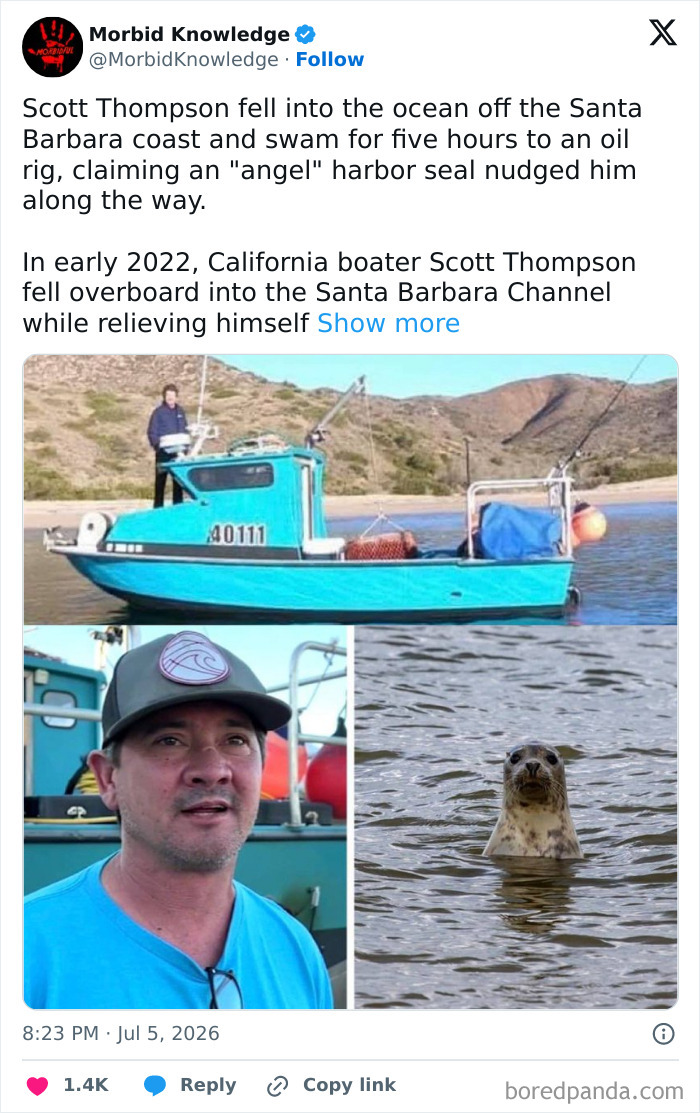
A powerful wave knocked him off balance, and he could only watch as the boat, still in gear, sailed away into the darkness without him.
He was wearing just shorts and a T-shirt in freezing Pacific water.
"The panic set in," he said. "This is a pretty heavy situation." An expert diver and experienced swimmer, he knew land was too far.
His only option was an offshore oil platform called Platform Gail, visible only as a faint glow in the blackness. He set off for it.
He pushed himself forward by thinking of his family. "I was devastating myself through my mind, just picturing my girls and my son growing up without me, and my wife not having a husband."
He kept telling himself: "Just keep swimming. You gotta get home to your family." Then he heard a splash.
"It was a medium-sized harbour seal. The seal would go underwater and he came up and nudged me, like a dog comes up and nudges your leg."
Thompson wrote in a blog post that the seal twice bumped him in the back of his legs with its nose when he stopped swimming and started treading water.
He began talking to it, singing it Grateful Dead songs and telling it jokes, which he said took his mind off his situation.
Five hours after entering the water, freezing and exhausted, he reached the platform.
"It started getting brighter and I'm just like, I'm crying. Shouting at the sky."
Crew aboard hauled him out, warmed him up, and called the Coast Guard. He was airlifted to hospital and treated for hypothermia.
The tow boat crew that later recovered his vessel said they couldn't believe he survived.
"Even putting on a wetsuit, being prepared, getting in that water, and swimming to that platform was horrendous," one crew member said.
“I can't imagine being in the water with shorts and a T-shirt at night. There was no moon. It was pitch black."
Thompson called the seal an angel. Nobody has ever offered a better explanation
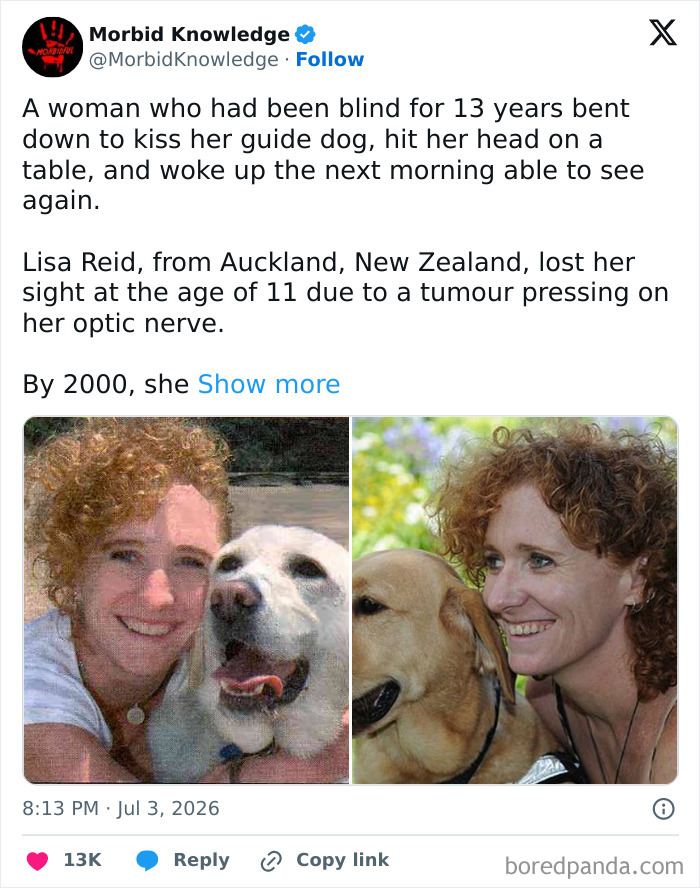
By 2000, she had been completely blind for over a decade, living with the support of her guide dog, Ami, and New Zealand's Blind Foundation.
On the evening of 16 November 2000, the 24-year-old bent down to kiss Ami goodnight and knocked her head against a coffee table. It didn't seem serious. She went to bed as normal.
When she woke the next morning at 9:30am, she could see. She kept it to herself for a few hours at first, content to play with Ami in the back yard.
Then she called her mother and read aloud a health warning from a cigarette packet down the phone.
Auckland Hospital eye surgeon Ross McKay confirmed she had regained 80 per cent vision in her left eye.
He had no explanation for the recovery and said he had never encountered a similar case in 25 years as an eye specialist.
"For some reason she's got her sight back, and don't ask me for an explanation, because I don't have one," he said.
Among the most emotional moments of her recovery was seeing her brother for the first time since he was a boy.
"He was a man, with a goatee and everything. My brother's a man," she said. When she saw her mother, she told her: "You look the same but older."
"It's the little things," Reid later reflected. "Like the colour of the grass, how blue the sky is, the things we all take for granted."
She went on to write a memoir about her experience, titled Angel Eyes.

Why is this "morbid knowledge", it's beautiful, I'm so happy for her. Where's her movie...
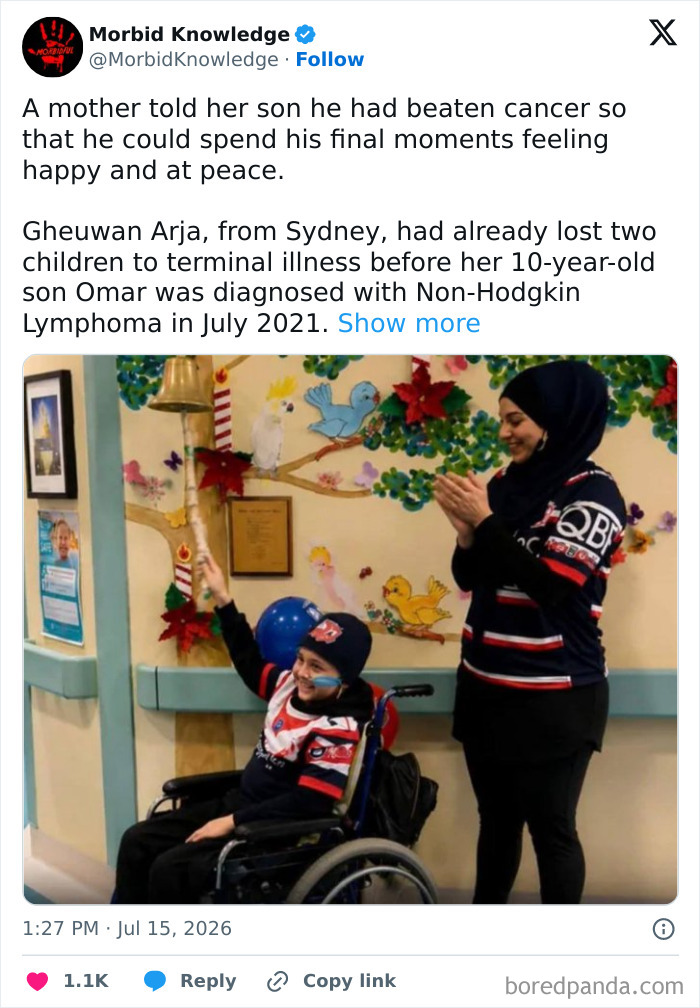
After six months of chemotherapy and 18 surgeries, Omar showed no signs of recovery. Doctors had no more options. He had days left.
So she made a choice no parent should ever have to make. She told him he had beaten cancer and let him ring the hospital bell, the moment usually reserved for patients in remission, while nurses and doctors clapped around him.
He was beaming. She was quietly falling apart.
"One of the worst days of my life lying to him," she later said.
Omar passed in January 2022.
Walmart staff took the items back from her and she began walking home. Police were called anyway.
Officer Austin Hopp pushed her to the ground and handcuffed her.
In the footage she appears confused and scared, at one point pleading: "I am going home." The arrest fractured her arm, dislocated her shoulder, and sprained her wrist.
She was then held in a jail cell for hours without medical attention.
Back at the station, precinct cameras caught Hopp and two colleagues eating popcorn, laughing, and fist-bumping as they replayed the bodycam footage.
One officer said: "Ready for the pop? Hear the pop?" Another said: "Body-cams are my favorite thing to watch."
Hopp pleaded guilty to second-degree felony assault. Garner's family opposed the plea deal.
Four officers in total were placed on administrative leave.
The city of Loveland ultimately paid Karen Garner $3 million to settle the civil lawsuit. She had forgotten to pay for $13.88 worth of shopping.
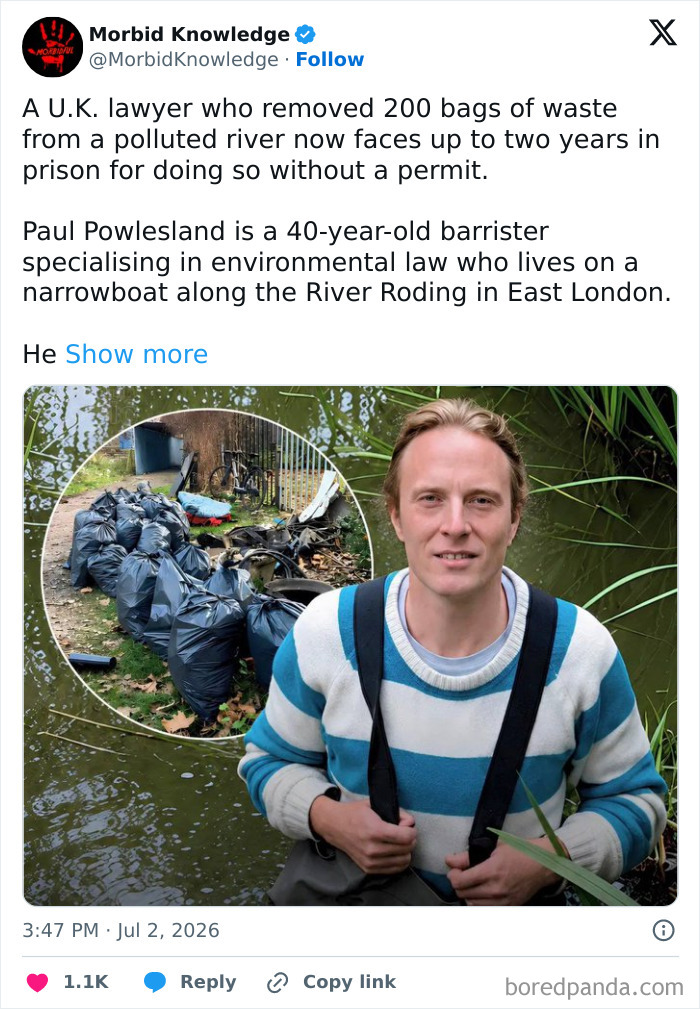
He founded the River Roding Trust, a community organisation working to restore the river through litter removal, habitat restoration and tree planting.
For years, he asked the Environment Agency to address the crisis on Alders Brook, a tributary choked with waste. Nothing happened.
So in February 2026, Powlesland and his volunteers took matters into their own hands. Over ten days, they hired an excavator for roughly £1,000 and cleared a heavily polluted 250-metre stretch of the brook.
The team removed more than 200 bags of rubbish, along with branches, thick silt, invasive weeds, discarded household appliances, used needles, and even abandoned weapons.
The results were immediate. Within weeks, the restored stretch began flowing again.
Fish, dragonflies, herons, irises and reed beds returned to a section of river that had been ecologically dead.
Then came the letter. The Environment Agency informed Powlesland he was under investigation for carrying out "unpermitted works," alleging the dredging constituted a flood risk activity requiring an environmental permit.
The offence carries a maximum penalty of two years in prison.
Powlesland's response was pointed. "After decades of ignoring rampant environmental crime on the Roding, the Environment Agency has finally decided to act.
But it's not action against Thames Water for dumping billions of litres of sewage, or the waste criminals who dumped thousands of tonnes of rubbish on its banks, but against the River Roding Trust for restoring a river without a permit."
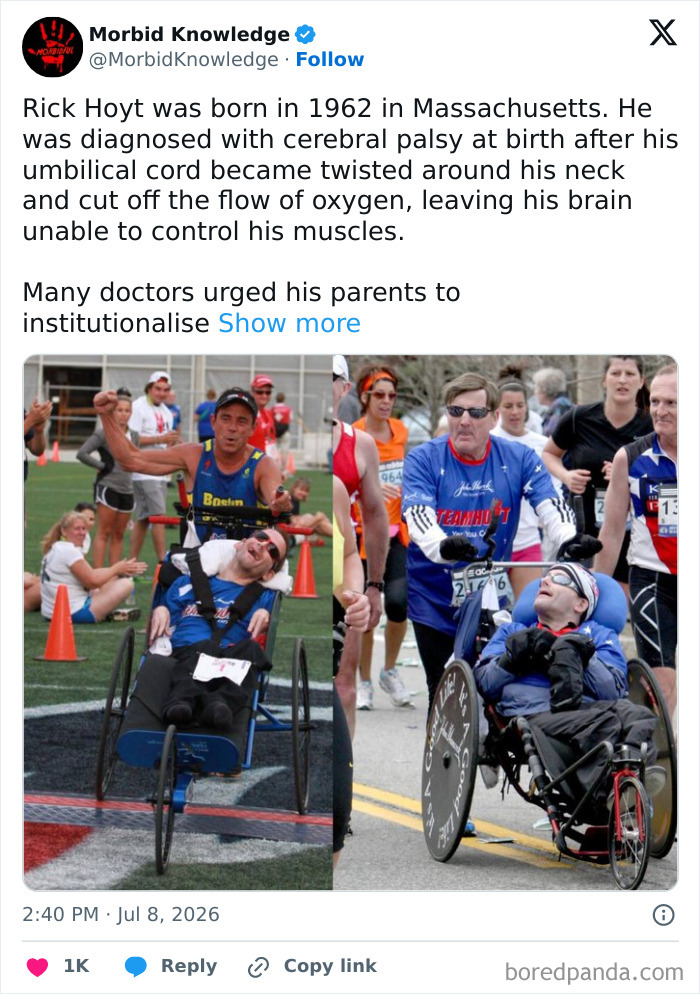
Many doctors urged his parents to institutionalise him, saying he would never be more than a "vegetable."
His parents, Dick and Judy, refused, and brought him home to raise like any other child.
The prognosis about his mind proved completely wrong. At age 11, after his parents pushed for it, Rick was fitted with a computer he operated with head movements, and it revealed he was fully intelligent.
That breakthrough changed everything, he attended public school for the first time and went on to graduate from Boston University in 1993 with a degree in special education.
In 1977, Rick asked his father if they could run a five-mile race to raise money for a paralysed lacrosse player. Dick, not a runner, pushed him the entire way and they finished next to last, but not last.
Afterwards Rick typed: "Dad, when I'm running, it feels like I'm not handicapped."
What they went on to achieve would be remarkable for any elite athlete, let alone a father pushing his son.
They competed in over 1,100 endurance events, including 72 marathons and six Ironman Triathlons, and ran the Boston Marathon 32 times between 1980 and 2014.
In the triathlons, Dick towed Rick in a boat for the swim, pedalled him on a special bike, and pushed his chair for the run.
In 1992 they crossed the United States, biking and running 3,735 miles in 45 days.
Dick Hoyt passed in 2021 at 80, and Rick passed in 2023 at 61. A bronze statue of the pair still stands near the Boston Marathon starting line in Hopkinton.

If I could ever be this for one of my sons, I would need nothing else. I would be complete.
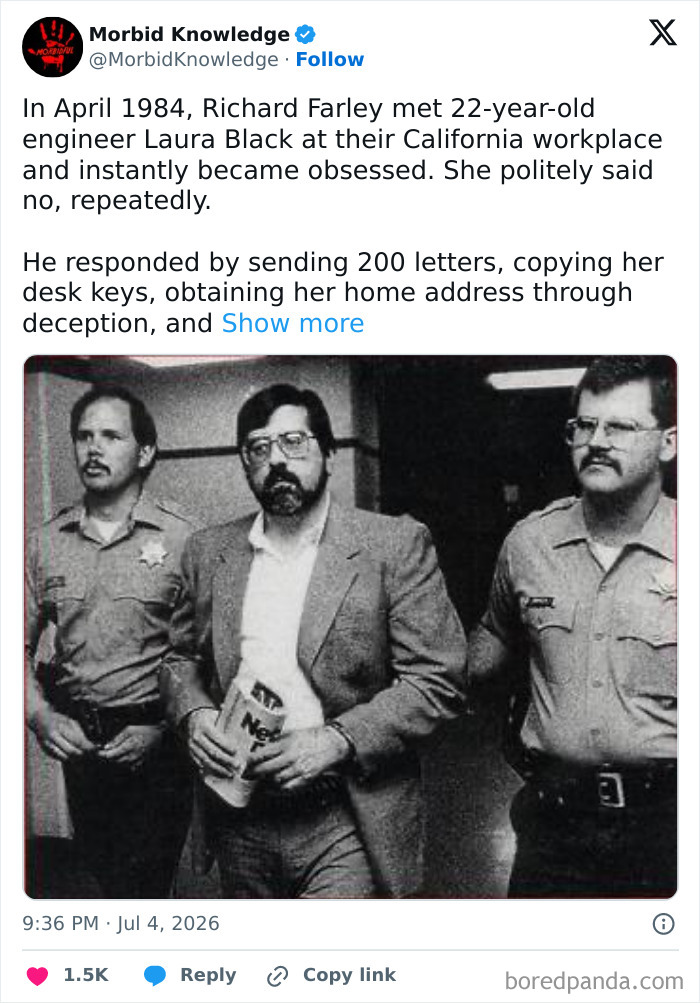
He responded by sending 200 letters, copying her desk keys, obtaining her home address through deception, and following her to her aerobics class.
The company eventually fired him in 1986. He found work at a rival firm and kept stalking her.
When Black finally filed a restraining order in February 1988, Farley arrived at the ESL building the day before the court hearing carrying 98 pounds of weapons.
He blasted his way through the building toward Black's office. Seven people were ki*led. Black was shot in the shoulder but survived.
The standoff ended when a negotiator convinced Farley to surrender in exchange for a sandwich and a soda.
California passed the first anti-stalking laws in the US directly as a result of this case. Every other state followed.
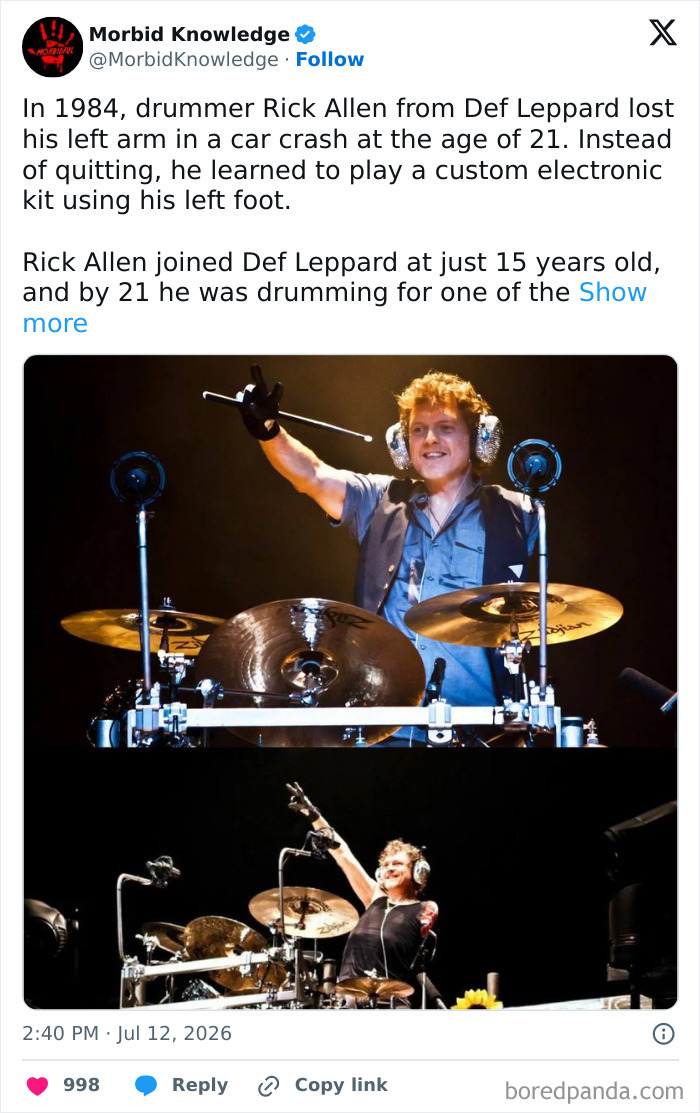
Rick Allen joined Def Leppard at just 15 years old, and by 21 he was drumming for one of the biggest rock bands on the planet. Their album Pyromania had turned them into stadium headliners almost overnight, with a US Gallup poll that year naming Def Leppard America's favourite rock band, ahead of AC/DC, Journey, and even the Rolling Stones.
Then came New Year's Eve, 1984.
Rick was driving back from Ladybower Reservoir near Sheffield with his girlfriend Miriam Barendsen when he lost control of his left-hand-drive Corvette Stingray on a sharp bend, hitting a wall.
The car flipped. His seatbelt came undone, and as he was thrown through the sunroof, it tore off his left arm at the shoulder.
What few people know is that he'd also badly broken his right arm, and at one point doctors warned him there was a chance he could lose that one too.
The man who made his living with his hands was staring down the possibility of having none.
Surgeons initially reattached the arm, but on 4th January 1985, it had to be amputated due to infection.
Within three months of the accident, he was drumming again, working with engineers to build something the world had never seen.
Drum manufacturer Simmons collaborated with him to design a custom electronic kit that reassigned his left-hand parts to a series of foot pedals, so his one arm and both feet could cover what most drummers need two arms to do.
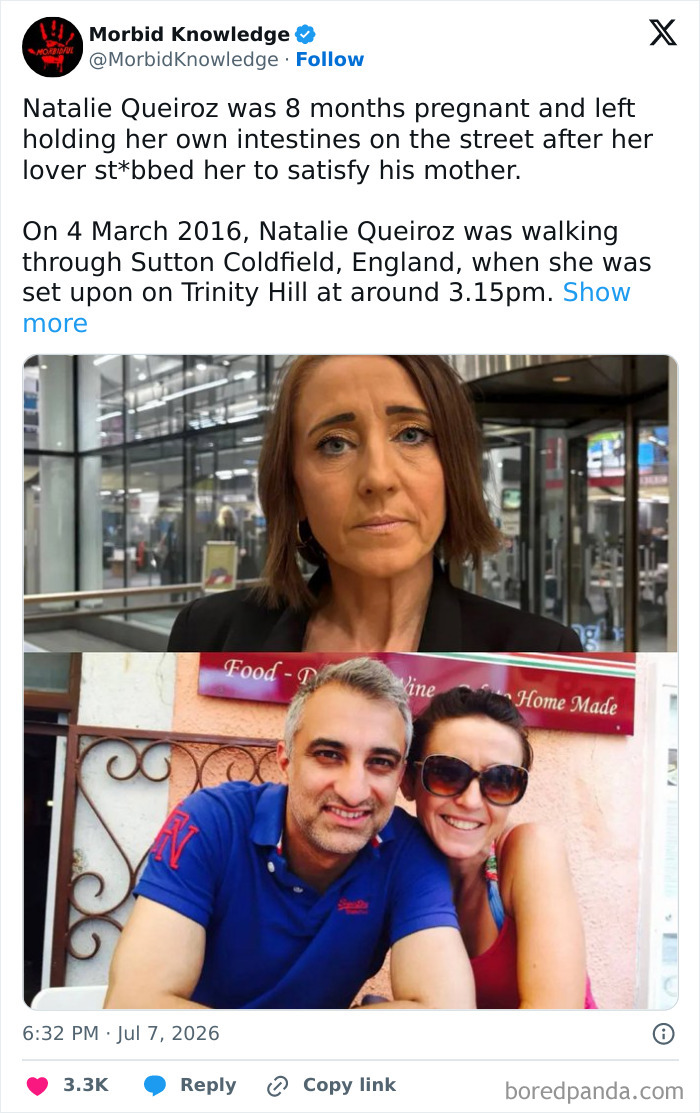
On 4 March 2016, Natalie Queiroz was walking through Sutton Coldfield, England, when she was set upon on Trinity Hill at around 3.15pm.
She was st*bbed 24 times by her then partner, Babur Karamat Raja, known as "Bobby." She was 37 weeks pregnant, just over three weeks past her 40th birthday.
Natalie and Raja had known each other since their school days in Birmingham, had got together as adults, and in August 2015 had thrown a party to announce her pregnancy.
But Raja had been concealing the truth about his life. Natalie later described him as having lived a "double or triple life" and that hidden world, along with the collapse of their relationship, formed the backdrop to the attack.
The a***ult was sustained and frenzied. He st*bbed her 24 times in the heart, lung, liver and uterus, and attempted to slit her wrists, survivors' accounts describe it as lasting around nine minutes.
The wounds were so severe that her abdomen was opened, she was left holding her own organs in the street.
What saved both lives was the courage of passers-by and the speed of the medical response.
Three bystanders, John Mitchell, Anthony Smith and Callum Gibson, stepped in to wrestle the carving knife away from Raja.
Of the 24 wounds, one was just 2mm from their unborn daughter.
A Midlands Air Ambulance crew landed on Sutton Coldfield High Street to reach her, and she was airlifted to the Queen Elizabeth Hospital in critical condition.
Natalie was in a coma when her daughter was delivered by Caesarean section shortly before 8pm; she underwent emergency surgery and pulled through.
Mother and baby both survived against the medical odds.
Justice came swiftly. Raja was charged with attempted m**der and attempted child destruction of his biological daughter, pleaded guilty to both, and was jailed for 18 years on 23 June 2016.
The most extraordinary chapter is what Natalie did afterwards. Within 18 months of the attack, she completed a mud run and an abseil to raise money for the air ambulance charity that helped save her, despite having only limited use of one hand.
She went on to be appointed MBE for services to young people and the prevention of knife crime, became a victims' advocate for West Midlands Police.
Tommy McHugh was born in Liverpool in 1949, left school at 14, spent his teens and early twenties in and out of borstals and prisons for violence and theft, overcame a four-year heroin addiction in the 1980s, and eventually settled into life as a builder.
He had never painted, never written a poem, and had no interest in either. He once joked that the only reason he'd ever entered an art gallery was to case it.
In January 2001, Tommy was sitting on the toilet when a knock at the door made him strain to finish quickly.
The sudden pressure severed arteries in both the frontal and temporal lobes of his brain.
In his own words: "I suddenly felt an explosion in the left side of my head and ended up on the floor. I think the only thing that kept me conscious was that I didn't want to be found with my pants down. Then the other side of my head went bang."
His wife Jan found him and called an ambulance. He underwent five hours of emergency neurosurgery and spent a week in a coma.
When he came round, he looked out of the hospital window and saw a tree sprouting numbers, 3, 6, and 9.
Then he started talking in rhyme and couldn't stop. Within days he was painting compulsively, covering walls, ceilings, and floors with vivid murals. No surface in his house was safe. He worked for up to 18 hours a day.
Neurologist Dr. Alice Flaherty from Harvard, who studied McHugh, said the aneurysms had altered the temporal lobes l, the parts of the brain linked to visual processing and emotional response, and that his case was extremely rare.
“He's pretty straightforward and says this wasn't a talent that was hidden," she said. "He had no interest in art. And I have to believe him."
His case is one of only three known examples in the world of "sudden artistic output following brain injury."
Doctors discovered she has a rare genetic condition causing hyper-ovulation, her ovaries release an unusually high number of eggs per cycle, making multiple births almost inevitable every pregnancy.
Her 44 children came from just 15 pregnancies, she had four sets of quadruplets, four sets of triplets, six sets of twins, and six single births.
Doctors advised her to stop having children due to the health risks. She said she had little choice, her husband kept her from accessing contraception.
Her husband eventually abandoned her and the children, leaving her to raise them alone while working as a herbalist and event decorator.
She would wake at 7am, prepare food for all the children, work all day, and return home to cook again.
Tragically, six of her children have d*ed, leaving around 38 surviving. The eldest was caring for the youngest when she spoke to the BBC.
"God gave me all these children and I have to take care of them," she said. "If you are given a burden you carry it."
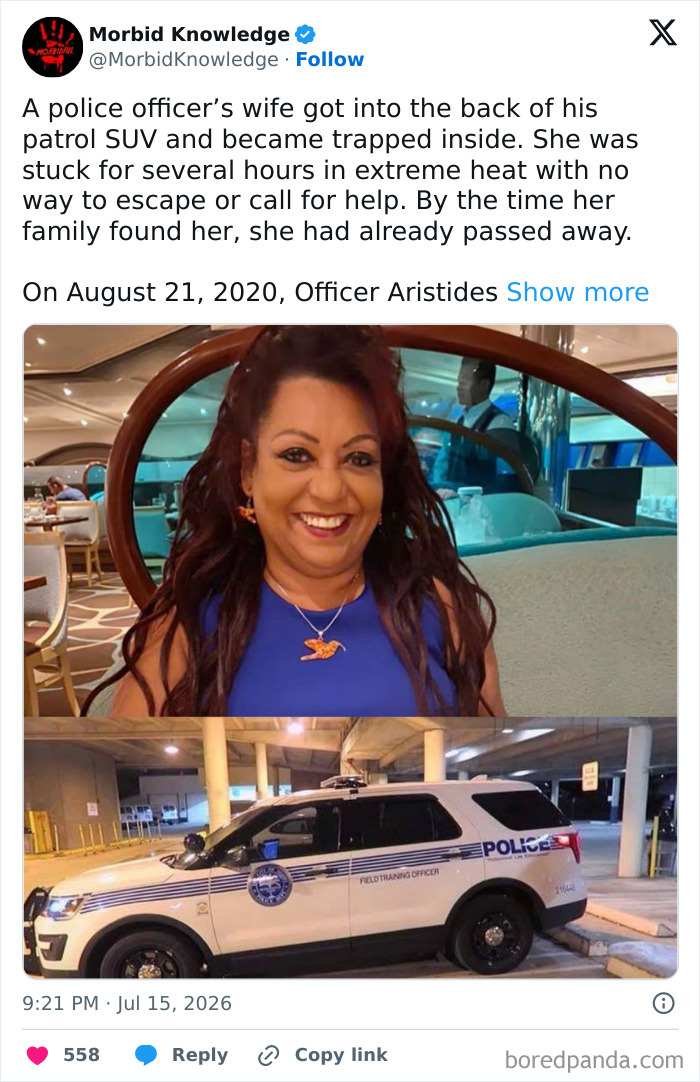
On August 21, 2020, Officer Aristides Paulino came home from a midnight shift and left his marked SUV in the driveway of their Miami Shores home.
As he slept, his wife Clara climbed into the backseat, possibly looking for something and the doors closed behind her, triggering the self-locking mechanism.
The SUV had bars on the windows, a metal cage separating the back from the front, and doors that could only be opened from the outside.
She was completely sealed in, with no phone, no way to honk the horn, and no passersby in the quiet neighbourhood who might have spotted her.
Temperatures reached over 90°F as she spent roughly four hours trapped inside.
When Aristides woke around 5 p.m. and couldn't find Clara, he found her phone on the back patio.
He and his son searched and found her unconscious in the backseat. They performed CPR, but she was pronounced de*d at hospital.
The medical examiner ruled her de*th accidental heat stroke.
She was trapped in plain sight, in her own driveway, just steps from her front door.
I heard this story from Mr. Ballen. Absolutely devastating for her family. Poor woman.
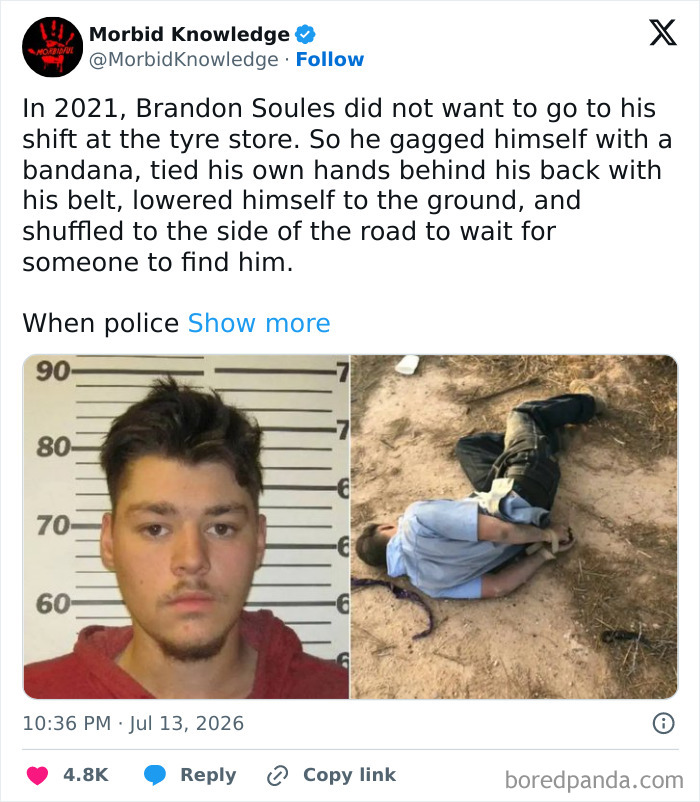
When police arrived they found the 19-year-old bound and gagged.
He told them two masked men had kidnapped him, knocked him unconscious, driven him around demanding to know where his father had buried a large sum of money in the desert, and then abandoned him there.
Detectives spent days investigating. They reviewed surveillance footage, interviewed witnesses, checked his phone records and text messages.
None of it matched his story.
Hospital records showed no concussion or head injury. There was no evidence of any kidnapping whatsoever.
When confronted with the evidence, Soules admitted he had fabricated the entire story to avoid going to work. He was fired from the tyre shop.
He was charged with false reporting to law enforcement.
His plan to get a day off resulted in a criminal record and national media coverage. Calling in sick would have worked better.
I mean, I've definitely had days I didn't want to go to work, and thought of ways to get out of it, but this is a whole different level!
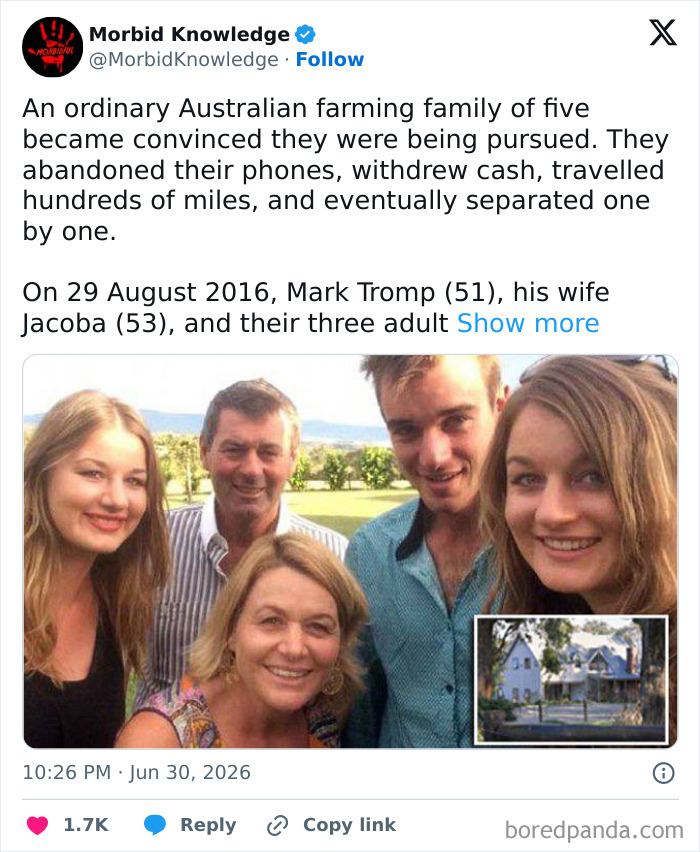
On 29 August 2016, Mark Tromp (51), his wife Jacoba (53), and their three adult children, Riana (29), Mitchell (25), and Ella (22), inexplicably fled their berry farm in Silvan, Victoria.
In the days leading up to the disappearance, Mark had become increasingly paranoid.
He was convinced someone was watching the family, that their phones were being tracked, their money wasn't safe, and that disappearing was the only way to protect them.
They took a large sum of cash and left behind their bank cards, phones, and passports.
Mitchell secretly brought his own phone, but his parents discovered it about 32 kilometres into the trip and made him throw it out the window, convinced it was being used to track them.
Then, one by one, the family began to fracture. The next day, Mitchell decided to turn back.
Later, the two daughters left their parents at Jenolan Caves, somehow acquired a car, and drove to Goulburn, where they reported their parents missing.
Ella stole a car and drove home alone. Police found Riana in a catatonic state, unable to speak, as if trapped inside her own mind.
Mark was eventually spotted walking on the outskirts of Wangaratta and taken in for a mental health assessment.
Jacoba was hospitalised in severe distress.
Local police Sergeant Mark Knight called it "the most bizarre case in 30 years."
Psychologists suspected a phenomenon called folie à plusieurs, a rare form of shared delusion where paranoia spreads like an infection from one person to those closest to them.
Mark later apologised for what he called a "family breakdown," but never revealed what triggered it.
The Tromps have never fully explained what they were running from.
Lisa Anderson, a 44-year-old mother of five from Devon, said the craving began after the birth of her youngest son when she used powder on him after a bath and felt an overwhelming urge to eat it.
What started as a single moment became a daily compulsion she couldn't stop.
She runs to the bathroom at least 40 times a day to eat powder off the back of her hand, and wakes up four times a night to feed the habit.
She cannot go more than 30 minutes without it. In public she eats mints as a substitute.
She eats only one meal a day, skipping breakfast and lunch to consume powder throughout the day instead.
The longest she has ever gone without it was two days, which she described as the worst time of her life.
Doctors believe she may have PICA syndrome, an eating disorder characterised by compulsive consumption of non-food items, potentially linked to iron deficiency or OCD.
😮 How bad is that for your stomach?? I wonder if she p0ops out powder too? 😂
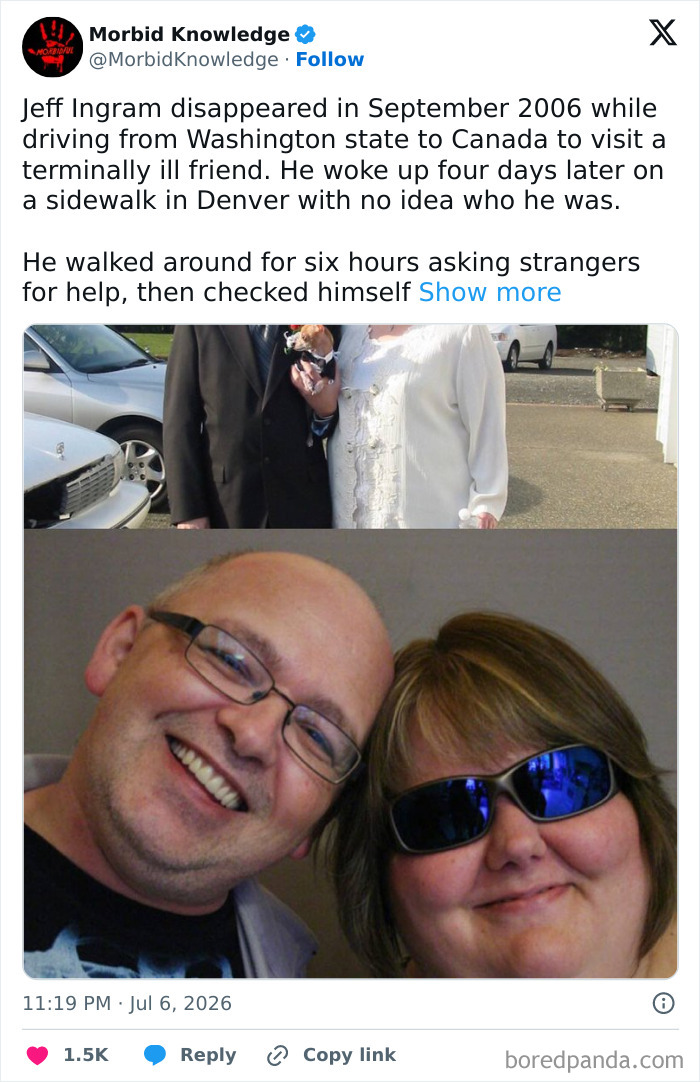
He had no ID, no memory of his name, his home, or his fiancée Penny Hansen.
He was diagnosed with dissociative fugue. After a month with no leads, he appeared on Good Morning America asking the public: "If anybody recognises me, knows who I am, please let somebody know."
Penny's brother saw the broadcast and called her immediately.
When Penny arrived and said "Hi, I'm Penny, your fiancée," he didn't recognise her. He asked: "Do we have kids? What's my life like?"
She offered to sleep in the spare room so as not to overwhelm him.
When he finally settled in at home, Jeff called Penny's mother and asked for Penny's hand in marriage, again.
Her mother told him she'd already said yes.
They married on New Year's Eve 2006. Jeff says his biggest regret is forgetting the wedding.
Penny told him they'd get married again so he could remember it.
"It's harder for you because you have the memories and the heartache," he told her.
It wasn't his first episode, he had disappeared for nine months in 1994 and was found in Seattle with no memory of that period either.
He has had three fugue episodes in total.
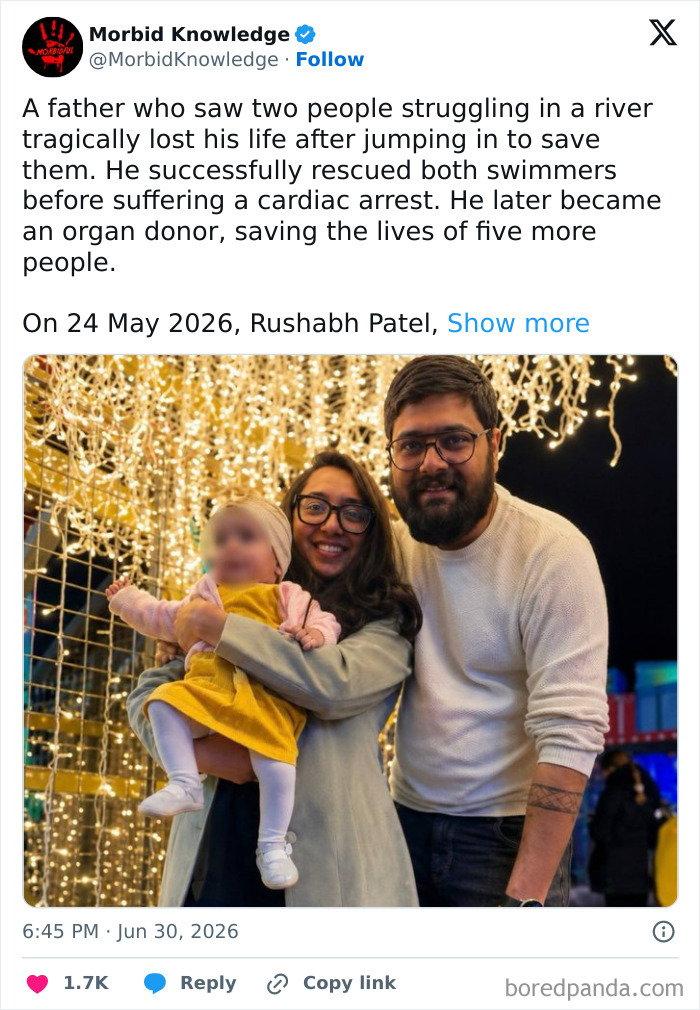
On 24 May 2026, Rushabh Patel, 28, was enjoying a picnic with his family in Newport Pagnell, Milton Keynes, when two people from the group got into difficulty while swimming in the River Great Ouse at a popular open water spot known locally as "The Beach."
Without hesitation, he jumped in. Their lives were saved, but in the process of rescuing them, Rushabh suffered a cardiac arrest and drowned.
He was airlifted to Milton Keynes University Hospital, where doctors worked tirelessly for days to save him.
Tragically, despite every effort, he passed away on 28 May 2026. His wife Mili and their 18-month-old daughter Vrumi were present that day.
In an interview, Mili described the moment: "I just see his head up in the water and I can't explain that feeling."
She also spoke of their daughter waking at 5am every day to look for her father.
His brother Aman said: "Rushabh's final act on this earth was one of extraordinary courage and sacrifice. He gave his life while saving others. He was a hero in every sense of the word."
In d*ath, Rushabh's generosity continued. Through organ donation, he gave five to six people a new chance at life.
This seems to be happening a lot this summer. People trying to help a drowning swimmer and end up drowning themselves. (And yes, I know that's not what happened in this story) Please don't try to save someone unless you have something that floats for the swimmer to grab on to - otherwise they will grab you and drag you under. And if you can't swim PLEASE wear a life jacket, even if you're just in knee deep water.
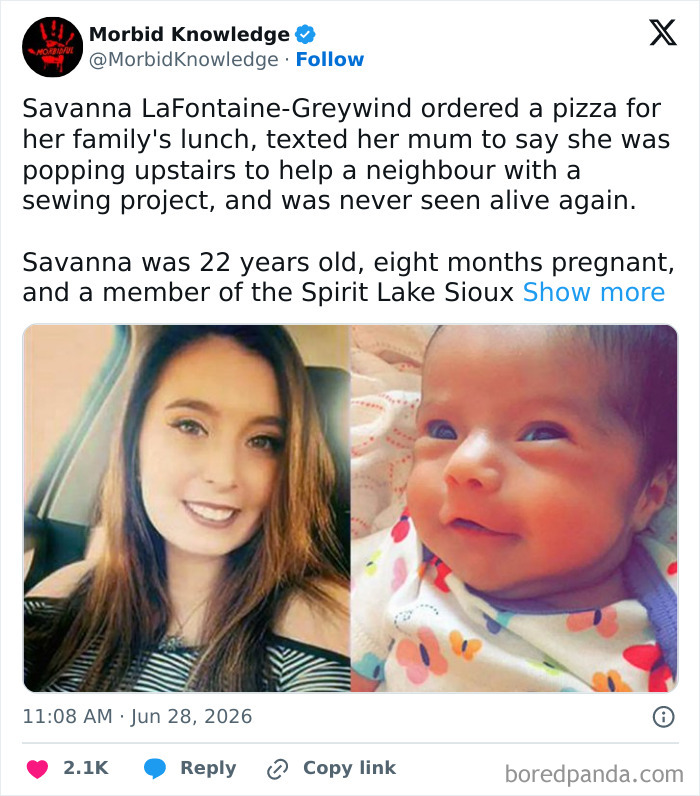
Savanna was 22 years old, eight months pregnant, and a member of the Spirit Lake Sioux Tribe.
She and her boyfriend had just signed a lease on their own apartment. She was due to start a new job as a nursing assistant the following week.
Brooke Crews, 40, had been lying to her boyfriend William Hoehn for months, faking a pregnancy using old sonograms and recordings of a heartbeat found online to keep him in the relationship.
When August arrived and no baby appeared, she lured Savanna upstairs to her apartment.
Crews instigated a fight, pushed Savanna, causing her to hit her head on the bathroom sink and lose consciousness.
While Savanna drifted in and out of consciousness, Crews retrieved a knife and cut the baby from her womb.
Police searched the apartment three times and found nothing. Savanna's body was hidden in a bathroom closet during the first two searches.
The baby was lying on the bed covered by a blanket next to Hoehn.
Savanna's body was eventually found by kayakers in the Red River, wrapped in duct tape and plastic.
The baby, a girl named Haisley Jo, was found alive on the fourth search, weighing 4 pounds 13 ounces and in astonishing health.
Crews was sentenced to life without parole. Hoehn received 20 years.
Savanna's m*rder directly inspired Savanna's Act, passed by Congress in 2020 to address the crisis of missing and m*rdered Indigenous women across America.
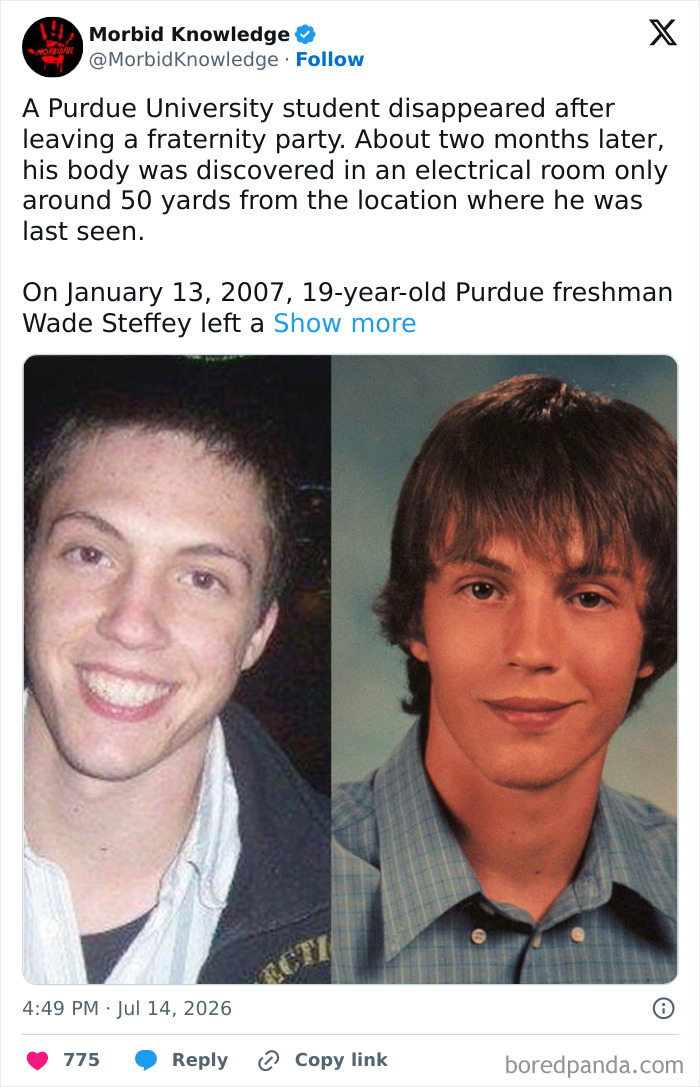
On January 13, 2007, 19-year-old Purdue freshman Wade Steffey left a fraternity party just after midnight and headed to Owen Hall to retrieve a coat he'd left in a friend's room. That was the last anyone saw of him.
Around 12:30 a.m., a witness saw him outside Owen Hall. He made phone calls to friends inside, then vanished.
Campus searches went on for over two months. Nothing.
The answer came when a maintenance worker followed a strange "pinging" sound into a high-voltage utility room at Owen Hall, and found Wade's body slumped over the machinery.
Officials believe he had been trying various doors to get into the dorm, found the exterior utility room door unsecured, and walked in.
The door had no high-voltage warning sign. Once inside, he climbed into a narrow space between a transformer and a wall and was electrocuted when his finger touched an exposed conductor. He d*ed instantly.
Because of where his body was positioned, it wasn't spotted during the visual inspections that had already been carried out 50 yards from where he was last seen.
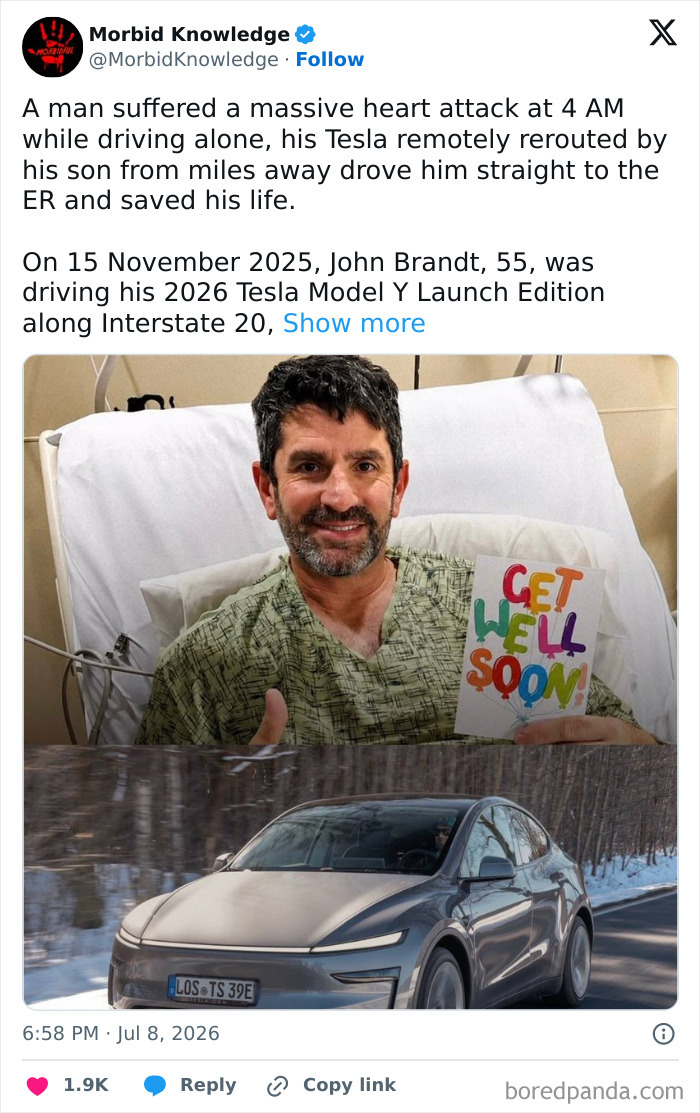
On 15 November 2025, John Brandt, 55, was driving his 2026 Tesla Model Y Launch Edition along Interstate 20, travelling between Atlanta and Birmingham in the early hours.
His car had recently received the Full Self-Driving v14.1.3 update, and crucially, FSD was engaged and keeping the vehicle steady on the highway.
Around 3:50 a.m. he began experiencing severe chest pain, could barely stay conscious, and could no longer safely control the vehicle.
Fading in and out, he managed to phone his son, Jack. That's where the connected-car technology became a lifeline.
As an authorised driver on his father's Tesla account, Jack was able to remotely change the car's FSD navigation from his own 2014 Model S, redirecting it to Tanner Medical Center in Carrollton, Georgia, and alerting the hospital that the vehicle was inbound.
Despite fighting to stay conscious, John himself managed to switch the car's speed profile to "Mad Max" to get there as fast as possible, and the ER staff, forewarned, were waiting when he arrived.
Doctors diagnosed a massive STEMI heart attack requiring immediate intervention on three blocked arteries, and told the family that if he had pulled over to wait for an ambulance or kept driving toward Birmingham, he would not have survived.
He received treatment and recovered.

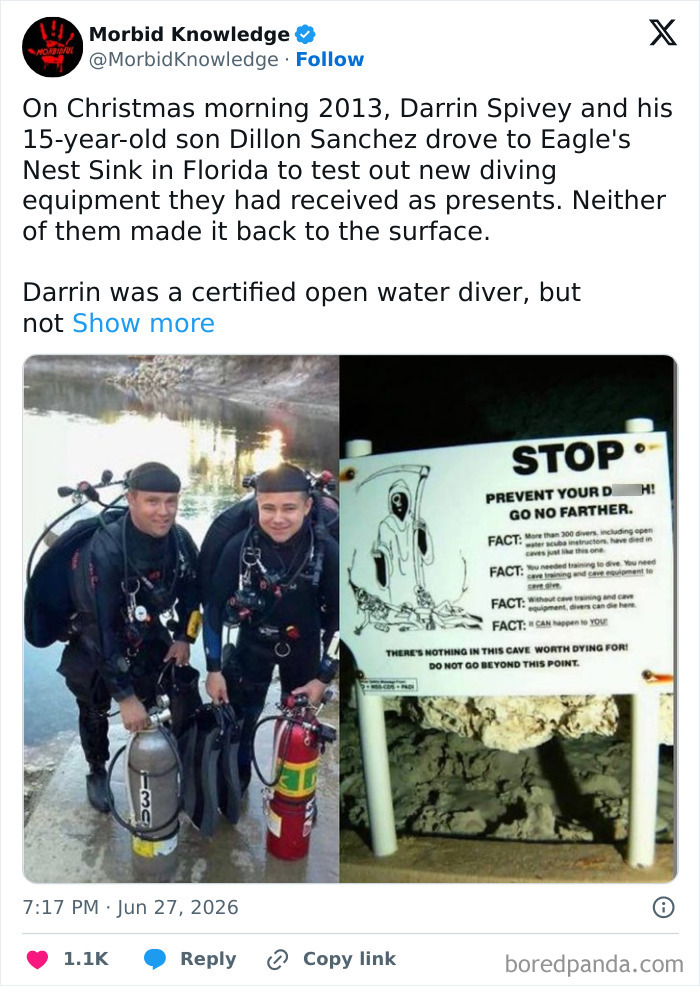
Darrin was a certified open water diver, but not certified for cave diving. Dillon had no diving certification at all.
Eagle's Nest requires full cave certification, trimix qualifications, and extensive experience. Its passageways plunge to 310 feet in places.
A sign at the water's edge reads: "Cave diving in this area is extremely dangerous, even life threatening."
When Darrin's fiancée Holly King couldn't reach them that evening, she called the sheriff's office.
A hunter at the site told deputies the last time he had seen the pair was around 11:30am as they suited up for their dive.
Recovery divers found Dillon's body 67 feet below the surface.
Darrin was found at 127 feet, near a warning sign at the top of a sand hill.
Their gauges showed both had descended to over 230 feet, nearly four times deeper than Darrin's certification permitted.
At that depth, a phenomenon called nitrogen narcosis sets in, known as the Martini Effect because every 50 feet is equivalent to the disorienting effect of a martini on an empty stomach.
At 230 feet they would have been nearly five martinis deep, likely unable to think clearly enough to find their way out.
Inside Eagle's Nest, 125 feet down, there is a permanently posted sign bearing a Grim Reaper. It reads: "There's nothing in this cave worth dying for." They never made it that far down to see it.
Eagle's Nest is one of the most dangerous caves in the world. And yet this idiot took his stepson diving there when the kid had never dived before! The place has signs everywhere warning of the danger.
Yadav, 35, from Chhindkalo village in Chhattisgarh, India, collapsed at home on December 14, 2024 shortly after returning from a bath.
His family rushed him to hospital where he was pronounced dead on arrival. Doctors initially found no abnormalities in his vital organs.
During the post-mortem, forensic expert Dr Santu Bag made an incision near Yadav's throat and discovered a live chick lodged inside.
“This is the first case I have encountered in over 15,000 autopsies. We were shocked," he told India Today.
The chick, approximately 20cm long, had become stuck in a U-shape obstructing both his airway and oesophagus simultaneously, causing asphyxiation.
Villagers reported he had been in contact with a local tantric who allegedly suggested the practice as a cure for infertility.
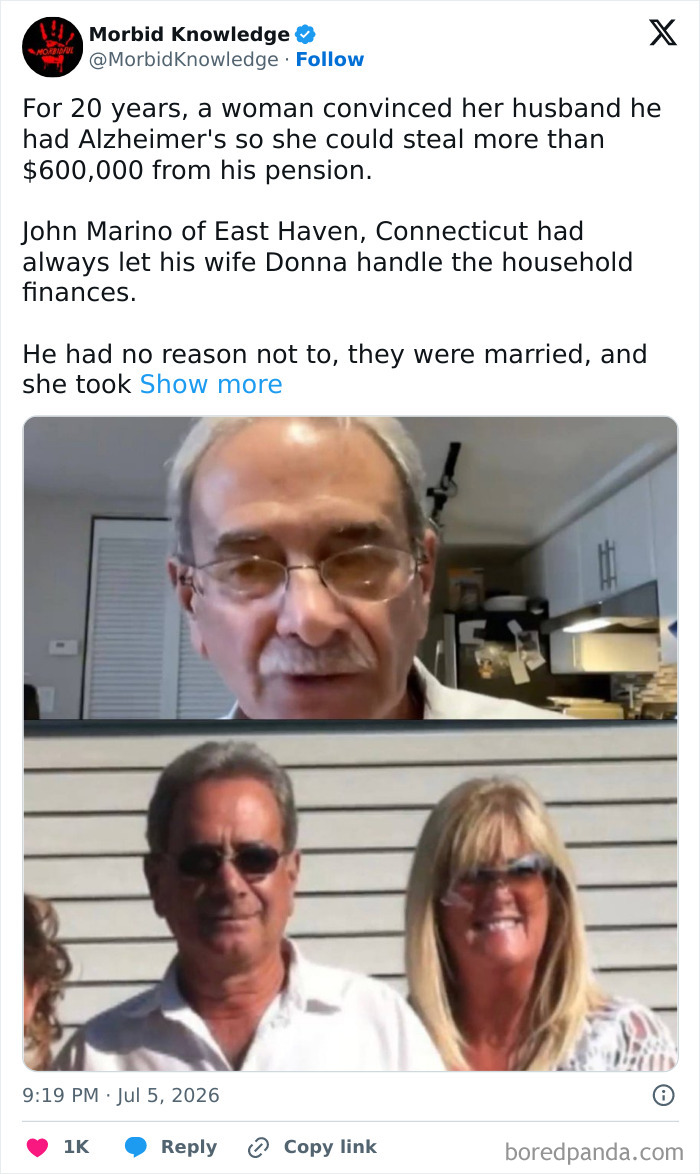
He had no reason not to, they were married, and she took care of everything.
What he didn't know was that starting around 1999, Donna had begun forging his signature on his pension checks, Social Security checks, and workers' compensation settlements, depositing the money into a secret bank account.
But the forgery alone wasn't enough to keep the scheme hidden. She needed him to stay away from the bank.
Police say Donna told her husband that he had Alzheimer's disease, exploiting the fact that it runs in his family and was one of his greatest fears.
Whenever he expressed a desire to go inside a bank, she told him that the last time he'd gone in, he had made a scene because of his condition. He stayed away to avoid the embarrassment.
She also fraudulently obtained power of attorney by having a notary friend sign the document without her husband present, then used it to file taxes in his name.
She pawned his jewellery and rare coin collection without his knowledge. Police found she had deposited 17 of his pension cheques, over $23,000, directly into her own mother's bank account.
The scheme unravelled in 2019 when John's adult daughter Elena came across financial paperwork at the family home and stumbled on the theft by accident.
She said her father's biggest fear had always been Alzheimer's and her stepmother had used that fear as a tool for two decades.
When police interviewed Donna, she admitted she had convinced him he had the disease, and said the money was used to help other family members with rent, groceries, and car payments.
"Donna stated she was trying to make everyone happy, but it was at her husband's expense," police wrote.
She was charged with first-degree larceny and third-degree forgery and held on a $25,000 bond.
Due to the statute of limitations, police could only formally investigate the last five years of the scheme, meaning the full twenty years of theft may never be fully accounted for in court.
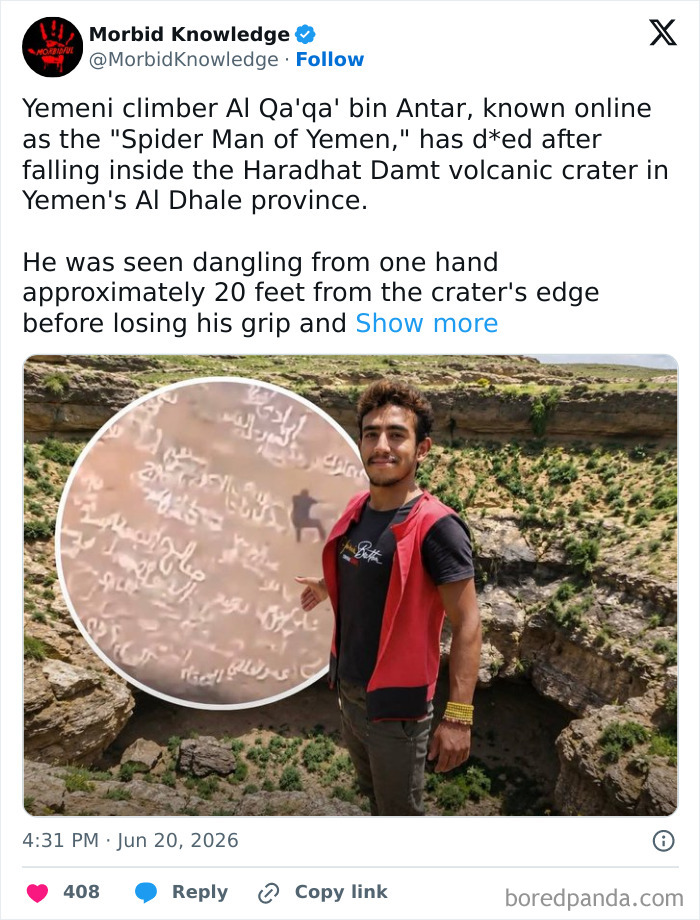
He was seen dangling from one hand approximately 20 feet from the crater's edge before losing his grip and dropping 300 feet into the scalding water at the base.
The pool of water at the bottom of the Haradhat Damt volcanic crater is 120 metres deep, covered in debris, and ranges between 40 and 60 degrees Celsius. Rescue divers had to wear insulated suits just to enter it.
The recovery operation lasted nearly 24 hours due to the steep rocky terrain, limited access routes, and hazardous conditions inside the crater.
He was 30 years old.
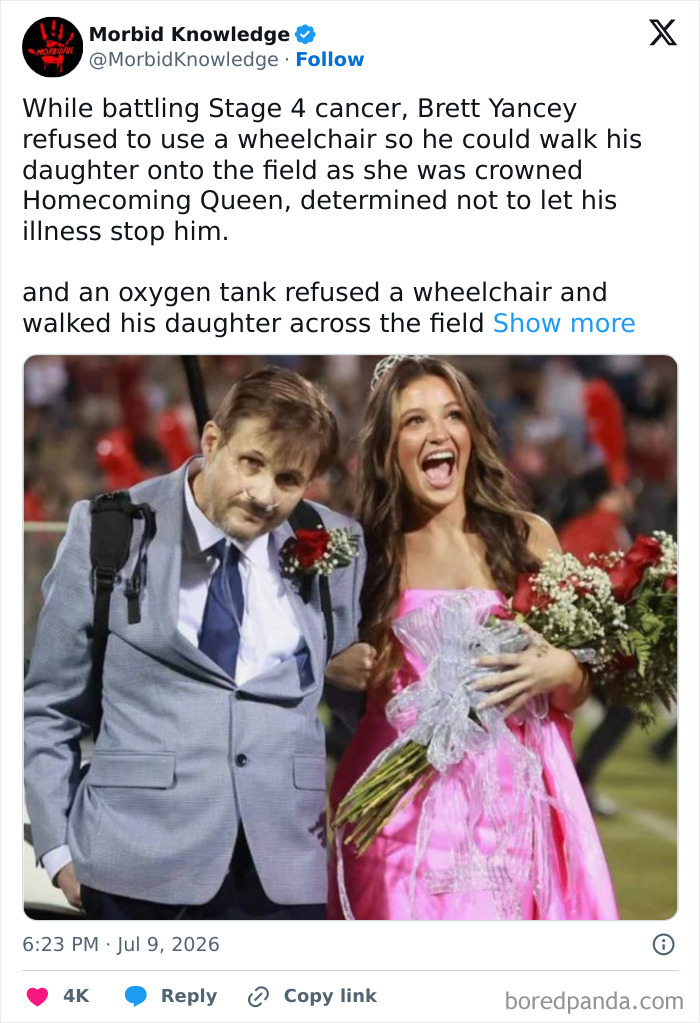
In October 2023. Brett Yancey, 47, of Southside, Alabama, had been undergoing treatment for stage 4 esophageal cancer for six years.
His illness began when he struggled to swallow, leading to a stage 3 diagnosis, after surgery and a brief remission, the cancer returned and progressed to stage 4, spreading to his lungs, brain, carotid artery and nerves.
Before he became ill, he had been the head football coach at Southside High School and had coached all three of his daughters in sports.
In the lead-up to homecoming, Brett experienced paralysis in his left leg and changes in behaviour.
His wife Carrie suggested alternatives, riding in a golf cart, or letting their daughter walk the field alone, but Brett refused.
"I'm going to walk her across that field. I'll walk my baby across that field," he told her.
When the moment came, he did exactly that. Carrie watched from a high vantage point as Brett walked steadily across the field.
Once the pair reached the other candidates, his youngest daughter, 17-year-old Sara Kate, was crowned homecoming queen.
In September 2018, Kertisha Brabson, a 31-year-old mother of two from Alliance, Ohio, began acting strangely, reaching for things that weren't there, talking incoherently, and dancing as if at a concert.
Her mother, Kertease Williams, knew immediately something was deeply wrong, saying something had "taken over" her daughter.
A seizure then put Kertisha into a coma that would last seven months.
The cause was eventually identified as anti-NMDA receptor encephalitis, a disease in which the body's own immune system attacks its brain cells.
It's a rare condition, only identified in 2007, and notoriously difficult to recognise, which is part of why her case became so dire before it was understood.
As doctors struggled to diagnose or treat her, the outlook turned grim.
"They told me she was brain-dead and pull the plug and all those things," Williams recalled.
But she refused to accept it. "I don't have no doctor's background. I've never been to school for anything, but when it's your child, you're going to do everything in your power to bring your daughter back."
She had Kertisha moved to the Ohio State University Wexner Medical Center in Columbus, where a team treated her condition and seizures aggressively.
Then came the moment no one expected. Kertisha woke up on 7 April 2019. To her, no time had passed at all, she thought it was still September, the same moment she'd fallen asleep seven months earlier.
A nurse told her, "Ms. Brabson, you've been asleep for seven months."
One of her doctors, Shraddha Mainali, recalled a resident texting her in disbelief that Kertisha was opening her eyes and following simple commands.
By that Christmas, she was home with her mother and her two children, Diamonique and Perez.
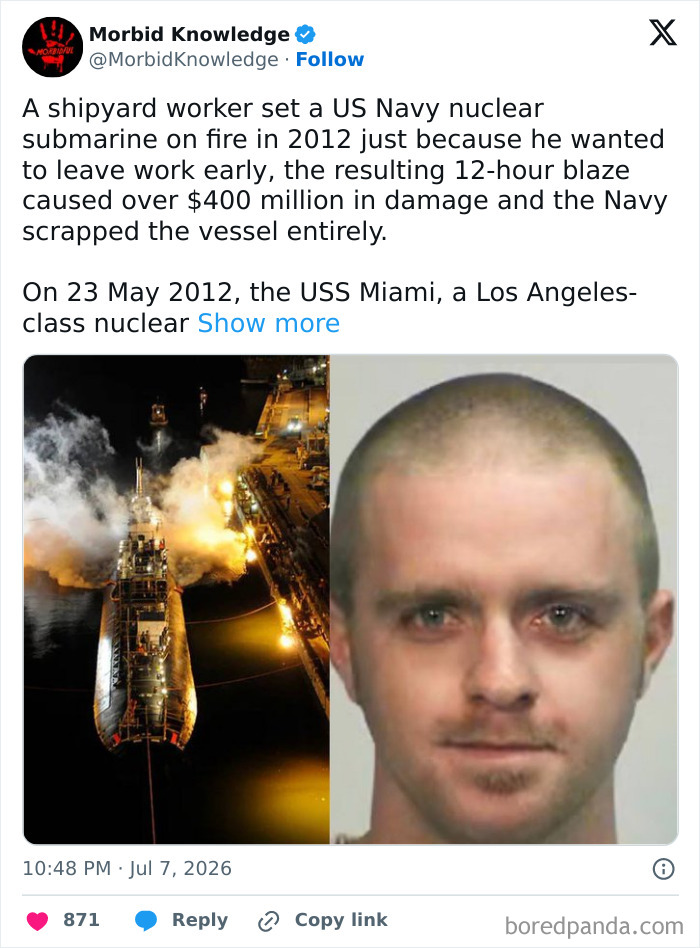
On 23 May 2012, the USS Miami, a Los Angeles-class nuclear attack submarine, sat in dry dock at the Portsmouth Naval Shipyard in Kittery, Maine, midway through a 20-month overhaul.
A 25-year-old civilian painter and sandblaster named Casey James Fury set fire to a plastic bag full of rags and left it on a bunk inside the submarine.
The flames tore through the forward compartments.
The blaze burned for around 12 hours and took more than 100 firefighters to extinguish, gutting the submarine's command and control center, crew living quarters and torpedo room.
Five people were injured fighting it. Crucially, the fire never reached the rear of the boat, where the nuclear reactor and propulsion systems were housed,
The Navy first blamed an industrial vacuum cleaner, but on 23 July 2012 Fury was indicted for arson after confessing that he had set the fire to get out of work early.
He told investigators he lit it after an upsetting exchange of text messages, and he was taking multiple medications for anxiety, depression and insomnia at the time.
It also wasn't isolated, he set a second fire weeks later, on 16 June, which was quickly extinguished.
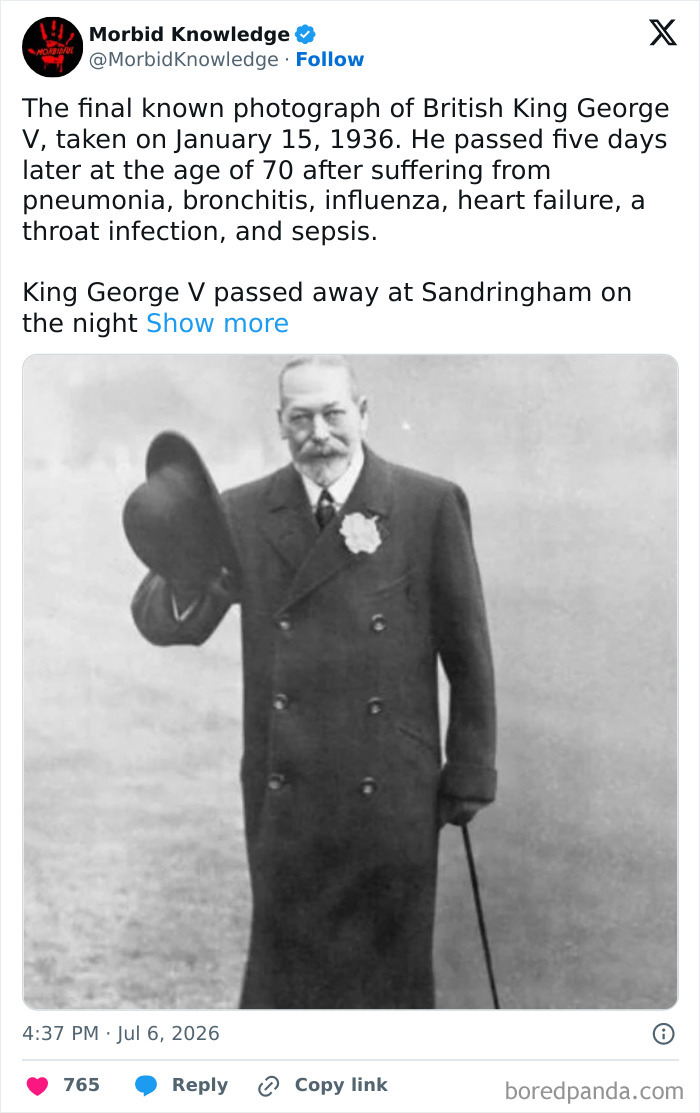
King George V passed away at Sandringham on the night of January 20, 1936, aged 70, after months of declining health.
The official announcement said he had passed peacefully at midnight. The next morning, The Times ran the headline: "A Peaceful Ending at Midnight." It was a lie, one carefully engineered by his own doctor.
In 1986, fifty years after the King's death, the private diary of his royal physician Lord Bertrand Dawson was made public by his biographer.
The diary revealed that Dawson had personally injected the King with three-quarters of a grain of morphine and one grain of coca*ne directly into his jugular vein at around 11pm, hastening his d*ath by several hours.
Dawson's stated reasons were twofold, and one of them is extraordinary.
He wrote that the King's lingering d*ath "little comported with that dignity and serenity which he so richly merited," and that he wished to spare the family from hours of distress.
But he also explicitly noted that he wanted to ensure the d*ath announcement appeared in the morning edition of The Times rather than in "less appropriate evening journals."
He called the Palace and told the Times editor to stand by for late news.
The King's actual last words, it turned out, were not the widely reported and reverently repeated "How is the Empire?", they were "God damn you!" directed at his nurse as she administered a sedative.
The same year the King d*ed, a bill to legalise voluntary euthanasia was debated in the House of Lords.
Lord Dawson voted against it, while having already secretly performed the act on the monarch.
He said such decisions should be left to individual physicians rather than regulated by law.
When the diary notes were revealed in 1986, the public reaction was outrage.
George V's official biographer Kenneth Rose accused Dawson of m*rder. The notes are now held in the Windsor Castle archives.
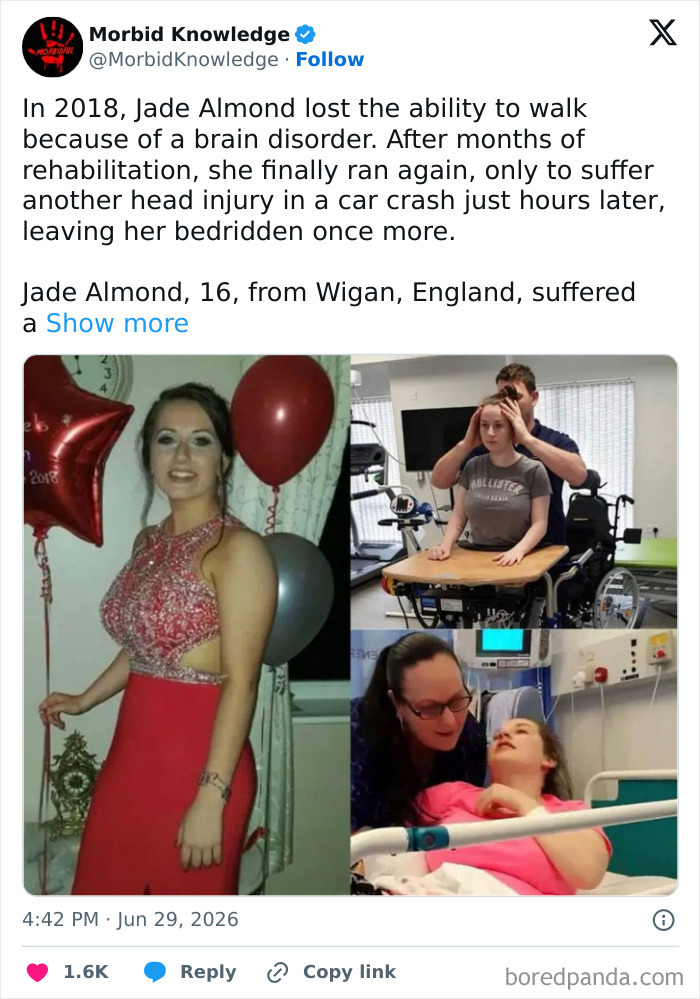
Jade Almond, 16, from Wigan, England, suffered a bang to the head during a Duke of Edinburgh Award project in July 2018.
Within weeks she had developed Functional Neurological Disorder, a condition in which the brain fails to send correct signals to the body.
She lost the ability to walk, control her right arm, and began collapsing frequently.
Her family fundraised £14,500 to pay for intensive private rehabilitation at the STEPS centre in Sheffield.
After seven months of gruelling work, Jade was finally discharged. A video taken moments after her last appointment showed her running up and down stairs for the first time in nearly eight months.
She got in the car to go home.
That evening, another vehicle ploughed into the back of the car on the M60 motorway. The crash wiped out months of progress in a single moment.
Jade said: "You couldn't make it up that on the day I left physio this happened. It was heartbreaking knowing all the hard work had been undone because of a motorway crash. I was so scared."
She was taken back to Sheffield for a second stint at the STEPS centre, working to regain movement in her arms and rebuild her core strength through hydrotherapy.
Her mother Michelle said: "It's slow progress but that is a good thing because we want her to be better forever."
She was a Wigan Athletic Ladies goalkeeper before FND took everything. She spent two years getting it back twice.
As the ceremony got underway on March 31, 2021, the groom's mother noticed a distinctive birthmark on the bride's hand that looked identical to one belonging to her daughter who had gone missing decades earlier.
She gathered herself and asked the bride's parents an unexpected question: "Did you adopt your daughter?"
The adoption had been kept a complete secret for twenty years. The fact that this stranger knew it was the first confirmation she needed.
The bride's parents confirmed they had found her abandoned as a baby by the roadside and raised her as their own. Both women broke down completely.
The panic that followed was understandable. The bride was about to marry the biological daughter of her mother-in-law, which would make them siblings.
The groom's mother then revealed the twist that saved the wedding, her son had been adopted. The wedding went ahead.
"the bride was about to marry the biological daughter of her mother-in-law" I think that should be "about to marry the biological *son* of her mother-in-law"
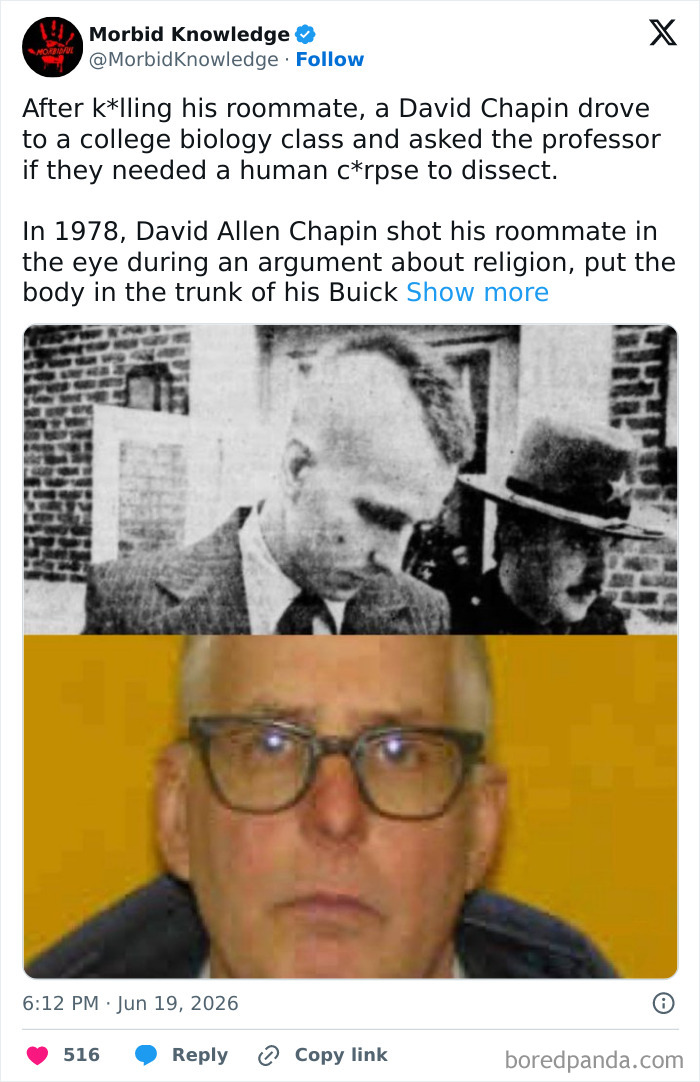
In 1978, David Allen Chapin shot his roommate in the eye during an argument about religion, put the body in the trunk of his Buick Skylark, drove to biology class, and asked his professor if he needed a c*rpse to dissect.
The professor called security and had him arrested on the spot.
Chapin and Donald Liming had been friends since childhood and shared an apartment in Milford, Ohio.
Chapin was a Baptist; Liming described himself as simultaneously Catholic, Buddhist, and Pagan. On October 3, 1978, the argument escalated and Chapin shot Liming in the eye.
He then put Liming's body in his car trunk and drove to Raymond Walters College, where he was a student, and asked his biology professor if he needed a corpse to dissect.
After realising Chapin was serious, Professor DeJong reported him to security and he was arrested immediately.
At trial it got stranger. Chapin told a court-ordered psychiatrist that he had eaten part of Liming's brain as part of a "mutual agreement" between the roommates, that whoever d*ed first would have their brain consumed by the other.
The psychiatrist noted Chapin had a "warm, personable smile" while describing the m*rder.
He was convicted of aggravated m*rder and sentenced to life in prison.
As of 2016 he had been denied parole five times. Liming's family writes letters to the parole board before every hearing to oppose his release. They have done so for nearly fifty years.
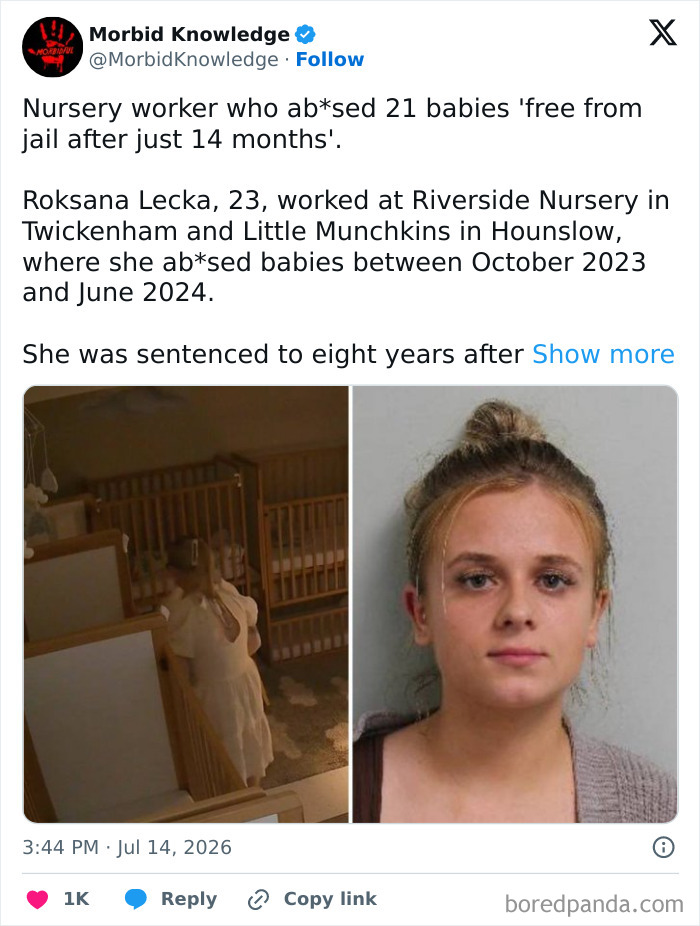
She was sentenced to eight years after admitting seven child cruelty offences and being found guilty of 14 more.
Under the Early Release Scheme, she was deported to Poland in February 2026 having served less than 15% of her sentence.
Then came the blunder.
British officials used a unilateral deportation procedure instead of a formal prison transfer, meaning Polish authorities had no legal basis to arrest her when she landed.
She walked through Warsaw Airport like a regular traveller and has since disappeared.
A father of one victim said the early release was "really hard to swallow", that after all the witness statements, victim impact statements, and trauma of the trial, the sentence felt "hollow."
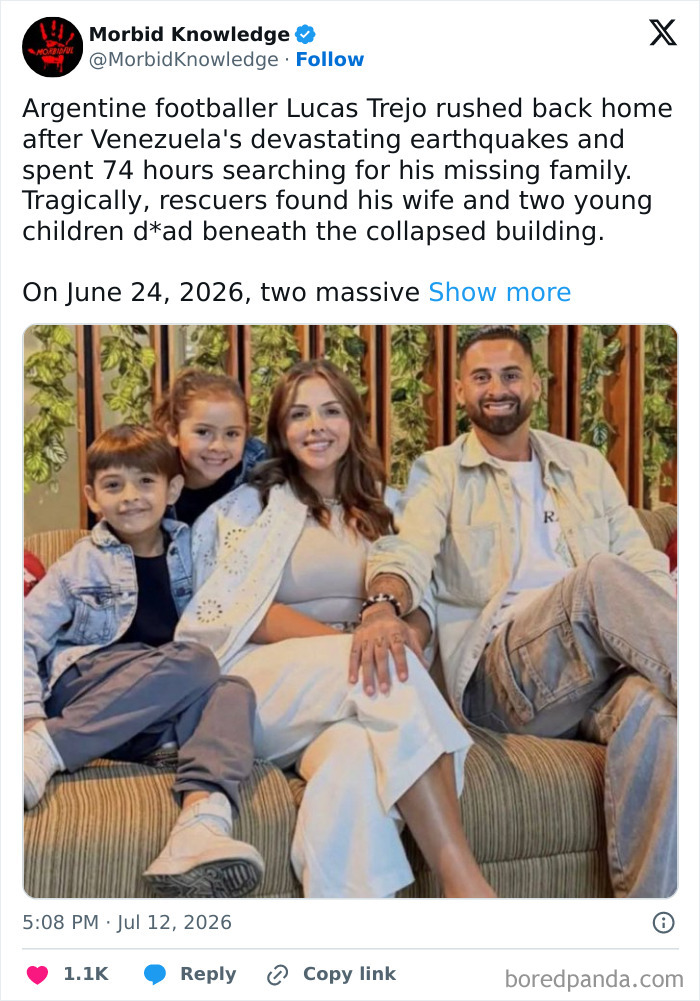
On June 24, 2026, two massive earthquakes struck Venezuela's northern coast just 39 seconds apart, a rare "doublet" that levelled entire neighbourhoods.
The d*ath toll has risen to over 1,400, making it one of the worst natural disasters in the country's modern history.
Lucas Trejo, a 38-year-old Argentine centre-back playing for Venezuelan club Sport Marítimo de La Guaira, was in Caracas with his team when the quakes hit.
His family's apartment building in Playa Grande, La Guaira, collapsed.
"Our building in Playa Grande collapsed. I don't know anything about my family," he wrote on online, before rushing to the disaster zone to search himself.
His brother-in-law told CNN Español that Trejo was "emotionally overwhelmed" and that "absolutely nothing" was left of the beachfront home.
After 74 hours, rescuers recovered the bodies of his wife Yanina Maranella and their two children, Aarón and Ainhoa.
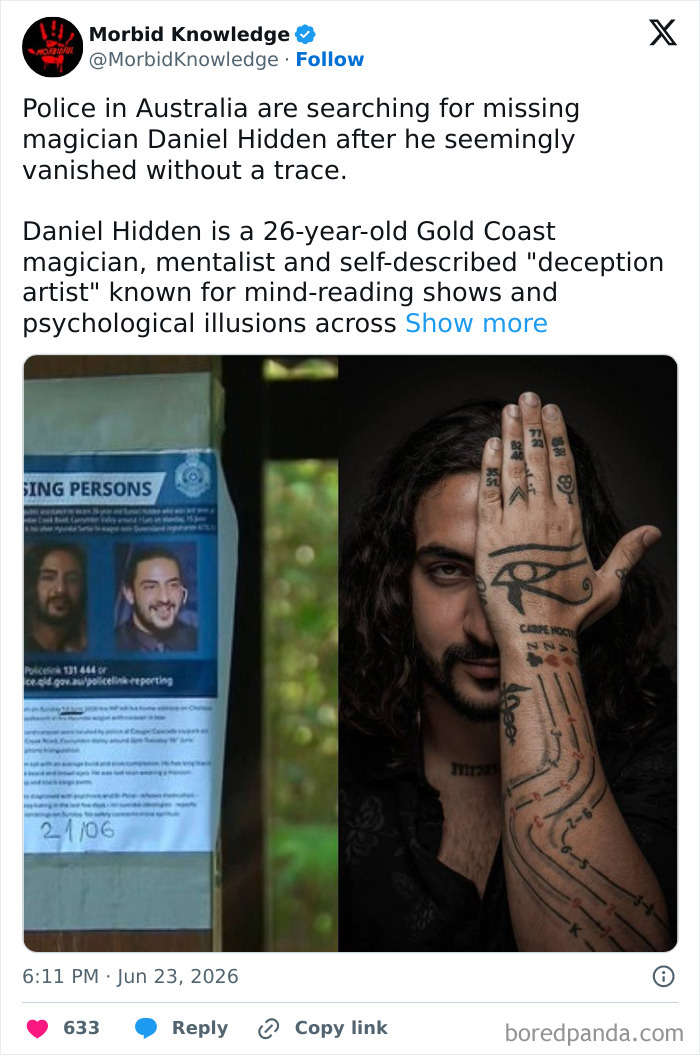
Daniel Hidden is a 26-year-old Gold Coast magician, mentalist and self-described "deception artist" known for mind-reading shows and psychological illusions across Queensland.
At approximately 3am on 14 June 2026, he was seen leaving his Broadbeach home in a silver Hyundai Santa Fe towing a caravan.
His phone was switched off three hours later. Nobody has heard from him since.
Two days after he disappeared, police found his car and caravan abandoned in a car park on Currumbin Creek Road in Currumbin Valley, near a popular hiking area around Gorge Falls and Cougal Cascades.
His brother Ilya said: "He hasn't taken his phone with him, which is a bit unusual. A week without contact or shelter, that's pretty unusual to us."
He added that the area where the car was found holds deep significance for Daniel: "He's got the coordinates of a spot in this place tattooed on his fingers."
Then came the detail that broke the internet. Hidden's professional website currently reads: "Transformation requires disappearance."
Another message says: "The new experience is currently under construction."
Police say there is no confirmed link between the messages and his disappearance, and the case is not being treated as suspicious.
The search has since escalated to involve roughly 100 volunteers, Queensland Police, firefighters, drones, aerial assets, and the Australian Defence Force.
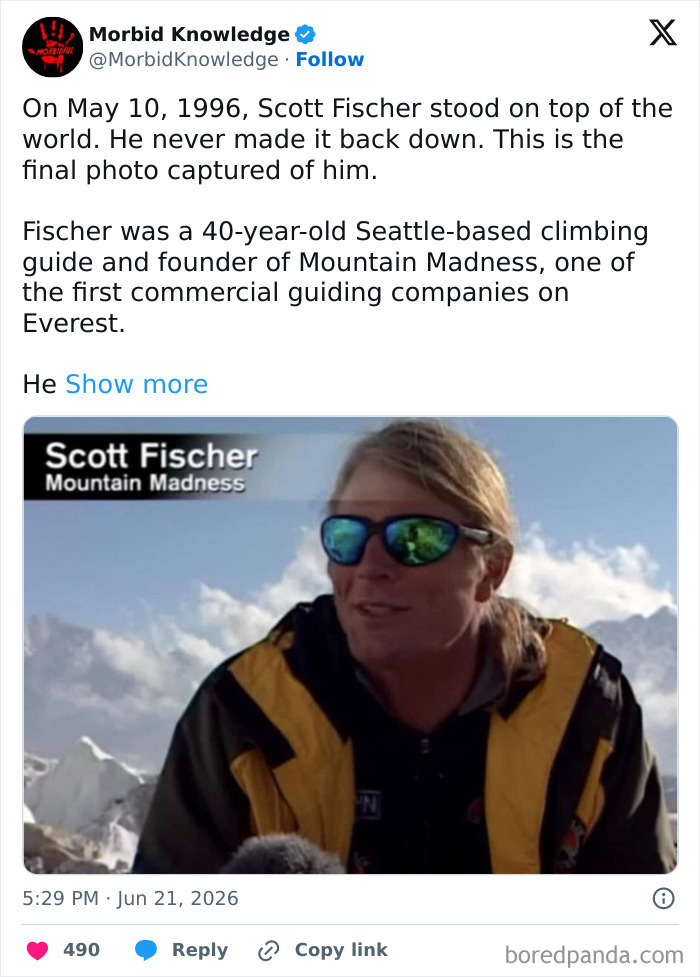
He had summited K2 without supplemental oxygen alongside Ed Viesturs, and was among the most accomplished American climbers of his generation.
On the afternoon of the summit push, Fischer reached the top later than planned, after 3:30pm.
On the descent, he lost consciousness due to severe hypothermia and cerebral oedema and died approximately 1,200 feet above the South Col, unable to move further.
What made his passing particularly brutal was the context surrounding it. Every other member of his Mountain Madness team made it back safely.
Fischer remained behind during the descent and never returned.
His guide Anatoli Boukreev, who had descended ahead of the group to recover at Camp 4, later went back up into the storm three times that night to rescue stranded climbers, saving multiple lives.
When Boukreev finally located Fischer, he was already beyond help. His reported words were: "There is nothing I can do. Scott is dead."
Fischer's body remains on Everest to this day. He was 40 years old, and left behind two children.
The disaster was documented in Jon Krakauer's book Into Thin Air, and Fischer was portrayed by Jake Gyllenhaal in the 2015 film Everest.
This needs a whole lot more info. 8 people di.ed that day due to a sudden storm. It's considered one of the worst disasters Everest has ever seen. I'll post a link below. And I highly recommend Krakauer's book!
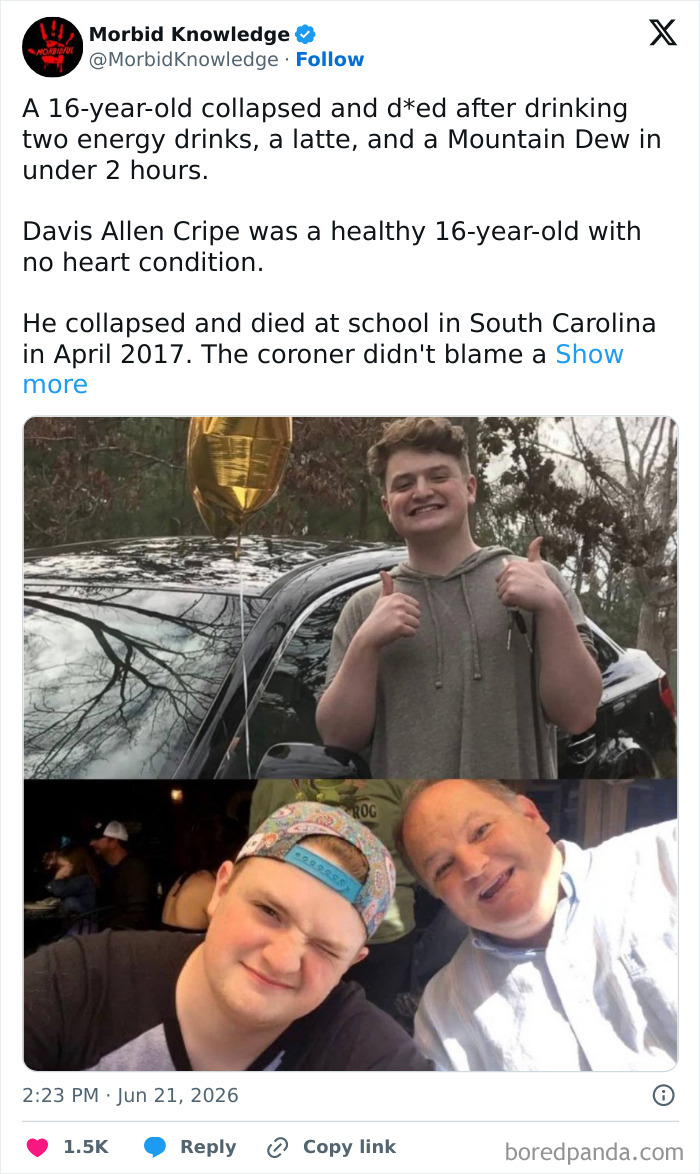
The coroner didn't blame a pre-existing problem. He blamed a large Mountain Dew, a café latte, and an energy drink consumed in under two hours.
Richland County Coroner Gary Watts held a press conference specifically to clarify that Davis had no underlying heart condition and that caffeine toxicity caused a fatal cardiac arrhythmia. "This is not a caffeine overdose," Watts said. "We're not saying that. What we're saying is that this is a caffeine-induced cardiac event."
The total caffeine across the three drinks was estimated at between 400 and 470 milligrams, consumed rapidly within approximately two hours. The FDA's general guidance puts 400mg per day as the threshold above which cardiovascular risks increase in healthy adults.
Davis hit that threshold in a single sitting with no time for his body to process it between drinks.
Davis had been at school for a robotics competition. He collapsed after a break and could not be revived.
He was 16 years old and had done nothing most teenagers don't do every day.
The speed and volume of consumption was what k**led him.
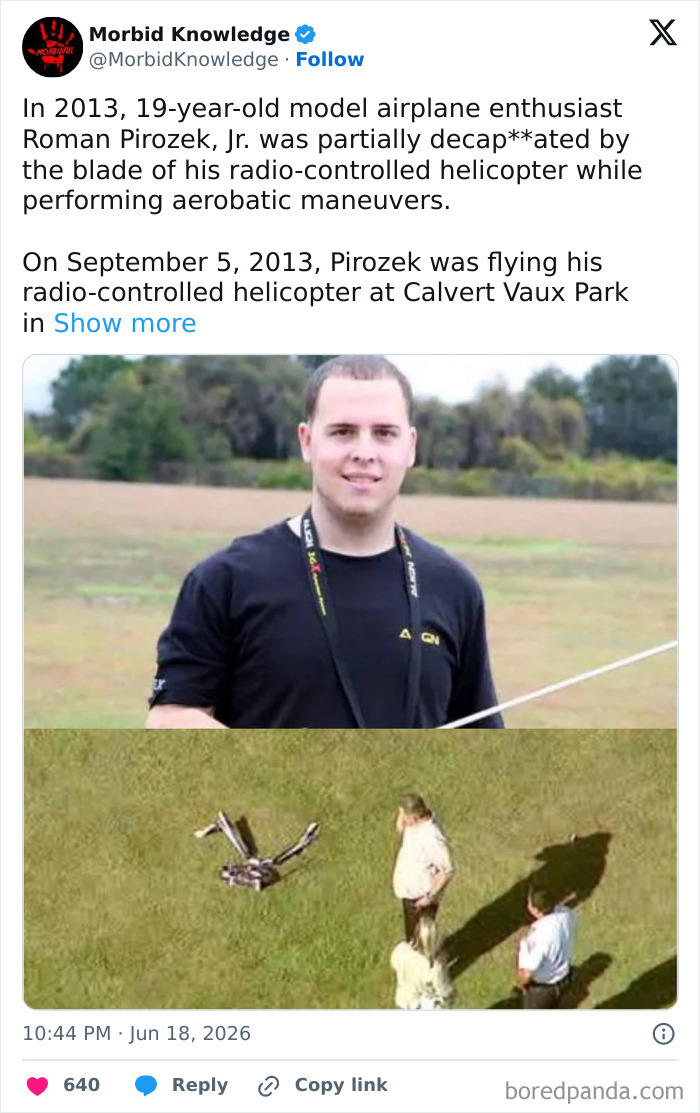
On September 5, 2013, Pirozek was flying his radio-controlled helicopter at Calvert Vaux Park in Brooklyn with his father and other club members when the aircraft lost control and veered into his head.
One of the propeller blades sliced off a piece of his skull. He was pronounced dead at the scene.
An expert who reviewed footage Pirozek had posted concluded he was likely attempting high-speed freestyle 3D maneuvers and had a mechanical failure.
"There was something wrong with that helicopter," the expert said. "I noticed strange oscillation as it took off. There was an imbalance somewhere."
His passing is believed to be only the second ever caused by a remote-control helicopter in the United States. His father was reportedly inconsolable.
His sister Amy said: "He always protected me. He always looked out for me. I'll never forget that."
Hospitals that discovered what he was doing were reluctant to formally report him, fearing lawsuits and lost credibility. They quietly fired him and let him move on.
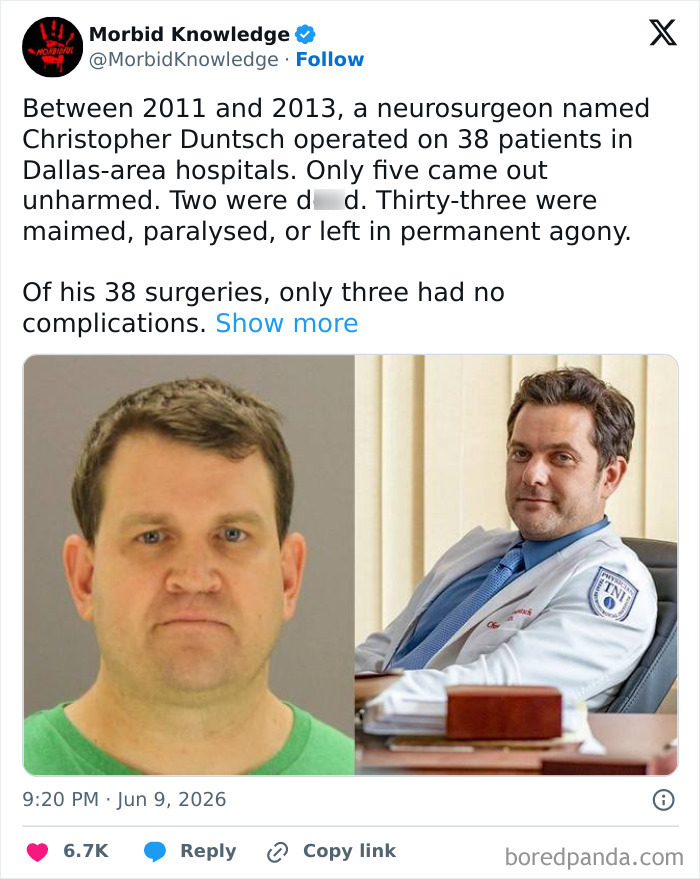
Patients woke from his surgeries paralysed from the neck down. One left with paralysed vocal cords. One became paraplegic.
He left a surgical sponge inside a patient's neck wound. He operated on the wrong part of another patient's spine.
In May 2013, University General Hospital threw a celebratory dinner to welcome Duntsch to their medical staff.
The following month he cut into a patient's vertebral artery and left a sponge in his neck.
His licence was suspended on June 26, 2013.
The most chilling detail came out at trial. Prosecutors presented a 2011 email Duntsch had written, sent after his first surgeries went wrong, detailing his plans to "become a cold blooded k*ller."
After 13 days of trial, the jury deliberated just four hours before convicting him.
On February 20, 2017, he was sentenced to life in prison, the first surgeon in US history convicted and imprisoned for actions committed in the operating room.
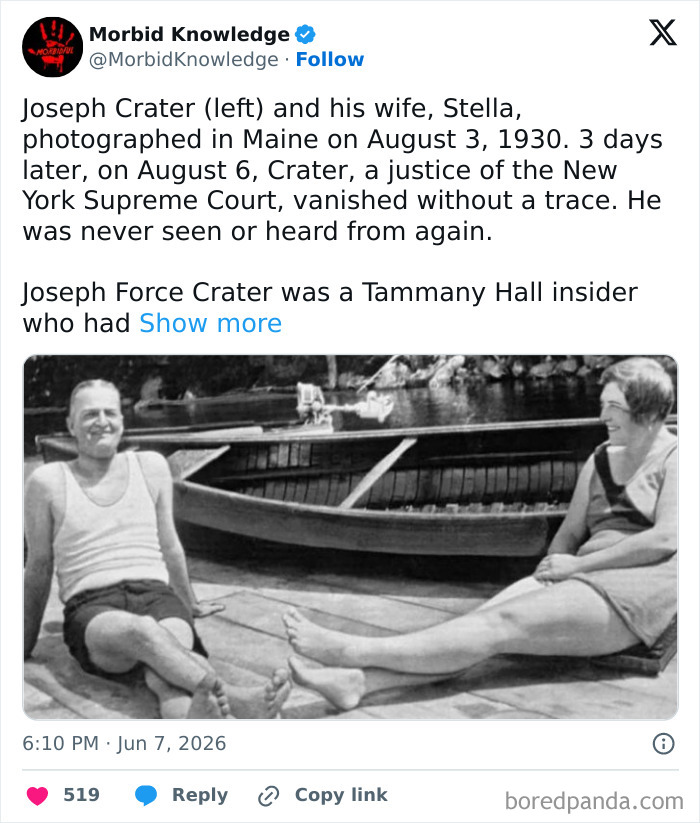
Joseph Force Crater was a Tammany Hall insider who had just landed a prestigious judgeship paying $23,000 a year.
He was tangled up in corruption, office-buying schemes, and shady real estate deals. He had a taste for Broadway chorus girls, speakeasies run by gangsters, and envelopes stuffed with cash.
The disappearance was preceded by suspicious behaviour.
While on vacation in Maine with his wife, Crater received a mysterious phone call and immediately told Stella he needed to return to New York on urgent business.
Back in the city, he went to his office and destroyed documents, shuttled others to his apartment, and withdrew large sums of cash from his bank accounts.
That evening he had dinner with friends at Billy Haas's Chophouse on West 45th Street, stepped outside, hailed a cab, and vanished into Manhattan traffic. He was 41 years old.
Over 16,000 leads were investigated. His showgirl girlfriend also disappeared around the same time and was never found.
The phrase "pulling a Crater" entered American slang as shorthand for going AWOL.
Then in 2005 came the closest thing to an answer.
A woman who had recently d*ed left a handwritten note claiming her husband and several other men, including a police officer, had m*rdered Crater and buried his body beneath a section of the boardwalk at Coney Island.
That section had been paved over decades earlier. It was never excavated.
Every year until her death in 1969, Stella would visit a bar in Greenwich Village on August 6, sit alone, and order two drinks.
She would have only one, raise the other, and say: "Good luck, Joe, wherever you are."
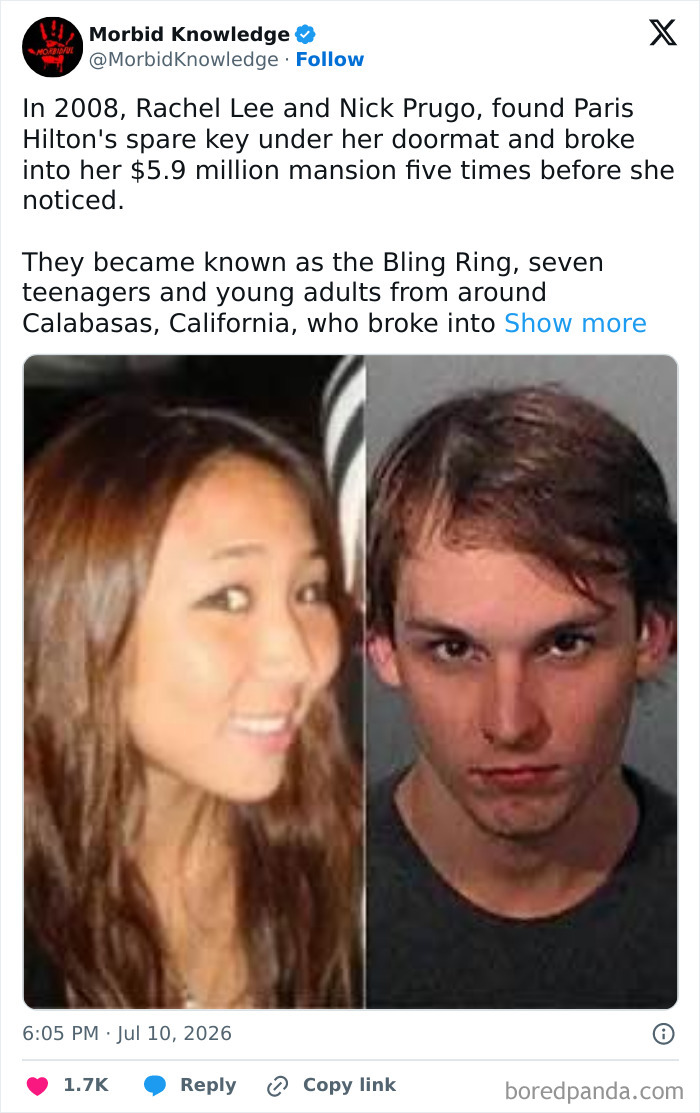
They became known as the Bling Ring, seven teenagers and young adults from around Calabasas, California, who broke into celebrity homes between October 2008 and August 2009 and stole roughly $3 million in cash and belongings.
The ringleaders were Rachel Lee and her childhood friend Nick Prugo.
It began small, checking handles on unlocked cars after parties, until they found a website listing celebrity addresses and treated it like hitting the jackpot.
Their first target was Paris Hilton, chosen because they assumed she was careless enough to leave a door unlocked.
In late 2008 they drove to her $5.9 million home, rang the bell to see if she was in, and when no one answered, found a spare key under the mat and let themselves in.
Lee treated Hilton's closet like a personal shopping suite. They returned at least four more times, and Hilton didn't notice anything was gone until around $2 million in money, clothing and jewellery had vanished.
Lee reportedly added Hilton's spare key to her own keychain.
From there the spree widened, Lindsay Lohan, Rachel Bilson, Orlando Bloom, Audrina Patridge, and the home Brian Austin Green shared with Megan Fox, where they took Green's semi-automatic handgun.
At Orlando Bloom's house, shared with model Miranda Kerr, they spent about three hours going through the couple's things and took close to $500,000 in Rolex watches along with luggage and art.
For Lee it was less about money than the thrill, the anxiety before, the adrenaline during, the rush after.
Walking into a star's home and trying on their clothes, she later said, let her "live in their world."
Planning was chillingly easy, they found houses on Google Maps and worked out when owners would be away by tracking their event appearances on social media.
Their undoing came from a security camera at Audrina Patridge's home.
The footage hit the media, a tipster recognised Nick Prugo, and he confessed and named the others.
When police arrested Lee in Las Vegas, they found a coat belonging to Lohan and topless photos of Hilton taken from a safe in her house.
Lee served about sixteen months of a four-year sentence; Prugo served one year of two.
The whole saga was later turned into Sofia Coppola's 2013 film The Bling Ring, filmed, fittingly, inside Paris Hilton's actual house.
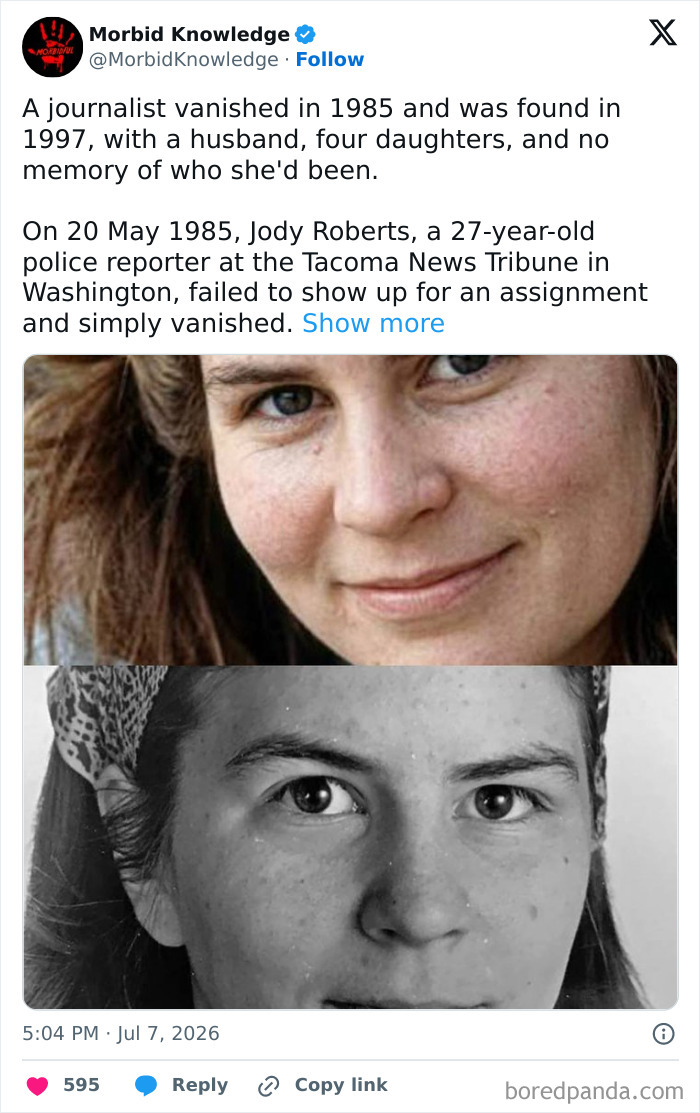
Her car was found in a car park near the office. There were no clues, no note, and no body.
The case was eventually reclassified as a hom*cide.
Five days after her disappearance, a woman was found wandering, confused, in a shopping mall near Denver.
She appeared in a local newspaper under the headline "Amnesia victim." That woman was Jody Roberts.
She renamed herself Jane Dee. In 1989, she moved to Alaska.
She married a man named Dan Williams, had two sets of twin girls, and built a life entirely from scratch, without any memory of her career, her family, or the first 27 years of her existence.
The case broke in 1997 when a former co-worker recognised her face on a cable TV news segment about the case and called police.
A detective tracked her down, called her at home in Sitka, Alaska, and broke the news.
Roberts got on the internet and read newspaper articles about herself. She had not been aware anyone was looking for her.
When her mother finally spoke with her by phone, Roberts thought she was 35. She was 39. She didn't know when her birthday was.
Questions remain unanswered to this day.
Before her disappearance, Roberts had emptied her bank account, taken her cats to the Humane Society, and made a last-minute vacation request at work, none of which are typical of someone planning to vanish involuntarily.
Whether it was genuine fugue or something else entirely, she has never fully explained what happened.
Whoa, from my stomping grounds, I've never heard of this. Very bizarre... sounds like she may have had a mental break of sorts...time to go in a wikipedia hole...
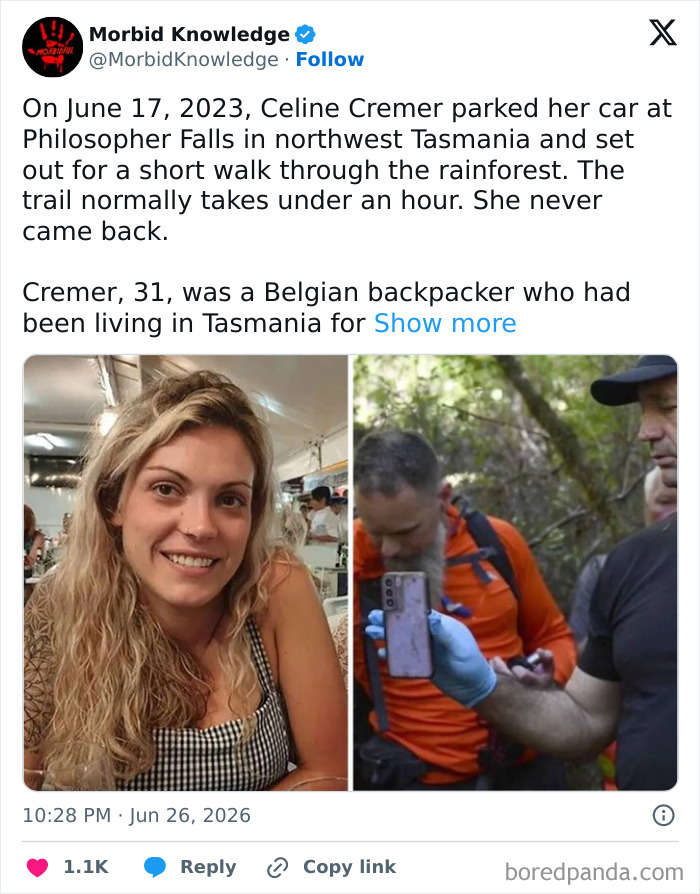
Cremer, 31, was a Belgian backpacker who had been living in Tasmania for six months and was planning to relocate to Victoria the very week she disappeared.
Her friends reported her missing nine days after she was last seen. By then the area had experienced subzero temperatures, snow and heavy rainfall.
Medical experts advised police she could not have survived so many days in those conditions.
The official search lasted two weeks and found nothing.
Follow-up searches over the following two years found nothing. She had simply vanished.
Then her friends refused to accept it. In December 2025, an independent search party organised by Cremer's family and friends found her phone at the falls, the first sign of her ever located in the area, more than two years after she disappeared.
On January 28, 2026, a volunteer searcher found human remains near Philosopher Falls. Police formally joined the search.
Car keys belonging to Cremer were subsequently recovered from the Arthur River nearby.
On February 26, 2026, Tasmania Police confirmed the remains had been provisionally identified as Celine Cremer's.
Investigators believe she became lost in the dense rainforest, dropped her phone accidentally, and could not survive the harsh conditions of the remote wilderness alone.
The trail she set out on takes forty-five minutes. It took the world two and a half years to find her.
On May 3, 2019, Jose Rodriguez-Castro and his girlfriend Lexi Rivera were sitting at a red light in Milwaukee when a car pulled up alongside them. The driver opened fire with a semiautomatic pistol.
"He just looked at me and covered me," Rivera told reporters. "That's it. Just said 'babe' and threw himself over me."
Jose bore the full force of the gunfire, sustaining multiple direct hits as 21 rounds were fired at the couple from point blank range.
He was found slumped over the wheel with a faint pulse. He passed at the scene. Lexi survived with a minor injury from shattered glass.
The sh*oter was Victor Cintron Jr., Lexi's violent ex-boyfriend who had been charged with repeatedly assaulting and threatening her in the weeks before the attack.
He was tracked down in California by US Marshals and convicted of first-degree intentional hom*cide. He was sentenced to life in prison with the possibility of parole after 50 years.
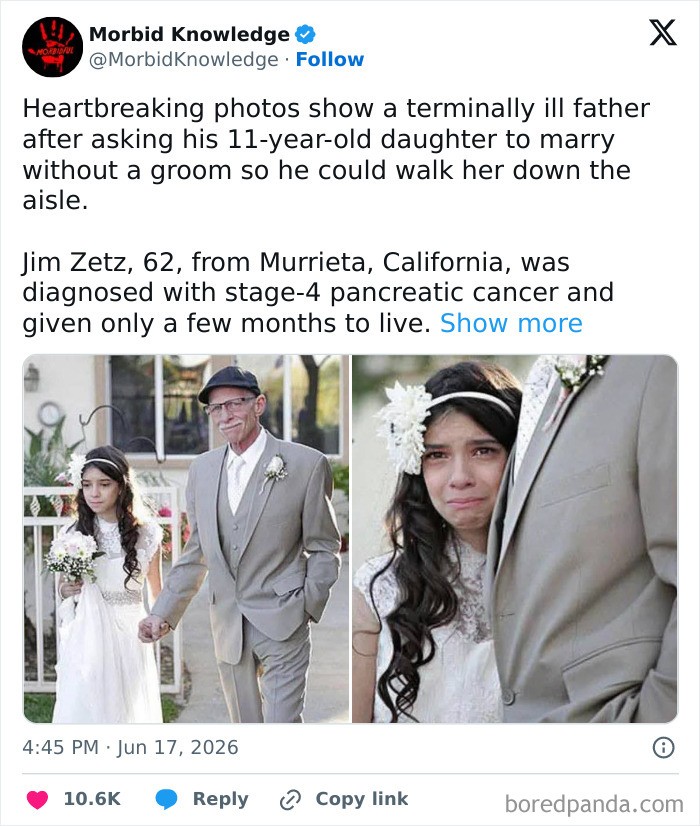
Photographer Lindsey Villatoro, who had been documenting his final months with the family, had an idea for Josie's 11th birthday.
"She mentioned she was so emotional about her dad not being there for memories down the line," Villatoro wrote.
"So I figured we would make some now."
In 72 hours she collected donations for Jim's suit, Josie's white gown, a wedding cake, catered food, and flowers.
Twenty-three members of the community helped pull it together. Josie was picked up from school, told nothing, and taken home.
With the Wedding March playing, Jim walked his daughter down the aisle toward the pastor.
"Your dad may not get to see you get married, but he is here to walk you down the aisle today," the pastor said.
He pronounced them "daddy and daughter."
"It was not easy to do, let me tell you, but I wouldn't change it for the world," Jim said. "In twenty years, when she really gets married, she's going to be happy that happened."
Jim passed away a few weeks later. Josie will have the video to play at her real wedding, as if he were physically there.
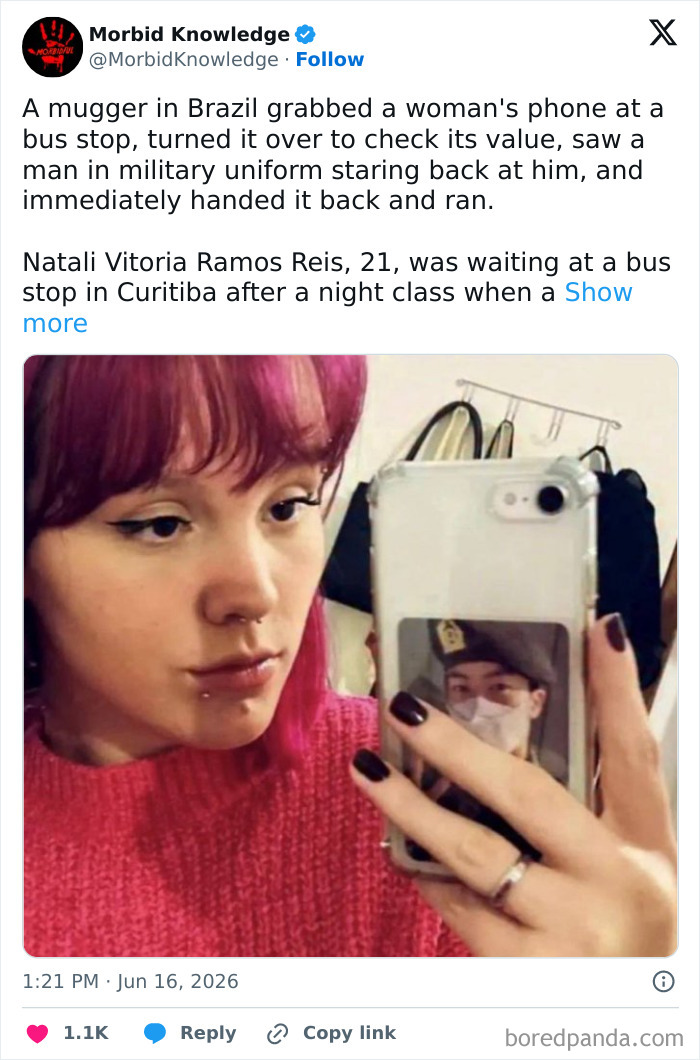
Natali Vitoria Ramos Reis, 21, was waiting at a bus stop in Curitiba after a night class when a man approached and snatched her phone.
He turned the device around, saw the photo on the back of the case, and returned it before fleeing immediately.
The photo was a photocard of Jin, the BTS member who had been serving mandatory military service in South Korea since December 2022. He was photographed in full uniform.
"When he managed to grab the cell phone from my hand, he turned the device around and looked at the picture," Natali told RIC TV.
"He must have thought my boyfriend was in the military because he didn't steal it."
At the time of the incident, Jin had already been recognised as an elite soldier and received an early promotion to corporal for excellence in training.
He was thousands of miles away in a South Korean barracks, completely unaware he had just foiled a robbery.
I find it interesting that even some of the biggest (and richest) pop stars in the world (BTS) are not exempt from their country's military service. In most countries they would probably be excused due to fame privilege.
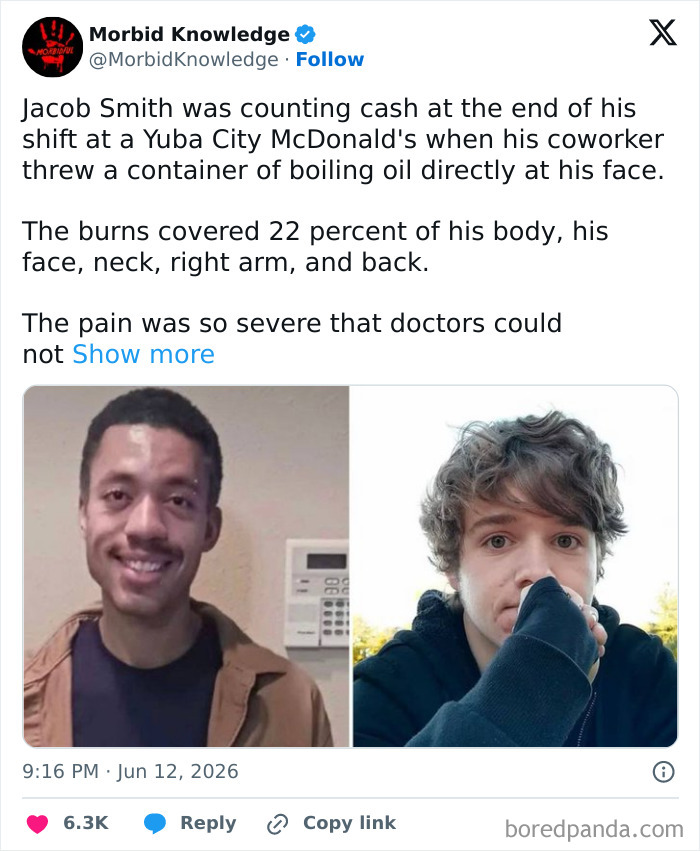
The pain was so severe that doctors could not give him adequate pain relief outside of the ICU.
The suspect, 23-year-old Jalani Bluett, fled the restaurant immediately after the attack.
Police issued a missing person alert citing vulnerabilities related to a diagnosis before locating and arresting him the following day.
He was charged with battery causing serious bodily injury, mayhem, and a***ult with a deadly weapon. He pleaded not guilty.
The two men worked together. Jacob's mother Amber told reporters: "As his mother, it broke my heart when he looked at me and said, 'Why would he do this to me?'"
Jacob is preparing for skin graft surgery.
Despite his injuries he wrote on his GoFundMe: "As much as I want to be angry, or want to hate people and be scared of people, it's just so hard to be when I have so many people showing their love for me."
This just happened last month so the guy who did it hasn't been prosecuted yet - he's in jail though.
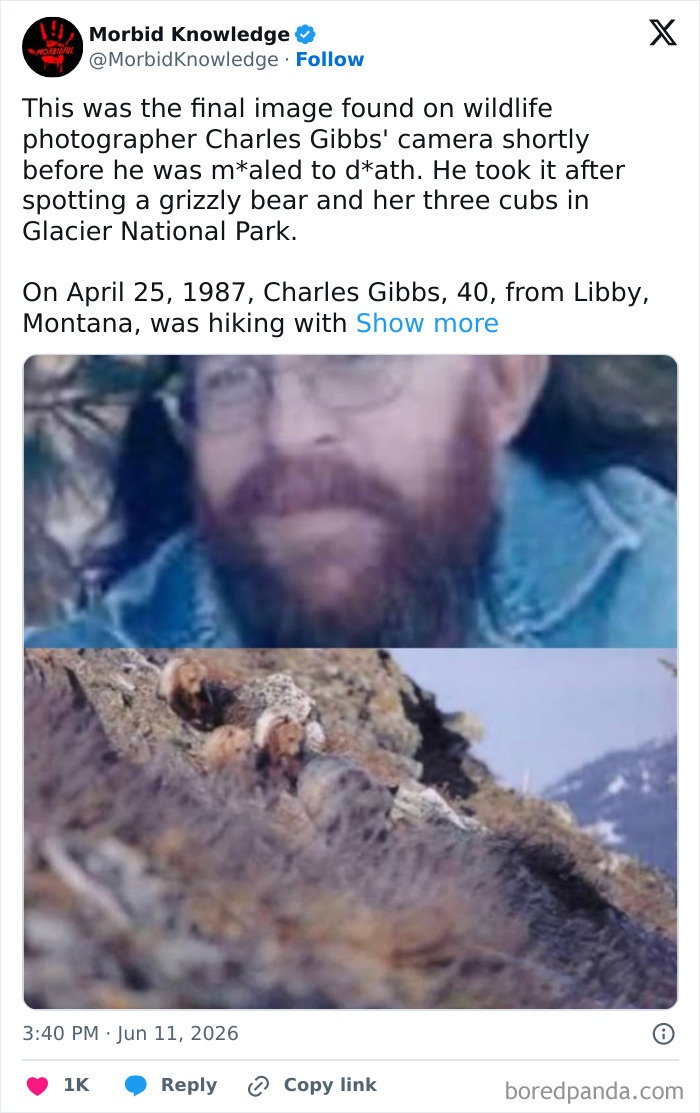
On April 25, 1987, Charles Gibbs, 40, from Libby, Montana, was hiking with his wife Glenda near Elk Mountain in Glacier National Park when they spotted a female grizzly with her three yearling cubs high on the mountain's southwest face.
Gibbs decided to get closer. His wife continued to the car.
His camera told the rest of the story. The final photographs showed the bears charging directly toward him from approximately 50 feet away.
Park officials believe he climbed a nearby tree to escape. The sow climbed up after him and pulled him down, ma*ling him to d*ath beneath it.
When Gibbs did not return that night, Glenda reported him missing. His body was found the following day.
The National Park Service's official records of grizzly fatalities at Glacier confirm his de*th on April 25, 1987, classifying it as a defensive response by the bear.
No action was taken against the sow or her cubs.
His photographs were published posthumously in The Hungry Horse News, the wildlife publication he had always dreamed of being featured in.
Built on a foundation of water-soluble gypsum, the ground beneath it is constantly eroding, requiring continuous grouting with concrete around the clock to help maintain its stability.
Experts have long warned that a catastrophic failure could unleash devastating flooding across northern Iraq, threatening cities including Mosul and potentially reaching Baghdad, with some estimates suggesting up to 1.5 million lives could be at risk.
Wang, from Hunan Province in central China, was diagnosed this February with pituitary hormone deficiency, a condition in which the pituitary gland fails to produce the hormones that control growth and metabolism.
His family had struggled to identify or afford treatment for years. His father worked as a construction worker on a low income.
For most of Wang's life, no doctor had given them a name for what was happening.
Three years after Wang was born, his parents had his younger sister Xiaoling.
When Xiaoling was in elementary school, their mother was diagnosed with terminal cancer.
Until then Xiaoling had been distant from her brother, but the diagnosis changed everything.
She decided to stay home after graduating from nursing school rather than move to the city, taking a job at a local clinic in Changsha so she could remain close.
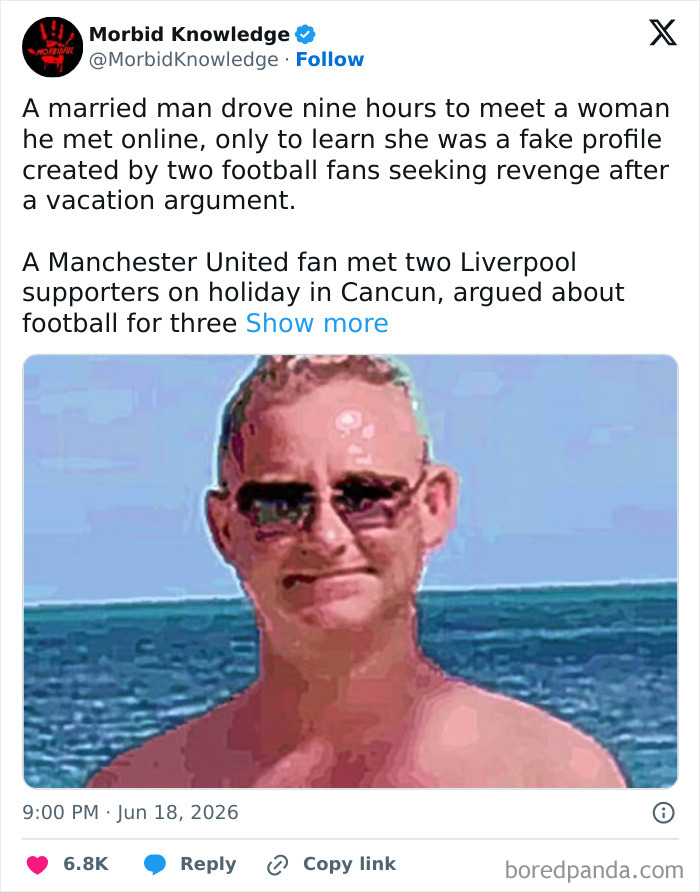
A Manchester United fan met two Liverpool supporters on holiday in Cancun, argued about football for three weeks, got thrown in the swimming pool, and drove nine hours to Aberdeen to meet a woman who didn't exist.
They made it all the way from Mexico to Sheffield before striking.
Back home, the two Liverpool fans set up a fake social media account for a Scottish woman named Emma and began messaging Stuart Slann, 39, from Sheffield.
After a month of flirtatious emails and texts, Emma invited him to visit her at a remote farm in Aberdeen.
Slann drove nine hours through the night. When he arrived the farm was empty. Emma sent a text saying she was still at work. He waited in his car for three and a half hours.
Then his phone rang.
"Do you recognise our voices, Stuart? It's them Scouse lads who threw you in the pool. Do you recognise our Scouse accents?"
He replied: "Yes I do." They told him: "You've been framed" and burst into laughter.
Slann told the Sheffield Star: "It was a cruel thing to do. If they had asked me to drive to Manchester, Leeds or even Liverpool it wouldn't have been so bad. But Aberdeen was just cruel."
The story has one final, brutal footnote. His wife reportedly left him after discovering he had driven nine hours to meet a woman from the internet.
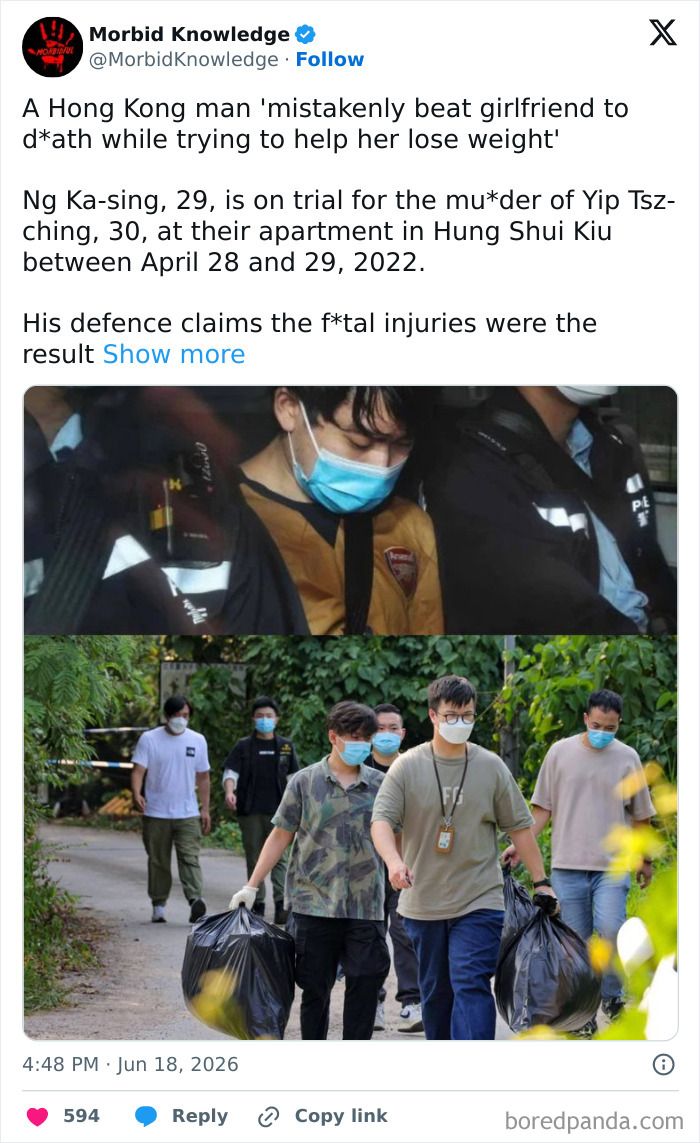
His defence claims the f*tal injuries were the result of a mistake during an attempt to help Yip lose weight by keeping her awake at night.
Prosecutors rejected his offer to plead guilty to the lesser charge of mansla*ghter.
Prosecutors told the court Ng beat her intermittently from 10pm on April 27 until 5:30am the following morning.
He allegedly told police he continued because she did not tell him to stop. He also claimed she poured drain cleaner on herself, while he only splashed it on the floor to "stimulate" her feet.
He said she hit herself against a wall seven or eight times by slipping.
At 5am Yip told Ng she felt pain and might not survive. At 7:21am she fell into a coma and never recovered.
The following morning, joggers spotted a leg protruding from a rolled-up quilt on a wheelboard being pulled along a road.
Ng was found standing next to it, not in a state of panic. A street cleaner asked what he was doing. He said he was taking the body to the station.
The pathologist found multiple bruises, lacerations, extensive burns covering 55 percent of her body, and identified her cause of d*ath as suffocation following head injuries. The trial is expected to last 18 days.
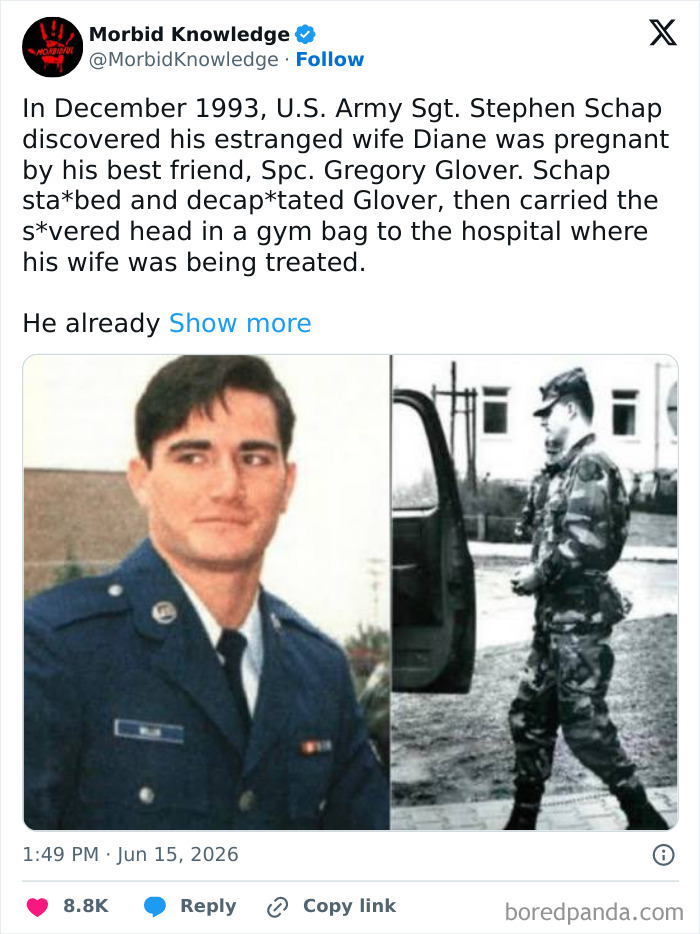
He already had a vasectomy. He knew the baby could not be his. He walked out of the hospital and within thirty minutes had figured out who it was.
He found Glover at a payphone on the base, mid-call with Diane. With Diane still on the line, Schap confronted him.
He stabbed Glover fifteen times, then dec*pitated him. He carried out the k*lling in front of witnesses who saw him flee with the head.
He placed the head in a gym bag, returned to the hospital, walked into Diane's room, unzipped the bag, placed the head on her bedside tray table and physically forced her to look at it.
He told her: "Look Diane, Glover's here. He'll sleep with you every night now."
Schap was court-martialled for the m*rder of Gregory Glover in April 1994 and found guilty of premeditated m*rder.
The mandatory life sentence was reduced by the convening authority to 45 years.
Diane Schap testified against her husband at trial, confirming the affair and that Glover was the father of her child.
Total psycho! Cheating is not cool, but bringing the guy's head to the hospital is beyond f.ucked up.
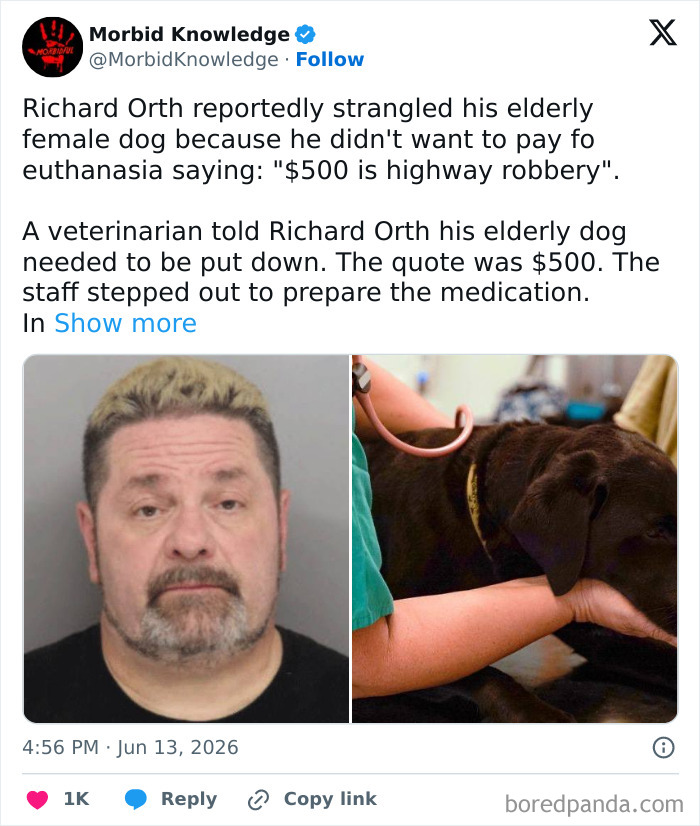
In the two minutes they were gone, Orth decided to handle it himself.
The 59-year-old from East Price Hill, Cincinnati, brought Tinkerbell to the Animal Hospital of Delhi Hills on May 23.
When staff left the room, audio recordings captured him saying: "Go be with God. I won't let you suffer. $500 is highway robbery." He then strangled her.
Tinkerbell sustained serious injuries to her neck and throat.
Despite efforts by staff, she had to be euthanised due to the trauma inflicted, the very outcome Orth had brought her in for, just not the way he intended.
Hamilton County Prosecutor Connie Pillich charged him with one count of cruel treatment of companion animals.
“There's no excuse for what happened here," she said. "Our office is committed to holding those accountable who harm animals."
Orth faces up to one year in prison if convicted. The irony is not subtle, had he asked, the clinic may have been able to arrange a payment plan or connect him with financial assistance.
Instead he is facing a felony charge over a bill he still didn't manage to avoid paying.
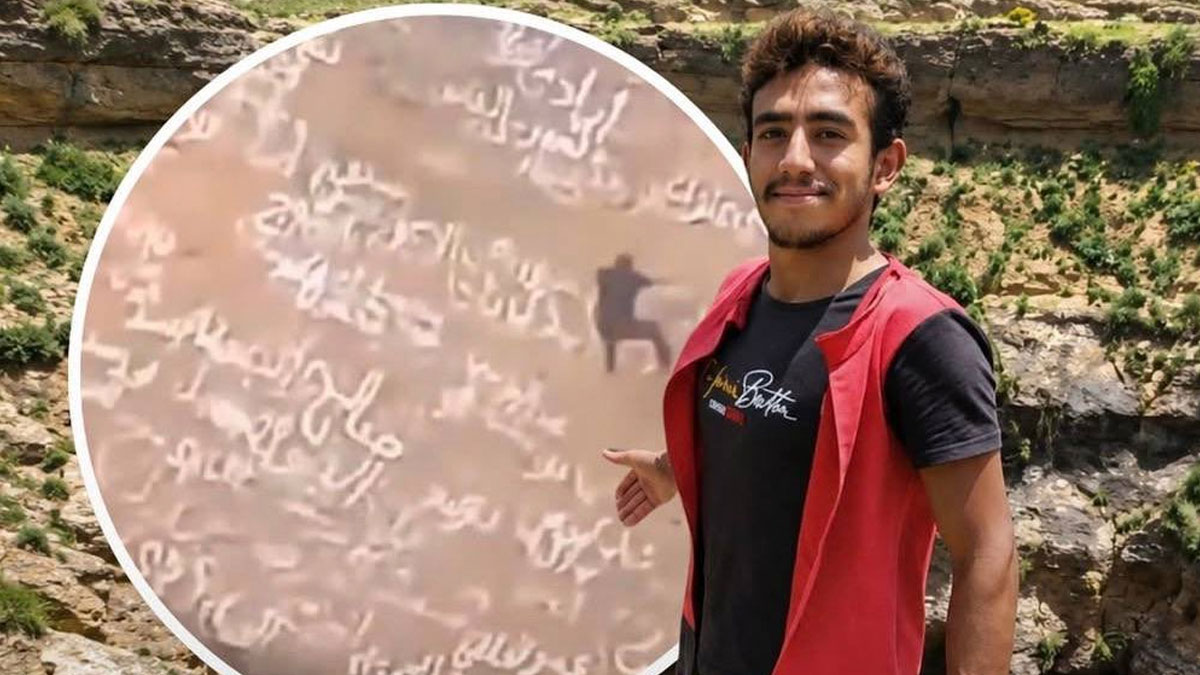
On June 1, 2007, A-Rod was greeted by a sea of blonde-female-masked Red Sox fans in box seats along the third base line at Fenway Park. The masks had not even been bought for the occasion.
Jim Phipps, a lifelong Red Sox fan, had purchased the masks for a birthday party and had 33 left over. He handed them out to people in his section before the game.
"I was watching Good Morning America and they showed a picture from the Post of A-Rod and I said, 'Hey, that girl looks like that mask, and bingo!'" he told the New York Post.
Outside the park, Boston radio station WBCN had staffers walking down Yawkey Way in blonde wigs holding signs reading "I'm with A-Rod" alongside a silhouette of a pole dancer.
The story had one more twist.
Hours before the game, Rodriguez had reportedly tried to make amends with his wife Cynthia by buying her a $6,000 necklace at the Ritz-Carlton in Boston. She appeared publicly alongside him anyway.
A few weeks later she sat in the Yankee Stadium stands wearing a tank top that read "F*** You" across the back, with their two-year-old daughter beside her.
The Yankees won 12 of their next 15 games. New York tabloids suggested the scandal had somehow focused the team.



















 No fees, cancel anytime