Get Premium
Dark mode theme is available exclusively for premium users. Learn more about the benefits of subscribing.
No fees, cancel anytime.

 Dark Mode Ad-Free Browsing Unlimited Content
 Ad-Free Browsing Unlimited Content Dark Mode
Join 1.2 million Panda readers who get the best art, memes, and fun stories every week!
You’ve probably seen that meme of Anakin Skywalker and a naive Padmé Amidala, when she asks if they’re going to cure cancer with the help of AI? Well, in the years since AI has become a major part of our lives, it’s already become a bogeyman for white-collar workers, the source of thousands of memes – but here’s a truly awesome story of AI actually helping to cure cancer.
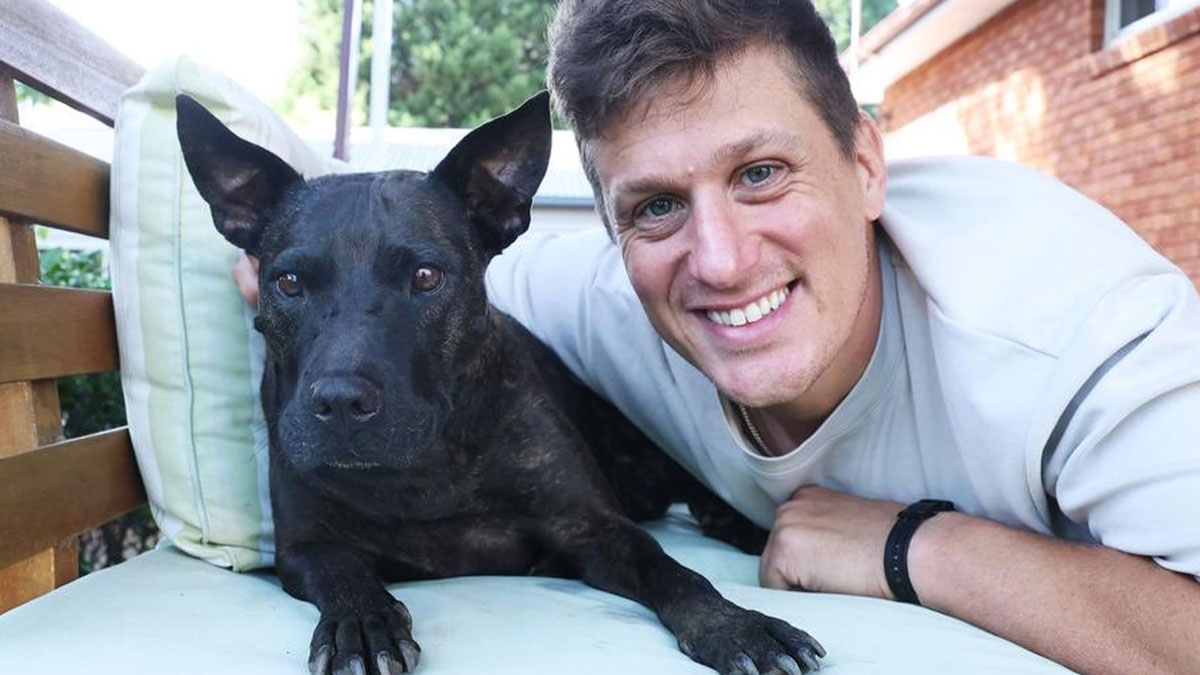
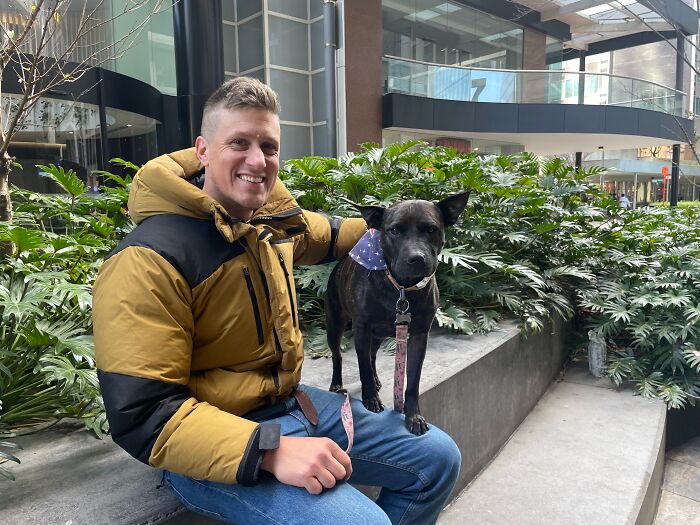
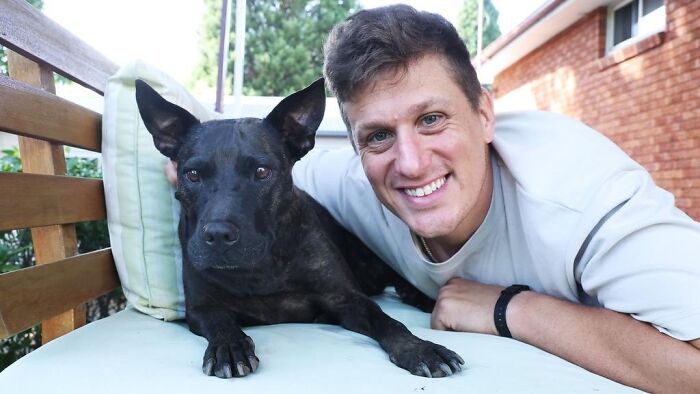
Australian IT entrepreneur Paul Conyngham is considered one of the pioneers of AI in his country, so it’s no surprise that when the vets said his beloved dog had only a couple of months to live due to advanced cancer, he turned to ChatGPT. And, surprisingly, he was successful.
Image credits: Paul S. Conyngham / x.com
Paul Conyngham, with an engineering background, is the co-founder of Core Intelligence Technologies and the director of the Australian Association for Data Science and Artificial Intelligence. In 2019, Rosie, a wonderful and very playful Staffordshire Terrier–Shar Pei mix, came into his life. Five years later, Rosie was diagnosed with cancer.
Rosie is no longer young – by the time Paul adopted her from the shelter, she was already eight years old. Unfortunately, statistics are merciless – for example, this study published in the NIH online library claims that around 50% of older dogs develop cancer. The percentage of terminal cases is also quite high – around 25%. But Paul and Rosie didn’t surrender to fate.
The dog developed multiple tumors, and although she underwent chemotherapy and surgery, it, unfortunately, yielded no results. The vets said Rosie would survive for up to six months, but then the disease would inevitably take its toll. But the dog’s owner didn’t give up and continued to search for ways to help his beloved pet.
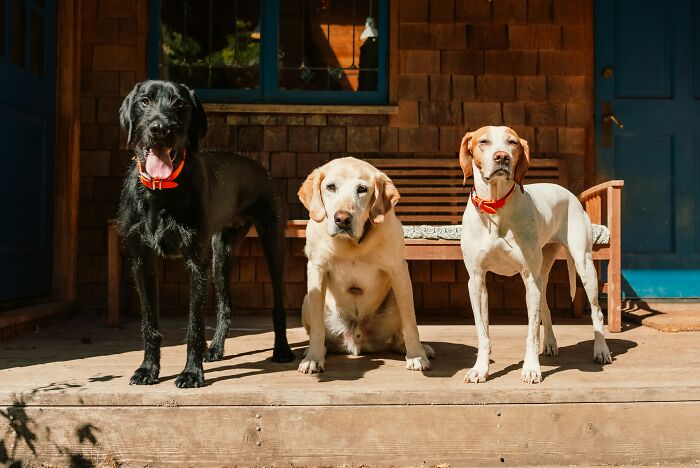
Image credits: Josh Hild / Unsplash (not the actual photo)
Conyngham turned to ChatGPT to brainstorm this problem and thus discovered the concept of mRNA-based therapeutic vaccines. Well, we must admit here that this is nothing new for a biologist or physician, as such vaccines have been in development for decades. But Conyngham, as we’ve already noted, is an engineer, not a biologist.
ChatGPT took on the role of biologist in this connection. The idea behind these vaccines is that the body, or more precisely, the immune system, is artificially “cued” to specifically target cancer cells. Mutations in the genome result in the emergence of so-called neoantigens, which distinguish cancer cells from all other cells in the body.
Image credits: Paul S. Conyngham / x.com
The problem is that the emergence of neoantigens is a completely random process, so each specific tumor essentially requires its own vaccine. In other words, it’s necessary to take a biopsy of healthy tissue and the tumor, perform full DNA sequencing of these samples, and then analyze their differences.
This analysis is the most complex part of the process. This was pointed out to Conyngham by staff at the University of New South Wales, where he took Rosie for a biopsy. But the guy was adamant – AI would take over this role. After spending $3K on DNA sequencing, Paul spent hours and hours communicating with ChatGPT, which created a roadmap for him.
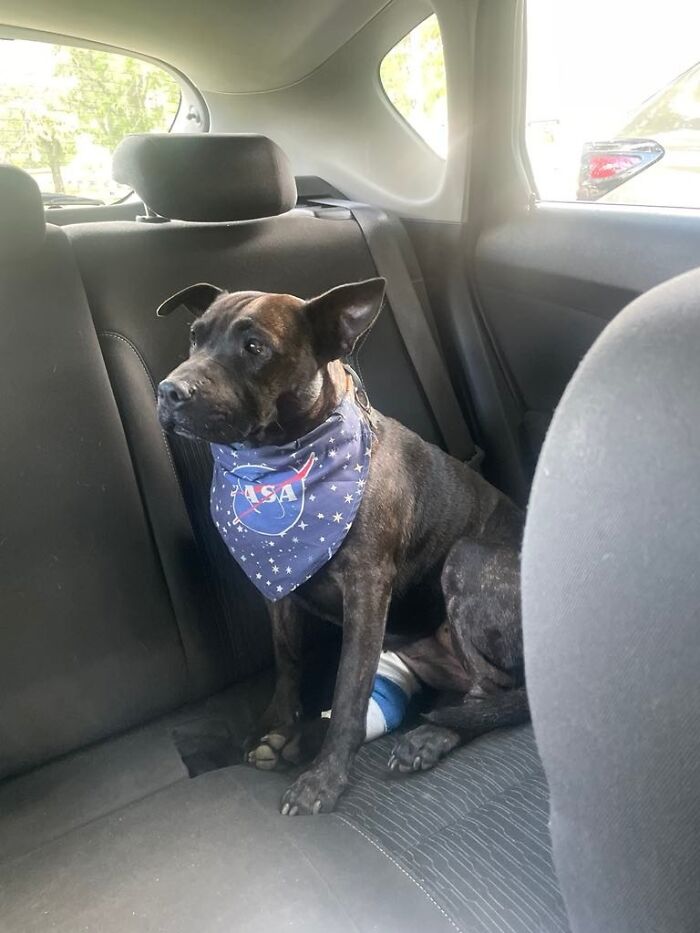
Image credits: Paul S. Conyngham / x.com
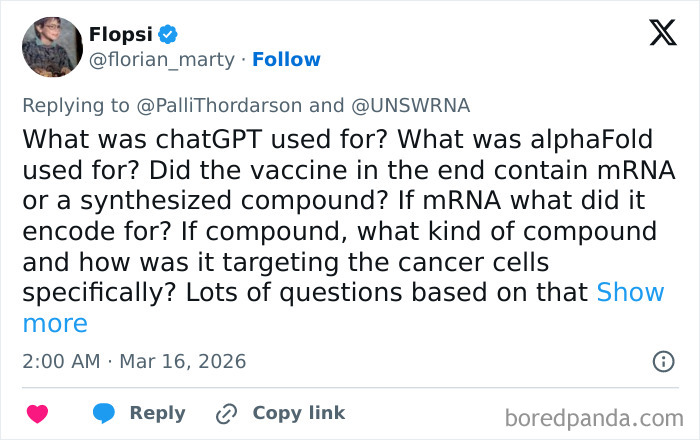
ChatGPT also recommended using the AlphaFold program (also based on artificial intelligence) to create suitable constructs for a specialized vaccine for Rosie. And then, again at the UNSW, the vaccine was finally created.
Did you think that was the end of the problems? Not really – now they needed approval from the ethics committee to use the vaccine, and Conyngham spent literally three months finally securing it. Then, he managed to contact a research lab that was researching various medications for dogs, and last December, Rosie received her first injection.
Image credits: Levart_Photographer / Unsplash (not the actual photo)
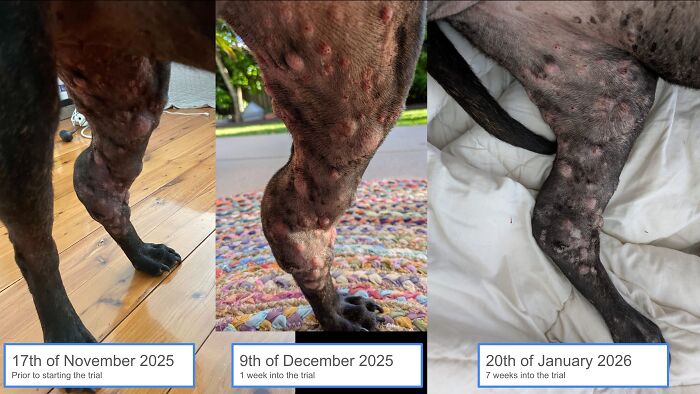
A booster vaccination followed, and a few months later, the results are clear. Some of the tumors (the largest of which was the size of a tennis ball) simply disappeared, and the dog is now much more active and looking much healthier. And judging by her appearance, anyone can be sure the treatment is working.
Canine cancer research has made significant progress in recent decades. Since the mechanisms of cancer development in dogs are largely similar to those in humans, as this paper says. So, doctors’ interest in studying this problem stems from more than just their love for pets. Therefore, Paul’s discovery could have a significant impact on further cancer research.
Image credits: Paul S. Conyngham / x.com
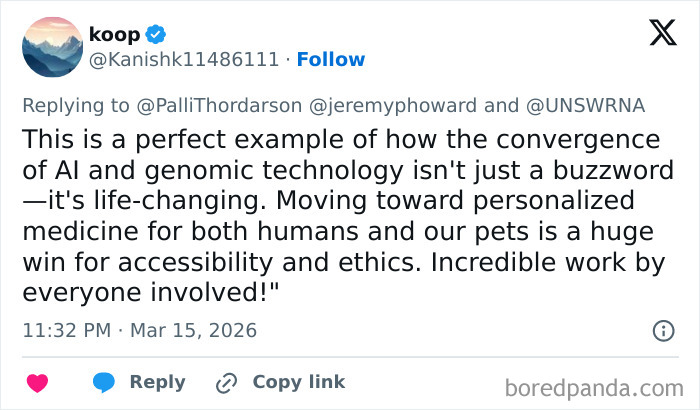
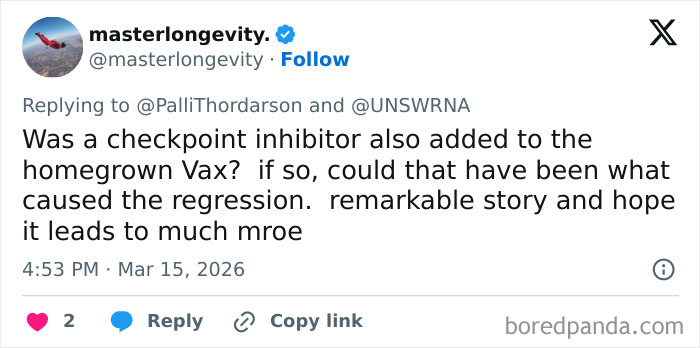
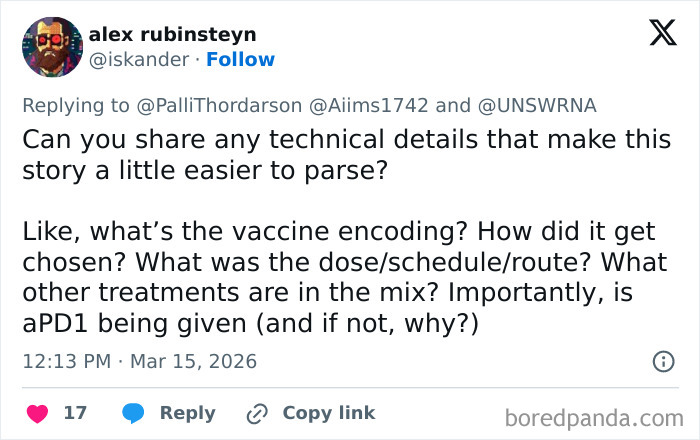
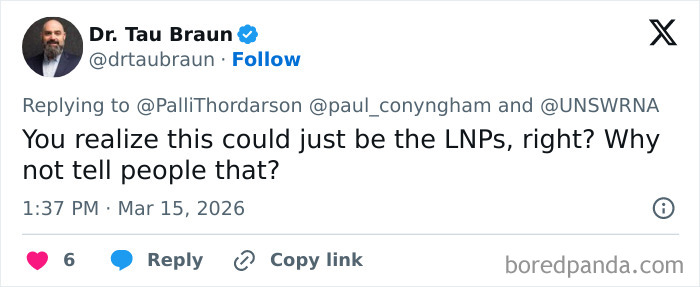
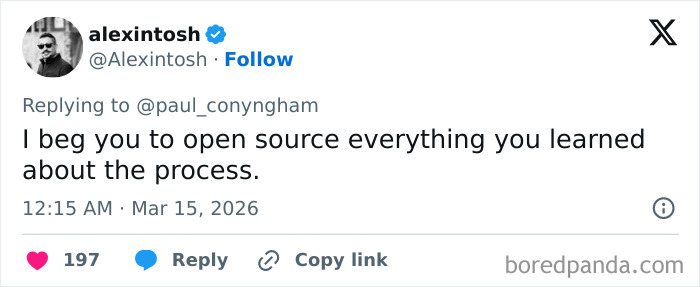
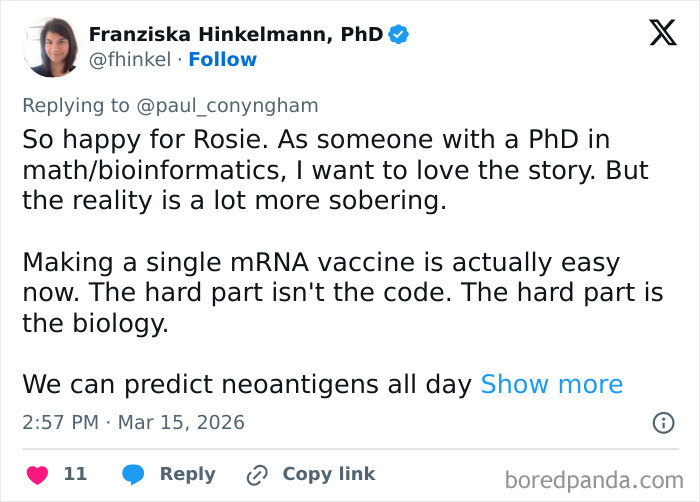
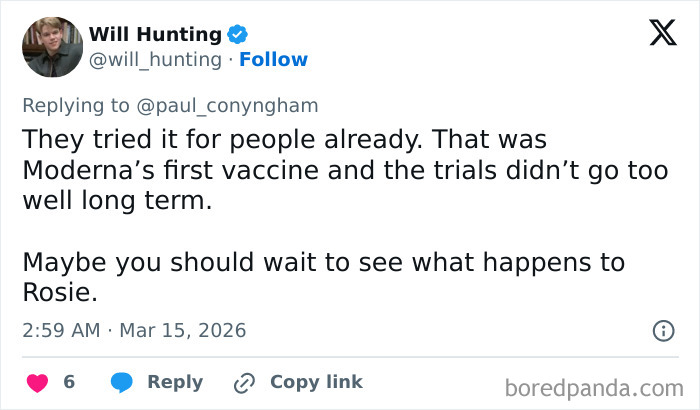
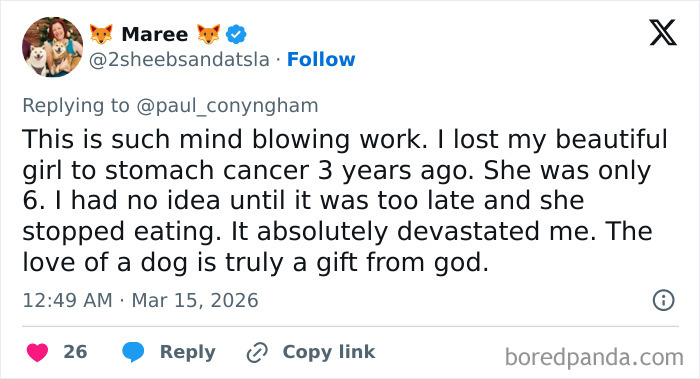
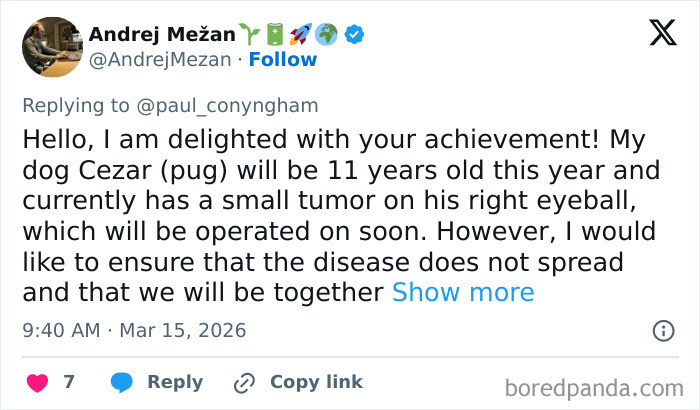
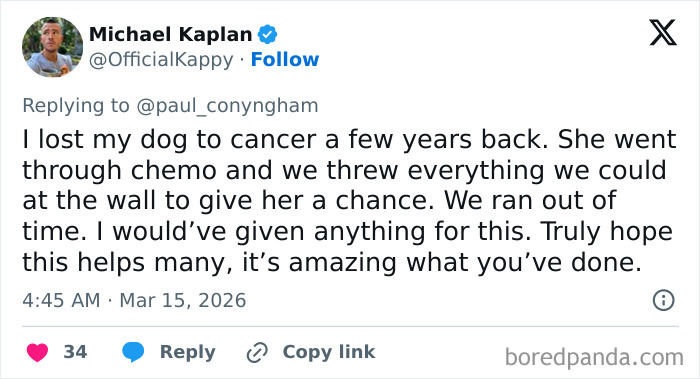
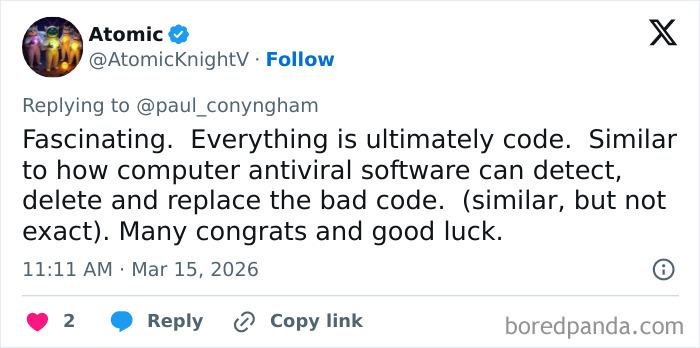
No, a complete cure has not yet been achieved. Several tumors failed to respond to the vaccine – clearly, a separate medication must be developed for them. Some commenters with medical backgrounds on X also noted that the effects of vaccination can be really unpredictable.
But at least Paul Conyngham already knows what he needs to do, and hopefully, he’ll succeed. And who knows, maybe one day this inspiring story will be remembered as the first step toward creating a universal cancer vaccine for all humanity?

By entering your email and clicking Subscribe, you're agreeing to let us send you customized marketing messages about us and our advertising partners. You are also agreeing to our Privacy Policy.
Thank you! You've successfully subscribed to newsletters!

Ignoring the mahooosive misrepresentation of the actual work that went into this, this is really a story about animal experimentation.

It's about saving his dog's life. I have a degenerative neuromuscular disease and would gladly try anything if there was a chance I could get even a little of my life back. I personally know a dozen other people who would as well. Being a guinea pig is preferable to a slow, painful death.
Load More Replies...
Reminds me of the story of Augusto, Michaela, and Lorenzo Odone. They were told their son wouldn't survive, they refused to give in, educated themselves on the subject, and found a treatment to help (not cure). Anytime someone defies the world in the name of love, rises above the naysayers, and finds something that helps.... I'm not religious, but in those moments, I see God. I see it in the person, their love and their effort. Kudos to this gentleman, we need more of this. Keep fighting for what you love.

Wasn't there a film about this? Lorenzo's Oil I think.
Load More Replies... Ignoring the mahooosive misrepresentation of the actual work that went into this, this is really a story about animal experimentation.
It's about saving his dog's life. I have a degenerative neuromuscular disease and would gladly try anything if there was a chance I could get even a little of my life back. I personally know a dozen other people who would as well. Being a guinea pig is preferable to a slow, painful death.
Load More Replies... Reminds me of the story of Augusto, Michaela, and Lorenzo Odone. They were told their son wouldn't survive, they refused to give in, educated themselves on the subject, and found a treatment to help (not cure). Anytime someone defies the world in the name of love, rises above the naysayers, and finds something that helps.... I'm not religious, but in those moments, I see God. I see it in the person, their love and their effort. Kudos to this gentleman, we need more of this. Keep fighting for what you love.
Wasn't there a film about this? Lorenzo's Oil I think.
Load More Replies...




 No fees, cancel anytime





41
4