Get Premium
Dark mode theme is available exclusively for premium users. Learn more about the benefits of subscribing.
No fees, cancel anytime.

 Dark Mode Ad-Free Browsing Unlimited Content
 Ad-Free Browsing Unlimited Content Dark Mode
Join 1.2 million Panda readers who get the best art, memes, and fun stories every week!
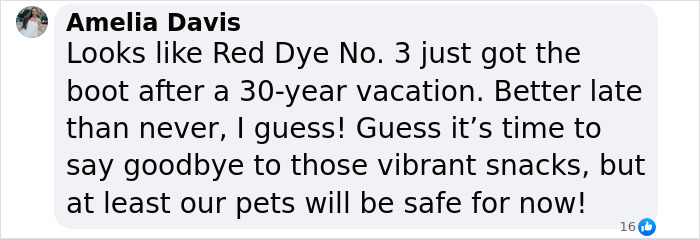
The U.S. Food and Drug Administration has officially banned the use of red dye No.3 after the knowledge that it can cause cancer in animals — a discovery found more than 30 years ago.
The synthetic additive, also known scientifically as erythrosine, is most commonly used to give foods and beverages a distinct, bright, cherry-red color and has been a key substance in America’s food system.
Manufacturers using Red No. 3 in goods and ingested drugs now have until January 15, 2027, and January 18, 2028, respectively, to reformulate their products, as stated by the FDA.
“Today’s action by FDA is long overdue, is a small step in the right direction, and hopefully signals a renewed effort by FDA to do its job despite the many barriers the food industry places in its way,” wrote Dr. Jerold Mande, adjunct professor of nutrition at the Harvard University T.H. Chan School of Public Health.
Image credits: pvproductions/Freepik (Not the actual photo)
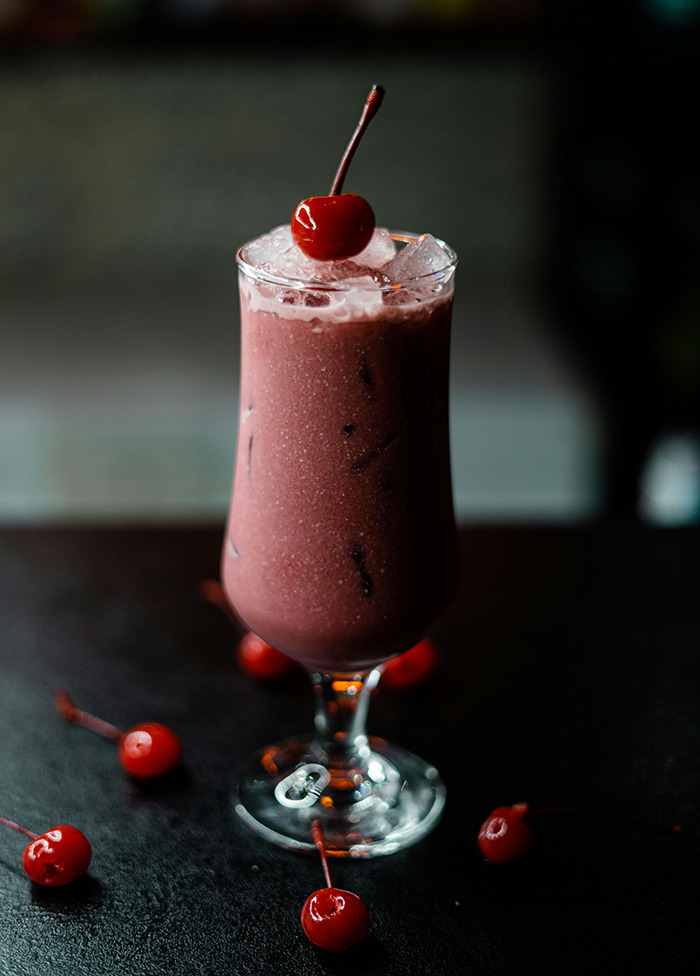
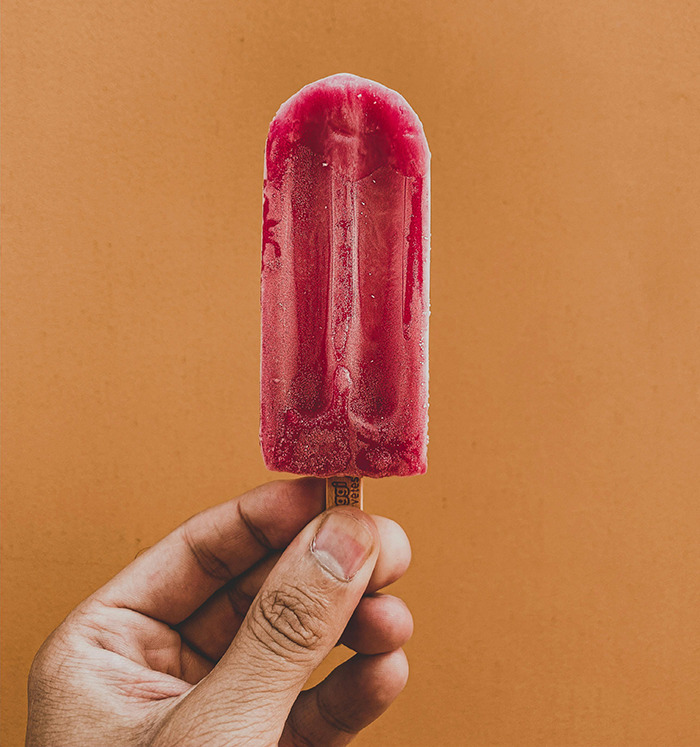
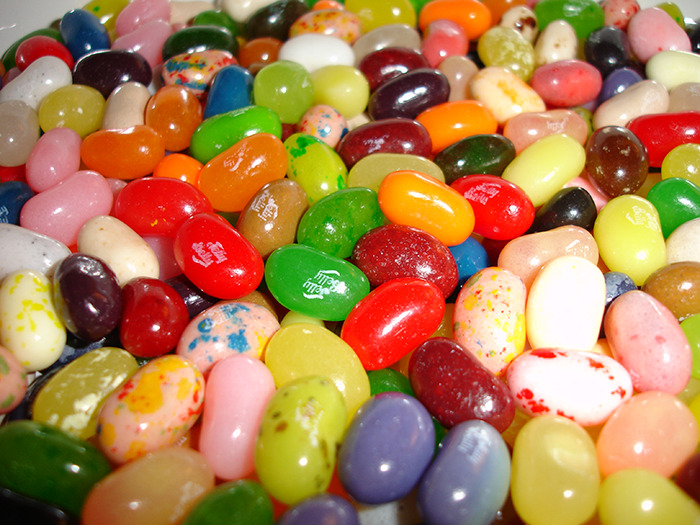
As per the FDA, the Center for Science in the Public Interest (CSPI) and Amanda Beaver, a dietician at Houston Methodist Hospital, note that a few common foods containing the substance include candy (especially seasonal candies, like candy corn), cakes/cupcakes, frozen strawberry-flavored desserts, fruit cocktails, sausages, frosting, and bacon bits — among others.
Dr. Peter Lurie, the president and executive director of CSPI, additionally told TODAY.com that noticeable oral medicines such as acetaminophen, a pain reliever, and fluoxetine, an antidepressant, may have traces of Red No.3.
But while this ban is fresh news, it appears the substance has been under scrutiny for a long while before its official nationwide prohibition.
Image credits: Ron Lach/Pexels (Not the actual photo)
In 1990, under the Delaney Clause, the FDA banned the additive in cosmetics and topical drugs after research found it to be carcinogenic — having the potential to cause cancer — in high doses for rats in lab tests. However, because it didn’t have the same results in humans, these studies did not raise additional concerns.
And although there is still no confirmation that it may cause cancer in people, the Federal Food, Drug, and Cosmetic Act (FD&C Act) states that the FDA can no longer authorize it “if it has been found to induce cancer in humans or animals.”
Additionally, Lurie says there are a “variety of technical reasons” that make it difficult to ever be certain whether substances such as food additives cause cancer in humans.
Image credits: Collab Media/Pexels (Not the actual photo)
According to CSPI, California initially outlawed the use of red dye No. 3 in their foods in 2023. Ten other states, including South Dakota, Washington, Illinois, and Missouri, additionally introduced the legislation in recent years in order to restrict its use.
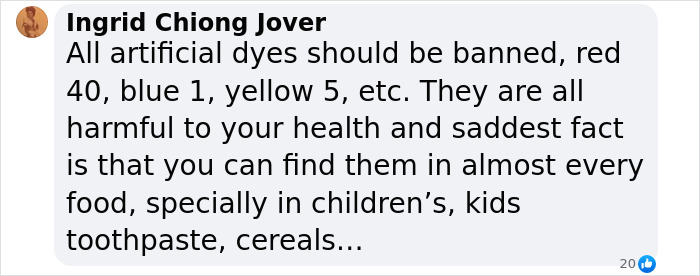
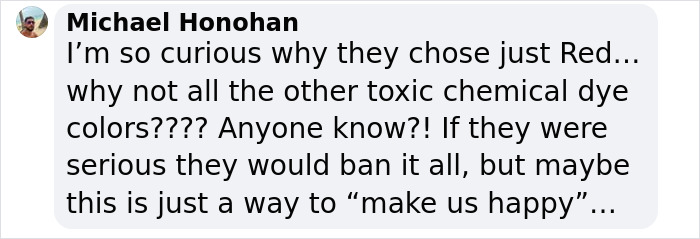
Some companies have now started turning to red dye No. 40, which is considered a healthier option, as it hasn’t been directly associated with cancer in animals.
Image credits: Mikhail Nilov/Pexels (Not the actual photo)
But California has banned red dye No. 40 from any foods or beverages sold in public schools beginning in September, following concerns of behavioral and attention difficulties among children, as reported by CNN.
One study also found a possible risk of accelerated immune-system tumor growth in mice.
Image credits: Thiago Calamita/Pexels (Not the actual photo)
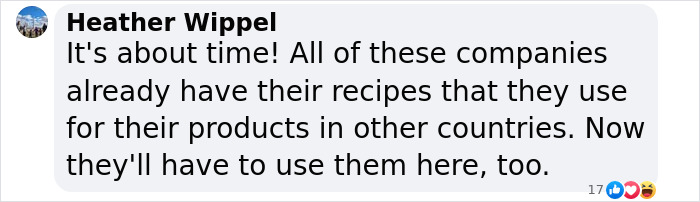
Now that this ban is in place, the “food landscape” of the U.S. is slightly closer to that of the European Union, which had prohibited the dye back in 1994, with the exception of a few maraschino cherry products.
“There is not a rational reason within FDA’s mission that they did not ban red dye #3 from food in the 1990s,” said Dr. Jennifer Pomeranz, an associate professor of public health policy and management at New York University’s School of Global Public Health.
She added that it is still unclear as to why the agency takes “so long to ban ingredients with known health harms.”
Image credits: Wikimedia Commons
But Mande claims this is due to the priorities of many businesses being misplaced.
“This is because food companies have lost sight of their primary mission, providing food we will thrive on, and focusing entirely on their profits instead,” he said.
“Unfortunately, the U.S. government doesn’t fund the research needed to determine the exact health risks posed by Red Dye #3. Industry works with Congress to block funding for the needed research.”

By entering your email and clicking Subscribe, you're agreeing to let us send you customized marketing messages about us and our advertising partners. You are also agreeing to our Privacy Policy.
Thank you! You've successfully subscribed to newsletters!


My favorite story about red dye #6 is when the farmer noticed that his rat poison had been changed - it had been red but was now green. The farmer called the company to find out why and was told they were no longer using red dye #6 in their rat poison because #6 caused cancer. In poison.




Title should be "What Foods Have Red Dye No. 3? Common Artificial Color Banned IN THE USA 30 Years After Cancer Alert". Look, I don't mind many articles being about the USA, but this site is supposed to be international. So plz, when writing an article, keep that in mind. Us non-USA inhabitants do not understand all references or find them relevant.
My favorite story about red dye #6 is when the farmer noticed that his rat poison had been changed - it had been red but was now green. The farmer called the company to find out why and was told they were no longer using red dye #6 in their rat poison because #6 caused cancer. In poison.
Title should be "What Foods Have Red Dye No. 3? Common Artificial Color Banned IN THE USA 30 Years After Cancer Alert". Look, I don't mind many articles being about the USA, but this site is supposed to be international. So plz, when writing an article, keep that in mind. Us non-USA inhabitants do not understand all references or find them relevant.



























 No fees, cancel anytime
















31
9