Get Premium
Dark mode theme is available exclusively for premium users. Learn more about the benefits of subscribing.
No fees, cancel anytime.

 Dark Mode Ad-Free Browsing Unlimited Content
 Ad-Free Browsing Unlimited Content Dark Mode
Join 1.2 million Panda readers who get the best art, memes, and fun stories every week!
While the Odyssey isn’t exactly history (the cyclops and casual conversations with deities should be a giveaway), its success suggests that, actually, there is a decent amount of curiosity about the pre-modern world. After all, the world has always been interesting.
The “Look Through History” Instagram account is dedicated to sharing interesting stories from the past, not all of them entirely pleasant. So settle in as you scroll through, upvote your favorites and be sure to share your own thoughts and tales in the comments section down below.
More info: Instagram
This post may include affiliate links.
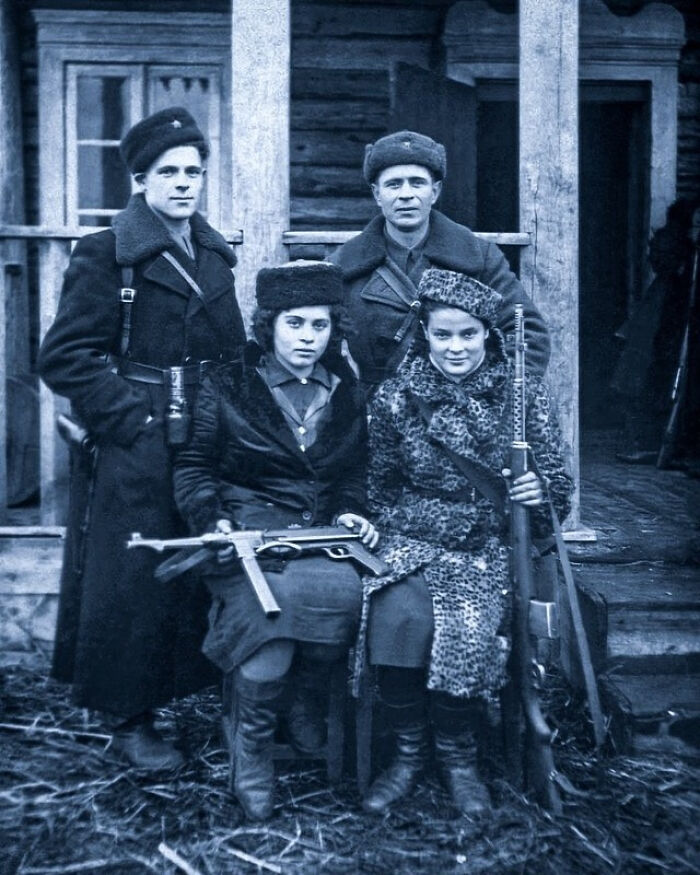 Jewish partisans near Pinsk, Belorussia. The woman in leopard print is Faye Schulman, known for her work photographing partisans during World War 2; 1944
Born to a large family on November 28, 1919, in Lenin, Poland she learned photography from her brother Moishe and assisted him in his photography business.
On August 14, 1942, the Germans k**led 1,850 Jews from the Lenin ghetto, including Faye's parents, sisters, and younger brother. They spared only 26 people that day, among them Faye for her photographic abilities. The Germans ordered Faye to develop their photographs of the m*ssacre. Secretly she also made copies for herself.
During a partisan raid, Faye fled to the forests and joined the Molotava Brigade, a partisan group made mostly of escaped Soviet Red Army POWs. She took over a hundred photographs, developing the medium format negatives under blankets and making “sun prints” during the day. On missions Faye buried the camera and tripod to keep it safe. Her photos show a rare side of partisan activity that would otherwise be lost to time.
After liberation, Faye married Morris Schulman, also a Jewish partisan. Faye and Morris enjoyed a prosperous life as decorated Soviet partisans, but wanted to leave Pinsk, Poland, which reminded them of a “graveyard”. Morris and Faye lived in the Landsberg displaced persons camp in Germany for the next three years and immigrated to Canada in 1948. She lives in Canada to this day at the age of 101.
“I want people to know that there was resistance. Jews did not go like sheep to the sl**ghter. I was a photographer. I have pictures. I have proof.”
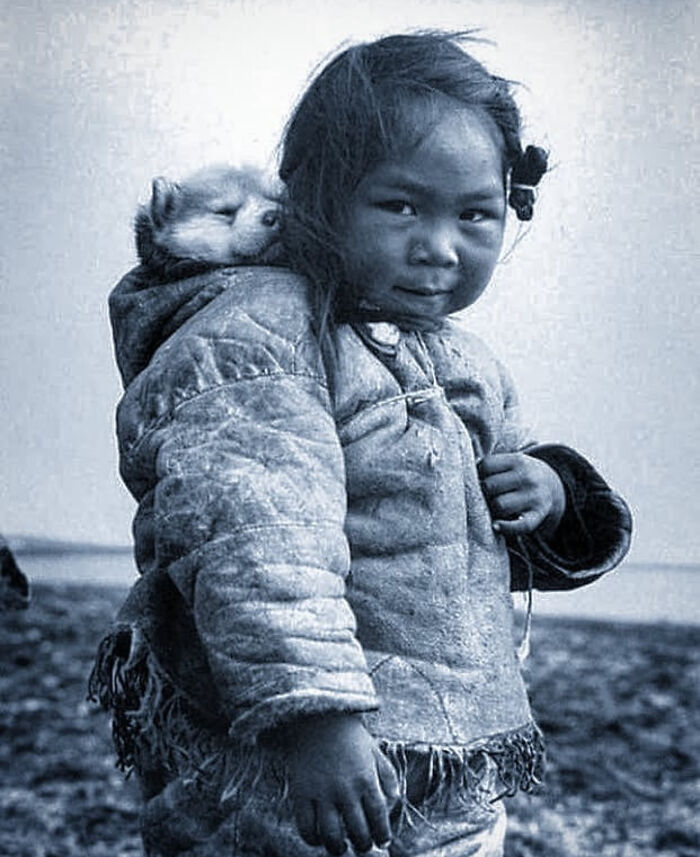 A young Inuk girl stand to face the camera with her small Malamute puppy on her back; 1949.
Photo by Richard Harrington
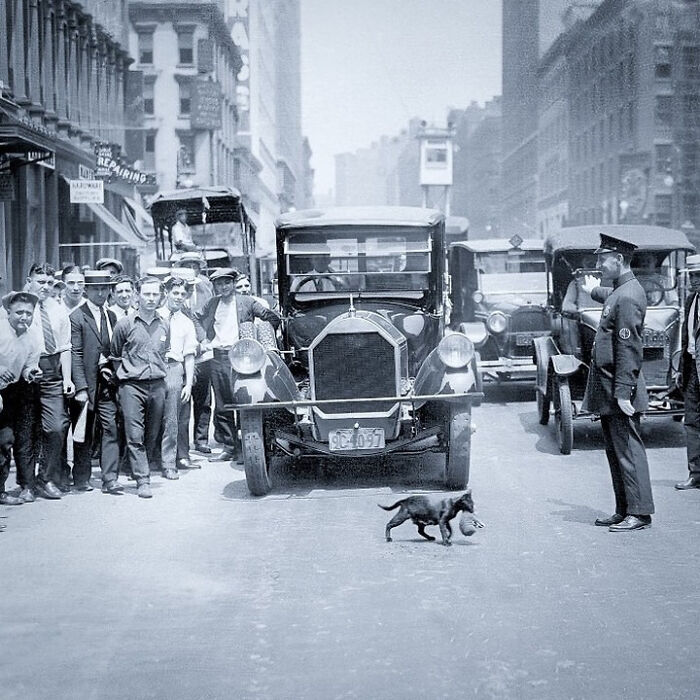 A New York City police officer takes the time to calm things down in the city that never sleeps, stopping the NYC Traffic to allow for a cat and her kitten to cross the road; 1925.
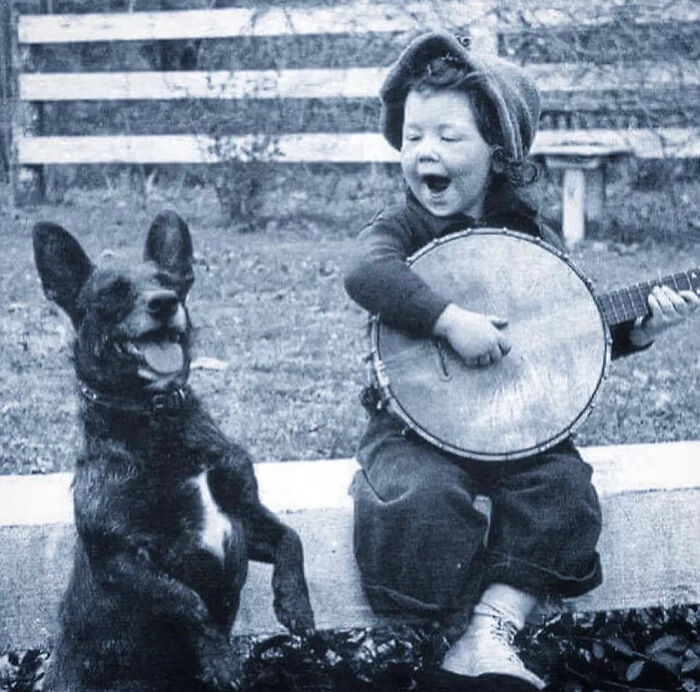 If happiness was a 1920s photograph.
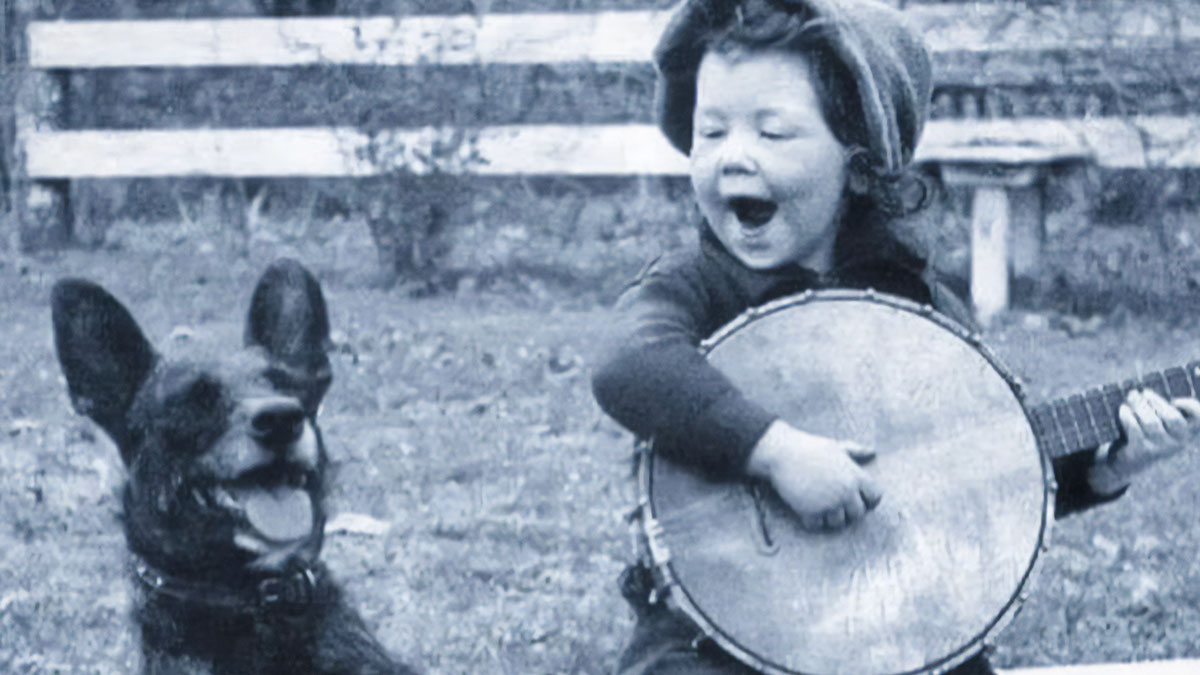
A young child cheerfully plays their banjo to a seemingly equally cheerful crowd.
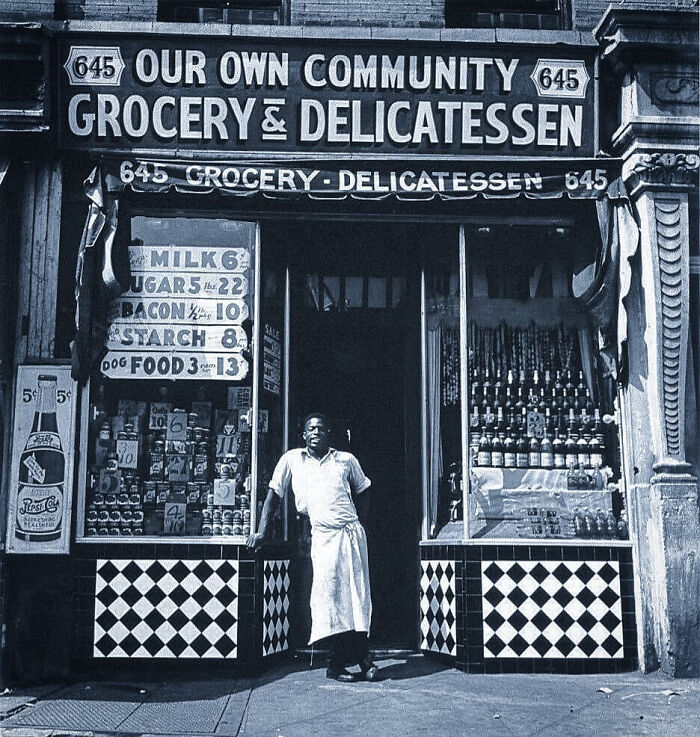 A man poses outside his fully stocked grocery store in Harlem as photographer Aaron Siskind takes his photo; 1940.
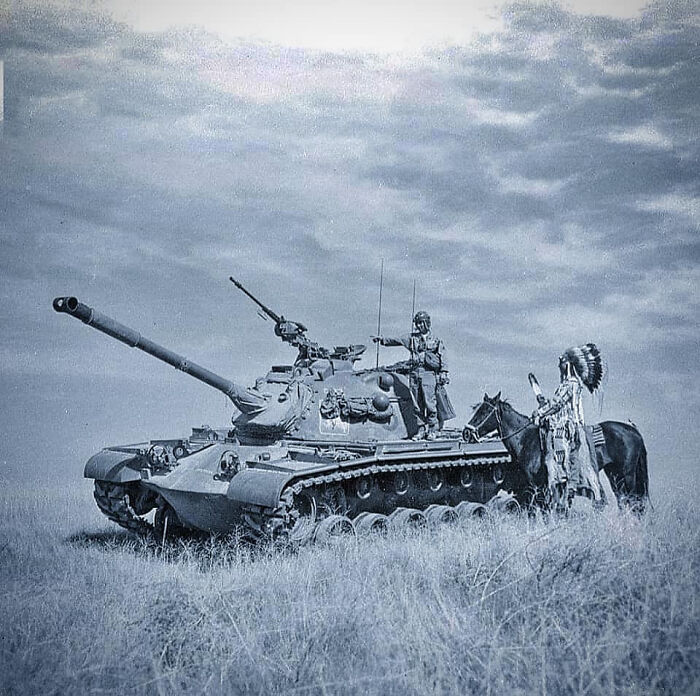 A Native American Chief sits astride his horse next to his enlisted son, a Corporal in the US Army; 1957.
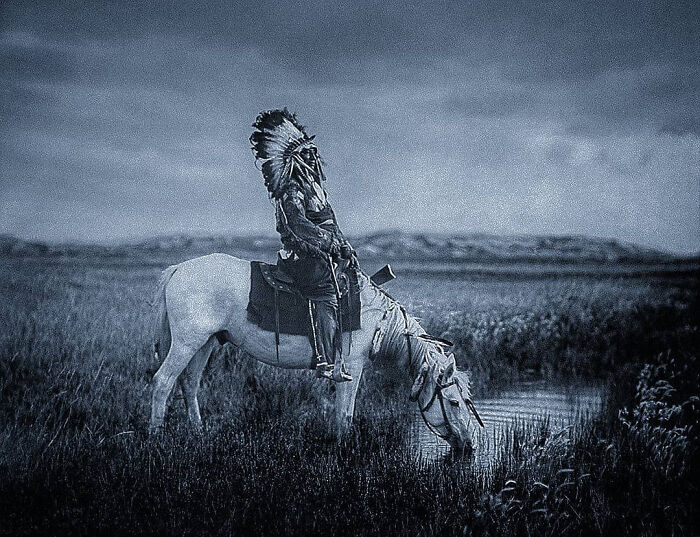 Red Hawk from the Oglala tribe sits uptop his horse as it drinks from the river, captured by Edward S. Curtis; 1905.
Red Hawk was born in 1854 and fought against US troops over the plains of North America, including the famous battle of Little Bighorn, also known as "Custers last stand" in 1876. It is incredible to have photos that connect us to these historical events. This is made all the more better with how great the photo itself is.
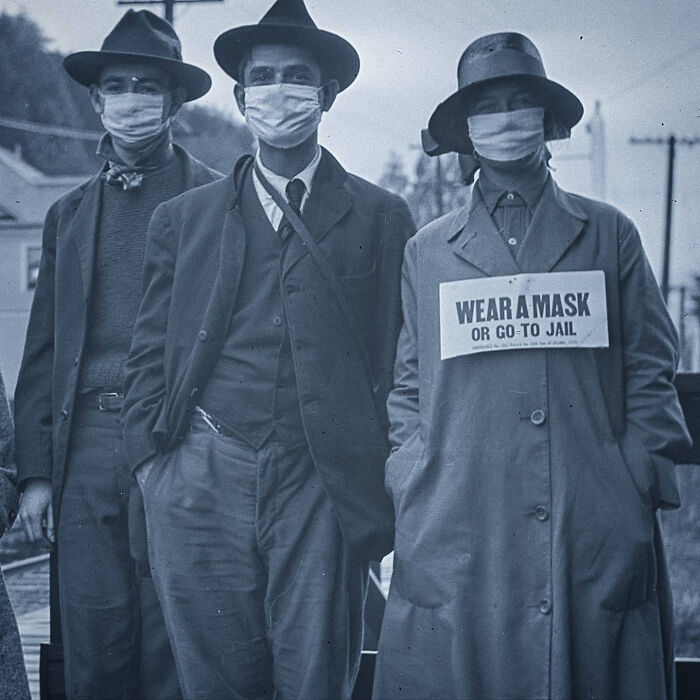 A group of people pose for a photo whilst wearing face masks during the second wave of the Spanish Flu in California; 1918.
The sign around the women's neck reads "wear a mask or go to jail". On the day state-wide infections rose to 50,000, for a disease that k**led 50 million worldwide, anyone not wearing a mask could be fined up to $100 or face jail time of up to 10 days.
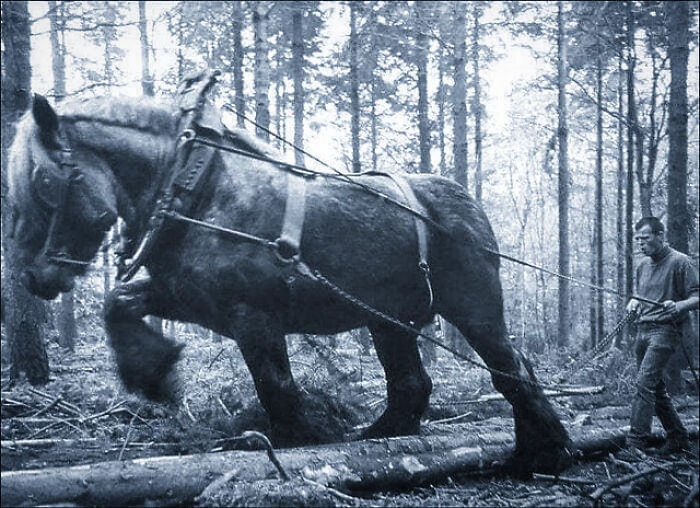 A Ardennes draught horse gets put to work to assist with tree felling.
The largest horse to ever live was Sampson, a Shire horse gelding foaled in 1846 in Toddington Mills, Bedfordshire, England. Owned by Thomas Cleaver, Sampson stood 2.19 metres (7 ft 2 in) high by the time he was four years old, when he was renamed Mammoth. His peak weight was estimated at 3,360 lb (1,524 kg).
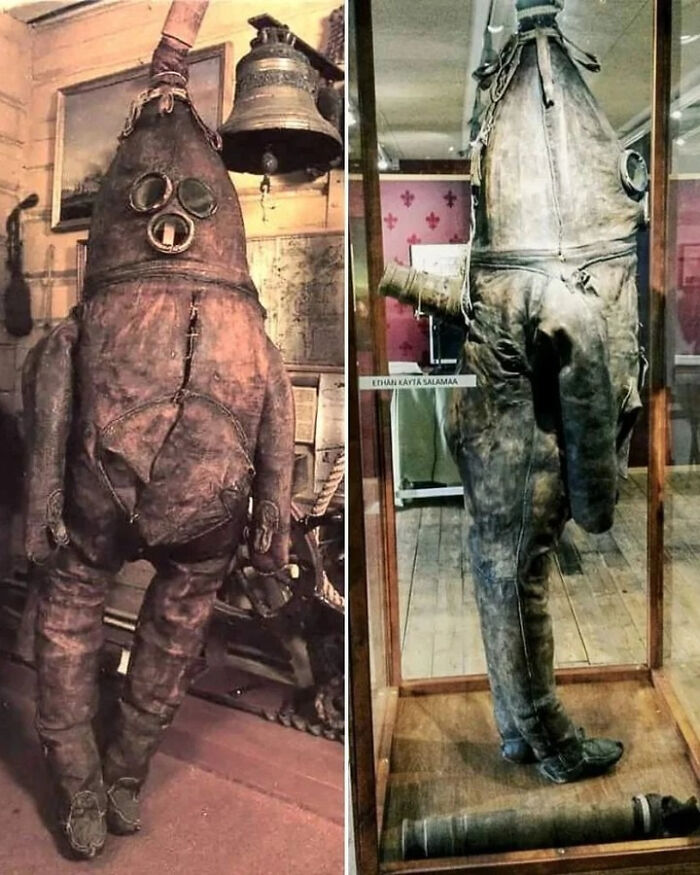 ‘The Old Gentleman’ A leather diving suit made in the early 1700’s kept in Raahe Museum in Finland.
I’m not sure if I think it looks funny or truly terrifying…
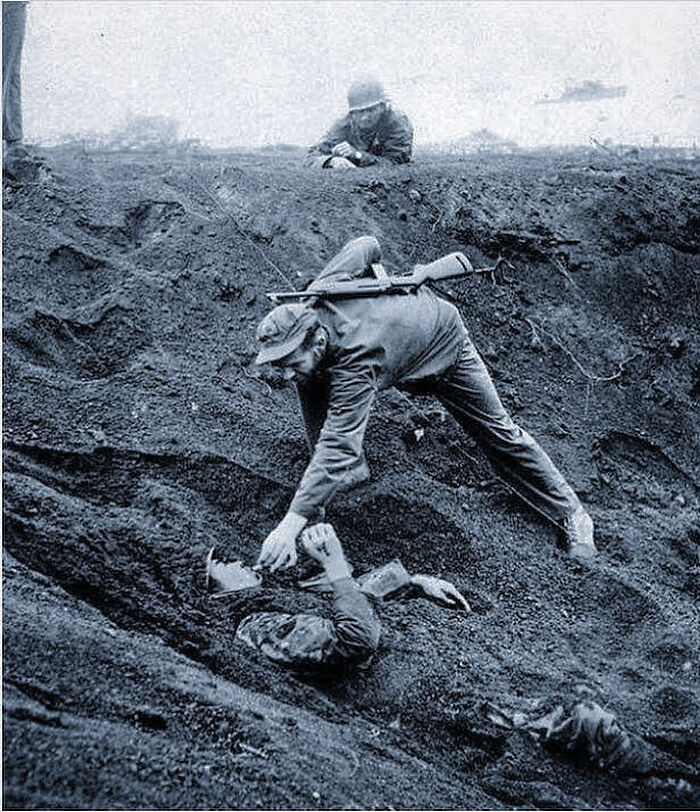 A US Marine gives a cigarette to an injured Japanese soldier buried in the volcanic sand of Iwo Jima; 1945.
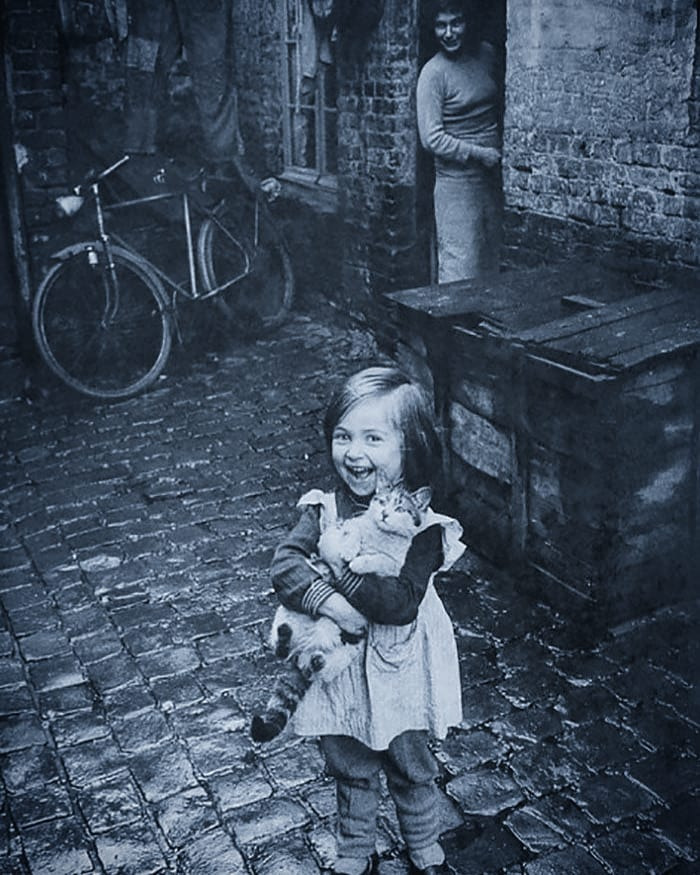 A young French girl jubilantly shows off her cat for the camera; 1959.
Much of the historical photos are of big moments, often tainted with sadness or negative emotions. In some strange way it makes these seemingly trivial but purely happy captured moments all the more special.
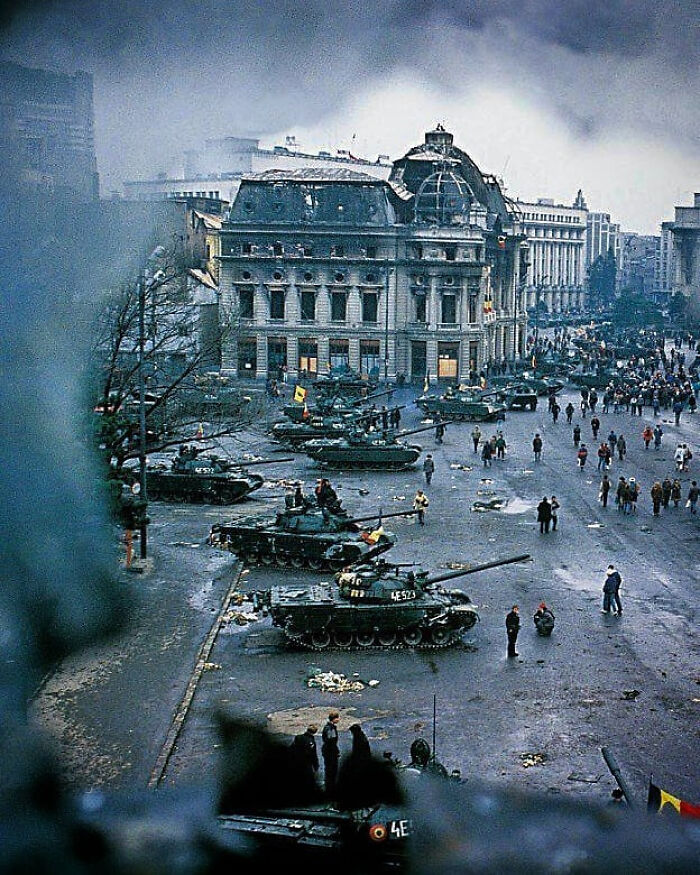 A picture through the broken glass of an upper story window showing tanks lining the streets of Bucharest during the Romanian Revolution; 1989.
The movement saw the ousting and ex*cution of the communist party General Secretary Nicolae Ceausescu and his wife Elena. It brought to an end 42 years of Communist rule in Romania.
Nicolae Ceauçescu's most damning policies was Decree 660, which outlawed birth control and abortion. Such things were only permitted for women who had 5 kids already. Orphanages overflowed with kids people couldnt afford. Romania's infant mortality rate was the highest in the entirety of European countries at the time. Ultimately, it would be the children forced into the world by Ceauçescu who would overthrow his regime. Quite poetic and a warning to similar regimes today.
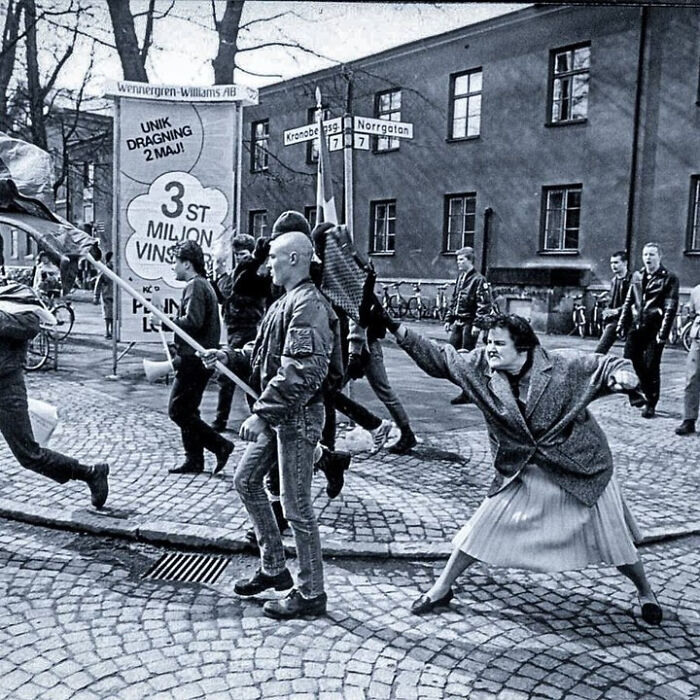 38 year-old Danuta Danielsson, uses her handbag to hit a flag waving neo-Nazi during a march in Växjö, Sweden; 1985.
The photo was taken during a small demonstration of The Nordic Realm Party supporters on 13 April 1985. As approved by the authorities, the rally had been planned to be held shortly after the end of a public speech delivered by the Left Party-Communists leader Lars Werner in the centre of Växjö, and skirmishes between left-wing supporters and neo-Nazis began even before the start of the far-right demonstration.
Danuta was born in March 1947 in Poland and was of Jewish Polish heritage. Her mother had survived a German concentration camp in Poland during The Holocaust reportedly Auschwitz or in Majdanek. Her actions are captured in this photo therefore feel even more empowering and justified.
In memorial to this photograph a statue a local artist, Susanna Arwin, expressed desire to raise a life-sized statue of Danielsson in Växjö however this was decided against due to concerns about such a statue to be interpreted as promoting violence, and because Danielsson's surviving family reported that they would be unhappy with Danielsson memorialized in such a manner. Danielsson herself apparently did not like the photo and regretted its fame. In September 2015, Swedish hotel entrepreneur Lasse Diding announced he had bought the statue and intended to donate it to Varberg municipality. The statue was later unveiled at Varberg Fortress but the Varberg board of culture voted in April 2016 not to accept the donation. The statue now resides in the garden of Lasse Diding's Villa Wäring in Varberg and a second statue has been unveiled in the town of Alingsås.
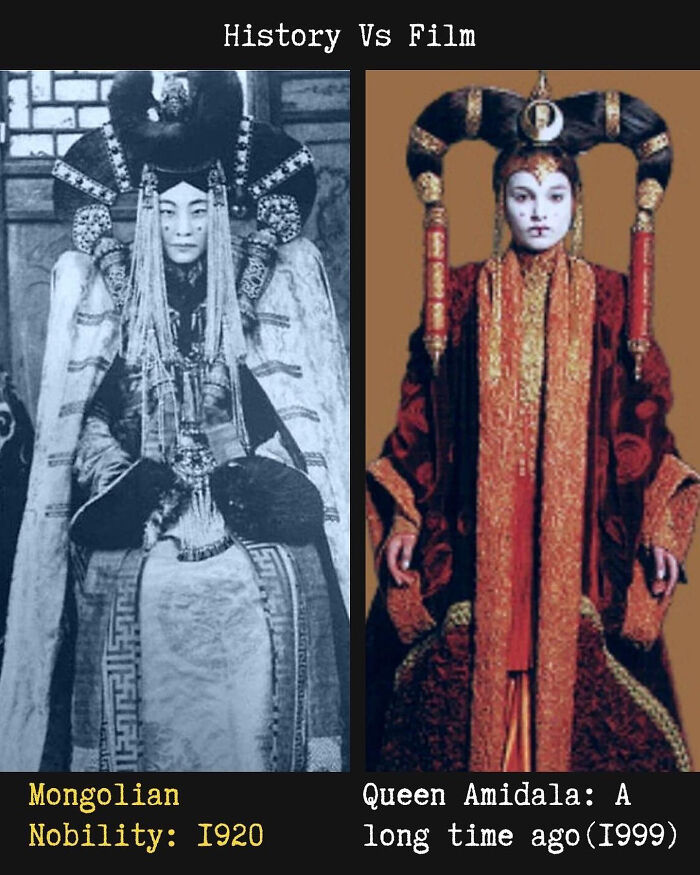 A photo showing a Mongolian lady wearing traditional clothing of the nobility; 1920.
Interestingly, this Mongolian clothing served as inspiration for the Star Wars character Queen Amidala. The designers confirmed that they looked at Mongolian, Tibetan and other traditional Asian fashion styles as inspiration for the costume.
This image is often attributed to Queen Genepil, the last Queen of Mongolia. However, there is no evidence that this image indeed does show the queen who was sadly k**led in 1938, ex*cuted as part of the systematic Stalinist decimation of Mongolian culture.
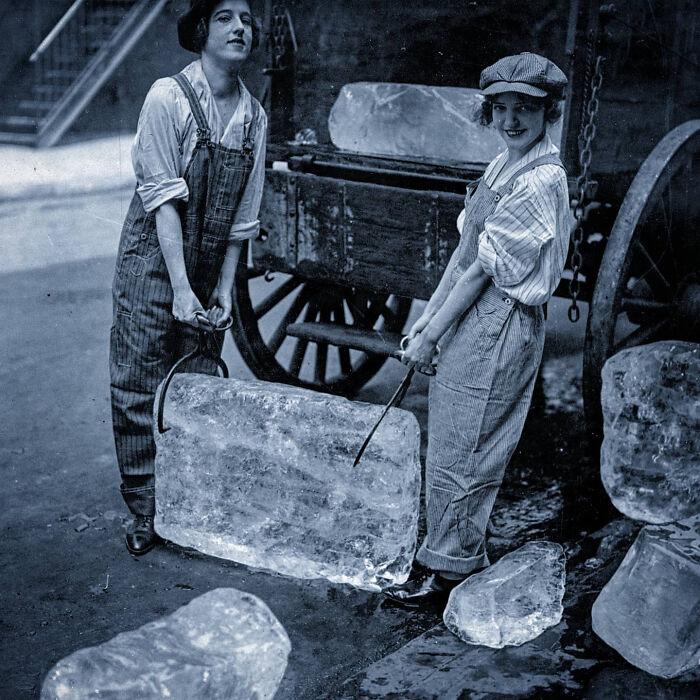 Two women unload a large block of ice for delivery; a job formerly only carried out by men: 1918.
With many men overseas involved in World War 1 jobs in many industries were taken up by women requiring "brawn as well as the patriotic ambition to help".

And when the war was over, women were sent back to the kitchen. Although, I do understand that men were the main breadwinners back then.
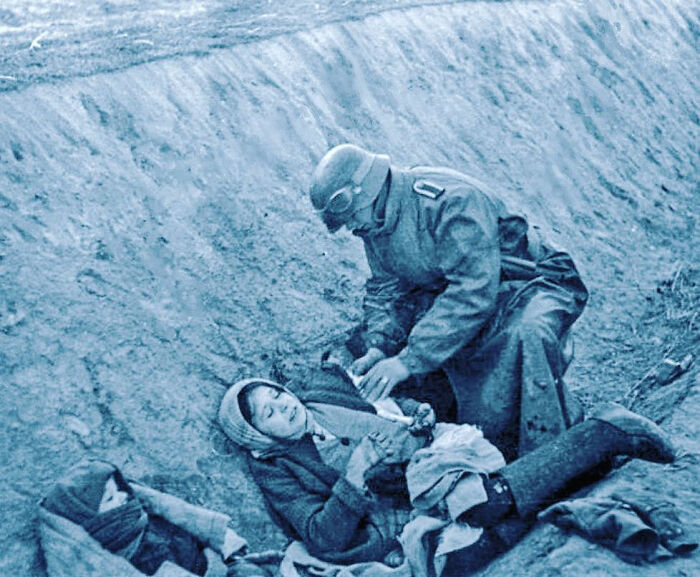 A German soldier treats an injured Russian women in a hollow trench with her child lying down next to her; 1942.
Whilst reminding us of the harsh reality that civilians are key victims in warfare. These are some of the most powerful images possible, showing both the human cost of war and the layers of humanity that exist everywhere. Even in one of the most destructive war machines we have ever seen.

"War isn't Hèll, Frank. War is war, and Hèll is Hèll, and of the two war is a lot worse... there are no innocent bystanders in Hèll, but war is full of them; kids, cripples, little old ladies..." B.F. 'Hawkeye' Pierce, M*A*S*H
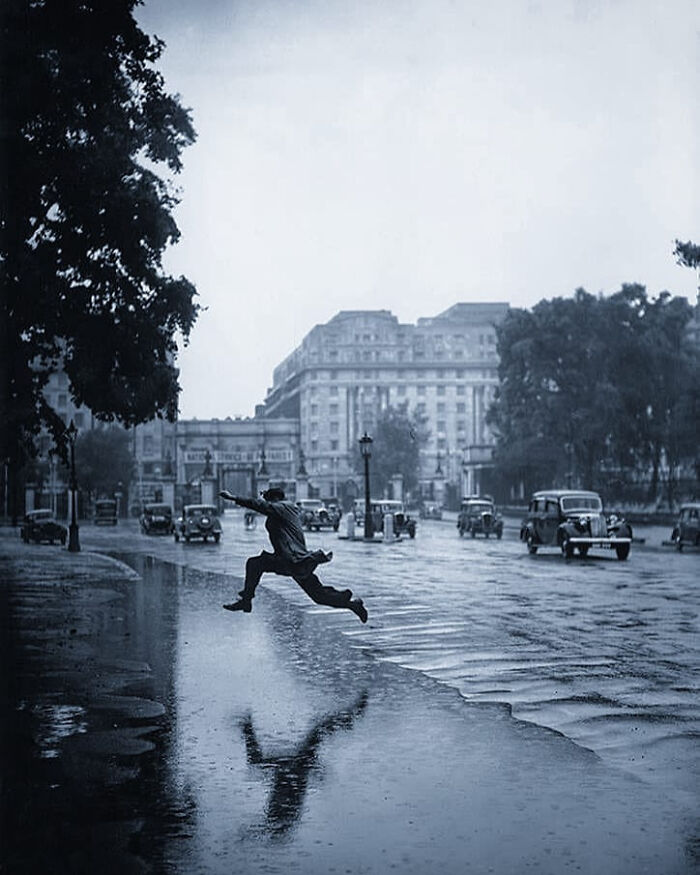 A London pedestrian takes a leap of faith across a puddle, from road to the pavement near Hyde Park; 1939.
The question is, did he get his feet wet?
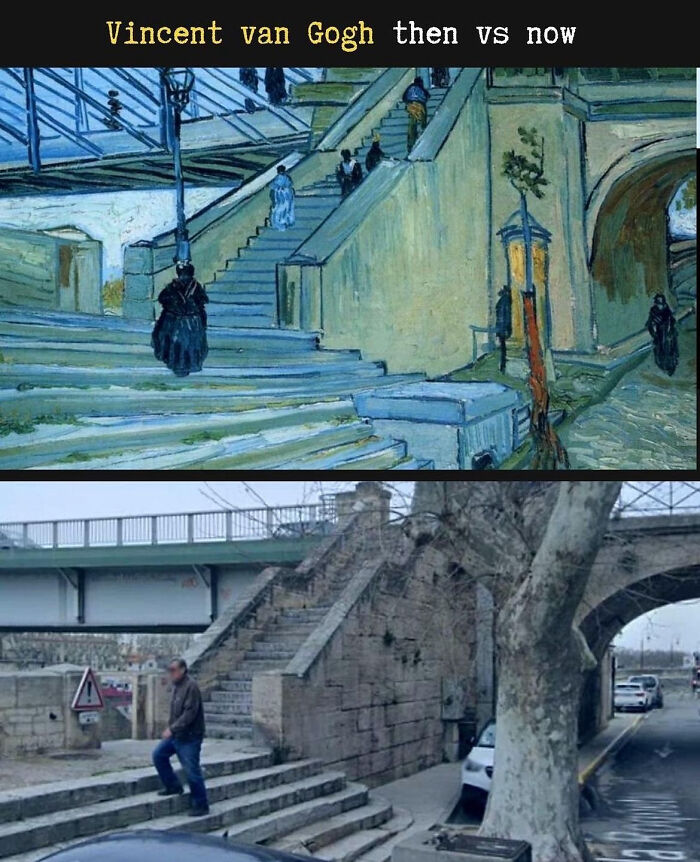 The legendary Dutch post-Impressionist painter Vincent van Gogh posthumously became one of the most famous and influential figures in Western art history.
Known for his post-impressionist paintings, his style underwent significant changes throughout his life. Early in his career, he was heavily influenced by the works of the Dutch Masters, and his paintings were characterised by dark, heavy brushstrokes, and a somber color palette.
Upon moving to Paris in 1886, he was exposed to the works of the Impressionists and Pointillists. This exposure greatly influenced van Gogh’s style and he began to experiment with brighter colors and lighter brushstrokes. He also began to use bold, thick outlines around his subjects.
When van Gogh moved to Arles in 1888, his style changed again. He was inspired by the vibrant, sun-drenched landscapes of the south of France, and his paintings became more vivid and colorful, with broad, sweeping brushstrokes.
Despite his relatively short career, van Gogh’s style evolved dramatically throughout his life. Vincent’s impact and influence on the development of modern art is unquestionable, with his paintings continuing to captivate audiences around the world.
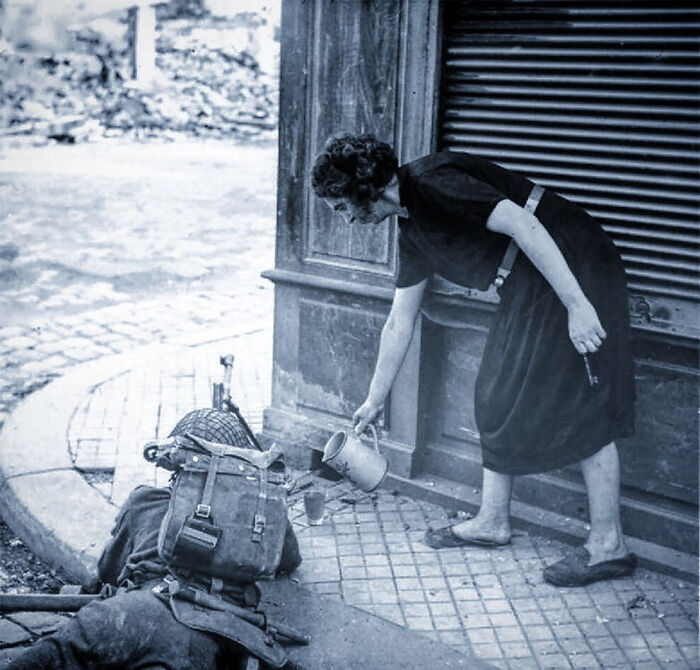 A women in the French town of Lisieux pours a fresh glass of cider for a British Bren gunner who are both seemingly on the frontline of the biggest, most destructive conflict the world has ever known; August 22 1944.
Photo courtesy: @imperialwarmuseums
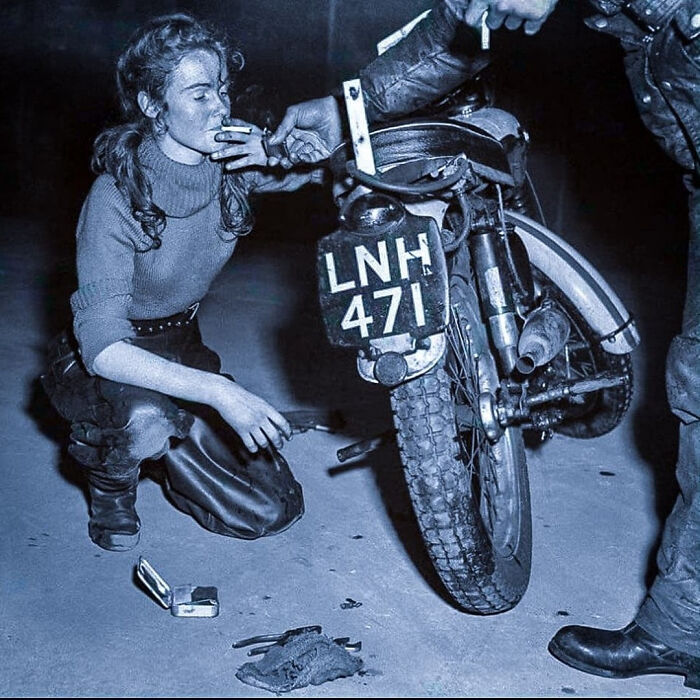 A woman takes a smoke break while fixing up a Triumph motorcycle; 1960s.
A "Ton up girl" in the 1950s, not 60s, in the UK. The "ton up" was because these ladies liked to ride at 100mph ( a ton ) and they learned how to repair their own bikes. These were the rebellious riders before the Mods and Rockers became the pop cultures of the 1960s.
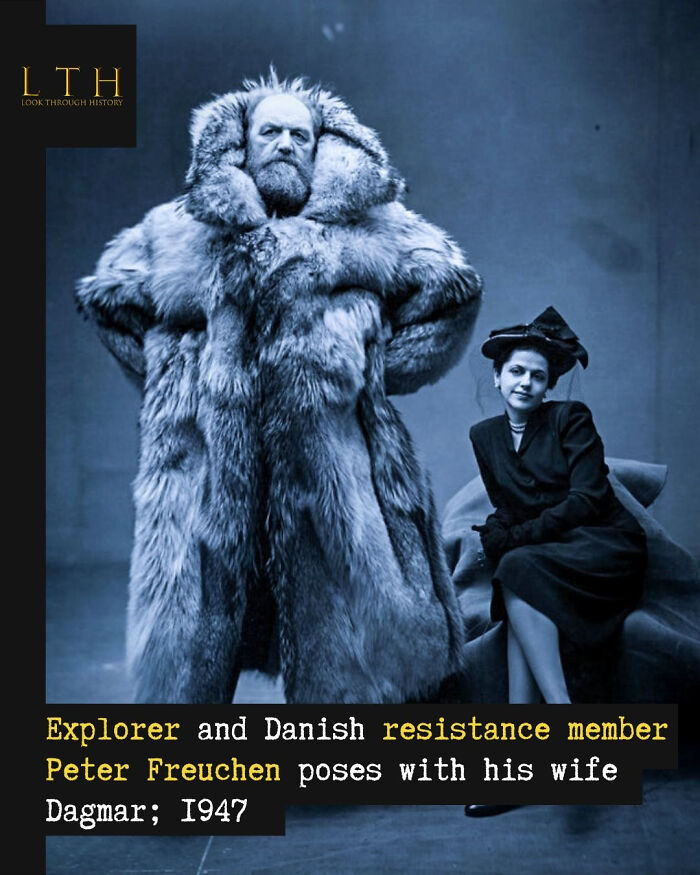 Explorer and Danish resistance member Peter Freuchen poses with his wife Dagmar Freuchen-Gale, New York City; 1947.
Freuchen enrolled in the University of Copenhagen and began to study medicine but before long realised his calling existed outside the reach of modern living. In 1906, he made his first expedition to Greenland. He and his friend Knud Rasmussen sailed from Denmark as far north as possible before leaving their ship and continuing by dogsled for over 600 miles. He allegedly made himself a coat out of a polar bear he’d k**led himself.
In 1910, Peter Freuchen and Rasmussen established a trading post, in Cape York, Greenland, naming it Thule. The name came from the term “Ultima Thule,” which to a medieval cartographer meant a place “beyond the borders of the known world.”
The post would serve as a base for seven expeditions, known as the Thule Expeditions, that would take place between 1912 and 1933.
During World War II, Freuchen was actively involved with the Danish resistance movement against the occupation by N*zi Germany despite having lost a leg to frostbite in 1926. Whenever he witnessed anti-semitism he would, in all his 6’7″ glory, openly claim to be Jewish. Freuchen was imprisoned by the Germans, and was sentenced to death, but he managed to escape and flee to Sweden.
In 1945, after fleeing the Third Reich, Freuchen met Danish-Jewish fashion illustrator Dagmar Cohn. The pair moved to New York City to escape N*zi persecution, where Cohn had a job working for Vogue.
"We're not going to church, Dagmar. We are going to the North Pole!"
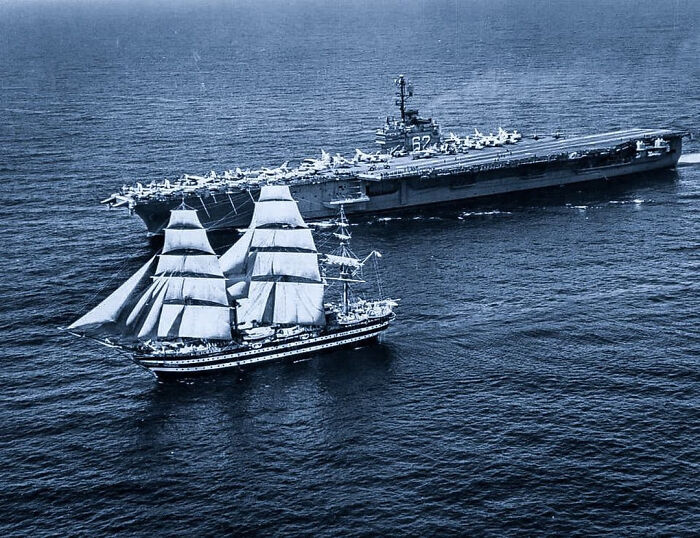 The Italian Navy training ship Amerigo Vespucci sailing next to American Aircraft Carrier the USS Independence; showing the incredible contrast between modern vessels and the age of sail.
Whilst launched in 1931 the Vespucci’s design, named after the famous explorer, was inspired by the style of large late 18th century 74-cannon ships of the line.
When USS Independence encountered this fully rigged ship in the Mediterranean in 1962, the carrier signaled to ask the sailing vessel to identify. “Amerigo Vespucci, Italian Navy,” was the response.“ The Independence reportedly signaled back, "You are the most beautiful ship in the world.
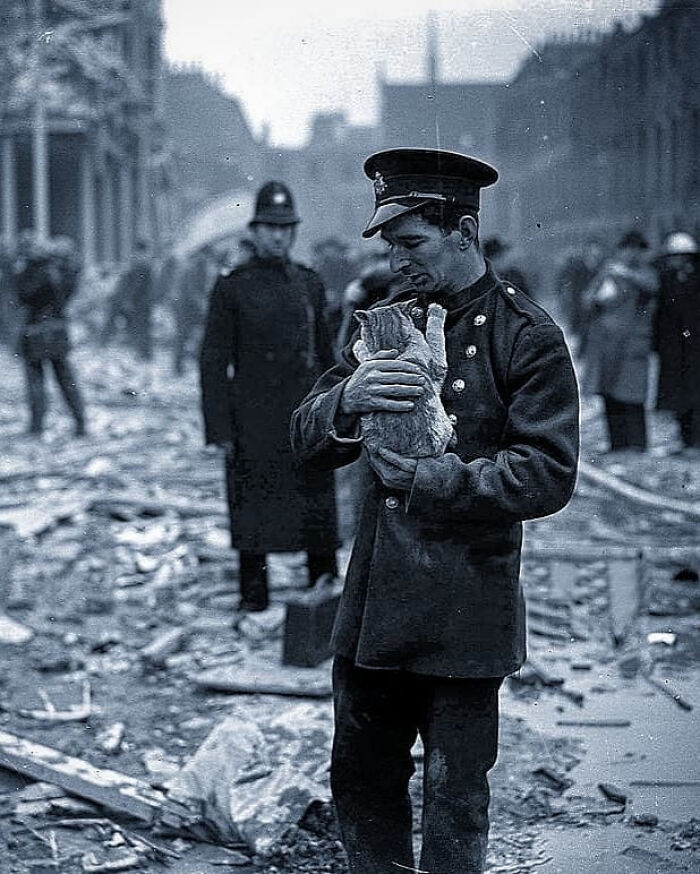 A rescue worker in the aftermath of a German rocket attack comforts a kitten amongst the rubble in London; 1945.
Photos like this provide so much more depth to the stories making up our history, showing a different layer of human emotion in those horrific times. A beautiful moment of peace that can be appreciated even now.
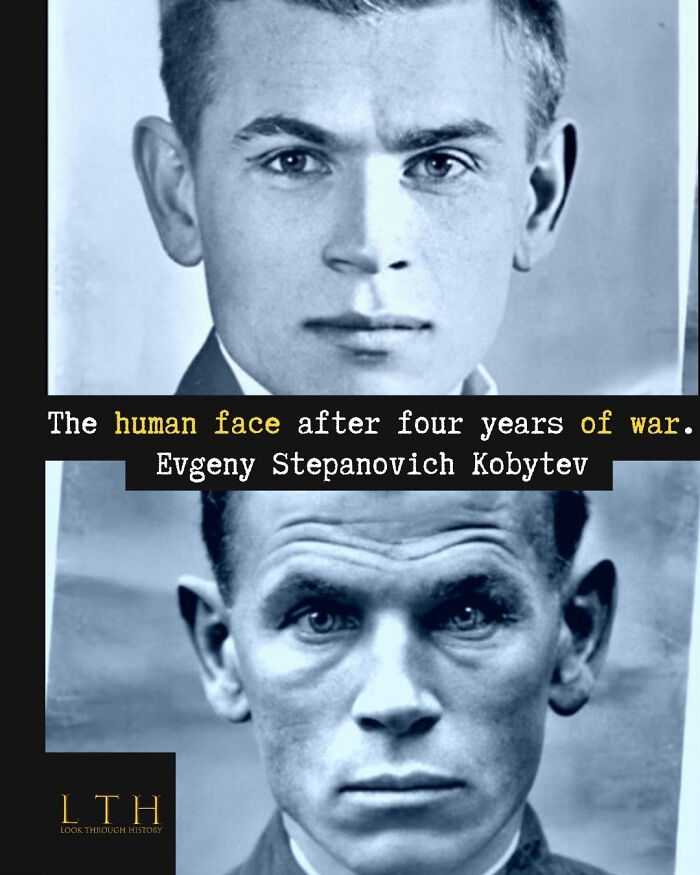 Two pictures taken four years apart in 1941 and 1945 showing Soviet soldier Evgeny Stepanovich Kobytev before and after his time fighting in World War 2.
In 1941 Evgeny graduated with honors from the Kyiv State Art Institute in Ukraine before normal life came to a crashing halt with Germany’s invasion of the Soviet Union on June 22, 1941 with “Operation Barbarossa”. He voluntarily enlisted into one of the artillery regiments of the Red Army which became engaged in a fierce battle to protect the small town of Pripyat, which lies between Kyiv and Kharkiv.
In September 1941, Kobytov was wounded in the leg and became a prisoner of war, managing to escape in 1943 where he again rejoined the Red Army. He participated in various military operations throughout Ukraine, Moldova, Poland, Germany. After the Second World War ended, he was awarded the Hero of the Soviet Union medal for his excellent military service during the battles for the liberation of Smila and Korsun in Ukraine. However, the High Command refused to award him the Victory over Germany medal since his military career was “spoiled” for being a prisoner of war.
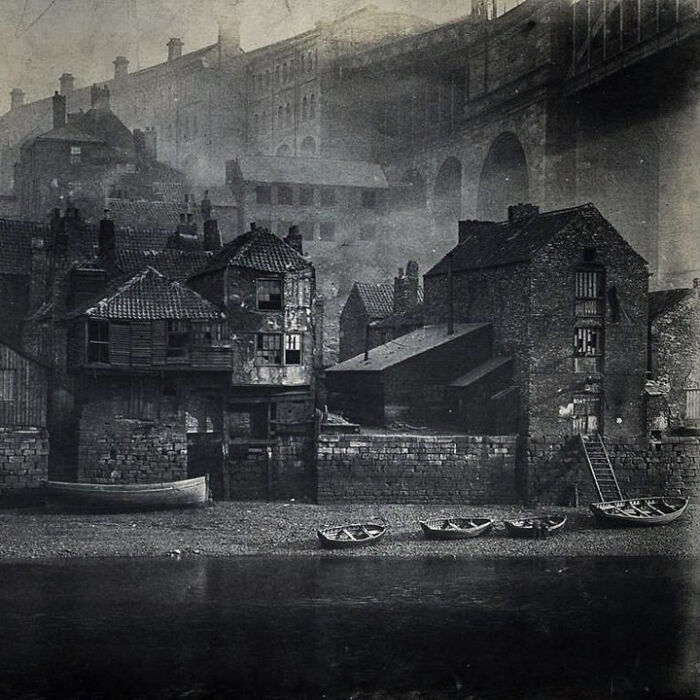 A photo of Victorian Newcastle with the River Tyne flowing near High Level Bridge; 1870. Photo: Newcastle Libraries.
The history of Newcastle Upon Tyne dates back almost 2,000 years, from around 120 AD, when the Romans built the first bridge to cross the River Tyne. The bridge was called Pons Aelius or 'Bridge of Aelius', Aelius being the family name of Roman Emperor Hadrian who was responsible for “Hadrian’s Wall”, the Roman wall built across northern England along the Tyne–Solway gap. Since then, it has been controlled by the Angles and the Norsemen amongst others.
Originally known by its Roman name Pons Aelius, the name "Newcastle" has been used since the Norman conquest of England. Due to its prime location on the River Tyne, the town developed greatly during the Middle Ages and it was to play a major role in the Industrial Revolution. It was granted city status soon after this photo was taken.
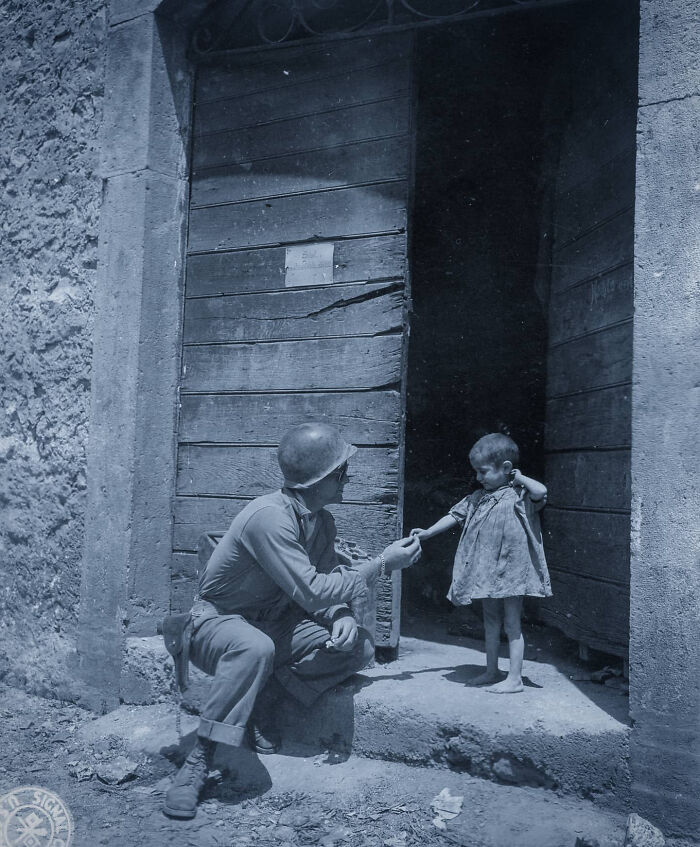 An Ameircan soldier gives a young Italian child who, judging by their age may have only known a world at war, a piece of candy: 1944
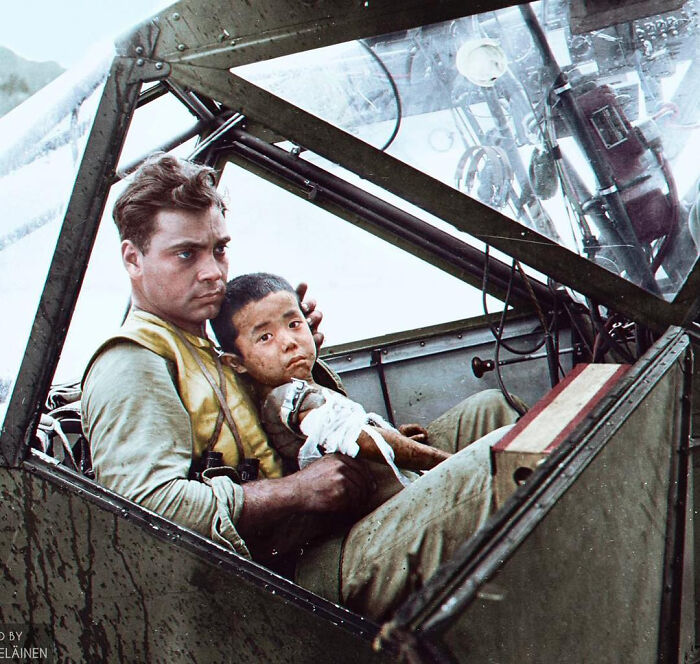 An American pilot looks after a Japanese boy wounded in the arm , sheltering him from the rain during the Battle of Saipan. The intensity of this battle, as with much of the Pacific theatre, was high as the Japanese fighting tooth and nail with some not even surrendering until after the war.
Commenting on his picture photographer Peter Stackpole said "On Saipan I witnessed s**cides during the very last of the fighting at the south end of the island. Japanese propaganda had told the native population that they ought to take their own lives because the Americans were going to torture anyone they captured. That wasn't the case at all, but I saw girls, all holding hands, jump off the reef in the ocean, trying to drown themselves.
In a truckload of civilians that the Marines had rounded up, I saw a little Japanese kid with his arm badly mangled and some makeshift bandages on it. The kid was about to be in a state of shock, and just then one of those observation planes landed on the road. I took the boy over to the plane and said to the pilot, "Is there any way you can take this kid... where he can get medical treatment?" He didn't want to at first. Then he looked at the kid and said, "Sure." The kid sat on his lap, I took one picture, and the plane took off."
There are two cliffs in Saipan still called Banzai Cliff and S*****e Cliff
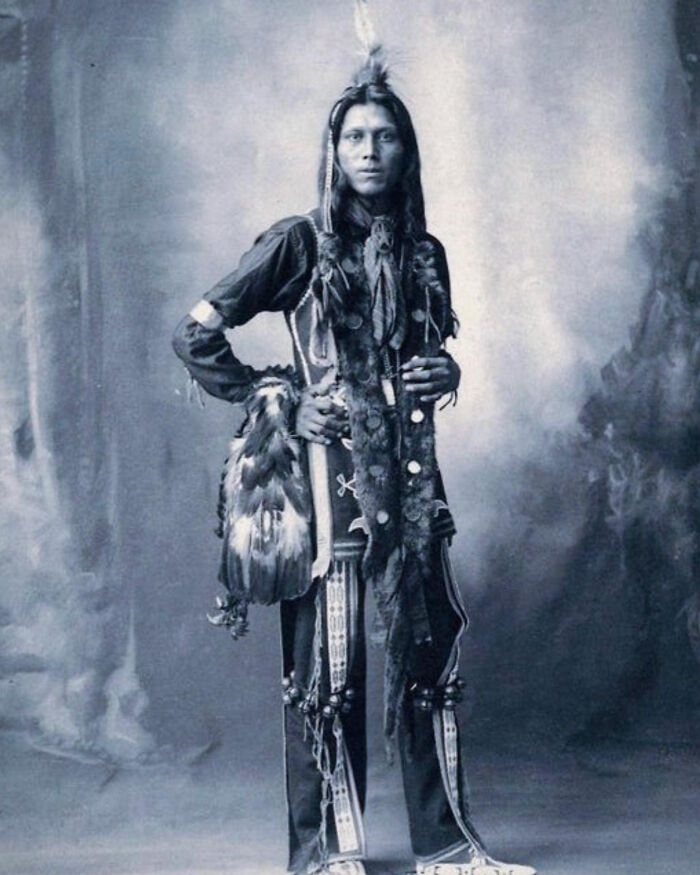 A series of photographs showing Native American leaders and members of the delegations who attended the 1898 Indian Congress in Omaha.
The photographs were taken by Frank Rinehart. Rinehart was a photographer who captured Native American personalities and scenes, especially portrait settings during the Congress. He was commissioned to photograph the event and those who attended it. Together with his assistant Adolph Muhr,they produced what has been stated as "the Rinehart Indian Photographs, as they were popularly known, constitute one of the best photographic documentations of Indian leaders at the turn of the century” (considered Paula Fleming, curator of photographs at the Smithsonian’s National Anthropological Archives).
From the digital collections: "Standing studio portrait of a Native American (Ponca) man, Pete Mitchell (Dust Maker). He wears a single feather in his hair, a kerchief with a star medallion, a fur pelt decorated with coins, dark shirt, metal arm band, vest, breechcloth, leggings with a beaded band, below the knee garters with bells, and beaded moccasins. Over his wrist he holds an eagle fan with the eagle's head attached." Wiki Diki -> "The Ponca people are a nation primarily located in the Great Plains of North America that share a common Ponca culture, history, and language, identified with two Indigenous nations: the Ponca Tribe of Indians of Oklahoma or the Ponca Tribe of Nebraska."
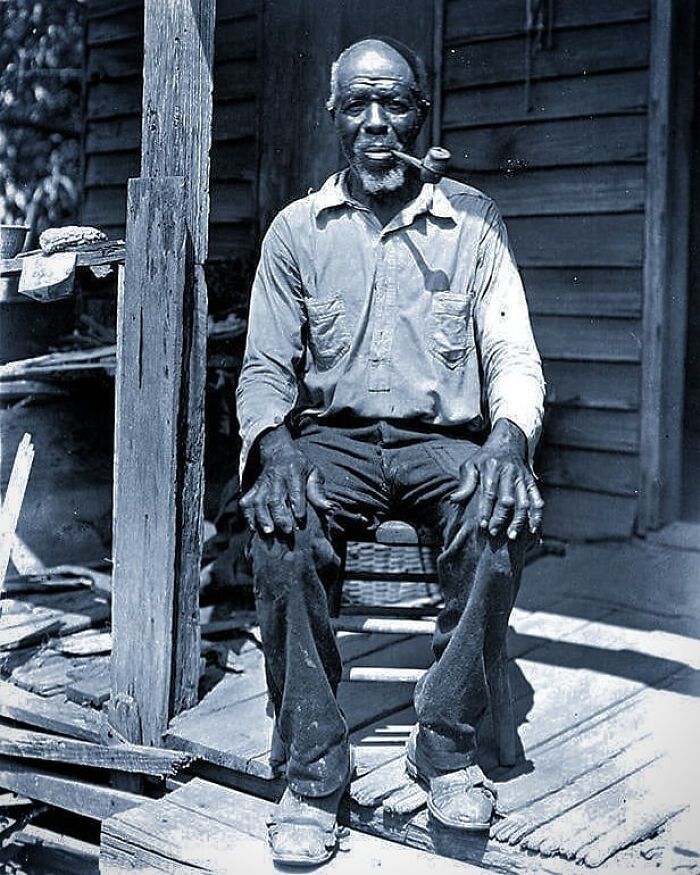 Cudjoe Kazoola Lewis, known as the last surviving member of the Atlantic sl*ve trade, sits smoking his pipe; 1900s.
Born in West Africa around 1841 Cudjoe was taken prisoner in 1860 and taken to the slaving port of Ouidah where he was sold to Captain William Foster of the Clotilda, an American slaving ship. He was smuggled into the United States through Alabama. Born free, smuggled across the planet far from home in chains, and living free again until passing away in 1935; Cudjoe's life is an epic in itself worthy of a Hollywood film. Yet it is but the faintest tip of the iceberg of the countless lives caught in the sl*ve trade. Unlike most, his story ended in relative freedom but he could still not raise the money to return to his homeland.
The 19th of June is celebrated as Juneteenth, recognising the date when news of emancipation finally reached Galveston, Texas, on June 19, 1865, when Maj. Gen. Gordon Granger along with more than 1,800 federal troops arrived to take control of the state, nearly two months after the end of the Civil War, confirming the freedom of the last remaining sl*ves in the deepest parts of the South.
Despite the Emancipation Proclamation, that “all persons held as sl*ves” would be free, was signed by President Abraham Lincoln in 1863 and Gen. Robert E. Lee marked the end of the Civil War in April of 1865, news spread slowly and often met resistance from plantation owners. It is a crucial date of remembrance in the annual calendar for us to take stock of this incredibly recent history and push together to build a better future.

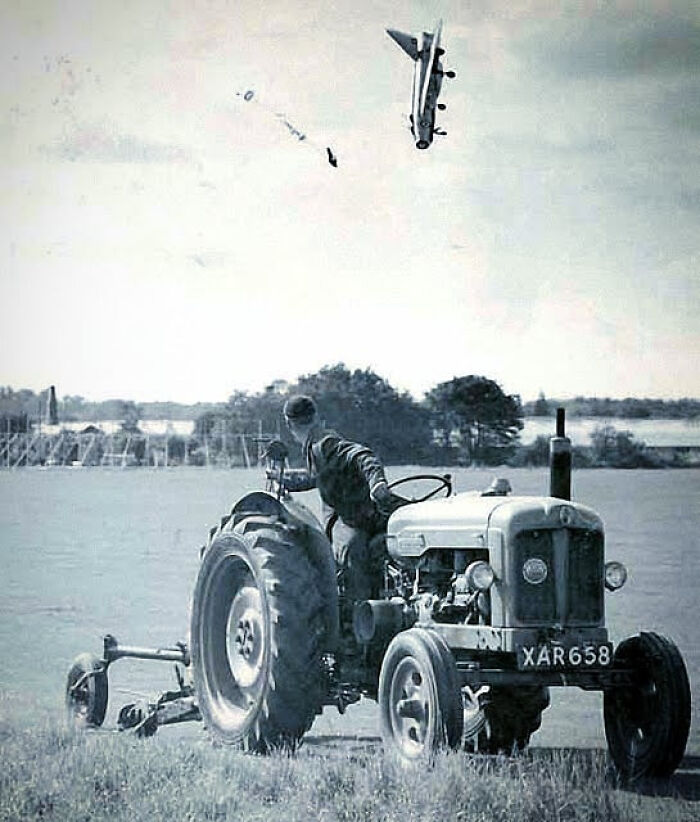 A farmer in Hertfordshire, England looks behind as test pilot George Aird ejects from the Lighting F1 aircraft, narrowly escaping with his life; 1962.
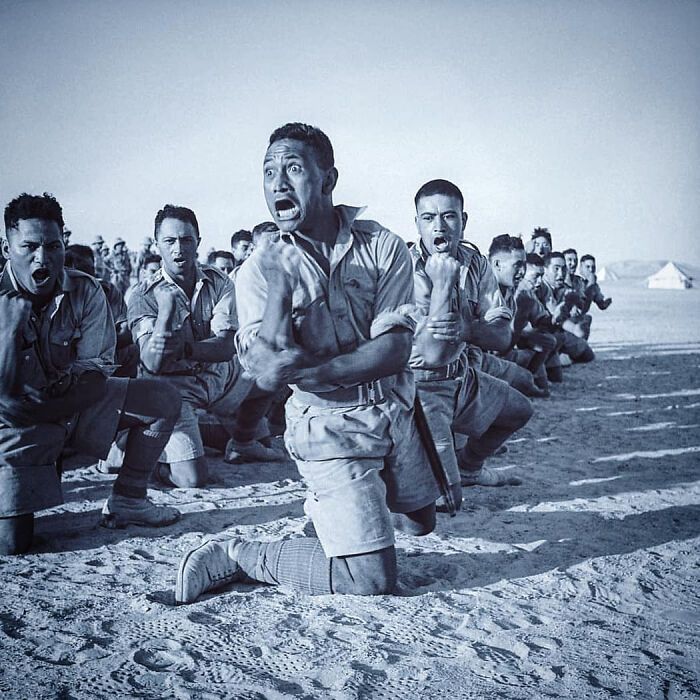 The New Zealand Maori Battalion performing the Haka in Egypt 1944.
By the end of the second world war this battalion had become one of the most decorated in New Zealand's history.
The most notable was Moana-Nui-a-Kiwa Ngarimu who won the Victoria Cross in 1943 for attacking enemy positions, taking out at least two machine g*n posts by himself to protect his men, and fearlessly defending the position once held. "As he fell he came to rest almost on top of those of the enemy who had fallen, the number of whom survived testified to his outstanding courage and fortitude".
The 28th Māori Battalion performing the Haka for King George II of Greece and Major General Bernard Freyburg, during training in the Western Desert in Egypt, 1941. They were a specialised infantry unit of the New Zealand Expeditionary Force during WWII. They received 99 individual bravery decorations and honours during the war. This was the highest total of individual gallantry decorations awarded to any of the New Zealand infantry battalions. Second Lieutenant Te Moana-nui-a-Kiwa Ngārimu was awarded the Victoria Cross posthumously. He was KIA March 27th 1943 aged 24. No other New Zealand unit saw more fighting or sustained such heavy losses as the 28th.
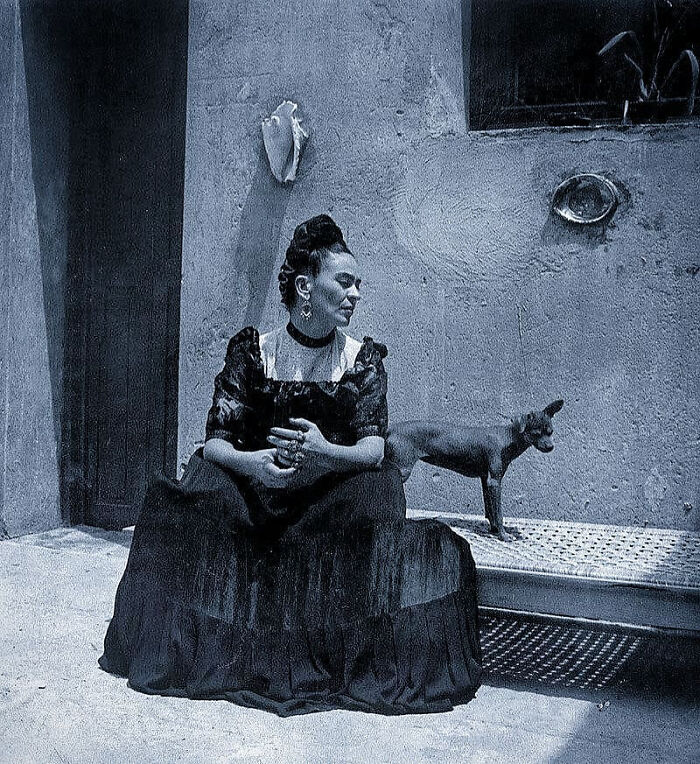 Mexican artist Frida Kahlo poses with one of her Xoloitzcuintle "Mexican hairless dogs"; 1944.
Born on the 6th July 1907, Considered one of Mexico's greatest artists. She was predominantly known for her many portraits and self-portraits; covering topics such as identity, life and death. One of the most significant events in her life thought to have inspired much of her art was a bus accident leading to serious permanent injury and over 30 surgeries throughout her life.
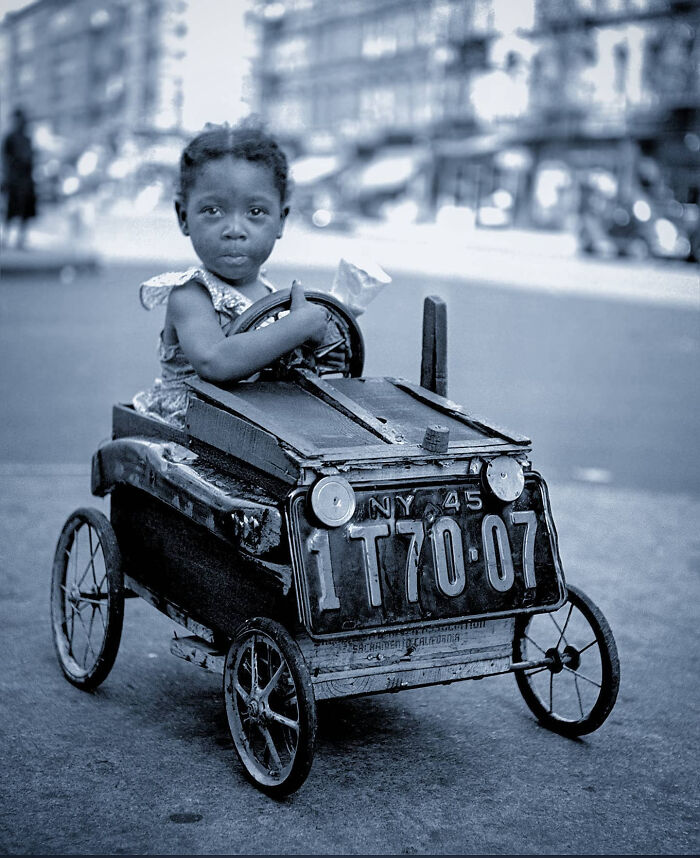 A young girl poses for the camera as she rolls down the street in 1940s New York City.
She's lucky. She had someone who loved her very much who built this cute little car for her. 😊
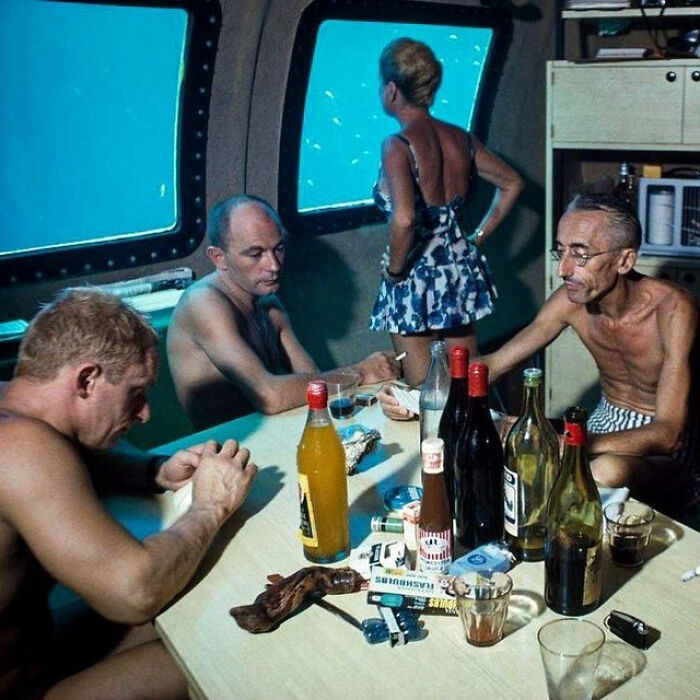 The Cousteaus and their crew relax in a submersible after work during the Conshelf Two Expedition; 1963
Continental Shelf Station Two was an attempt at creating an environment in which humans could live and work on the sea floor. Cousteau and his crew lived for a month in an in the Red Sea off the Sudanese coast 10 metres below the surface.
Idyllic to some, and hellish to others. Who would you live on Conshelf Two with? Or would you give this a pass?
Jacques! Among many other things, he co-invented the first successful open-circuit self-contained underwater breathing apparatus (SCUBA), called the Aqua-Lung, which assisted him in producing some of the first underwater documentaries.
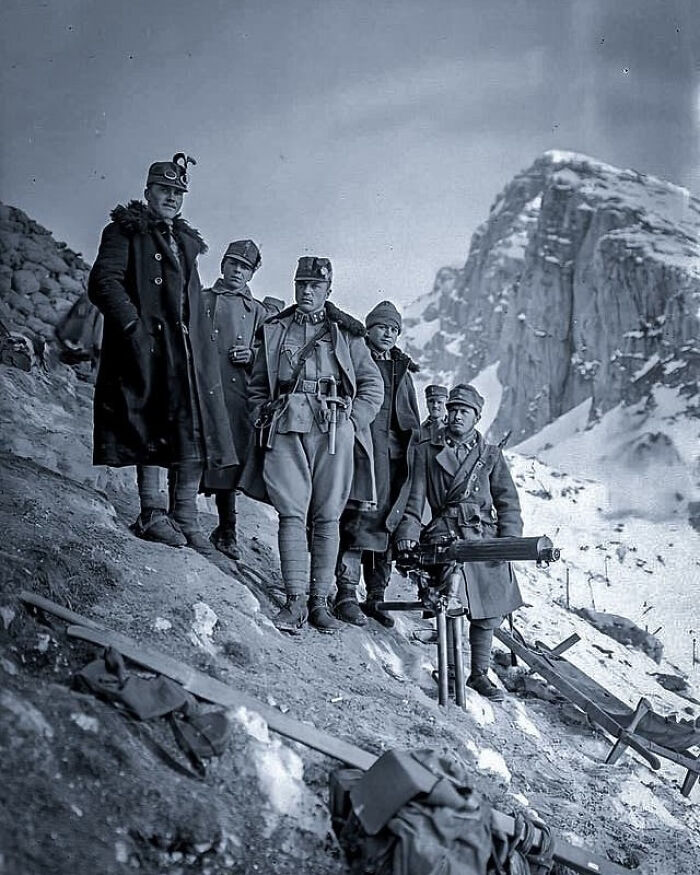 Austro-Hungarian mountain troops pose for a photograph in Dolomite mountain range on Italian front in World War 1; 1916.
Italy began the war on May 23, 1915. Its aim, stoked by a rising nationalist fervor, was to annex several regions particularly those inhabited by Italians held by the Austro-Hungarian Empire.
Troops clashed at altitudes up to 12,000 feet with temperatures as low as -30°C in the Guerra Bianca, or White War, named for its wintry theater. Never before had battles been waged on such towering peaks or in such frigid conditions. Austrian troops controlled the most strategically significant position. To supply this position however meant exposing themselves to their Italian adversaries. To overcome this issue the Austrians decided rather than expose themselves, they would dig deep into the glacier itself. 12 kms of tunnels were crafted into what became known as the "Ice City" housing everything required for 200 soldiers to live in the frozen deep.
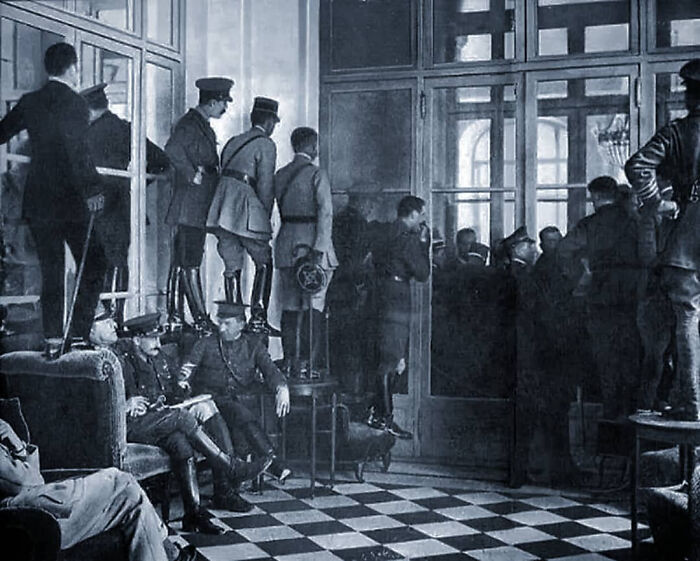 Officers and politicians clamber on furniture to peer through the window pane attempting to catch a glimpse of the Treaty of Versailles being signed; June 28 1919.
A moment in history that set the tone for the rest of the century.
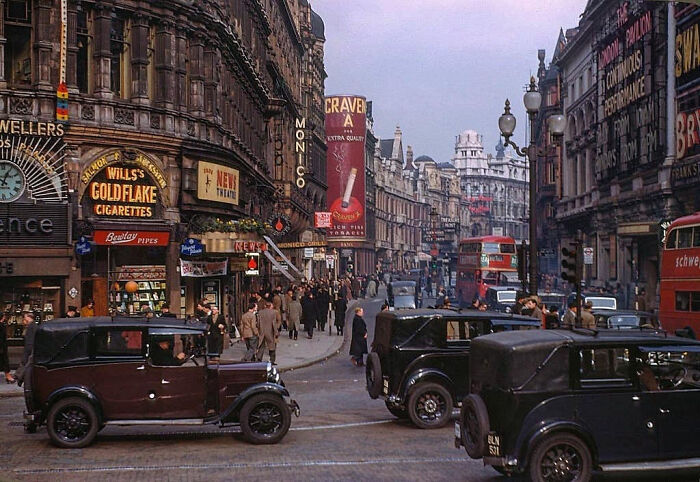 Four years after the devastation of World War 2 that left much of London in ruin life rolls on in the Capital city.
This kodachrome picture is an original colour photograph of London in 1949 on the corner of Shaftesbury Avenue towards Piccadilly Circus.
I could be wrong but I think this is looking down Shaftesbury Avenue, not towards Piccadilly Circus. It's the junction of Piccadilly Circus, Shaftesbury Avenue, and Coventry Street. That white cupola in the background is the Gielgud Theatre on Shaftesbury.
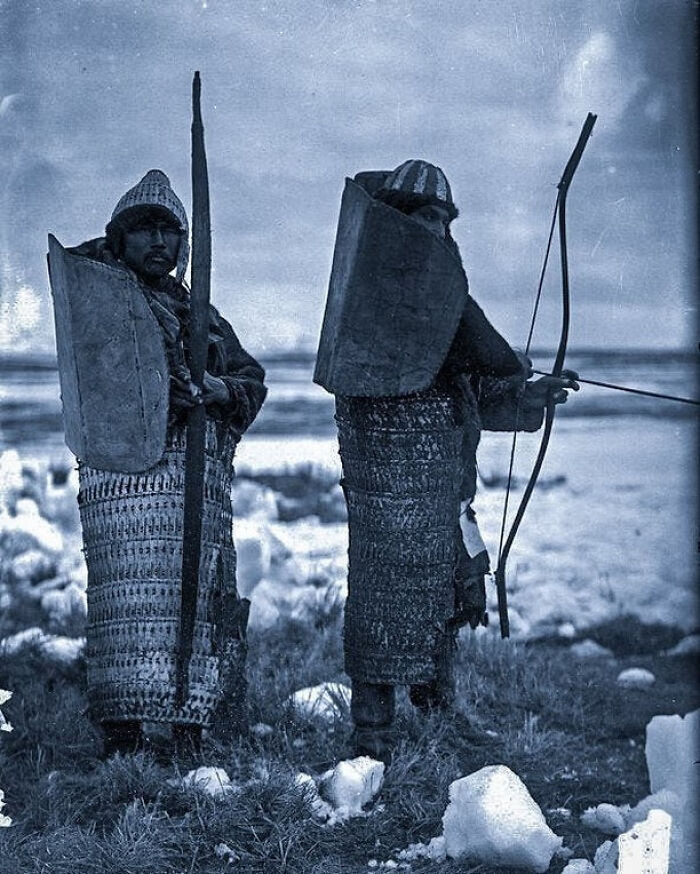 Koryak men showing off their traditional armour and bows for photographer Vladimir Jochelson during the Jesup North Pacific Expedition in Siberia; 1901.
These indigenous people of the Russian Far East numbered about 7,900 in the late 20th century. Some were nomadic reindeer keepers of the inland areas, while others were sedentary coastal dwellers who engaged in sea-mammal hunting and fishing.
The Jesup North Pacific Expedition was a major, multi-year anthropological expedition to Siberia, Alaska, and the northwest coast of Canada between 1897–1902. The purpose of the expedition was to investigate the relationships among the peoples at each side of the Bering Strait.
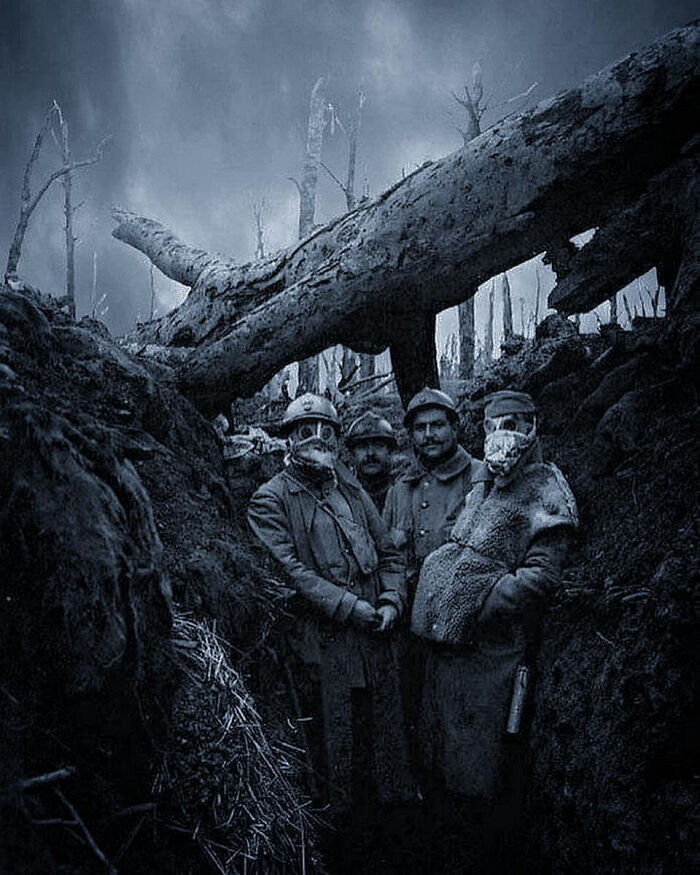 French soldiers stand huddled together in their trench surrounded by the nightmarish landscape of Verdun, The Devil's Anvil; 1916.
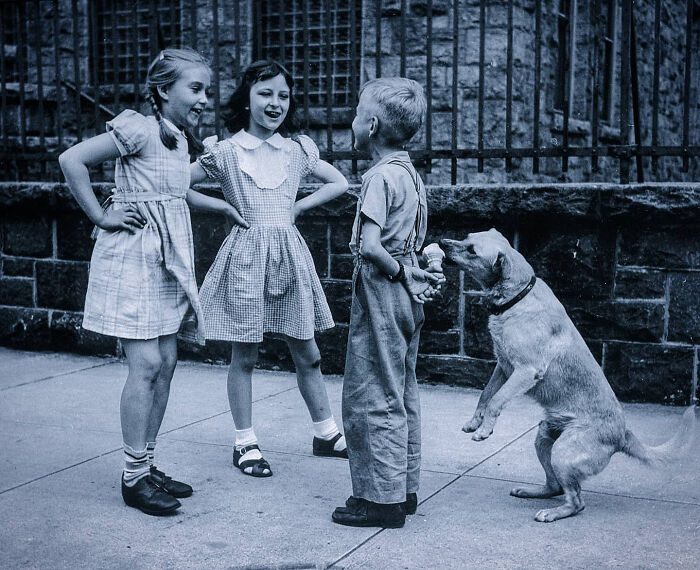 A young boy caught distracted loses out on his ice cream in 1950s New York.
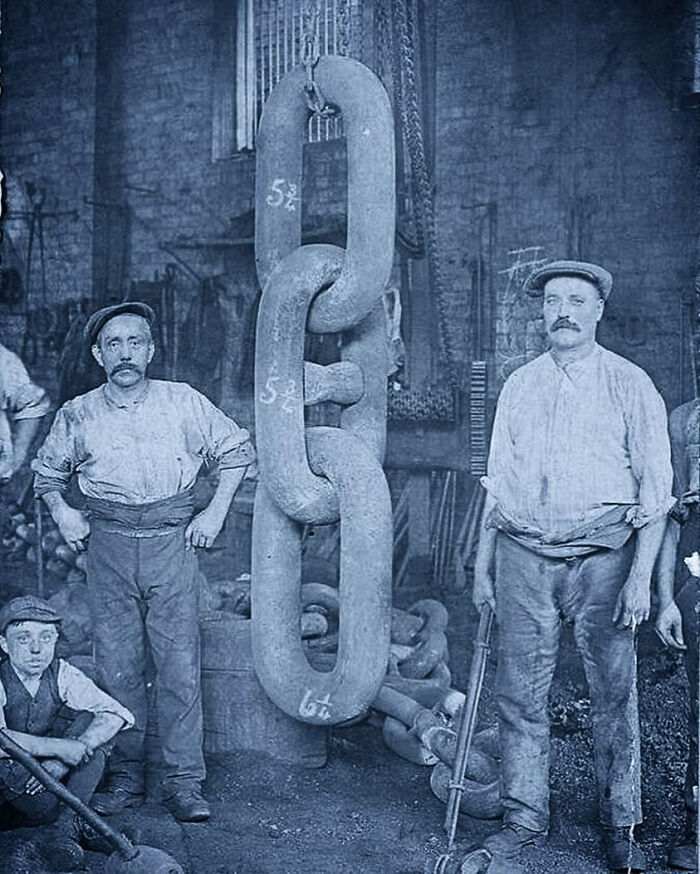 Workers of Hingley and Sons stand next to a section of chain destined for the anchor of the Titanic; 1910.
At the time the anchor was the biggest ever constructed at 18 foot in length and 10 foot wide. It weighed a massive 16 tonnes and is currently still sat idle 12,500 feet below the surface of the Atlantic, where it has been for the last 108 years since leaving the port of Southampton.
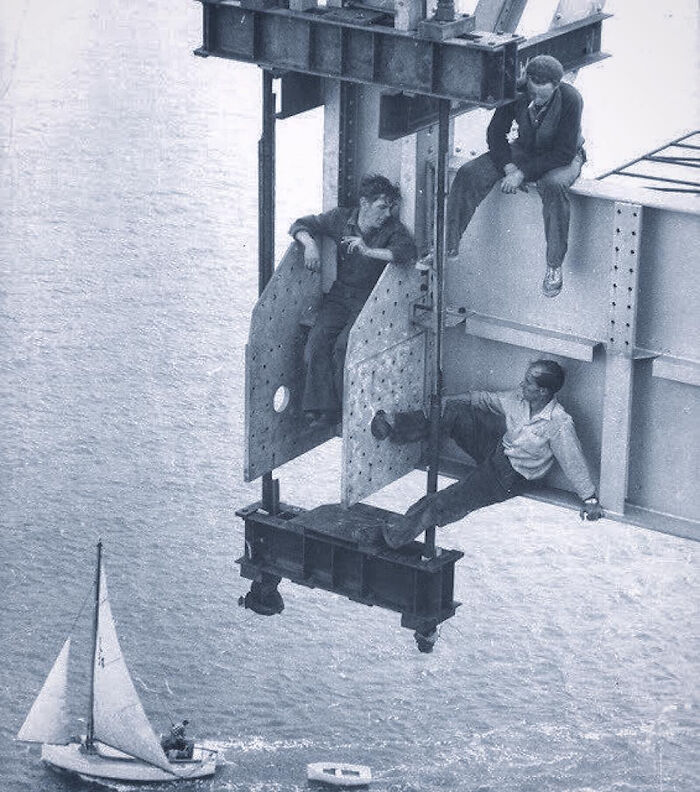 A trio of workers take some time out for a smoking break whilst constructing the Auckland Harbour Bridge; 1959.
They all seem very relaxed although I’m not even sure if this looks comfortable..
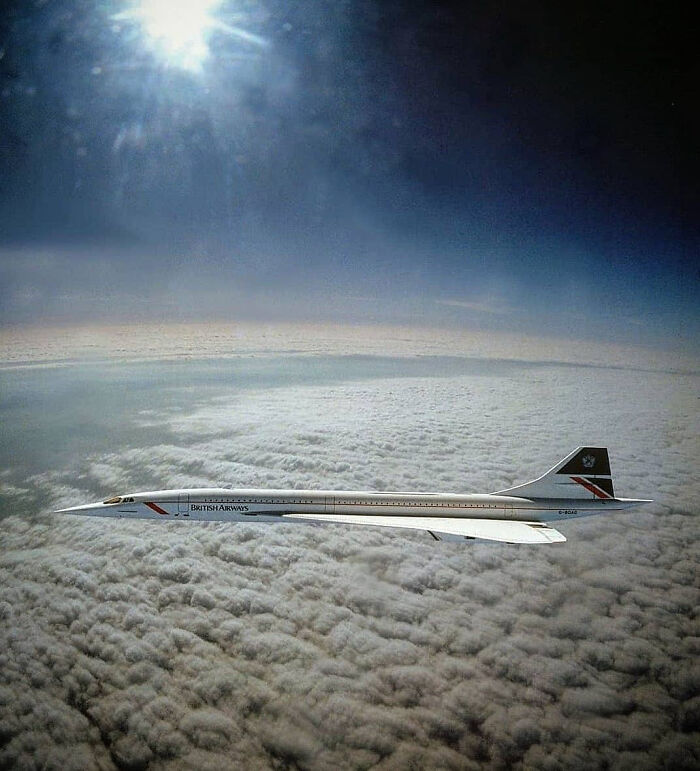 A photo of a British Airways Concorde from the window of an RAF Tornado travelling at Mach 1.6 over the Irish Sea; 1985.
To take this photo the Concorde slowed down from Mach 2 to match the Tornado's speed. After 4 minutes of keeping chase the RAF pilot Adrian Meredith broke of the rendezvous leaving the Concorde alone for its journey to JFK.
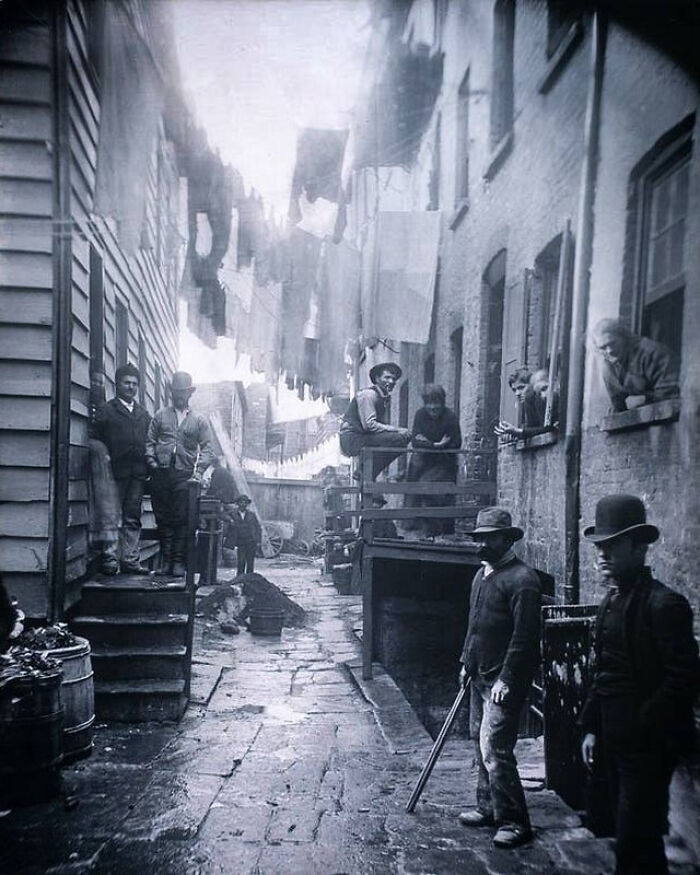 A photo of Bandits' Roost, 59½ Mulberry Street, New York City; 1888.
The late 19th-century New York City was a magnet for the world’s immigrants in search of the “American Dream”. The accomplishment of this dream was of course easier said than done. Many found themselves in densely populated streets brimming with squalor. Danish born reporter Jacob Riis documented this chapter of American history, venturing into the city’s most ominous neighborhoods to capture the crime, poverty and overcrowding.
One of his most famous photos here shows a Lower East Side street gang. Such work became the basis of his revelatory book How the Other Half Lives, which forced Americans to confront what they had long ignored and galvanized reformers like the young New York politician Theodore Roosevelt, who wrote to the photographer, “I have read your book, and I have come to help.” Riis’ work was instrumental in bringing about New York State’s landmark Tenement House Act of 1901, which improved conditions for the poor.
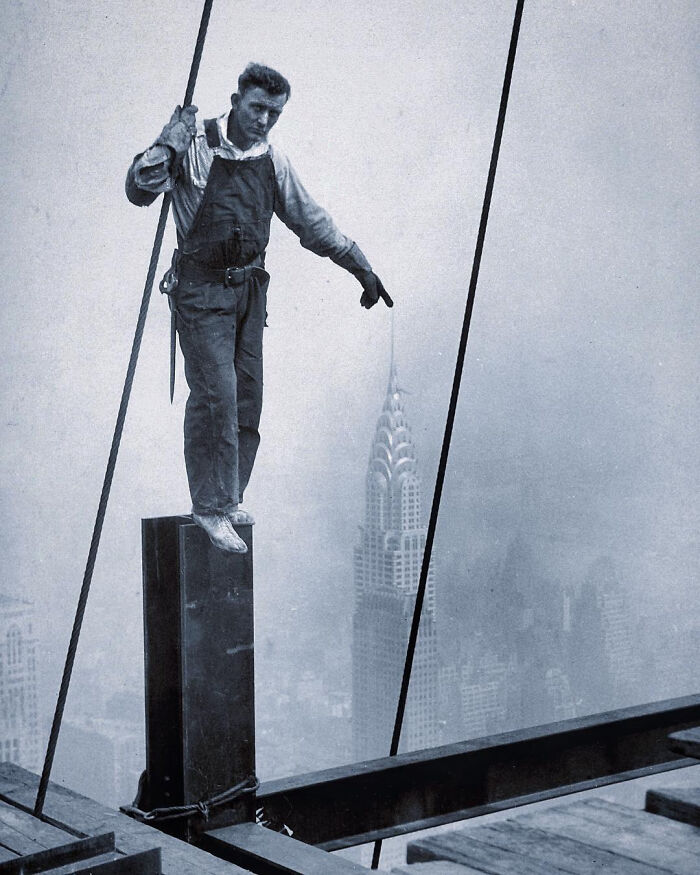 A New York iron worker touches the tip of the Chrysler Building during the construction of a skyscraper that would go on to dominate the Empire State; 1931.
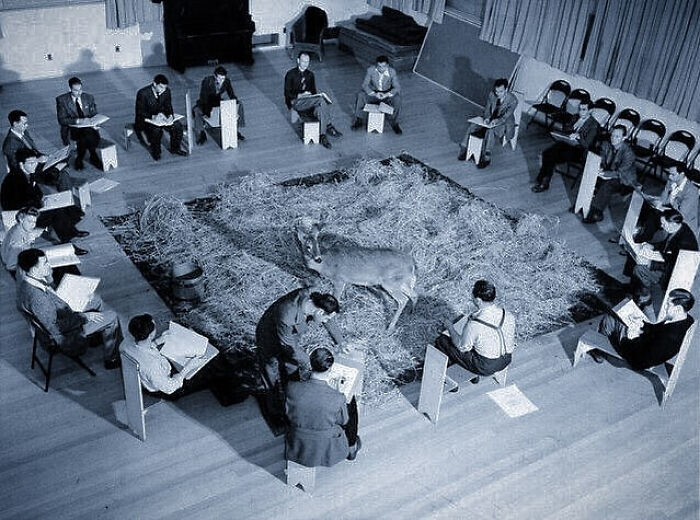 Disney artists get up close and personal studying a deer in preparation for one of their most famous creations: Bambi, 1942.
Now that is a cool job.
Apparently the place was overrun with spotty dogs and puppies during the making of 102 Dalmatians 😍
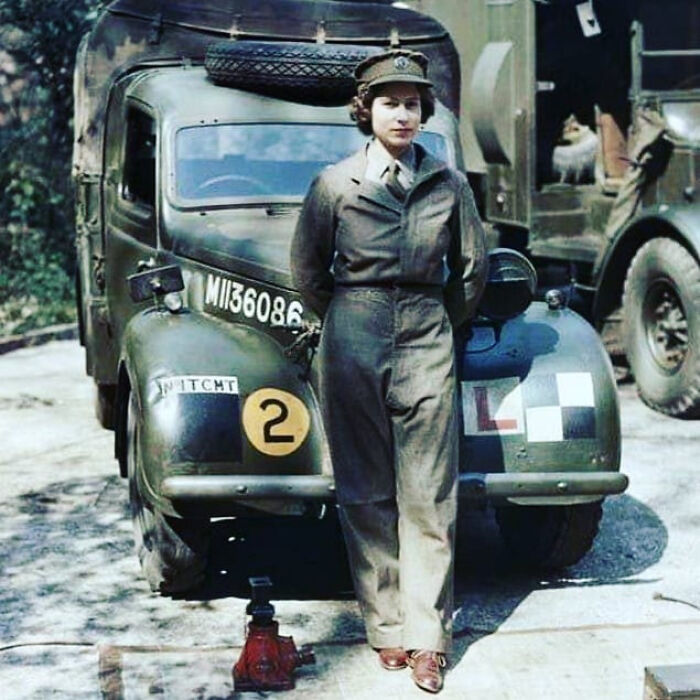 An 18 year old woman serving as a mechanic during WW2. During WW1 and WW2 many jobs and roles seen as a 'man's job' were left vacant as many able bodied men left to fight. These roles were then filled by women of all ages across the UK.
This shift in working roles is seen as a major step forwards for women's suffrage in the UK and the long march to equality.
This particular young woman grew up to be Her Royal Majesty Queen Elizabeth II.
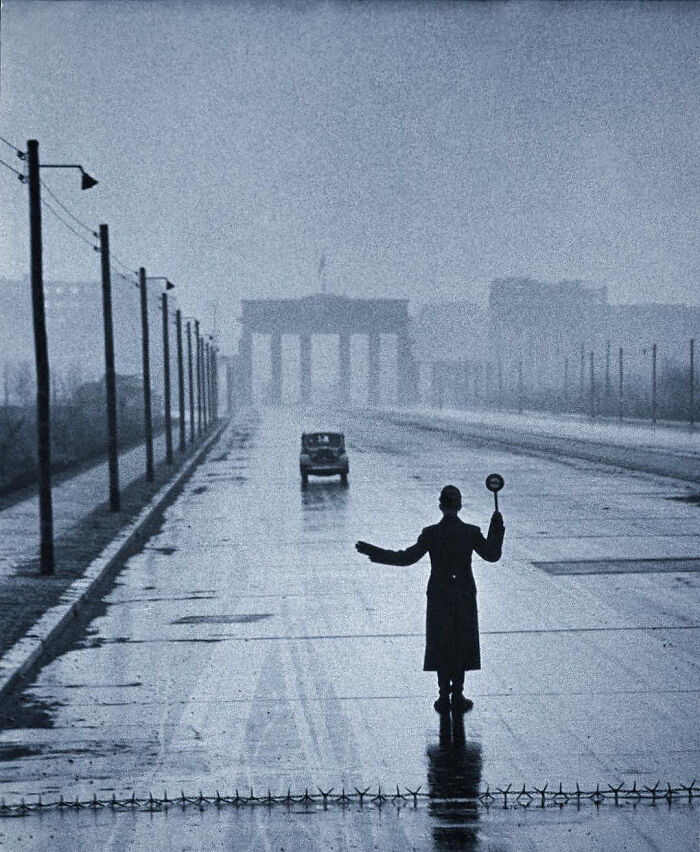 A Lonely car travelling from East Berlin with the Brandenburg Gate in the background is hailed down by a West Berlin police officer supported by the presence of spike traps; 1953.
It is a testament to the raw destructive power of war that even 8 years after the wars end buildings can still been seen lying in ruin.
It is a worry to think how long the once great cities in the Middle East such as Aleppo May take to fully recover from the events of this decade. Maybe not even in our lifetime?
Well thanks to the Marshall Plan the west looked a lot better than the soviet occupied east
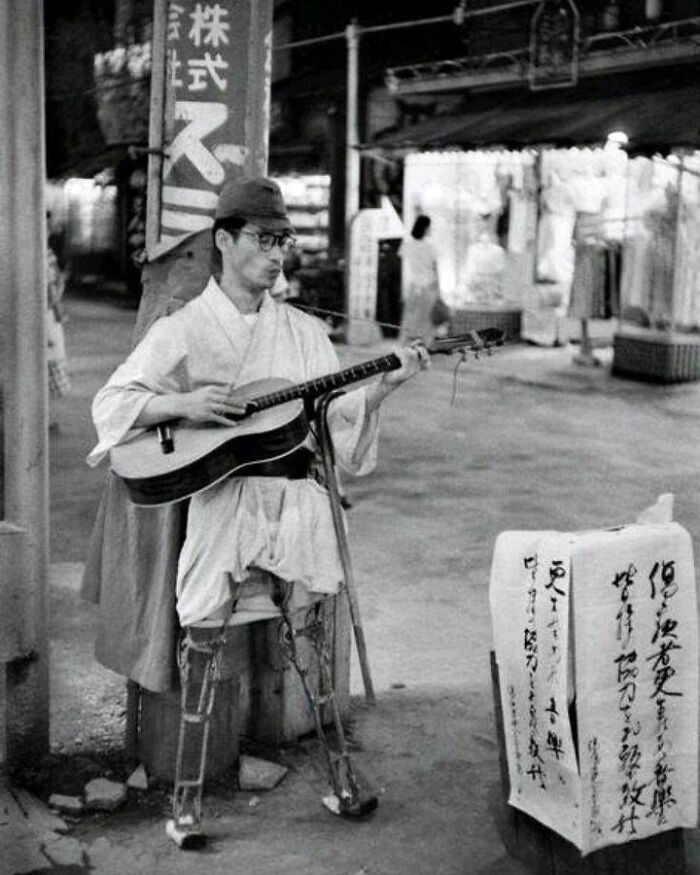 A Japanese veteran plays his guitar on the streets of Asakusa.
This photo taken by famed swiss photographer Werner Bischof was take in early 1950 and stands as a brutal reminder that the effects of war last long after the g*ns fall silent. To wonder how this man felt after enduring during the war to then return to his home defeated and strive to make a new life for himself in a war torn japan. One picture speaks a thousand words.
The amazing photography work done in Japan by Werner Bischof won him the coveted Prix Nadar award in 1955.
A pity the description makes no mention of the man's legs. Take a look... The failure to mention this obvious issue makes me suspect the caption's AI generated.
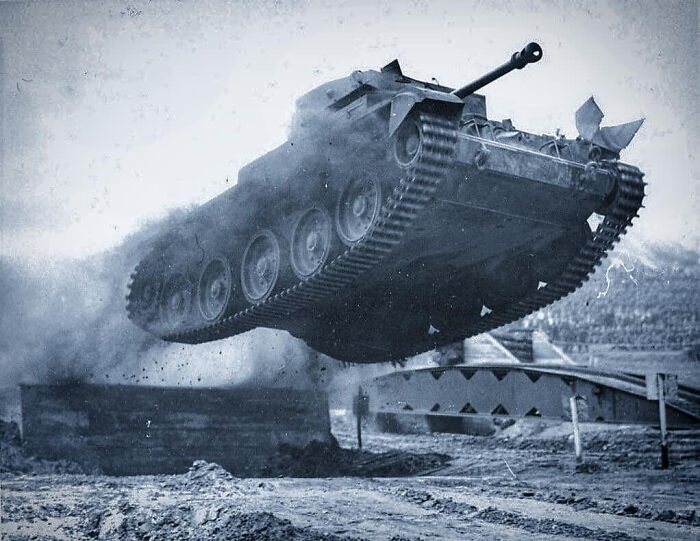 A British Cromwell tank charges off a ramp at Bovington in Dorset; 1944.
Whilst an impressive sh*t, it cant have been too comfortable for the crew inside.
I've never seen something like this before. I'm guessing that was quite a landing for the tank crew.
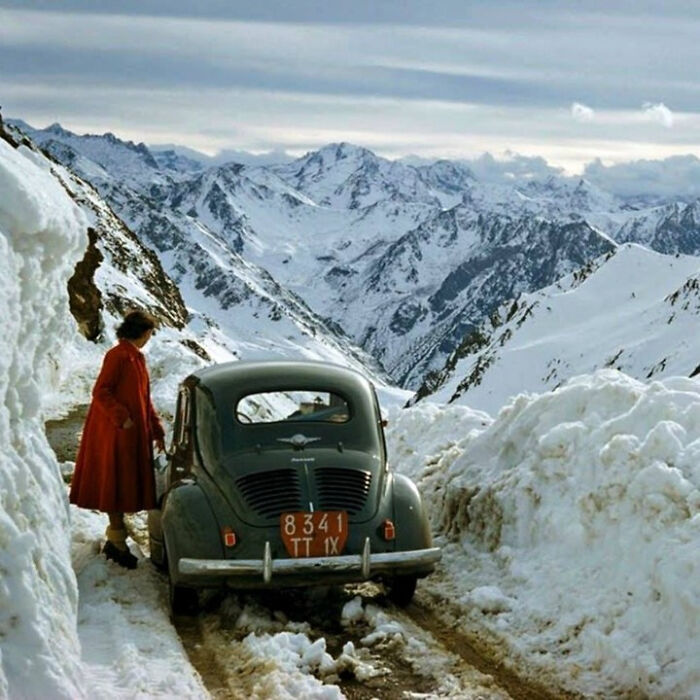 A woman overlooking a snowy mountain pass in The Pyrenees Mountains, France - 1956
This photo, called the 'High Road in the Pyrenees' first appeared in the March 1956 edition of National Geographic, taken by Justin Locke.
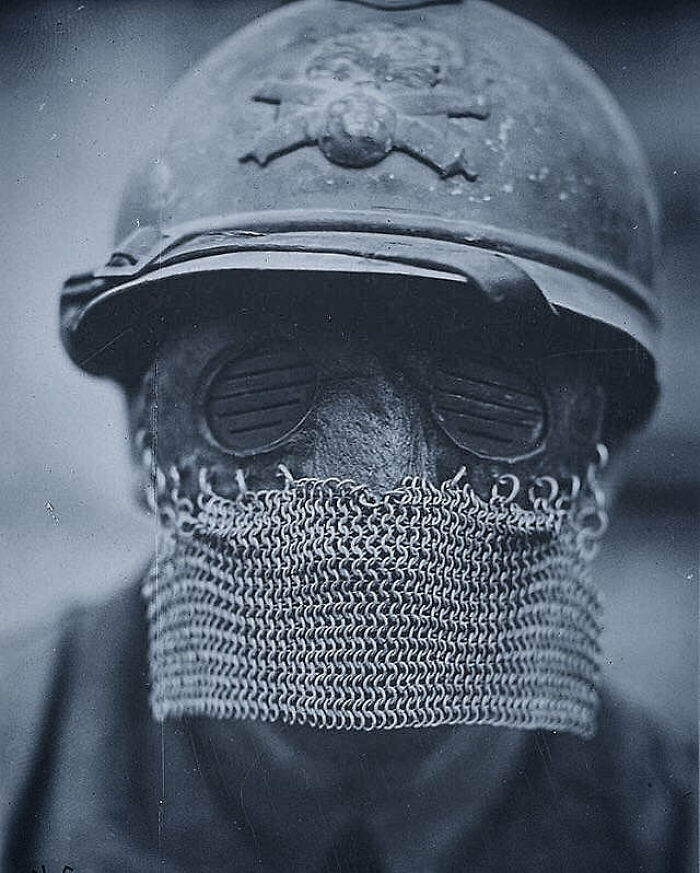 A French tanker of World War 1 wears a protective mask in response to the conditions of driving a tank under fire.
When hit, the shockwave transferring inside could cause bits of metal to sheer off flying around the compartment. With this mask soldiers would hope to stop this so called "spalling" and shrapnel from injuring the face.
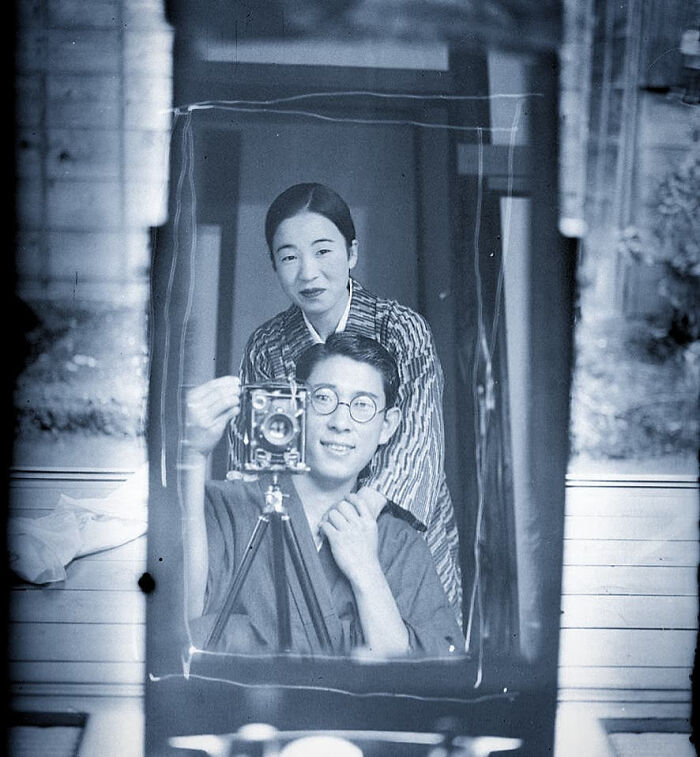 A young Japanese couple take a selfie together using thier mirror; 1920.
Tineless photos like this prove that, although 100 years apart, we are today no different from those that came before us. Because of this it also shows just how easily circumstances can change even today. You cannot help but wonder that whilst they are captured happy and together here what became of their lives knowing what the next 25 years of time would bring to them.
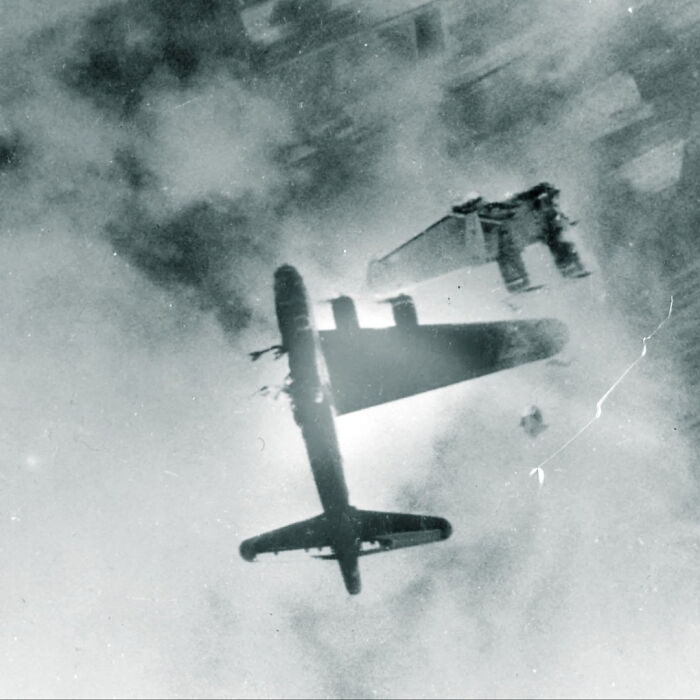 This incredible shot shows 'Wee-Willie', a B-17G Flying Fortress of the 322nd bomber squadron having just lost its left wing from flak fire over Stendal, Germany. 8th of April 1945.
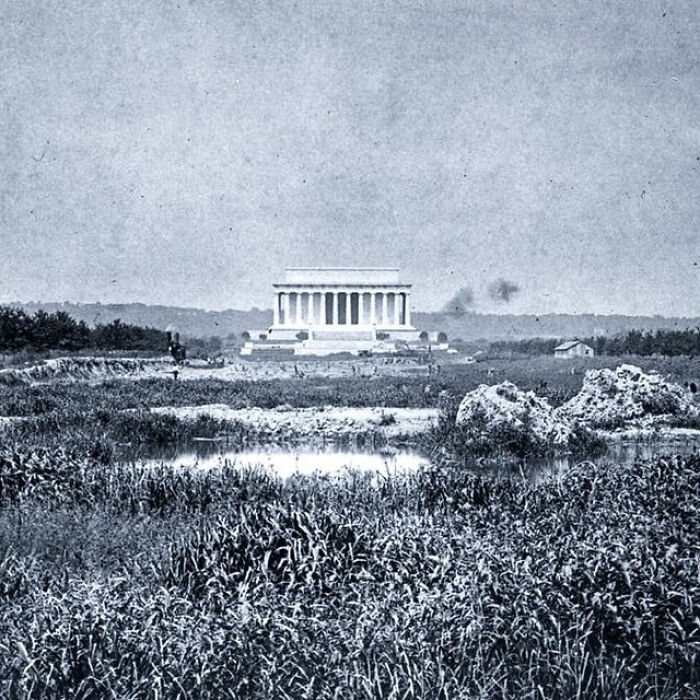 Marshland in front of the Lincoln Memorial before construction of the reflecting pool, 1916.
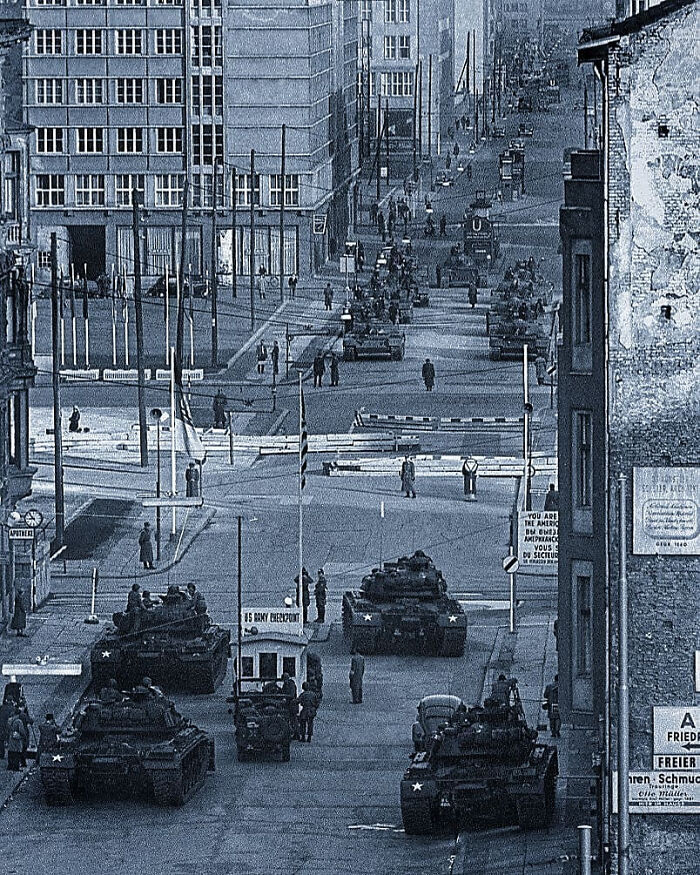 US and Soviet tanks stand off at Checkpoint Charlie. For 16 hours from the 27 to 28 October 1961, US and Soviet tanks faced each other in divided Berlin; one poorly made decision away from a third world war.
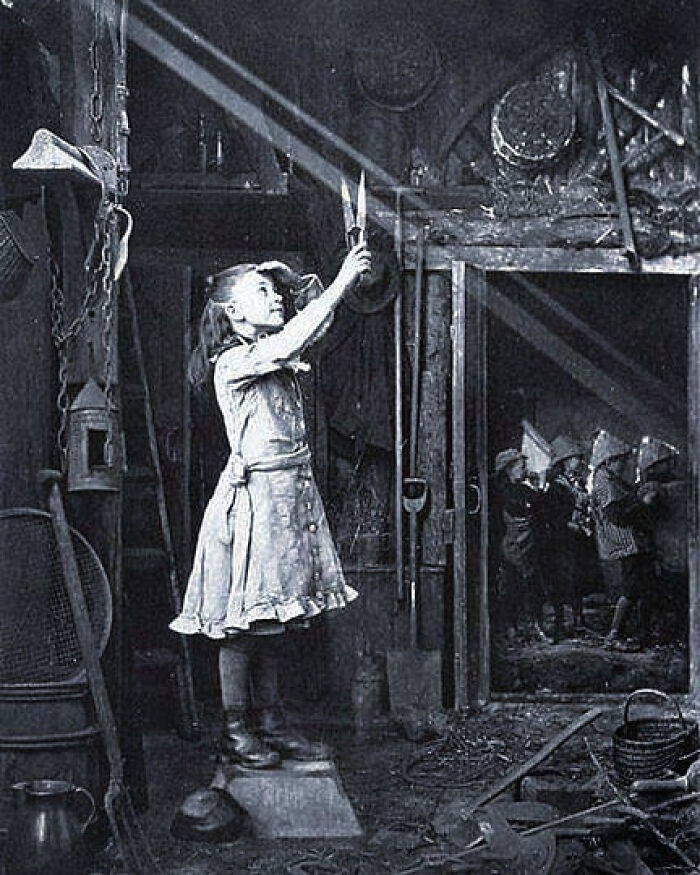 A young girl reaches up into the air to cut a beam of light; 1886.
This photo was taken by Adam Diston, a painter turned photographer, who in some of his work looked to tell subtle tales of morality. What was he looking to tell here I wonder..
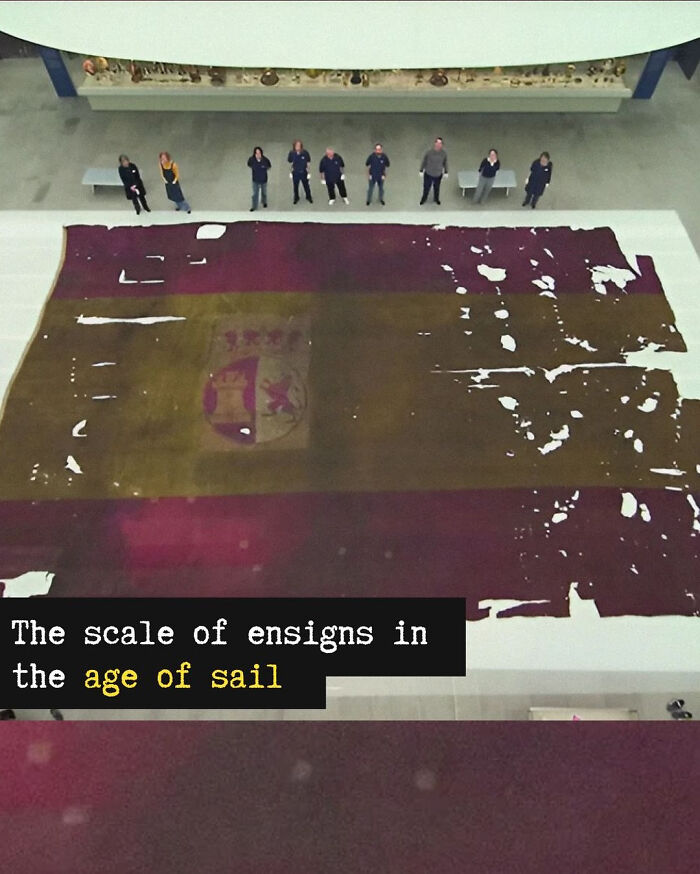 Photos illustrating the immense scale of the ensigns flown by ships in the age of sail. These are from the Spanish ship San Ildefonso and French ship Le Genereux.
The 74-g*n ship of the line San Ildefonso fought during the Battle of Trafalgar against Admiral Lord Nelson’s fleet of the Royal Navy in 1805. The ensign is made of wool, it’s dimensions measure 10m x 14.5m. The British third-rate HMS Defence captured San Ildefonso where its crew suffered 34 k**led and 126 wounded at the Battle of Trafalgar and successfully weathered the storm afterwards to be taken into Royal Navy service as HMS Ildefonso. It was hung in the crossing of St Paul’s Cathedral during Nelson’s funeral service on 9 January 1806 and was presented to the Royal Naval Museum by the Dean and Chapter of St Paul’s in 1907.
The French ensign of the Le Genereux was captured by one of Admiral Nelson’s captains, Sir Edward Berry, at the Battle of Malta Convoy in 1800.
G U N. K I L L E D. Fixed that for you. We censor the word but refuse to control the weapon.
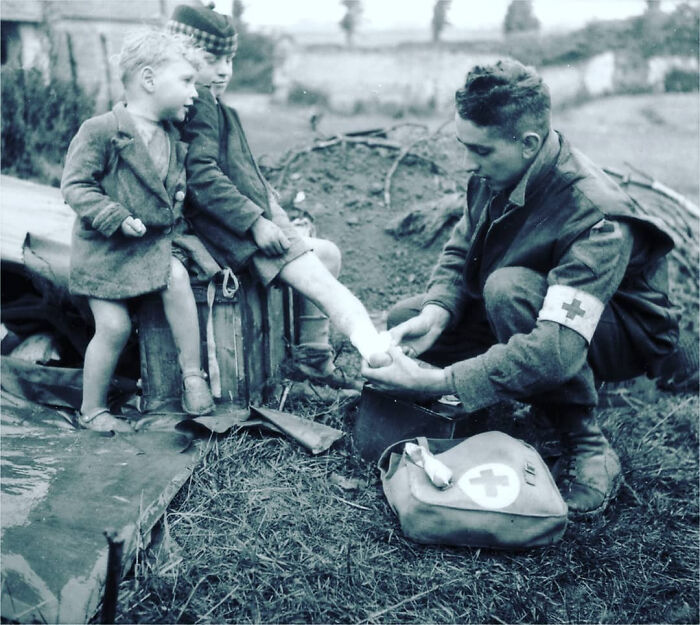 A royal Candaian army medic bandages the leg of a French boy as his brother looks on during the battle of Normandy [June 19th 1944].
.
In the brutal harsh world of war, even amongst the powerful and brutal weapons, the small acts of kindness are often the most powerful and lasting.
How is it that those boys are able to smile at all? It's astounding, and impossibly beautiful in the midst of such misery and destruction.
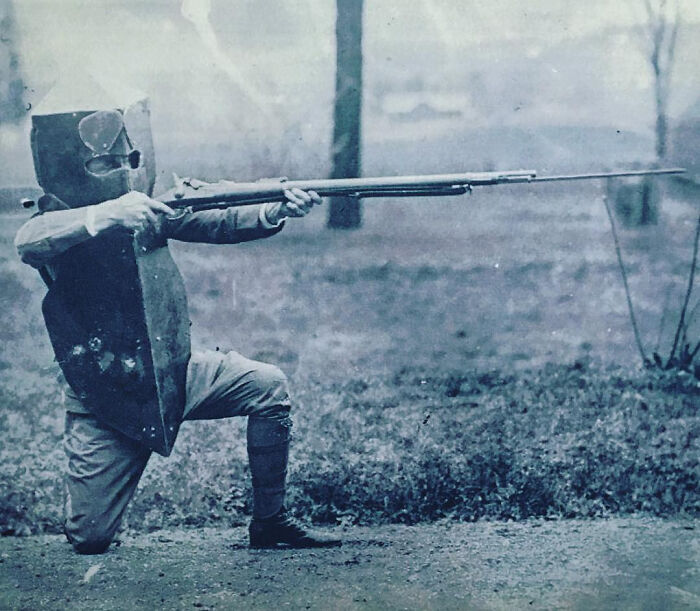 The Brewster Body Shield developed by Dr Guy Brewster, designed for the trenches in 1917.
This American armour was able to withstand incoming rounds from a Lewis Machine g*n however as can be clearly seen the drawbacks on manoeuvrability and sight proved too much to be ever considered useful.
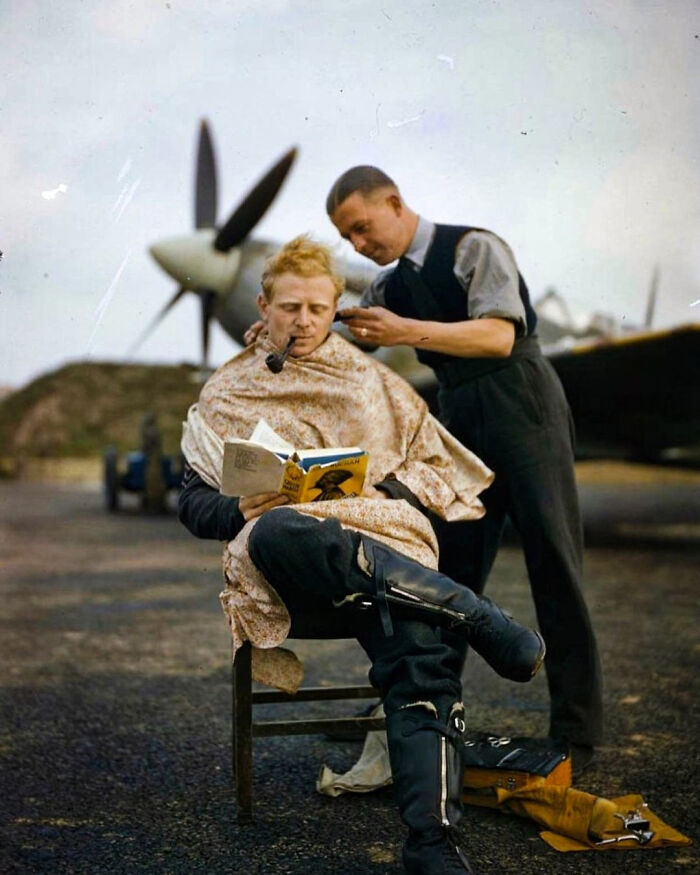 RAF Pilot Gets a Haircut in between Missions at Fairlop Airfield in Essex; 1942.
During WW2’s Battle of Britain pilots had to be ready at a moment's notice to jump into their cockpits and defend the country against German attack across the channel. Detection and monitoring of enemy aircraft by radar stations would feed into the RAF Fighter Command and from here, air crews would be scrambled. The scramble order was communicated to alert pilots waiting by their aircraft by the loud ringing of a bell. Every minute lost before takeoff would be advantageous to the enemy, as it could allow a pilot to gain extra height above the advancing plane formations.
No time to finish the trim, time to fly.
RAF Pilot Francis Mellersh, 20, gets a haircut while reading "Greenmantle" by John Buchan, while sitting in front of his Supermarine Spitfire, November 1942. He became a flying ace, credited with downing at least 8 enemy aircraft. During Operation Diver in 1944, he successfully intercepted and destroyed ~39 German V-1 flying bōmbs before they reached London. He was awarded the DFC and Bar ( the Distinguished Flying Cross twice ). After the war, he continued serving in the RAF and after serving more than 3 decades, he retired at the senior rank of Air Vice-Marshal.
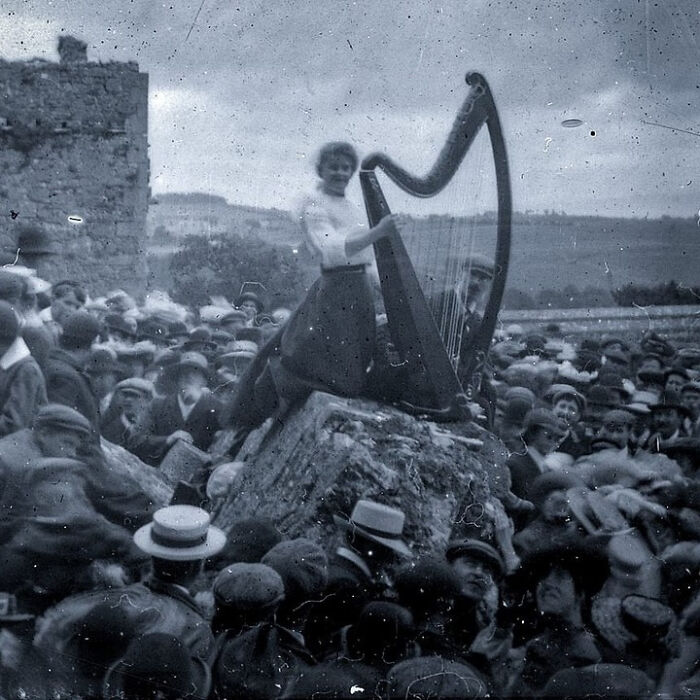 A young woman plays a harp to a large crowd in Ireland; 1910s.
The Harp has long been acknowledged as the national instrument of Ireland. Reference to the harp as the arms of the King of Ireland is found in one of the oldest medieval rolls of arms: The Wijnbergen Roll. This French roll of arms dating from c. 1280 and preserved in The Hague, Netherlands, attributed "D'azure a la harpe d'or" (Blue with a harp of gold) to the King of Ireland.
The harp was adopted as the symbol of the new Kingdom of Ireland, established by Henry VIII, in 1541. A document in the Office of the Ulster King of Arms, from either the late reign of Henry VIII or the early reign his son of Edward VI, states that they were the arms of the kingdom of Ireland. The arms were incorporated into the unified Royal Coats of Arms of England, Ireland and Scotland upon the Union of the Crowns of the three kingdoms in 1603. It is fitting and no surprise that it was therefore adopted as the emblem of the Irish Free State when it separated from the United Kingdom in 1922.
Oh dearie me. So, apparently 'The harp was adopted as the symbol of the new Kingdom of Ireland, established by Henry VIII' and apparently that means 'It is fitting and no surprise that it was therefore adopted as the emblem of the Irish Free State when it separated from the United Kingdom in 1922' 😂 Yeah, sure, that's exactly right... (seriously, I don't have the words, except that... look, really? An English king's decision in the 16th century is why the independent Irish decided on a heraldic emblem in the 20th century? 🙄)
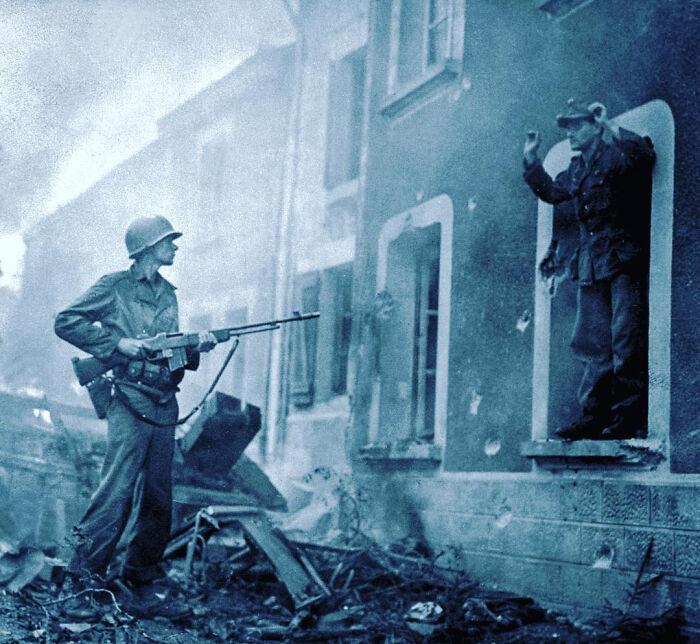 A German soldier keeps his hands raised whilst surrendering to an American carrying the intimidating Browning Automatic Rifle (BAR). This weapon saw extensive use in World War Two used within squads to provide a base of fire to the rifleman predominantly carrying the M1 Garand.
What accentuates this already powerful photo is the details such as the bullet impacts in the wall. When compared side by side to the person this clearly puts into perspective just what these men going in to battle faced.
The BAR 1918 was developed as automatic gun plattform for WW1 but saw very limited use as the war ended before it could have been deployed in large numbers
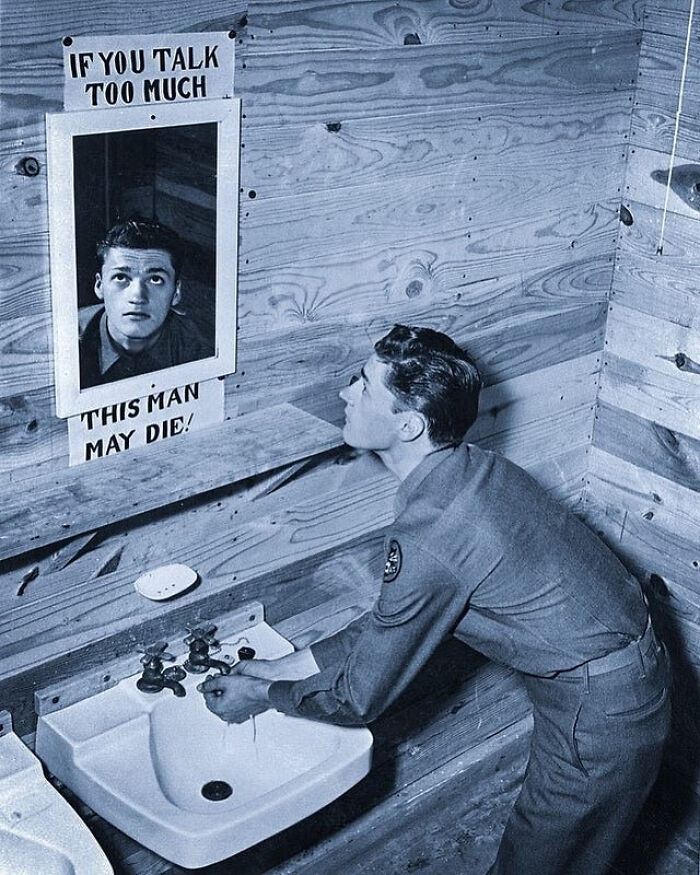 A U.S. soldier looks into the washroom mirror with a sign around it reading "IF YOU TALK TOO MUCH THIS MAN MAY DIE!" to encourage not spreading information which might be sensitive in the War effort during World War II; 1943.
Original caption: "Every man, a poster at Camp Hood. Taking a cue from the Office of War Information (OWI) poster "If you talk too much, this man may die", Private Ivan A. Smith, editor of the Camp Hood Panther, Camp Hood,Texas, originated this novel method of reminding his fellow soldiers to practice discretion. Looking into the mirror at the camp".
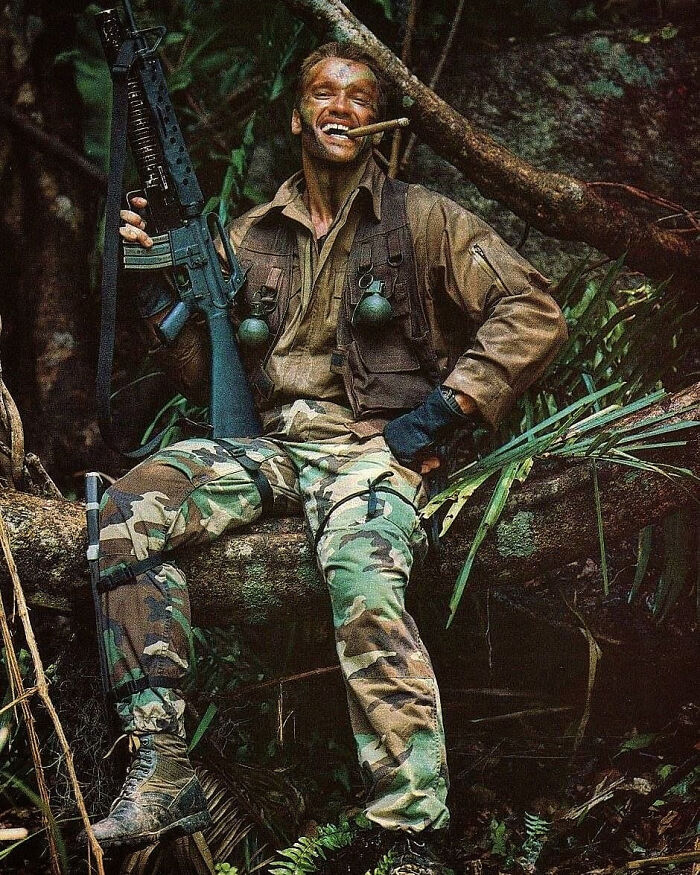 Arnold Schwarzenegger takes a well earned break from hunting a deadly alien in the central American jungle to smoke a cigar on the set of Predator; 1986.
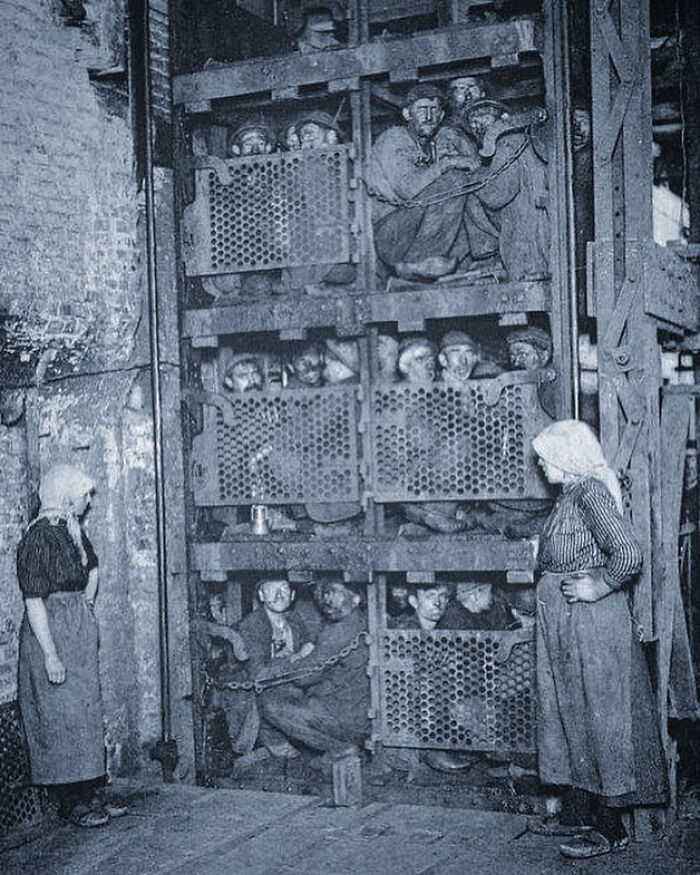 Miners in Belgium on their descent to work; 1900.
There is dispute as to the origins of this photo but many sources suggest these are Italian immigrants at the turn of the century working as cheap labour in hellish, cramped conditions underneath the earth.
If anyone is claustrophobic, this is surely the stuff of nightmares..
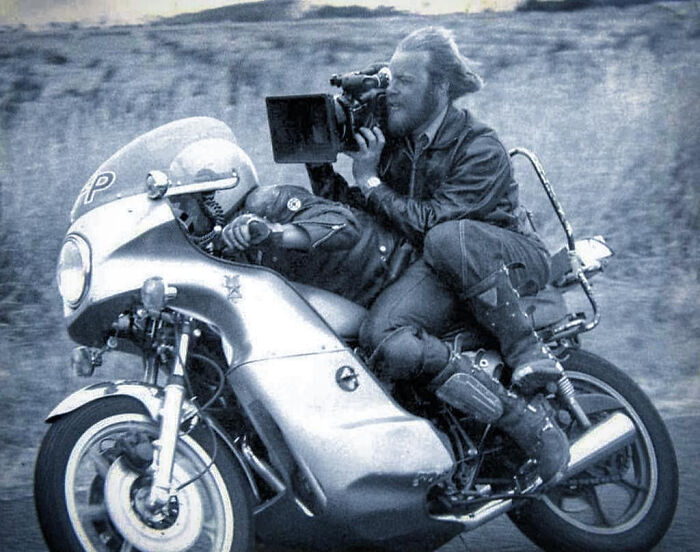 Mad Max cinematographer David Eggby sits on the backseat of a motorbike carrying a camera on his shoulder to get the amazing shot; 1977.
Around here, Mad Max was a helicopter pilot who, in 1986, was airborne and got film of a tornado as it swirled across the landscape in a northern suburb of the Twin Cities in Minnesota. His film gave meteorologists invaluable new insights into the life of a tornado. We saw the tornado from our backyard.
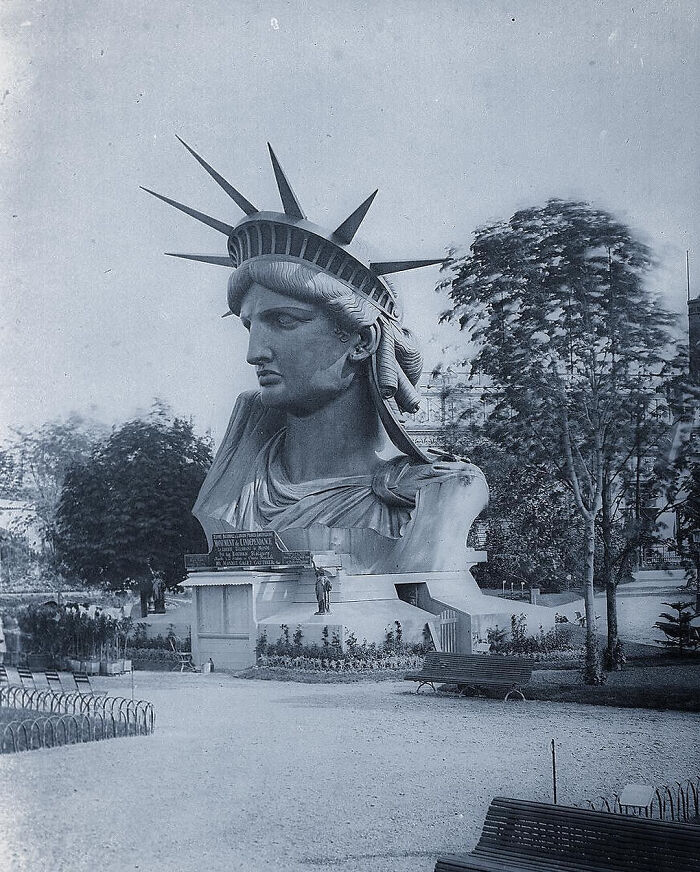 The head of Lady Liberty proudly displayed as an exhibit at the World Fair in Paris; 1878.
After this exhibit fundraising continued to fund the rest of the project which was tremendously successful. Structural engineer Gustav Eiffel (of which the world was yet to see his most famous creation) was brought in to assist with this huge project.
On the 23rd October 1886, after delivery of the statue, it she was dedicated to the people of the United States by the French, officially unveiling it in the famous spot at New York harbour.
The original place for her was thought to be the northern end of the Suez-Channel, but the project was cut due to already exploding costs. When looking for a gift for the USA they got back to the artist and after a little redesign was used for that instead
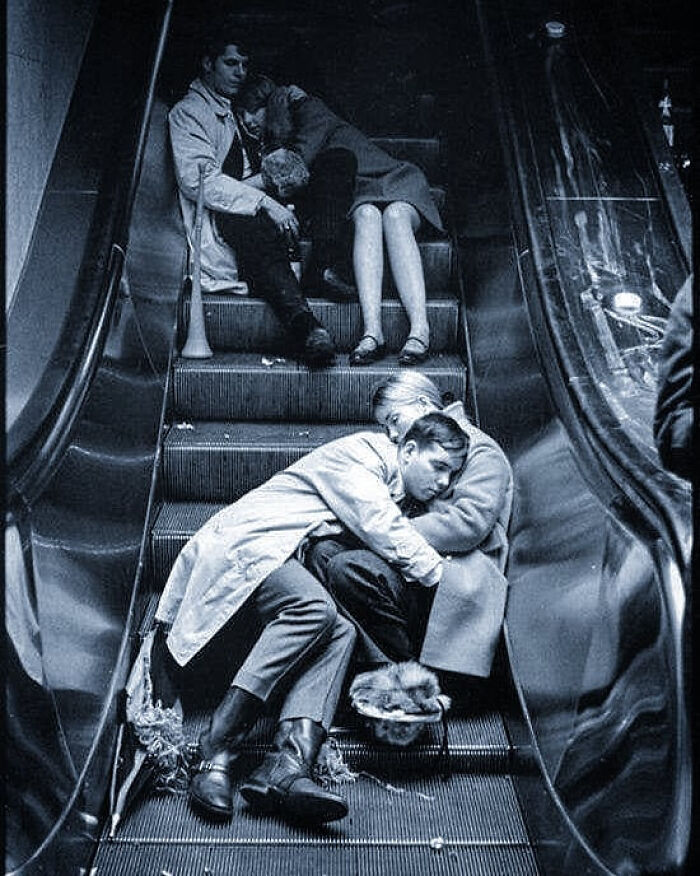 Party-goers rest on the escalator in Grand Central Station, New York following New Years celebrations; 1969.
Photo by Leonard Freed.
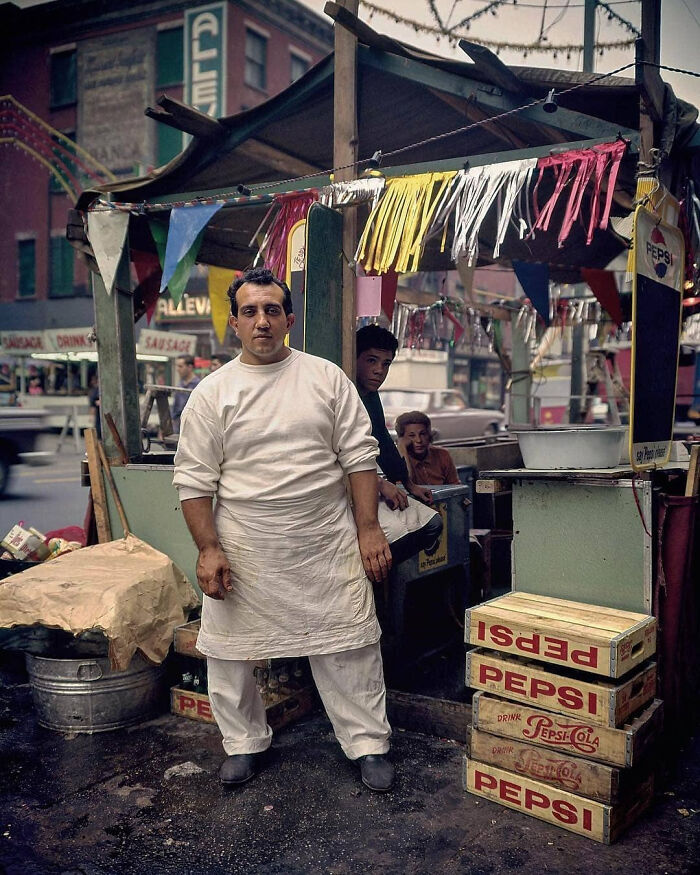 Selling hot dogs and drinking Pepsi, NYC; 1963.
Photo: Evelyn Hofer
OMG! My childhood is now showing up in "historical" photos! 😥
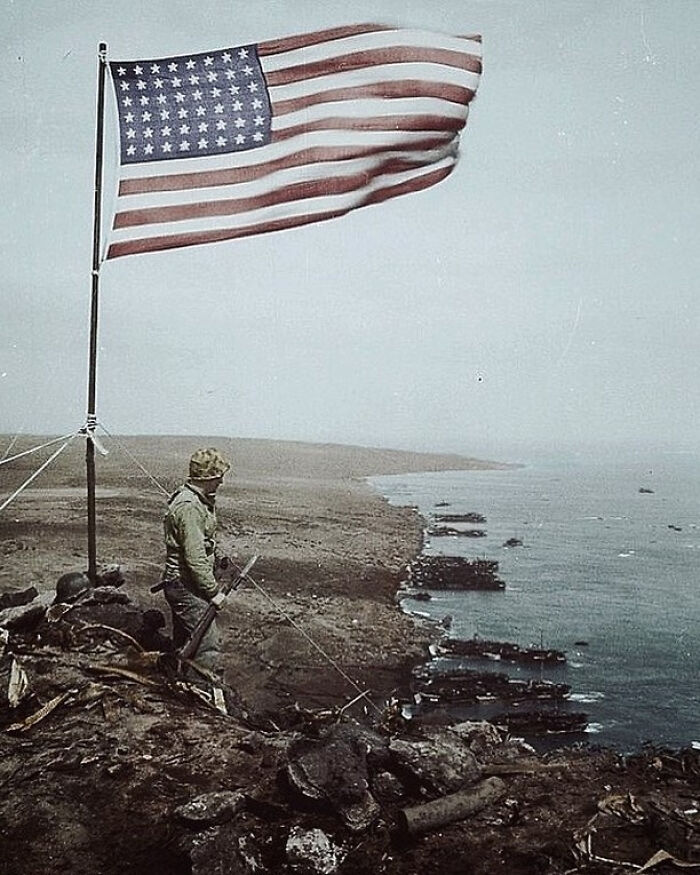 On this day in 1945 the U.S Army and Marines make their amphibious a**ault against the Japanese on the Pacific Island of Iwo Jima.
“Operation Detachment’s” aim was to capture the entire island and the three crucial airfields. This operation was vital in ensuring the U.S had tactical capability to strike the Japanese mainland with their B-29 b*mbers. 23,000 Japanese were dug in to the volcanic rock like a tic with a complex network of tunnels, dugouts and caves making the already fierce defenders a nightmare to evict.
Before the landings the island was heavily b*mbarded from sea, air superiority ensured 7,000 tonnes of explosive was dropped to provide support to the invasion. At 8.30am the US Marines took to the beaches. The volcanic ash made it impossible for effective use of amphibious vehicles turning the beach into a hellish and brutal place to be.
Over the coming weeks those on Iwo Jima experienced some of the most bloody fighting in the whole of the war. U.S soldiers who managed to secure objectives would be subject to huge banzai charges under the cover of night, whilst the Japanese in strongly held positions were flushed out through the use of grenades and flamethrowers in the hot sun.
By the end of the battle on the 26th March most of the Japanese garrison would be k**led with only 216 surrendering along with 6,800 Allies killed in action.
This post massively overstates the importance of these islands, and downplayed the casualties. These airfields were not crucial and not essential for the B52s. That narrative was pushed after the islands were captured because of the massive amount of criticism, including from those high up in the forces, for the cost of taking these islands which had very little value. Over confident, they had not bothered to involve the marines in the planning stage, and were confident the islands would be taken easily and within a week. In reality it took 5 weeks, and as well as the 6800 k****d, over 19000 were wounded, and 44 tanks lost.
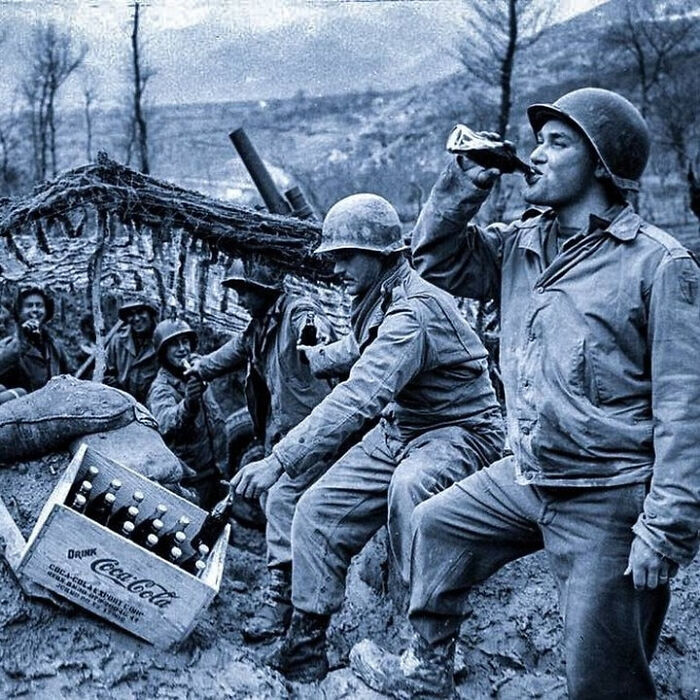 A group of US soldiers enjoy bottles of Coca-Cola during World War 2.
Whilst this photo seems far too well composed to be considered ‘candid’, more than 5 billion bottles of Coke were distributed to soldiers during the war.
“Coke” became the preferred drink of the troops due to a marketing campaign in the States: any American in uniform could buy a Coke for a nickel regardless of its listed price. But there were few sources of the drink for Americans serving in Europe, Africa, and Asia.
Accordingly, General Eisenhower requested 3 million bottles of Coke be shipped to his current location in North Africa, along with the equipment and supplies to refill them as needed so they could maintain a constant supply of Coke. 148 personnel were sent to install and manage the overseas bottling plants. The specialists were given uniforms and a rank of “technical adviser”, often called “Cola Colonels”.
Rations of servicemen also often included M&Ms. These worked well because their hard outer shell prevented the chocolate interior from melting during transport to hot and humid locations in southeast Asia.
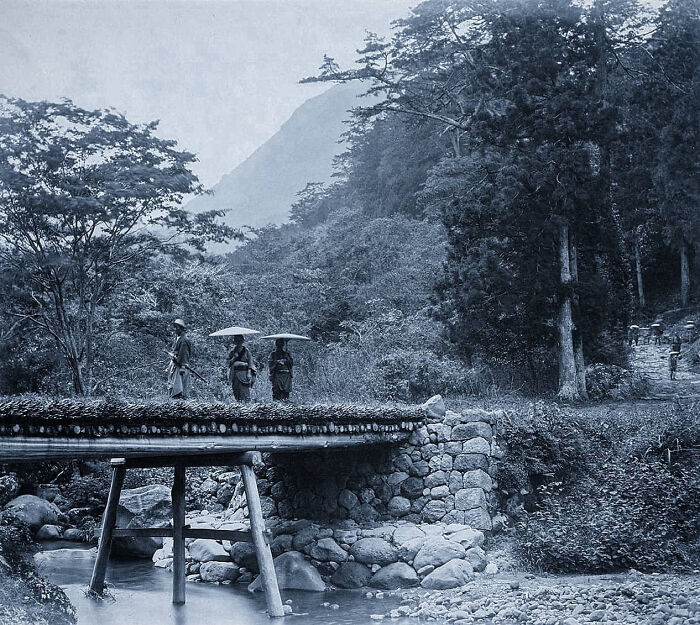 A samurai alongside two other individuals cross a bridge in 1880s Japan. Taken by Italian-British photographer Felice Beato.
A photographer with many stunning photographs showing us the world of the 19th century. He moved to Japan in 1864 at a time where a mostly undisturbed way of life was meeting with full force the modern world. Because of this, unlike any other period photographed, the snapshots captured by Felice transport you into a world full of unique cultural flavour and intrigue.
" A mostly undisturbed way of life was meeting with full force the modern world" - Well it was 4 years before the Meiji Restoration that lead to Japan becomming an industrial nation
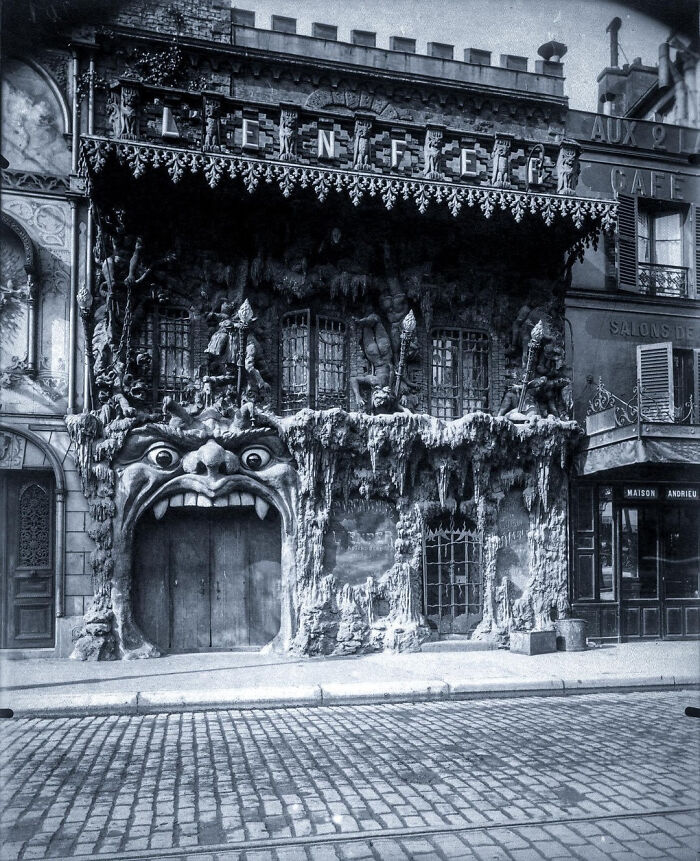 The Cabaret de L’Enfer in Montmartre, Paris; 1892.
The Cabaret de l'Enfer (The Cabaret of Hell) was a famous cabaret in Montmartre, founded in November 1892 by Antonin Alexander.
Once inside, patrons descended into the depths of the Cabaret of Hell, the Cabaret of Heaven, and a few from somewhere in between. All offered inventive cocktails, outlandish entertainment and ambience out of this world.
Published in 1899, Bohemian Paris of To-Day is the memoir covering four years of American art student W.C. Morrow’s life in the Latin Quarter of Paris. In the section titled A Night On Montmartre, Morrow takes his flat mate Bishop and his visiting friend, Mr. Thompkins, out on the town and into the jaws of the Cabaret Of Hell.
“We mounted a Montmartre ‘bus and were pulled up the hill to the Boul’ Clichy, the main artery of that strange Bohemian mountain with its eccentric, fantastic, and morbid attractions. Before us, in the Place Blanche, stood the great Moulin Rouge…a great crowd of lively, chatting, laughing people were pushing their way toward the entrance of this famous dance- hall of Paris.”
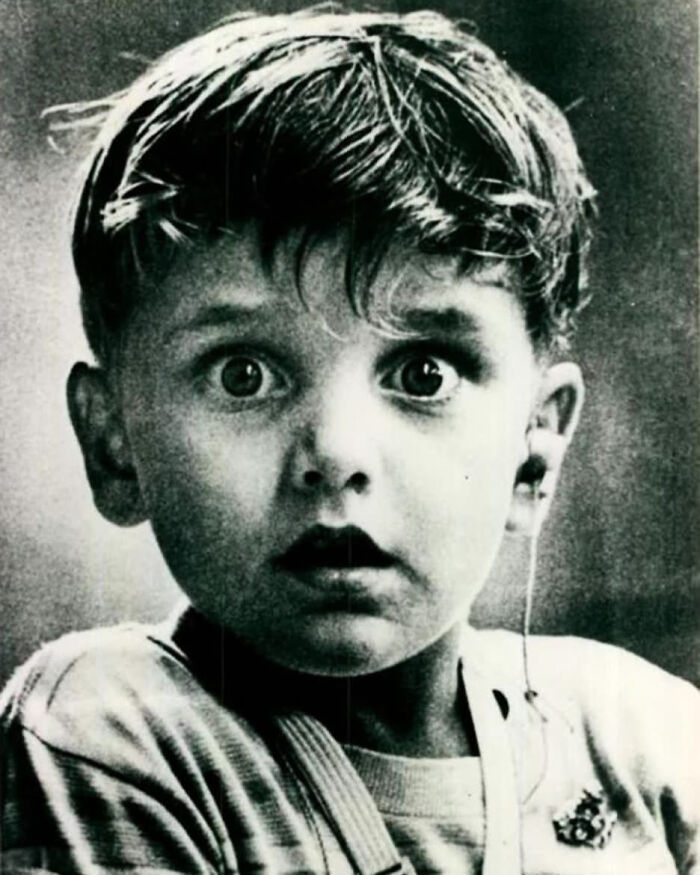 At five years old Harold Whittles hears for the first time - 1974
When looking through history, especially though a single moment caught on camera, it can be easy to fall into the trap of thinking history is a series of major events built around key people. A young boy visiting the doctors in the mid 70’s may not strike us as a key event in world history, but for Harold and it family it was.
From his view of history this one moment may be the most defining moment of all.
The great people and events we are drawn too are but a small part of our own view of the past, the innumerable small events are what make up the vast tapestry of our history.
To a young Harold people playing with magnets and wires in the late 1800’s would seem unimportant to his life. However the ideas that came from those tests, and the never ending tinkering, improvements and refinement, lead to the electronic hearing aid and his great moment in history. Not to mention the millions of others around the world who had their hearing restored.
What can be a small moment from one point of view; can be a paradigm shifting event from another. Only by studying history from as many possible angles as we can will we start to see the far reaching impact of all actions we make.

AI unnecessarily bloviating, diluting the impact of the photo. The first sentence was all that was needed so that the focus is on the photograph itself.
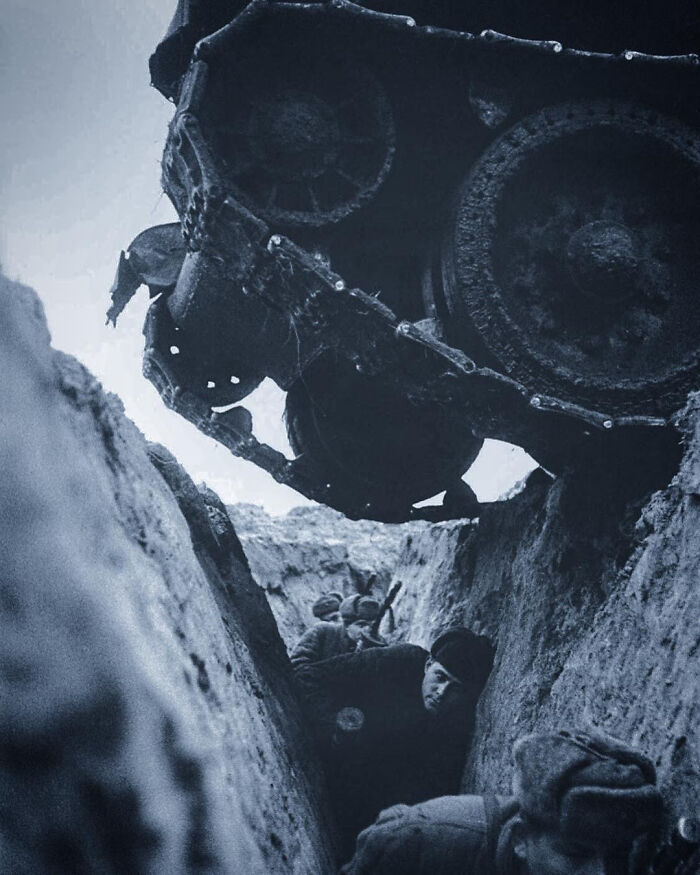 Soviet soldiers of the Red Army brace themselves in a narrow trench as a 26 tonne T-34 tank rumbles over their heads.
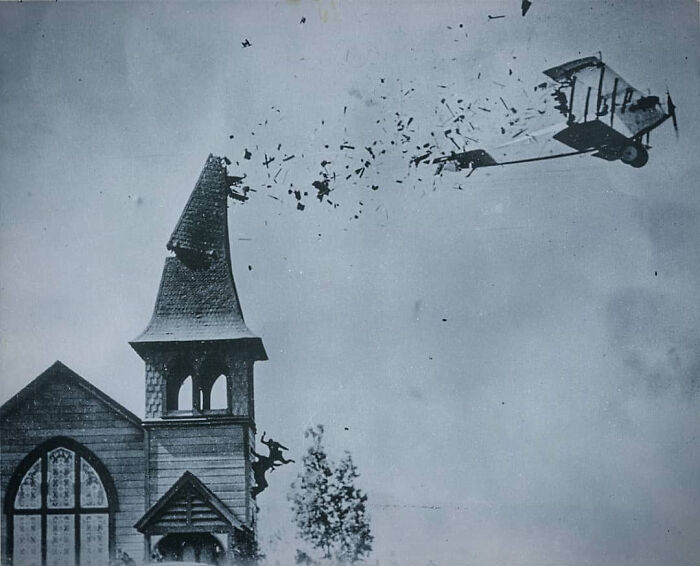 A biplane slices through a churches steeple as two individuals fall down the side of the building; 1920.
This still is actually from an American silent film that has sadly been lost to time as no copies still exist. The "Skywayman" is about a veteran suffering from amnesia whose loved one devises a plan involving Russian thieves in order to get his memory back.
Whilst the two pictured here survive this stunt sadly in a separate act the star Ormer Locklear and his co-pilot Milton Elliott lost their lives during a planned tail spin at night. Shortly after this the film was released attempting to capitalise on the deaths, premiering in Los Angeles.
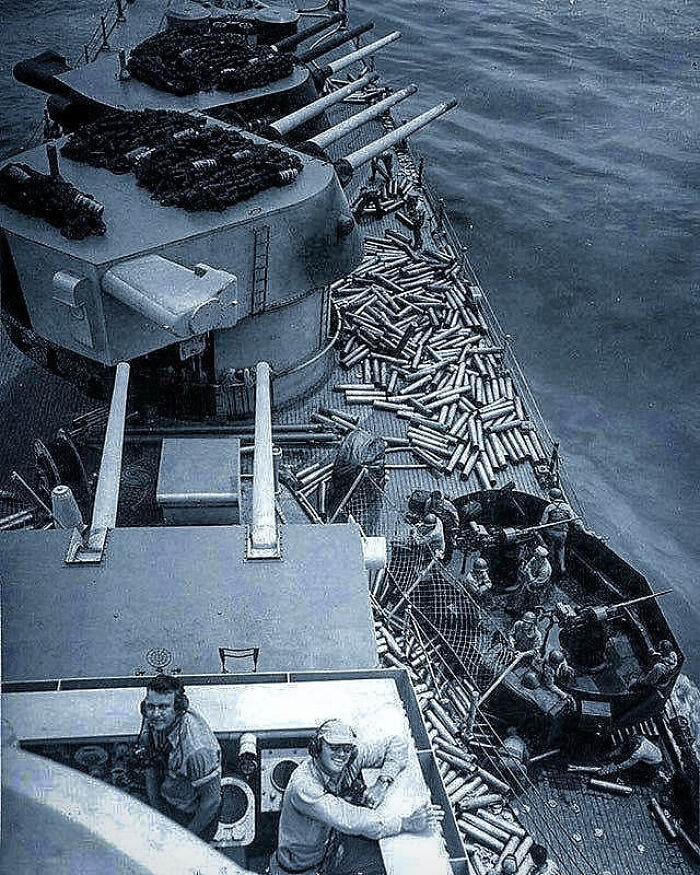 A Cleveland Class Light Cruiser, the USS Miami, following the aftermath of a naval bombardment offshore from the Palau Islands; September 1944.
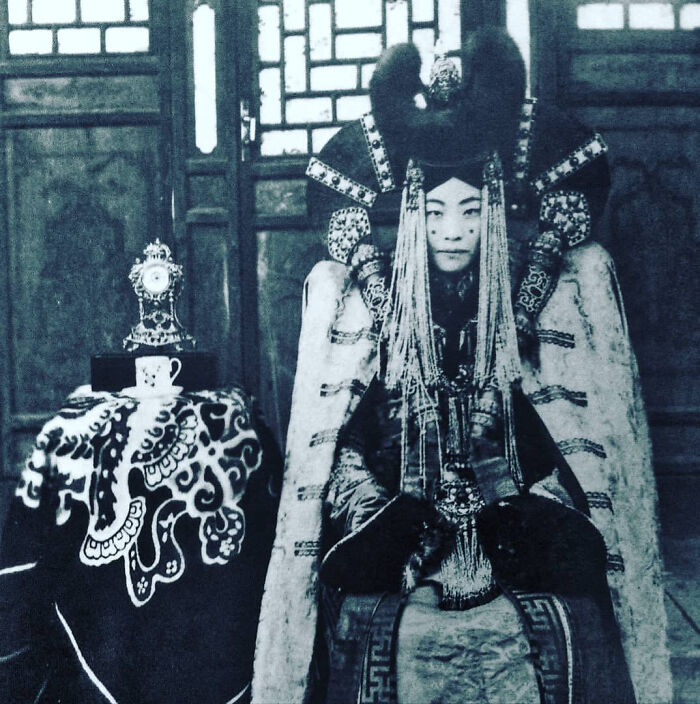 Queen Genepil. The last Queen of Mongolia [1920].
This incredibly detailed photos captures the stunning details of the secen.
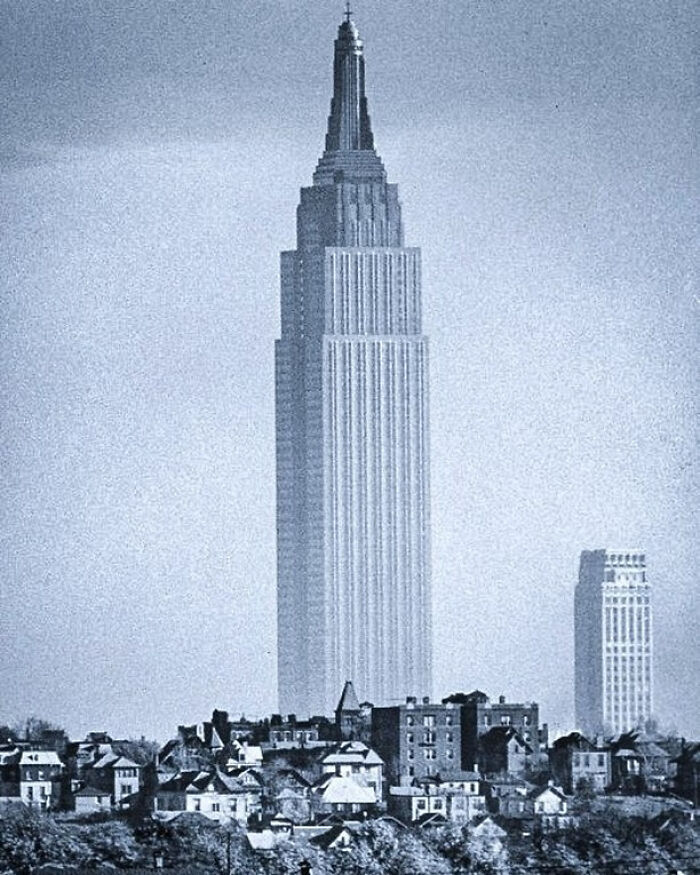 The Empire State Building towers imposingly over the New York City skyline; 1941.
Despite looking all alone, the building profits from good use of forced perspective to show no other coming close. In actual fact the city’s skyline by 1941 did have a large number of towering buildings. However, The Empire State Building was of course far and above the tallest building at the time; the photo here shows this architectural, engineering feat off fittingly.
Photo by Andreas Feininger
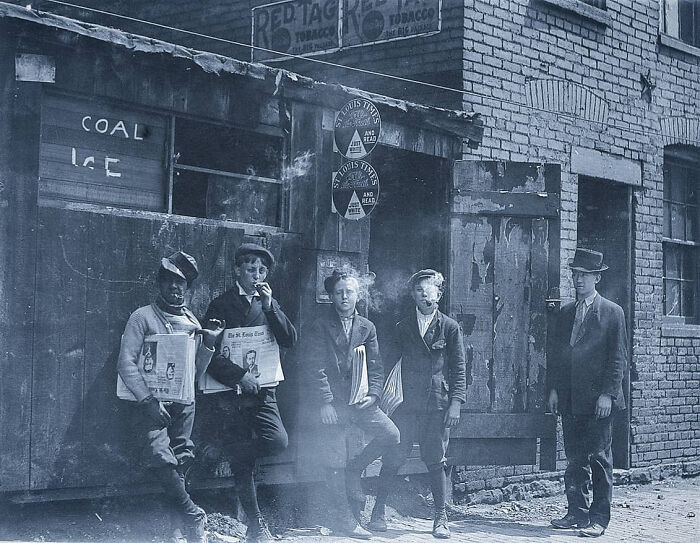 A group of newspaper boys stand outside a shop for a smoke break in St. Louis, Missouri; 1910s.
Remember, folks, this is the America that Republicans want to bring back; child labor and no health protections. At least by 1910 these newsboys were probably unionized.
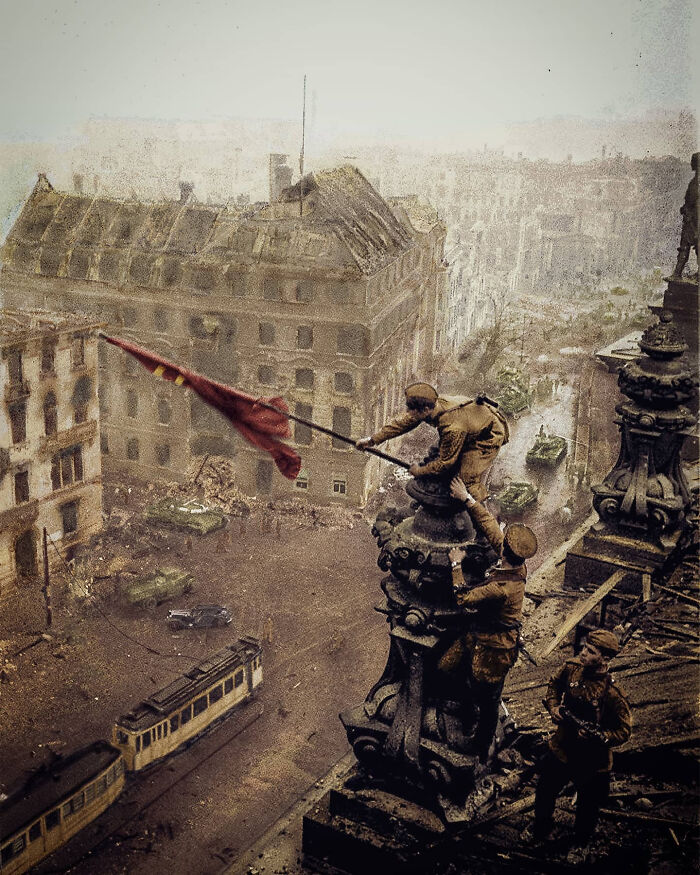 75 years ago today, years of continent-wide devastation in Europe, costing tens of millions of lives ended when Allied forces accepted the unconditional surrender of Nazi Germany.
Whilst not the end of World War Two, the significance of VE Day clearly cannot be understated. 12 years after Hitler's rise to power, his vision of a 1,000 year Reich came to a close through the sacrifice of those who paid the ultimate price. There is much to be celebrated about the victory of freedom and liberty, and rightly so. But the victory is one that is tainted by the reality of what came to pass across the world.
VE Day reminds us that the evils of humanity can bring us to our knees when provided the opportunity. It also reminds us however, that when those brave enough to stand up do so, those same evils can be overcome.
It's rare to see the original of this photo. It was later edited to not show that one of the soldiers is wearing 2 watches (probably from looting one).
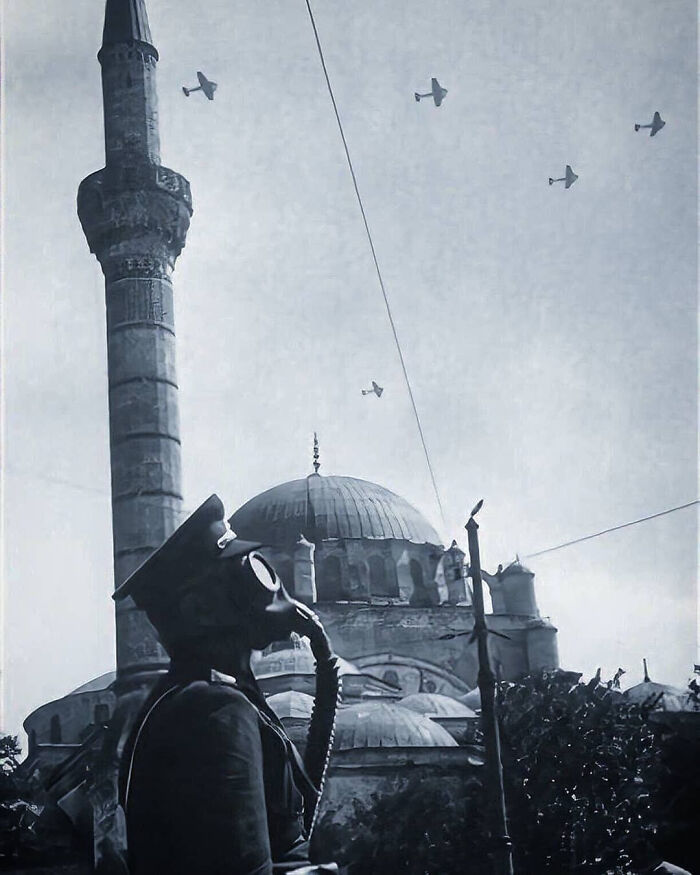 A Turkish soldier observes an aircraft drill flying overhead; 1939.

In the background is Bayezid II Mosque (Beyazıt Camii) located in İstanbul's Beyazıt Square, not Ayasofya (Hagia Sophia). Ayasofya Mosque has four minarets.
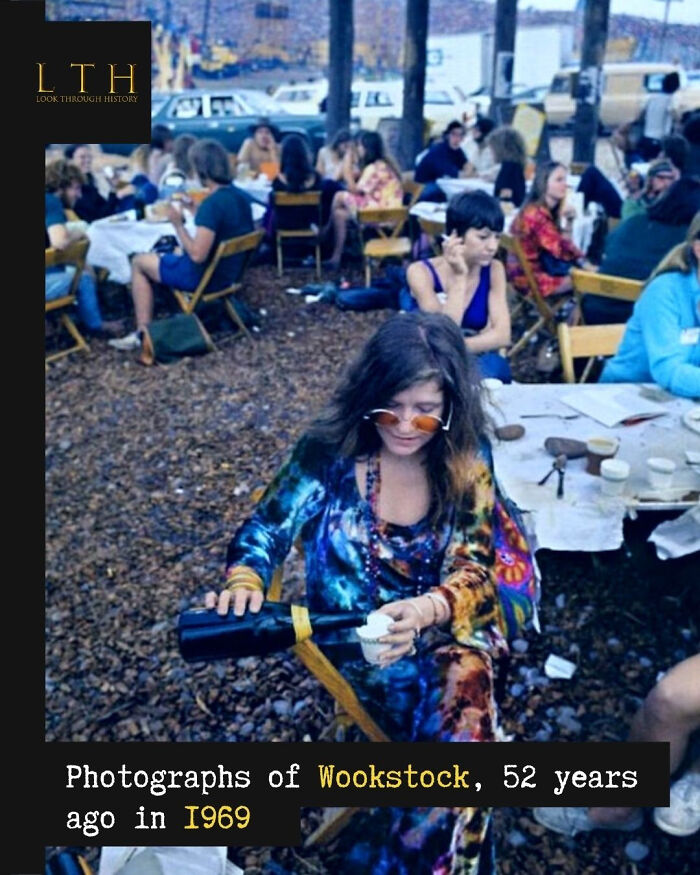 Photographs of Woodstock, 52 years ago in 1969.
Woodstock was a music festival held August 15–18, 1969, on Max Yasgur's dairy farm in Bethel, New York, 40 miles (65 km) southwest of the town of Woodstock. Billed as "an Aquarian Exposition: 3 Days of Peace & Music" and alternatively referred to as the Woodstock Rock Festival, it attracted an audience of more than 400,000.
In 2004, Rolling Stone magazine listed it as number 19 of the 50 Moments That Changed the History of Rock and Roll.
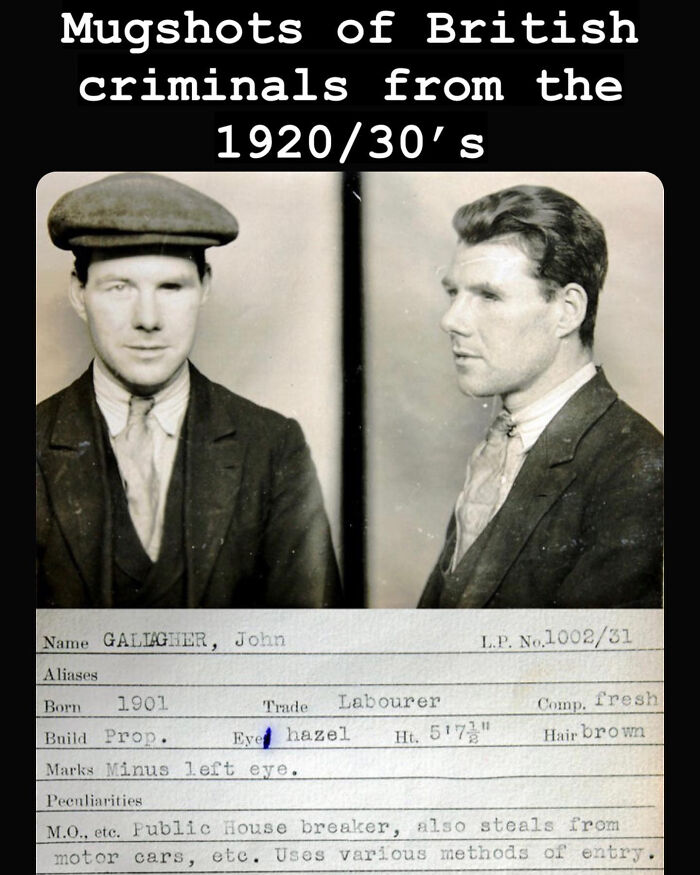 A collection of mugshots of British criminals from the 1920s and 30s from the Tyne and Wear Archives.
So much fascinating details and categories filled out on these including the ‘marks’ and ‘peculiarities’ sections.
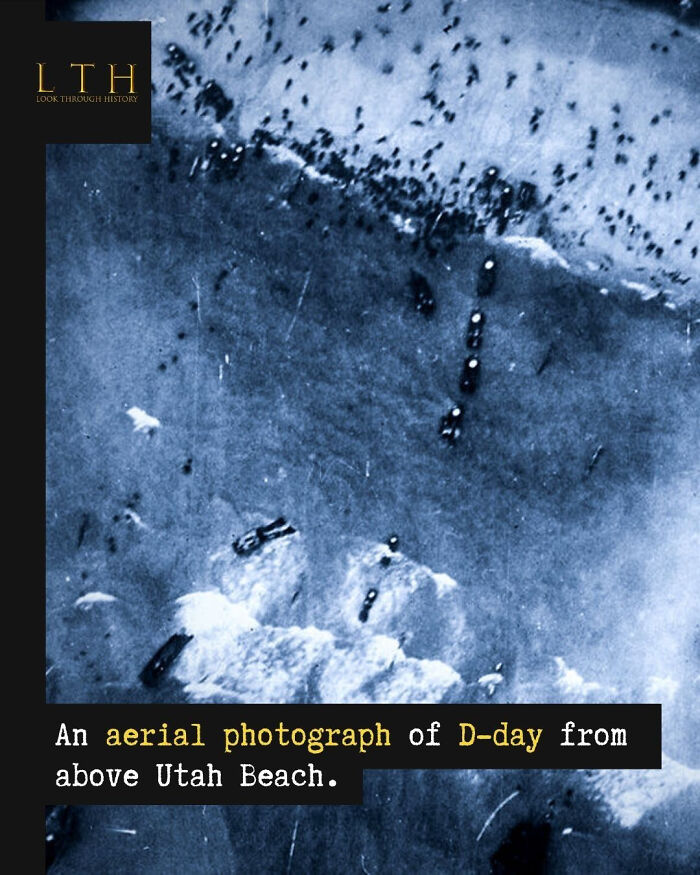 Aerial view of the Normandy Invasion taking place below on Utah Beach; June 6th, 1944.
Utah Beach was westernmost beach of the five landing areas of the Normandy Invasion of World War II. Taking the beach fel to the U.S. 4th Infantry Division, with the plan being to cross the beach and seize control of the coast roads, link up with airborne troops who were to have been dropped inland five hours earlier, and then be prepared to attack toward Cherbourg.
Recalling the invasion, Harry Bailey of Company E, 8th Infantry Regiment remembered jumping off the ramp of his landing craft into waist-deep water. He recalled that a man in his platoon “was the first to reach the sand dunes, and I ran and dropped down beside him…. He was immediately k**led with a hit to the head by a sniper’s bullet. I knew I had to move fast or I would be next.”
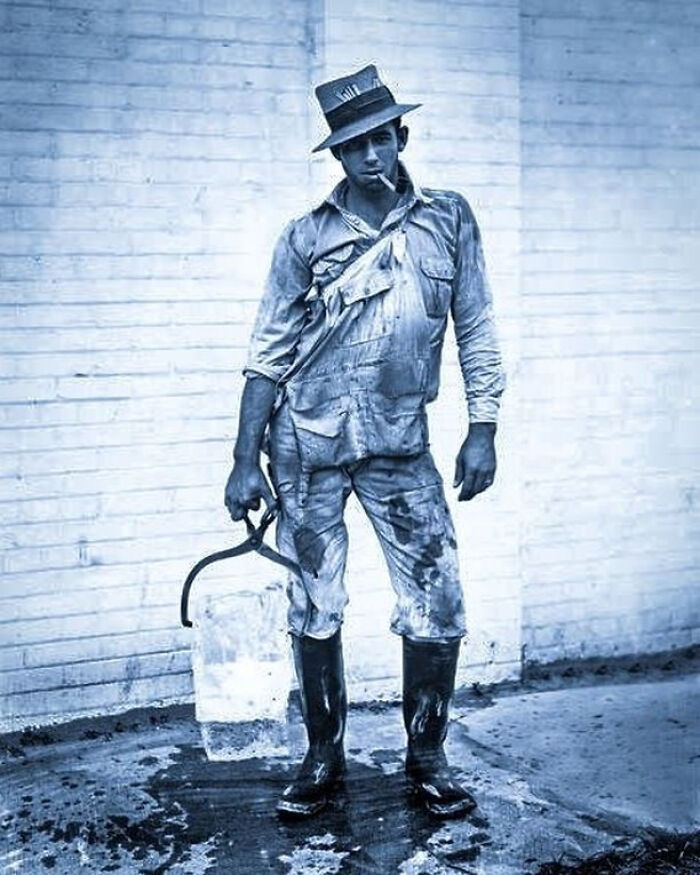 Ice delivery man in Houston, Texas; 1920.
From the late 19th century to mid-20th century, in cities and towns icemen would commonly make daily rounds delivering ice for iceboxes before the electric domestic refrigerator became commonplace.
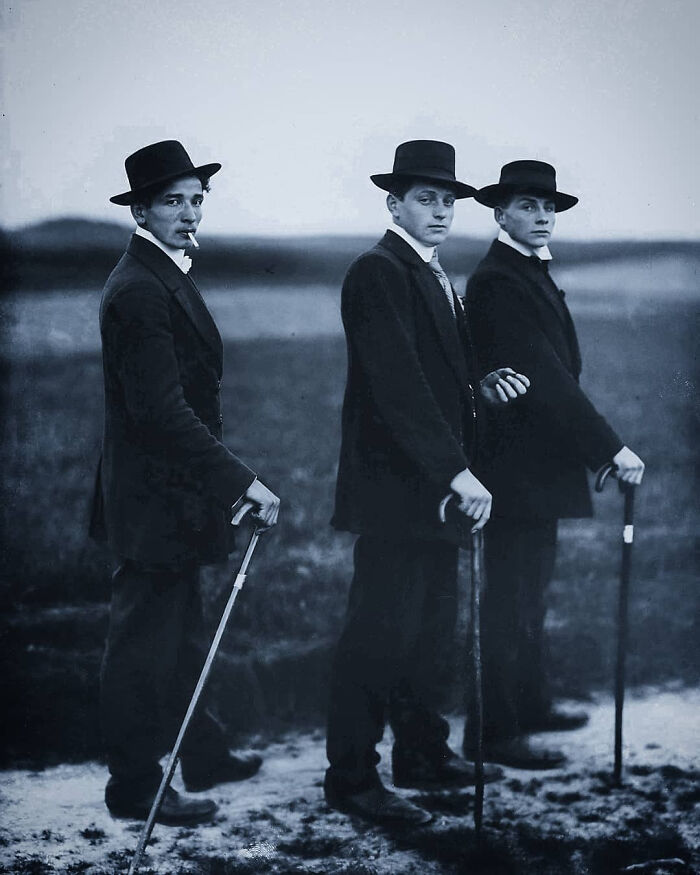 Three young farmers on their way to a dance, a photo by German photographer August Sander; 1914.
It is an incredibly striking image in its own right with the contrast between the smart suits and rural open landscape. However, it is made even more powerful through our knowledge of the past. That whilst dressed up to be amongst the company of friends on this day, fast approaching on the horizon the most deadly conflict the world had ever faced would be at their door with World War 1.
In March of the following year the man in the middle, also named August, would be k**led serving in the German Army.
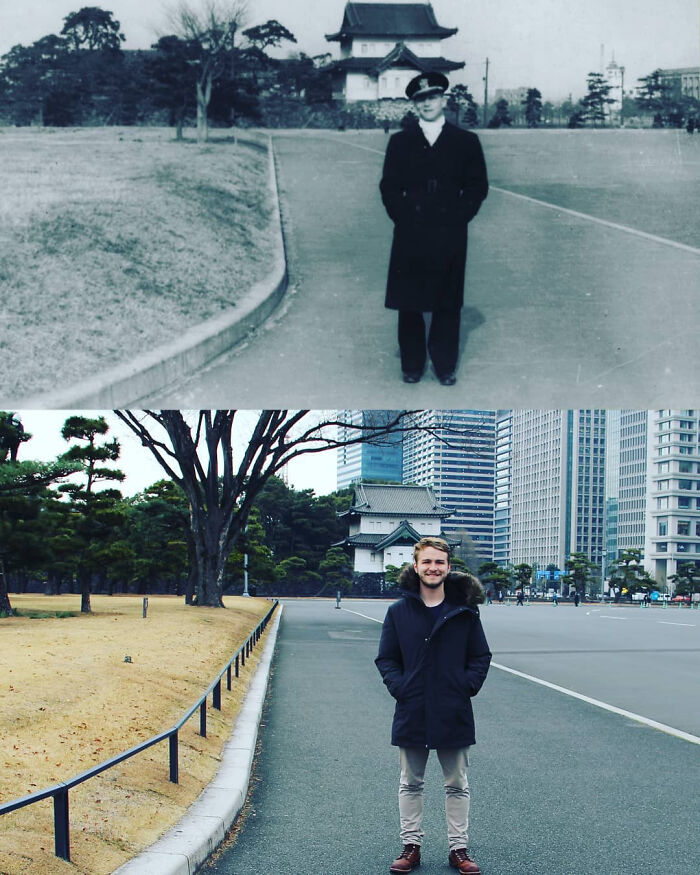 A clear link to the past.
This amazing photo comes courtesy of @agentcodybine posted on Reddit (u/Dauntless1)
‘Both taken at the Imperial Palace in Tokyo. My grandfather was a naval dentist surgeon and called himself ‘The Flying Dentist’ because he was possibly the only naval dentist to also be trained as a paratrooper. After the war he was a part of the occupation of Tokyo. I believe the photo was taken in 1946 or 47’
The photo here not only remind us of our clear and direct link to the history all around us but also serves to highlight the post war miracle of Japan.
At the end of WW2 Japan found it’s self crippled; her vast empire lost, home islands under occupation by the Americans and her major cities devastated by nuclear strikes and relentless napalm b*mbing.
Aware of how the harsh punishment of Germany after WW1 helped lead to WW2 General MacArthur took on the role of rebuilding the country after its unconditional surrender in 1945. MacArthur’s first acts were swift and decisive, he demilitarised the entire nation, imported $92m ($1,317,000,000 in 2020 dollars) worth of food and shielded the emperor and his family from the upcoming trials.
The last of these actions is still seen as incredibly controversial, as all members of the imperial family were kept out of the war crime trials and all responsibility fell on to the prime minister Hediki Tojo. The reasoning for this was that the Emperor and Imperial family still held such importance to the people of Japan that any recriminations against them would cause mass unrest.
With the situation stabilised the occupying American forces enforced strict rules up until the hand over in 1952 back to the Japanese civilian government. There was widespread censorship, the rising sun flag and state religion of Shinto was banned, and many political prisoners were selectively released to sway Japanese politics to a more western style. Another controversial act was the forced purchase of 1/3 of Japans farmland that was then sold on incredibly cheaply to the tenant farmers. One of many acts to break the old monopolies in Japan.
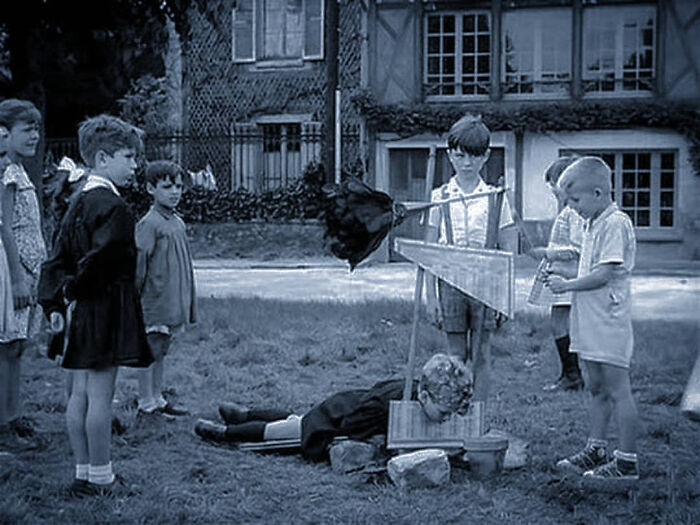 Children play with a makeshift guillotine in the French 1951 film La Poison, showing what could happen to the main character trial for k**ling his wife.
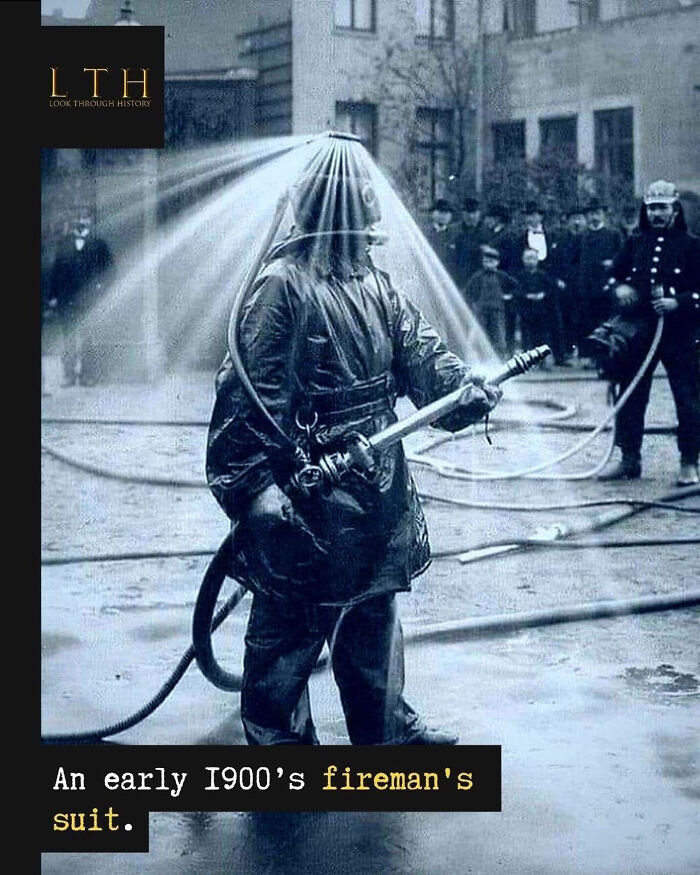 A photo showing an early 1900’s fireman's suit with a sprinkler-like system on the helmet to allow them to get closer to the fire.
The photo shows, alongside the news clipping in the second slide, a “modern German firefighter arrayed in his new individual sprinkler system which is operated off a connection attached to the hose nozzle”.
“Its a far cry from the old bucket brigade to modern fire-fighting efficiency. Even now the American fireman is known as a “smoke-eater”, but that term would hardly fit the present day fire laddie in Germany, for with the new portable sprinkler system adopted by some of the larger cities of that country a fireman may approach quite close to the flames without being singed.
The outfit, which looks like a deep sea diver’s uniform is equipped with a sprinkler helmet which operates off a connection attached to the nozzle of the hose. The fireman can control the spray by a single movement of the hand lever”.
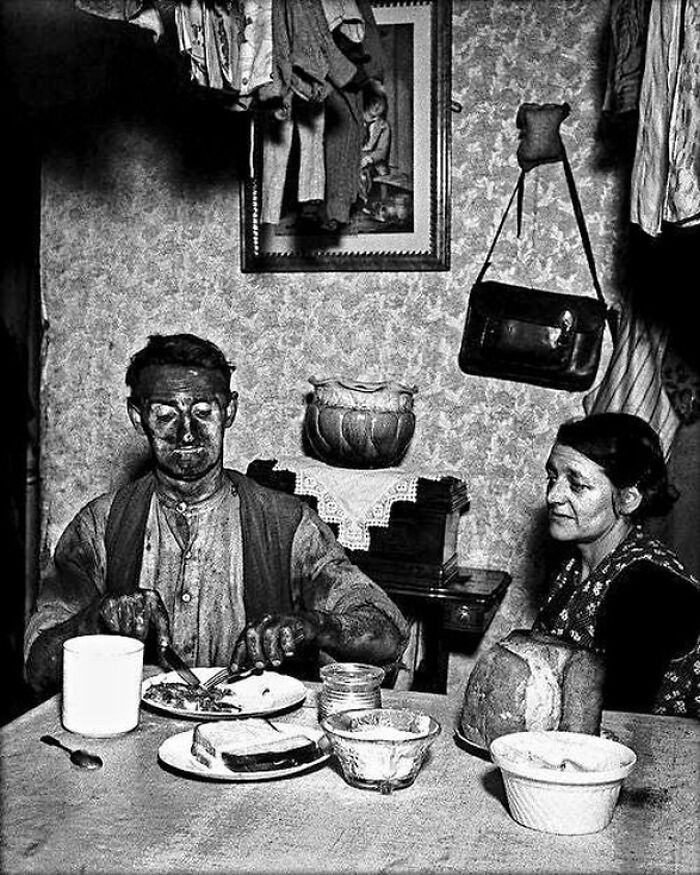 A hard days work.
This shot captures a Northumbrian coal miner tucking into his dinner alongside his wife still covered in the grit and grime of his days labours. [1937]
The north of England and Scotland saw the birth of the industrial revolution, a revolution powered by the abundant coal in the area. As factories, transport and ships moved to coal power the demand the mineral became insatiable and was supplied buy hundreds of thousands of men, women and children working in unimaginably poor conditions.
As the world has developed and learnt of the issues with mass consumption of carbon fossil fuels the industrial heartland of Britain has moved on, but across the area the signs of the coal fuelled past can still be seen pock marking the landscape with old chimney and mine workings and a reminder of time when the world was run on hard won coal.
This is a completely staged scene, no miner would sit down to eat until he'd either washed his hands and face, or had a bath. The photographer, Bill Brandt, was known to set scenes for dramatic effect, especially when portraying "extremely poor" people.
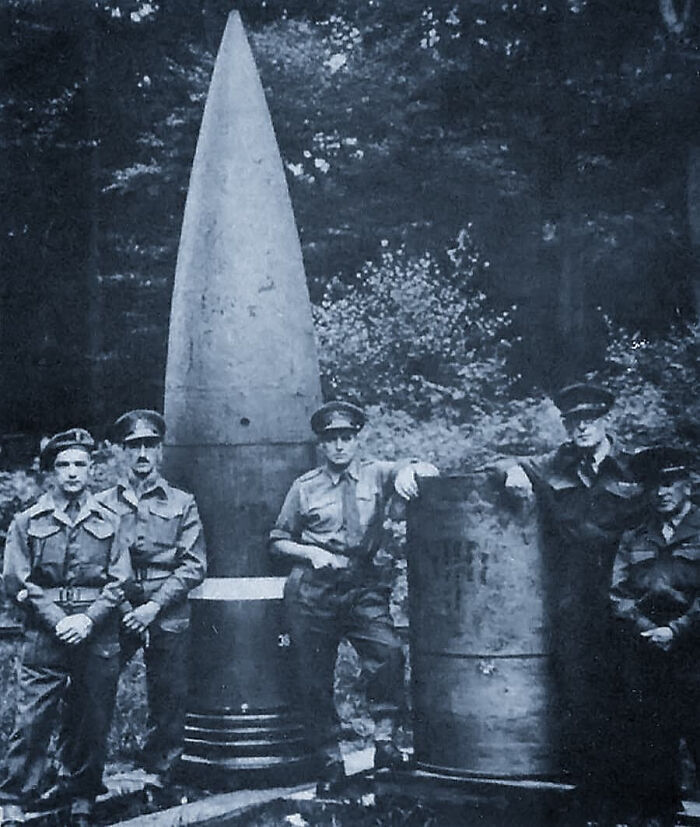 Allied soldiers pose next to and provide good comparison for the incredibly sized shells of the German Schwerer Gustav. The world's largest g*n at the time was capable of firing these 7 tonne shells roughly 24 miles with an air time of 2 minutes.
Due to their size and the time taken to load only about 15 could be fired each day. Originally built to smash the string French defences of the Maginot Line the Gustav g*n saw it's most effective use on the Eastern Front during the siege of Sevastopol.
On 5 June 1942, the Schwerer Gustav fired its first round at Sevastopol, and 13 additional shots followed that day. On 6 June, the Schwerer Gustav achieved the highpoint of its career. An ammunition magazine at White Cliff suffered a direct hit from the Schwerer Gustav. The magazine was buried 98 ft (30 m) under Severnaya Bay and had 33 ft (10 m) of concrete protection. The AP round passed though the water, ground, and concrete before detonating the magazine. At least one ship was also sunk after being damaged by blast waves from the impact of nearby shells.
The Allied soldier second from the left has an unfortunate moustache.
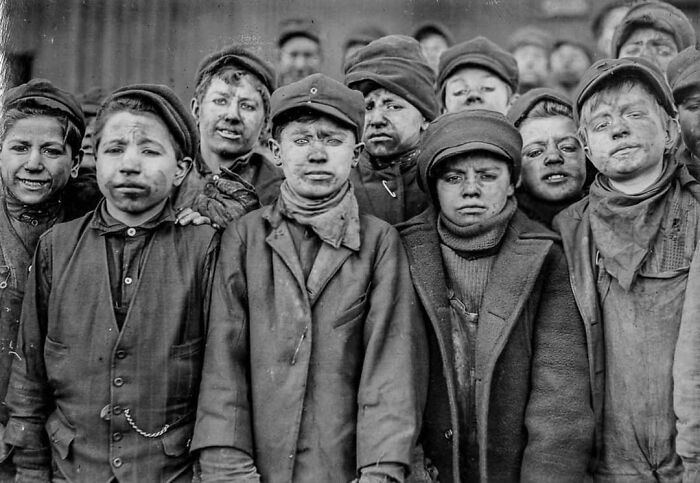 The Breaker Boys [1911]
Young children, know as breaker boys, were employed to work down mines. Their small size led to them often working the smallest and most dangerous seams. Many thousands died deep underground loosing their whole futures of opportunity.
Since the turn of the 18th century much of the world has worked hard to stamp out the practice of child miners, but sadly there are many still working today across the world.
Photos like this reminds us of how much we have improved the lives of children, and how much further we have to go.
The caption's utter nonsense. Breaker Boys worked above ground, sorting the coal from the useless rocks brought up from the mine below. Link follows.
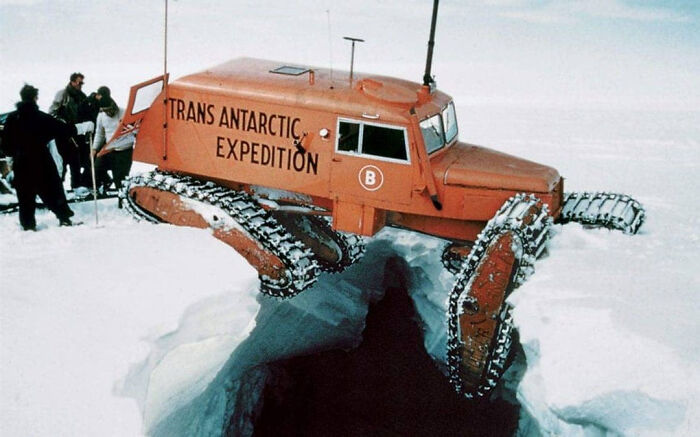 Easy does it!
This jaw dropping shot was taken on the 1954 Transantarctic expedition and shows one of the teams Trucker Sno-Cat's hovering over an open crevasse.
The Commonwealth Trans-Antarctic Expedition (CTAE) of 1955–1958 was a Commonwealth-sponsored expedition that successfully completed the first overland crossing of Antarctica, via the South Pole. It was the first expedition to reach the South Pole overland for 46 years, preceded only by Amundsen's expedition and Scott's expedition in 1911 and 1912.
In keeping with the tradition of polar expeditions of the Heroic Age of Antarctic Exploration, the CTAE was a private venture, though it was supported by the governments of the United Kingdom, New Zealand, United States, Australia and South Africa, as well as many corporate and individual donations, under the patronage of Queen Elizabeth II.
It was headed by British explorer Vivian Fuchs, with New Zealander Sir Edmund Hillary (of Mt Everest fame) leading the New Zealand Ross Sea Support team. The New Zealand party included scientists participating in International Geophysical Year research while the British team were separately based at Halley Bay.
Fuchs was knighted for his accomplishment. The second overland crossing of the continent did not occur until 1981, during the Transglobe Expedition led by Ranulph Fiennes.
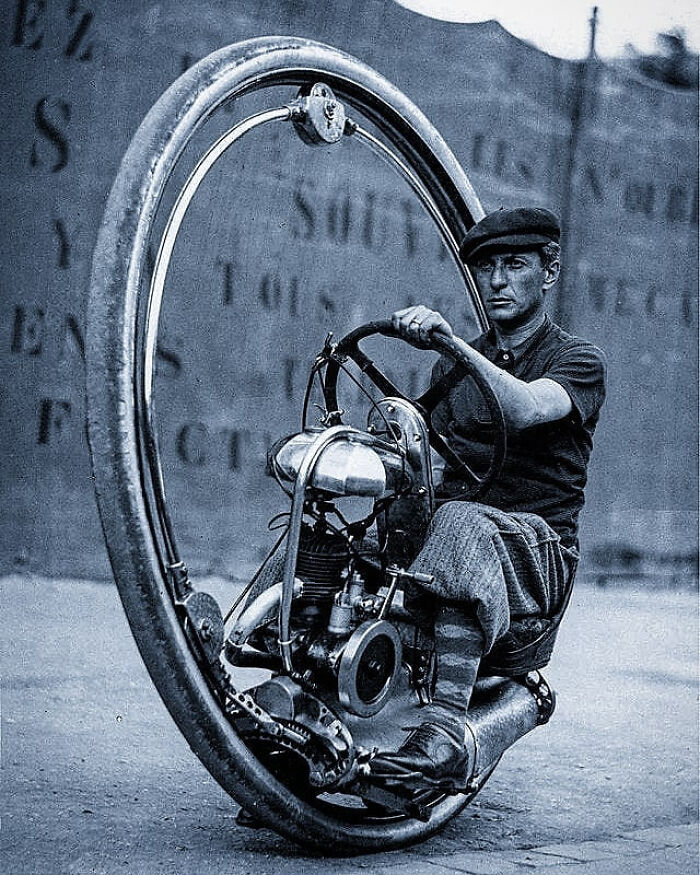 Itallian inventor Davide Chislagi tests his engine powered "monowheel" in France; 1933.
The monowheel became a trend between world wars, with an influx of technological possibility.
There were a number produced but whilst looking impressive it is also clear that the driver is not afforded much safety.
The world record for a monowheel was reached in 2016 by Kevin Scott of Lincoln, UK reaching a speed of 61mph (98kph).
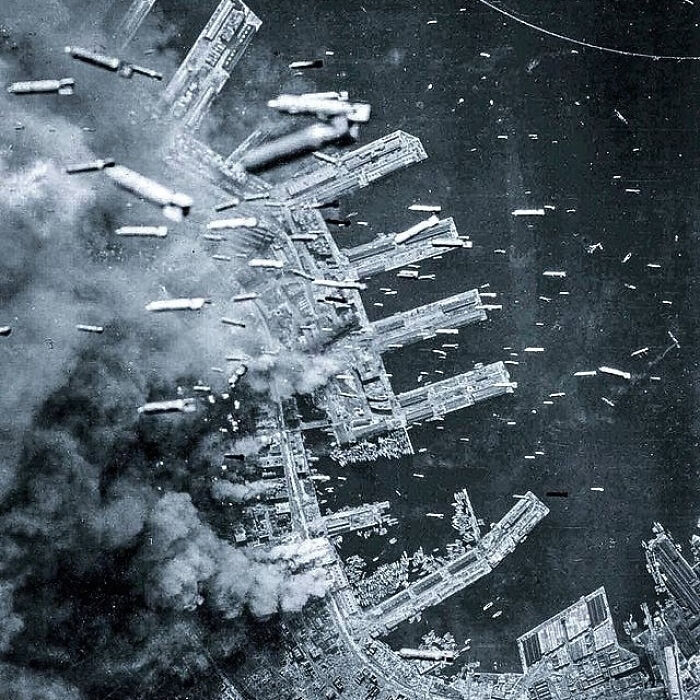 Incendiary b*mbs descend in a hail of fire and fury onto the city of Kobe, Japan from B-29 Superfortress bombers; 1945.
This mission formed part of the strategic b*mbing campaign waged by the United States against military and civilian targets during the Japan home islands campaign in the closing stages of World War II. The sixth-largest city in Japan at the time, with a population of roughly 1 million it would be b*mbed once more a month later. The houses were mostly built with wood making them highly flammable. As Japan's largest port, home to the largest concentration of shipbuilding and industry, and an important city for transportation Kobe was a high priority target. Its low water supply and poor firefighting equipment created quite literally a tinderbox for city wide destruction.
Of the city's residents, 8,841 were confirmed to have been killed in the resulting firestorms, destroying 21% of Kobe's urban area. More than 650,000 people had their homes destroyed.
During the raid, 280 Japanese fighters were spotted, 96 of which engaged the B-29 b*mbers in 128 attacks; this constituted a higher proportion of fighters sighted to those attacking than previously experienced during a night raid over Japan. Three b*mbers were lost during the raid. Two of the airmen in the downed aircraft, Sergeant Algy S. Augunus and Second Lieutenant Robert E. Copeland, survived and were captured by the Japanese.
They were subsequently tried by a hastily convened court for the "indiscriminate b*mbing" of Kobe and Osaka, sentenced to death, and executed by firing squad.
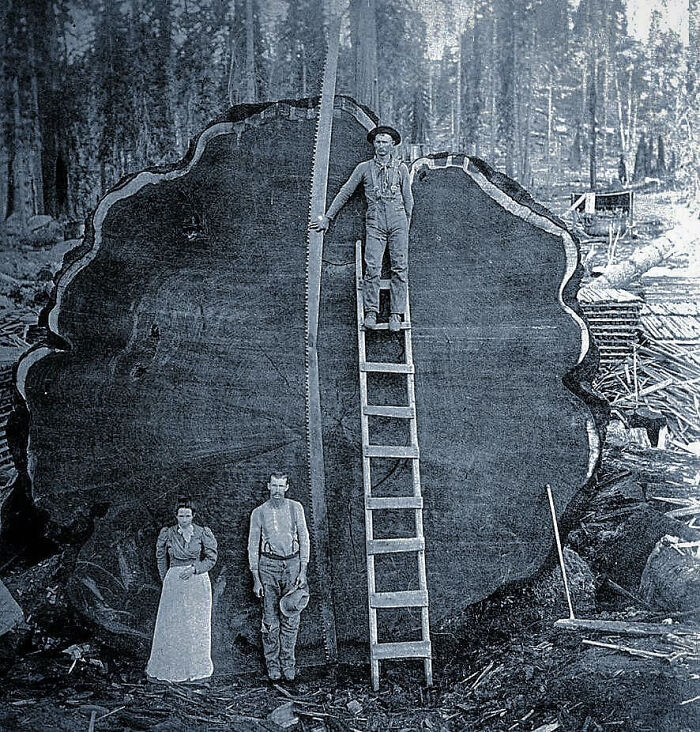 Three people pose in front of a recently felled Sequoia tree named "Mark Twain" in what is now Sequoia National Park; 1892.
These trees that are one of 3 species that are Redwood trees are some of the oldest living organisms in the world, with the one pictured here belived to be 1341 years old. The reminence of Mark Twain can still be visited on Big Stump Trail and whilst incredible to behold it raises an ever pressing question regarding conservation and pur environment. A once great being can all to easily be reduced to preservation in photos and museums rather than in their natural habitat.
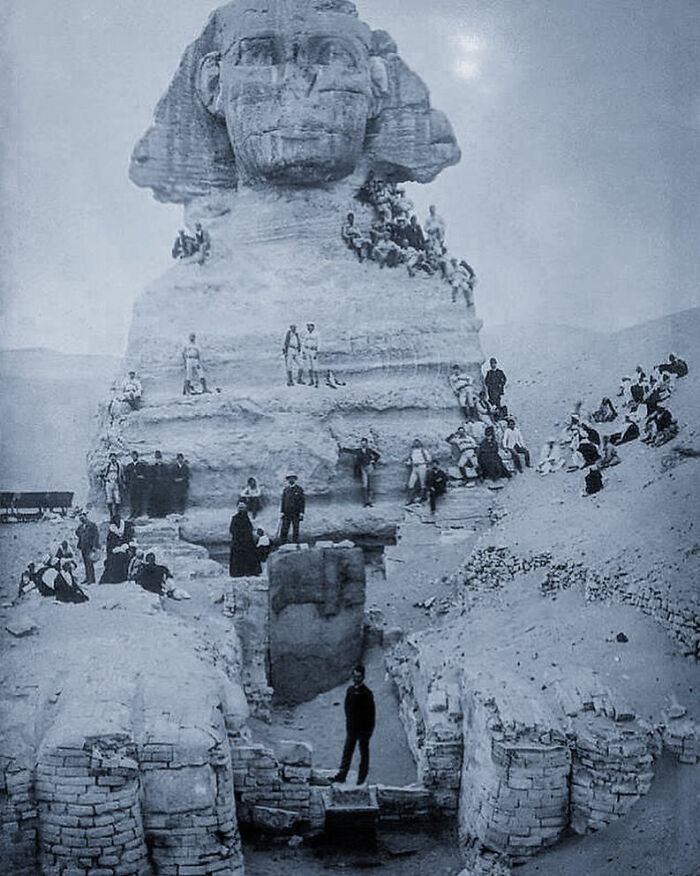 The Chicago White Stockings baseball team take a photo with the Sphinx before their world tour match in Giza; 1889.
The White Stockings were the first professional baseball team in Chicago after they began paying some of their players in the upcoming season of 1869. This team was the predecessor to both the Chicago Cubs and the White Sox.
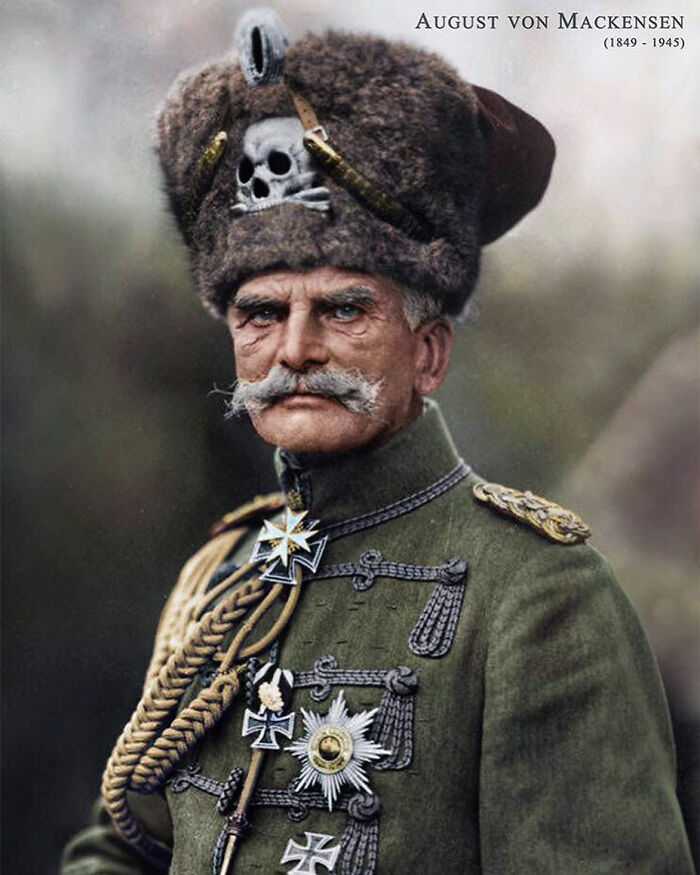 As a general rule I don’t share colourised photographs that I didn’t personally create and if I do I make sure I get the credit to who made it. However, this photo is absolutely stunning and needed to share it with you all despite the fact I can’t find the creator!
This photo shows August von Mackensen in his German military attire. Born in 1849 he began his service for the Prussian Empire fighting in the Franco-Prussian war during 1870-71, winning his first Iron Cross for leading a charge against French positions. Witnessing the birth of Germany he went on to become a major Military leader during the First World War. Remaining within government over the following years his relationship with the Nazi regime was never clear with evidence for both disloyalty, allegedly suspected by Hitler and Goebbels, and possible allegiance. Mackensen died in November of 1945 with his life spanning the proud Kingdom of Prussia to the allied occupation of Germany. The things he must have seen.
This colourisation was done by “Kai” but I have no idea who this is and how they can be found. If you know please tag them in this or let me know so they can get some proper credit! Also, that hat...

My husband was the first after the second world war to receive the "croux du guerre".
Fabulous photos. The captions leave a lot to be desired. I suspect AI involvement.
This could’ve been a great article. AI writing made it tedious to scroll through.
Nice collection, most of which I haven't seen before. Thanks Justin.
Fabulous photos. The captions leave a lot to be desired. I suspect AI involvement.
This could’ve been a great article. AI writing made it tedious to scroll through.
Nice collection, most of which I haven't seen before. Thanks Justin.





















 No fees, cancel anytime