Get Premium
Dark mode theme is available exclusively for premium users. Learn more about the benefits of subscribing.
No fees, cancel anytime.

 Dark Mode Ad-Free Browsing Unlimited Content
 Ad-Free Browsing Unlimited Content Dark Mode
Join 1.2 million Panda readers who get the best art, memes, and fun stories every week!
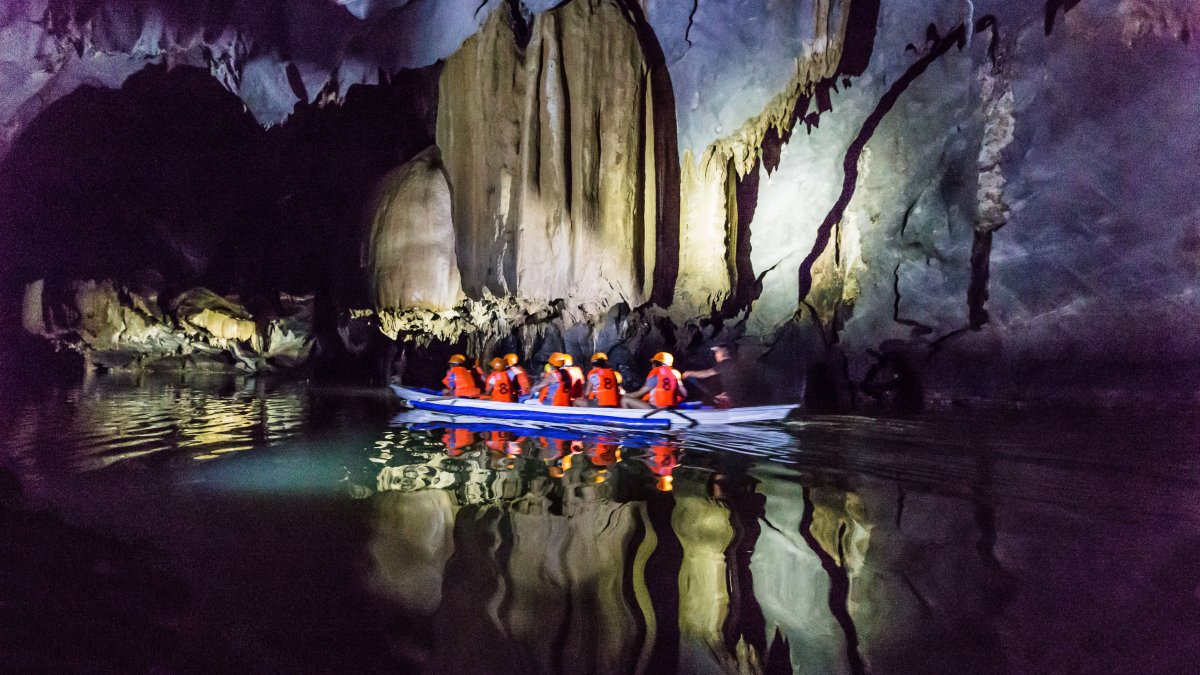
Few places on Earth feel as untouched as what lies directly beneath our feet.
While we map distant planets and chart ocean floors, entire worlds remain hidden in the darkness below, including underground rivers that have never seen daylight.
Cathedral-sized caves carved over millions of years, underground rivers that have never seen daylight, ancient catacombs that outlasted the civilizations that built them, and subterranean cities that sheltered generations of survivors.
The pull of these places is hard to explain. It's part wonder, part unease, the knowledge that you're standing somewhere sunlight has never reached, surrounded by geological time made visible in stone.
From the jungle-filled chambers of Vietnam to the glowing waters of the Philippines, we've gathered the most extraordinary underground destinations on the planet: subterranean realms that feel less like Earth and more like somewhere altogether different.
This post may include affiliate links.
There are many ancient cisterns hidden beneath the streets and houses of Istanbul, but the Basilica Cistern is by far the most majestic.
This Sunken Palace provides insight into the intricate system that brought drinking water into the city from Thrace via a network of aqueducts.
The cistern gets its name from the Stoa Basilica, a large public square that once stood above it on the First Hill of Constantinople, commissioned in 532 AD by Emperor Justinian I. For centuries, the site was forgotten by the Western world until it was rediscovered in 1545 by the Frenchman Peter Gyllius, who was intrigued by locals who filled water and caught fish through holes in their basement floors.
While the 65-meter-wide chamber has undergone multiple restorations to clear away centuries of neglect, it now stands as a primary cultural landmark. The interior is famous for its forest of 336 marble columns, including two iconic bases carved with the face of Medusa, positioned side by side and upside down to ward off her mythical gaze.
Today, visitors can walk along raised platforms to admire the vaulted ceilings and the shallow waters where carp still swim (via New Goreme).
The Cave of Altamira stands as one of the most iconic caves of all time. The Paleolithic art within the cave was discovered in 1879 by Marcelino Sanz de Sautuola.
The markings provided one of the earliest indications that people of that era were capable of creating complex carvings and paintings on subterranean walls and ceilings. The aesthetic and technical quality of the cave art stands out to this day, featuring unique illustrations that represent Magdalenian culture.
The discovery of art in this UNESCO World Heritage site is directly linked to the appearance of Homo sapiens in Europe over 40,000 years ago, serving as a profound testament to their cognitive development.
Since the original paintings are so sensitive to changes in humidity and carbon dioxide, the cave is largely closed to the public to prevent constant exposure that could erase ancient history.
On the bright side, a meticulous, full-scale replica, the Neo-Cave, allows visitors to experience the Sistine Chapel of Prehistory without damaging the 20,000-year-old pigments.

Is this the one where people thought he had someone draw them and it wasn't proven that they were real until after he died?
Naours is a quiet village two hours outside of Paris, home to a labyrinth of secret tunnels. With about 300 chambers, La Cité Souterraine de Naours dates back to the 3rd century and was used as a refuge during invasions until the 17th century.
Over time, the tunnels developed into a complex system that included chapels, piazzas, and even a bakery with working ovens.
Sitting 106 feet below ground, the pathways stretch nearly two miles. They were famously used as hideouts by French and Australian soldiers during World War I and World War II.
The underground city was initially a limestone quarry built by the Romans in the 2nd century AD, which gradually fell into disuse. Since it was later repurposed as a place to hide, the site was planned with utmost care.
Eventually, the abandoned city was rediscovered in 1887 by a man who was renovating his house. It has since become a popular tourist attraction, housing the largest collection of World War I graffiti on the Western Front (via Ancient-Origins).
Stepping into the Catacombs of San Gennaro in Naples is like entering an attraction of immense historical value that remains open to visitors today. The site is arranged on two levels, both of which feature vast spaces unusual for subterranean cemeteries.
The original nucleus dates back to the 2nd century AD and was likely the tomb of a noble family, who eventually provided spaces for the Christian community.
The expansion of this underground marvel began in the 4th century AD, following the deposition of the remains of the city's first patron, St. Agrippinus.
To this day, Mass is still celebrated in the ancient Basilica of Sant’Agrippino. Historically, loved ones in Naples were primarily buried underground, as the relationship with the afterlife is a core part of everyday life in Neapolitan culture.
These catacombs are considered places where the ancestors live rather than mere archaeological remains.
Specifically, the upper catacomb evolved into a major pilgrimage site and a coveted burial ground, filled with the tombs of historical figures and the earliest Christian paintings in southern Italy (via Catacombe Di Napoli).
This wondrous system of limestone caves features one of the largest known underground chambers in the world. Located in the Kras region, the Škocjan Caves comprise collapsed dolines, 6 km of passages, and a total depth of more than 200 m, with flourishing waterfalls.
It is one of the most famous places in the world for the study of karstic phenomena and is a designated UNESCO World Heritage site.
The expansive underground halls and chambers of the cave system showcase breathtaking variations of limestone bedrock and secondary cave formations.
The caves also support a variety of endemic and endangered species, including the Proteus, as well as various invertebrates and crustaceans.
Interestingly, archaeological excavations have revealed human occupation dating back to prehistoric times, suggesting that our ancestors once settled the area long before recorded history.
Amid the rugged mountains of Oaxaca, México, lies the underground chasm of Sistema Huautla. Currently explored to a depth of 1,560 meters, it is the deepest known cave in the Western Hemisphere and the ninth deepest in the world.
The expansive system includes 29 separate entrances, with a sprawling network of interconnected caves totaling over 100 kilometers of mapped passage (via Pesh Caving).
This subterranean labyrinth is surrounded by thundering waterfalls, placid lakes, and vast galleries that have drawn spelunkers from around the world since explorations began in 1964.
What makes Huautla a scientific obsession is its almost shocking verticality. Expeditions often require explorers to camp underground for weeks at a time to navigate technical passages and steep vertical drops.
The cave remains a hotspot for discovery with recent expeditions uncovering paleontological remains, including the skull of a Pleistocene ground sloth, and stalagmites that provide a 342,000-year-old record of Earth’s climate (via EOS).
Rich in natural treasures, the Grotta del Vento is a beautiful system of caves and grottoes that wind underneath the Pania Secca peaks of the Apuan Alps. To reach the entrance, travelers must head to Gallicano and travel the mountain road leading to the small village of Fornovolasco.
Currently, the grotto can be visited on three distinct itineraries, each ranging from one to three hours, with a professional guide. Up until the late 1800s, the cave entrance was nothing more than a small hole that dispensed a constant stream of cold air, which locals used as a natural refrigerator to store food.
This hole was widened gradually over the last century to allow exploration of the hidden tunnels. The grotto has two openings: the entrance for visitors, at 642 meters above sea level, and a second vent at the top of the mountain, above 1,400 meters.
While the airflow inside the cavern fluctuates with the seasons, the temperature inside remains a constant 10.7°C, providing a chilled sanctuary even during the hottest summer months (via Discover Tuscany).
Renowned as one of New Zealand’s best natural attractions, the Waitomo Glowworm Caves boast a history dating back 30 million years. The caverns can be explored on foot or by boat to see the bioluminescent glowworm, a species unique to the country.
The system is split into two levels: a dry upper chamber decorated with dainty cave formations, and a lower chamber composed of stream passages, the luminous larvae, and the famous Cathedral chamber.
Many of the tour guides are direct descendants of the Māori chief who originally explored the caves, in an attempt to maintain a deep cultural history.
Interestingly, the glowworms are actually the larval form of the fungus gnat, Arachnocampa Luminosa. While they do exist in other parts of New Zealand, these caves provide the ideal habitat for the larvae to hunt, using their glowing silk threads to attract insects in complete darkness (via Nature Institute).
Often referred to as the Window to the world due to its vivid scenery, the Fengshan Karst UNESCO Global Geopark boasts a spectacular array of mountains, rivers, and caves. The system comprises seven closely connected collapsed sinkholes, partly intertwined with a massive underground river system.
It is also a booming natural oxygen zone with an anion content of more than 10,000 per square centimeter, a stark and refreshing contrast to urban landscapes.
The region is also a geological masterpiece of the Permian period, where the continuous flow of water has carved out the world’s largest natural stone arch, the Jiangzhou Immortal Bridge.
Diverse karst formations, including dolines, karst canyons, poljes, underground rivers, and karst springs, dominate the landscape.
These sedimentary rocks have a 500-million-year history, dating back to the Cambrian era. The park’s crown jewels include three primary wonders: the Dashiwei Tiankeng cluster, the Sanmenhai karst windows, and the Luomeidong Cave.
Located near the town of Arecibo on Puerto Rico’s north coast, the Río Camuy Caves are part of an immense network of natural limestone caves and underground waterways carved out by the Camuy River, the third-largest underground river in the world (via Uncommon Caribbean).
The Río Camuy Cave Park spans three towns: Camuy, Hatillo, and Lares, with the main entrance located in the Quebrada area of Camuy.
The cave system was officially discovered in 1958, but archaeological evidence indicates that indigenous inhabitants had explored these chambers hundreds of years earlier. While over 10 miles of caverns, 220 caves, and 17 entrances have been mapped, this is merely a fraction of the larger system.
Experts believe it contains an additional 800 undiscovered caves. Today, only a very small part of the complex is open to public exploration, allowing visitors to witness the colossal scale of the Clara Cave and the 600-foot-deep Tres Pueblos Sinkhole (via Discover Puerto Rico).
Hidden deep within the jungles of Phong Nha-Ke Bang National Park, Hang Son Doong is the world’s largest natural cave.
Discovered in 1990 by Ho Khanh, a Phong Nha local, the cavern stretches nearly 9 km in length and has a staggering volume of 38.5 million cubic meters.
What makes the cave truly special is its complex and monolithic stalactites, with many visitors comparing the scenery in Son Doong to that in the movie Avatar.
It also boasts a unique ecosystem and an intricate cave system created by a powerful underground river.
It even features dolines, areas where the roof collapsed, allowing sunlight to nourish a literal jungle inside the cave, a feature explorers often call the Garden of Edam.
Through its values, the cave has contributed significantly to the region’s tourism development, bringing the province onto the world tourism map (via Oxalis Adventure).
Hidden deep within the jungles of Phong Nha-Ke Bang National Park, Hang Son Doong is the world’s largest natural cave.
Discovered in 1990 by Ho Khanh, a Phong Nha local, the cavern stretches nearly 9 km in length and has a staggering volume of 38.5 million cubic meters.
What makes the cave truly special is its complex and monolithic stalactites, with many visitors comparing the scenery in Son Doong to that in the movie Avatar.
It also boasts a unique ecosystem and an intricate cave system created by a powerful underground river.
It even features dolines, areas where the roof collapsed, allowing sunlight to nourish a literal jungle inside the cave, a feature explorers often call the Garden of Edam.
Through its values, the cave has contributed significantly to the region’s tourism development, bringing the province onto the world tourism map (via Oxalis Adventure).
Home to thousands of dramatic stalactites and stalagmites, the Rio Secreto is a mystical underground river that should be on everyone’s bucket list.
Located on the Yucatán Peninsula, it’s part of a vast network of natural limestone caves that provide a unique glimpse into the planet’s depths.
Discovered in 2006 by a local landowner, it was previously a secret known only to the Maya, who consider water-filled caves sacred realms home to the rain god, Chaac. This semi-flooded limestone cave has been developed with a strict focus on sustainable tourism to preserve the ancient ecosystem.
Beyond its aesthetic appeal, the cave is a vital source of freshwater for the Yucatán Peninsula, which lacks surface rivers.
Today, it also serves as a living museum that captures the essence of Mayan cosmology, where visitors may even catch a glimpse of rare wildlife and fossils etched into the walls (via Forever Vacation).
One of the most protected areas in the Philippines, the Puerto Princesa Subterranean River National Park is home to an astonishing limestone karst landscape and a stunning underground river. The fact that the river empties directly into the sea is one of its most distinctive qualities, as the lower portion is subject to tidal influences.
The site is also a critical location for biodiversity conservation and houses some of the most important forest ecosystems in Asia. Located in the southwestern part of the Philippine Archipelago, this UNESCO World Heritage site’s cavern features eye-catching rock formations.
To add to its scientific value, researchers have identified at least 11 minerals, rare crystals, and egg-shaped rock formations, as well as a 20-million-year-old Miocene-age Sirenia fossil embedded within the cave walls.
Boasting a full mountain-to-sea ecosystem centered on environmental conservation, it was rightfully declared one of the New 7 Wonders of Nature. The Puerto Princesa Underground River (PPUR) remains one of the few world-class caves that are easily accessible to the general public for underground adventure.
The violin-making capital, Cremona, has far more to show beneath its surface than above. Beneath the streets of this Italian city lies a hidden world of underground ice-houses, air-raid shelters, crypts, and a complex network of canals and tunnels.
It also houses a 17th-century hypogeum beneath the Church of Sant’Abbondio, which was originally built as a burial site for members of the Teatini religious community. Opportunities to experience these underground marvels are rare, typically occurring only a couple of times a year through exclusive guided tours.
Recent archaeological efforts led by urban speleologists have focused on the city’s Ghiacciaie, monumental ice houses that served as the industrial refrigerators of the 18th century.
These circular chambers highlight a sophisticated early obsession with thermal engineering, showcasing how ancient residents mastered temperature control long before modern technology (via Turismo Cremona).
The underground world asks something of you that few other places do: to move slowly, to look carefully, and to accept that the most extraordinary things are often the ones most thoroughly hidden.
Whether you're drifting through a bioluminescent cave in New Zealand, tracing Mayan sacred routes in Mexico, or standing beneath a Roman cistern in Istanbul, the experience shares a common thread: the humbling reminder that the planet's most astonishing stories aren't always written on the surface.
These places took millions of years to form. They ask only a few hours of your attention in return.

I am willing to go spelunking so long as I don't have to crawl or squeeze through small, tight cracks.

I am willing to go spelunking so long as I don't have to crawl or squeeze through small, tight cracks.






































 No fees, cancel anytime