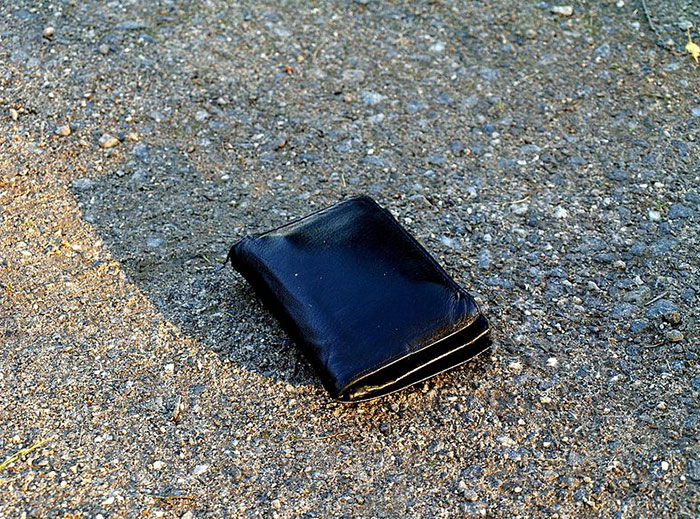
Researchers Placed 17,000 Wallets In Different Cities To See How Many People Would Return Them
How often do you catch yourself in a position where you are totally dependent on other people’s kindness? Car broke down? Lost in the city without a map? Need someone to lend you phone for a call? These are only a few examples of situations where you will not be able to get around without somebody helping you. One thing that these type of circumstances teaches you is always to be kind if you spot someone who needs your help because you can never be sure when you’ll end up wishing somebody helped you.
More info: Science
Recently, researchers at Science journal conducted an experiment that cost them around half a million dollars
The idea of this social experiment is quite simple. Eleven men and two women have traveled to 355 major cities across 40 countries where they “lost” 17,000 wallets. The main goal was to see how differently citizens in each country responded to a lost wallet. Would they return the lost and found item? Would they keep the money? What was the reasoning behind their actions?
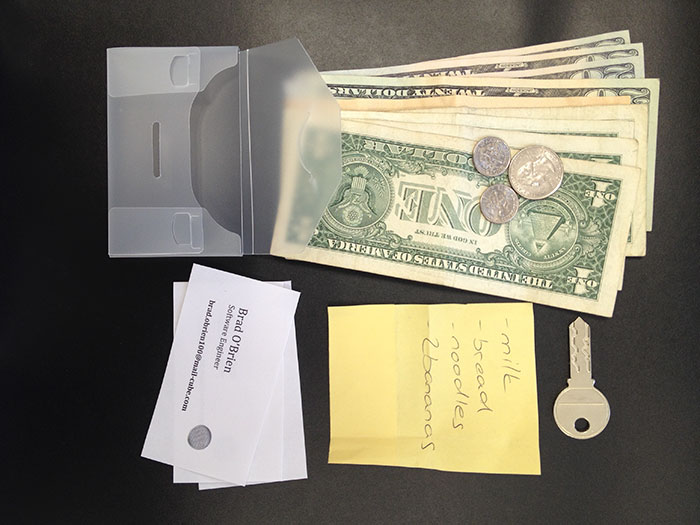
There were two types of wallets used in the experiment, one had a key and no money inside, another one had some money and a key
These wallets contained grocery lists written in the native language, business cards with the owner’s name and email written on them, some money, and a key.
The average amount of lost money in the wallet was $13.45 (USD) in the country’s currency, and a few countries (United Kingdom, Poland, and the United States) had a larger sum of $94.15. As mentioned before, there were also wallets that had no money but had a key.
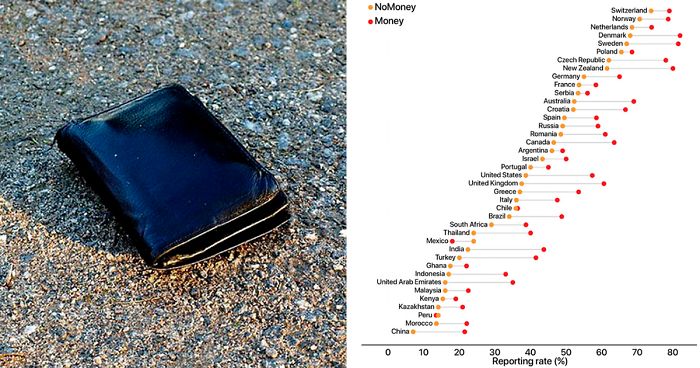
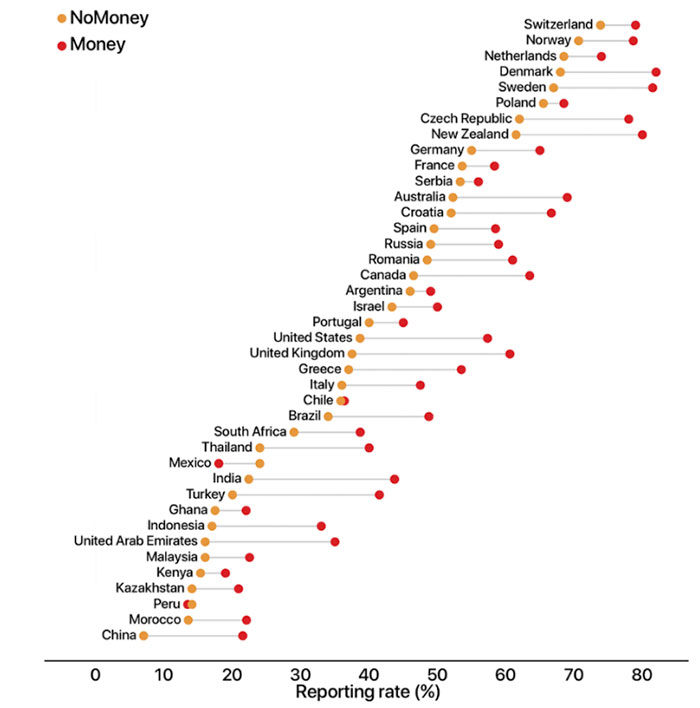
Here’s the graph portraying how different countries responded to this experiment
As shown in the graph, the yellow dot symbolizes the percentage of wallets without any in money in them that were returned, and the red dot shows the percentage of returned wallets that contained money inside them. Nordic people aced the experiment by returning the biggest amount of lost wallets. Unfortunately, countries like China, Morocco, Peru, and Kazakhstan had the smallest return-rate.
There were a few factors that affected the way people responded to the lost wallet – researchers found that wallets that had a key were returned way more often than those without the key, which mainly has to do with people thinking the key has a more significant value to the owner.
Of course, people rushed to react to this experiment
203Kviews
Share on FacebookI remember that I found a laptop bag as an undergraduate student, some 15 years ago. The laptop was gone but there were some documents and a business card in it. When the owner came to collect his bag, he insisted on giving money as a thank-you. I gave my banking account and he transferred €200, a huge amount for a poor undergraduate. Still wonder what those documents were all about...!

There are a number of legal documents that either cannot be replaced or you have to jump through hoops and pay an extortionate amount of money for it. I'm just a student myself, but as I study abroad I had to haul a bunch of my papers (in original) with me. To replace them via the consulate would easily cost around £1000.
Load More Replies...Years ago, My father left his wallet on the car roof with all of his wages in it (I think around £150) He drove off and obviously it went flying off his roof, some notes came out of it. When he arrived home, a guy pulled in behind him. He gave him the wallet and told him that he saw it fly off the roof and he stopped to pick up the notes but he thinks it is all there. He was trying to get his attention but my father hadn't seen him. Over 30 years later and I still remember this. What an awesome dude!


Something that must be taken into perspective is that if the citizens of a country consider the Police corrupted, they won't return the wallet. If there is ID inside they will try to contact the owner directly (assuming they can read the card AND/OR have an Internet connection). That may explain the low scores of some countries.
That's an interesting idea, but this study had nothing to do with the Police. The return rates were only based on emailing the owner.
Load More Replies...Okay, I'm one of the dummies who doesn't understand the graph. The way I see it Mexico is the only country to return cashless wallets. What am I missing? I'm kinda used to being humiliated so have at it.
It's Ok, look at the percents at the bottom. So where Mexico's orange dot is at 22% return rate roughly, and red dot is at roughly 16-17% return rate. The other countries look different as the red dot(money) is returned more often (higher percentage) that orange dot(no money), and Mexico is other way around :) it's a weird graph
Load More Replies...I once accidentally stomped on a lost wallet at the bakery. Didn't open to see what's inside, just instinctively handed it out to the bakery staff, like "hey, someone lost their wallet here in your shop. Please, take care of it." Another time I found someone's phone under the desk at the university. I just gave it to the professor.
I remember being btwn6-8 years old, I found a $2 coin in the bookstore. I was excited, but my mum pointed out what if a little girl like you lost That, wouldn't she want it back? So we handed in to the counter (they were taken aback but cottoned on), I left my phone number, and they called 2 weeks later after no one had claimed it. I'm always grateful my mum taught me that lesson that day.
Load More Replies...I'm grateful to everyone on this thread who have made efforts to return things. I worked in a bar and about six months into my job, a new manager asked for my help in straightening up the office, which was left a nest by the previous disorganized manager. We found two things: a bundle of lost IDs -- about 60-70 in a rubber band -- and a "lost and found" box filled with wallets and purses. I asked if I could send out my business card to let people know we had their item and to claim them at the bar. People were incredibly grateful, I explained their item was unearthed when we got a new manager. One woman said the pictures of her children were all she had left because a house fire destroyed the rest. Another woman said she had been trying to function without her driver's license, because her parents are both immigrants and to get another she needed to get a copy of her Social Security card and couldn't without her ID. It was a vicious cycle trying to obtain her identity items.d
Unfortunately in Mexico theres a culture of blaming for example if you found someone injure, someone will call police or ambulance but caller or witnesses wouldn't cooperate with police because theres always the fear of get involved in the situation. So I dont know if people just think returning a wallet would put them in trouble like being accused of stole the wallet or the victim saying the amount of money was more than original amount. Just what I know. And live
Someone else also commented on how people are less likely to report when the country has poor institutions that are untrustworthy.
Load More Replies...I remember that I found a laptop bag as an undergraduate student, some 15 years ago. The laptop was gone but there were some documents and a business card in it. When the owner came to collect his bag, he insisted on giving money as a thank-you. I gave my banking account and he transferred €200, a huge amount for a poor undergraduate. Still wonder what those documents were all about...!
There are a number of legal documents that either cannot be replaced or you have to jump through hoops and pay an extortionate amount of money for it. I'm just a student myself, but as I study abroad I had to haul a bunch of my papers (in original) with me. To replace them via the consulate would easily cost around £1000.
Load More Replies...Years ago, My father left his wallet on the car roof with all of his wages in it (I think around £150) He drove off and obviously it went flying off his roof, some notes came out of it. When he arrived home, a guy pulled in behind him. He gave him the wallet and told him that he saw it fly off the roof and he stopped to pick up the notes but he thinks it is all there. He was trying to get his attention but my father hadn't seen him. Over 30 years later and I still remember this. What an awesome dude!

Something that must be taken into perspective is that if the citizens of a country consider the Police corrupted, they won't return the wallet. If there is ID inside they will try to contact the owner directly (assuming they can read the card AND/OR have an Internet connection). That may explain the low scores of some countries.
That's an interesting idea, but this study had nothing to do with the Police. The return rates were only based on emailing the owner.
Load More Replies...Okay, I'm one of the dummies who doesn't understand the graph. The way I see it Mexico is the only country to return cashless wallets. What am I missing? I'm kinda used to being humiliated so have at it.
It's Ok, look at the percents at the bottom. So where Mexico's orange dot is at 22% return rate roughly, and red dot is at roughly 16-17% return rate. The other countries look different as the red dot(money) is returned more often (higher percentage) that orange dot(no money), and Mexico is other way around :) it's a weird graph
Load More Replies...I once accidentally stomped on a lost wallet at the bakery. Didn't open to see what's inside, just instinctively handed it out to the bakery staff, like "hey, someone lost their wallet here in your shop. Please, take care of it." Another time I found someone's phone under the desk at the university. I just gave it to the professor.
I remember being btwn6-8 years old, I found a $2 coin in the bookstore. I was excited, but my mum pointed out what if a little girl like you lost That, wouldn't she want it back? So we handed in to the counter (they were taken aback but cottoned on), I left my phone number, and they called 2 weeks later after no one had claimed it. I'm always grateful my mum taught me that lesson that day.
Load More Replies...I'm grateful to everyone on this thread who have made efforts to return things. I worked in a bar and about six months into my job, a new manager asked for my help in straightening up the office, which was left a nest by the previous disorganized manager. We found two things: a bundle of lost IDs -- about 60-70 in a rubber band -- and a "lost and found" box filled with wallets and purses. I asked if I could send out my business card to let people know we had their item and to claim them at the bar. People were incredibly grateful, I explained their item was unearthed when we got a new manager. One woman said the pictures of her children were all she had left because a house fire destroyed the rest. Another woman said she had been trying to function without her driver's license, because her parents are both immigrants and to get another she needed to get a copy of her Social Security card and couldn't without her ID. It was a vicious cycle trying to obtain her identity items.d
Unfortunately in Mexico theres a culture of blaming for example if you found someone injure, someone will call police or ambulance but caller or witnesses wouldn't cooperate with police because theres always the fear of get involved in the situation. So I dont know if people just think returning a wallet would put them in trouble like being accused of stole the wallet or the victim saying the amount of money was more than original amount. Just what I know. And live
Someone else also commented on how people are less likely to report when the country has poor institutions that are untrustworthy.
Load More Replies...


288
188