Get Premium
Dark mode theme is available exclusively for premium users. Learn more about the benefits of subscribing.
No fees, cancel anytime.

 Dark Mode Ad-Free Browsing Unlimited Content
 Ad-Free Browsing Unlimited Content Dark Mode
Join 1.2 million Panda readers who get the best art, memes, and fun stories every week!

When you are out in public, shopping, dining, playing with your family at the park, do you know what’s going on around you? When you walk out of your front door, or walk to your car after work, do you know who’s around?
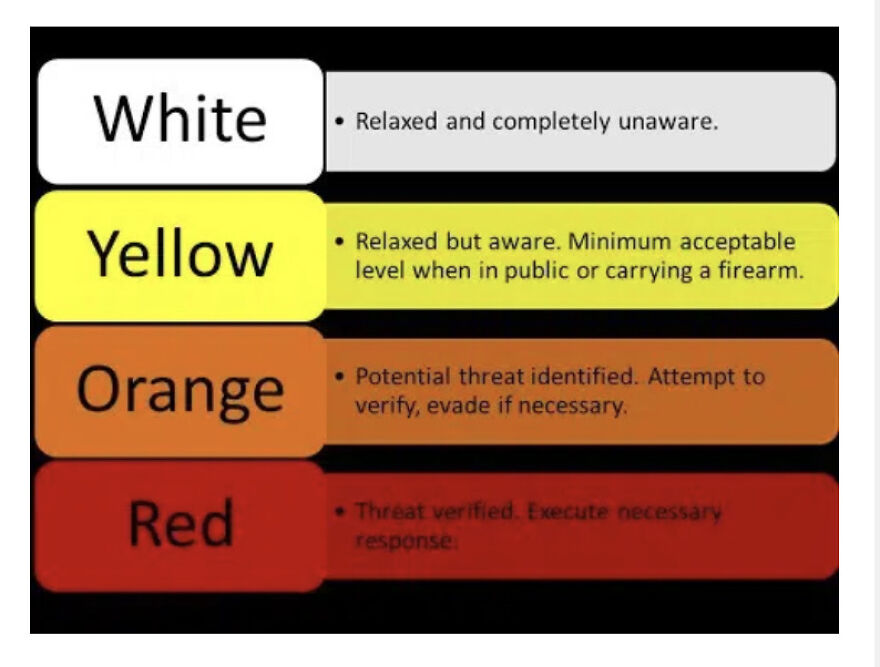
So many times, we walk around with our heads down, faces in our phones, and earbuds in our ears. We are totally clueless about the potential dangers around us. Cooper’s Color Code can help you to remember how alert we should be and how prepared we should be to take action if necessary.
Originally created for law enforcement officers who carry firearms, this chart can help us be aware of our surroundings and help us avoid becoming a target of opportunity for would-be bad actors. By using the color which best represents the current situation in which we find ourselves, we can be appropriately aware and have a plan if our color/situation suddenly changes.
Take some time to review the chart and try to stay in the yellow zone whenever you step outside of your own home. If you find yourself facing a potential threat and have moved to Orange, what are your next steps? Is it an actual threat? If so, can you get to safety before the threat gets too close? If the threat is real and you cannot get to safety, is there a panic button on your key ring, assuming you have your keys in hand? Is there some other way to alert those around you that you need assistance? For example, asking a security officer to walk you to your car. If there is no way to avoid the threat, and you now find yourself in the red zone, do you have a plan? The best way to avoid freezing when you need to act is to have a plan and practice, either in your head or in real life. Practice doesn’t always make perfect, but it can prevent you from freezing up.
So, the next time you find yourself out and about, think about what color you are in. Stay alert. Stay safe.
When you are out in public, shopping, dining, playing with your family at the park, do you know what’s going on around you? When you walk out of your front door, or walk to your car after work, do you know who’s around?
So many times, we walk around with our heads down, faces in our phones, and earbuds in our ears. We are totally clueless about the potential dangers around us. Cooper’s Color Code can help you to remember how alert we should be and how prepared we should be to take action if necessary.
Originally created for law enforcement officers who carry firearms, this chart can help us be aware of our surroundings and help us avoid becoming a target of opportunity for would-be bad actors. By using the color which best represents the current situation in which we find ourselves, we can be appropriately aware and have a plan if our color/situation suddenly changes.
Take some time to review the chart and try to stay in the yellow zone whenever you step outside of your own home. If you find yourself facing a potential threat and have moved to Orange, what are your next steps? Is it an actual threat? If so, can you get to safety before the threat gets too close? If the threat is real and you cannot get to safety, is there a panic button on your key ring, assuming you have your keys in hand? Is there some other way to alert those around you that you need assistance? For example, asking a security officer to walk you to your car. If there is no way to avoid the threat, and you now find yourself in the red zone, do you have a plan? The best way to avoid freezing when you need to act is to have a plan and practice, either in your head or in real life. Practice doesn’t always make perfect, but it can prevent you from freezing up.
So, the next time you find yourself out and about, think about what color you are in. Stay alert. Stay safe.

As stated in my article, Cooper’s Color Code was originally designed for law enforcement agencies, so it’s written with that audience in mind. However, any time one is out in public, a heightened level of awareness is necessary for prevention of becoming a victim of opportunistic bad actors.
Load More Replies...
I have to assume the OP is in the US. The idea that if a child is throwing rocks on the playground, the ONLY "reasonable" response is to give all of the other kids rocks. This mindset breeds paranoia, and the irony is that the US is probably the most likely area where people are too wrapped up in their cell phones to recognize potential dangers around them. Still, regardless of where you are or who you are with, being aware (not "hyper-aware" or paranoid!), is still valid advice and can help you avoid potentially dangerous situations.
You are correct that I live in the US. How you were able to misconstrue the article to suggest that I am speaking of a fight fire with fire approach and use children on a playground to illustrate such, is mind boggling. I am saying, if one finds themselves out in public, to be alert and aware of potential dangers and have a plan of escape (or confront, when absolutely necessary). This is an encapsulation of one of the chapters in my book, “Situational Awareness for Women - Safer Daily Living”. Sadly, I do see women and girls consistently being unaware of their surroundings and becoming victims of opportunistic bad actors. If you’ve ever been a victim of a crime, it’s not your fault, but you can take measures to minimize the potential of it happening, regardless of where you are in the world.
Load More Replies... As stated in my article, Cooper’s Color Code was originally designed for law enforcement agencies, so it’s written with that audience in mind. However, any time one is out in public, a heightened level of awareness is necessary for prevention of becoming a victim of opportunistic bad actors.
Load More Replies... I have to assume the OP is in the US. The idea that if a child is throwing rocks on the playground, the ONLY "reasonable" response is to give all of the other kids rocks. This mindset breeds paranoia, and the irony is that the US is probably the most likely area where people are too wrapped up in their cell phones to recognize potential dangers around them. Still, regardless of where you are or who you are with, being aware (not "hyper-aware" or paranoid!), is still valid advice and can help you avoid potentially dangerous situations.
You are correct that I live in the US. How you were able to misconstrue the article to suggest that I am speaking of a fight fire with fire approach and use children on a playground to illustrate such, is mind boggling. I am saying, if one finds themselves out in public, to be alert and aware of potential dangers and have a plan of escape (or confront, when absolutely necessary). This is an encapsulation of one of the chapters in my book, “Situational Awareness for Women - Safer Daily Living”. Sadly, I do see women and girls consistently being unaware of their surroundings and becoming victims of opportunistic bad actors. If you’ve ever been a victim of a crime, it’s not your fault, but you can take measures to minimize the potential of it happening, regardless of where you are in the world.
Load More Replies... No fees, cancel anytime



-1
4