Get Premium
Dark mode theme is available exclusively for premium users. Learn more about the benefits of subscribing.
No fees, cancel anytime.

 Dark Mode Ad-Free Browsing Unlimited Content
 Ad-Free Browsing Unlimited Content Dark Mode
Join 1.2 million Panda readers who get the best art, memes, and fun stories every week!
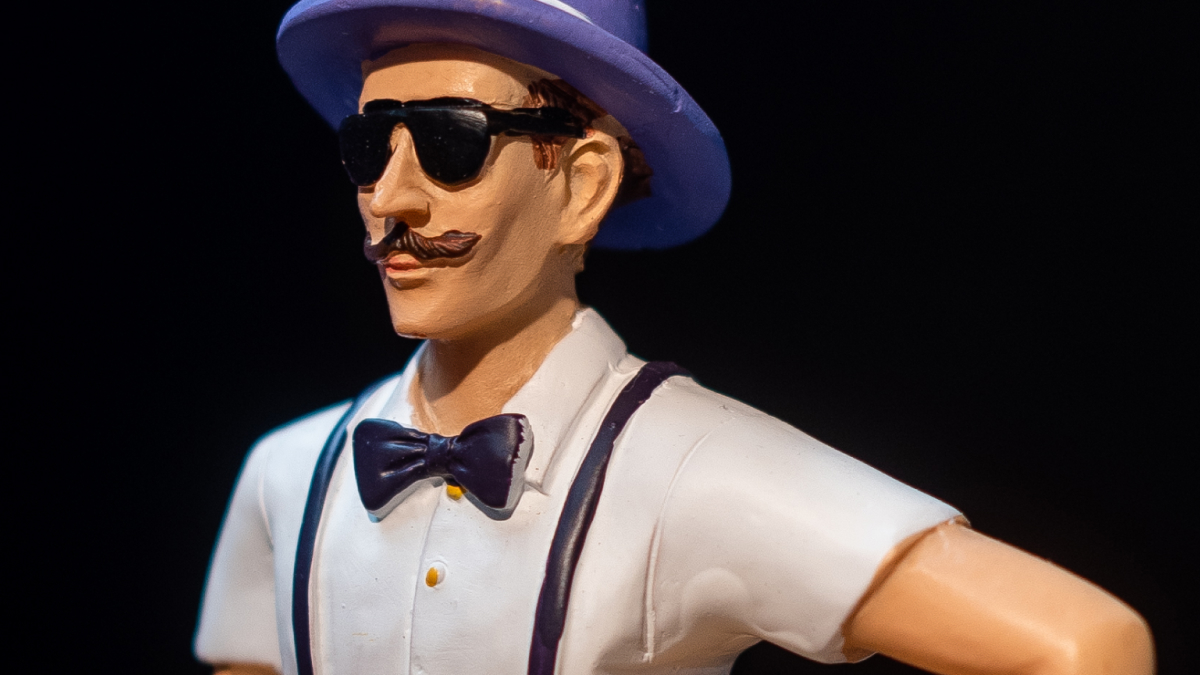
Scroll through your feed and you’ll probably spot him. He’s stretched out in the park on a sunny day, tote bag slung over one shoulder, an upside-down copy of “Ain’t I a Woman?” by Bell Hooks in hand. His other hand grips an iced matcha latte. The moment seems effortless, but it’s staged with care. This is the era of the performative male.
This social media-made persona has become a viral staple in 2025. TikToks and memes revolve around this character, the guy who tries a little too hard to prove he’s progressive. He blasts Clairo, threads labubus through his belt loops, and name-drops gender theory. It might look like a running joke, but it reflects something more unsettling about identity today. In a world designed for broadcasting curated lives, performance has become a new way to measure masculinity. As men compete for attention, approval, and clout, the question shifts: who gains from the performance, and what’s the cost of keeping it up?
To the chronically online or casual observer, the performative male trend has made the rounds as an endless contest for attention to find the most viral male. The games play out in multiple ways, each with its own rules and aesthetics. But before performative males became popular, we had the hypermasculine man as a major contender. Men showed off gym selfies, grueling workout routines, and chiseled bodies. As TIME notes, some fitness influencers even framed extreme training, which could cause injuries, as being tough like a real man, reinforcing the belief of “no pain, no gain.” They pushed physical discipline and self-control as the determinants of masculine worth, believing it would boost testosterone and make them more attractive to women. Unfortunately, as a 2024 study in Sage Journals found, repeatedly consuming this kind of content actually led to increased body dissatisfaction in men.
View this post on Instagram
In recent times, the performative “soft boy” aesthetic has run parallel to the hypermasculine man. This archetype rejects macho displays in favor of curated sensitivity. Vox lists some of their cultural markers: tote bags, matcha lattes, feminist books, and indie music. These traits signal the performative male’s progressiveness, often to attract women by showing them he’s not like other guys. Some lean into parody, exaggerating the look to make fun of themselves, while others make a genuine attempt. Either way, the goal remains the same: appeal to the female gaze and gain clout. Social media algorithms amplify this contest, rewarding content that provokes strong reactions. The more extreme the performance, whether hyper-masculine or hyper-sensitive, the more likely it is to go viral.
@yungjackinnanen Day in the life of a performative man in nyc fall edition w/ @UNIQLO USA #UNIQLOPartner#UNIQLO♬ original sound – Jack Innanen
This online trend has spilled over into the real world, with actual “performative male contests.” According to The Hill, these lookalike contests have been held on college campuses from Seattle to Chicago, where men deliver feminist monologues with props like rare vinyl records and painted nails. Though these contests are tongue-in-cheek, a real-life spillover of the online trend shows just how mainstream the meme has become. One contest was even described as a “straight men drag show,” highlighting how performative males act out a specific feminine-adjacent identity. While winners might get a matcha gift card or a hug from a woman, the actual prize is fleeting online fame, measured in likes, shares, and online validation.
View this post on Instagram
Before the matcha-toting soft boy arrived, online masculinity was defined by other archetypes that turned into meme gold. Forbes notes that the alpha, beta, and sigma labels once formed a pseudo-hierarchy of how men presented themselves.
These categories, loosely based on animal behavior, formed a simple pecking order: alpha as the dominant leader, beta as the obedient follower, and sigma as the aloof outsider.
@wffnews Male Personality Types, which one are you OR are you attracted too? #fyp#foryou#foryoupage#type#greenscreen#rizz#alpha#beta#delta#gamma#omega#sigma♬ original sound – WFF NEWS
The self-proclaimed alpha male is often polarizing. Influencers such as Andrew Tate have built personal brands around this macho persona, encouraging others to do the same. However, many who label themselves alpha end up as the punchline, since true leaders rarely need to declare their status.
@wffnews Male Personality Types, which one are you OR are you attracted too? #fyp#foryou#foryoupage#type#greenscreen#rizz#alpha#beta#delta#gamma#omega#sigma♬ original sound – WFF NEWS
The sigma male emerged in contrast, defined as the independent, emotionally distant loner. VICE ties this archetype to fictional characters like Patrick Bateman and John Wick, men who operate outside the pack and play by their own rules. The “sigma face”—a smug look modeled after Christian Bale’s Bane—became a visual shorthand for this identity. Some adopt it sincerely as a marker of independence, while others use it for satire to mock the entire concept. 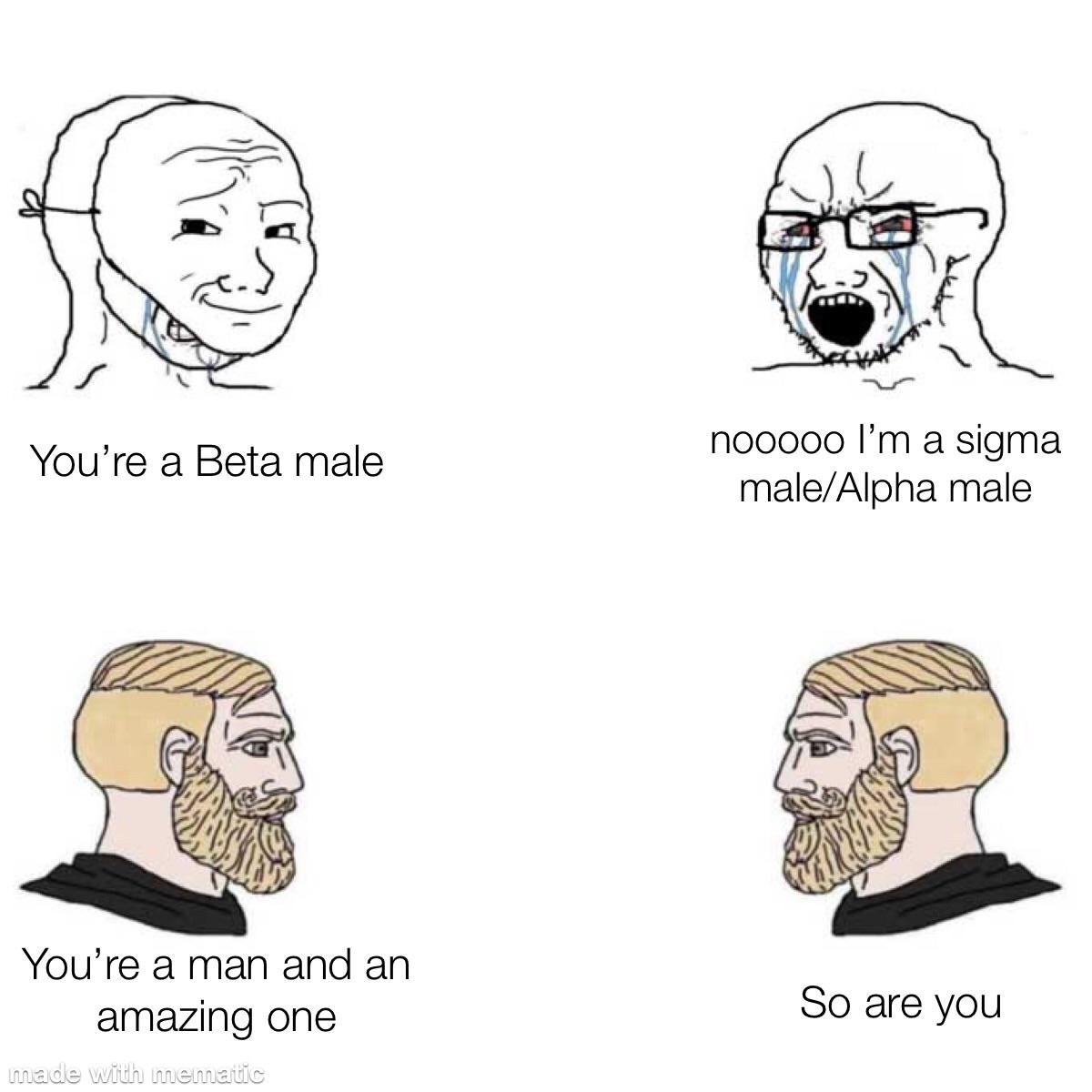
Image credits: r/memes
Beneath the humor, these roles carry troubling themes. A 2025 University of Montréal study found that sigma-related content on TikTok often blurs the line between self-help and misogyny, portraying women as distractions and emotional detachment as power. France 24 similarly reported that alpha male influencers push a superiority narrative that reinforces gender inequality. The performative male is just the latest in a long string of masculinity templates. But unlike the alphas and sigmas who perform for male approval, this version aims to appeal to women by performing progressiveness.
As with other masculinity shows, the general response to these performative males, who seem painfully unaware of how the behavior comes across, has been a mix of amusement and cringe. A young man reading feminist books on an escalator in a dramatically relaxed pose is cute for the first couple of videos, but when it’s the tenth reel showing off his collection of labubus, the law of diminishing returns starts to set in.
The try-hard overt femininity shows a mismatch between intent and execution, and cringing is the online audience’s form of decentralized social policing, setting the boundaries of acceptable behavior in the pursuit of social media engagement. Interestingly, as content attracts more negative responses, creators respond in different ways. Some double down on their original performance, trying to stay relevant. Others switch to irony, embracing their “cringe” status as a new performance that allows them to continue their behavior while deflecting criticism by claiming they were “in on the joke” all along. Importantly, not all instances of behaviors that have now taken the performative male tag are aimed at calculated performance. But in 2025, a genuine interest in feminist literature can easily be labeled performative and cringeworthy, restarting the cycle that dunks down on these interests. As Vox reports, the need to fit a stereotype reflects a broader trend of distrust in social and dating spaces. There is heightened suspicion surrounding the intent behind people’s actions. Over time, this back-and-forth makes it challenging to distinguish authenticity from parody. Each act of exaggeration or irony builds on the last, until the focus shifts away from the original performance and to the response it generates. Eventually, everyone, including creators, commenters, and viewers, becomes part of the performance itself, creating an online space that makes you wonder whether anyone is left genuinely watching.
Performative masculinity runs on a mix of social pressure, insecurity, and social media algorithms. Vox calls it part of a masculinity crisis, driven by the collapse of traditional male roles.
As gender norms shift, many young men feel unsure of how to express themselves. Some turn to social media personas in search of identity and validation. But the platforms don’t just display these performances; they shape them. Algorithms reward engagement, so content that sparks strong reactions, whether positive or negative, is pushed to the top. A 2024 University of Kent study found that TikTok and similar apps guide users toward more extreme content. This creates a loop that encourages exaggeration. Even sincere behavior can evolve into performance if that’s what earns views. These rewards are both social and biological. Stanford Medicine explains that likes and shares trigger the release of dopamine. That makes the attention addictive. At the same time, constant comparison to curated lives increases stress and dissatisfaction. For those adopting these personas, the gap between their online image and real identity can lead to anxiety, low self-worth, and disconnection. The pressure to perform delays personal growth and undermines authenticity. This impact isn’t limited to individuals. Groups made up of performative personalities struggle to build trust or community. The American Survey Center found that men already check in with friends less often than women. In this climate, even a basic connection becomes harder to form.
The effects of pretending to be someone else online don’t stop when the screen turns off. They spill into real life, disrupting friendships, dating, and mental health. Constant performance weakens the ability to form meaningful, lasting connections.
When men posture as progressive solely to attract women, it becomes harder for partners to tell sincerity from strategy. On the surface, this trend appears to promote traits once dismissed as unmasculine. In reality, it introduces a new kind of dating confusion. Social media also offers a low-effort substitute for real friendships. An Interpersona study found that online friendships require less vulnerability. Because these spaces are easier to control, performative behavior thrives. But over time, this can stunt emotional closeness, leaving bonds that feel hollow once the trend fades. The mental impact is steep. Psychiatry Times reports that excessive use is tied to depression and anxiety. Even lighthearted posts can leave behind a permanent digital footprint. Content intended as a joke may be misunderstood by employers or schools, leading to lost opportunities and lasting damage. The clout may be temporary, but the personal cost of online performance can follow someone for years.
Amid the cringe cycles and copycat trends, some creators and communities are working to reshape what masculinity looks like. This movement centers on “positive masculinity,” which focuses on empathy, emotional strength, and connection (per Psychology Today). Rather than prescribing new rules, it encourages men to grow emotionally and support one another without pretense.
On TikTok and other platforms, creators like Rob Kenney use channels like Dad, How Do I? to offer guidance and basic life skills to young men who lack father figures.
View this post on Instagram
In mental health, Dr. Alex George and podcaster Chris Williamson openly discuss topics like anxiety and depression. They aim to reduce stigma and promote emotional awareness. Comedian Devon Palmer takes a different path, using humor to satirize male archetypes.
@devon_palmerAlpha decision♬ original sound – Devon Palmer
Instagram personalities such as Olly Bowman also challenge the polished image culture. By encouraging followers to embrace awkwardness and be seen trying, he reframes vulnerability as strength.
View this post on Instagram
Pop culture contributes too. Celebrities like Harry Styles, who blend masculine and feminine fashion, often face criticism. But their visibility pushes for more expansive ideas of self-expression. Even if some men begin this journey for show, it can still lead somewhere real. As Dr. Juliet Williams told the Independent, getting men “in the door is halfway to victory.” A superficial entry point can still spark genuine change. The answer to performative masculinity is not retreating to old models. It is building space for honesty, humor, and connection without forcing anyone to fit a mold.
According to Merriam-Webster, a person is being performative when they’re doing something mainly to impress an audience, or when they’re acting or displaying certain behaviors for show or effect.
Based on Judith Butler’s view of gender theory, gender doesn’t come from biology (per The Conversation). Rather, it is something performed through the ways we talk, dress, and act.

By entering your email and clicking Subscribe, you're agreeing to let us send you customized marketing messages about us and our advertising partners. You are also agreeing to our Privacy Policy.
Thank you! You've successfully subscribed to newsletters!

The answer to anyone telling me how to be a man, whether "progressive" or "alpha" is, of course, "f**k off, I do what I want."

So dudes are being dudes on social media, and we're going to harass them and tear them into little shreds for it? We're going to scathingly mock them and call them shallow? Maybe we should talk about "performative femininity" on social media as well before we throw stones - because I guarantee you that for every man reading a book in a pic on social media (GASP, men can READ?!) there's a woman doing something equally "performative". Are we seriously calling out JUST men for "pretending to be someone else" on social media? Please. Women do the same thing. Misandry is just as disgusting and offensive as misogyny.

Just let people be themselves. Some men like working out a lot and looking like tough guys, whatever, that’s not my thing but there’s nothing wrong with it. Other men want to look sophisticated and “metrosexual”, again not my thing but I have absolutely no problem with that. Problems begin when someone tries to impose their view of how men should look like as the only valid one.
The answer to anyone telling me how to be a man, whether "progressive" or "alpha" is, of course, "f**k off, I do what I want."
So dudes are being dudes on social media, and we're going to harass them and tear them into little shreds for it? We're going to scathingly mock them and call them shallow? Maybe we should talk about "performative femininity" on social media as well before we throw stones - because I guarantee you that for every man reading a book in a pic on social media (GASP, men can READ?!) there's a woman doing something equally "performative". Are we seriously calling out JUST men for "pretending to be someone else" on social media? Please. Women do the same thing. Misandry is just as disgusting and offensive as misogyny.
Just let people be themselves. Some men like working out a lot and looking like tough guys, whatever, that’s not my thing but there’s nothing wrong with it. Other men want to look sophisticated and “metrosexual”, again not my thing but I have absolutely no problem with that. Problems begin when someone tries to impose their view of how men should look like as the only valid one.








 No fees, cancel anytime






21
6