Get Premium
Dark mode theme is available exclusively for premium users. Learn more about the benefits of subscribing.
No fees, cancel anytime.

 Dark Mode Ad-Free Browsing Unlimited Content
 Ad-Free Browsing Unlimited Content Dark Mode
Join 1.2 million Panda readers who get the best art, memes, and fun stories every week!

Being duped is one of the most unpleasant experiences anyone can go through. It makes you feel stupid, knowing that another person fooled you into getting what they want.
The feeling could be ten times worse if it involved someone you’ve known for a long time. This is what a bridesmaid went through when the maid of honor tricked the entire bridal party and profited off of them.
To add insult to injury, the woman says she expected such behavior, but this one was a “whole new level.”
Image credits: Melike B / pexels (not the actual photo)
Image credits: 2designbcn / envato (not the actual photo)
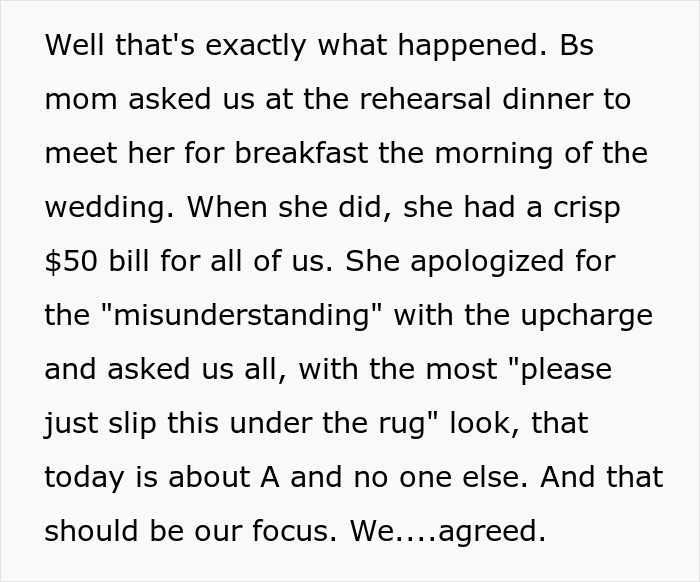
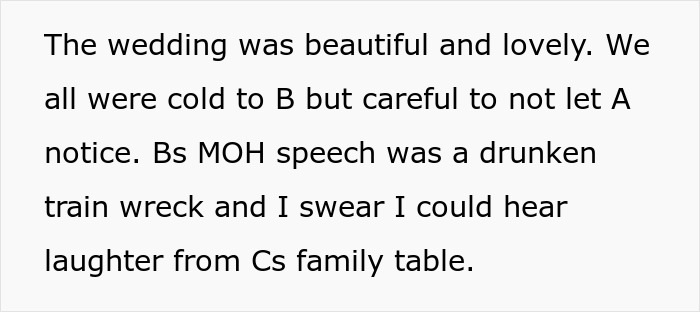
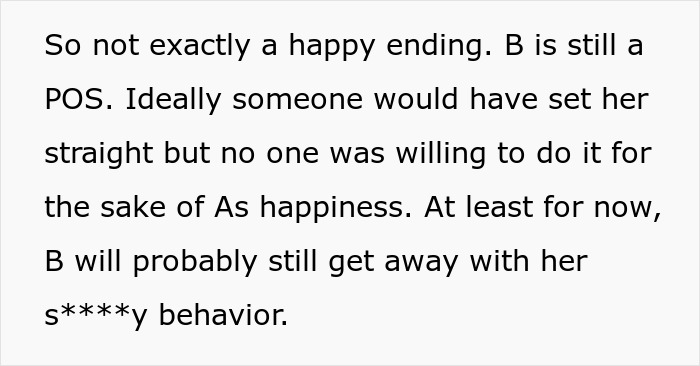
Image credits: sixfingeredman7
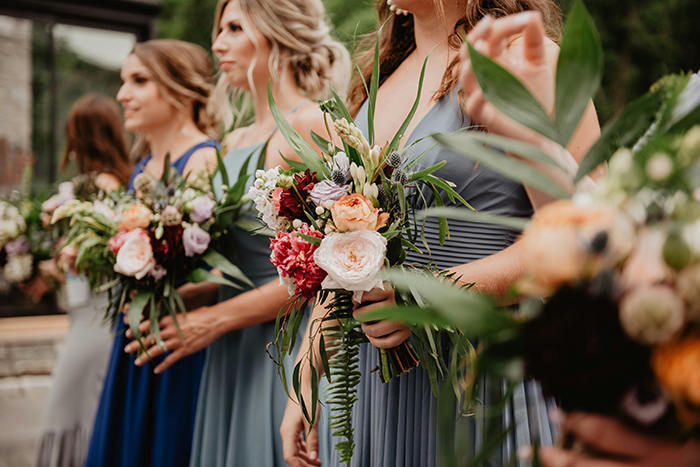
Image credits: Emma Bauso / pexels (not the actual photo)
In the story, the woman knew that the maid of honor wasn’t a good person. Yet, she still ignored the red flags she noticed until it was too late. Experts refer to this as an optimism bias, where people aren’t always on the lookout for the worst-case scenarios.
According to Carolyn Misir, principal psychologist at the Singapore Police Psychological Services Division, scammers leverage these biases to get what they want without the person suspecting too much.
“Most people can’t go around thinking of all the worst-case scenarios,” Misir said in a 2022 interview. “So (when they encounter a scam) people don’t think ‘oh, this might be a scam’.”
Winning someone’s trust is another common tactic scammers use. As Nanyang Technological University associate professor Joyce Pang explains, the person may go the extra mile to create a sense of intimacy before they strike.
This is likely why the maid of honor made everyone believe she was doing an excellent job planning the bachelorette party, when in reality, she had her motives planned all along.
Falling for a scam may feel like an insult to our intelligence, especially in the story’s case, where everyone knew what to expect. Anyone can be a victim of deception, and experts like cybersecurity researcher Dr. KF Cheung emphasize that it isn’t an indication of weakness or naivety.
If you do feel you’ve been deceived, Dr. Cheung advises focusing on reporting the scam, seeking support, and learning from the experience.
At this point, the bridesmaid would be better off exposing the MOH once they’ve gathered enough proof. They may (or may not) get their money back, but it may help prevent similar situations from happening again.

By entering your email and clicking Subscribe, you're agreeing to let us send you customized marketing messages about us and our advertising partners. You are also agreeing to our Privacy Policy.
Thank you! You've successfully subscribed to newsletters!


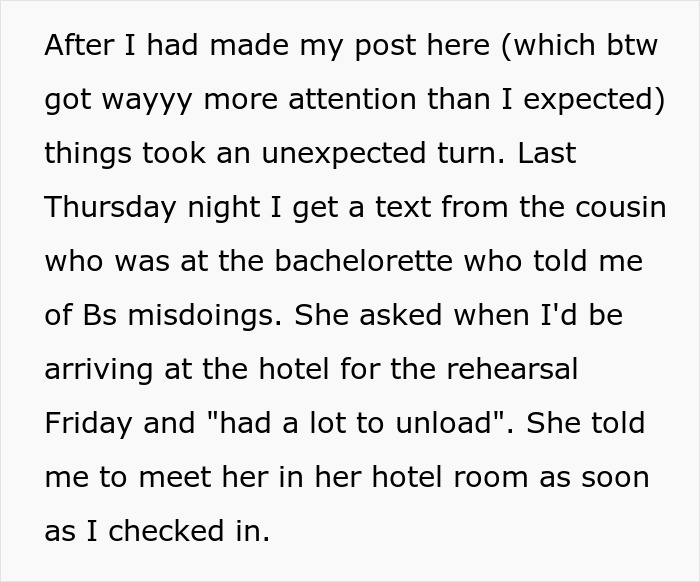
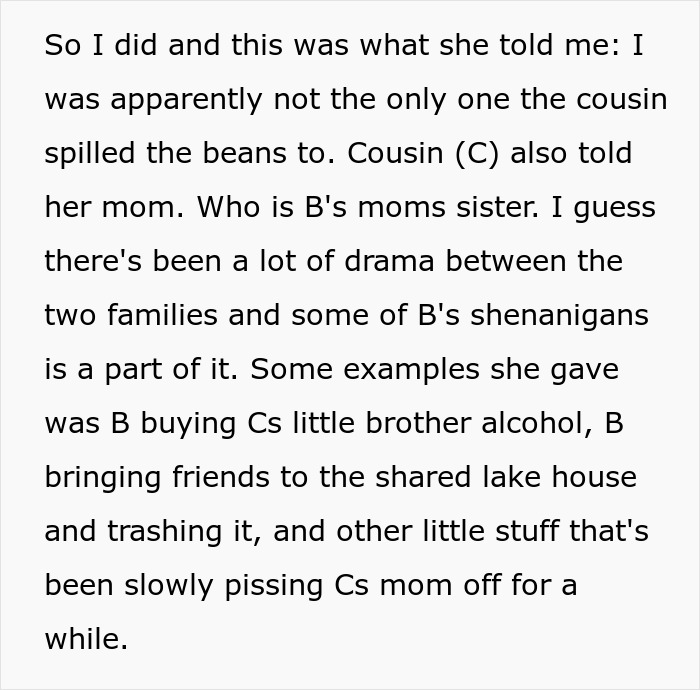
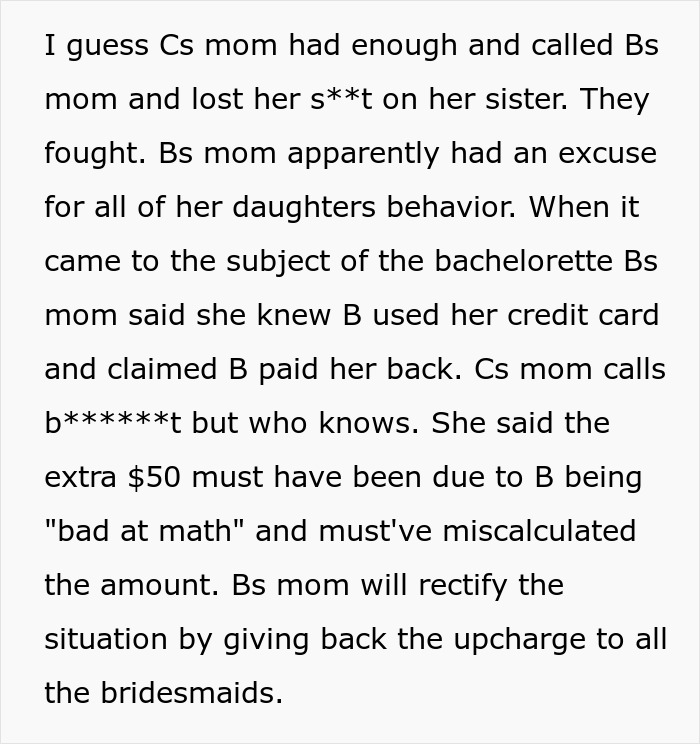
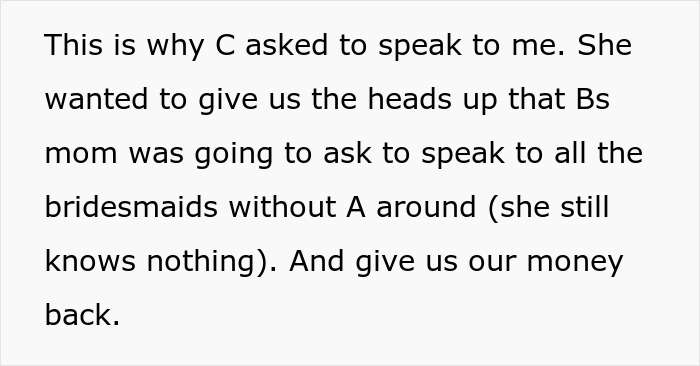
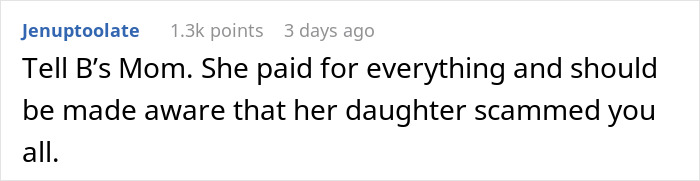
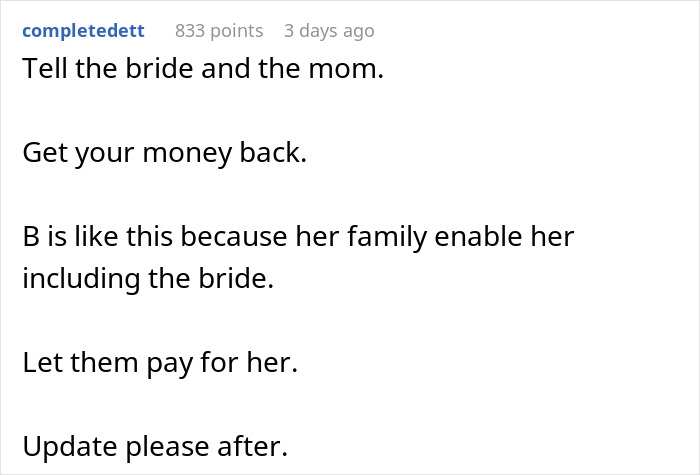
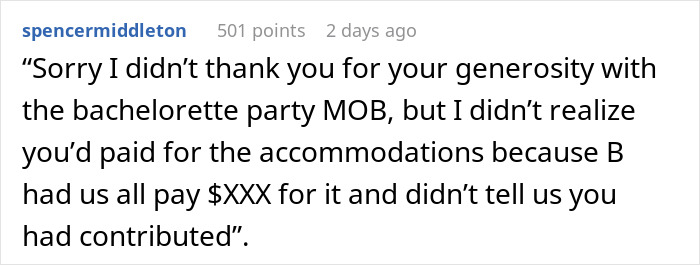
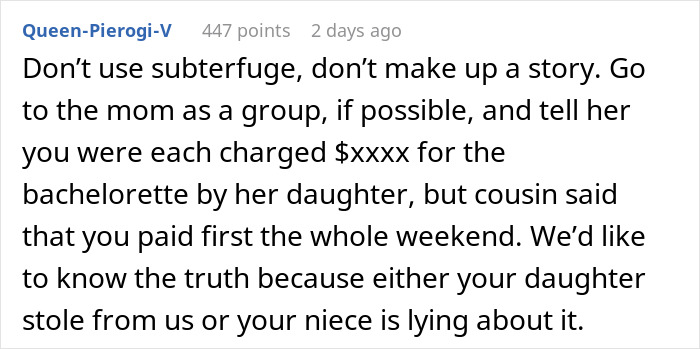
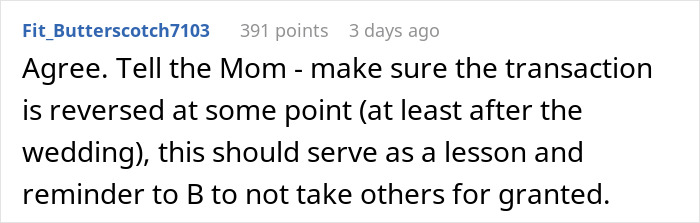
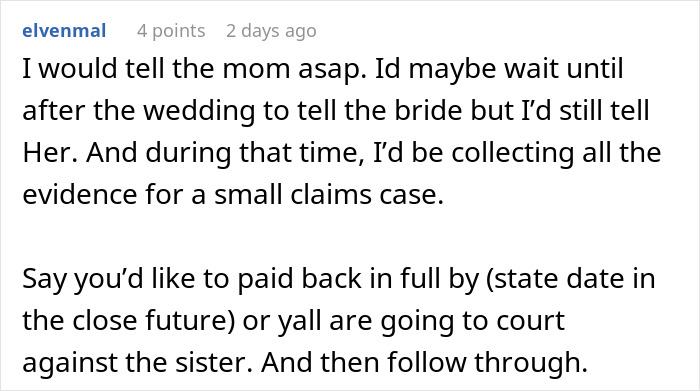
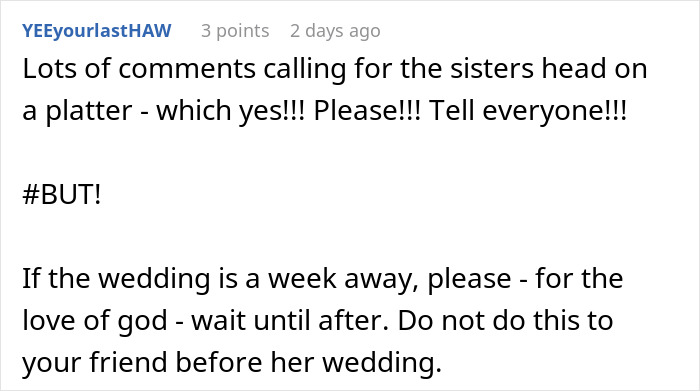
There's an update added to the post now. Apparently B had to pay her mom back. She (B's mom) paid the bridesmaids back for the extra $50 and asked them not to tell A. They agreed. I hope at least one of them only meant for the wedding/honeymoon and will tell A later. A deserves to know what her sister tried to pull before she entrusts her with any other major life events. I have no sympathy since they couldn't find their spines long enough to ask for an itemized bill, which is very normal before paying any bill.
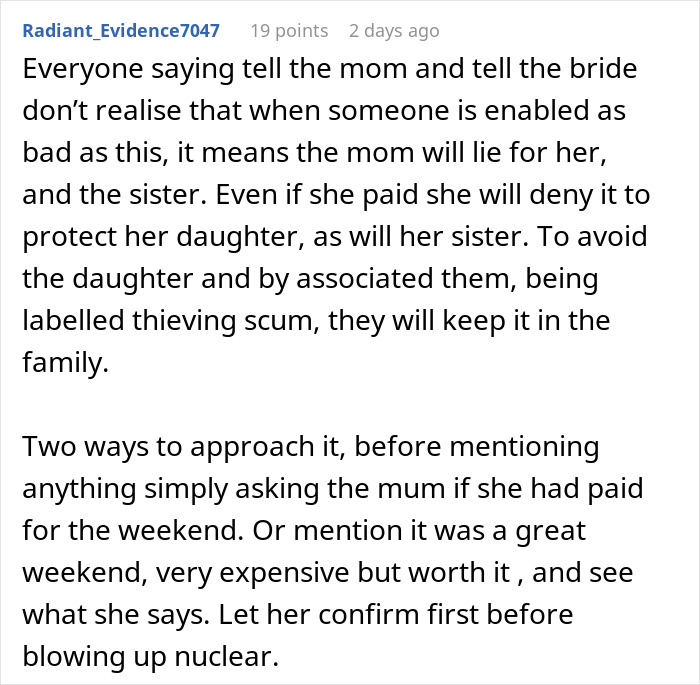
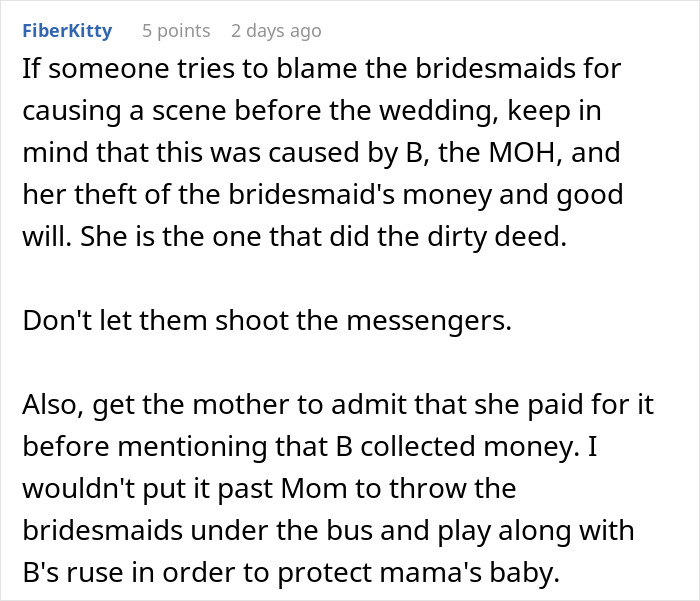
Her mother SAID that B paid her back. That might be just a lie to protect her daughter. Enablers are wild like that.
Load More Replies...
If this is in the USA, “embezzlement” is intent to deprive someone of an asset (in this case, money) under false pretenses. “Racketeering” is an organized scheme/plan to generate profit, often requiring proof of a pattern of such activities (the same process with several victims). Each bridesmaid can file a federal complaint online and also report it to the local authorities. The former will support the latter with investigation. The scope of proof is rather wide and the burden would be on the MOH to prove it was embezzlement and/or racketeering. These two crimes don’t have to be on a grand scale with grand amounts of assets stolen.

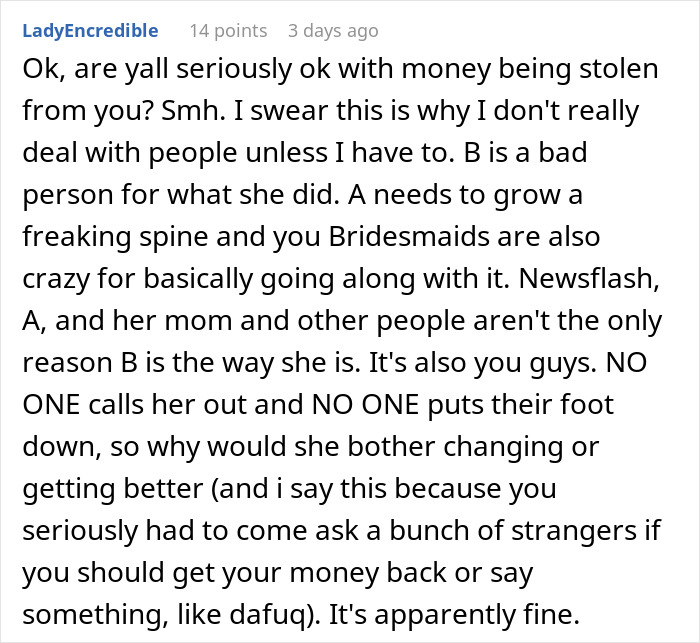
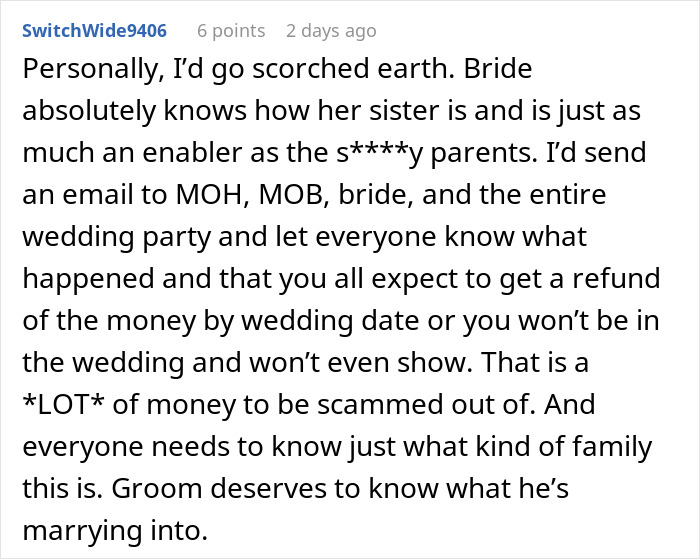
B is entitled and needs to swing for this. It won't be the first time she's pulled this stunt. Let everyone know, remembering that A, B, and MOB are all related and will back B before they back any of the bridal party.
There's an update added to the post now. Apparently B had to pay her mom back. She (B's mom) paid the bridesmaids back for the extra $50 and asked them not to tell A. They agreed. I hope at least one of them only meant for the wedding/honeymoon and will tell A later. A deserves to know what her sister tried to pull before she entrusts her with any other major life events. I have no sympathy since they couldn't find their spines long enough to ask for an itemized bill, which is very normal before paying any bill.
Her mother SAID that B paid her back. That might be just a lie to protect her daughter. Enablers are wild like that.
Load More Replies... If this is in the USA, “embezzlement” is intent to deprive someone of an asset (in this case, money) under false pretenses. “Racketeering” is an organized scheme/plan to generate profit, often requiring proof of a pattern of such activities (the same process with several victims). Each bridesmaid can file a federal complaint online and also report it to the local authorities. The former will support the latter with investigation. The scope of proof is rather wide and the burden would be on the MOH to prove it was embezzlement and/or racketeering. These two crimes don’t have to be on a grand scale with grand amounts of assets stolen.
B is entitled and needs to swing for this. It won't be the first time she's pulled this stunt. Let everyone know, remembering that A, B, and MOB are all related and will back B before they back any of the bridal party.
















 No fees, cancel anytime


















37
8