Get Premium
Dark mode theme is available exclusively for premium users. Learn more about the benefits of subscribing.
No fees, cancel anytime.

 Dark Mode Ad-Free Browsing Unlimited Content

 Ad-Free Browsing Unlimited Content Dark Mode

Join 1.2 million Panda readers who get the best art, memes, and fun stories every week!
The world is, objectively, the root of all our anxiety right now. The news is bad, and the algorithm knows it, seeing no issue with pushing it in our faces 24/7. But the Brainypedia Instagram page has made it their business to find the part of the picture that does not make it onto the front page, and it turns out there is quite a lot of it.
People tracking down lost pets across impossible distances. Strangers pooling resources to get someone through cancer treatment they could not get alone. Nature reclaiming what is rightfully hers. All of this is happening in the background while the bad-news noise distracts us. These are the facts that did not go viral because they were not outrageous enough, which is exactly why they needed their own list.
This post may include affiliate links.
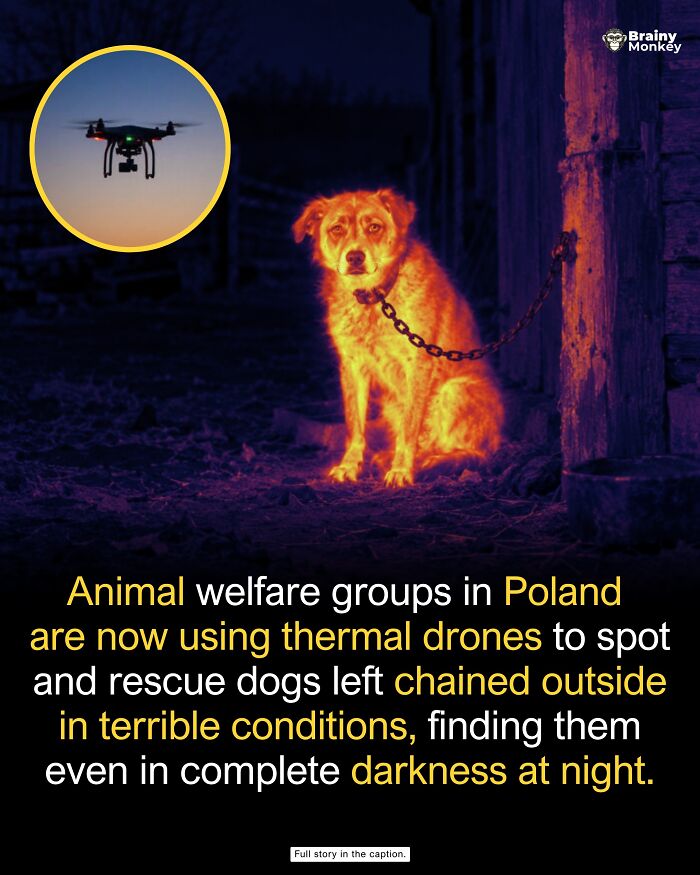
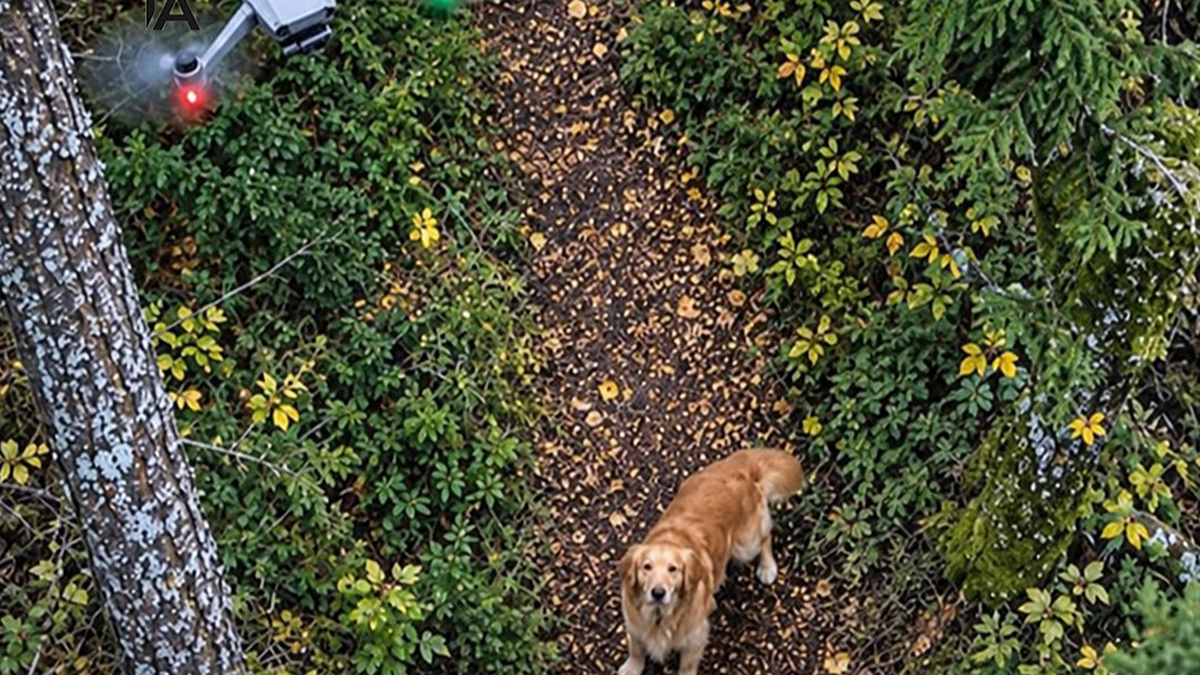
They’re using thermal drones to find chained dogs hiding in the dark.
In Poland, animal welfare groups are using thermal imaging drones to locate dogs left outside in freezing and dangerous conditions, even in places rescuers cannot easily see from the ground.
The drones detect body heat, helping teams spot animals behind fences, sheds, and barns. Powerful zoom cameras can also help inspectors check chain lengths and visible injuries from a distance.
Each flight can record GPS coordinates and timestamps, giving authorities evidence that may be used in animal cruelty investigations.
A single drone can scan dozens of properties in minutes, helping rescuers cover far more ground than traditional inspections alone.
Even in complete darkness, neglected dogs are becoming harder to hide.
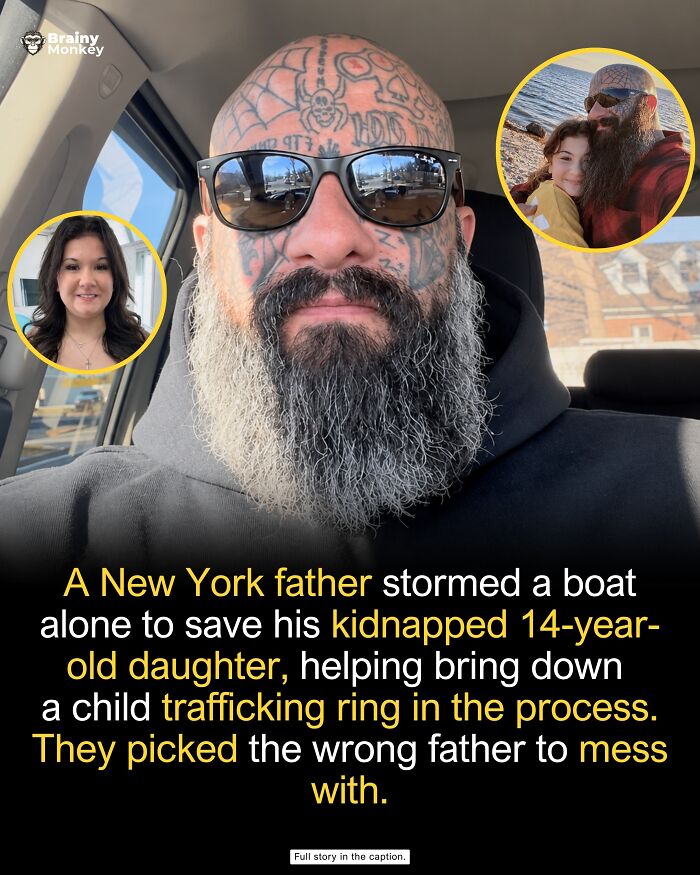
They picked the wrong father to mess with.
New York father Frank Gervasi spent 26 days searching for his missing 14-year-old daughter, Emmarae Gervasi, refusing to stop until he found her.
Then a tip led him to a 56-foot yacht in Islip, Long Island, New York.
Frank went there himself and found Emmarae before police arrived, finally bringing his daughter home after nearly 1 month of searching.
But the rescue was only the beginning. The case later expanded into a major investigation involving allegations of kidnapping, r**e, and child s*x trafficking.
Authorities ultimately arrested 13 people, while 11 suspects were named in an 83-count indictment connected to the case.
For Frank, it was never about being called a hero. He just wanted Emmarae back.
26 days. One determined father. And he never gave up until his daughter was home.

Well done, that dad. I hope Emmarae got the help she would've needed following that experience
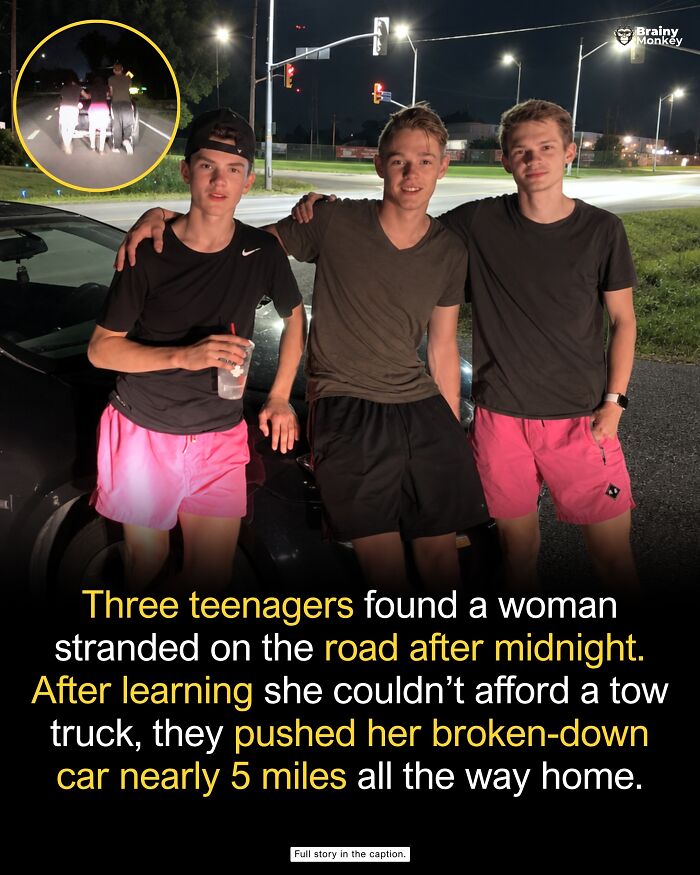
Three teenagers went out for a late-night snack and ended up pushing a stranger’s broken-down car nearly 7 kilometers home.
Around 1 a.m. in Ontario, Canada, 18-year-old Aeron McQuillin, 17-year-old Bailey Campbell, and 15-year-old Billy Tarbett spotted a woman stranded on the side of the road.
Her car had broken down, and she told them she couldn’t afford a tow truck. They could have kept driving. Instead, they decided to help.
With the woman steering, the three teenagers began pushing the car by hand, moving it nearly 7 kilometers down the road toward her home. The trip took more than 2 hours.
Another driver eventually stopped to help by following behind them with headlights and hazard lights on for safety.
Even with hills, exhaustion making things harder, the boys kept going.
Just after 4 a.m., they finally pushed the car into the woman’s driveway.
3 teenagers. Nearly 7 kilometers. More than 2 hours of pushing. One stranger they refused to leave behind.
Sometimes kindness looks like showing up when nobody expects you to.
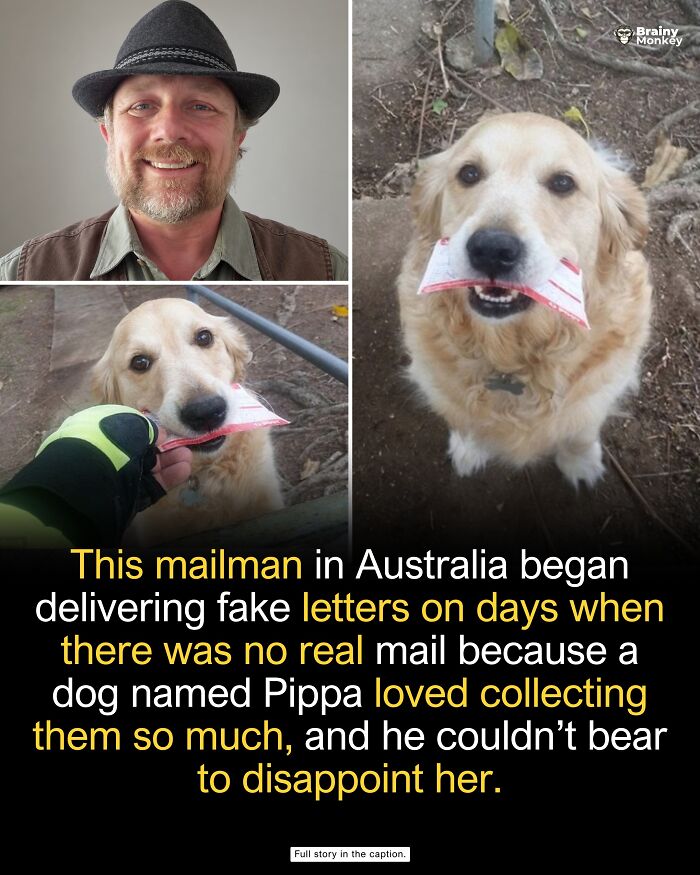
This mailman started writing fake letters for a dog because he couldn’t stand seeing her disappointed.
Back in 2016, Australian mail carrier Martin Studer had one very enthusiastic customer: a golden retriever named Pippa.
Every morning, Pippa would wait by the gate for Martin, gently take the family’s mail from his hand, and proudly carry it back inside like it was her official job.
But on days when there was no mail, Pippa would be left waiting with nothing to collect.
Martin couldn’t bear to disappoint her.
So he started carrying blank postal cards in his bag and writing “Mail for Pippa” on them.
Whenever there was no real post, he would hand Pippa one of the fake letters so she could still complete her daily mission.
1 mailman. 1 golden retriever. 0 real letters needed to make her day.
Sometimes the smallest act of kindness can mean everything to a dog.
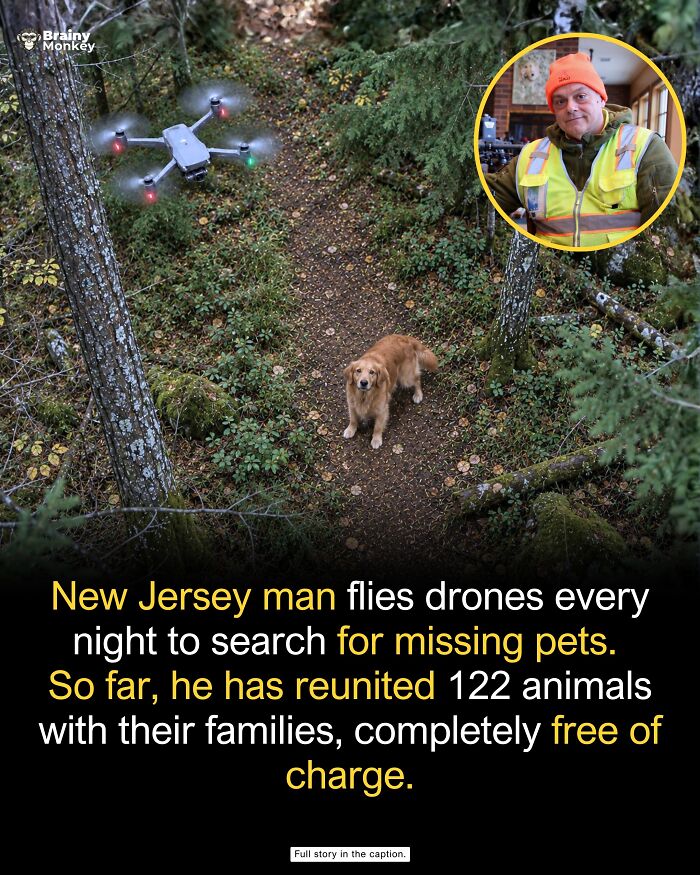
He’s known as the “Drone Ranger,” and his nighttime missions have already brought 122 lost pets back home, completely free.
In Manasquan, New Jersey, 64-year-old Michael Parziale spends his evenings flying a fleet of 18 drones, many equipped with thermal cameras, searching woods, fields, and neighborhoods for missing animals.
In just two years, he has helped recover 122 pets, including dogs, cats, and even a cow.
One puppy named Shade had been missing for 27 hours. Parziale found him in just 41 minutes.
And he never charges the families.
His nonprofit, Unmanned Search and Rescue (U.S.A.R.) Drone Team, runs on donations so seniors and low-income pet owners can get help without worrying about the cost.
Parziale also trains military veterans to fly drones, giving them skills that can lead to work in surveying, agriculture, photography, and infrastructure inspection.
122 animals found. Countless families relieved. One man using technology to bring loved ones home.
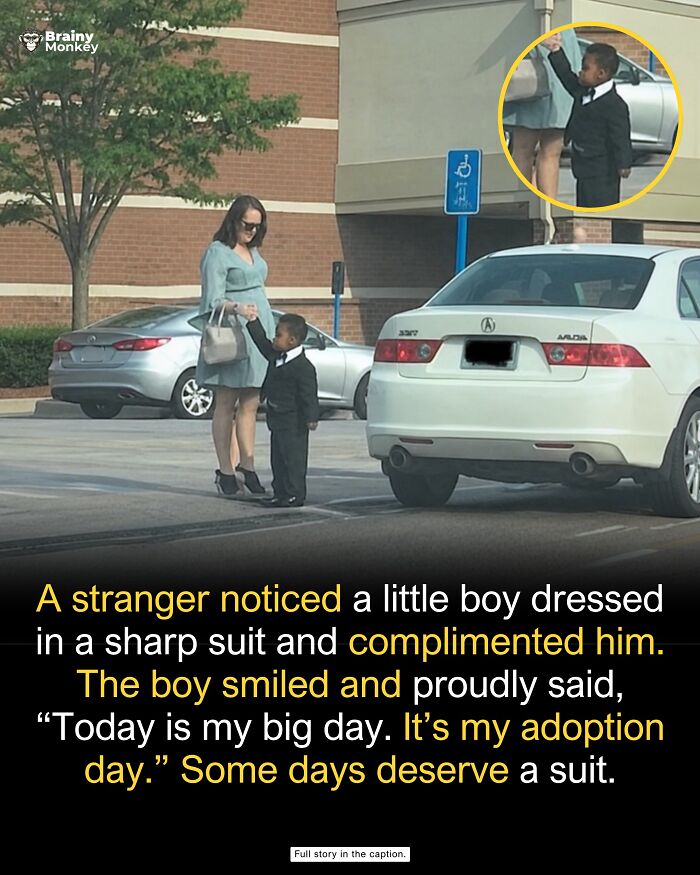
He wore a suit for one of the biggest days of his life, and one sentence melted hearts everywhere.
In 2022, a little boy was spotted in public dressed sharply in a suit. When a stranger complimented him, he smiled and proudly replied:
“Today is my big day. It’s my adoption day.”
The simple moment quickly spread online, with people celebrating the joy of a child finally beginning a new chapter with his forever family.
For many families, adoption day is more than paperwork. It is the day waiting ends and belonging begins.
One little boy. One sharp suit. One adoption day. One unforgettable reason to dress for the occasion.
Some days really do deserve a suit.
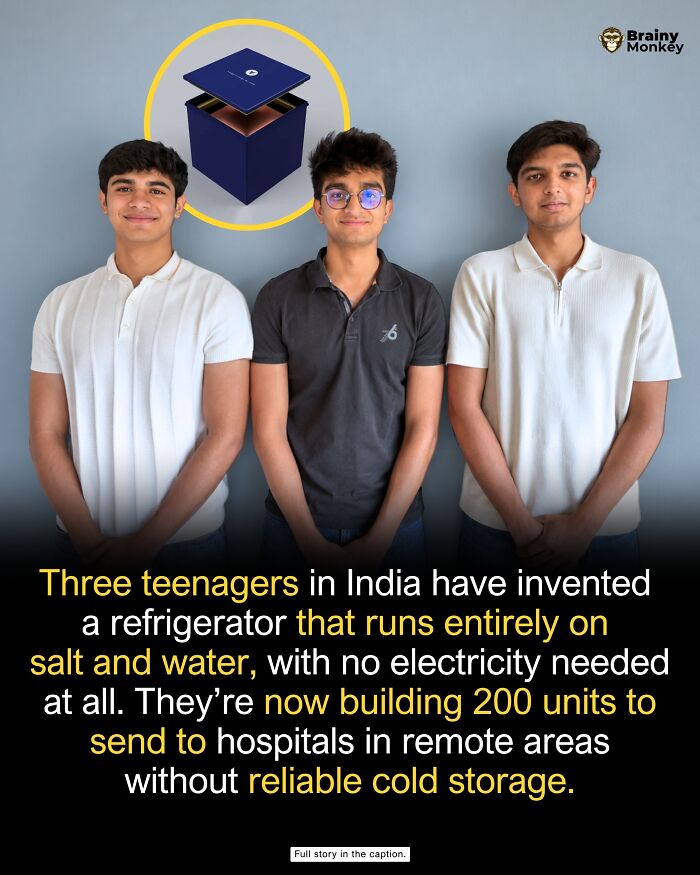
Three teenagers in India have built a refrigerator that could help save lives, and it runs on salt and water. No electricity. No batteries.
In 2025, 16- and 17-year-olds Dhruv Chaudhary, Mithran Ladhania, and Mridul Jain created Thermavault, a portable cooling system designed to keep medicines and vaccines cold in places where reliable electricity is hard to find.
The device can maintain temperatures of around 2–6 °C (35–43 °F) for 10–12 hours, making it suitable for storing temperature-sensitive medical supplies.
Even better, the salts used in the cooling process can be reused, helping keep operating costs low.
Their idea earned them the Earth Prize Asia 2025 and $12,500 in funding. Now, they plan to build 200 units and test them across 120 hospitals in India.
The inspiration came from a real problem. During COVID-19, many rural clinics struggled to keep vaccines cold because of unreliable power.
Their solution is simple, portable, and potentially life-changing.
Three teenagers. Salt, water, and one idea that could bring reliable cold storage to places that need it most.
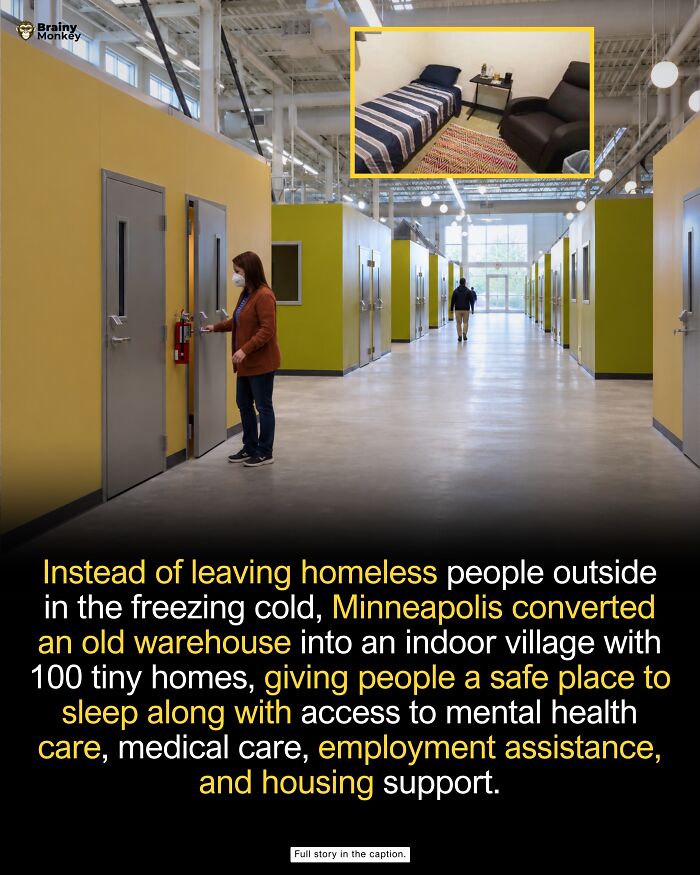
They didn’t build another crowded shelter. They turned an entire warehouse into a village of 100 private tiny homes.
In Minneapolis, a former warehouse was transformed into Avivo Village, an indoor community created for people experiencing homelessness.
Instead of sleeping in a large shared room, each resident gets their own private tiny home and a safe place to stay while working toward permanent housing.
The village also offers on-site mental health care, medical services, substance-use treatment, employment support, housing assistance, and case management.
Staff and security are available 24/7, giving residents support around the clock.
Since opening in December 2020, Avivo Village has helped hundreds of people get off the streets.
By July 2026, 873 people had stayed there, and 339 residents had moved into permanent housing.
100 private tiny homes.
873 people served.
339 moved into permanent housing.
One warehouse turned into a second chance.
He refused to let his disabled bird lose the sky.
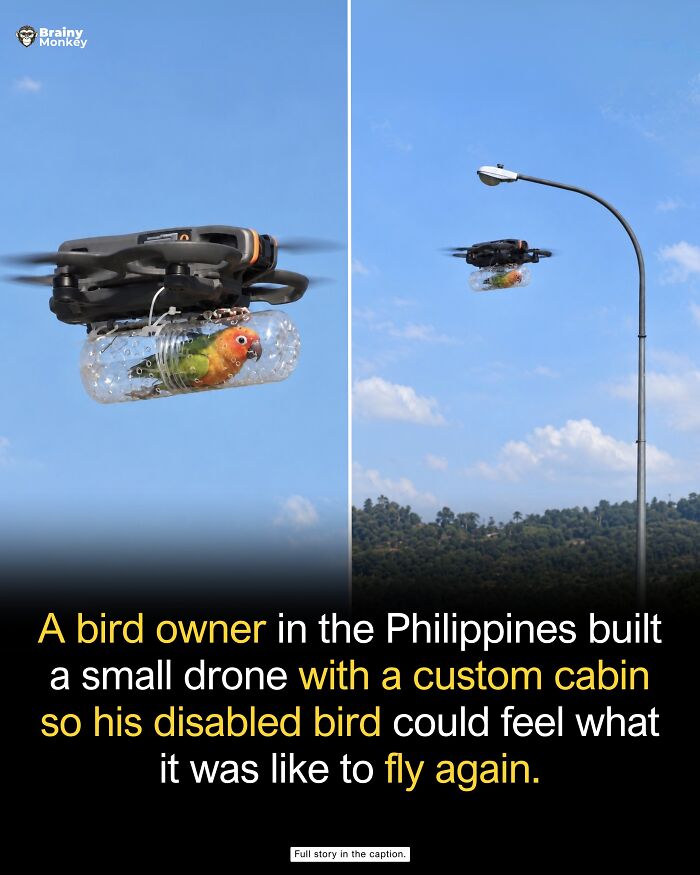
In Davao City, Philippines, bird owner Marc Joseph Colando built a custom transparent cabin beneath a drone so his injured lovebird, Nitya, could experience flying again.
Nitya had been badly hurt in a cat attack in 2025, leaving her unable to stand, walk, or land properly. She could still manage short, low flights, but nothing like before.
So Marc built her a lightweight, ventilated cabin and securely attached it beneath a DJI drone.
On April 13, 2026, Nitya took her first assisted flight.
Since then, she has spent 10 to 15 minutes in the air almost every day, soaring above fields and parks while chirping from her tiny cabin.
One bird. One drone. One owner who refused to let an injury take away her sky.
He didn’t buy 400,000 acres of the Amazon to profit from the trees. He bought the land to keep them standing.
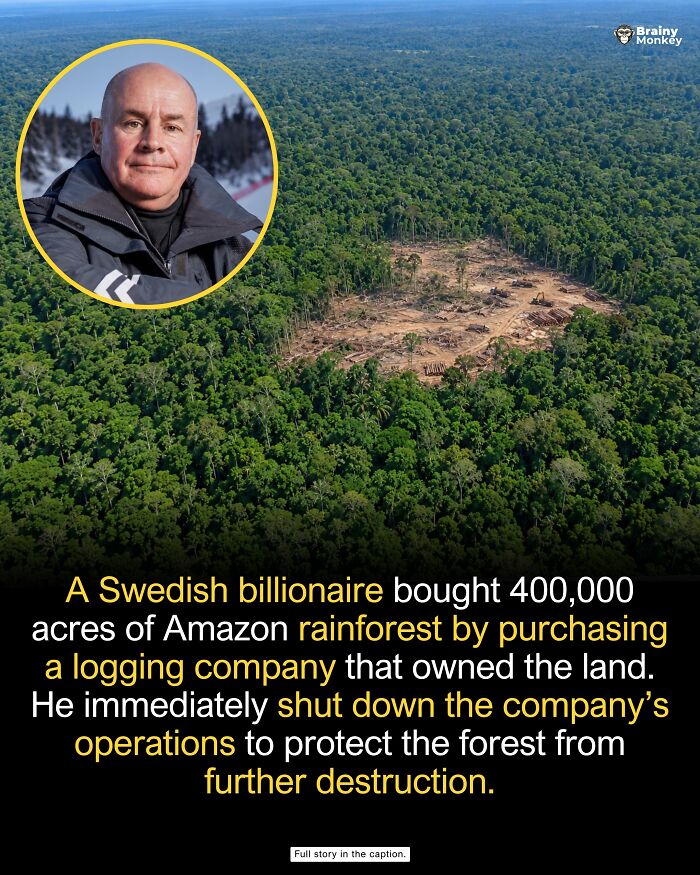
In 2005, Swedish billionaire Johan Eliasch acquired roughly 400,000 acres of Amazon rainforest in Brazil by purchasing a logging company that controlled the land.
Then he did something unexpected.
Instead of continuing to cut down trees, Eliasch shut down the company’s logging operations and focused on protecting the rainforest from further destruction.
The land became part of a much bigger conservation effort, preserving valuable wildlife habitat and helping protect one of the planet’s most important natural carbon stores.
His actions also helped draw more attention to the global fight against deforestation and the need to protect tropical forests.
400,000 acres.
1 logging company purchased.
1 decision to stop cutting trees.
A female shark at a Seoul aquarium got tired of a male shark repeatedly bumping into her. Her response was brutal: she ate him.
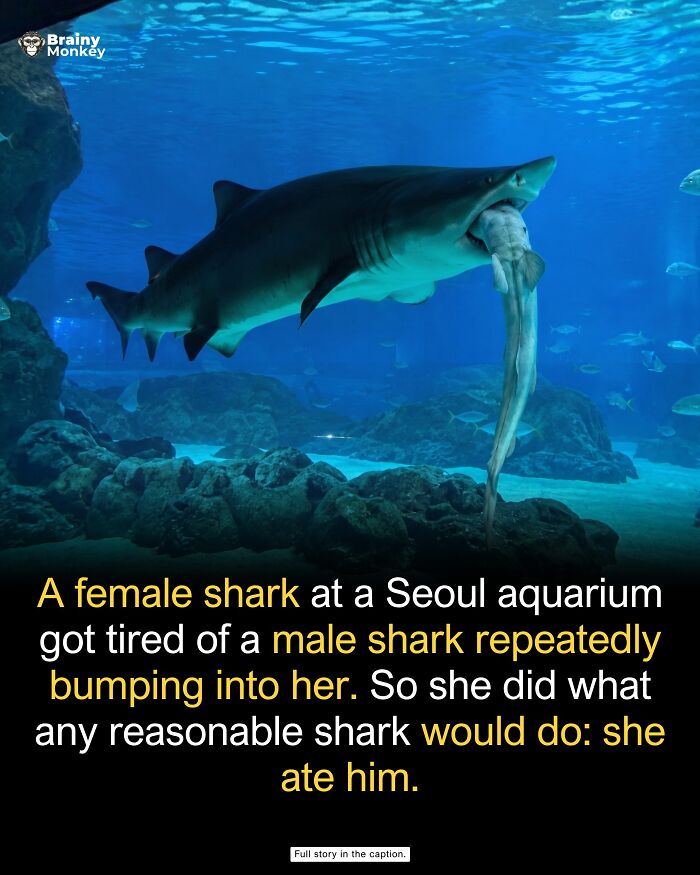
In January 2016, an 8-year-old female sand tiger shark at the COEX Aquarium in Seoul attacked a smaller 5-year-old male banded houndshark after repeated collisions inside their shared tank.
Then came the part visitors could hardly believe.
Over the next 21 hours, the female slowly swallowed the male almost completely, leaving only his tail sticking out of her mouth.
Aquarium staff described the incident as a territorial dispute, explaining that sharks can become aggressive when another animal repeatedly enters their space.
The size difference made it even more dramatic: the female was about 7.2 feet long, while the male was roughly 4 feet.
Denmark wants to make it much harder for AI to steal your identity.
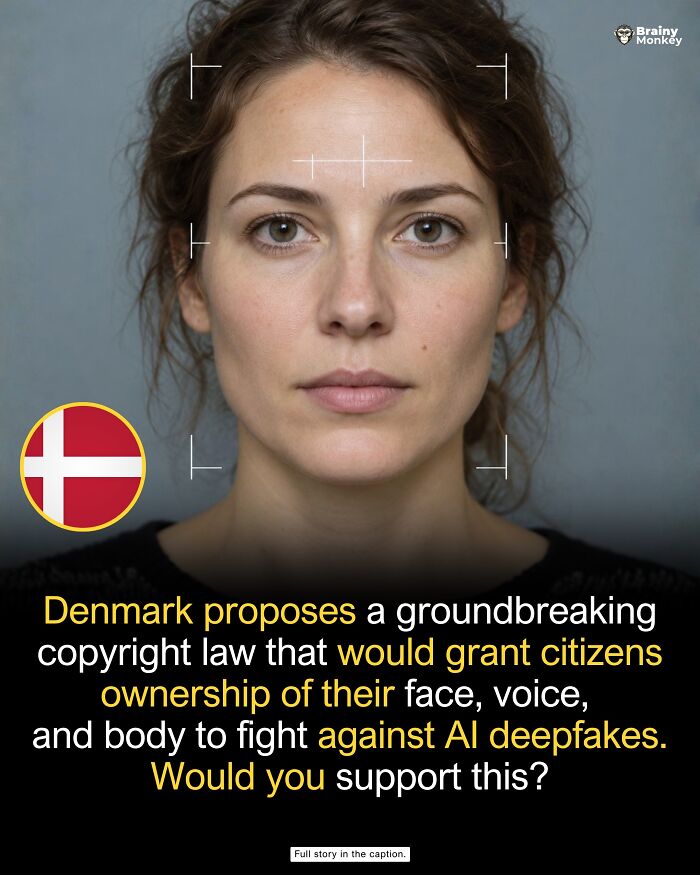
In June 2025, Denmark announced plans to strengthen its copyright law to protect people from realistic AI-generated deepfakes.
The proposal would give people stronger legal control over unauthorized digital copies of their face, voice, appearance, and movements.
If someone creates and publicly shares a realistic AI version of you without consent, you could demand that it be removed and potentially seek compensation.
The proposal has broad political support in Denmark and is aimed at protecting people from identity misuse as generative AI becomes more powerful.
It has not yet become law, but if approved, Denmark could introduce one of Europe’s strongest legal protections against deepfakes.
As AI gets better at copying people, Denmark is asking a simple question: Should your digital identity still belong to you?
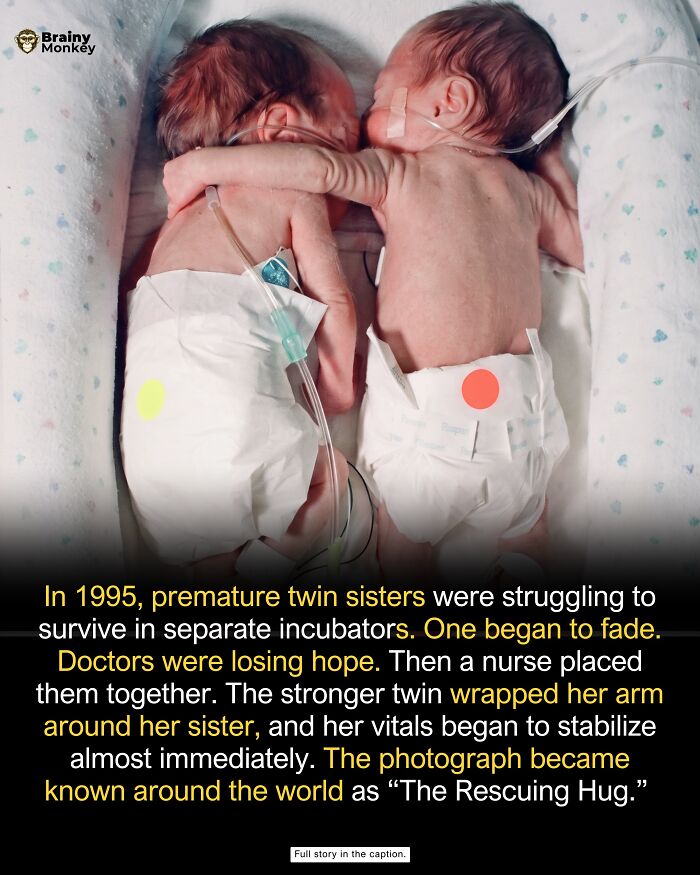
One tiny hug became one of the most unforgettable moments in neonatal history.
In 1995, premature twin sisters Kyrie and Brielle Jackson were born 12 weeks early, each weighing less than 2 pounds. Because of their fragile condition, they were placed in separate incubators.
Then Brielle began to deteriorate.
Her oxygen levels dropped, her heart rate climbed, and doctors struggled to stabilize her.
That’s when nurse Gayle Kasparian tried something unusual: she placed the twins together.
Within moments, Kyrie wrapped her tiny arm around Brielle. Soon after, Brielle’s breathing eased, her heart rate improved, and her temperature began to rise.
The photograph of that moment became famous around the world as “The Rescuing Hug.”
Two tiny sisters. One instinctive embrace. A moment that helped change how premature twins were cared for.
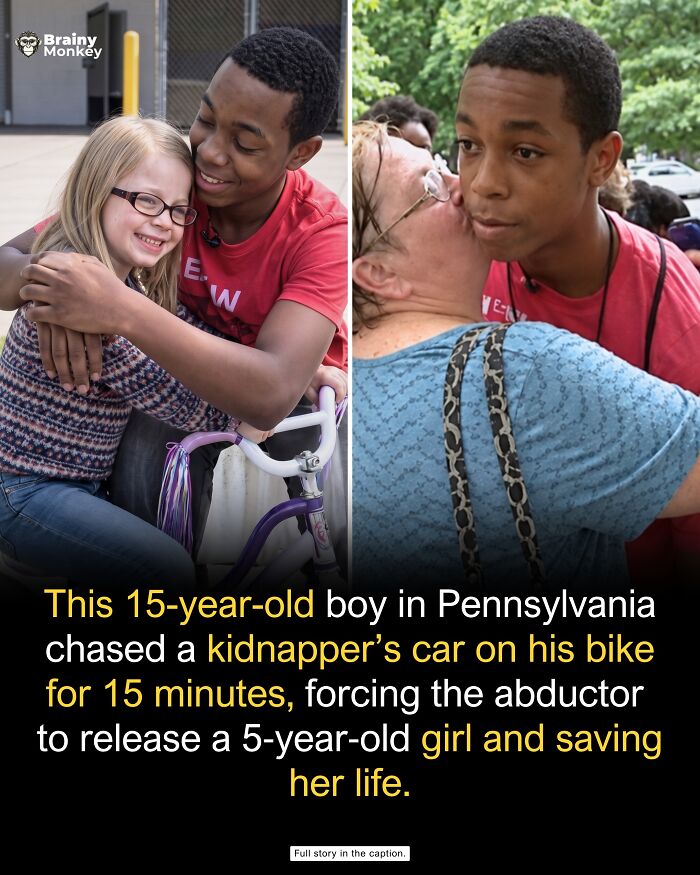
He was only 15 years old, but when a little girl was kidnapped, he refused to look away.
In 2013, Temar Boggs of Lancaster, Pennsylvania heard that 5-year-old Jocelyn Rojas had been taken from her front yard. He jumped on his bike with a friend, spotted a suspicious car, and chased it through the neighborhood for nearly 15 minutes.
The driver eventually stopped and let Jocelyn out.
She ran straight to Temar and said she wanted her mommy.
Police later arrested a suspect, and Jocelyn was safely reunited with her family.
One teenager. One bicycle. One 15-minute chase. One little girl brought home alive.
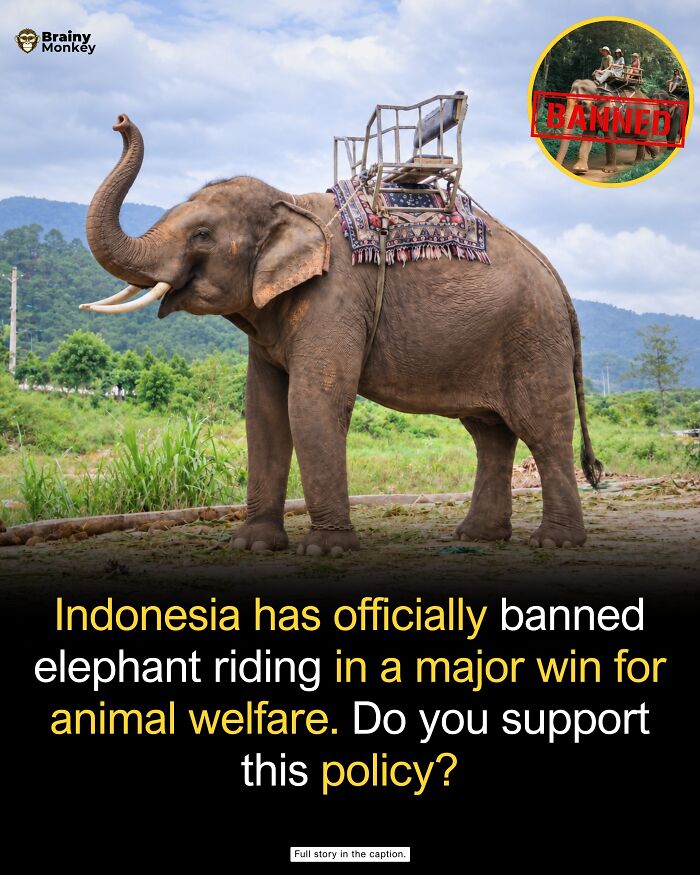
Indonesia has officially said the elephant ride is over.
In a major move for animal welfare, Indonesia has banned elephant-riding activities at conservation institutions and wildlife tourism facilities nationwide, shifting the focus from rides to observation, education, and more ethical wildlife experiences.
The policy was introduced in late 2025 and began taking effect in 2026.
Officials said the goal is to protect the physical and psychological well-being of elephants and move away from using them as tourist entertainment.
Wildlife parks and conservation centers are now being required to end elephant-riding programs and replace them with more animal-friendly alternatives.
Several major facilities have already made the switch, allowing visitors to observe and learn about elephants without climbing onto their backs.
2025: policy introduced.
2026: implementation begins.
1 nationwide shift away from elephant rides.
For Indonesia’s elephants, tourism is starting to look a lot less like entertainment and a lot more like respect.
Across the country, empty shopping centers are being repurposed into housing projects, with some designs even transforming food courts into communal dining halls.
With millions of square feet of retail space sitting empty after the decline of big chains like Sears and Target, developers across Canada are reimagining these properties as housing solutions.
Why malls? They already have many of the things new neighborhoods need: roads, parking, transit access, utilities, and huge amounts of indoor space.
Projects in cities such as Calgary, Edmonton, and Ottawa are exploring or building new uses for underused mall properties, including senior housing and rental apartments.
With Canada facing a housing shortage while traditional malls struggle with vacancies, developers are looking at millions of square feet of retail space differently.
Less empty retail. More places to live. One old idea getting a completely new purpose.
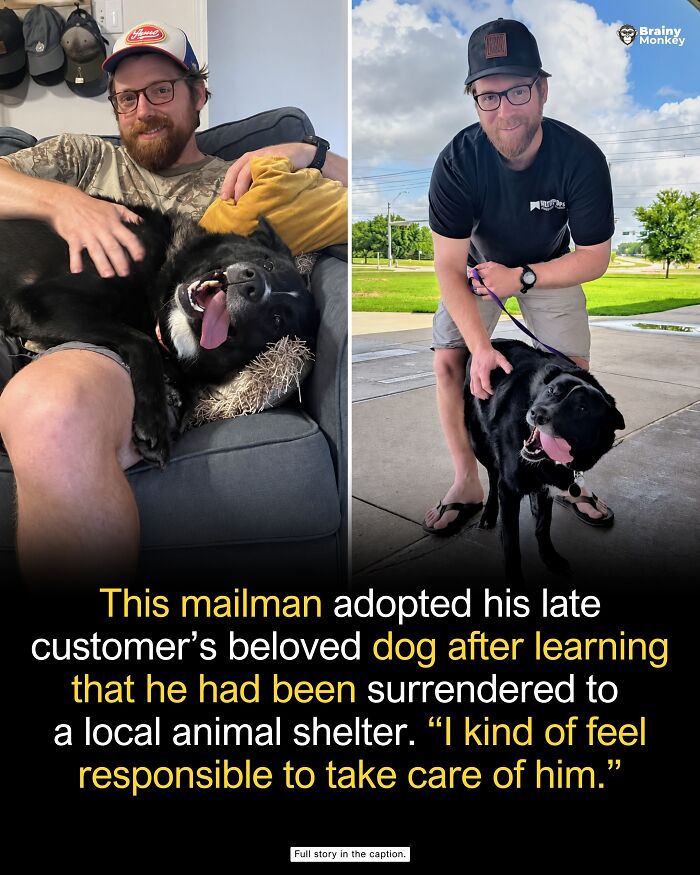
For three years, this mailman delivered letters to the same house. Along the way, he became best friends with the dog waiting at the door.
In Denton, Texas, mail carrier Ian Burke formed a bond with Floyd, the beloved dog of a Vietnam veteran who used a wheelchair.
When Floyd’s owner passed away in 2025, the 70-pound German shepherd and border collie mix was surrendered to the City of Denton Animal Shelter.
The moment Burke found out, he knew exactly what he had to do.
He arrived at the shelter at 9:50 a.m., ten minutes before it opened, determined to be first in line to adopt the dog he had known for three years.
“I kind of feel responsible to take care of him,” Burke said. “I think his former owner would be pleased to know his mailman is taking good care of his dog.”
Three years of friendship. One heartbreaking goodbye. One mailman who made sure Floyd never had to wonder where home was again.
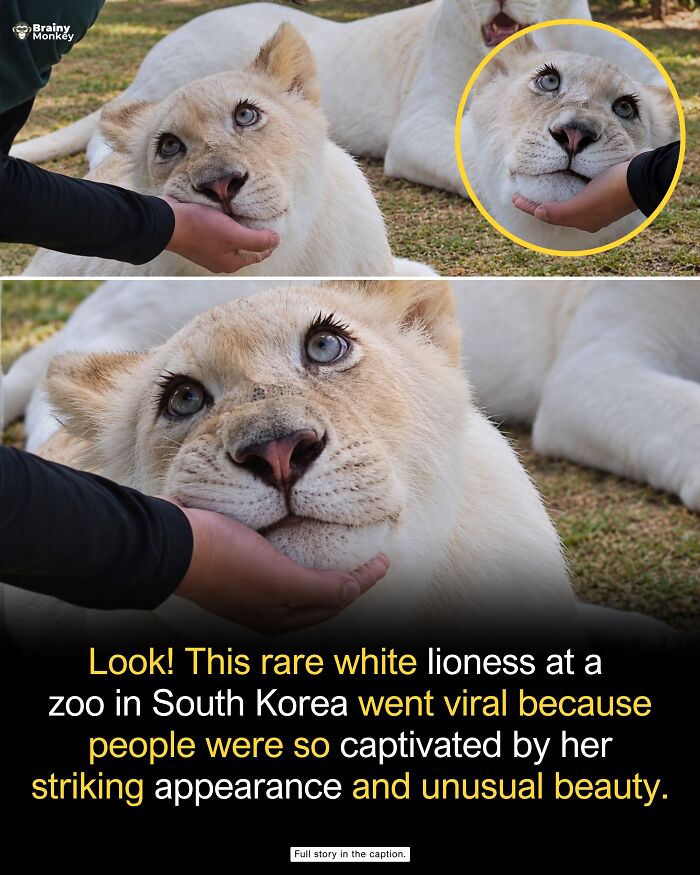
This rare white lioness became an internet sensation simply because people couldn’t stop admiring her beauty.
Her name is Luna, and she lives at Nature Park Zoo in Daegu, South Korea.
Born in August 2025, Luna quickly captured attention online with her pale cream-colored coat, striking eyes, and almost unreal appearance.
But Luna is not albino. Her unusual coloring comes from leucism, a genetic condition that reduces pigmentation while still allowing normal color in the eyes and skin.
Her story is even more special because her parents were reportedly rescued from poor conditions at another zoo before Luna and her siblings were born.
Now, Luna has become one of those animals people can’t seem to scroll past.
One look at those eyes and it’s easy to see why she went viral.
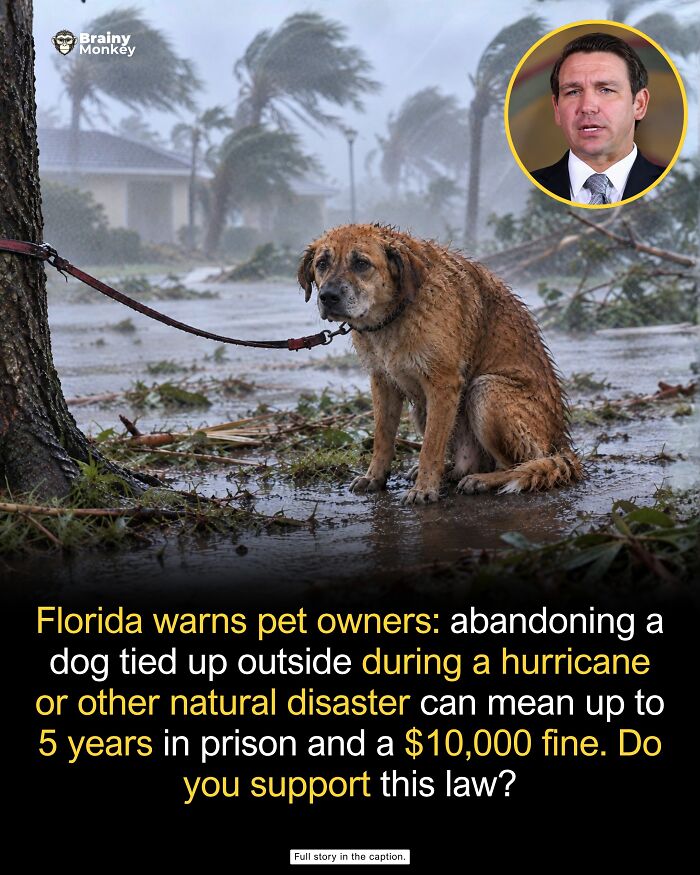
Leave your dog tied up outside during a hurricane in Florida, and you could face a felony, up to 5 years in prison, and a $10,000 fine.
Florida’s Trooper’s Law makes it a third-degree felony to restrain a dog outside and abandon it during a declared natural disaster or evacuation.
The law was inspired by Trooper, a dog who was found tied to a fence as floodwaters rose ahead of Hurricane Milton. His rescue sparked widespread outrage and helped push Florida toward stronger protections for pets during emergencies.
State officials are also reminding residents that pet-friendly shelters are available during evacuations, so leaving an animal behind is not an acceptable option.
During a hurricane, pets have no way to save themselves. They depend entirely on the people responsible for them.
Up to 5 years in prison and a $10,000 fine for abandoning a dog during a disaster. Do you support this law?

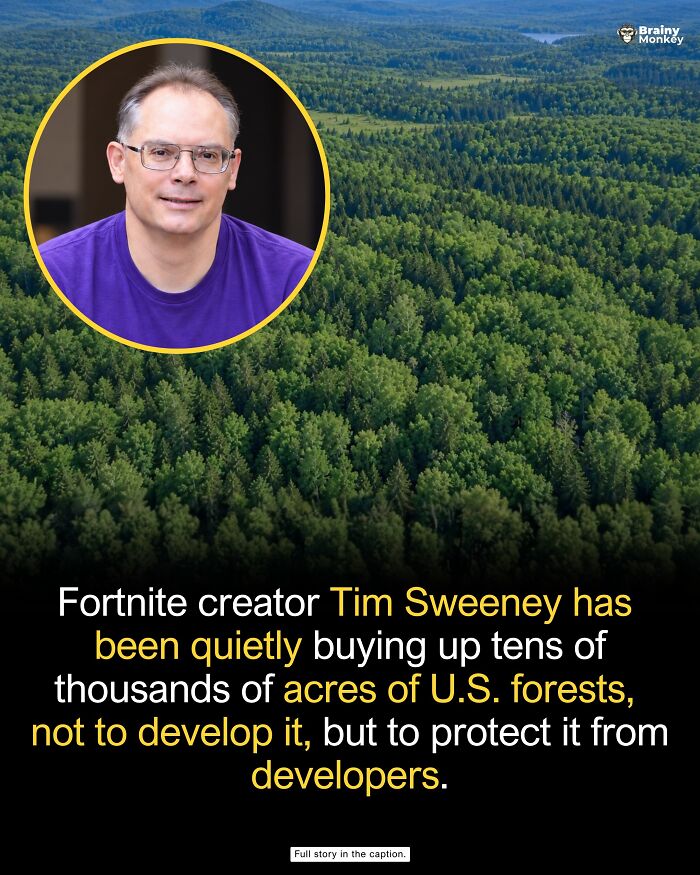
The man behind Fortnite is spending part of his fortune on something very different: saving forests from development.
Epic Games founder and CEO Tim Sweeney has spent years quietly buying huge stretches of wilderness across North Carolina, then protecting the land instead of building on it.
Since 2009, Sweeney has acquired more than 54,000 acres across 15 counties, including forests, mountain landscapes, and habitats home to rare plants and wildlife.
And he hasn’t kept all of it.
In 2021, Sweeney donated 7,500 acres in the Roan Highlands to the Southern Appalachian Highlands Conservancy, one of the largest private conservation land donations in North Carolina history.
Rather than turning the land into subdivisions, resorts, or commercial projects, he has worked with conservation groups and government agencies to help keep thousands of acres permanently protected.
54,000+ acres. 15 counties. 7,500 acres donated. Nearly two decades of conservation.
He helped build one of the biggest games in the world. Now he’s helping make sure some parts of the real world stay untouched.
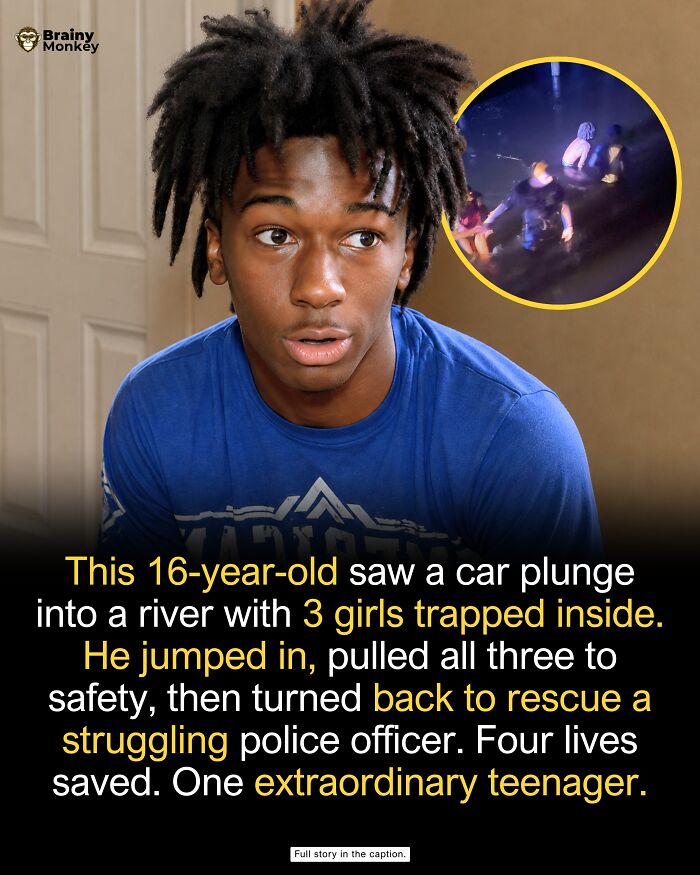
He was only 16 years old, but when four people needed help, he didn’t hesitate.
At around 2:30 a.m., Corion Evans saw a car carrying three teenage girls plunge into the Pascagoula River in Mississippi and begin sinking about 20 feet from shore.
Corion immediately jumped into the water.
He swam back and forth through the darkness, pulling all three girls to safety, one by one. Then, when a police officer who had entered the water began struggling himself, Corion went back again and helped save him too.
3 teenage girls. 1 police officer. 4 lives saved by one 16-year-old.
His bravery later earned recognition from city officials, the Mississippi Senate, and the American Red Cross, which honored him with a national hero award.
Corion didn’t have time to think about medals or recognition that night. He simply saw people in danger and acted.
Four people made it home because one teenager refused to stand by and watch.

True definition of what a Hero is. Corion did an incredible thing indeed, outstanding.
Imagine walking through a city where the biggest billboards don’t feature celebrities or influencers, but the scientists who helped change the world.
That’s exactly what’s happening in parts of China, where several cities have started displaying renowned scientists on giant public screens, metro stations, shopping centers, and other high-visibility spaces usually dominated by commercial ads.
Among the faces being featured are rocket scientist Qian Xuesen, Nobel Prize winner Tu Youyou, and agricultural pioneer Yuan Longping, with displays highlighting their discoveries, achievements, and contributions to society.
The idea has attracted attention because it puts science, education, and innovation in the same spotlight usually reserved for entertainment and celebrity culture.
Supporters say the message to young people is simple: these are people worth looking up to too.
The trend began in parts of Shandong Province and has since appeared in places including Henan, Anhui, Inner Mongolia, and beyond.
Chinese cities are putting scientists on giant billboards so the next generation grows up seeing discovery and achievement as something worth celebrating. Would you support this where you live?
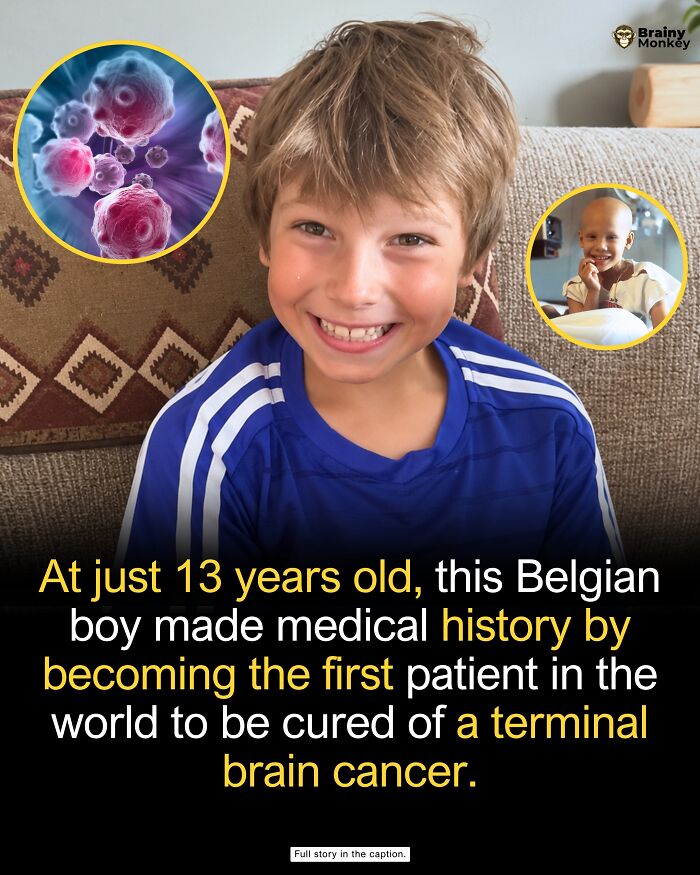
At just 13 years old, Lucas achieved something doctors had never seen before.
At age six, he was diagnosed with diffuse intrinsic pontine glioma (DIPG), one of the deadliest childhood brain tumors, with most patients surviving less than two years.
Lucas joined the BIOMEDE clinical trial in Paris and was treated with everolimus, a drug designed to block pathways involved in tumor growth.
Then something extraordinary happened.
Scan after scan showed the tumor shrinking, until eventually it disappeared completely.
By 2024, Lucas was reported as the first known patient in the world to achieve a complete, lasting response to DIPG, turning a diagnosis once considered almost universally fatal into a medical milestone.
A boy given almost no chance became the case that gave doctors a reason to believe the impossible might not stay impossible forever.
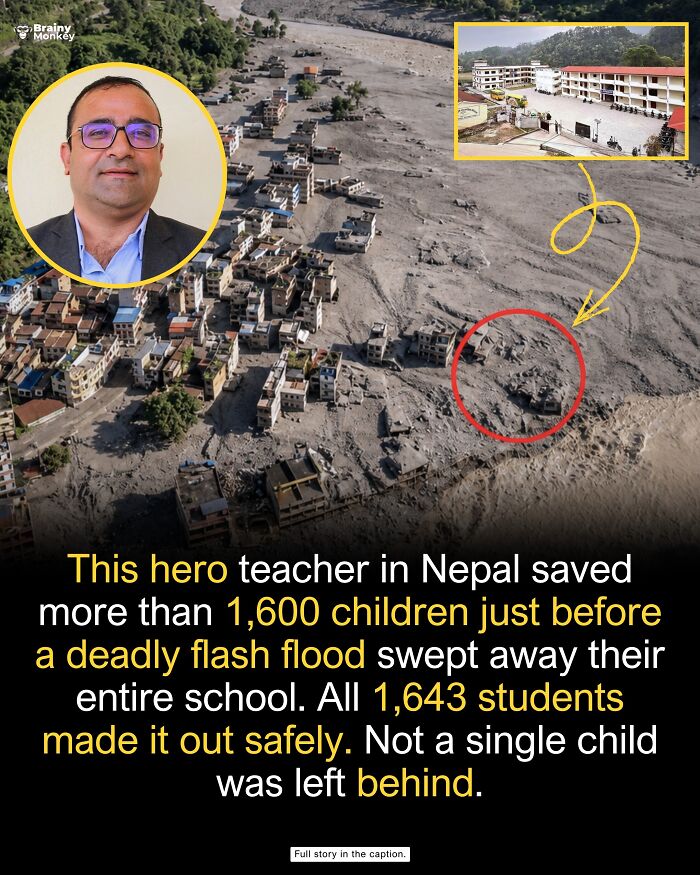
They called him a principal. That morning, he became the reason 1,643 children made it home alive.
On August 26, 2026, Rajendra Dawadi, principal of Tribhuvan Trishuli Secondary School in Nepal, received an urgent warning that a catastrophic flash flood was rushing toward the Trishuli Valley.
He didn’t wait.
Dawadi rang the school bell, ordered classrooms evacuated, called school bus drivers to turn back, and led students uphill toward higher ground. Minutes later, floodwaters swept through the area and destroyed the school buildings.
All 1,643 students escaped. Not a single child was swept away from the school. Some students and staff were stranded on higher ground for days afterward, but they had escaped the immediate disaster.
Tragically, two school employees were later reported passed away after separately returning toward the flood zone. The wider disaster has devastated Nepal and Tibet, with hundreds of lives ended and thousands still missing.
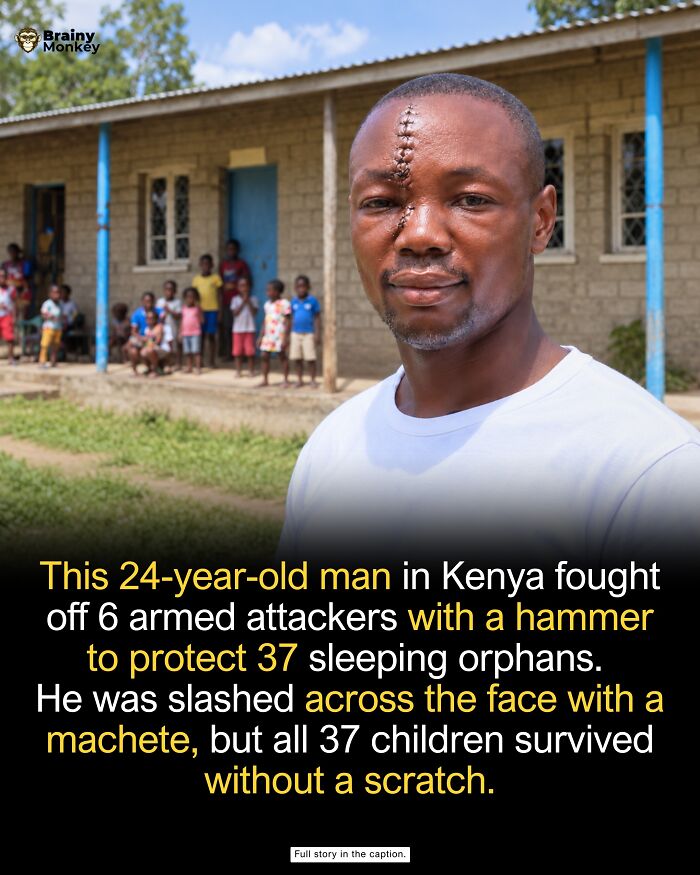
He stood between six machete-wielding attackers and 37 sleeping children, armed with nothing but a hammer.
In January 2012, 24-year-old Anthony Omari was guarding the Faraja Children’s Home in Ngong, Kenya, when six intruders tried to break in while 37 orphans slept inside.
Omari grabbed a hammer and fought back.
During the struggle, he was slashed across the head and face, suffering deep wounds that required stitches. But he refused to retreat until the attackers finally fled.
Not one of the 37 children was harmed.
One man. One hammer. Six armed attackers. 37 children protected.
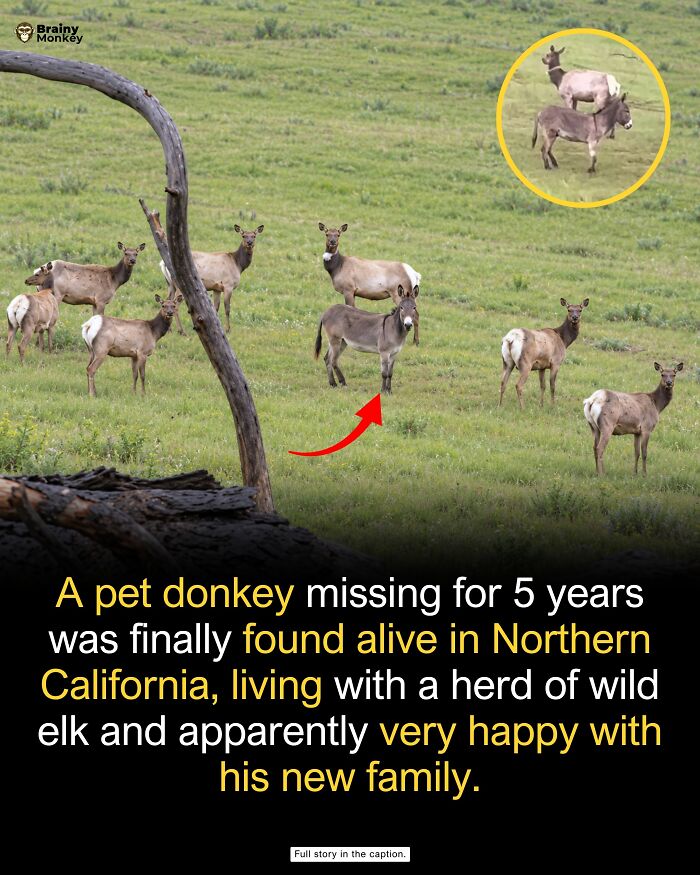
He disappeared for 5 years, then turned up living with an entirely different species.
A pet donkey named Diesel went missing in 2019 near Northern California’s Cache Creek Wilderness after getting spooked during a hike.
His owners searched for weeks, even using drones, but eventually had to accept that he might never come home.
Then in 2024, a hunter spotted something unexpected.
Diesel was alive and living with a herd of about 15 wild elk.
Video showed him moving comfortably among the herd, looking healthy, well-fed, and seemingly accepted as one of their own.
When his owners saw the footage, they decided not to bring him back because he appeared happy and settled into his new life in the wild.
5 years missing.
About 15 elk.
1 donkey who found himself a completely new family.
Sometimes getting lost leads you somewhere you never expected.
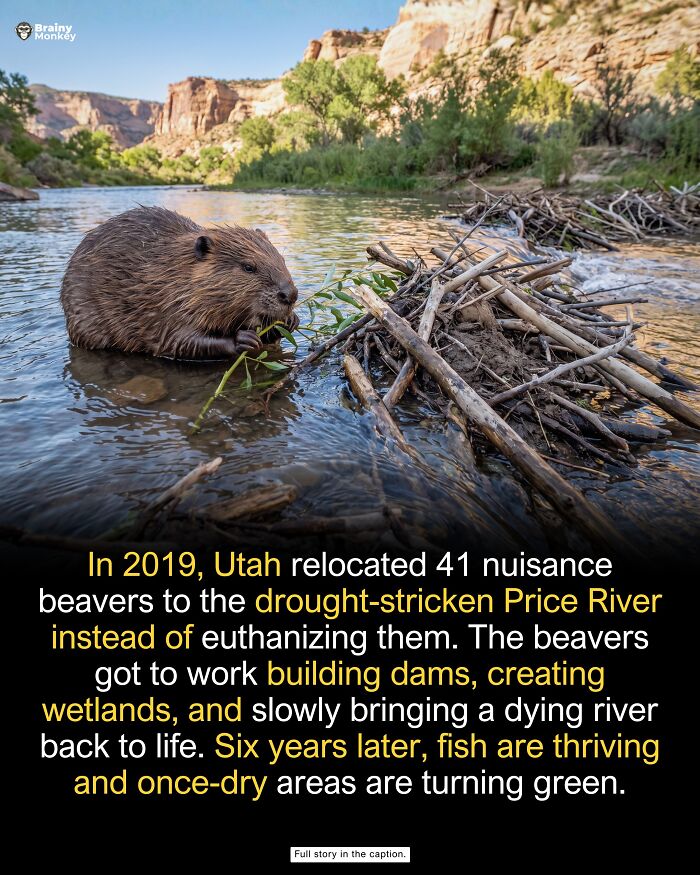
In 2019, Utah gave 41 nuisance beavers a second chance instead of euthanizing them, and they returned the favor by helping bring a struggling river back to life.
Wildlife experts relocated the beavers to the drought-stricken Price River, where they immediately did what beavers do best: build dams, slow rushing water, and create wetlands.
Those dams helped hold water in the landscape longer, rehydrate dry areas, and create new habitat for fish and other wildlife.
Six years later, the transformation is hard to miss.
Fish are thriving. Wetlands have returned. Once-dry areas are turning green again.
The animals once considered a nuisance became part of the solution.
41 beavers were given a second chance, and an entire river ecosystem got one too.
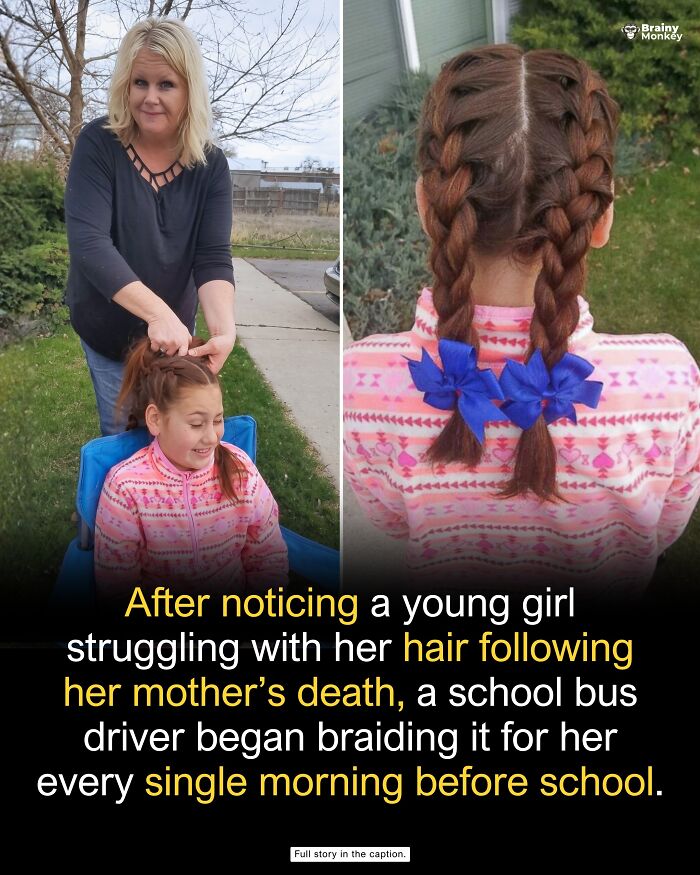
Every morning before school, kindness was waiting on the bus.
When 11-year-old Isabella Pieri lost her mother at just 9 years old, even simple things like doing her hair became difficult. Her father did his best, but styling it was something he struggled with.
Then her school bus driver, Tracy Dean, noticed.
Instead of looking the other way, Tracy began braiding Isabella’s hair before school, turning a small act of kindness into a daily routine that gave the young girl confidence, comfort, and a little extra care when she needed it most.
Nobody asked Tracy to do it. It wasn’t part of her job.
She simply saw a child who needed someone and decided to show up.
Sometimes the people who change a child’s life aren’t the ones they expect. They’re simply the ones who notice.
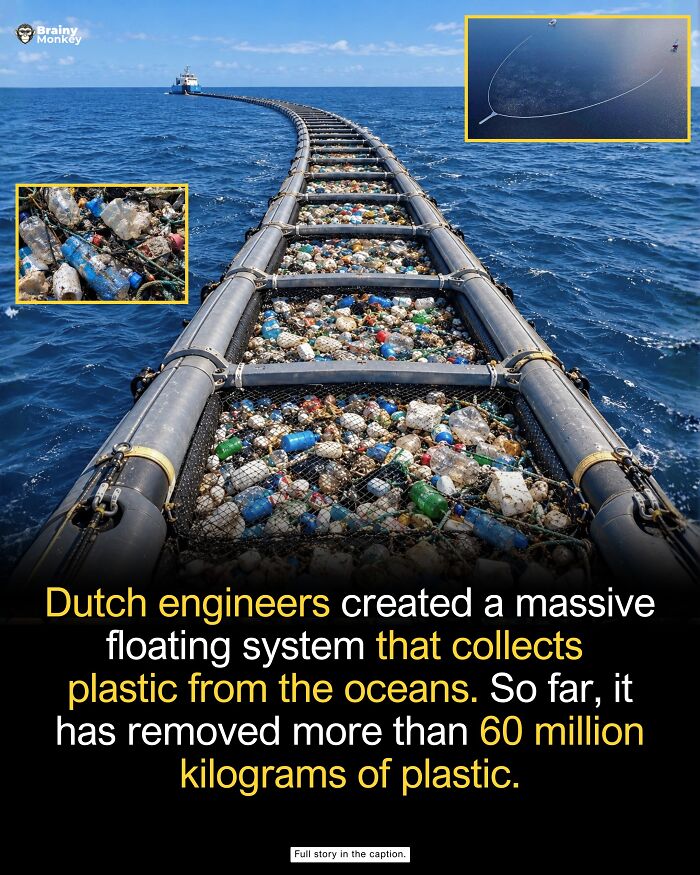
What started as one teenager’s idea is now pulling millions of kilograms of plastic out of the world’s oceans.
Founded in 2013 by Dutch inventor Boyan Slat, The Ocean Cleanup now deploys massive floating barriers across polluted waters, including the Great Pacific Garbage Patch, where ocean currents naturally concentrate plastic waste.
The project also uses solar-powered Interceptors in rivers to stop trash before it ever reaches the sea.
So far, the organization says it has removed more than 60 million kilograms of plastic from oceans and waterways worldwide.
What began as one young inventor’s ambitious idea has grown into a global operation involving more than 150 engineers and scientists, all working toward an even bigger goal: reducing floating ocean plastic by 90% by 2040.
60+ million kilograms removed. 150+ engineers and scientists. One mission: stop plastic before it takes over our oceans.
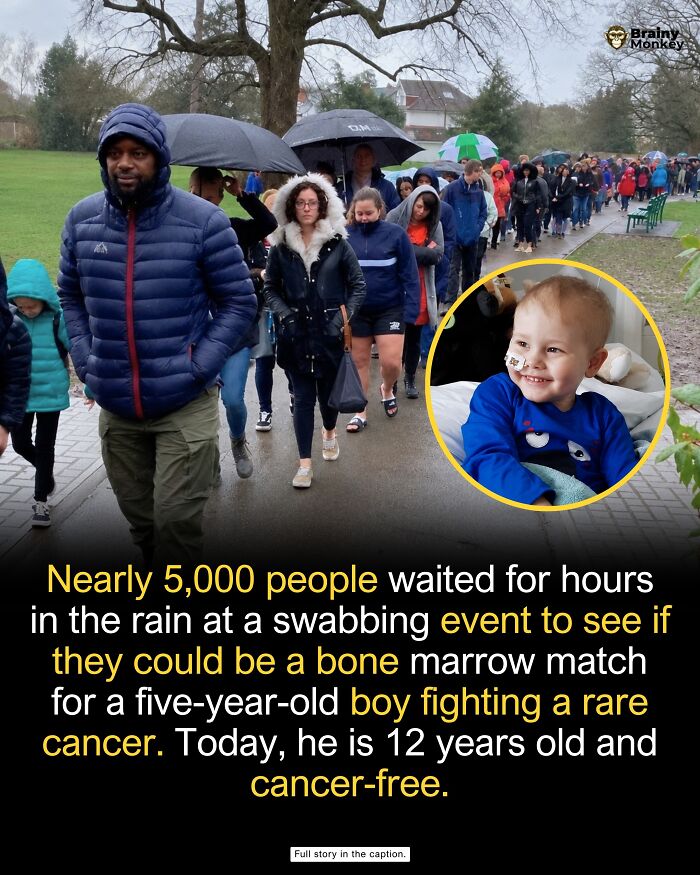
They stood in the pouring rain for hours, not for tickets or a sale, but for the chance to save a 5-year-old boy’s life.
In March 2019, Oscar Saxelby-Lee from Worcester, England, was battling a rare and aggressive form of leukemia and urgently needed a stem cell transplant.
His community organized a donor drive at his primary school, hoping to find a match.
Then something incredible happened.
Despite the relentless rain, 4,855 people showed up and waited in line for hours just to have their cheeks swabbed. The turnout more than doubled the charity’s previous single-event record of 2,200 registrations.
And it worked.
A matching donor was found for Oscar. After his transplant and further treatment, he went on to become cancer-free.
4,855 strangers. One little boy. One massive act of community kindness.
Sometimes, saving a life really can begin with something as simple as a cotton swab.
A grocery store where families in need can shop for free is changing how food assistance works in Canada.
The Regina Food Bank in Saskatchewan opened a grocery-store-style food hub where registered clients can walk through the aisles and choose the food they actually need.
Families can visit once every 2 weeks by appointment, and clients can leave with about $200 worth of groceries per person at no cost.
Instead of receiving a pre-packed food hamper, people can select their own items, giving them more choice and dignity.
The store is designed to make food assistance feel more like regular grocery shopping while helping families stretch their budgets during difficult times.
Free groceries, but with the freedom to choose. Should more cities do this?
Nashville just moved one step closer to putting Dolly Parton’s name on its airport.
On September 11, 2026, the Metropolitan Nashville Airport Authority board voted unanimously, 6–0, to begin the process of renaming Nashville International Airport (BNA) in her honor.
If the change is completed, Dolly would become the first woman to have a major U.S. airport named after her.
Support has been huge. The proposal has backing from Tennessee leaders, Nashville officials, and more than 175,000 people who signed a petition supporting the idea.
Six votes. 175,000 supporters. One legendary Tennessee icon.
Soon, millions of travelers could be flying through an airport bearing the name Dolly Parton.
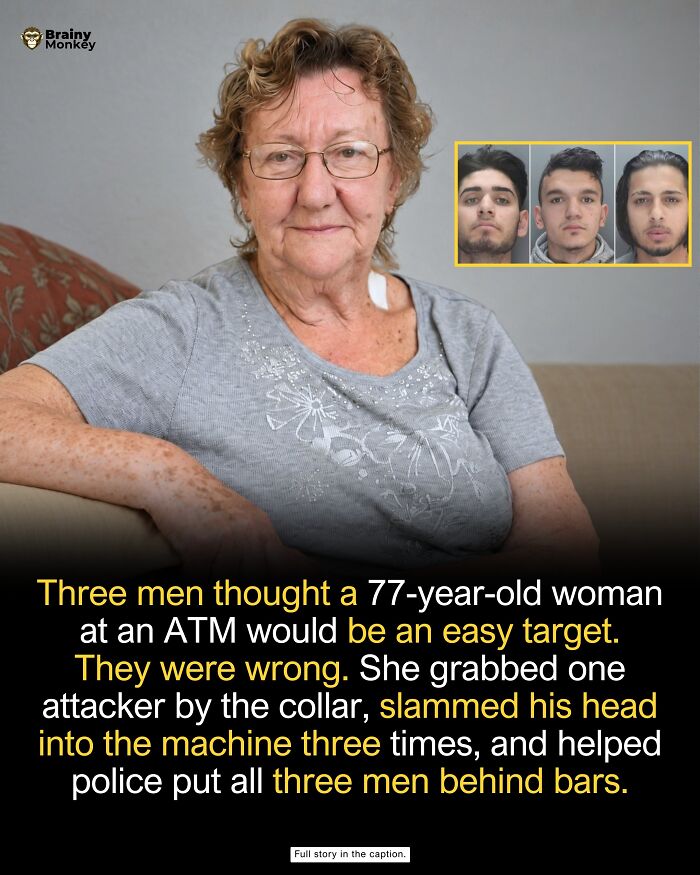
Three robbers thought a 77-year-old woman at an ATM would be an easy target. They were very wrong.
In 2016, Winifred Peel was using an ATM in England when 3 men tried to rob her.
Instead of freezing, she fought back, grabbed one attacker by the collar, and slammed his head into the ATM 3 times.
The men fled, but all 3 were later caught and sent to prison for the attempted robbery.
At 77 years old, Winifred proved they had picked the wrong person to underestimate.
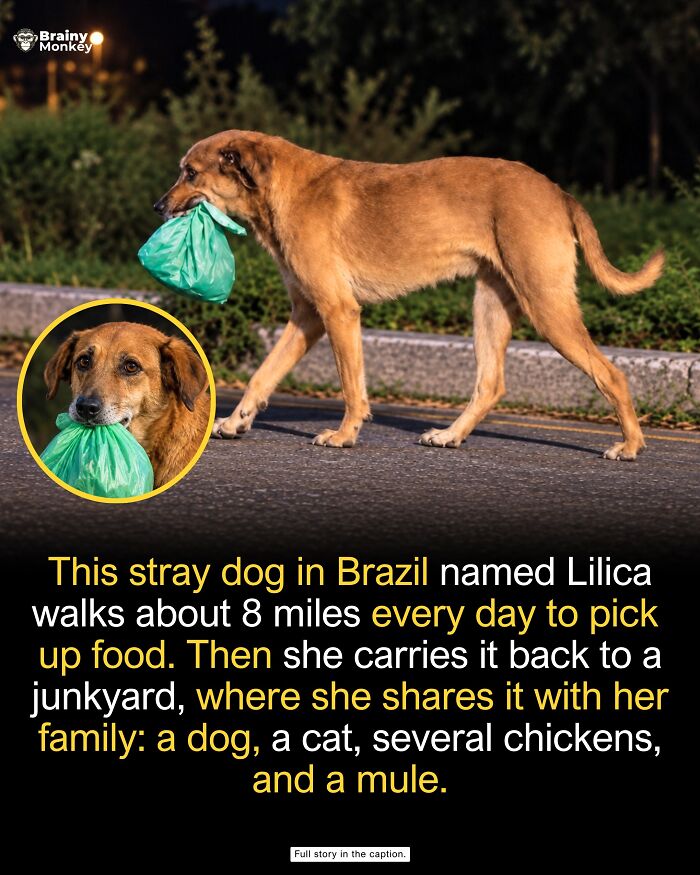
Every night, a stray dog in Brazil walked miles for food, but she never kept it all for herself.
In São Carlos, São Paulo, a dog named Lilica became known for traveling up to 8 miles, about 12 km, to meet a teacher named Lucia Helena de Souza, who would give her food.
Then Lilica would carry the bag all the way back to the junkyard where she lived.
Waiting for her were the animals she considered family: another dog, a cat, several chickens, and even a mule.
She repeated the journey for years, sharing what she had instead of eating it alone.
One stray dog. An 8-mile journey. One bag of food. A whole family waiting for her return.
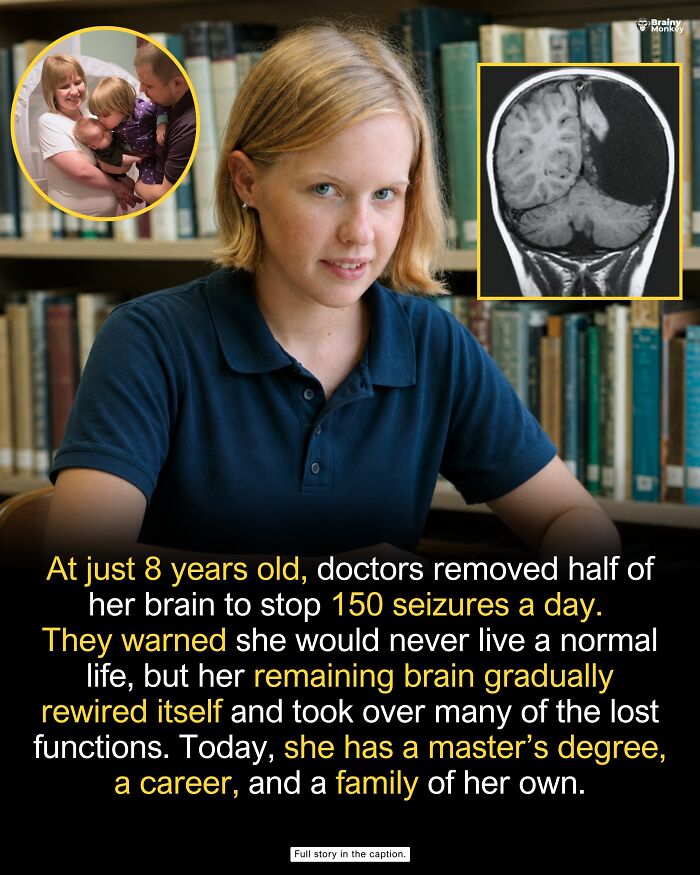
At just 8 years old, she was having up to 150 seizures a day. Then doctors removed half of her brain.
Christina Santhouse underwent a rare hemispherectomy, a life-saving surgery that removed the right hemisphere of her brain in an effort to stop the relentless seizures.
Doctors warned that the consequences could be devastating. She might struggle to walk, speak, or ever live independently.
But Christina’s brain did something extraordinary.
Through neuroplasticity, the remaining half gradually reorganized itself and took over many of the functions that had been lost.
And she didn’t just recover.
Christina went on to earn a bachelor’s degree and a master’s degree, build a career as a speech pathologist, and start a family of her own.
Half a brain removed. 150 seizures a day stopped. A life doctors feared might never be normal became anything but ordinary.
Her story is a remarkable example of just how powerful and adaptable the human brain can be.
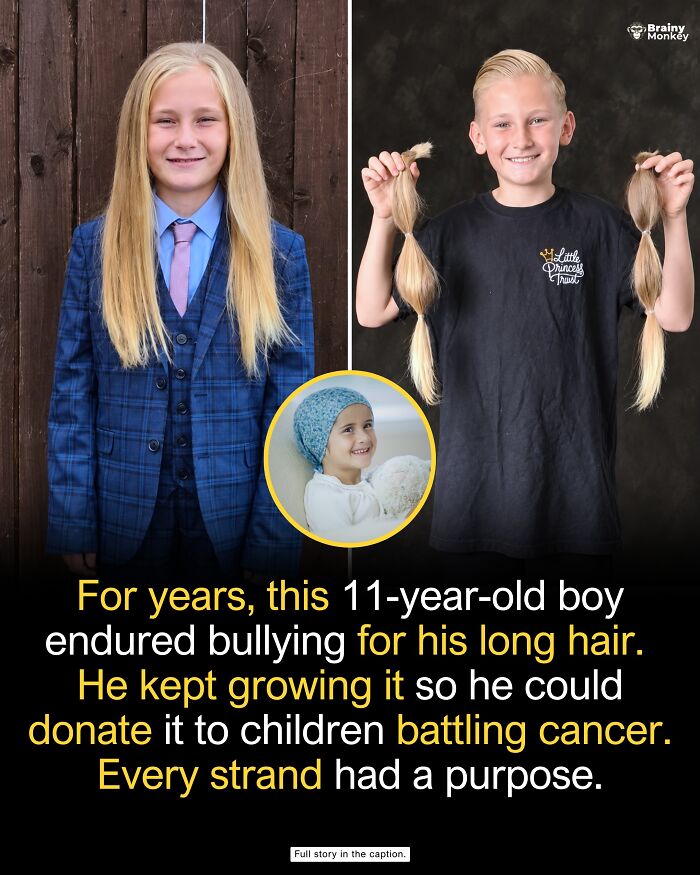
He was bullied for his long hair, but he refused to cut it because every inch had a purpose.
At just 11 years old, Jacob McPeake from Gloucester, England, decided to grow his hair for children who had lost theirs during cancer treatment. His motivation was deeply personal. Three of his grandparents had battled cancer.
As his hair grew longer, so did the teasing. Other children mocked him so much that Jacob nearly gave up and cut it early.
But he didn’t.
He kept growing it until he could finally donate an incredible 18 inches of hair to help make wigs for children experiencing hair loss. He also raised £1,230 for the cause.
His determination even caught the attention of professional rugby player Guy Thompson, who had previously grown his own hair for charity and encouraged Jacob to keep going.
11 years old. 18 inches of hair donated. £1,230 raised. All despite months of bullying.
Every strand had a purpose.
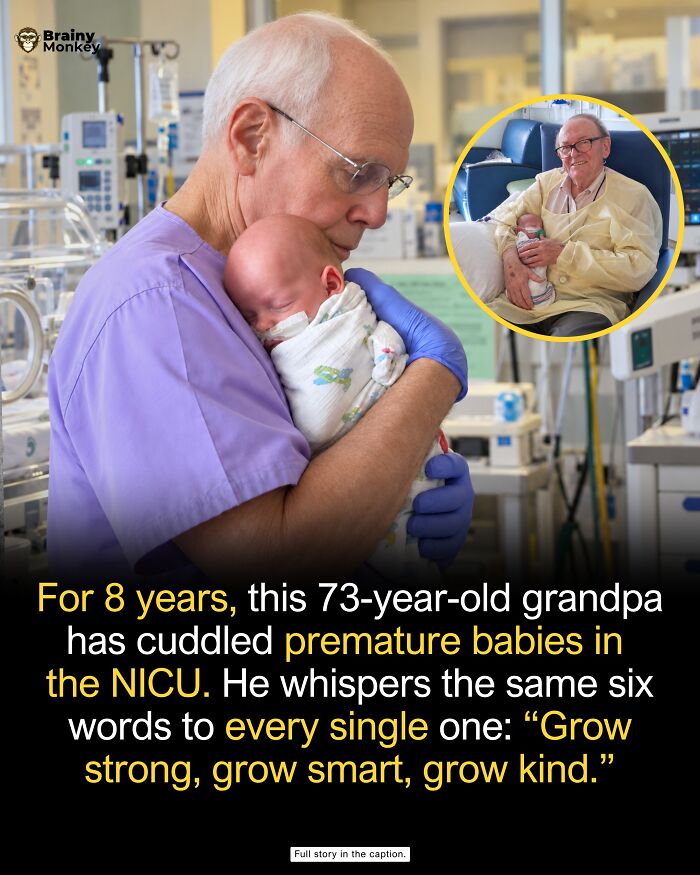
For eight years, one grandfather has given premature babies something medicine can’t prescribe: time, warmth, and a gentle voice.
Dave Whitlow, 73, volunteers twice a week at the Children’s Hospital of Richmond at VCU, where he cuddles fragile newborns in the NICU.
During each visit, he may hold 5 or 6 babies, some weighing as little as 2 pounds, rocking them gently and giving them the comfort of human touch.
And before placing each baby back in the crib, he whispers the same six words:
“Grow strong, grow smart, grow kind.”
After 8 years, hundreds of babies have heard those words.
One grandfather. Two days a week. Hundreds of tiny lives comforted by kindness.
She was pregnant, glowing, and apparently ready for her close-up.
In 2021, a Jack Russell terrier named Khloe went viral after her owner celebrated her first pregnancy with a full maternity photoshoot.
Surrounded by flowers, ribbons, and pink backdrops, Khloe posed like a total professional, and the internet absolutely loved it.
The photos were taken before she gave birth to 4 puppies, turning a simple family memory into one of the cutest maternity shoots online.
Years later, the pictures resurfaced and went viral all over again.
1 proud mama. 4 puppies. One unforgettable maternity shoot.
She looked incredible. She knew it.
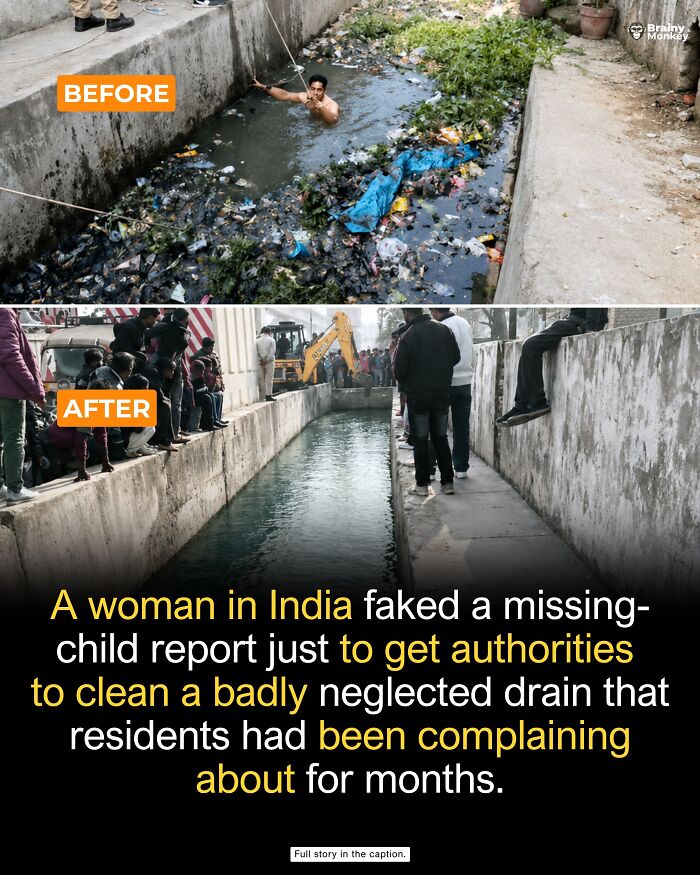
She faked a missing-child report, and somehow it finally got the drain cleaned.
In February 2026, a woman in Meerut, Uttar Pradesh, told police that a child had fallen into a filthy, clogged drain that residents had reportedly been complaining about for months.
Authorities rushed in, launching a three-hour rescue operation with sanitation workers and heavy machinery.
But there was one problem:
No child was missing.
The report had been fabricated to force officials to finally clear the neglected drain.
The stunt sparked mixed reactions. Some called it classic “jugaad”, a clever workaround when bureaucracy fails. Others criticized it for wasting emergency resources and creating a false alarm.
Still, one fact was impossible to ignore:
Months of complaints changed nothing. One fake emergency got the drain cleaned in hours.
One simple selfie turned into a massive wave of online cruelty, but she refused to disappear.
In June 2025, 37-year-old Zambian lawyer Naomie Pilula posted a casual selfie online.
The photo quickly went viral, drawing hundreds of thousands of comments and shares, including thousands of cruel remarks about her appearance.
Instead of deleting the photo, Naomie left it up and responded with confidence:
“I am not aesthetically beautiful, and that’s okay. But I love myself, and I can be myself.”
Her story resonated with people around the world, and her following grew from about 1,000 to 20,000 within weeks.
What began as online mockery became a powerful reminder that self-worth does not have to depend on other people’s approval.

A happy face, a kind face, a confident face, these are what make a beautiful face.
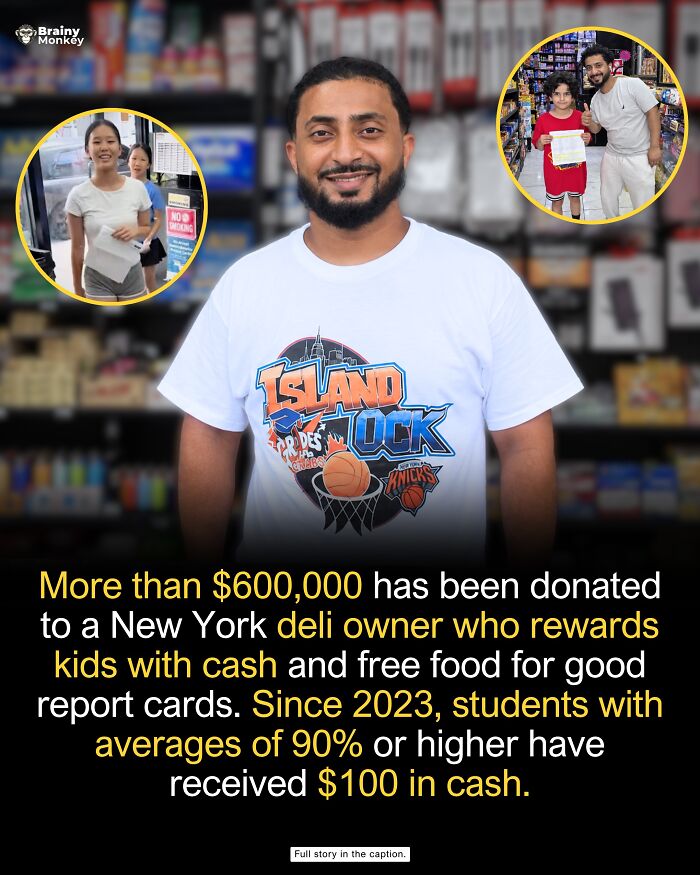
A New York deli owner started paying kids for good grades, and the internet responded with more than $600,000 in donations.
Wail Alselwi, known as “Island Ock,” runs a Staten Island deli where students can bring in their report cards and earn rewards for strong grades or major improvement.
Students scoring 90% or higher can receive $100 in cash, while others may get free snacks, groceries, and other rewards.
His “Grades for Grabs” program went viral, inspiring more than 13,000 donations and raising about $608,000 to help keep the rewards going.
What started as one deli owner encouraging local kids has turned into a community-backed effort to make academic success feel worth celebrating.
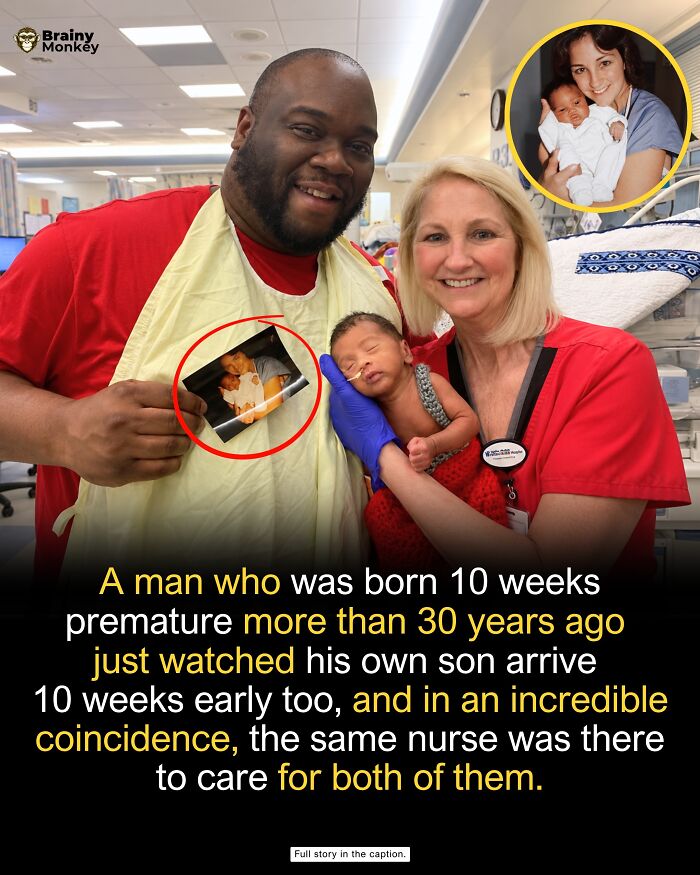
More than 30 years later, the same nurse was there for the next generation.
In 1986, David Caldwell was born six weeks premature in New Jersey and spent weeks in the NICU at Saint Peter’s University Hospital. One of the nurses who cared for him was Lissa McGowan.
Then, 34 years later, David returned to the same hospital under very different circumstances.
His son, Zayne, had arrived 10 weeks early, weighing only 3 pounds, and was admitted to the very same NICU.
And somehow, the nurse caring for Zayne was the same woman who had cared for David as a premature baby decades earlier.
The family later found an old photo of Lissa holding David in 1986 and recreated it with Zayne in her arms in 2020.
One nurse. Two generations. 34 years apart. Some connections really do come full circle.
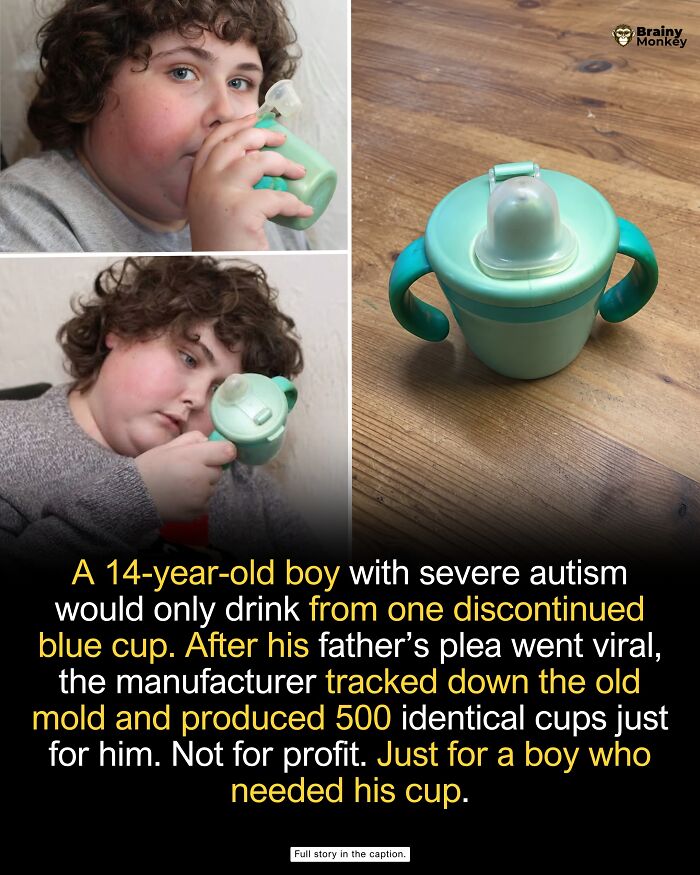
One blue cup was the only thing standing between a boy and dehydration, and the internet helped find a solution.
Ben Carter, a teenager with severe autism from England, would only drink from one specific blue training cup he had used since childhood.
When the cup was discontinued and his last one began falling apart, his father made a desperate online appeal.
For Ben, it wasn’t simply a favorite cup. Even tiny changes in shape, color, or texture could make him refuse to drink. His attachment was so strong that he had previously been hospitalized with dehydration after rejecting other cups.
Then the story went viral.
The manufacturer tracked down the original mold, restarted production, and made 500 identical cups just for Ben, giving him what was essentially a lifetime supply.
1 blue cup. 1 worried father. More than a decade after the model was discontinued. 500 replacements made for one boy.
Sometimes the smallest things can mean everything.
When five siblings under the age of 6 were about to be split into different homes, one man made a decision. He adopted all five of them. By himself.
In Buffalo, New York, single father Lamont Thomas learned that five brothers and sisters, all under the age of 6, had been separated in foster care.
He decided to bring them all under one roof.
The children were Zendaya, 5; Jamel, 4; Nakia, 3; Major, 2; and Michaela, 1. Thomas fostered them first, then officially adopted all five, making sure they could grow up together as one family.
And this wasn’t his first time opening his home. Over the years, Thomas had already fostered more than 30 children.
1 single dad. 5 siblings. All under 6. More than 30 children fostered over the years.
He could have chosen a quieter life. Instead, he chose to keep a family together.
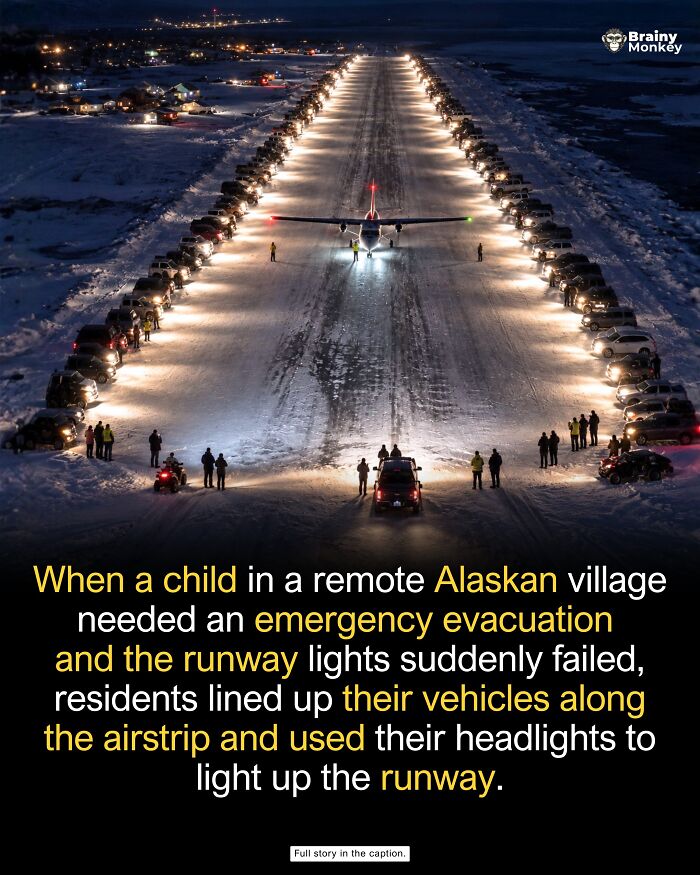
When the runway lights failed, an entire Alaskan village turned their headlights into a lifeline.
In August 2020, a child in the remote village of Igiugig, Alaska, needed an emergency medical evacuation. But there was one terrifying problem: the runway lights weren’t working.
With only 68 people living in the village, tribal clerk Ida Nelson started calling neighbors for help.
Within about 20 minutes, roughly 20 cars, trucks, and ATVs lined both sides of the airstrip, aiming their headlights toward the runway to create a glowing path through the darkness.
Residents from 8 to 70 years old rushed out, some still in their pajamas, just to help.
The medevac plane landed safely, picked up the child, and took off again under the light of the villagers’ vehicles.
The child was flown to Anchorage for treatment.
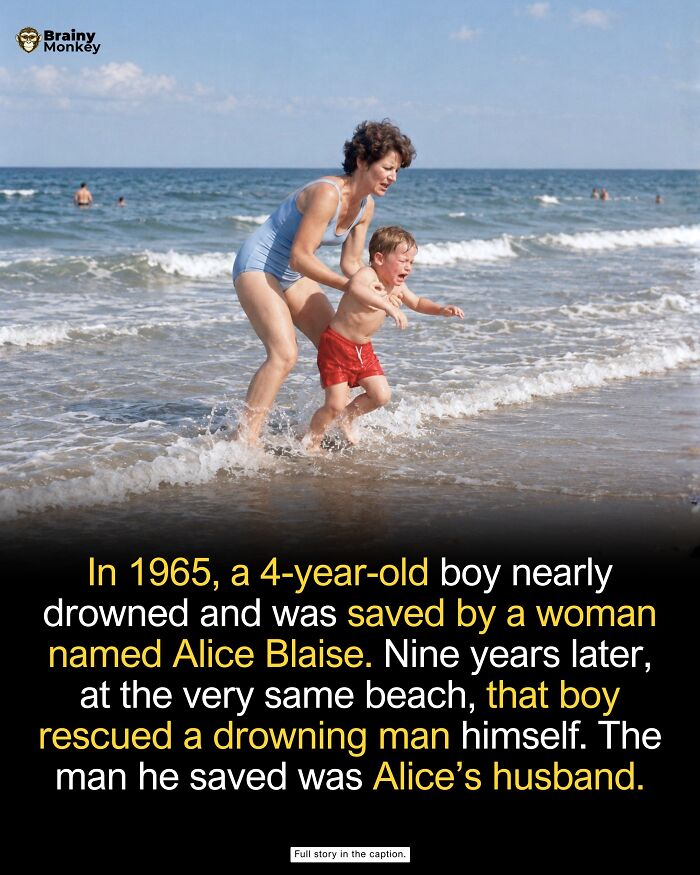
A stranger saved his life as a little boy. Nine years later, he saved her husband at the exact same beach.
In 1965, 4-year-old Roger Lausier nearly drowned at Salem Willows Beach in Massachusetts. A woman named Alice Blaise rushed in and pulled him to safety.
Then, in 1974, Roger returned to that same beach.
Now 13 years old, he spotted a man struggling in the water. Roger paddled out on an inflatable raft and helped bring him safely back to shore.
Only afterward did he learn who the man was.
It was Bob Blaise, the husband of the woman who had saved Roger’s life nine years earlier.
One beach. Two rescues. Nine years apart. And one incredible full-circle moment.
They were offered more than $26 million for their family farm, and they still said no.
A Kentucky mother and daughter reportedly rejected about $26.48 million for roughly 534 acres of farmland that had been in their family for nearly 200 years.
The land was being sought for a massive 2.2-gigawatt data center project linked to the growing demand for AI infrastructure.
Their family owns around 1,200 acres in the area, but they chose to protect the land rather than sell it for industrial development.
For them, preserving generations of family farmland was worth more than a multimillion-dollar payday.
$26 million to sell, or keep the land in the family. Would you have made the same choice?
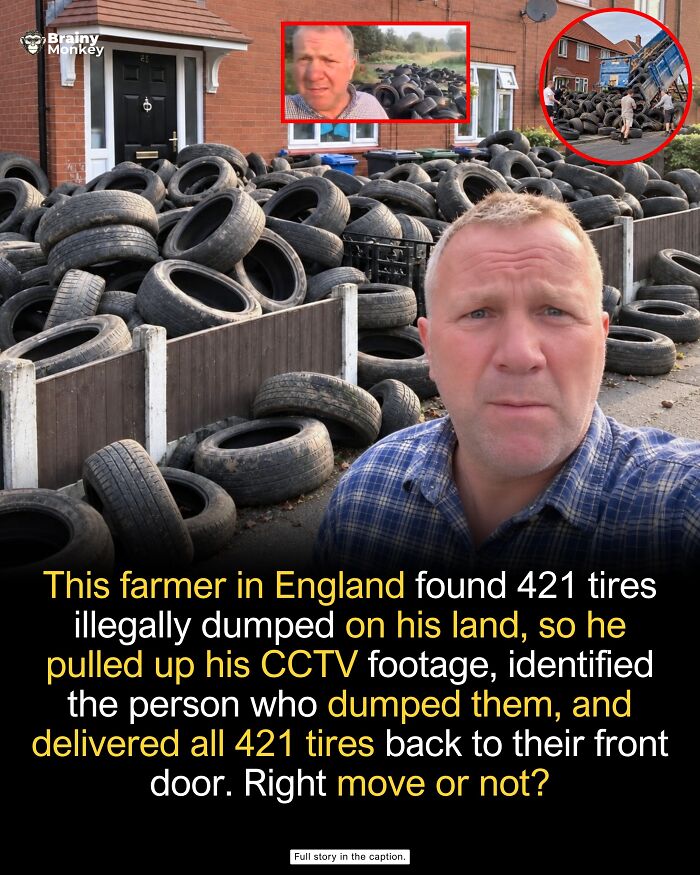
This farmer found 421 tires illegally dumped on his land, so he sent every single one back.
In 2020, English farmer Stuart Baldwin discovered a huge pile of dumped tires on his property.
He checked his CCTV footage, identified the person believed to be responsible, and gave them 3 days to come back and clean it up.
They didn’t. So Baldwin loaded all 421 tires onto a truck and delivered them straight back to the person’s front door and garden.
His response quickly went viral, with people divided over whether it was perfect justice or taking matters too far.
Would you have done the same?
REAL LEADERSHIP IS PROVEN IN THE MOMENTS WHEN EVERY SECOND COUNTS.
At 3 a.m., with torrential rain pounding his village and floodwaters rising around him, 56-year-old village captain Tian Ruliang went door to door in Shanghongyan Village, Yunnan Province, China, waking families and telling them to get out immediately.
He was exhausted. He was covered in mud. At one point, floodwaters even knocked him off his feet, forcing him to cling to a tree to survive.
But he kept going.
Tian continued knocking on doors and shouting warnings through a loudspeaker until all 60 residents from 21 households had reached higher ground.
Minutes later, the mountainside gave way.
More than 10,000 cubic meters of mud and rock crashed into the village, burying homes and covering much of the area that families had just escaped.
60 people made it to safety. Not one resident was left behind.
Tian didn’t wait for someone else to take responsibility. He saw danger coming and kept moving until everyone was safe.
That is what leadership looks like when there is no time for speeches, only action.
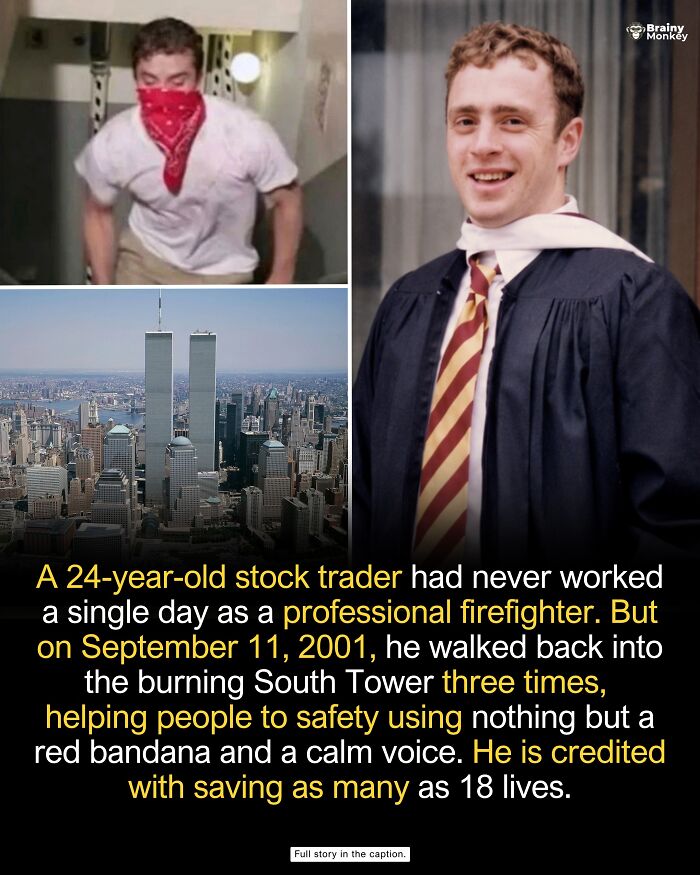
He wasn’t a professional firefighter. But on 9/11, he became the man in the red bandana.
On September 11, 2001, 24-year-old Welles Crowther was working as a stock trader on the 104th floor of the South Tower when the attacks began.
Instead of escaping and staying out, he tied his trademark red bandana over his face and went back into the burning tower three separate times.
Survivors remembered his calm voice as he carried one injured woman on his back and guided groups of people down 17 floors to safety. Crowther had trained as a volunteer firefighter in his hometown of Nyack, New York, but had never worked professionally.
He is credited with helping save as many as 18 lives.
Crowther was last seen heading back upstairs with firefighters before the South Tower collapsed at 9:59 a.m. Months later, survivors finally identified their rescuer as “the man in the red bandana.”
His legacy lives on through Boston College’s Red Bandana Game, and in May 2026, he was posthumously awarded the Presidential Medal of Freedom.
24 years old. Three trips back inside. Up to 18 lives saved. One legacy that still inspires millions.
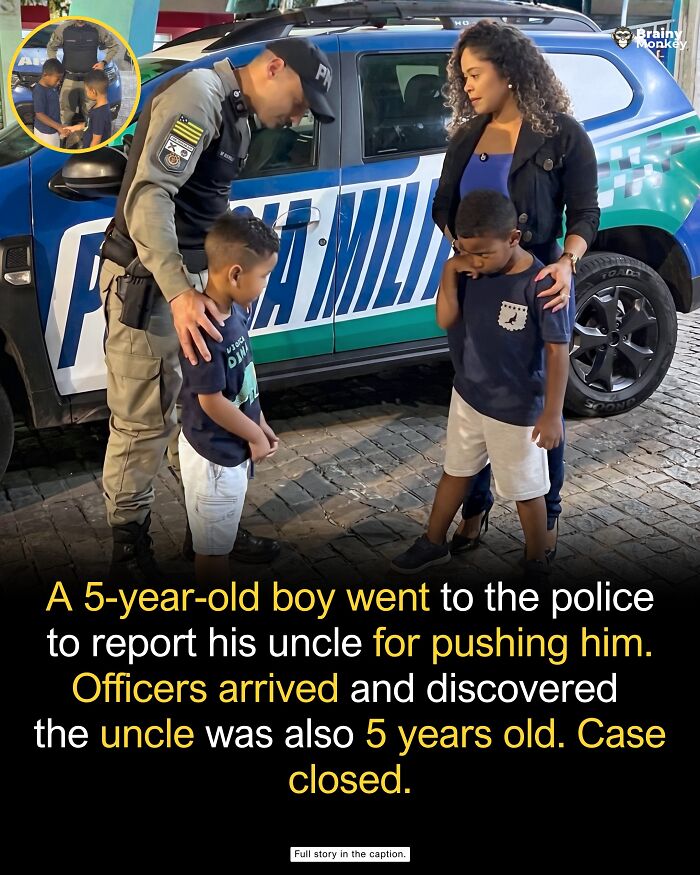
A 5-year-old went to the police to report his uncle for pushing him. The twist? His uncle was also 5 years old.
In August 2026, during a community event in Senador Canedo, Brazil, little Gabriel Carvalho approached officer Guilherme Toledo with a very serious complaint: his uncle, Rafael, had pushed him.
There was just one small complication.
Rafael was also 5.
The unusual family situation happened because Gabriel’s mother and Rafael’s sister were pregnant around the same time, making two boys the same age technically uncle and nephew.
Instead of brushing it off, the officer played along and turned it into a mock hearing. His wife even stepped in as Rafael’s “defense lawyer.”
In the end, the boys shook hands, made peace, and sealed the case with a hug.
The video quickly went viral, with millions laughing at one of the most adorable family disputes ever taken to the police.
Wouldn't Gabriel's mother BE Rafael's sister? (Or, sister-in-law would also work.). His mother would have been pregnant with him at the same time his grandmother was pregnant with Rafael.
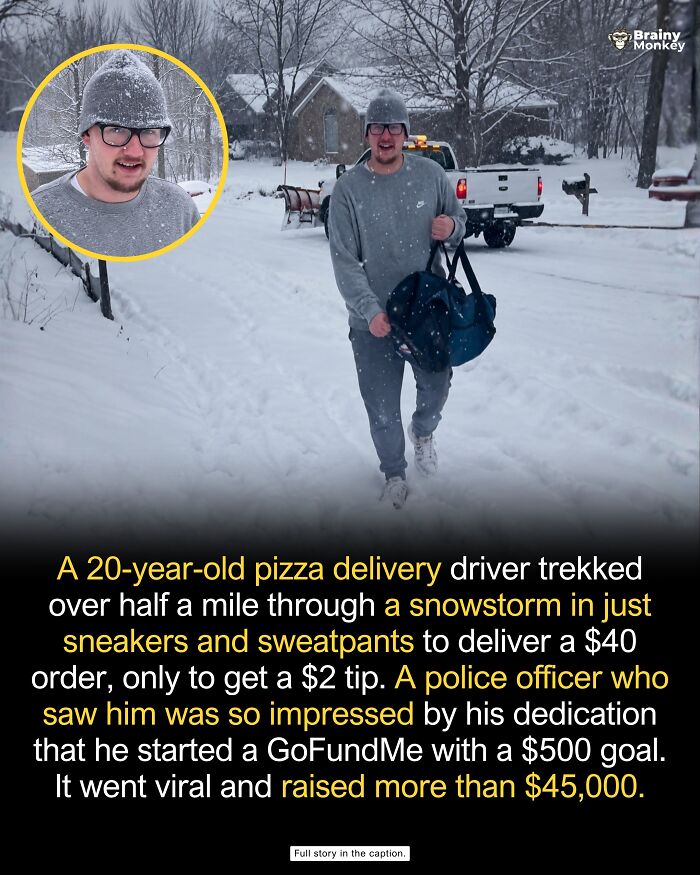
He walked through a snowstorm for a $40 pizza order and got just a $2 tip. What happened next changed everything.
In January 2025, 20-year-old Connor Stephanoff of Brownsburg, Indiana trekked more than half a mile through heavy snow wearing only sweatpants and sneakers to make a delivery.
A police officer who saw his effort was so impressed that he started a GoFundMe with a goal of just $500.
Then the internet stepped in.
Within days, more than 2,000 people had donated, pushing the total past $45,000.
What started as a disappointing delivery ended with strangers across the country rewarding a young man for simply refusing to quit.
A $2 tip turned into $45,000 worth of kindness.
In those 21 years, China’s railway system changed almost beyond recognition.
In 1996, a Chinese train driver posed beside a soot-covered steam locomotive, the kind that moved at around 60 km/h.
Then came the second photo.
In 2017, the same man stood beside a sleek high-speed train capable of reaching 350 km/h, surrounded by a modern station of glass and steel.
By 2017, the country had built the world’s largest high-speed rail network, stretching more than 25,000 kilometers and connecting major cities that once required long, exhausting journeys.
Trips that once took days could now be completed in hours.
Two photos. One train driver. 21 years of transformation captured in a single comparison.
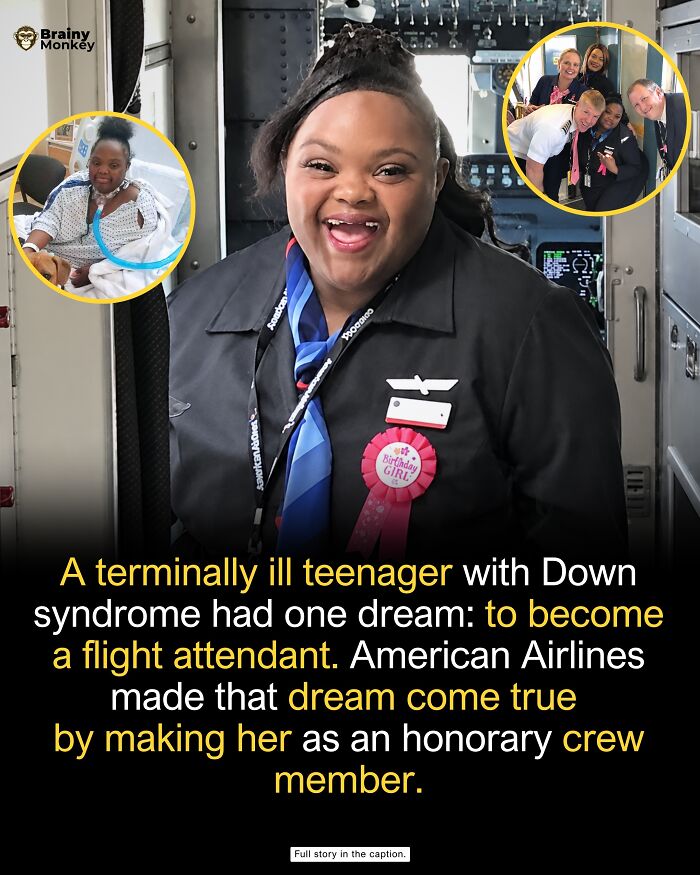
She was told she might not live to see 17. Instead, she became a flight attendant.
In 2018, Shantell “Shannie” Pooser, a South Carolina teenager with Down syndrome and a rare life-threatening airway condition, saw her biggest dream come true when American Airlines welcomed her as an honorary crew member.
By then, Shannie had already endured more than 30 surgeries and taken over 50 flights between South Carolina and Cincinnati for medical treatment.
But on her 17th birthday, she boarded a plane for a very different reason.
She received her own uniform, badge, and wings, then worked alongside the crew aboard a CRJ-900, greeting passengers, helping serve snacks, and experiencing the job she had dreamed about for years.
Doctors once feared she might never reach 17.
She didn’t just reach it. She reached the sky.
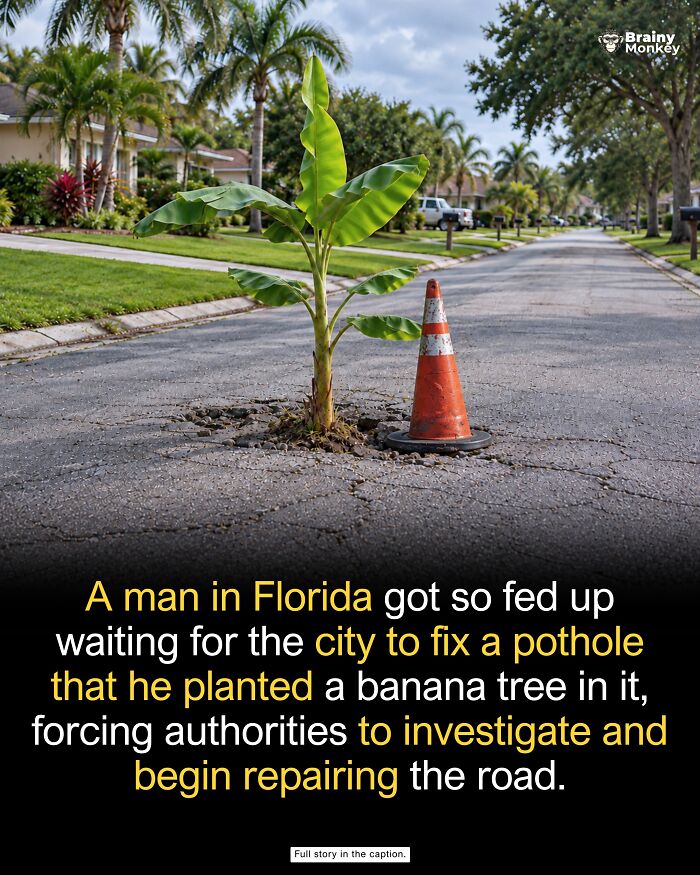
Jacksonville residents waited months for the city to fix a massive pothole. Nobody came. So someone planted a banana tree in it.
Then another one.
The stunt quickly went viral, drawing national attention and forcing the local utility JEA to investigate. Neighbors said the potholes had been left unrepaired for months, creating hazards for cars and bikes.
By planting two banana trees in separate potholes, residents turned frustration into a headline that finally got the city’s attention. Two banana trees accomplished what months of complaints couldn't.
The potholes aren't fixed yet. But for the first time, somebody is actually coming.
Proof that sometimes creativity works faster than bureaucracy.
Forget buffering. Japan just pushed internet speed into another universe.
Researchers at Japan’s National Institute of Information and Communications Technology (NICT) achieved a staggering data transmission speed of 1.02 petabits per second using optical fiber.
That is roughly 1.02 billion megabits per second, fast enough to theoretically download the entire Netflix library in about one second.
Even more impressive, the data traveled across 1,808 kilometers (1,123 miles) using a specially designed 19-core optical fiber that is about the same thickness as conventional fiber cables. That means future versions of the technology could potentially work with existing infrastructure.
At speeds like this, downloading huge files could become nearly instant, massive AI datasets could move in seconds, and ultra-high-definition streaming could happen with virtually no waiting.
The technology is still experimental, so your home Wi-Fi is not getting this upgrade tomorrow.
But one thing is clear: the future of the internet may be a lot faster than we ever imagined.
She thought she would walk down the aisle without a father beside her. Then her 79-year-old landlord stepped in.
In August 2025, Cincinnati bride Shacole Fox was preparing for her wedding when her landlord, Gil Pulliam, learned that she had grown up never knowing her father.
Over time, the two had built a close bond. So when Gil realized she had no father to walk her down the aisle, he offered to do it himself.
Her answer was immediate: “Yes, yes, yes!”
On her wedding day, the two walked side by side as guests watched. Shacole later said the moment felt “like a wound had been healed in my heart.”
One bride. One 79-year-old landlord. One walk down the aisle. And one beautiful reminder that sometimes, family is the person who chooses to show up.
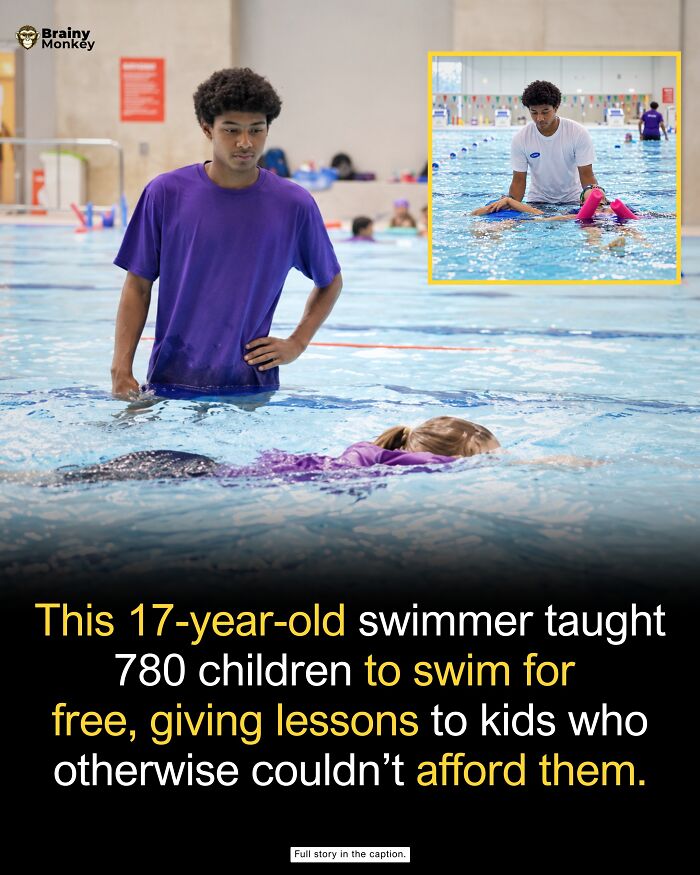
He’s only 17 years old, but he has already taught 780 children how to swim for free.
In 2026, competitive swimmer Jeremiah Carnegie launched the Newham Future Swimmers programme after seeing how many children in London couldn’t afford swimming lessons.
Instead of just talking about the problem, he did something about it.
Hundreds of primary school children were given five free 30-minute lessons, while families who needed help also received swimsuits, trunks, and goggles at no cost.
Of the 780 children who joined, 320 had never learned to swim before.
The programme was supported by the Mayor of London’s Sport Unlocked fund, helping open the doors of the Olympic Aquatics Centre to children who might otherwise never have had the chance.
Jeremiah didn’t just teach kids how to swim. He gave hundreds of them confidence in the water that could one day save their lives.
In some of Haiti’s poorest communities, hunger can become so severe that people turn to “mud cookies” just to make an empty stomach feel full.
These discs are made from clay-like dirt mixed with salt and vegetable shortening or oil, shaped by hand, then left to dry in the sun.
They provide very little nutrition, and health experts warn that eating them can worsen malnutrition and potentially expose people to parasites, bacteria, or harmful substances in the soil.
Yet when real food is simply too expensive, some families have relied on them as a desperate way to suppress hunger, even if only temporarily.
The practice has been documented for years and remains one of the starkest examples of what extreme food insecurity can look like.
For some people, this is what they eat when there is nothing else. Next time you sit down to a meal, remember how fortunate you are to have one.
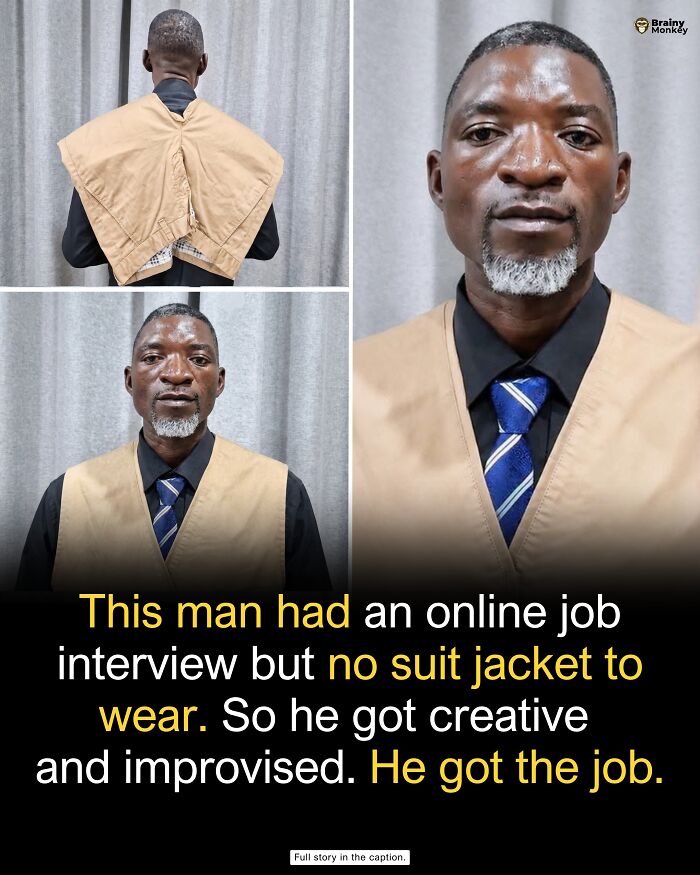
He couldn’t afford a suit jacket for his online interview, so he made one out of a pair of khaki pants.
With no money for formal clothes, the man got creative. He draped the trousers over his shoulders and positioned the legs so that, from the webcam angle, they looked surprisingly similar to the lapels of a blazer.
It was unconventional, but it worked.
He showed up confidently, completed the interview, and got the job.
His clever solution later went viral, proving that sometimes you don’t need perfect resources to make an impression.
You just need enough creativity to make what you have work.
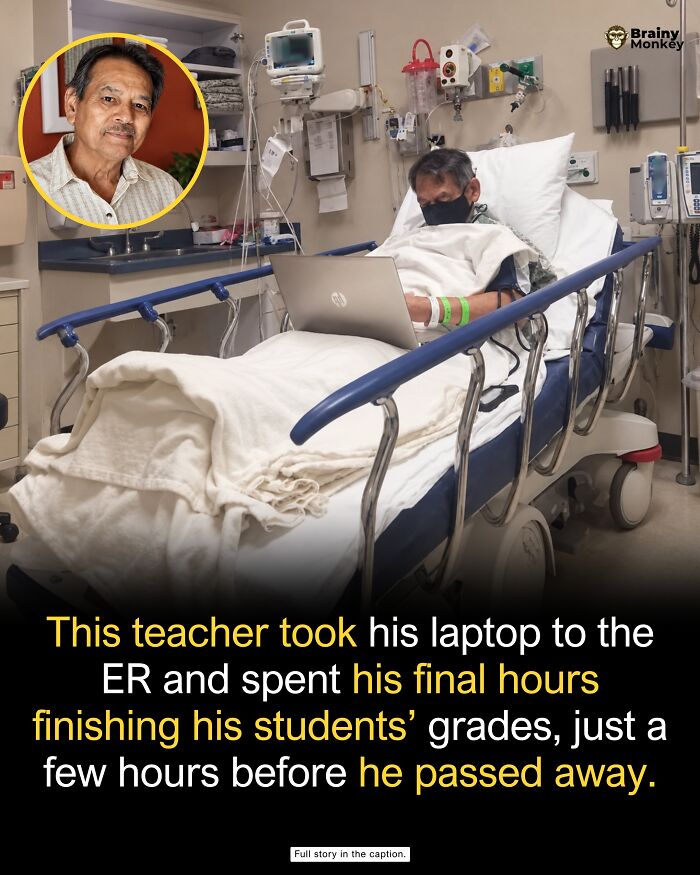
He brought his laptop to the hospital because he was worried about finishing his students’ grades. Just hours later, he passed away.
In Del Rio, Texas, middle school math teacher Alejandro Navarro was hospitalized with serious heart problems. Even from his hospital bed, he kept working, determined to make sure his students’ grades were completed.
His daughter later shared the heartbreaking moment, saying her father had packed his laptop and charger when he was admitted because he was still thinking about his students.
The photo quickly went viral, with more than 73,000 likes and thousands of people moved by his dedication.
26+ years of teaching. One laptop in a hospital bed. One final act of responsibility.
Some teachers stop teaching when the bell rings. Others carry their students with them until the very end.
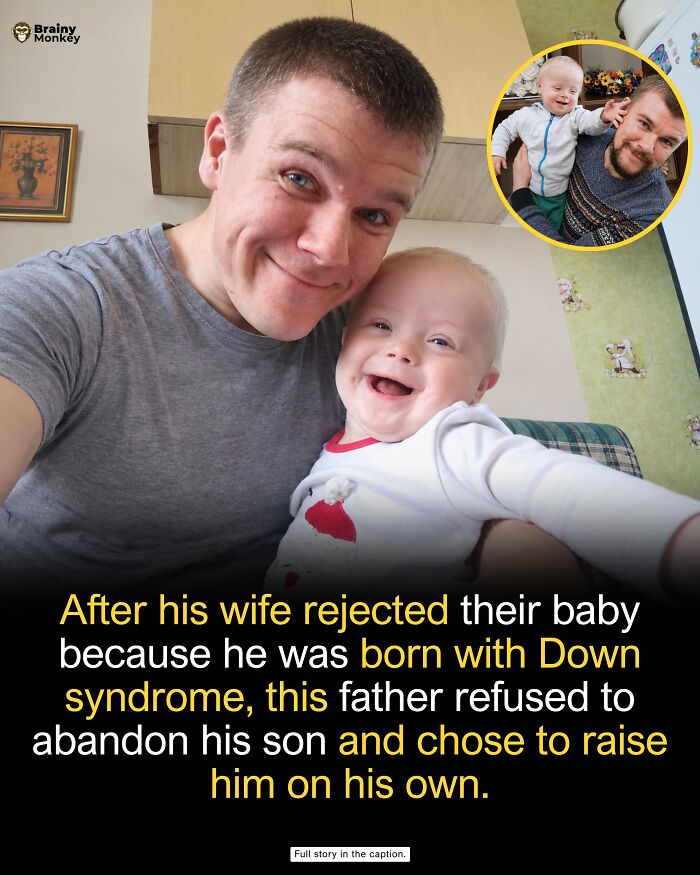
When his son was born with Down syndrome, his wife wanted to place the baby in an orphanage and later left the family. But Evgeny Anisimov refused to abandon his baby.
His son Misha was born in 2018, and the diagnosis came shortly after birth. The news left the family overwhelmed and uncertain about what life would look like.
But Evgeny made one decision immediately: his son was staying with him.
He began learning everything he could about Down syndrome, took on life as a single father, and devoted himself to giving Misha the love, care, and opportunities every child deserves.
As Misha grew, Evgeny started sharing their life publicly, hoping to challenge the stigma surrounding Down syndrome and show other families that a diagnosis does not make a child any less worthy of love.
2018: Misha was born. 1 father chose to stay. 1 little boy given the chance to grow up surrounded by love.
When others saw a diagnosis, his dad saw his son.
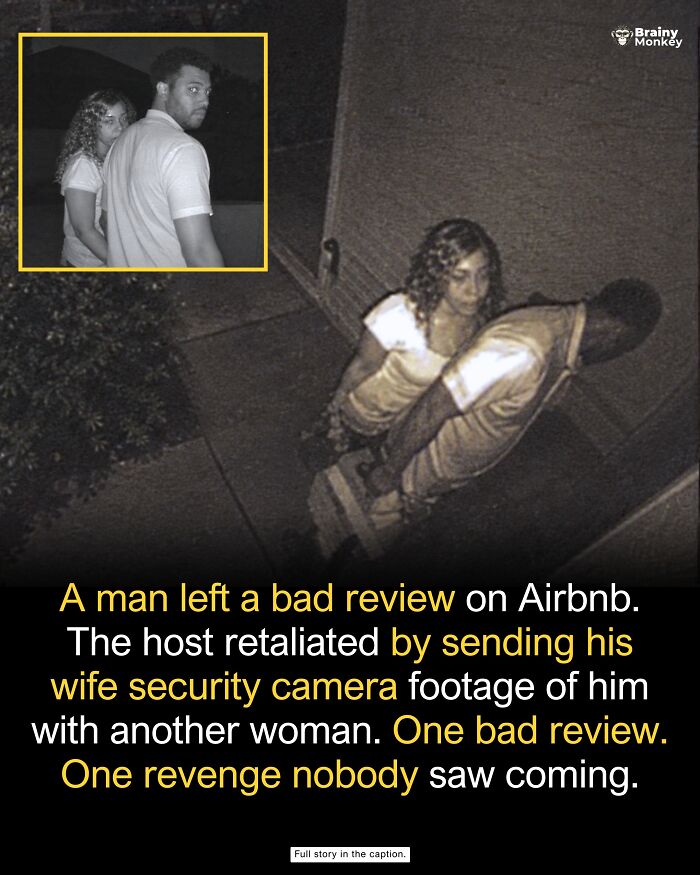
A bad Airbnb review allegedly turned into a very personal nightmare.
According to a U.S. lawsuit, a guest says his Airbnb host retaliated after he posted a negative review by sending his wife security camera footage allegedly showing him arriving at the rental with another woman.
The dispute started after a two-night stay at $567 per night. After checkout, the host sought another $960 for alleged rule violations. The guest refused to pay and left a critical review instead.
Then things escalated.
He claims his wife later received an email containing doorbell-camera footage of him returning around 3 a.m. with another woman.
The guest is now suing over claims including invasion of privacy, blackmail, and emotional distress. The host denies sending the footage, while Airbnb is seeking to move the dispute into arbitration.
$567 a night. $960 in disputed charges. Two nights. One bad review. And one lawsuit nobody saw coming.



























 No fees, cancel anytime