Get Premium
Dark mode theme is available exclusively for premium users. Learn more about the benefits of subscribing.
No fees, cancel anytime.

 Dark Mode Ad-Free Browsing Unlimited Content
 Ad-Free Browsing Unlimited Content Dark Mode
Join 1.2 million Panda readers who get the best art, memes, and fun stories every week!
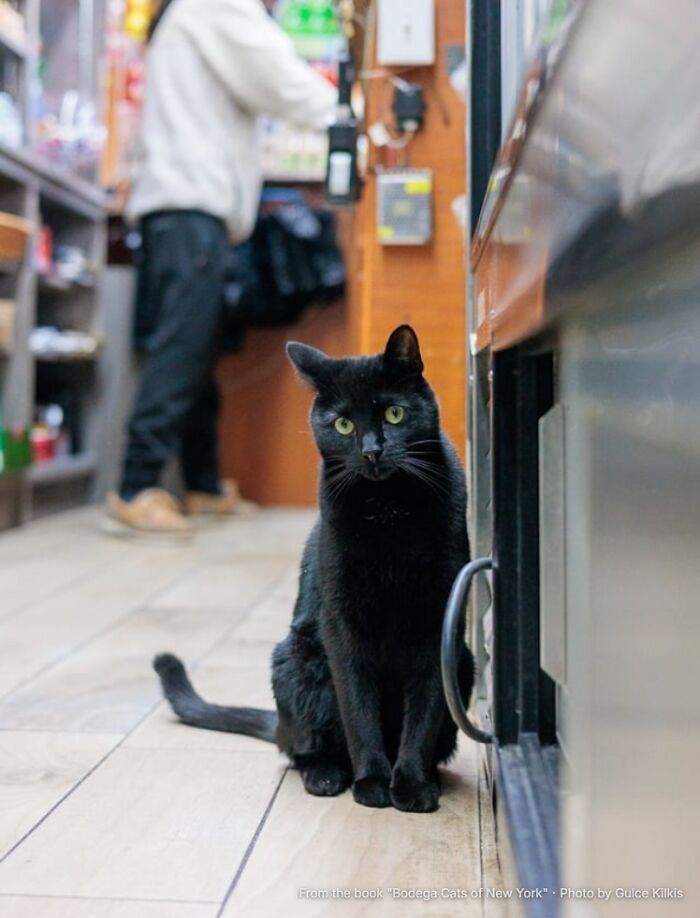
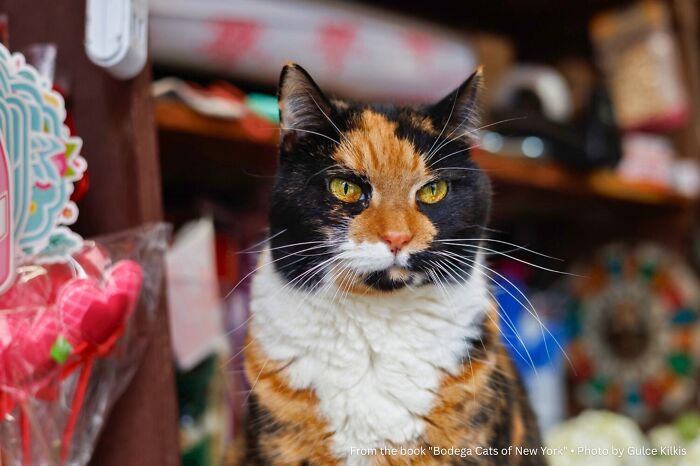
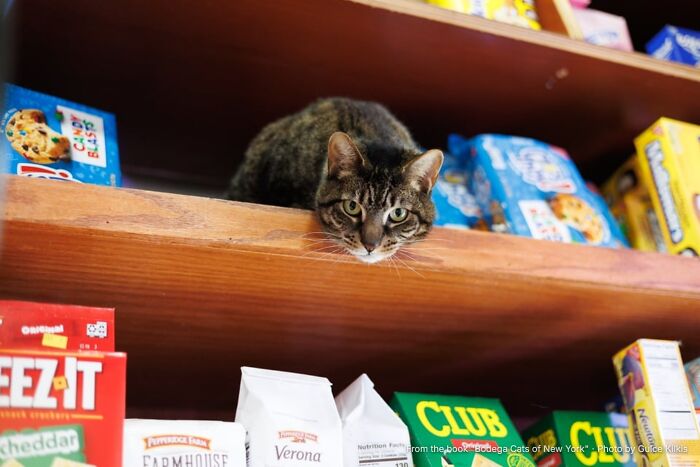
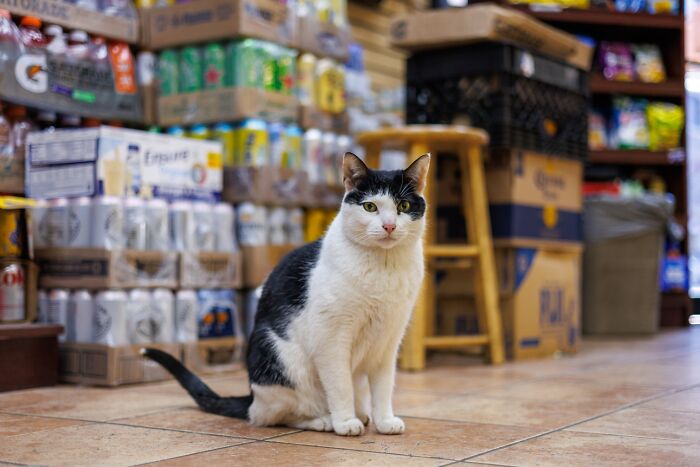
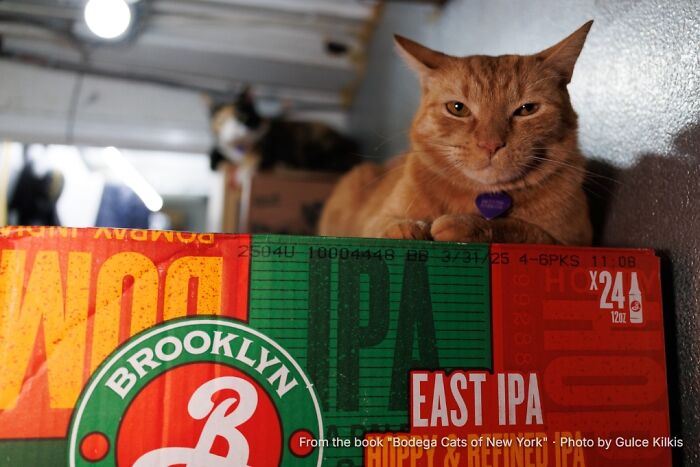
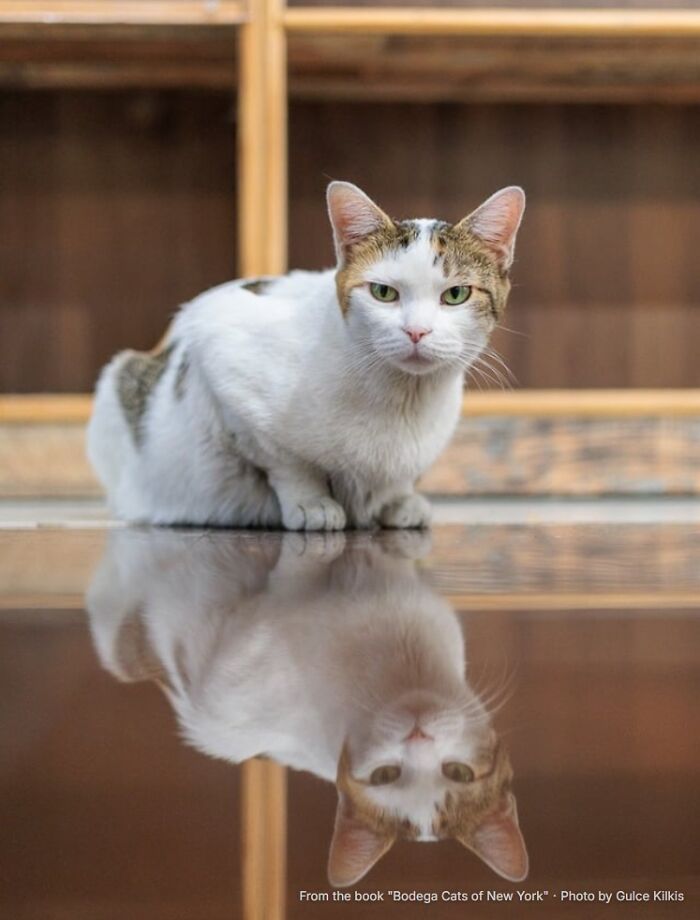
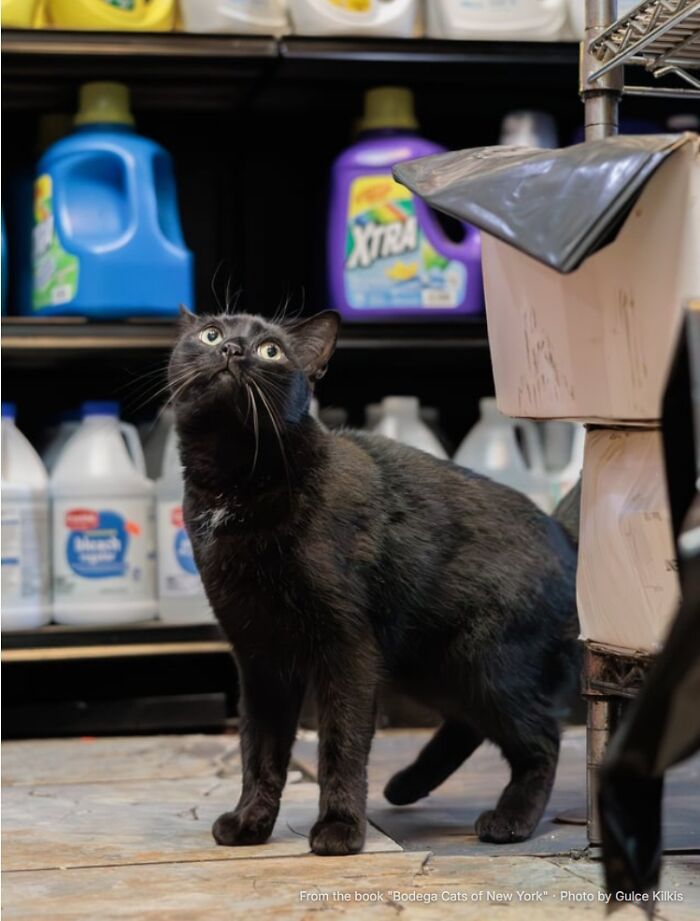
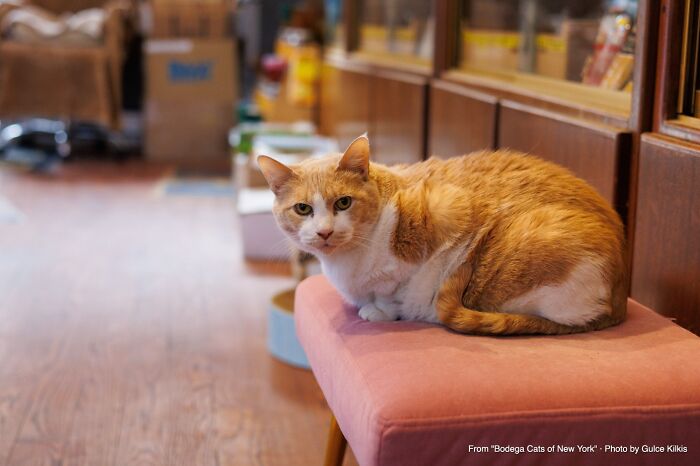
If you’ve ever spent time in New York City, chances are you’ve crossed paths with one of its most iconic and beloved unofficial residents: the bodega cat. Whether curled up beside the register, tucked between shelves, or watching the street from a sunny window, these cats have become a small but instantly recognizable part of the city’s everyday rhythm. For many New Yorkers, spotting one feels like finding a tiny moment of warmth in the middle of the city’s constant motion. That quiet charm is at the heart of Bodega Cats of New York City, a book that will bring together heartwarming photographs of these furry shop companions while also highlighting the communities, store owners, and neighborhood routines surrounding them. More than a simple photo collection, the project offers a closer look at a culture that has existed across New York for generations, turning ordinary corner stores into places with personality, memory, and familiar faces.
Behind the project is the popular Instagram page New York Bodega Cats, which has been documenting these cats across the city and transforming quick, everyday encounters into something much more meaningful. Each image does more than introduce another adorable cat; it offers a glimpse into the small local businesses that keep New York moving, the people who run them, and the animals that have become part of their identity. What makes the project so captivating is its authenticity: these are not staged portraits, but real moments captured in real places, from sleepy cats lounging on snack displays to alert little guardians keeping watch over the store. Bodega cats may be cute, but they are also part of the neighborhood, building bonds with customers, bringing character to the shops, and representing a wonderfully practical, resilient, and slightly chaotic piece of New York’s local culture.
Bored Panda reached out to the page's creator to learn more about their project and what readers can expect from the book. So scroll down to read the full interview and, of course, vote on your favorite from this selection of feline store staff.
More info: Instagram | bodegacatsofnewyork.com | bodegacatsofnewyork.com
This post may include affiliate links.
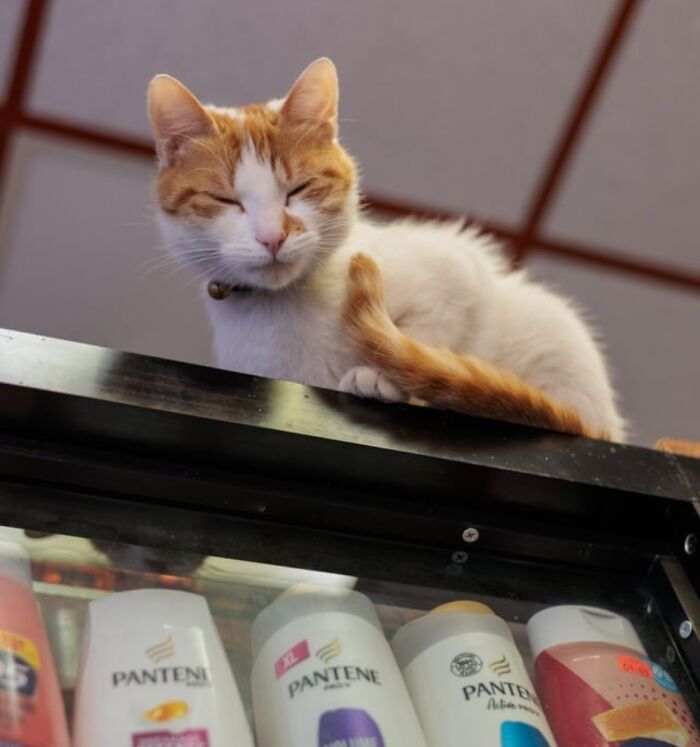
“His favorite spot is the refrigerator.
Not on top of it. Inside.
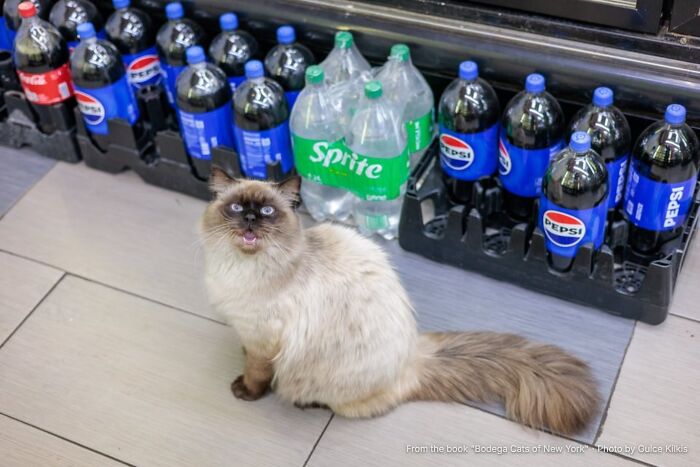
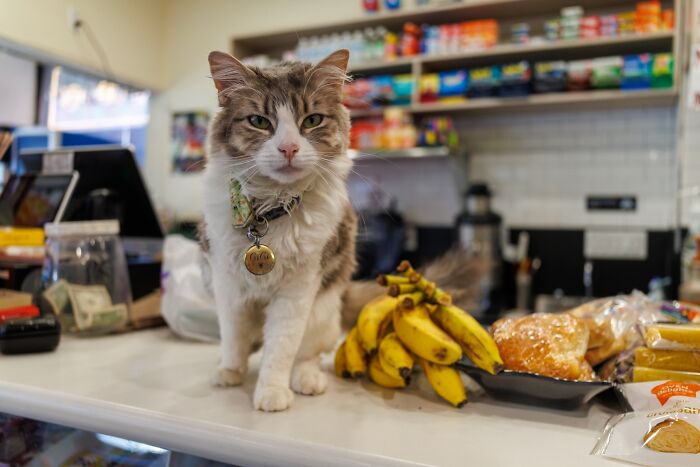
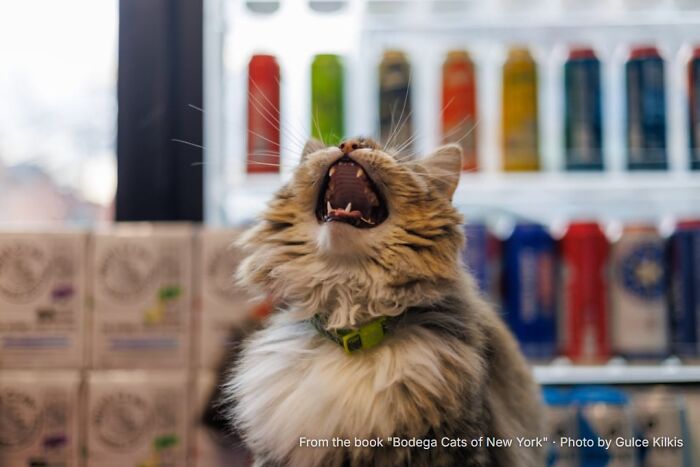
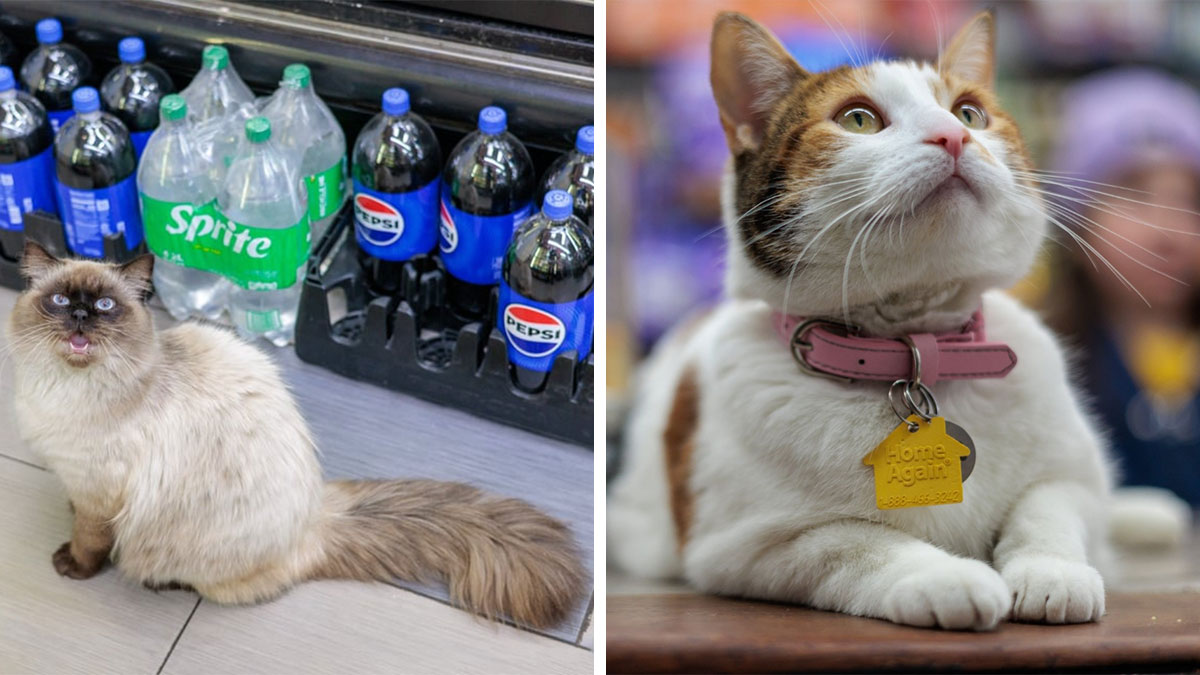
Suliman bought Tony as a baby. Mixed Himalayan, fluffy, with the kind of face that makes people stop mid-errand. He has been at the bodega for almost a year now. In that time, he has developed a routine that no one taught him and no one can break.
During summer, the moment a customer opens the refrigerator, Tony slips in and finds a shelf. He stays there for an hour sometimes, napping in the cold while people reach around him for drinks. Then he comes out when he is ready.
“Every summer, as soon as a customer opens the refrigerator, he goes in there for an hour, takes a nap, and comes out.”
Suliman explained this matter-of-factly. Like it was just part of how the store operates. The drinks are on the left. The cat is on the middle shelf. Reach around him.
The regulars expect it. Nobody complains.
Suliman showed us baby pictures on his phone. Tony as a kitten, small enough to hold in one hand. Now he is a full-grown Himalayan who has claimed the cold case as his personal retreat.
I asked if customers ever react badly. If anyone has complained about a cat in the refrigerator, fur near the beverages, health code implications.
Suliman shrugged. The people who come here know Tony. The people who do not know Tony learn fast. It is not a problem. It is just how things work.
That is the part of bodega cats that is hard to explain to people who have never experienced it. The arrangements are specific. The rules are local. What would seem strange anywhere else becomes normal in a particular store on a particular block because the regulars accept it and the owner does not see a reason to change.
Tony found a cool place to sleep. The customers adjusted. The store kept running.
Cats find warm spots constantly. Radiators, cable boxes, ATMs, anything generating heat. Tony is the only one I have met who went the other direction. He found the coldest spot in the store and made it his.
Maybe it is the Himalayan in him. The breed comes from cold climates. Maybe he just figured out that the refrigerator is the one place in a New York summer that feels bearable.
Either way, he is in there most afternoons. Curled on a shelf. Eyes half-closed. Completely unbothered by the hands reaching past him for a Gatorade.
When he is done, he comes out. He stretches. He finds Suliman. He goes back to being a regular bodega cat until the next hot day, when the cycle starts again.
The refrigerator is not his only spot. But it is the one people talk about. It is the one that makes customers smile when they open the door and see him there, like a small surprise built into the routine of buying a drink.
Tony does not know he is unusual. He just knows where he likes to sleep.”

I'd go into that bodega to get a drink every time I'd pass it just to see if Tony was in there!
Asked what first inspired the project and eventually the book, the creator shared that it all began with one particular cat: “A specific cat. Luna. She was a tuxedo cat at a bodega near my apartment in Fort Greene, Brooklyn, and I rerouted my walk just to see her. She inspired the brand logo years later. At the time, I was not thinking about bodega cats as a category. I was thinking about one cat.
“Myers of Keswick has been selling British pies and groceries in the West Village since 1985.
Peter Myers opened it on July 4th of that year. On day one, he sold one pork pie. His wife Irene was devastated. Peter looked at her and said, “See, I told you we would double profits in one day.” They sold two the next day.
The shop has been there ever since. Shelves packed with Heinz Baked Beans, PG Tips tea, McVitie's digestives, and HP sauce. Peter's homemade sausages have been shipped to Keith Richards, Rod Stewart, and Elton John. His daughter Jennifer runs the place now.
There has always been a cat.
Before Gracie, there was Molly.
Molly became famous in 2006 when she disappeared inside the walls of the building. Peter heard a faint meow coming from between 634 and 636 Hudson Street. He called the fire department. They told him there was nothing they could do.
It took 12 days to get her out.
The story made CNN. Peter's wife Irene heard about it while she was on a trip to Moscow. Pet psychics called offering help. Animal Care and Control sent people. Her rescue was announced at a Mets game. When they finally freed her, she appeared on Regis and Kelly, Good Day New York, and most of the local papers.
Molly lived at the shop for 15 more years after that. She passed away in December 2021 after a short battle with cancer.
A month later, they adopted Gracie.
Gracie does not know any of this history. She does not know about Molly or the wall or the 12 days or the Mets game announcement. She just knows the shop. The shelves of British imports. The customers who come in for meat pies and stay to pet her. The black and white tiled floors that have been there since 1985.
She is playful. She loves meeting new people. She walks the aisles with the confidence of a cat who has never been stuck in a wall and does not intend to start now.
The health code says cats do not belong in food establishments. Jennifer pays the fines when they come. She has done the math. The customers expect a cat. They have expected one since Molly. If Gracie were gone, they would notice.
“She has some big paws to fill,” the shop's website says. “But we are confident she will do a great job. As long as she stays away from small spaces between buildings, we should be ok.”
Gracie is still there. Still walking the aisles. Still carrying forward a tradition that started with a cat who once made international news for getting stuck in a wall.”
I'm sorry Inspector. Are you sure she didn't sneak in when you opened the door?
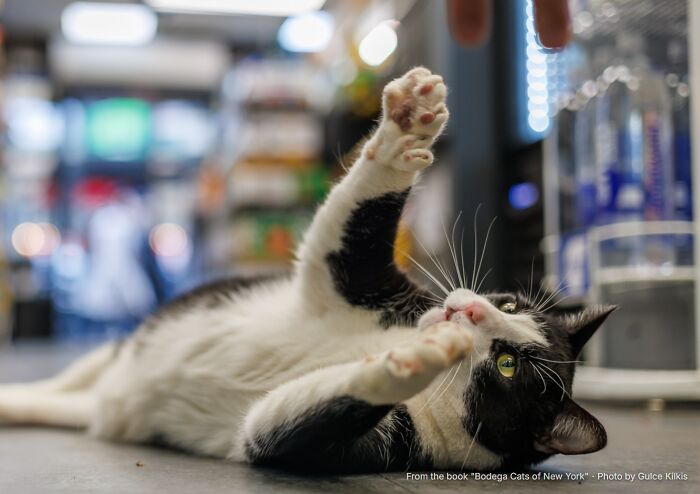
“The owner pointed toward the back when we asked about the cat. “The famous Oreo. The cat with thumbs.”
Oreo came out. Black and white, stocky. A few customers came over when they saw us photographing him. They wanted to see the paws up close.
His paws stopped me cold. Massive, with extra toes that looked like thumbs. Polydactyl. While Gulce shot, we watched Oreo grip the counter edge with those thumbs, anchoring himself when someone reached down to pet him.
The owner said Oreo used to live in someone's home, but there were problems and he ended up at the store four years ago. Now customers come just to see him. He likes to eat. The owner joked about his appetite. He tolerates people well, though he will give a warning bite if you push it.
After we finished, the owner asked if we could help find someone to groom Oreo. We posted on Instagram and got a dozen responses. Michelladonna and The Shop Cats Show crew handled it, posting a video that showed Oreo gripping the table with those toes while they bathed him.
The West 47th Street Block Association once held a “Best Bodega Cat” contest. Oreo won. Beat out cats from all five boroughs. On his block, nobody was surprised.
Four years in the store, and he is still the one people cross the street to meet. Not because of the thumbs. Because of what he does with them. He holds on.”
“In 2020, the streets emptied out, and the bodegas stayed open. I started paying attention to the cats I had been walking past for years. I posted from my own neighborhood. Within weeks, strangers were DMing photos of their own bodega cats. Queens. The Bronx. Neighborhoods I had never been to. The account stopped being mine and started being the city's. The book came later, when it became clear that nobody had ever properly documented this across all five boroughs, including the owners' stories. These cats deserved something permanent.”
“The owner's daughter named her. That is the sweetest part of this story. The rest is Kiki's.
Kiki works at a bodega in Bushwick. Her preferred post is the top of the ATM, which she has claimed like a throne. She sits up there, perfectly still, watching anyone who approaches the machine with the kind of focus that makes people reconsider their transaction.
When someone steps up to withdraw cash, Kiki stares them down. Not aggressively. Patiently. Like she is waiting for an explanation. Most people apologize before they start pressing buttons. Some take their card out and use a different machine at a different store.
“She just sits there,” a regular told us. “But it feels like she's judging you.”
The owner has tried moving her. She comes back. The ATM is warm, it is elevated, and it puts her at exactly the right height to make eye contact with anyone holding a debit card. From Kiki's perspective, this is the ideal workspace. The customers have adjusted.
Kiki does not know her name was chosen by a child. She does not know that some customers use a different bodega just to avoid her. She does not know that her stare, to her, is just watching, but to everyone else it is an audit.
She just knows the top of the machine. The warmth. The steady stream of people who come, apologize, and leave.”
Needs a sign: Yes Kiki is judging you, but in a good way, kind of like your mother. She just wants to make sure you're doing it right.
“A customer found him on Petfinder. She walked into the deli, showed the owner her phone, and asked what he wanted. He said he needed a black one.
She paid $125, picked up the cat, and dropped him off the next day. A gift from a regular. That was three years ago.
Midnight works at a deli on Staten Island. During the day, he sprawls across a basket near the register or sits behind the counter. He has a spot upstairs in a double box where he sleeps between shifts. The arrangement is simple: the store is his during business hours, the box is his after close.
Except Midnight rewrote the arrangement.
Every night after closing, the owner would walk to his car. Midnight would appear out of nowhere and follow him across the lot. The owner started letting him in. Midnight would ride home, walk through the front door, and immediately start meowing. Loud. Relentless. The kind of volume that makes you question every decision you have ever made. The owner would open the door. Midnight would walk back out.
Every time. Same routine. He did not want to be an indoor cat. He just wanted to make sure the owner got home.
Most of the customers here are older folks from the neighborhood. They know him by name. Some come in just to see him and leave without buying anything.
Midnight does not know a stranger picked him off a website. He does not know someone paid $125 and delivered him like a package. He does not know the owner stopped letting him in the car because the meowing was never going to stop.
He just knows the basket. The counter. The walk to the car that he still attempts every night.”
Speaking about how long the project took to complete, they explained that the final book represents years of work, trust-building, and documentation: “About four years of documenting and roughly two years of active shooting. The other two years went into things people do not see in the final book. Building trust with bodega owners. Chasing leads on cats. Getting referrals from one store to the next. Mapping where these cats actually were across the five boroughs.”
“The store had been closed for four years. When the new owner took over the lease, he knew what he was inheriting. The basement was overrun. Not a mouse here and there. A full takeover.
He brought Layla in. Within three days, the mice were gone. He has not seen one since.
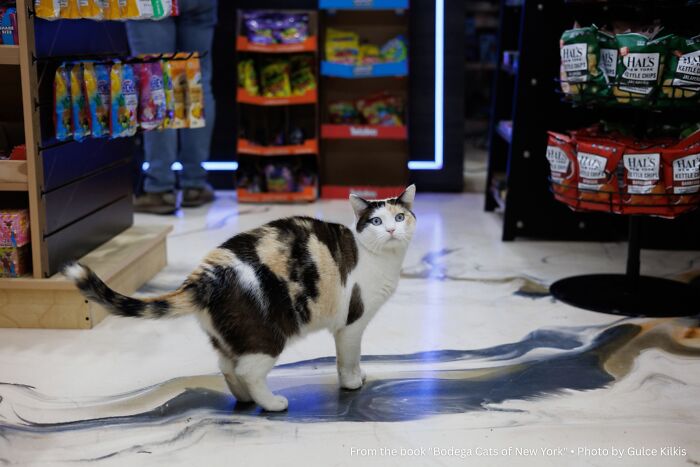
When the contractor came to start the remodel, he asked what color tile the owner wanted for the floor. The owner thought about it for a moment. Then he pointed at his cat.
“If she is staying,” he said, “the place should match.”
She had only been there three weeks.
Layla works at a bodega on Maiden Lane in the Financial District. She sits on a cat tree pushed up against the front window, watching the foot traffic pass. Her eyes are pale. Almost white depending on the light. Pedestrians stop outside just to look for her through the glass.
The owner is from Yemen. Layla means “night” in Arabic. He named her before he knew what she would do for the store. Before the mice disappeared. Before the floor matched her coat. He just liked the name.
There is a shelf near the register now. It is not for sale. It holds the things customers have bought specifically for her. Treats. Toys. A small blanket someone brought in one morning without being asked.
The morning worker knows her routine by heart. The commuters come first. Then the construction crews from the nearby site. Then the kids cutting through on their way to school. Layla watches all of them from her spot by the window. She does not leave it often.
She does not know the store sat empty for four years. She does not know about the mice that used to own the basement. She does not know the owner looked at her coat and told a contractor to match the floor to it.
She just knows the window. The cat tree. The shelf of gifts she did not ask for.
The floor is the same shade as her fur. If you did not know the story, you might not notice. You might think it was a coincidence.
It was not.
She had been there three weeks when he made the decision. She has been there ever since.”
“Richie was eight months old when we met him. Asleep in a shopping bag a customer had left on the counter, wedged between bags of Takis and Doritos like he had claimed the whole snack aisle.
He works at a bodega in Williamsburg. Still new to the job. Still figuring out the boundaries, which so far he has decided do not apply to him.
When a customer finishes paying, the register prints a receipt. The second it comes out, Richie swats it off the counter. Every time. The cashier told us they stopped fighting it months ago. They just print duplicates now.
His collection is somewhere behind the register. Nobody has been brave enough to look.
The shopping bag thing is a daily occurrence. Customers leave bags on the counter while they browse. Richie climbs in. When they come back and reach for their groceries, his head pops out. Nobody complains. A few people told us they buy extra just to see him do it again.
He is not efficient. He is not intimidating. He has not caught a single mouse that anyone can confirm. But the store runs differently since he arrived. People linger. They ask about him. They come back.
Richie does not know he has a receipt collection. He does not know the cashier prints duplicates because of him. He does not know that customers buy things they do not need just to watch him pop out of a bag.
He just knows the counter. The warm printer. The bags that show up and never fight back.”
“I hired Gulce Kilkis to handle the photography. We work as a pair. I run point with the owners. She runs the camera. The real challenge was access. Bodega owners have good reason to be cautious around anyone with a camera. Cats in food establishments technically violate NYC Health Code 81.25, and fines run a few hundred dollars. Many owners assumed we were health inspectors running a sting. Others thought we were going to take the cat away or do something bad with it. Showing them the camera and pulling up the shots we had taken that day usually got us past it. Sometimes it took a few visits before an owner would even talk to us.”
“Pancha works at Clinton Fruit Market on 9th Avenue in Hell's Kitchen. There is a flower stand out front called Pascal's Flowers. The two businesses share the space. Pancha covers both.
She is 16 years old. She has been sitting in the same spot among the buckets and bouquets for as long as anyone can remember.
The West 47th Street Block Association nominated her for “Best Bodega Cat” in the city. The nomination said she was “truly a celebrity on this block with many admirers.”
She did not win. A cat named Oreo from Flatbush took the title. But on 47th Street, nobody cares about Oreo.
Followers told us Pancha shows up on Google Street View four different times. We could only find two of them.
In one capture, a stranger is stopped in the middle of the sidewalk, leaning down to pet her. Google's car photographed the whole thing. The stranger does not know they are being recorded. Pancha does not care.
When she is not in her usual spot, the neighbors notice. They text each other. They check.
That is the kind of cat she is. The kind people keep track of.
We visited three times before we got our photos.
The first time, she was sleeping. Strict do-not-disturb policy. We left.
The second time, she was not there. Nobody knew where she went. We left again.
The third time, she had drawn a small crowd of school kids. They were taking turns petting her. We waited. They eventually moved on. She stayed exactly where she was.
She did not move for the camera. Did not need to. She has been photographed by Google's satellites. A couple of strangers with a camera is nothing.”
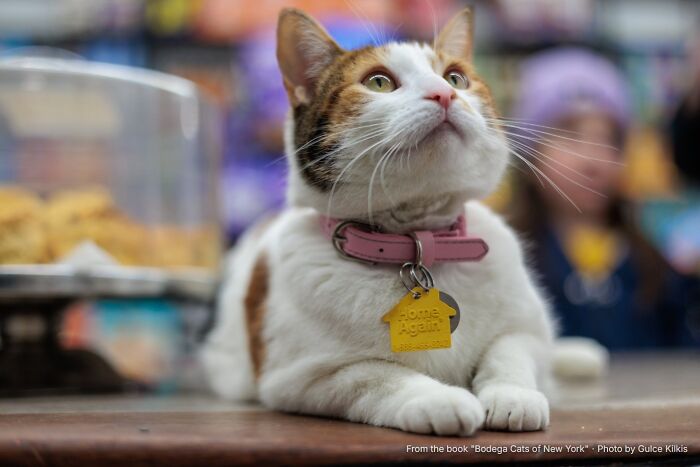
“Paulie is a calico who came all the way from Egypt.
The owner brought her over himself. He does not talk much about the logistics. Just that she made the trip, she survived it, and now she lives in his shop on the counter near the register.
I asked how she ended up here. He shrugged.
“She's my cat,” he said. “I brought her.”
That was the whole explanation.
Paulie sits on the counter most days. She watches the transactions. She stretches across the lottery tickets when she feels like it. Customers reach over her to pay. She does not move. She has learned that she does not have to.
The owner estimates she brings in $300 to $400 a day in extra business.
“People come for the cat,” he said. “They stay for the snacks.”
He is not exaggerating. We watched it happen.
A group of teenagers walked in, took turns holding Paulie, bought nothing, and left. Five minutes later, a woman came in, photographed the cat from three angles, then grabbed a bag of chips and a drink on her way out. A man stopped at the door, asked if this was "the cat store," and came inside when the owner nodded.
The cat is the draw. The purchases follow.
Paulie does not know she is a revenue generator. She does not know she traveled 5,000 miles to end up on a counter in New York. She does not know that her presence has become a line item in someone's business model, that her face has been posted and reposted by strangers she will never meet.
She just knows the spot is warm. The customers are friendly. Nobody rushes her when she decides to take up the whole register.”
“Language was its own layer. Some owners only spoke Arabic or Spanish, and we ended up relying on customers in the store to translate what we were doing. That was often how the trust actually got built. A regular vouching for us in the language the owner actually spoke.”
“Prince came with the shop when ownership changed. He has been there longer than the current owner. Twelve years at his post.
He once killed two birds in front of witnesses, then walked back inside and went to sleep like nothing happened. Regulars still talk about it. The story gets retold at the counter with the same cadence every time, the details slightly different depending on who is telling it.
Every day he walks next door for cheese from the pizza guys. Knows the routine. They know his. Nobody arranged this. It just became the schedule.
Prince was featured in the New York Times. That did not change anything about the way he operates. He does not care what you think of him. He does not perform for cameras. He does not adjust his behavior for strangers. He has been in the same spot for over a decade, watching the same block turn over around him. Rents went up. Neighbors moved. Storefronts changed. Prince stayed.
Twelve years is a long time in a city that replaces things constantly. Most restaurants do not last twelve years. Some buildings do not. Prince has outlasted awnings, leases, and entire neighborhood identities.
He is not trying to be memorable. He is just still here.”
“Williamsburg. Siblings, probably. Carlos thinks so but isn't certain. They came from somewhere else before he started working there.
Papelito got his name first. “Little piece of paper.” When they found him, he was so small that picking him up felt like lifting nothing at all.
Masha never accepted that kind of handling. Carlos tried to bring her upstairs for photos and warned us: "She doesn't like too many people." He's protective of her boundaries in a way that suggests years of learning them.
The basement is where they live. One percent lighting, tight space, not somewhere most owners would invite strangers. Carlos took us down anyway. On a busy day. With the counter packed. The coworkers behind the register had no idea Masha was famous on Instagram until we told them. Carlos just shrugged. He already knew.
“Those cats look very happy,” I said when we came back up.
He nodded. “People think of them too much as pets. These are working cats.”
When Carlos goes on vacation, a neighbor named Marietta feeds them.”
“When asked whether there was one favorite photo or story from the project, they pointed to Layla, a bodega cat in Manhattan: “Layla, in Manhattan. Her owner is from Yemen. The bodega had been shuttered for four years before he took it over, and the basement was overrun with mice. He brought Layla in. Three days later, he says, the mice were gone.”
“When we walked in to photograph her, a woman was already on the floor. Cross-legged. Work clothes still on, bags at her feet. Delilah was sitting in front of her, paws tucked, staring up like this was a standing appointment.
The woman had found her the week before. Now she made a daily detour just to sit with her before heading home.
Delilah came from Morocco. Muhammad brought her over when she was small enough to fit in one hand, curious enough to treat every new sound like something she could solve. She is two and a half now, settled into the role she chose for herself at a bodega on the Upper East Side.
For a while, she shared the store with a German Shepherd. They grew up together, played together, slept near each other. Then the dog got too big and too energetic for the narrow aisles. Muhammad took him home. Delilah stayed. This was her territory. These were her people.
Muhammad was not surprised by the woman on the floor. He sees it all the time. People craning their necks through the window. People walking in and scanning every shelf until they find her. Some buy something. Some do not. Their routines bend around Delilah without her trying.
She sleeps on the newspapers. Customers work around her. Nobody moves her. That is not a rule Muhammad posted anywhere. People just figured it out.
She patrols every aisle twice a day. Morning and evening, same route. Muhammad says she checks the back room first, then the shelves, then the window. When she finishes, she returns to the counter and waits for whoever walks in next.
“She picks them,” Muhammad told us. “She decides who gets her attention.”
The woman on the floor got ten minutes. She stood up, grabbed her bags, said thank you to Muhammad, and left without buying anything. She would be back tomorrow.
Delilah does not know she came from Morocco. She does not know the German Shepherd moved out because the aisles were too narrow. She does not know that a woman in work clothes rearranges her commute every evening just to sit on the floor with her.
She just knows the counter. The newspapers. The morning route and the evening route. The people who crouch down and wait to be chosen.”
“Someone filmed her sitting in a takeout container and the video spread online.
That is how Ice Spice became famous. Not through us. Not through any formal documentation. Just a customer with a phone, a cat in a container, and the algorithm doing what it does.
Now she has a fan base. According to the staff, people check on her daily. They stop by specifically to see if she is there. They ask about her by name. They have opinions about her routine.
Ice Spice lives in a Brooklyn bodega. She is well-known enough in her neighborhood that when she wanders outside, people recognize her and bring her back to the store.
That part surprised me.
Most bodega cats stay inside. The ones who go out tend to stay close, maybe a few feet past the door, watching the sidewalk from a safe distance. But Ice Spice roams. She leaves, and the neighborhood tracks her.
The owner told us she went missing once. Not for long. The community found her through Instagram and had her home before midnight.
That is what visibility does. When people know a cat, they watch for that cat. When the cat disappears, they notice. When someone spots her three blocks away, they know exactly where she belongs and they bring her back.
Ice Spice does not know any of this. She does not know about the TikTok video or the fan base or the fact that her face has been seen by strangers in other states. She knows the store, the container she likes to sit in, and the fact that when she wanders too far, someone always walks her home.
The bodega runs the way most bodegas run. Regulars in the morning. Lunch rush. Slow afternoons. Lottery tickets and loosies and the same faces at the same hours. But the cat adds something. People come in asking about her. They take photos. They tell their friends.
She was not hired to do marketing. She just does it anyway.”
“When a contractor came to install the new floor, the owner pointed at his cat and said, ' Make it look like her. He was not joking. The store now has a floor the color of Layla, and customers walk in asking whether he picked the cat to match the floor or the floor to match the cat. Layla came first. That story captures what these cats actually do for the stores they live in. Most owners figure it out eventually. This one figured it out fast enough to tile the floor in her honor.”
“Mike has run this First Avenue shop for 35 years. “Maybe before you born,” he said.
Cookie is four. She showed up as a kitten and never left. At first she was just a cat. Then people started showing up with cameras.
“Pretty famous that cat,” Mike told us.
That was an understatement.
People find the store through Instagram. NPR came by. The New York Times did a piece. A crew from Japan once flew in specifically to film her. Mike did not fully understand why, but he let them shoot. He has learned not to ask too many questions when strangers crouch on his floor with professional equipment pointed at a cat.
When we asked how many visitors come in just to see Cookie, Mike thought about it for a moment.
“Maybe 14,000 a year,” he said.
The number sounds high until you watch it happen.
A woman walked in while we were there. She saw Cookie on the counter and immediately pulled out her phone. She did not buy anything. She took six photos, said “thank you,” and left. Mike nodded. He has seen this before. He sees it every day.
Cookie does not know she has been in the news. She does not know about the Instagram account or the journalists or the production crew from Tokyo. She does not know that her face has appeared in publications she will never read, in languages she will never hear.
She just knows the counter. The customers. The fact that when strangers crouch down to say hello, she is supposed to let them.
She does. Then she goes back to whatever she was doing before anyone walked in.
She will sit still for this one too.”
“Luna is a tuxedo in Fort Greene. She is the reason this entire project exists.
I do not remember exactly when I first saw her. It was during the stretch of 2020 when the city went quiet enough that you could actually notice things you had been walking past for years. She was on the register. Not sleeping on it. Sitting on it. Watching the door like she was keeping count.
The morning regulars shuffle in with their Greek coffee cups, greeting her before the cashier. Kids ask their parents if they can say hello. She has been on that register longer than some workers have lived in New York.
There is nothing dramatic about Luna. She does not do tricks. She does not go viral. She does not scratch inspectors or draw film crews from Japan. She sits in her spot. The neighborhood comes to her.
That consistency is what caught me. Not the personality, not the story. The fact that she was always there. Every time I walked in, same spot, same posture, same calm. The workers changed. The stock rotated. The awning faded. Luna stayed.
I started noticing other cats after her. One bodega, then another. A tabby in the chip aisle. An orange cat in a doorway. A tortie on a radiator. Each one stationed in its place like it had been assigned a shift. The pattern was everywhere once I knew to look for it.
Luna did not start the project. She started the looking.
I have photographed well over a hundred bodega cats since then. Written about dozens. Helped push a bill into City Council. The project grew into something I could not have planned. But when people ask where it began, I think about a tuxedo on a register who did not move for anyone.
The original manager.”
As for what they hope people take away from the work, the creator emphasized that bodega cats are not just charming neighborhood mascots: “That these are working animals doing real jobs. Not mascots. Not pets. They earn their keep, and they get recognized by name on their block. Most New Yorkers walk past one every week without realizing the cat might be the reason that the store is still in business.”
“Boka is a Russian Blue from Green Olives Deli & Grill in Park Slope, Brooklyn. Owner Abdulmajeed Albahri adopted him in January 2022 when he was two weeks old. By July, someone stole him off the sidewalk in broad daylight.
Surveillance footage of the theft circulated on TikTok and hit 150,000 views. Flyers went up across the neighborhood. The story hit local news. A week later, a friend of the person who took him convinced them to give Boka back. When Albahri posted that Boka was home, the store filled with people who came just to see him.
The account bio says it plainly: Retired Deli Kitty. "Kedi" is Turkish for cat. He no longer works the floor at Green Olives. He earned it.”
“A follower sent the location. The message said there was a cat named Tiger in Williamsburg. I added it to the list and we went to see her.
She was there when we walked in. Stationed in the back room like she had been waiting. Did not move much. Did not talk much. Seven years old and built like she had no plans to rush anything. Khalil, the owner, had built her a setup back there. Her own corner. Her own routine.
He told us he appreciates her company. Long days behind the register, and she spends them with him. When customers see her, when they stop and crouch down to say hello, it makes his day. That is what he said.
A regular couple walked in while we were shooting. The woman looked at the cat and said, “Oh hey, look. Julia is going to be famous.”
I looked at Khalil. Julia. Not Tiger.
This happened all the time. The names change as they pass along. Sometimes the cat comes with the lease and the new owner never learns the original name. Sometimes a customer starts calling the cat something and it sticks. Sometimes the delivery drivers have their own name entirely. You write down Tiger. Someone else writes down Julia. Both are correct.
A bodega cat does not have a name. It has names. Plural. Overlapping. Sometimes contradictory. The morning worker calls her one thing. The delivery driver calls her another. The regular who stops in every afternoon has his own version. None of them coordinate. The cat answers to all of them or none of them, depending on her mood and whether there is food involved.
This is not confusion. It is how bodega cats work. They do not belong to one person with the authority to name them permanently. They belong to everyone who walks through the door.
She watched us from her corner, calm and unhurried. Claimed by anyone who walked through the door.”
“The other piece is that this is a culture worth protecting. Bodega cats have been part of New York for over a hundred years, and they are currently illegal under Health Code 81.25. We are working to change that. NYC Council bill Int. 1471 and New York State Assembly Bill A08341 are both moving through. The book is the documentation. The bills are what the documentation is for.”
“Kiki prefers the top of the ATM. She claims it like a throne.
The owner's daughter named her. The daughter does not work there. She just made the decision early and nobody overruled it.
ATMs run hot. Bodega cats figure this out fast. In the winter, the machine is the warmest surface in the store. In the summer, it is still warm, but the cat does not care. The spot is claimed. The habit is set. Other warm surfaces exist. Kiki is not interested.
When people try to use the machine, she stares them down until they apologize. Some customers use a different bodega just to avoid the confrontation. Kiki does not care about lost revenue. The owner does, but only a little. Most people laugh. Some take photos. A few just reach around her and punch in their PIN while she watches.
If you have spent enough time in bodegas, you learn to check the ATM first. Fur on top of the machine means there is a cat in the store. You just have to find it. Sometimes the fur is the only evidence. The cat is in the back, in the basement, behind the paper towels. But the ATM knows.
Kiki skips the subtlety. She is right there. Elevated, visible, unbothered. Watching everyone who walks in like she is deciding whether they deserve access to their own money.”
“Gigi is an older cat in the East Village. She has outlasted multiple awnings, owners, and neighborhood eras. Still in her window spot, watching the same corner she has watched for a decade.
People who moved away years ago come back and take photos of her to prove the block still feels like home.
That is what she represents for the neighborhood. Not nostalgia exactly. Proof. The coffee shop on the corner is a bank now. The hardware store is a juice bar. The laundromat closed. But Gigi is in the window. If Gigi is in the window, the block is still the block.
There are neighborhoods in New York where the only constant across a full decade is a cat in a window. Everything else turned over. The cat did not move. She does not know she is the thread connecting 2014 to 2024. She does not know that a woman who used to live upstairs moved to Portland and still checks Google Street View to see if the cat is there. She does not know any of that.
She knows the window. She knows the light. She knows the afternoon sun hits a certain angle around 3 PM and that is when she stretches out fully and closes her eyes.
Gigi is not trying to hold a neighborhood together. She is just still here. That is enough.”
“Simba was named when he was small. He grew into the name perfectly.
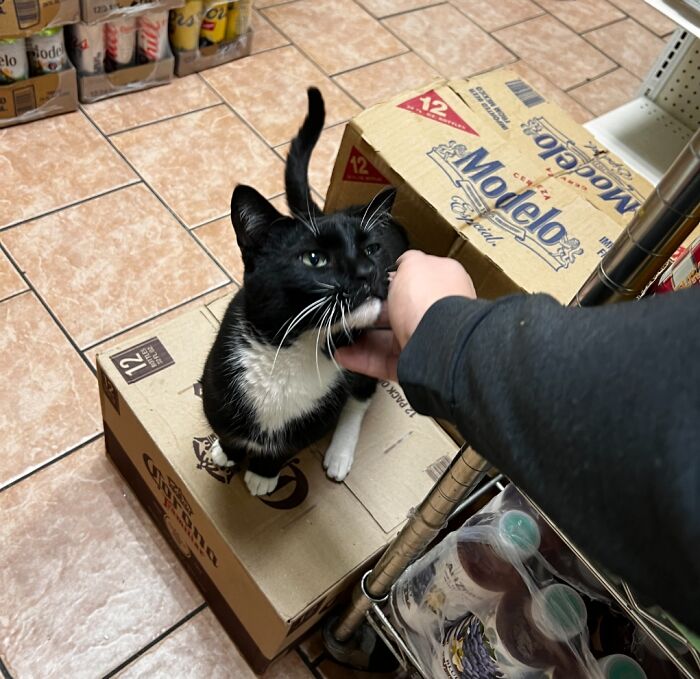
Now he is the size of a small dog and has the confidence to match. Customers step around him and the stacked Corona boxes like he is part of the store layout. Simba does not move for anyone.
He picks a spot and that spot becomes his for the rest of the shift. If it happens to be the middle of the aisle, customers adjust. If it happens to be on top of the delivery that just arrived, the delivery waits. Nobody moves Simba. Simba moves when Simba is ready.
There is a type of bodega cat who makes the store fit around him instead of fitting into the store. Simba is that type. The aisles are narrow. The inventory is stacked high. There is barely room for two people to pass. And there is Simba, planted in the center of it, watching the whole operation like he is running it.
He was small once. Nobody remembers that version of him. The name is all that is left of it.”
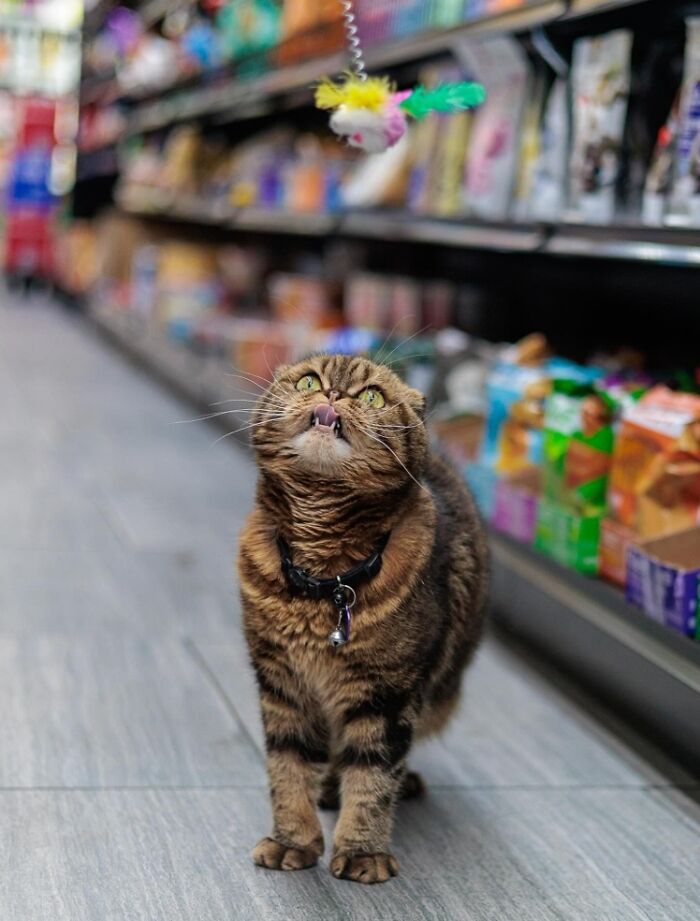
“Tiger is a Scottish Fold in Williamsburg. His owner Chiku brings him to the store, which says something about the arrangement. Tiger is not running pest control operations. He sits. Customers stop. That's the job.
He doesn't understand he's supposed to kill mice, which makes him, by working cat standards, unemployed. The store is better for having him there anyway. That's the argument in miniature for every bodega cat in the city.”
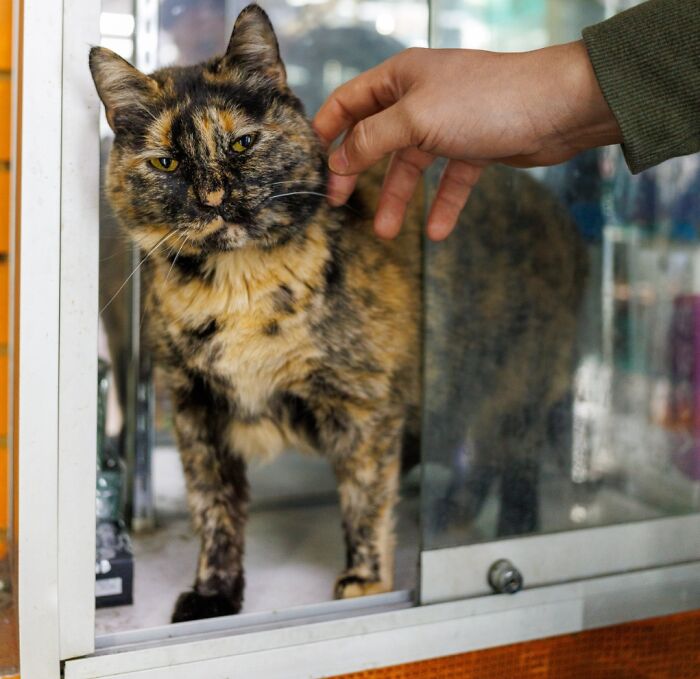
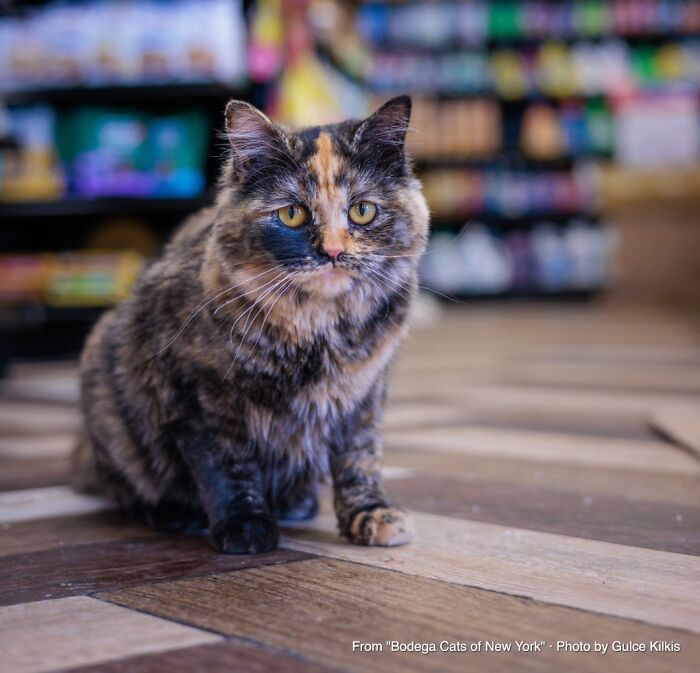
“Zorro is a tortoiseshell who lives at a Mexican grocer on Avenue A. She sits on the radiator by the front door and watches everyone who comes in.
The story goes like this: A health inspector came for a routine visit. He spotted Zorro on the radiator but didn't say anything. He finished the inspection, gave the store an A rating, and headed for the exit.
As he passed the radiator, Zorro swiped him. Two to three inches across the arm.
The inspector stopped. He turned to the owner, Ruben, and said: “Really, man? Really?”
Ruben shrugged. “Look, I'm sorry. Nothing I can do.”
The inspector walked out with an A rating and a scratch.
We can't independently verify this story. Ruben tells it. It's become part of the neighborhood lore. Whether Zorro was defending her territory, objecting to regulation, or just being a cat, nobody knows.
If you want to meet her, she's still there. Just give her space.”
“It started with Juicy. A calico who walked into his juice bar years ago and sat on top of a produce box. Omer says she brought him luck. He was able to expand the store. Then expand again. Then open an adoption center three doors down.
Juicy is retired now. Eighteen years old, living upstairs, no longer working the counter. But she changed how Omer sees animals. Before her, he treated them like objects. After her, he saw that they feel pain. That they have emotions. That recognition became a kind of obligation.
Luna came next. Another rescue who stayed until she couldn't. When she got sick, Omer paid for her treatment. When she died, he buried her under a cherry tree behind the building.
“She's still here,” he said, standing near the tree. Literally.
Senor arrived in 2020. His previous owner lost a job and planned to surrender him to a shelter. Omer took him instead. Now Senor has his own “summer house” with a warming pad. He follows Omer to the bathroom. He naps on his legs during slow hours. He bites visitors when he wants Omer's attention back.
“Whenever they come for the inspection,” Omer told us, “I say, give me the ticket. I'll pay for it.”
Kids press their faces to the adoption room windows. Regulars ask about specific cats by name. His mother brings cookies and helps with the feeding schedule. The economics don't work. He does it anyway.
“In Turkey, everyone has cats,” he said. “It's normal. Here people look at me like I'm crazy. But what am I supposed to do?”
Outside, he pointed to the feeders he leaves for raccoons and squirrels.
“Why?” I asked.
He shrugged. “Because they're hungry.”
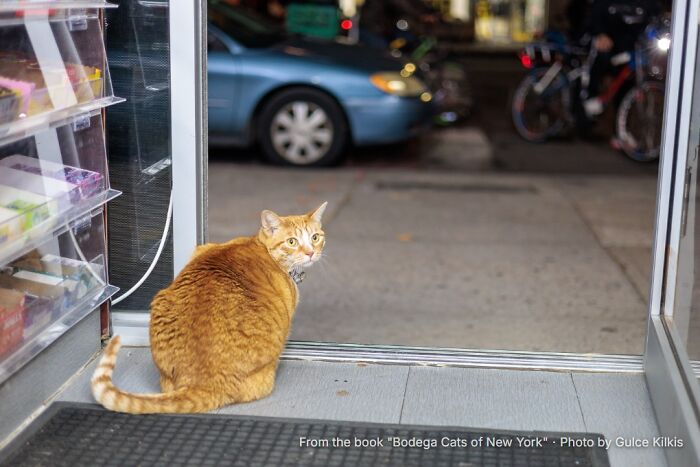
“We were on our way somewhere else when we saw him, a giant orange tabby planted in the doorway like he was on duty.
He walked straight over, sniffed the camera, brushed my leg, then returned to his spot facing the street. Same tile. Same posture. Like he had a shift to finish.
The owner was behind the counter filling orders. He watched us watching Jimmy.
“You want to photograph him? Go ahead.”
I told him we were working on a book. He nodded like that explained everything.
“He gets me business every day,” he said.
“How?”
“People come for him, then they buy something. He sits right there and people follow him inside.”
While we were there, it kept happening. Someone slowed down at the doorway and smiled before they even looked at the shelves. Another person crouched to say hello like it was part of their routine.
The owner leaned in and told me he put a tracker on Jimmy.
“Not because he gets lost,” he said. “Because he's too friendly. People fall in love with him.”
A delivery driver walked in and immediately knelt down in front of Jimmy. Not in a hurry. Not passing through. He pulled out his phone and started showing him photos, like Jimmy was the one who needed the update.
The owner watched this and laughed.
“The reason I love cats,” he said, “is because when I was young, they taught me everything I know about sales.”
He said it like he was telling me his origin story.
“You have to go to them,” he continued. “You earn their trust. If you don't do it right, they leave and find someone else. Then you start over.”
He paused.
“That's sales.”
I asked about mice.
He shrugged. “People say we keep a cat for mice. Sure. But really, I catch the mice. Jimmy's my advertisement.”
“A cat named Obama worked at a bodega in Bushwick. Then someone took him.
The owner filed a police report. The neighborhood posted flyers. Block by block, stapled to telephone poles and taped inside laundromat windows. Obama never came back.
A month passed. The store felt different without a cat. Regulars noticed. The owner noticed. The empty spot by the register stayed empty.
Then Lucky walked in. A stray. Black coat, no collar, no history anyone could trace. He came through the open door on a Tuesday afternoon, walked past the chip aisle, sat down near the counter, and did not leave.
The owner did not go looking for a replacement. He did not put out an ad or call a rescue. Lucky just showed up and started working.
“He walked in like he already had the job,” the owner told us.
Two years later, Lucky is still there. He is two years old, fully settled, fully employed. The regulars who remember Obama have accepted him. The ones who came after don't know the history. They just know the black cat by the register.
But the nickname stuck. Customers who never met Obama still call Lucky “the new guy.” Not to his face. Just among themselves, like it's a running joke that never quite ended. The owner hears it and shrugs. He stopped correcting people months ago.
The flyers are gone now. The telephone poles have new layers. Nobody talks about Obama anymore unless someone new asks why the cat's name is Lucky.
Lucky does not know about Obama. He does not know about the police report or the flyers or the weeks the store sat catless. He does not know that his name is a commentary on how he arrived.
He just knows the counter. The door that opens. The regulars who scratch behind his ears without introducing themselves.
They still call him the new guy. He has been here two years.”
“Pumpkin was born on Halloween. The name was not a negotiation.
She is four years old now. Works at a bodega in Bushwick. Her spot is the candy shelf, which she treats like a balcony. She watches customers from up there like they are on parade. Seated, composed, slightly above everyone.
Parents point her out to their kids. The kids then refuse to leave without waving goodbye. Some days, the line to wave at Pumpkin is longer than the line to pay.
Workers told us she is the reason the store feels friendly. Not because she does anything specific. She just sits there. She watches. People walk in tense from whatever their day has been, look up, see the cat on the candy shelf, and something loosens. It is not dramatic. It is just a small reset.
“She was born on Halloween,” the owner said. Like that explained everything.
Pumpkin does not know she was named for the day she was born. She does not know kids wave at her on the way out. She does not know that the candy shelf, to her, is just a shelf, but to everyone else it is the first thing they look at when they walk through the door.
She just knows the height. The view. The parade that never stops.”
“Tommy works at the bodega on 10th Avenue in Hell's Kitchen. He sits on a flattened cardboard box pushed up against the heater.
The door chime rings constantly. People walk in, scan the aisles, and leave without buying a single thing. They aren't looking for soda. They aren't looking for chips. They are looking for the white cat on the cardboard.
“People come in just to visit him,” the worker told us. She has been there five years. She watches customers stop, pull out their phones, take a photo, and walk back out to the sidewalk.
They come for the eyes.
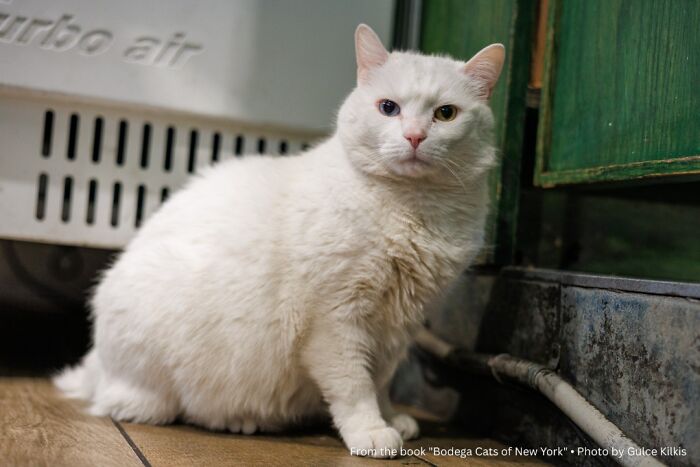
One eye is blue. The other is green. Against his solid white coat, the difference is stark. It looks almost artificial.
It stops people on the sidewalk. They see him through the glass and they come inside. They want to make sure it is real.
Tommy allows it. He does not perform for them. He accepts the attention, waits for the camera shutter, and then goes back to sleep.
Tommy was not always a shop cat.
Five years ago, he belonged to a family in the neighborhood. They had two children, two cats, and the mother was pregnant. They were moving, and in the logistics of the move, a calculation was made.
They could not take everyone. They took one cat with them. They brought Tommy to the store.
We found out about him from an old newspaper article. When we visited, he was asleep in his bed. The worker woke him gently.
“Hi, baby,” she said.
Tommy stretched, yawned, and turned to face us with those mismatched eyes. He didn't seem bothered. He didn't seem impressed either.
He doesn't know about the family's new life. He doesn't know that people travel specifically to see his eyes. He just knows the box. The heater. The worker who wakes him up gently.
The family took one cat with them. Tommy got a bodega.”
“Omish was our first shoot.
We did not know if this project was going to work. We had an idea, a camera, and a list of locations people had sent us. But we had never actually done it. We had never walked into a bodega, asked permission, and tried to photograph a cat who had no obligation to cooperate.
Omish changed that.
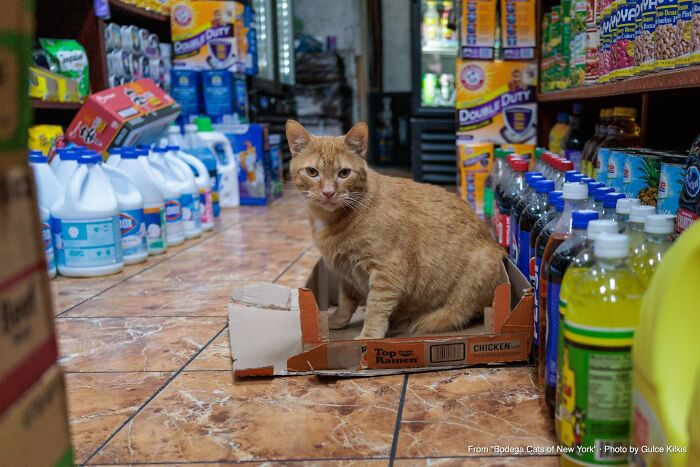
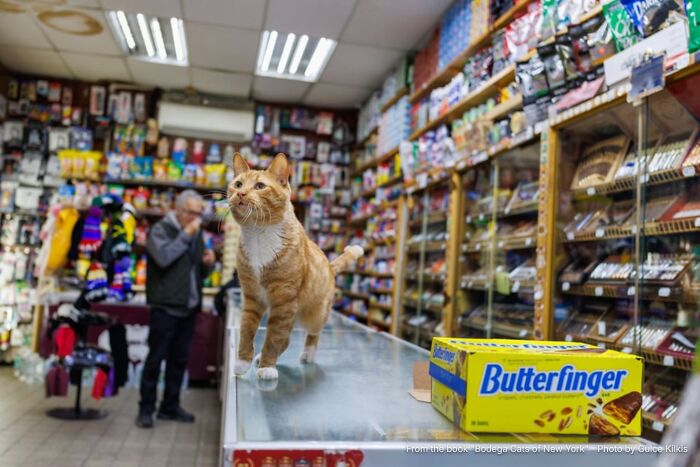
He is an orange tabby in Park Slope. He has grown into the role over four years. When we arrived, he was on the counter, watching us the way bodega cats watch everyone: calm, skeptical, waiting to see what we wanted.
The neighborhood guys were already there. Regulars. They stood around watching us work, waiting to see if the cat would actually pose.
He did.
Omish sat on the counter, completely unbothered by the chaos. Gulce moved around him, adjusting angles, getting close, pulling back. He did not flinch. He did not leave. He sat there like he understood exactly what was happening and had decided to allow it.
That was the moment I knew this project was going to work.
Not because Omish was special, though he is. Because he proved something. Bodega cats are not performing for anyone. They are not trained. They do not care about cameras or books or Instagram accounts. But if you approach them right, if you move slow and keep your energy calm, they will let you document them.
Omish let us.
The regulars watched the whole thing. A few of them commented. A few laughed. One guy asked what we were doing and nodded when we explained. “Yeah,” he said. “That's Omish.”
That is how it works in these stores. The cat is known. The cat has a name. The cat is part of the texture of the place, and the people who come in every day treat him like furniture that happens to breathe.
We got the shots. We thanked the owner. We left.
Walking out, I remember thinking: this is going to take years. Every store is different. Every owner has a different level of trust. Every cat has a different tolerance for strangers with cameras. Some will cooperate. Some will hide. Some will swat. But Omish cooperated, and that meant at least some of them would.
Four years later, we have documented well over a hundred bodega cats across all five boroughs. We have been turned away, chased out, and politely declined more times than I can count. But we have also been welcomed, offered tea, shown baby pictures of cats, and told stories that would never fit in a caption.
It started with Omish.
He is still there. Still on that counter. Still unbothered.
“Customers adore her. Not in a passing way. In a stop-mid-errand, crouch-down-on-the-tile, forget-your-coffee-order kind of way.
Michu runs the front of the bodega with authority. She recognizes regulars. She inspects newcomers. She will greet anyone who approaches calmly, but she evaluates everyone first. Five or six years in the store, and she has the routine down to a science.
But dogs? No chance.
The worker told us this while juggling everything at once: filling Grubhub orders, ringing up customers, taking a phone call, restocking shelves. We were following him around the store, trying to get quotes in the gaps between transactions. As a true New Yorker, he was doing his job first and squeezing in answers between customers.
“She loves people,” he said. “Just not dogs. She warns them. They don't listen. She warns them again.”
One dog did not take the hint. Tried to play with her. Moved too close. Kept sniffing, kept pushing, thinking Michu was playing back.
She wasn't.
Michu gave two quick, precise swats. The dog finally understood.
“This is her territory,” the worker said. “She's not aggressive. She just has rules.”
She navigates the store like she is patrolling familiar ground. When customers gather, she drifts toward them. When the aisles are quiet, she roams at her own pace. She knows which shelves are safe to nap under, which displays she is forbidden from climbing, which corners deliver extra warmth from the equipment behind the wall.
Behind her, the grill guy works through the lunch chopped cheese rush, the smell drifting toward the front. Michu barely looks up.
The one thing she will not challenge is a health inspector. The moment she senses that energy—clipboard, serious face, unfamiliar purpose—she disappears. Downstairs. Out of sight. The staff does not even have to say anything.
“She knows the drill,” one worker said. “When they do come, we bring her downstairs. So she's nowhere up here when they come.”
While we photographed her, the cooks peeked out from the kitchen. When they found out Michu was getting photographed for a book, they lit up. They passed around sample prints, arguing over which angle captured her attitude best. The whole kitchen staff got excited. I handed out stickers.
Michu did not react to any of it. She sat nearby, flicking her tail.”
“Manny has the presence of a cat who knows exactly how much of the block falls under his jurisdiction.
Big frame. Two-toned nose. He sits outside his market watching foot traffic. When we arrived, he was already in his preferred spot, acknowledging greetings, ignoring anything unimportant. People paused to talk to him. Some crouched down. Some just nodded at him like he was a neighbor sitting on a stoop.
Customers stop just to see him. Not to shop. Not to browse. To see Manny.
The worker told us this with a shrug. “He knows everybody. Customers. Delivery guys. People from upstairs. He keeps track of things.”
He watches every face. Notes who walks fast, who hesitates, who is new. When people stop to greet him, he gives them a slow blink or a small shift in posture. Inside, he moves slower. Controlled. He has designated zones, spots he cycles through. A shelf he naps under. A stretch of wall he uses as a vantage point. A counter he avoids because it does not interest him.
His routine is consistent enough that the workers can predict where he will be at different times of day.
The part that surprised us most was his timing with health inspectors.
“He knows what they look like,” the worker said. Clipboard. Jacket. The particular type of walk. Manny picks up the signal immediately. And the second he does, he is gone. Not dramatically. Just quietly somewhere else. Outside. Down the hall. Behind a stack of crates.
Three years in the store. Not a single violation.
The workers do not take credit. They point at Manny.
“He just knows,” they said. “We don't teach him.”
Nobody trains a cat to recognize a health inspector. Nobody explains the stakes. But cats read environments. They notice patterns humans miss. A certain posture. A certain pace. A certain way of looking around that says this person is checking things.
Manny noticed, and he adapted.
By the time the inspector finishes the checklist, Manny is back on the counter like nothing happened. No citation. No warning. No evidence he was ever there.
Three years, zero violations.
When we left, he was back outside, watching the sidewalk. Same spot. Same posture. Same slow scan of everyone passing by.
The block belongs to him. He just lets people walk through it.”
“Chanel sleeps through most shifts. Only wakes for deliveries.
When the UPS truck pulls up, she is at the door before the driver gets out. She inspects every box. Sits on them. Sniffs the edges. Confirms everything is correct. Once the boxes are inside and accounted for, she walks back to her spot and goes to sleep like she just clocked out.
The owner tried to film this once to prove it was not coincidence. Chanel performed exactly on cue. “She hears the engine from two blocks away,” he said.
Delivery drivers across the city know certain cats. They have routes, and the routes include stops where a cat will be waiting. Some drivers keep treats in their pockets. Some just know to move slowly. The relationship between delivery drivers and bodega cats is one of those patterns nobody writes about because nobody thinks it counts as a story. It counts.
Chanel does not greet customers. Does not sit in the window. Does not perform. She has one job and she does it on her own schedule. The rest of the time, she sleeps. Efficiency perfected. Work-life balance mastered.
The owner does not mind. A cat who sleeps eighteen hours and works for two minutes is still a cat who works.”
“Sofia is social. Customers bring toys specifically for her. Treats every visit like recess.
Some people stop by on their way to work just to play with her for five minutes. Someone holding a vape pauses mid-hit to crouch down and say hi. Sofia does not even blink. The owner says she has extended more commutes than the L train.
She has a preferred toy, a crinkled ball, that she carries around the store and drops at the feet of whoever she has decided needs to throw it. If you ignore her, she picks it up and drops it again. Louder. She is patient but persistent. One regular keeps a backup toy in his bag just in case Sofia's ball goes missing.
Most bodega cats are passive. They sit, they observe, they allow contact on their terms. Sofia initiates. She decides when it is time to play, and she decides who is playing. There is no opting out. You either throw the ball or you stand there while a cat stares at you with the ball at your feet, waiting.
The thing about Sofia is that she changes the pace of the store. People slow down. They put their phone away. They crouch. For a few minutes, the commute does not exist. The train is not coming. The meeting can wait. There is a cat with a crinkle ball who has chosen you.”
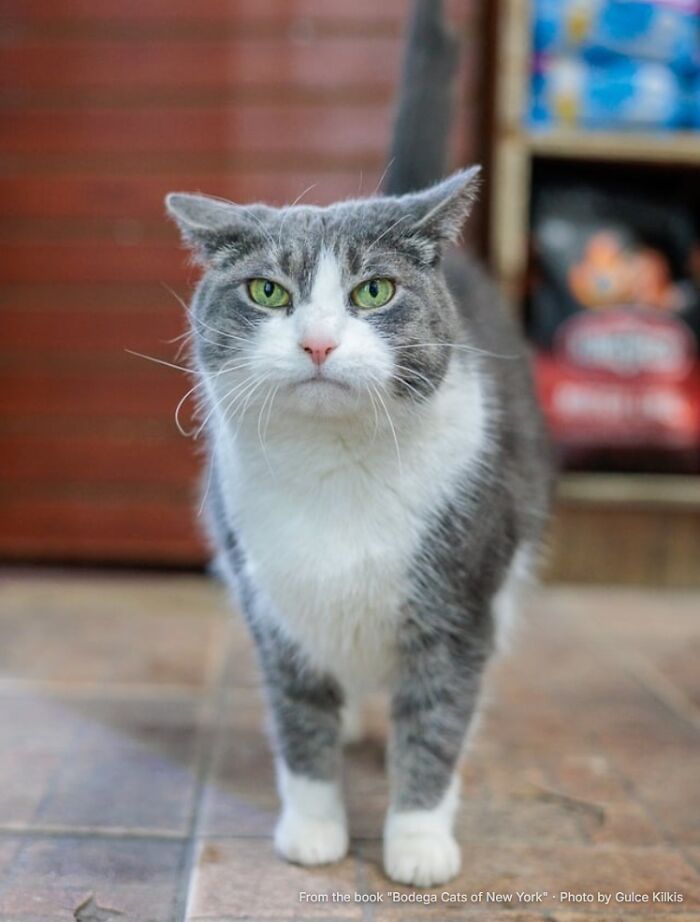
Charlie has rules. First-time customers get warned at the counter.
“Don't try to pet him. He'll let you know when he's ready.”
Some people never get the green light. Charlie is fine with that. He is aggressive with new people and loyal to regulars. The boundaries are respected by everyone because the consequences of ignoring them are immediate and clear.
Most bodega cats are approachable. They sit on the register and accept whatever attention comes their way. Charlie is the opposite. He decides who gets access and when. The regulars understand this. They have earned their standing over months, sometimes years. A new face means nothing to Charlie until it becomes a recurring one.
The workers do not apologize for him. They do not try to make him friendlier. They just deliver the warning and let people make their own decisions. Most listen. The ones who do not learn fast.
There is something honest about a cat who does not perform warmth he does not feel. Charlie is not rude. He is clear. The difference matters.”
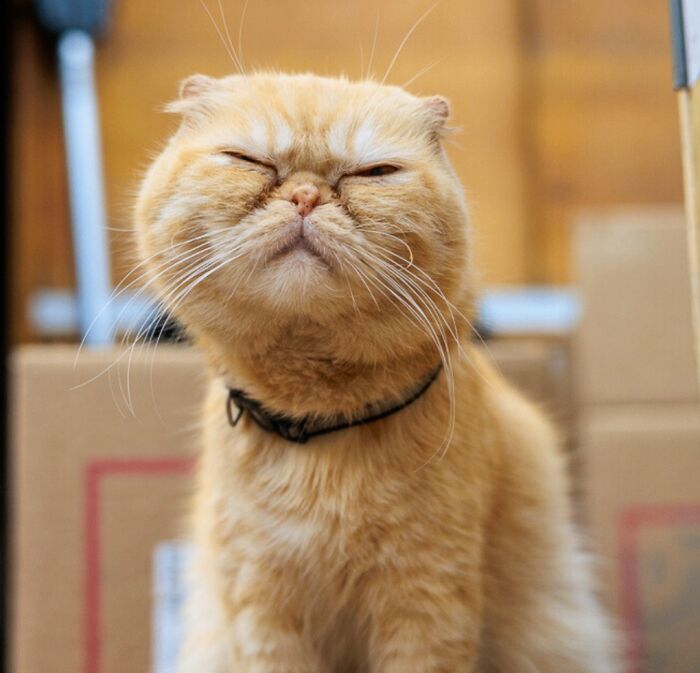
“Her full name is Mia Garfield.
They named a Persian cat Garfield. Nobody in the store sees the contradiction.
She has been holding down a bodega on 2nd Avenue in the Upper East Side for three years. In that time, Fox 5 has come by. Professional photographers have come by. A book crew came by.
She looked annoyed during all of it. That is just her face.
Mia is a Persian mix with a flat, compressed face that registers somewhere between unbothered and personally offended. She could be doing the most ridiculous thing in the store and still look like she is tolerating you. This is the whole arrangement. People come in specifically for it.
Some days she feels generous and posts up on the sidewalk outside. Sits there watching 2nd Avenue, not wandering, not chasing anything. People stop. They always stop.
Other days she is in the back of the store and nobody gets an audience. Her fans check daily to see which version of Mia they are getting.
Behind the scowl, she is a total goofball. She stretches across the floor like she is doing mat Pilates. She bunny kicks anyone who gets too close to her belly. She has a signature move where she poses with one leg up, and her followers have documented it enough times to recognize it on sight.
She has an Instagram account, 475 followers, run by someone the bio describes only as “my favorite fan.” Her titles are listed: bodega manager, security, personality hire, sidewalk model, UES princess.
Her highlight reels are labeled: posing, outside, friends?, my fans, weirdo, chillin. The question mark after “friends” is the most honest thing on the internet.
There is another cat in the store. A grey one. You would not know it from the Instagram.
The account is all Mia. Forty-five posts. The grey cat appears maybe once, in the background, out of focus.
Mia does not know about the Fox 5 segment. She does not know a stranger runs an Instagram account in her name, writing captions she will never read.
She does not know that her face is the reason people walk into a bodega on 2nd Avenue and stay longer than they planned.
She just knows the floor. The cooler. The sidewalk when she decides you deserve it.”

Hidrėlėy and Tarik, thank you so much! This is just how I needed to start my day! XXXXOOOO
Hidrėlėy and Tarik, thank you so much! This is just how I needed to start my day! XXXXOOOO



 No fees, cancel anytime