Get Premium
Dark mode theme is available exclusively for premium users. Learn more about the benefits of subscribing.
No fees, cancel anytime.

 Dark Mode Ad-Free Browsing Unlimited Content
 Ad-Free Browsing Unlimited Content Dark Mode
Join 1.2 million Panda readers who get the best art, memes, and fun stories every week!
The world of birds never stops fascinating us, and every time we start exploring it, we discover something new and surprising. That’s why we’ve put together another interesting collection for all curious bird lovers out there who are always eager to admire new species.
'Best Bird Shots' is an Instagram page dedicated to curating amazing photography from people traveling to the most remote locations just to capture the incredible diversity and beauty of birdlife.
We've gathered some of our favorite images shared by the page below. Scroll down, enjoy these incredible feathered creatures, and don't forget to upvote the photos that impressed you the most!
This post may include affiliate links.
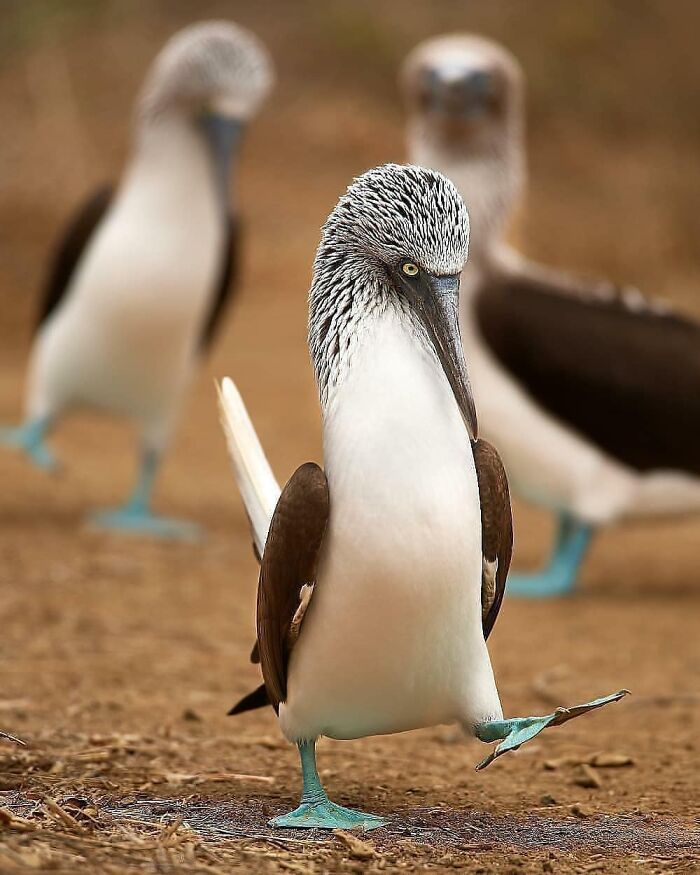
The Blue-Footed Booby (Sula nebouxii) is a marine bird famous for its bright, turquoise-blue webbed feet and its quirky, high-stepping courtship dance.
Their vibrant color comes from carotenoid pigments obtained from their diet of fresh fish. Brighter feet mean a healthier bird, making them highly attractive to potential mates.
During mating season, males lift their feet up and down in a slow, exaggerated strut, showing them off to females. They also point their beaks up at the sky and whistle.
They are incredible hunters. They fly high above the ocean, spot fish, and dive-bomb into the water from heights of up to 80 feet, hitting the surface at speeds around 60 mph.
Roughly half of the global population breeds on the Galápagos Islands, though they can be found along the Pacific coasts of Central and South America.
The word "booby" comes from the Spanish word bobo (meaning stupid or clownish). Early sailors called them this because the birds are clumsy on land and fearless around humans, making them easy to catch.
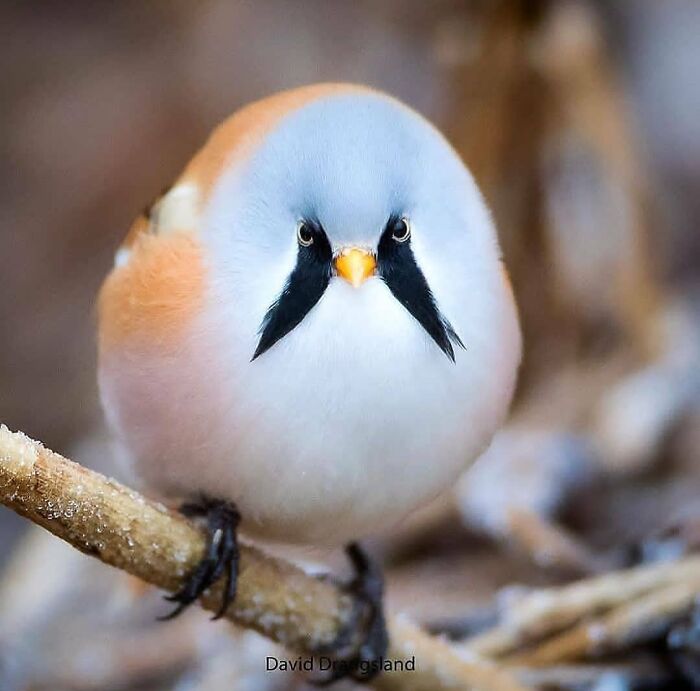
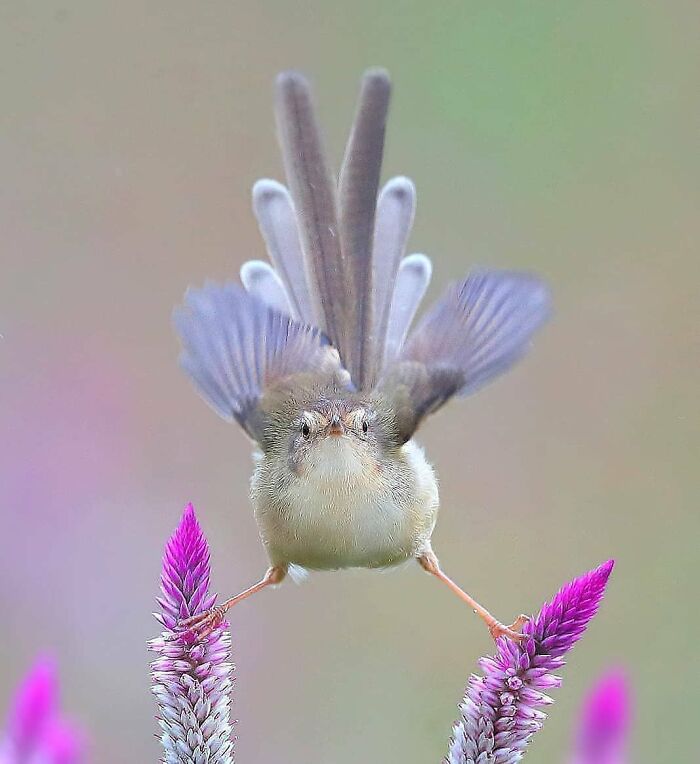
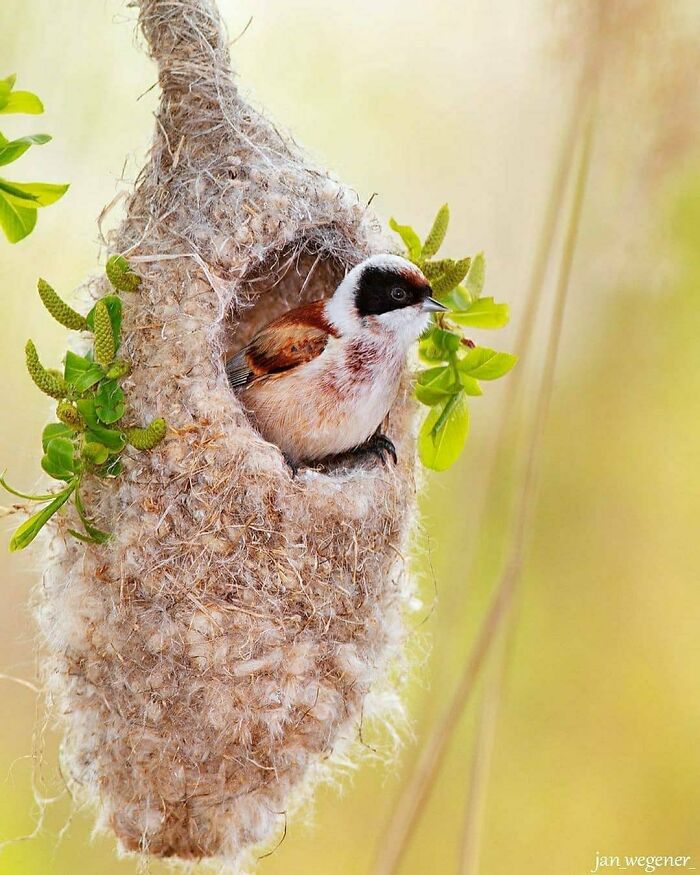
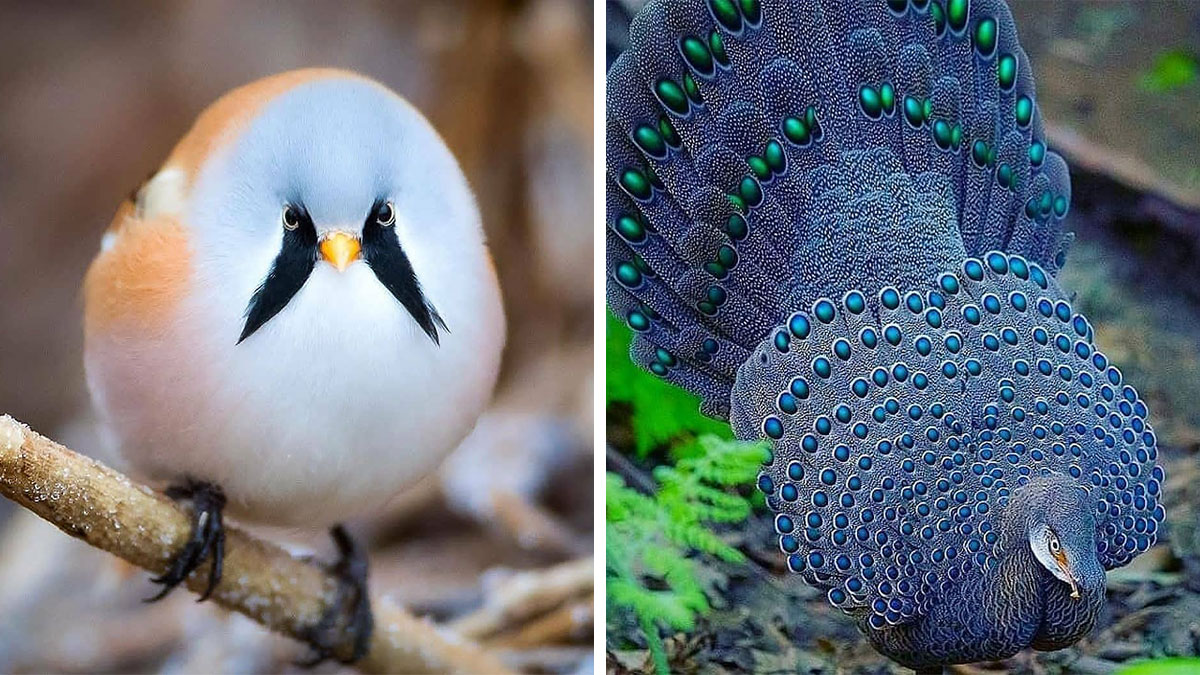
The Bearded Reedling (Panurus biarmicus), also commonly known as the Bearded Tit, is a small, highly distinctive wetland bird known for its round body, long tail, and striking facial markings.
Despite its name, the bird doesn't actually have a beard. The adult male features a striking blue-grey head with long, black markings that sweep down from the eyes like a dramatic handlebar mustache. Females are a more uniform warm brown and lack these black markings.
While it is often called the Bearded Tit, genetic testing has revealed it isn't a tit at all. It is the only surviving species in its own unique family, Panuridae.
They have a fascinating digestive adaptation. In the summer, they feed on insects like aphids and gnats. In the winter, when bugs disappear, they switch entirely to eating reed seeds. To digest the tough seeds, their stomach lining thickens, and they swallow tiny pieces of grit to help grind up the food.
They are entirely reliant on large reedbeds near water. They rarely travel far from these areas and can often be seen performing acrobatic splits, balancing perfectly between two vertical reed stems.
They are highly social birds that travel in lively groups. They are usually heard before they are seen, making a very distinct, metallic "ping" call that echoes through the reeds.

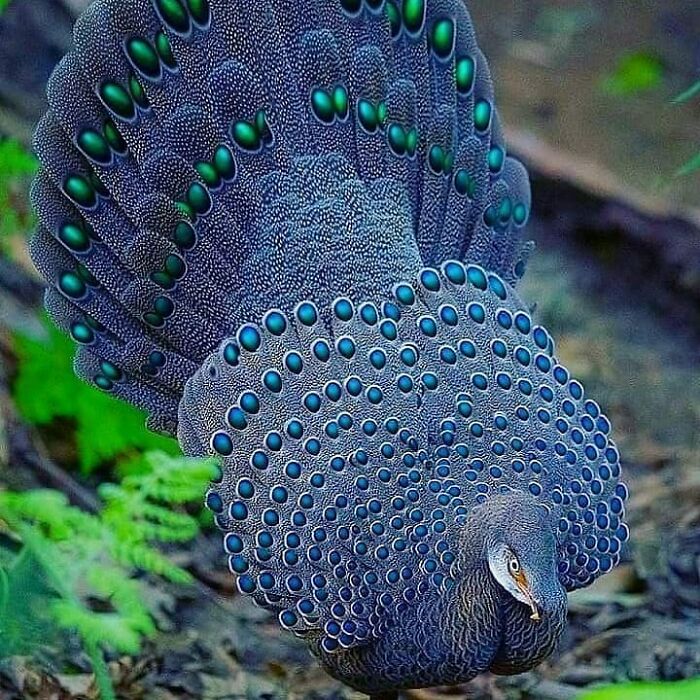
The Grey Peacock-Pheasant (Polyplectron bicalcaratum) is a secretive forest bird native to mainland Southeast Asia. It is widely recognized for its spectacular plumage and holds distinction as the national bird of Myanmar.
While their overall body plumage is a quiet, speckled grey-brown, their wings and tail are adorned with brilliant, iridescent blue-green eyespots called ocelli. When light hits them, they shimmer like real peacock feathers.
During courtship, the male transforms completely. He tilts his body forward, spreads his tail, and fans out his wings into a massive, shimmering circular shield, aiming the iridescent eyespots directly at a female.
They are incredibly shy and quiet birds. They spend almost their entire lives on the dense floor of tropical forests, scratching through leaf litter for seeds, berries, termites, and fallen fruits.
Despite being hard to spot in the wild, they are easily heard. If startled, they let out a series of loud, harsh, rhythmic whistles and croaks that act as a natural alarm system for other forest animals.
Beyond its official status in Myanmar, this bird has been featured prominently in regional folklore, royal emblems, and traditional artwork for centuries across Southeast Asia due to its majestic display.

This species is native to the tropical forests of Southeast Asia and is recognized as the national bird of Myanmar. Such beautiful beings :)
The Green Bee-Eater (Merops orientalis) is a slender, brilliantly colored bird found across sub-Saharan Africa, the Middle East, and Asia. It is famous for its acrobatic aerial hunting skills and its highly specialized diet.
As the name suggests, they love to eat bees, wasps, and hornets. To avoid getting stung, they carry the captured insect back to a perch and repeatedly smack its abdomen against a branch. This friction rubs off or forces out the stinger and safely expels the venom before the bird swallows it whole.
They are precision flyers. They usually sit quietly on a low wire or branch, spot a flying insect up to dozens of feet away, and launch into a rapid, twisting pursuit to snap the bug out of mid-air.
Aside from their intense lime-green plumage, they are easily recognized by a sharp black stripe running through their eyes, a thin black band across their throat, and two elongated, wire-like central tail feathers.
Instead of building nests in trees, Green Bee-Eaters dig long, horizontal tunnels into sandy riverbanks or soft soil. These burrows can stretch up to several feet deep, protecting their eggs from predators and intense heat.
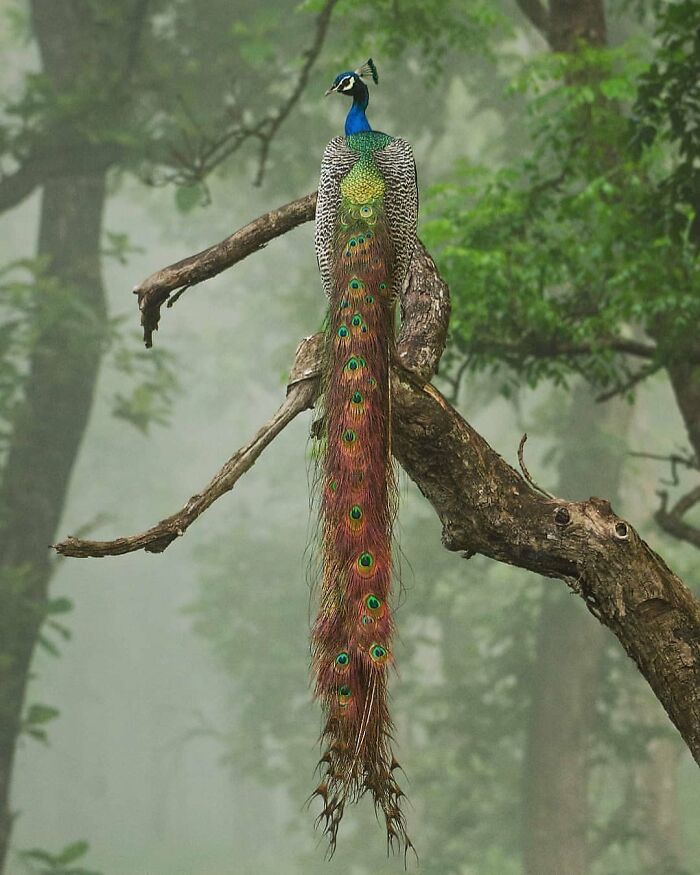
The Peacock is technically the male of the species—the overall bird is called a Peafowl (females are peahens). Famous for their unmatched, shimmering elegance, they are native to the forests of Asia and Africa but have been admired worldwide for thousands of years.
The massive, beautiful train that the peacock displays doesn't actually grow from its tail. They are highly elongated upper tail covert feathers (the feathers sitting just above the tail). Their actual tail feathers are short, stiff, and hidden behind the train to help prop it up.
A peacock’s feathers aren't actually blue or green. The feathers contain microscopic, crystal-like structures that reflect specific wavelengths of light. This creates iridescence, meaning the colors shift and shimmer depending on the angle you look at them.
When a peacock courts a peahen, he doesn't just stand there; he vibrates his feathers. This "train rattling" creates a shimmering visual effect and emits a low-frequency sound that humans can barely hear, but peahens can feel through the ground.
Despite dragging around a heavy train that can stretch up to 5 feet long, peacocks can fly perfectly fine. They can't fly long distances, but they easily launch themselves up into the safety of tall tree branches to escape predators and sleep at night.
Peacocks are incredibly loud. They make a piercing, high-pitched scream that sounds a bit like a human calling out for help. In the wild, this serves as an effective early warning system for other animals when tigers or leopards are nearby.
I love this photo, as one can see and appreciate an image of the beautiful tail feathers on display in full, not up and fanned out or resting on the ground like I'm used to
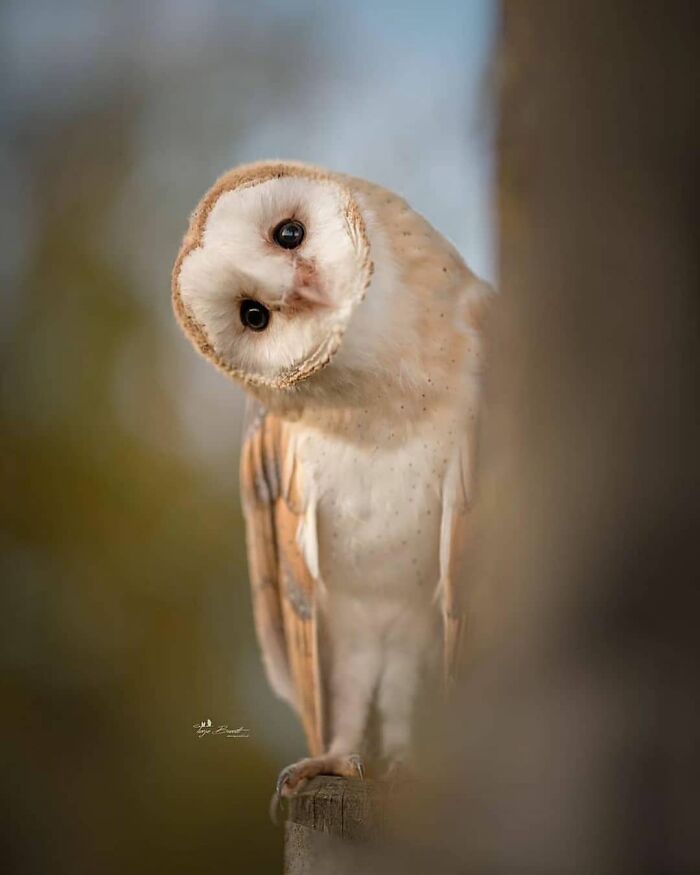
The Barn Owl (Tyto alba) is one of the most widely distributed birds in the world, found on almost every continent except Antarctica. Known for its ghostly appearance, it is a master of the night and a highly efficient predator.
Their iconic heart-shaped face isn't just for looks—it acts like a satellite dish. The stiff feathers of the facial disc channel even the faintest sounds directly into their ears, allowing them to locate prey by sound alone.
To help them pinpoint exactly where a sound is coming from, their ears are placed unevenly on their head (one is higher than the other). This allows them to detect the precise height and direction of a rustling mouse in complete darkness.
Barn Owls have specialized, velvety feathers with fringed edges that muffle the sound of rushing air. This silent flight allows them to sneak up on prey without warning and hear the movements of rodents while flying.
Unlike typical wood owls, Barn Owls do not make a "hoo-hoo" sound. Instead, they produce an eerie, raspy, long-drawn-out shriek that can be quite startling to hear in the dead of night.
A single wild Barn Owl family can consume thousands of rodents in a single nesting season. Because they love nesting in quiet, dark spaces like abandoned barns, silos, and church belfries, farmers actively encourage them to stick around as natural pest control.
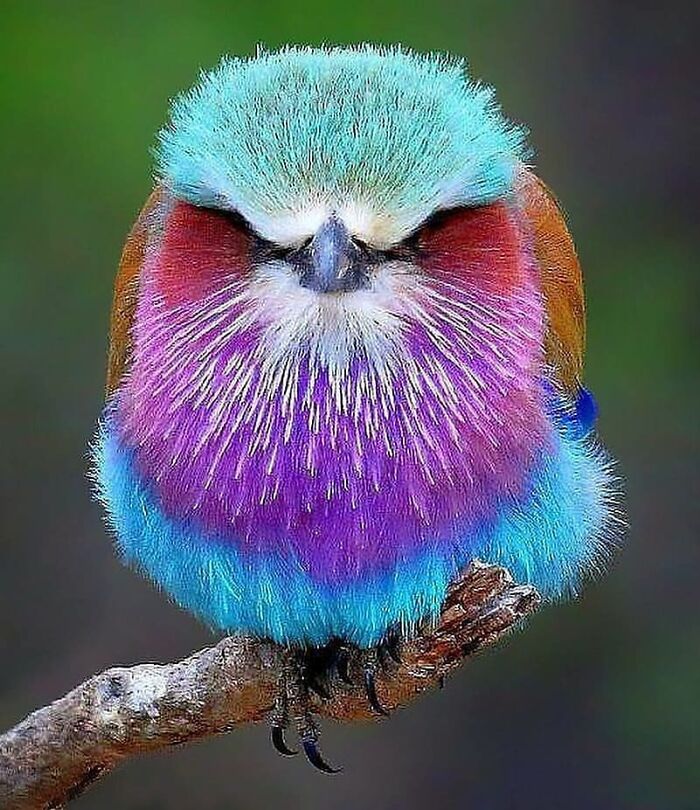
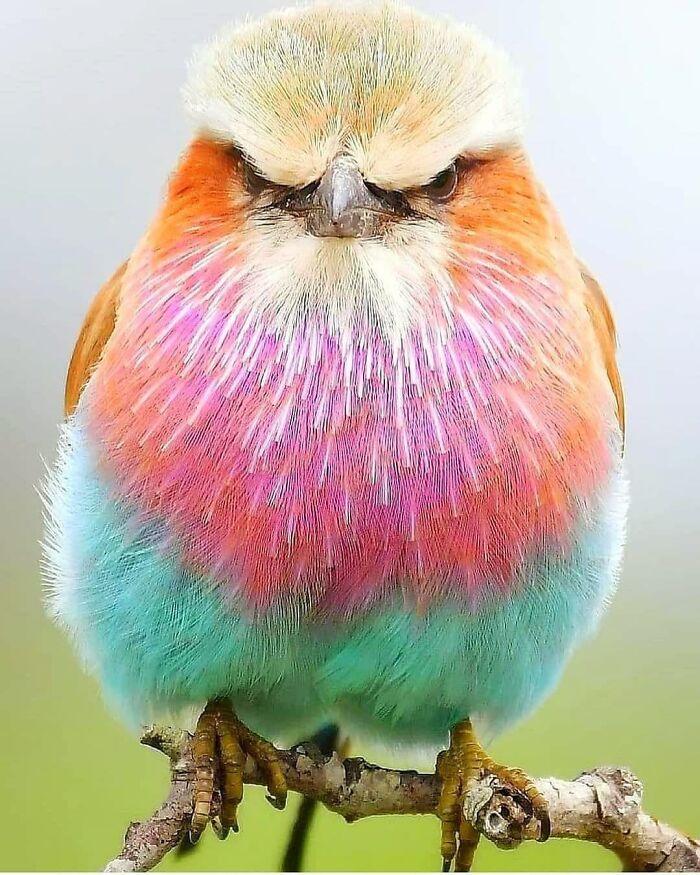
The Lilac-Breasted Roller (Coracias caudatus) is widely considered one of the most beautiful birds in the world. Native to sub-Saharan Africa and the southern Arabian Peninsula, it is famous for its breathtaking, multi-colored plumage.
True to its name, it sports a rich pastel-lilac breast, but it also features a turquoise belly, royal blue wing patches, a soft green crown, and a tan back. When it spreads its wings, it bursts into a brilliant display of electric blues.
Its name comes from its spectacular courtship flight patterns. To impress a mate, a male flies high into the air and then dives downward, rocking and rolling dynamically from side to side while making loud, rattling calls.
These birds have a brilliant, opportunistic hunting strategy. When a bushfire breaks out in the African savannah, instead of fleeing, they sit on the perimeter. As insects, lizards, and small rodents flee the smoke and flames, the rollers swoop down to catch them easily.
They are highly conspicuous and relatively fearless. They prefer to perch prominently on the very top of isolated trees, telephone poles, or wires to get an unobstructed view of the ground while scanning for movement.
Unlike many bird species where only one parent works, male and female Lilac-Breasted Rollers look identical and share responsibilities equally. They mate for life, defend their territory together, and take turns incubating their eggs in natural tree hollows.
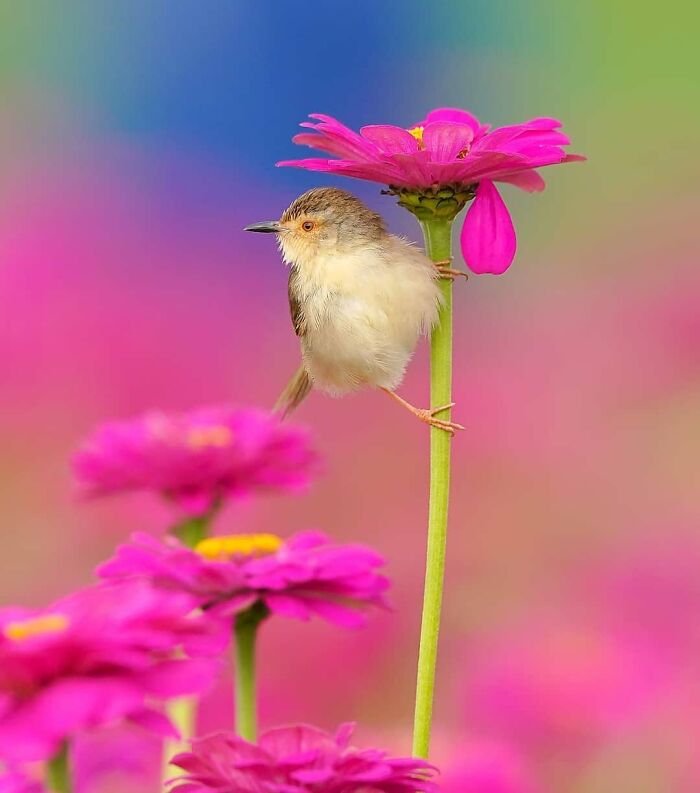
The Tawny-Flanked Prinia (Prinia subflava) is a small, highly active warbler-like bird native to sub-Saharan Africa. Known for its energetic personality and its long, expressive tail, it is a familiar presence in grasslands, shrublands, and garden edges across the continent.
This bird has a notably long, slender tail that it rarely keeps still. Whether it is hopping through tall grass or perched on a twig, it constantly jerks, wags, and cocks its tail up and down to signal its alertness.
While its back is a quiet grey-brown and its belly is pale white, its sides—or flanks—are washed in a beautiful, warm, reddish-tan ("tawny") color that gives the bird its name. It also features a distinct pale stripe running right over its eyes like an eyebrow.
They build incredibly intricate, pocket-shaped nests. Using their sharp beaks, they weave living strips of grass together into a tight, cozy pouch, often stitching it securely between large leaves or dense stalks close to the ground.
Despite being tiny, they have very loud voices. They are highly vocal and frequently repeat a sharp, rapid, metallic chattering song—often described as sounding like "jip-jip-jip-jip"—to aggressively defend their breeding territories.
Because they are such attentive parents, their nests are frequently targeted by the Cuckoo Finch, a parasitic bird. The Cuckoo Finch will sneak into the prinia's nest, lay a matching egg, and trick the prinias into raising its large, fast-growing chick.

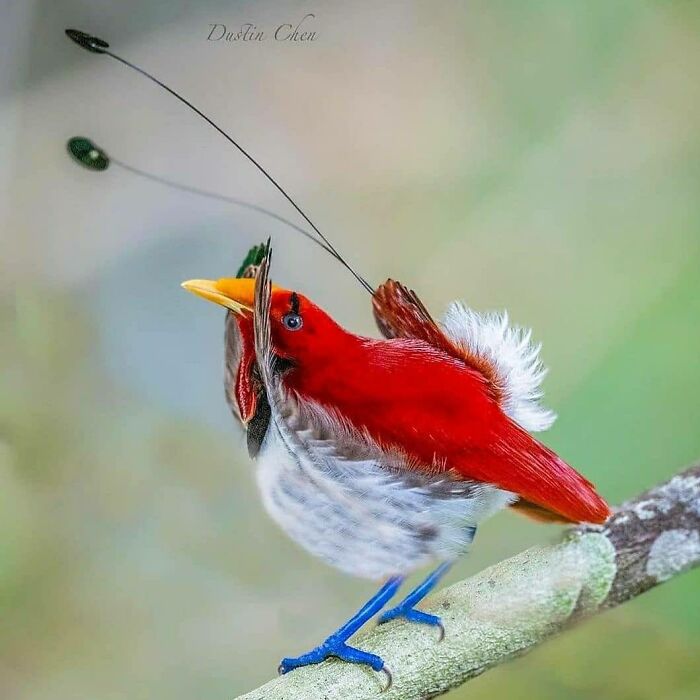
The King Bird-of-Paradise (Cicinnurus regius) is a tiny, jewel-like inhabitant of the lowland rainforests of New Guinea and its neighboring islands. Measuring just about 16 cm (6 inches) long, it holds the title of the smallest and most uniquely packaged member of the magnificent bird-of-paradise family.
While the female is dressed in an understated, camouflaging blend of olive-brown and buff bars, the male is a vivid masterclass in color. He features a brilliant crimson-scarlet head and back, a stark white belly, bright cobalt-blue legs, and two elongated, wire-like tail streamers tipped with iridescent emerald-green buttons.
During courtship, the male performs an astonishing, theatrical acrobatic dance on a cleared vertical branch. He puffs out his white belly feathers into a perfect round ball, flares out hidden green-tipped fan feathers on his chest, expands his tail wires over his head, and sways rhythmically while hanging upside down like a living pendant.
They are relatively solitary and active foragers within the forest canopy and middle layers. They spend their days flitting through the branches, feeding primarily on a varied diet of small tropical fruits, berries, and a wide array of insects and spiders.
Despite their dazzling appearance, they are far more frequently heard than seen due to the dense forest foliage. Males establish high perches called courts, from which they emit a series of loud, distinct, and characteristic whistles and cat-like mewing calls to proclaim their territory and attract a mate.
Beyond its biological marvels, this bird holds a deep cultural significance among the indigenous peoples of New Guinea. For generations, its vibrant red feathers and unique disk-tipped tail wires have been highly prized for use in traditional tribal headdresses and ceremonial regalia, symbolizing status and prestige.
During the courtship dance, the bird fans out its feathers, puffs up its breast feathers into a ball, and swings its tail wires above its head while dancing on branches. Yeah, that would work on me... ;)
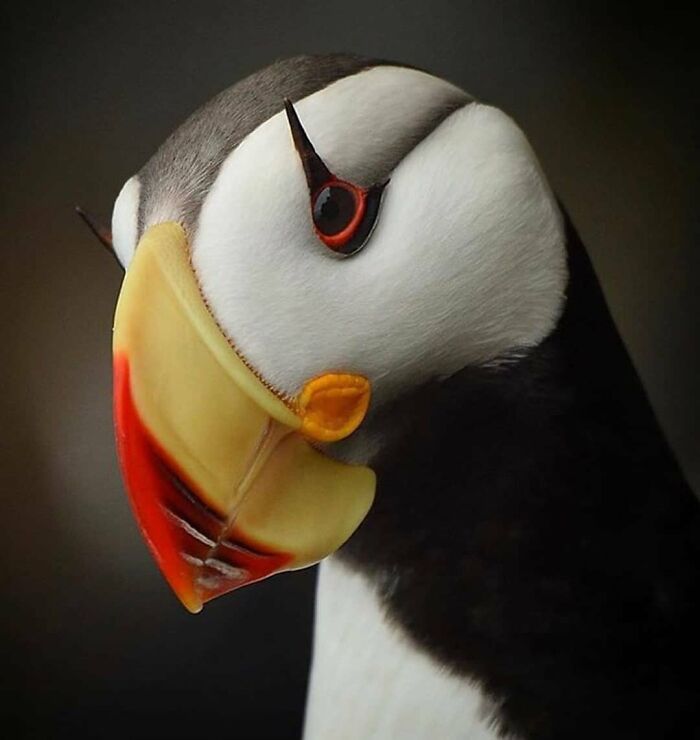
The Horned Puffin (Fratercula corniculata) is a striking, stocky seabird native to the cold waters of the North Pacific Ocean. A close relative of the well-known Atlantic Puffin, it spends its summers breeding on the rocky cliffs of Alaska and Siberia before heading far out to sea for the winter.
They get their name from a unique feature above their eyes: a small, dark, fleshy spike or "horn" that grows upward from the upper eyelid. They also have a striking orange line sweeping backward from their eye, giving them a very dramatic, painted look.
Their massive, bright yellow-and-orange beak is actually a seasonal accessory. In the spring, the bill grows a glowing outer layer to help attract mates. Once the breeding season ends in the autumn, they shed this colorful outer coating, leaving them with a much smaller, duller greyish beak for the winter.
While Atlantic Puffins are famous for digging deep underground burrows in soft soil, Horned Puffins take a different approach. They prefer to lay their single egg deep inside natural rock crevices, boulder piles, and steep cliff faces where land predators like foxes cannot reach them.
Horned Puffins are expert fishermen. They have specialized, backward-facing spines on the roof of their mouth called palatal denticles. This allows them to clamp down and hold dozens of slippery, wiggling small fish in their beak at the single time while continuing to hunt for more.
Because they are built to dive, they look a bit clumsy when flying through the air, flapping their short wings up to 400 times a minute. However, underwater, those same short wings act like powerful flippers, allowing them to effectively "fly" through the ocean depths down to 100 feet to catch prey.
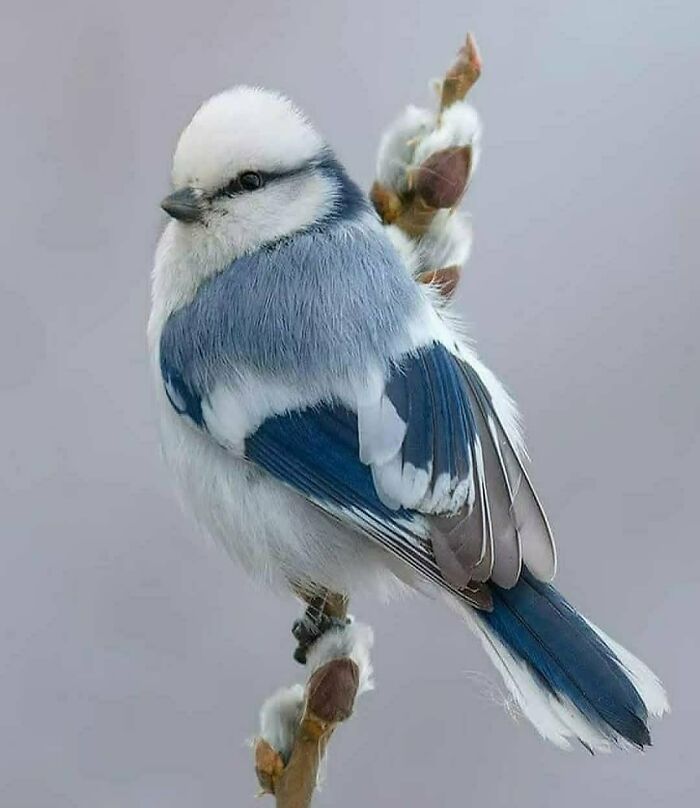
The Azure Tit (Cyanistes cyanus) is a tiny, strikingly beautiful songbird widespread across Russia, Central Asia, and parts of Eastern Europe. It looks like a frost-kissed cousin of the common Eurasian Blue Tit, traded in for a palette of crisp whites and deep,
Unlike many bright birds that stand out, the Azure Tit's colors are perfect for its cold habitat. Its pure white head, snowy underparts, and contrasting azure-blue wings blend beautifully with snow-covered branches and frost.
They are incredibly close relatives of the familiar Eurasian Blue Tit. In areas where their territories overlap, they occasionally interbreed, producing a beautiful, rare hybrid known as Pleske's Tit, which features a soft blue crown instead of a white one.
They are bundles of pure energy. Much like chickadees, Azure Tits hunt for insects, larvae, and winter seeds by hanging completely upside down from the very tips of thin twigs, reeds, and birch branches.
They thrive in damp, cold environments. Their favorite habitats are deciduous woodlands, riverbanks lined with willow and birch trees, and thick reedbeds near marshy areas.
Azure Tits nest inside small tree hollows, cracks in rocks, or old nesting holes abandoned by woodpeckers. They line these cozy cavities with thick layers of animal fur, moss, and feathers to keep their eggs insulated against freezing northern temperatures.
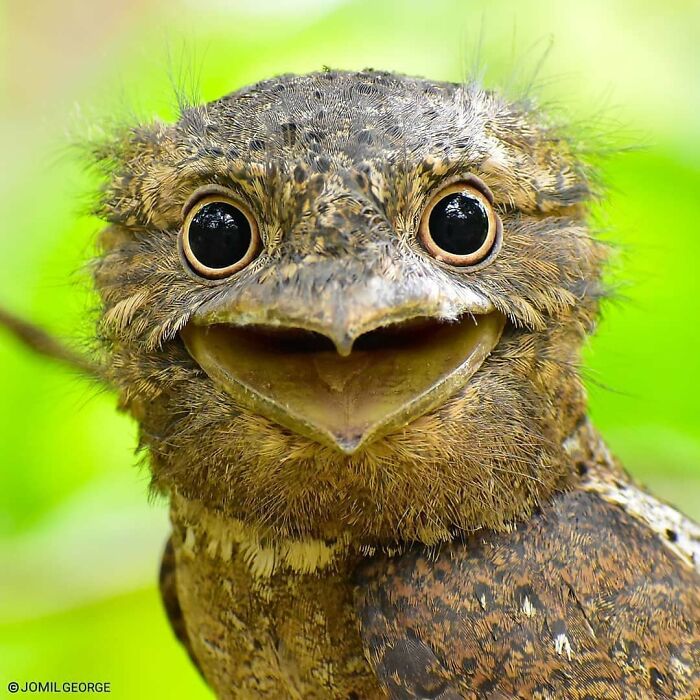
The Sri Lanka Frogmouth (Batrachostomus moniliger) is a bizarre, nocturnal bird found in the dense forest understory of Sri Lanka and the Western Ghats of India. It is famous for its uncanny ability to blend seamlessly into its environment, looking more like a broken tree branch than a living creature.
Its name comes from its wide, flat, triangular beak, which splits open to reveal a massive, gaping yellow interior reminiscent of a frog's mouth. This shape helps them scoop up large insects at night.
During the day, they roost completely still on branches. When they sense danger, they freeze, tilt their heads upward, and elongate their bodies. Combined with their speckled, feather pattern, they mimic dead leaves or broken wood perfectly.
Males and females look quite different, which helps them stay hidden in different parts of the forest. Females are a rich, warm rufous (reddish-brown), while males are a mottled grey-brown with white spots that resemble lichen on bark.
Like owls, they are active at night, but they aren't closely related to them. Instead of hunting on the wing, they sit patiently on low perches and suddenly drop down to the ground to snatch beetles, moths, and grasshoppers.
Their nests are small, shallow cups made almost entirely of moss, bark, and the bird’s own soft down feathers. The nest is so small that when a parent sits on it to incubate the single egg, the bird completely hides the nest from view.
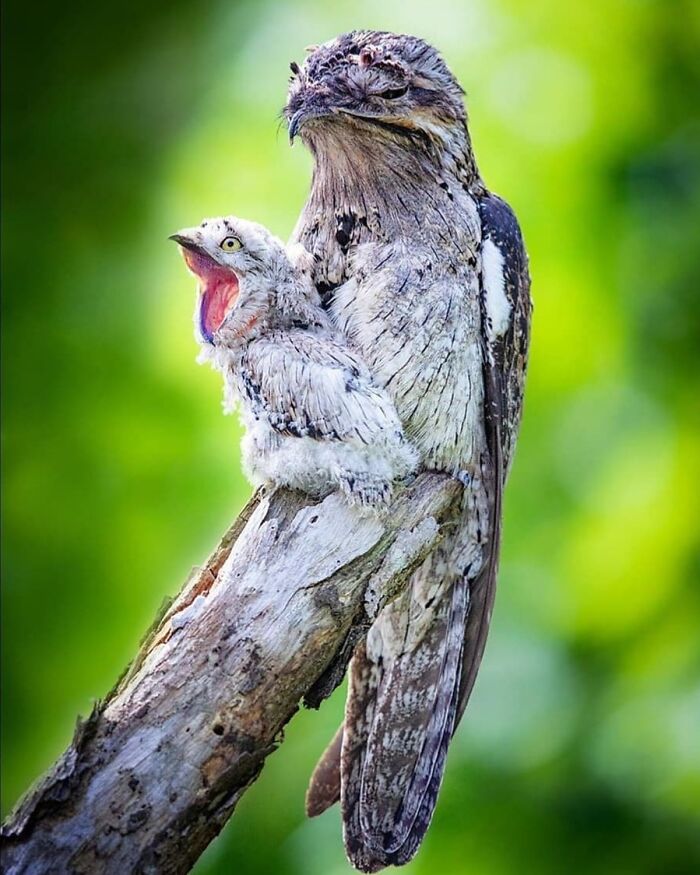
The Northern Potoo (Nyctibius jamaicensis) is a bizarre, nocturnal bird found in Central America, the Caribbean, and parts of Mexico. Closely related to nightjars and frogmouths, it is famous for its haunting nighttime cries and its mind-bogglingly effective camouflage.
During the day, the Northern Potoo rests completely out in the open on the ends of broken tree branches. By freezing perfectly still, pointing its beak up at the sky, and closing its eyes, its mottled bark-like feathers make it look exactly like a jagged wooden stump.
To maintain their disguise without being blindsided by predators, potoos have a brilliant anatomical feature: tiny, specialized slits in their upper eyelids. This allows them to monitor their surroundings and watch for threats even when their eyes are completely closed.
When it actually opens its eyes and mouth, its appearance changes completely. It has massive, bright yellow, circular eyes and an incredibly wide, cavernous mouth designed to scoop up large flying insects like beetles and moths mid-flight.
Instead of a traditional bird song, the Northern Potoo produces a deeply unsettling sound at night. It is a coarse, descending, melancholic bark or wail that has inspired many ghost stories and myths in local folklore.
Potoos don't bother building nests. The female lays a single, spotted egg directly into a shallow depression or a small knot on top of a broken branch. The parents take turns sitting on the egg, relying entirely on their camouflage to hide it from passing predators.
Mummy (or daddy?) looks about 120% done with it all. 5 in the morning after NYE and junior wants fooooood!
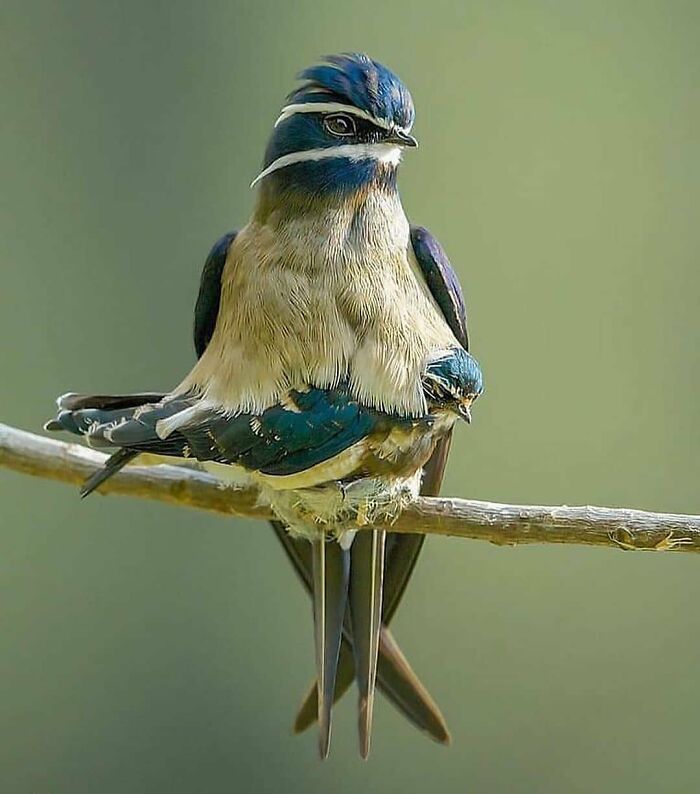
The Whiskered Treeswift (Hemiprocne comata) is a small, elegantly proportioned bird native to the subtropical and tropical lowland forests and mangroves of Southeast Asia, spanning across countries like Malaysia, Indonesia, and the Philippines. Measuring only about 15 cm (6 inches) in length, it is the smallest member of the unique treeswift family.
Their plumage is an exquisite blend of deep, muted tones and sharp, dramatic accents. They feature a rich, bronze-brown body and head, complemented by wings and a long, deeply forked tail that shimmer with an iridescent blue-black gloss. Their most striking features are the long, prominent white feathers running above and below their eyes, forming a crisp set of "eyebrows" and "whiskers" that contrast beautifully against their dark faces.
Unlike true swifts, which spend nearly their entire lives airborne and cannot easily perch, treeswifts have well-developed feet that allow them to hold onto branches. They prefer to sit openly on high, dead twigs, acting like flycatchers as they sally out in swift, acrobatic loops to snatch flying insects from the air before returning right back to the exact same vantage point.
Their nesting habits are a marvel of minimalist engineering. The parents use a mixture of their own hardened saliva, tiny bits of bark, and feathers to construct a microscopic, paper-thin crescent nest glued directly onto the side of a narrow, exposed tree branch. The nest is so small that it can hold only a single egg, and the adult must sit upright on the branch itself, covering the tiny cup with its belly feathers to incubate it.
They are generally encountered in pairs or close-knit family groups, frequently communicating with one another through a series of sharp, metallic, and high-pitched squeaks. Their distinct, graceful silhouette—resembling a cross between a swallow and a miniature falcon—is a common and welcome sight against the forest canopy.
Do not forget to give the birds water - especially when it is hot outside. Like with a bird bath. They don't just bathe, they also drink. Clean it daily, and put fresh water in the morning and in the evening.
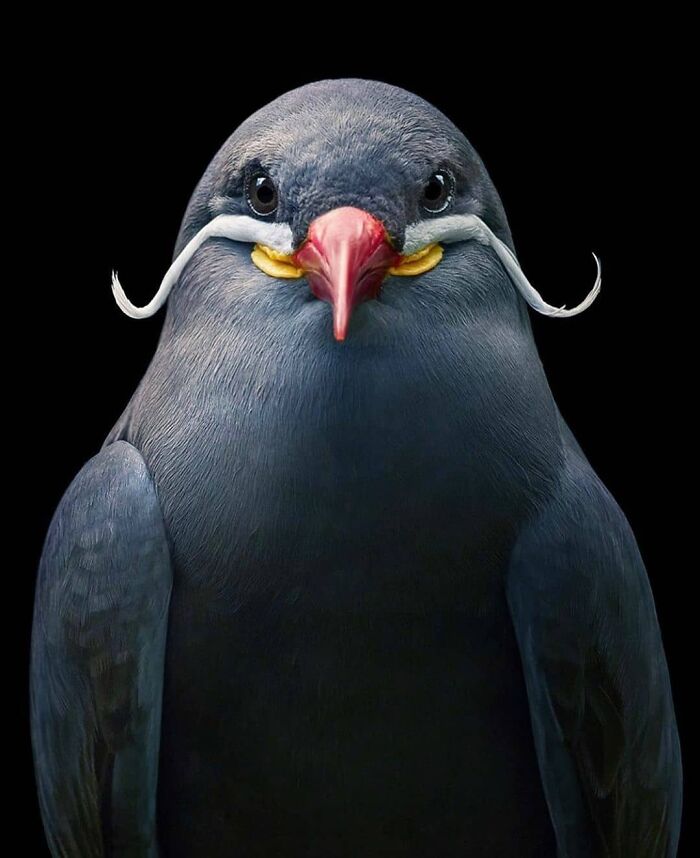
The Inca Tern (Larosterna inca) is a uniquely dapper seabird native to the rugged Pacific coast of South America, tracing the path of the cold Humboldt Current across Peru and Chile. Easily one of the most eccentric-looking marine birds in the world, its unmistakable features make it an absolute favorite among birdwatchers.
Their plumage looks like a perfectly tailored, slate-grey suit that covers their entire body, contrasted by a stark white trim on the edges of their wings. However, their true claim to fame is the magnificent, long white feather tufts that curl elegantly outward from the corners of their mouth, giving them the appearance of wearing a perfectly groomed, aristocratic handlebar mustache.
They are highly gregarious and master aerial hunters, specialized in plunge-diving into the ocean surf to capture small schooling fish like anchovies and sardines. They often gather in massive, chaotic flocks alongside sea lions, cormorants, and whales, capitalizing on the confusion to swoop down and snatch panicked fish right from the water's surface.
Instead of building traditional open nests out of sticks, they prefer to raise their chicks in dark, protected sanctuaries. They seek out deep rocky crevices, natural caves along ocean cliffs, or the abandoned burrows of Humboldt penguins, occasionally nesting in hollow gaps beneath old coastal docks and harbor structures.
They are incredibly vocal, creating a lively and chaotic atmosphere across their breeding colonies. Their distinct vocalization is famously compared to the high-pitched, nasal meowing of a kitten, which echoes constantly across the rocky cliffs as mates call out to one another or vigorously defend their nesting spots.
The name "Inca" serves as a direct geographical nod to the historical territory of the ancient Inca Empire, which once stretched across the very same South American coastline these birds call home. Today, they stand as a vulnerable but iconic symbol of the rich, fragile marine ecosystems fueled by the cold currents of the Humboldt system.
Sadly, currently listed as "Near Threatened" due to overfishing and climate disruptions like El Niño. Looks like an ancient sage :)
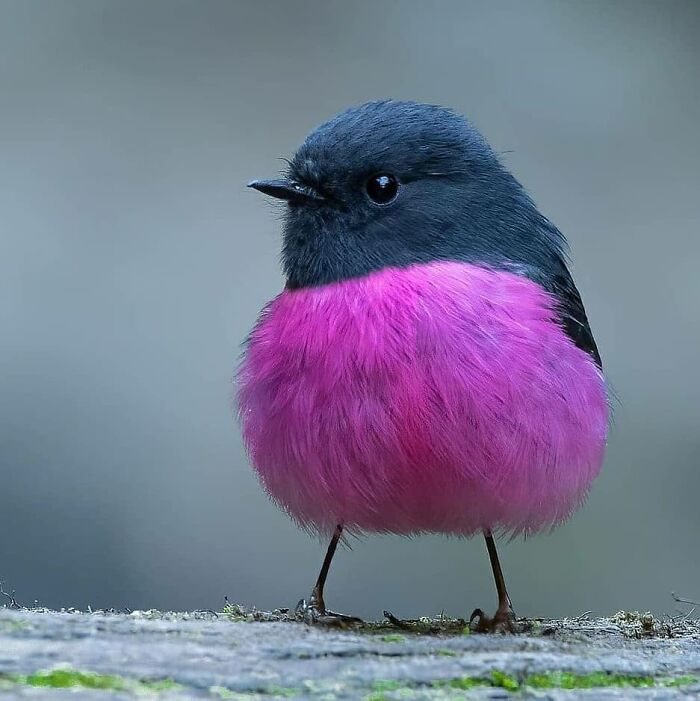
The Pink Robin (Petroica rodinogaster) looks like a tiny, round cotton ball dipped in vibrant pink ink. Native to the dense, cool temperate rainforests of southeastern Australia and Tasmania, it is a shy but breathtakingly beautiful creature.
Only the males sport the brilliant, neon-pink or magenta breast. Their heads and backs are a dark, smoky charcoal color, making the pink patch stand out even more. Females are a much more subtle, camouflaged olive-brown with buff-colored wing bars.
Despite its name, it is not closely related to the European or American robins. It belongs to the Australasian robin family (Petroicidae), a completely distinct group of birds.
They love dark, damp places. You won't usually find them in suburban parks; instead, they live in the deep understory of temperate rainforests, especially around gullies filled with moss, ferns, and sassafras trees.
They are sit-and-wait predators. A Pink Robin will sit perfectly still on a low branch or fern frond, scan the forest floor for insects, spiders, and centipedes, and then swoop down silently to grab them.
Their nests are miniature masterpieces of camouflage. They construct deep, cup-shaped nests using green moss, binding it tightly together with sticky spiderwebs, and lining the inside with soft fern down. Because of this, the nest looks exactly like a natural mossy knot on a branch.
Native to southeastern Australia and Tasmania. See, not all Australian species are "scary"...
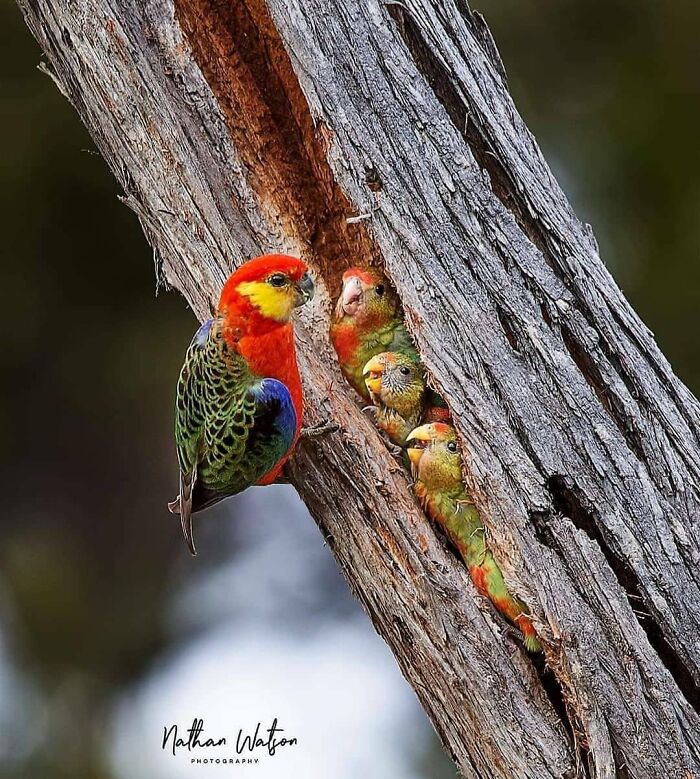
The Western Rosella (Platycercus icterotis), also known as the Moyadong, is a small, vibrant parrot native exclusively to the forests and woodlands of southwestern Australia. It holds the distinction of being the smallest of all the rosella species.
While most rosellas have blue or white cheek patches, the Western Rosella is easily picked out by its prominent, bright yellow cheeks.
Unlike many other rosellas where males and females look identical, this species shows clear differences. The male boasts a brilliant red head and underparts with a green-and-black scalloped back. The female is much more muted, wearing a mostly olive-green plumage with just a subtle flush of red on her face and underparts.
Rosellas are generally known for being loud and boisterous, but the Western Rosella is surprisingly quiet and placid. They make soft, musical piping whistles that are far less harsh than the shrieks of their larger cousins.
Their natural diet consists of eucalyptus seeds, grass seeds, and flowers. However, they have a major sweet tooth for introduced fruits. This frequently draws them into apple and pear orchards, which historically put them at odds with local farmers.
They breed in the deep hollows of mature, living eucalyptus trees—particularly the massive Jarrah and Marri trees. The female will sit on the eggs for about 20 days while the male dutifully flies back and forth to bring her food.
The young have mostly green plumage, lacking the bright red and yellow colors to help them camouflage from predators. As fully grown, the males are thie same color scheme as the adult pictured here
The Gang-Gang Cockatoo (Callocephalon fimbriatum) is a small, charismatic parrot native to the cooler, heavily forested mountain regions of southeastern Australia. It is instantly recognizable by its unique wispy crest and its highly unusual vocalizations.
While both sexes have slate-grey bodies with a beautifully "scalloped" feather pattern, only the male sports a brilliant, fiery-red head and a wild, wispy crest that curves forward. Females have a completely grey head and crest, but feature subtle green and pinkish bars across their bellies.
Instead of the loud, ear-piercing shrieks common to most cockatoos, the Gang-Gang makes a much quieter, distinctively raspy sound. Birdwatchers often describe it as sounding exactly like a creaky wooden door opening or a rusty corkscrew turning.
Unlike many tropical parrots, Gang-Gangs thrive in cold weather. They breed in sub-alpine eucalyptus forests and can frequently be seen playing or foraging in high-altitude zones even during light winter snowfalls.
They are specialized seed eaters, absolutely loving the seed cones of native eucalyptus trees and introduced hawthorn bushes. They use their powerful beaks to systematically shred cones, often making a quiet clicking sound while they chew and raining down a heavy shower of debris onto the forest floor below.
The Gang-Gang Cockatoo is deeply cherished in its native range and serves as the official faunal emblem of the Australian Capital Territory (ACT), which surrounds the capital city of Canberra.
It's a she. Unlike the male, who has a bright scarlet-red head and crest, the female has a fully grey head and a fluffy grey crest, but she has a colorful and beautiful underbelly :)
The Black-and-Yellow Broadbill (Eurylaimus ochromalus) is a small, chunkily built bird native to the tropical forests of Brunei, Indonesia, Malaysia, Myanmar, and Thailand. Looking almost like a stylized cartoon character, it is widely celebrated for its wild mix of neon colors and its incredibly wide, distinctive beak.
Its most shocking feature is its heavy, wide beak, which is a brilliant shade of bright, glowing turquoise or electric blue. This matches its stark yellow eyes, creating a sharp contrast against its pitch-black head.
Its name only scratches the surface. Along with its black head and yellow-streaked wings, it wears a crisp white collar around its neck, a soft pinkish-wine color across its breast, and a bright yellow under-tail area.
Despite being a bird, its call sounds remarkably like a noisy insect or a mechanical alarm. It starts as a series of low, metallic chuckles that steadily accelerate into a loud, high-pitched, vibrating trill—often easily mistaken for a cicada screaming in the jungle canopy.
Broadbills are famous for their engineering skills. They build large, pear-shaped or purse-like nests out of grass, leaves, roots, and moss. They suspend these bulky structures from long, thin vine tendrils directly over forest rivers or trails, making it incredibly difficult for snakes and monkeys to climb down to steal the eggs.
Its broad, scooping beak is perfectly evolved for its diet. It sits patiently in the lower and middle tiers of the rainforest before launching itself into quick aerial maneuvers to snatch up large insects like cicadas, grasshoppers, and beetles mid-air.
The Grey-headed Chickadee (Poecile cinctus), known across Europe and Asia as the Siberian Tit, is a small, incredibly resilient songbird that inhabits the high-latitude subarctic forests of the Northern Hemisphere. It holds a legendary reputation among North American birdwatchers as one of the continent's most elusive birds, clinging to a thin, remote breeding range in the stunted willow and spruce forests of Alaska and northwest Canada.
Their plumage is a cozy, muted arrangement designed perfectly for camouflage in cold climates. Unlike their more common relatives, they sport a soft, muted brownish-grey crown and back instead of a stark black cap. This is beautifully contrasted by clean white cheeks, a dark dusky-grey throat bib, and rich, buff-colored flanks that give them a fluffy, round appearance when puffed up against the cold.
They are master survivors of the brutal subarctic winters. To endure temperatures that routinely drop well below freezing, these chickadees utilize a physiological superpower known as nocturnal torpor—purposefully lowering their body temperature at night to save precious energy. They spend their days tirelessly foraging for insect larvae, pupae, and seeds hidden within the bark of trees, relying heavily on food caches they meticulously hid during the autumn.
During the breeding season, they reveal their strict dependency on old-growth habitats. They are secondary cavity nesters, meaning they rely on old holes carved out by woodpeckers or natural hollows in decaying trees to build their nests, which they line with insulating animal fur and moss. Because logging and climate change have altered these northern taiga forests, finding suitable old-growth nesting trees has become increasingly difficult for them.
They are generally quiet and unassuming, especially compared to other chickadee species, making them remarkably difficult to locate in the vast northern wilderness. Their calls include a soft, buzzy variation of the classic family sound—a distinct, nasal "chick-a-dee-dee"—alongside a collection of quiet, high-pitched whistles used to maintain close contact with their mates through the dense brush.
Beyond their biological grit, this bird represents one of the ultimate quests in North American birding. Because their territory is so incredibly remote and rugged, very few people have ever seen a Grey-headed Chickadee in the wild on the western side of the Atlantic. They stand as a quiet, stoic symbol of the untouched, freezing wilderness of the far north.
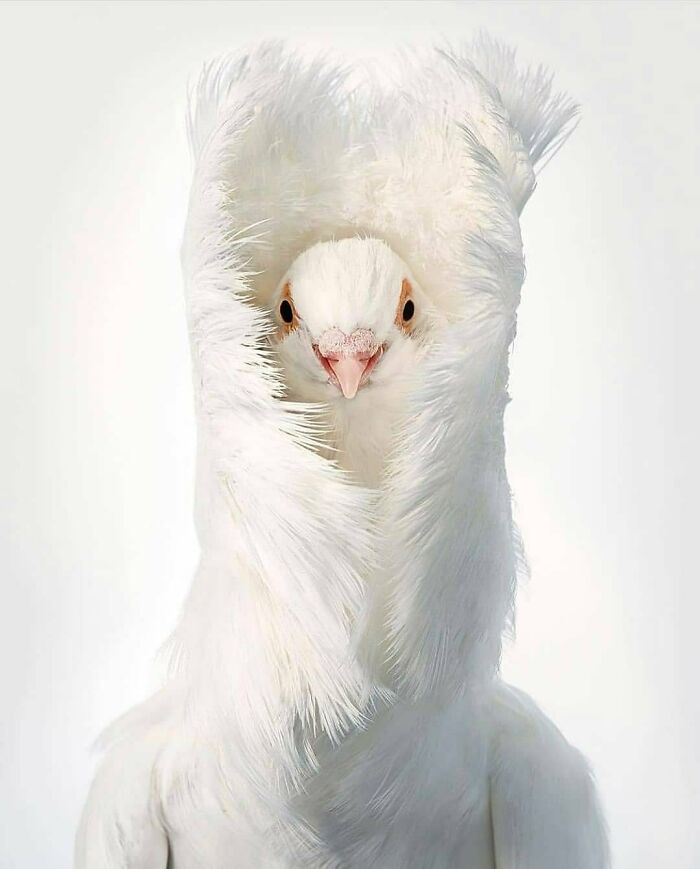
The Jacobin Pigeon is one of the oldest and most striking domestic fancy pigeon breeds in the world. Developed over centuries of selective breeding, it is famous for its extravagant "hood" of feathers that completely wraps around its head.
Their most notable feature is a dense, fluffy rosette of feathers curling forward around the neck and head. It is divided into three distinct parts: the hood (covering the top of the head), the chain (running down the sides of the neck), and the mane (growing upwards from the back of the neck).
The breed gets its name from the Jacobin order of Dominican friars who wore distinctive, dark-colored cowls or hoods. When the birds arrived in Europe, people immediately noticed the resemblance.
Jacobins became highly popular during the 16th and 17th centuries. Queen Victoria of the United Kingdom was famously fond of the breed, keeping and breeding them herself, which significantly raised their status among bird enthusiasts.
Because their feather hoods are so massive and wrap entirely around their eyes, Jacobin pigeons have very poor peripheral and forward vision. They cannot see predators easily and are generally kept in highly protected aviaries.
Beneath that massive explosion of neck feathers, the Jacobin actually has a very slender, long body with long flight feathers and a proud, upright stance. They come in a wide variety of colors, including white, black, red, and yellow.
The Mandarin Duck (Aix galericulata) is a medium-sized perching duck native to East Asia, primarily found across China, Japan, Korea, and eastern Russia. Renowned for its breathtakingly intricate patterns, this elegant waterfowl is universally celebrated as one of the most beautiful and visually striking birds in the world.
Their breeding plumage is an absolute masterpiece of natural art that looks almost entirely hand-painted. While the female sports a subtle, elegantly dappled grey and white camouflage, the drake features a brilliant red bill, a large iridescent crest of green and purple, a rich chestnut neck ruff, and two prominent, fan-shaped orange feather "sails" that stand completely upright on his back like a miniature ship.
Unlike most typical ducks that spend their time exclusively on the water or flat muddy banks, Mandarin ducks are highly adept perching birds. They possess specialized claws that allow them to easily grip tree branches, and they spend a significant amount of time roosting high up in the forest canopy near secluded, densely wooded lakes, rivers, and marshes.
Their nesting habits are remarkably unconventional for a waterfowl. Instead of nesting on the ground near the reeds, the female lays her eggs deep inside natural tree cavities sometimes up to 30 feet high; when the newly hatched ducklings are just a day old, the mother calls to them from below, prompting the tiny, fluffy chicks to bravely leap out of the tree hole and free-fall to the forest floor below before being led safely to water.
They are highly adaptable foragers, shifting their diet dramatically with the changing seasons. During the autumn and winter months, they feed almost exclusively on acorns and grains, frequently walking deep into the forest undergrowth to search for nuts, while in the spring and summer, they switch to an omnivorous menu of water plants, snails, small fish, and insects.
Beyond its physical beauty, this bird holds an incredibly deep cultural legacy in East Asian tradition, particularly in Chinese and Japanese folklore. Because they are famously known to form strong pair bonds and return to the same mate for years, a pair of Mandarin Ducks has served for centuries as a sacred symbol of lifelong fidelity, love, and marital bliss, often prominently featured in traditional wedding art and gifts.
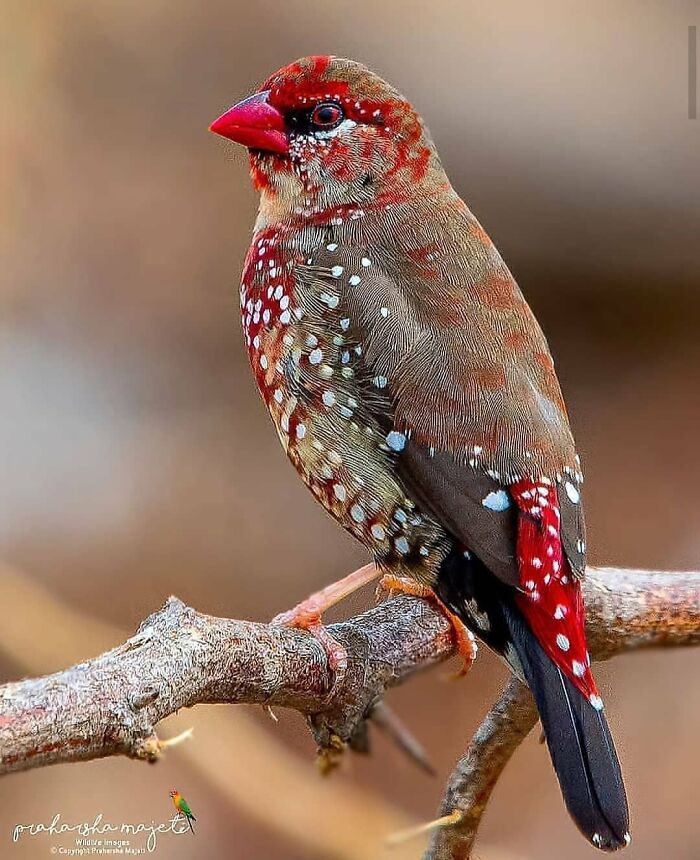
The Red Avadavat (Amandava amandava) is a tiny, sparrow-sized bird native to the tropical grasslands and plains of South and Southeast Asia. It is widely celebrated for its striking colors and holds a historic legacy as one of the world's most popular caged songbirds.
While both sexes spend most of the year in a modest, grayish-brown plumage, the breeding season triggers a dramatic transformation. The adult male molts into a brilliant, fiery crimson coat speckled with tiny white dots, making him look exactly like a ripe strawberry.
During courtship, the male puts on an endearing performance. He holds a single blade of grass or a feather in his beak, bows deeply, and hops around the female while singing a sweet, high-pitched, flute-like melody to win her over.
They are highly social and gentle creatures. Outside of the breeding season, they gather in large flocks of up to 100 birds, spending their days foraging for grass seeds on the ground and tightly huddling together—a behavior known as "clumping"—to keep warm and groom each other.
Despite their small size, they are incredibly hardy and adaptable. Originally from countries like India and Thailand, escaped birds from the pet trade have successfully established thriving wild populations in far-flung places, including Hawaii, Fiji, and southern Spain.
The unusual name "Avadavat" is a historic nod to the city of Ahmedabad in Gujarat, India. Centuries ago, this city served as the primary export hub that first introduced these "strawberry finches" to amazed bird lovers across the globe.
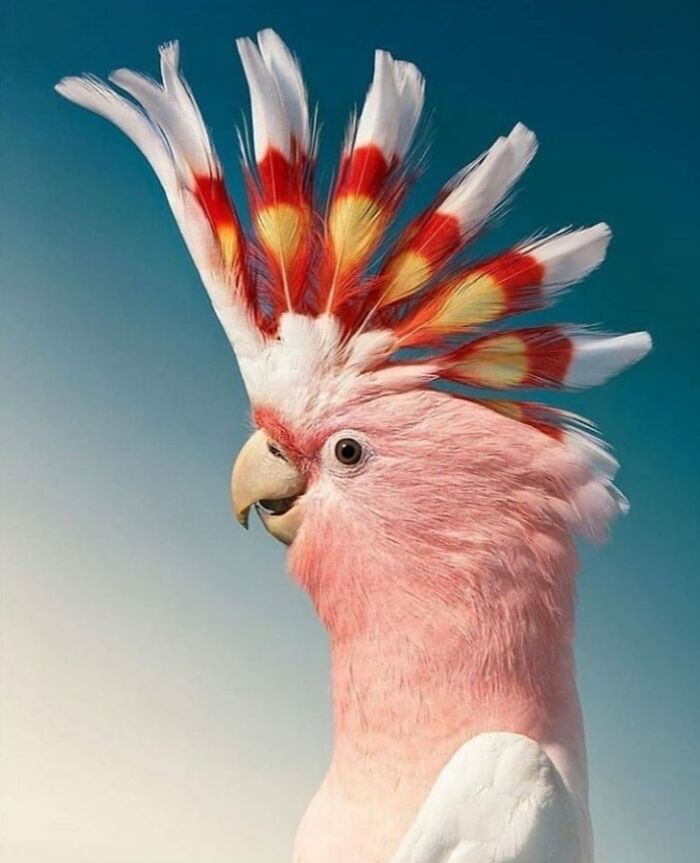
The Major Mitchell's Cockatoo (Lophochroa leadbeateri), also beautifully known as the Pink Cockatoo, is widely considered one of the most beautiful parrots in the world. Native to the dry, arid inland areas of Australia, its soft palette completely belies its tough, desert-dwelling nature.
While its body wears a soft, salmon-pink and white coloration, its crest is a jaw-dropping explosion of color. When raised, the crest reveals bold, horizontal bands of bright scarlet red and sunny yellow, framed by a crisp white trim.
These birds are true desert survivors. They thrive in the dry, open woodlands and scrubby inland plains of Australia, heavily relying on the presence of mature trees near water sources.
Unlike the Galah or the Sulphur-Crested Cockatoo, which gather in massive, raucous flocks of hundreds, Major Mitchell's Cockatoos are much more exclusive. They are typically seen in pairs or small family groups, and breeding pairs aggressively defend massive territories from other cockatoos.
Their vocalizations are quite distinct from other parrots. While they can still screech when startled, their standard call is a high-pitched, warbling, three-note cry that sounds a bit like "creek-ery-creek" or a stuttered whistle.
A famous captive Major Mitchell’s Cockatoo named "Cookie" lived at the Brookfield Zoo in Chicago. He arrived at the zoo when it opened in 1934 and lived to be 83 years old, officially making him the oldest documented parrot in history before he passed away in 2016.
It's fun to stay at the Y.M.C.A / It′s fun to stay at the Y.M.C.A / They have everything / For young men to enjoy / You can hang out with all the boys....
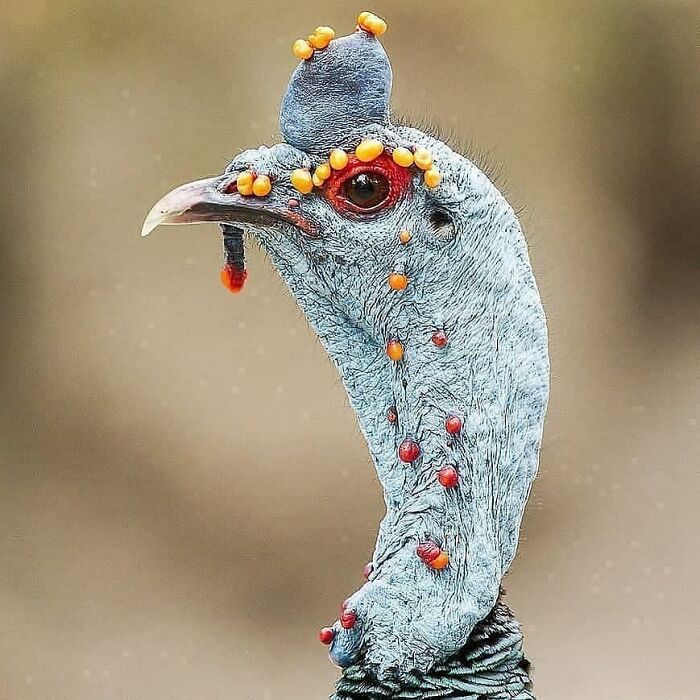
The Ocellated Turkey (Meleagris ocellata) is a large, spectacular bird found exclusively in a small pocket of Central America, primarily across the Yucatán Peninsula of Mexico, northern Guatemala, and northern Belize. A close relative of the more familiar North American wild turkey, this tropical cousin is widely regarded as one of the most stunningly colorful gamebirds in the world.
Their appearance is an absolute explosion of color, completely subverting the typical image of a muddy-brown farm turkey. Their body feathers are a mesmerizing, iridescent mosaic of bronze, emerald green, and deep blue that shimmers vividly in the sunlight. Most strikingly, their bare heads and necks are a brilliant powder-blue covered in bright orange and red warts, or nodules, which intensify in color during the mating season.
The name "Ocellated" comes from the magnificent, eye-like spots—called ocelli—that adorn their tail feathers. Much like the markings on a peacock, these blue and bronze rings are ringed with brilliant gold and are prominently featured during courtship. When a male wants to impress a female, he fans his tail wide, tucks his head back against his colorful plumage, vibrates his wings against the ground, and struts in an elegant, rhythmic circle.
They are largely ground-dwelling birds that prefer the mix of dense tropical forests and open clearings. They spend their days walking through the undergrowth in small family groups, foraging on an omnivorous diet of fallen fruits, seeds, leaves, and various insects. When night falls, they rely on powerful, heavy wingbeats to fly up into the forest canopy to roost safely out of reach of ground predators like jaguars.
Unlike the loud, familiar "gobble" of North American turkeys, the vocalizations of the Ocellated Turkey are uniquely musical and eerie. The male begins his breeding song with a series of low, hollow thumping sounds—resembling the starting engine of a small motorcycle—before accelerating into a high-pitched, warbling melody that echoes through the misty jungle mornings.
Beyond its ecological value, this bird holds a deep historical connection to the ancient Maya civilization. It is frequently depicted in classic Maya art, hieroglyphs, and pottery, where its vibrant feathers and distinct blue head were deeply revered and associated with royalty, religious rituals, and the gods of the natural world.

Well worth doing an image search on. The whole bird is magnificent, especially when it's strutting. There's a particularly stunning one on Wikipedia. (Ocellated turkey, Wikipedia)
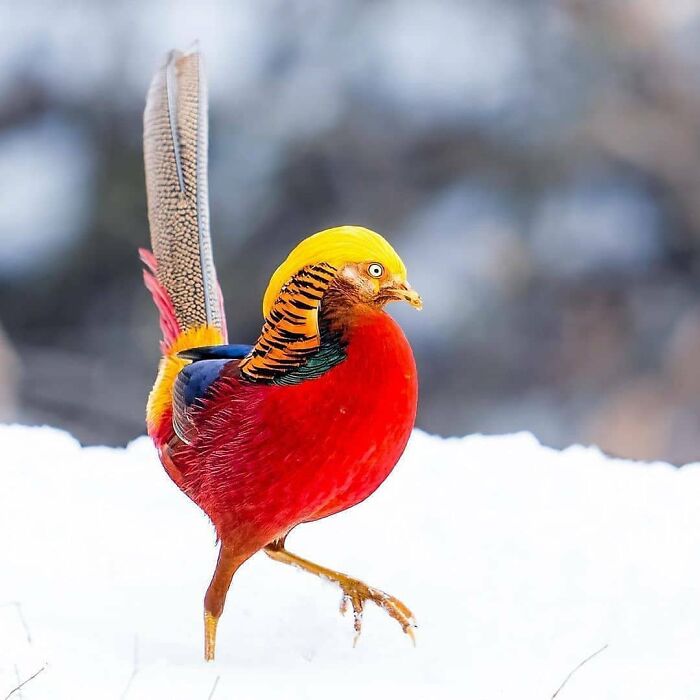
The Golden Pheasant (Chrysolophus pictus), also known as the Chinese Pheasant, is a spectacular gamebird native to the mountainous forests of western and central China. Renowned for its dazzling, multi-colored plumage, it is widely considered one of the most breathtakingly beautiful birds in the world.
The adult male is an absolute explosion of color. He features a shimmering golden-yellow crest and lower back, a deep scarlet-red breast, a metallic green upper back, and deep blue wings. To top it off, his long tail is intricately mottled with cinnamon and black.
During the breeding season, the male woos females by spreading his striped orange-and-black neck feathers (called a "ruff" or "cape") all the way forward like a fan. When fully deployed, it covers his entire face except for his piercing yellow eye, looking remarkably like an ancient Egyptian pharaoh's headdress.
In stark contrast to the flamboyant males, female Golden Pheasants are incredibly modest. They wear a dull, mottled brown and buff plumage designed to help them blend completely into the forest floor while incubating their eggs and hiding from predators.
Despite their neon colors, wild Golden Pheasants are notoriously difficult to spot in their native habitats. They are shy, solitary birds that spend most of their time foraging on the dark, dense floors of coniferous and bamboo forests, rarely flying unless they are suddenly startled.
While native to China, their unmatched beauty made them incredibly popular in private collections and aviaries worldwide. Escaped birds have successfully established wild, self-sustaining populations in several countries, including the United Kingdom, Germany, and parts of the Americas.
The common pheasant is spectacular, but the golden pheasant is even more so.
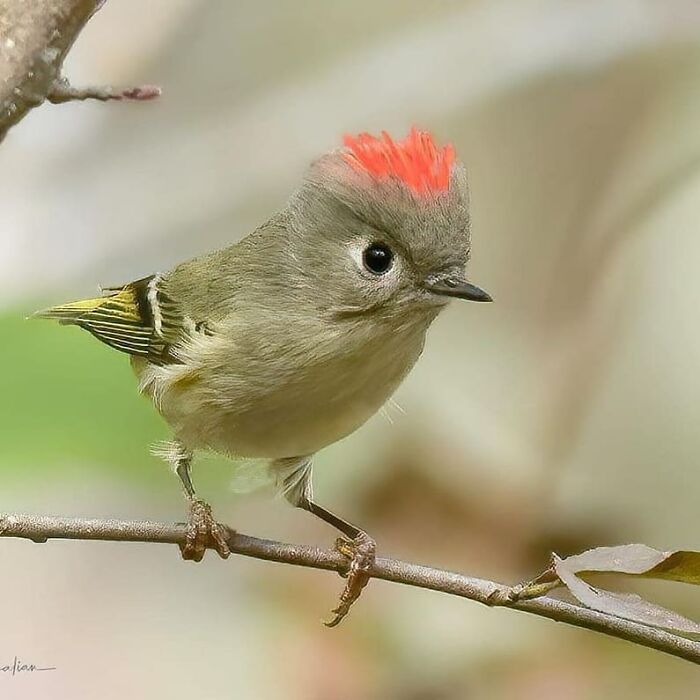
The Ruby-crowned Kinglet (Corthylio calendula) is a tiny, extraordinarily energetic songbird native to North America. Breeding in the dense boreal forests of Canada and Alaska, as well as high-elevation western mountains, these hyperactive dynamos migrate south for the winter, populating woodlands, suburbs, and brushy thickets across the United States and Mexico.
Most of the time, their appearance is rather plain and understated. They possess a plump, olive-green body, a pale underbelly, and a distinct, unbroken white eye-ring that gives them a permanently surprised expression. Their true namesake—a brilliant, ruby-red crown patch found exclusively on the males—is usually kept completely flat and hidden beneath their olive head feathers. The male only flashes this fiery streak when he is highly agitated, defending his territory, or trying to impress a female.
They are famously known as the restless spirits of the canopy. Kinglets almost never sit still; they spend their days constantly flitting from twig to twig, rapidly flicking their wings in a nervous, signature twitch. This frantic energy serves a purpose: they are highly agile insectivores, frequently hovering at the tips of branches to glean tiny insects, spiders, and insect eggs from the undersides of leaves, or executing quick aerial loop-de-loops to snap up gnats mid-air.
Their nesting biology is an impressive feat of insulation and engineering. Tucked safely high up in the dense needles of a conifer tree—often a spruce or fir—the female weaves a deep, elastic cup-shaped nest out of moss, lichens, bark strips, and spider silk. Because these birds lay exceptionally large clutches (sometimes up to 12 eggs in a single nest), the elastic walls stretch to accommodate the growing family, which is kept cozy by a thick inner lining of soft animal fur and feathers.
Despite weighing barely more than a nickel, the Ruby-crowned Kinglet possesses a astonishingly powerful voice. Their song is a remarkable vocal paradox: it begins with a few faint, ultra-high-pitched whistles, transitions into a low chattering, and then erupts into a surprisingly loud, rich, and rolling terminal trill that can easily be heard from hundreds of feet away. It is one of the loudest songs in the forest relative to the bird's miniature body size.
Beyond their biological grit, their seasonal movements make them a highly anticipated sign of the changing seasons for birdwatchers across North America. Often traveling alongside mixed-species winter flocks of chickadees, nuthatches, and warblers, their frantic wing-flicking and sudden, explosive bursts of song bring a delightful, spirited energy to the quiet autumn and winter woods.
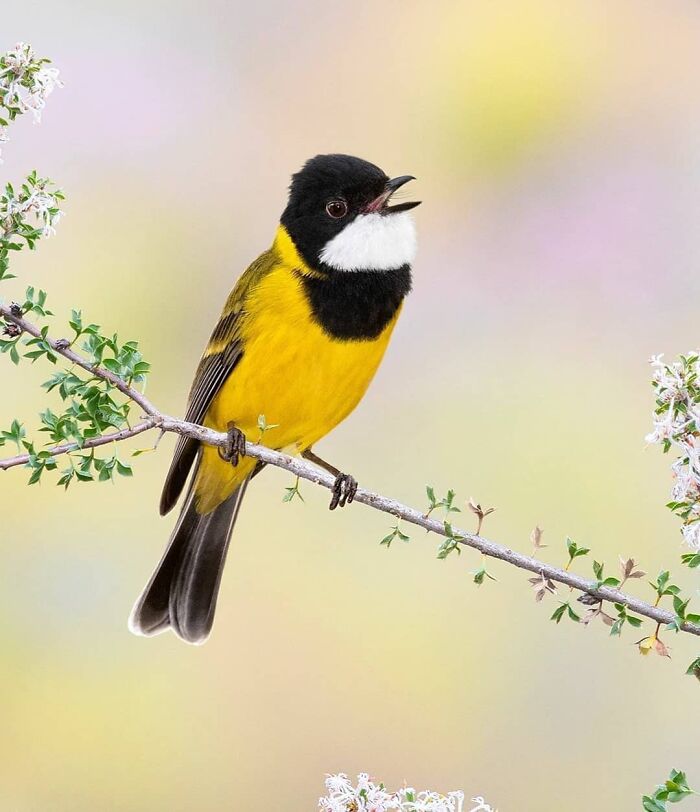
The Western Whistler (Pachycephala fuliginosa), previously recognized as a subspecies of the Golden Whistler, is a small, stocky songbird native to the woodlands, mallee, and forests of southern and western Australia. True to its name, it is celebrated for its loud, musical voice and beautiful plumage.
The adult male is an absolute standout. He sports a deep black head, a crisp white throat patch, and a striking black band across his chest that opens up to a brilliant, glowing golden-yellow belly and nape. Females are entirely different, wearing a modest, well-camouflaged palette of grey and olive-brown.
Whistlers get their name from their incredibly rich, powerful vocalizations. The male sings a series of sweet, ringing whistles that build up to an explosive, energetic finish that sounds almost like a sharp whip crack.
These birds are famous for a behavior called "thunder-clapping." If a loud, sudden noise echoes through the forest—like a clap of thunder, a branch breaking, or even a car door slamming—the male Western Whistler will immediately burst into song in response.
They are primarily insectivores, feeding on beetles, caterpillars, spiders, and small bugs. Instead of darting around hyperactively like flycatchers, they are methodical hunters. They sit completely still on a branch, scanning the surrounding bark and leaves, before making a sudden pounce to pluck their prey.
Nesting pairs work together to construct a neat, cup-shaped nest out of coarse grass, thin twigs, and bark strips. They usually tuck it away safely in the vertical fork of a small tree or a dense shrub, where the female will lay a small clutch of speckled eggs.
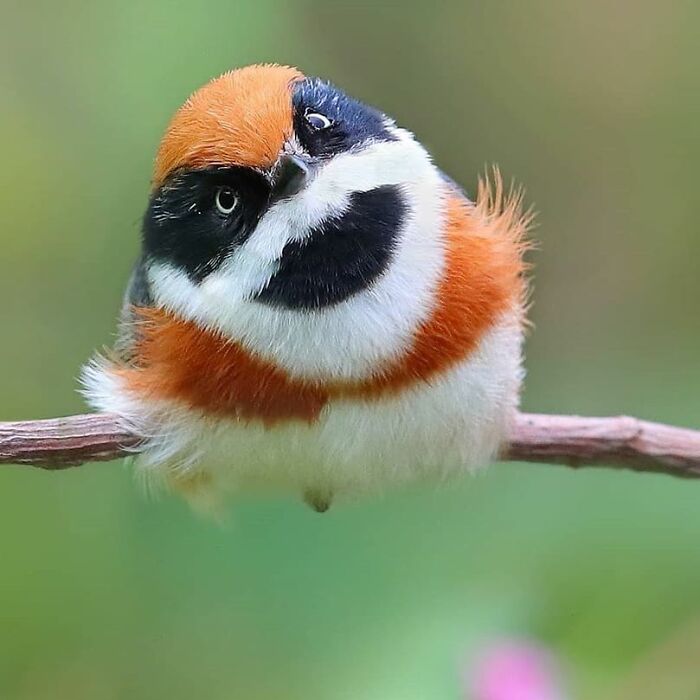
The Red-Headed Tit (Aegithalos concinnus), commonly known as the Black-Throated Bushtit, is a tiny, exceptionally cute songbird found across the Himalayas, southern China, and parts of Southeast Asia. Weighing less than a single sheet of paper, this little bird is packed with a mountain of energy and striking patterns.
Despite its small size, it has an incredibly bold facial pattern. It sports a bright reddish-orange (rufous) crown, a stark black "bandit mask" stretching across its eyes, a neat black bib on its throat, and a warm chestnut band across its chest.
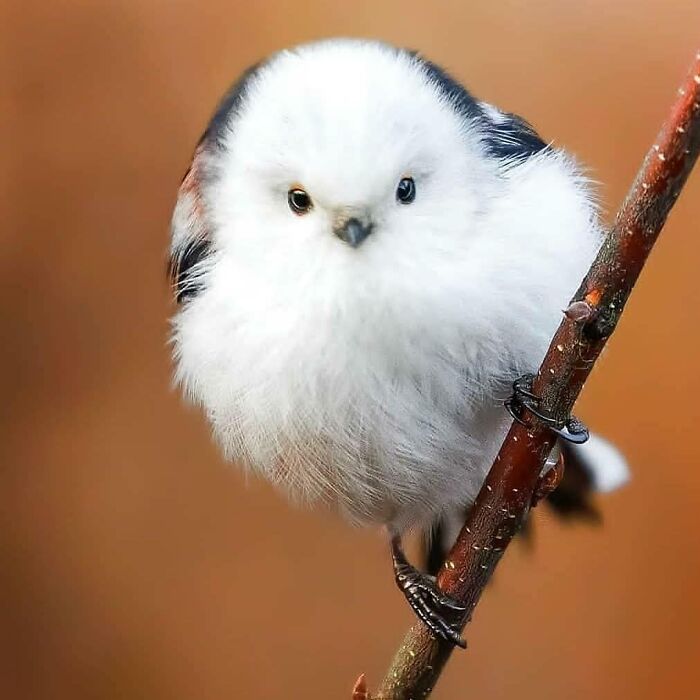
Even though it is widely called a tit, it actually belongs to the Aegithalidae family (long-tailed tits or bushtits) rather than the true tit family (Paridae). This makes it a closer relative to the famous, fluffy "snow fairy" bird of Japan (the Shima Enaga) than to chickadees.
You will rarely find a Red-Headed Tit alone. Outside of the breeding season, they travel in highly active, tightly knit flocks of up to 40 birds. They move rapidly through the forest canopy, keeping in constant contact with each other through soft, high-pitched "tsip-tsip" calls.
They are incredibly agile foragers. The flock will systematically scour broadleaf forests and bamboo thickets for spiders and small insects. They easily hang upside down from the very tips of leaves and thin twigs to snatch up hidden prey.
Their nests are masterpieces of avian architecture. Working as a team, a breeding pair uses moss, lichens, and animal hair to weave a deep, stretchy, dome-shaped pocket. They bind the whole structure together using sticky spider silk, which allows the nest to expand naturally as the chicks grow bigger.
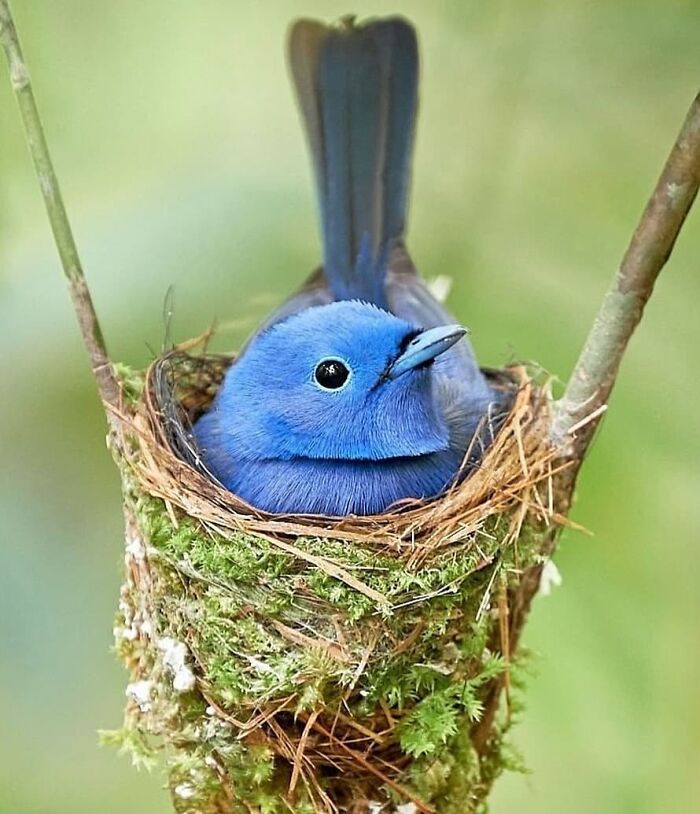
The Black-Naped Monarch (Hypothymis azurea) is a sleek, agile flycatcher native to the tropical forests of South and Southeast Asia. With its electric blue plumage and animated personality, this little bird looks like a tiny bolt of sapphire flashing through the forest understory.
The male is a brilliant azure blue with a crisp white belly. He gets his name from two sharp black markings: a small, velvety black patch on the back of his head (the nape) and a narrow, black "necklace" tracing across his throat. Females are much more understated, sporting a greyish-blue head with a soft olive-brown back and wings.
These birds are almost never still. They are highly active insectivores that hunt on the wing. They zip from branch to branch, suddenly darting into the air to snatch flies, moths, and mosquitoes right out of the sky with a sharp snap of their beaks.
When agitated or defending their territory, Black-Naped Monarchs will fan out their long tail feathers and cock them upward. They also slightly raise the feathers on the back of their head into a tiny, angular crest, giving them an incredibly intense, alert expression.
They build neat, deep, cup-shaped nests in the forks of slender tree branches. To keep the nest secure, they weave it using fine grass, bark shreds, and moss, completely wrapping the outside in thick layers of sticky spider silk to give it stability and camouflage.
Despite their small size (around 6 inches long), they are fiercely territorial. During the breeding season, pairs will boldly mob and drive away much larger birds, squirrels, or lizards that wander too close to their nesting site.
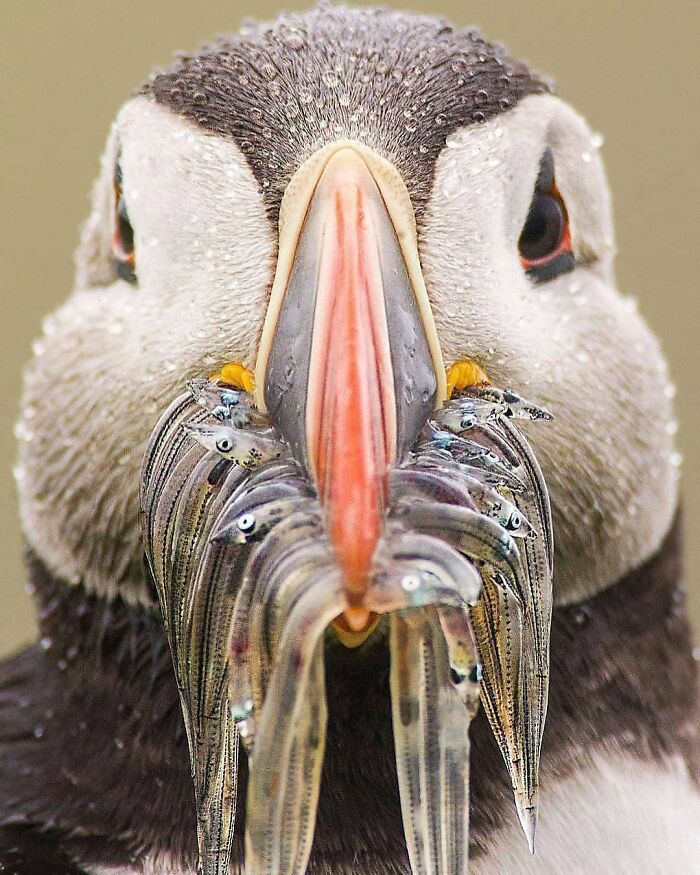
The Atlantic Puffin (Fratercula arctica) is a small, stocky seabird that spends most of its life at sea across the cold waters of the North Atlantic Ocean. Affectionately nicknamed the "clown of the sea" or "sea parrot," it is one of the world's most beloved marine birds, breeding in massive colonies on the rugged cliffs of Iceland, Norway, and the British Isles.
Their appearance is famously striking, resembling a miniature penguin dressed in a crisp black-and-white tuxedo. They feature pale gray cheek patches and a black crown, but their defining feature is a large, triangular, and spectacularly colorful beak striped in bright orange, yellow, and blue. Interestingly, this vivid beak is a seasonal ornament used to attract mates; after the breeding season ends, they shed the colorful outer layers, leaving them with a much smaller, dull gray beak for the winter.
They are exceptionally gifted swimmers and divers, highly specialized for hunting small schooling fish like sand eels and capelin. They utilize their short, powerful wings to literally "fly" underwater, diving to depths of up to 200 feet while steering with their bright orange webbed feet. Thanks to unique backward-pointing serrations inside their upper beak, a single puffin can hold dozens of slippery fish crosswise in its mouth at one time to bring back to its chick.
When they return to land in the spring to breed, they exhibit fascinating nesting behaviors. Instead of building nests out of twigs on rocky ledges, mating pairs use their sharp claws and beaks to dig deep burrows into the grassy turf of coastal cliffs, or they move into abandoned rabbit holes. Puffins are famously monogamous, reuniting with the same partner at the exact same burrow year after year, celebrating their reunion by rubbing their beaks together in a endearing ritual called "billing."
While they are silent and solitary during the long winter months at sea, their land colonies are a bustling hub of activity and sound. Their vocalizations are remarkably deep and comical, consisting of low, rumbling, growling calls that sound exactly like a muffled chainsaw or a cow's moo echoing from deep within their underground burrows.
Beyond their ecological significance as an indicator species for marine health, puffins hold a special place in coastal human cultures. They are celebrated emblems of places like Iceland—which hosts more than half of the world's puffin population—and Newfoundland, Canada. Today, they face mounting challenges from climate change and shifting fish populations, making the protection of their nesting islands more critical than ever.
The King Penguin (Aptenodytes patagonicus) is the second largest penguin species in the world, standing just behind the Emperor Penguin. Inhabiting the chilly sub-Antarctic islands, these penguins form massive, bustling colonies and are among the most colorful and elegant of all sea birds.
King Penguins are instantly identifiable by the bright, spoon-shaped patches of vivid orange on the sides of their heads. This deep golden-orange gradient bleeds beautifully down onto their upper breast, contrasting sharply with their pitch-black heads and silvery-grey backs.
King Penguin chicks look so completely different from adults that early European explorers actually thought they were an entirely separate species of bird! They are covered in a thick, fluffy coat of solid brown down feathers, earning them the historical nickname "oakum boys" (named after the loose brown fibers used to seal wooden ships).
Unlike most birds that breed annually, King Penguins operate on a grueling 14-to-16-month breeding cycle. Because it takes so long to raise a single chick, a breeding pair can typically only successfully raise two chicks every three years.
King Penguins do not build nests out of stones or grass. Instead, like their Emperor cousins, they keep their single egg warm by balancing it on top of their webbed feet, tucked safely beneath a warm, featherless flap of skin known as a brood patch.
They are absolute powerhouse swimmers. To hunt for fish, squid, and small crustaceans, King Penguins routinely dive to depths greater than 300 feet, and they have been recorded plunging down past 1,000 feet into the icy ocean darkness.
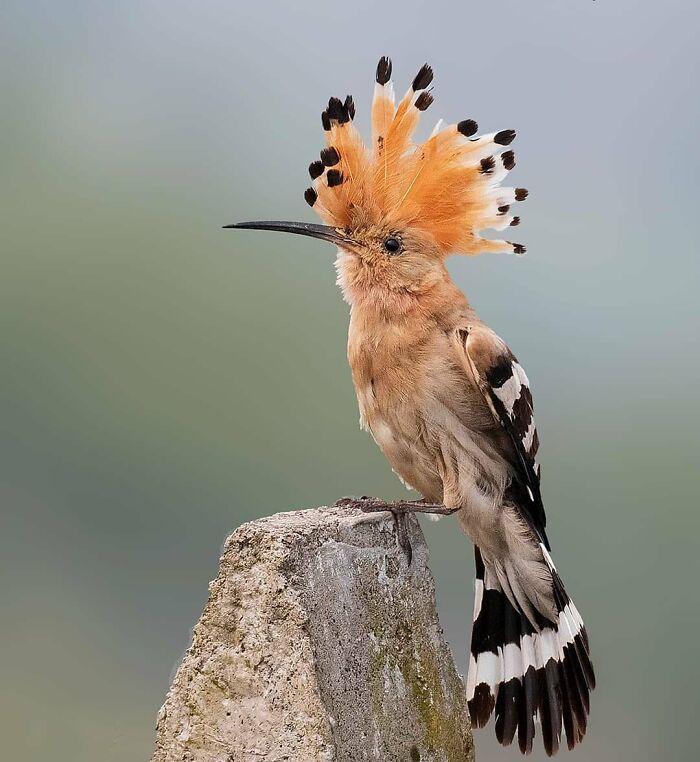
Der Wiedehopf, der Wiedehopf, / der bringt der Braut nen Blumentopf. / Aus: d*e Vogelhochzeit: Deutsches Volkslied.
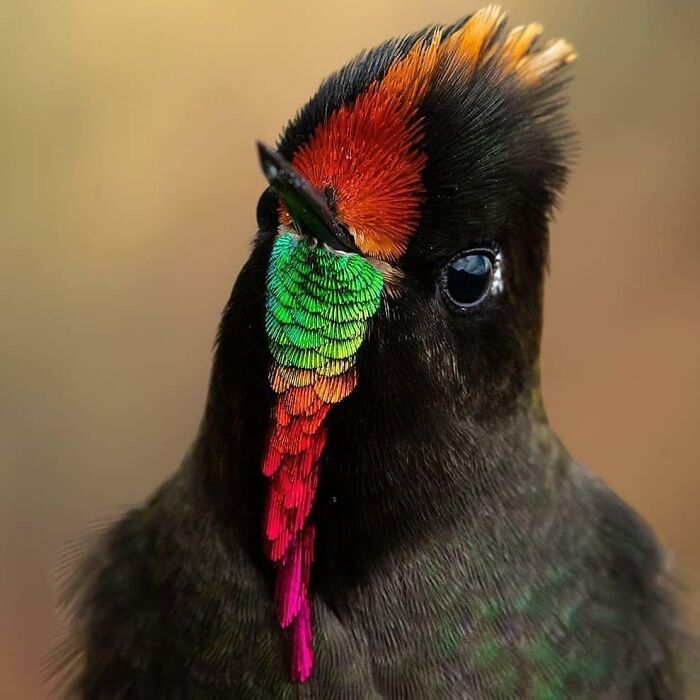
Looks like he took a sip of a rainbow and a few droplets ran down his chest. Gorgeous :)
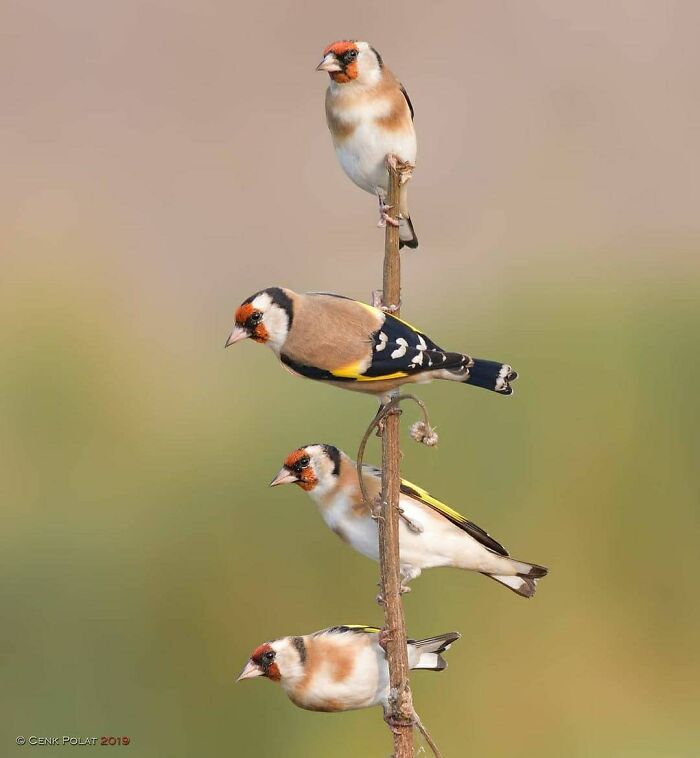
The European Goldfinch (Carduelis carduelis) is a small, delightfully vibrant songbird native to Europe, North Africa, and western Asia. Thriving in open woodlands, orchard orchards, and garden shrubbery, this cheerful finch is universally cherished for its bright colors, highly social nature, and sweet, liquid song.
Their plumage looks like a tiny, hand-painted masterpiece that splits the difference between striking contrasts and rich earth tones. They sport a brilliant, crimson-red face mask that is sharply outlined by clean white cheeks and a jet-black crown. When they take flight, their wings flash a bold, unmistakable bar of bright golden-yellow against a backdrop of deep black and brown, making them instantly recognizable even from a distance.
They are incredibly specialized granivores with a strong dietary preference for the seeds of thistles, dandelions, and teasels. Equipped with a sharp, fine, and needle-like beak, they possess an agile superpower: they can easily hover or cling upside down to the very tips of swaying weed heads, using their nimble weight to delicately pry out deeply wedged seeds that other birds simply cannot reach.
They are highly gregarious creatures, almost always moving through the landscape in close-knit, bouncing flocks. During the autumn and winter months, these flocks can swell into groups of several hundred birds—historically known as a "charm of goldfinches"—as they move across open fields in search of food, filling the chilly air with a constant, musical chattering of high-pitched liquid notes.
Their nesting architecture is incredibly neat and well-hidden. Working primarily in the fork of a high tree branch, the female constructs a tight, deep cup out of moss, fine grass, and roots, gluing it together using sticky spider silk for flexibility. To keep her chicks warm against the elements, she lavishly lines the interior with the softest materials available, specifically favoring thistle down and sheep's wool.
Beyond their ecological charm, these birds have held a deep, fascinating place in European history and human culture for centuries. Due to their striking looks and beautiful singing voices, they were highly prized as caged pets during the Victorian era. Furthermore, in Renaissance art, the goldfinch was a prominent sacred symbol, appearing in dozens of masterpieces—most famously Raphael's Madonna of the Goldfinch—where it represented endurance, spiritual beauty, and redemption.
Oh, I have them in my garden. German: Stieglitz or Distelfink. They love sunflowerseeds.
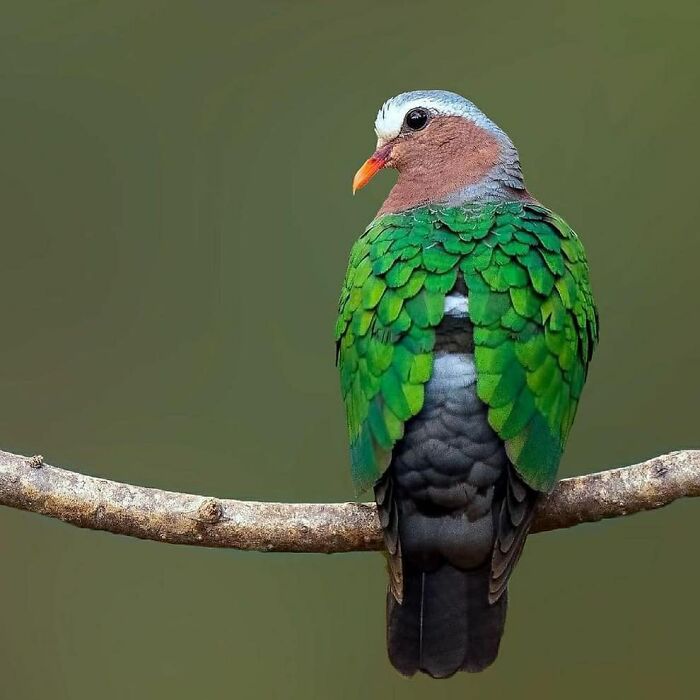
The Common Emerald Dove (Chalcophaps indica) is a medium-sized, stocky pigeon native to the tropical and subtropical rainforests, woodlands, and dense mangroves of South and Southeast Asia. Widely recognized for its dazzling coloration, this peaceful forest dweller brings a splash of brilliant, unexpected color to the dim jungle understory.
Their appearance is a striking, elegant combination of warm earthy tones and electric iridescence. They feature a soft, vinous-pinkish head, neck, and breast that blends into a deep brown body, sharply punctuated by a bright coral-red bill. Their absolute crowning glory is their wings and back, which are blanketed in metallic, emerald-green feathers that shimmer intensely with a jade or golden gloss whenever a ray of sunlight filters through the forest canopy.
They are primarily ground-dwelling birds that prefer the quiet safety of the deep forest floor over high treetops. They spend their days walking gracefully through leaf litter, searching for fallen wild fruits, berries, and various seeds; they will also feed on termites and small invertebrates when available, moving with a cautious, head-bobbing gait typical of the pigeon family.
Despite their bright wings, they can be remarkably difficult to spot due to their shy and secretive nature. When approached, they prefer to freeze and blend into the shadows of the low vegetation; if startled, however, they will launch themselves into a low, lightning-fast flight through the tangled trees, executing incredibly agile twists and turns to vanish into the dense foliage in seconds.
Their nesting architecture is remarkably sparse and minimalist, typical of many doves. The breeding pair constructs a fragile, semi-transparent platform of thin twigs and dry leaves tucked away in a low bush, tree fork, or tangled vine; the nest is often so loosely woven that the two creamy-white eggs can actually be seen from underneath, yet both parents take turns incubating them with immense dedication.
Beyond their ecological role as vital seed dispersers for tropical rainforest trees, these birds hold a cherished place in regional culture. Their distinct call—a low, rhythmic, and deeply resonant cooing "hoo-hoo-hooooo"—is a soothing and iconic background melody of the Asian jungle. Due to its gentle grace and radiant beauty, the Emerald Dove is proudly celebrated as the official state bird of the Indian state of Tamil Nadu.
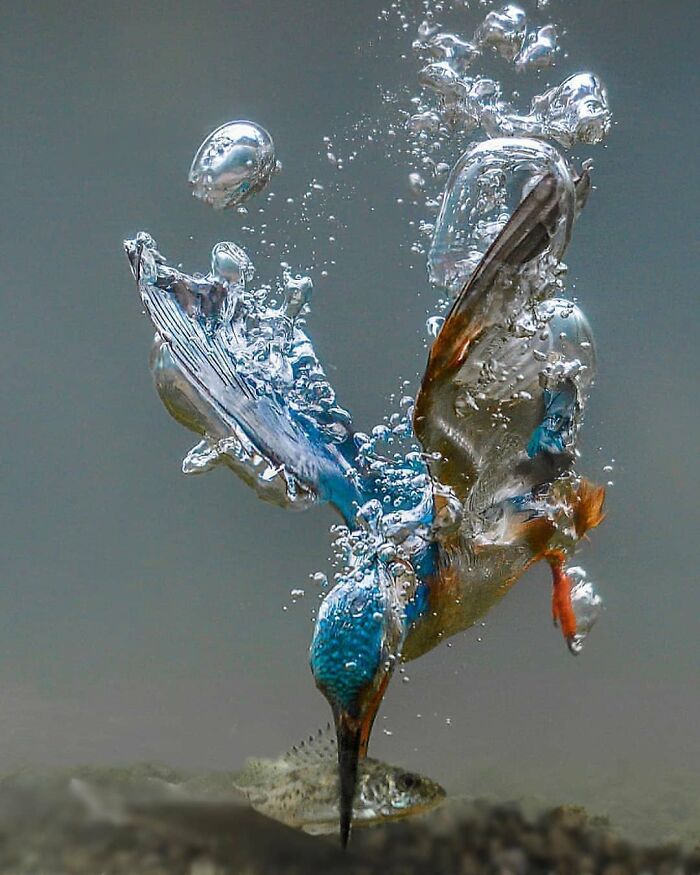
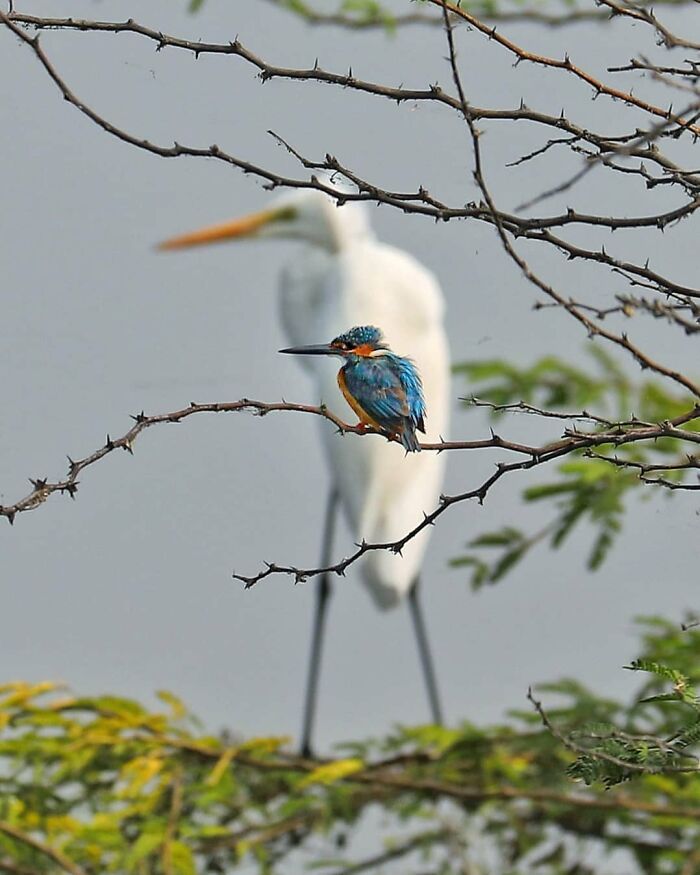
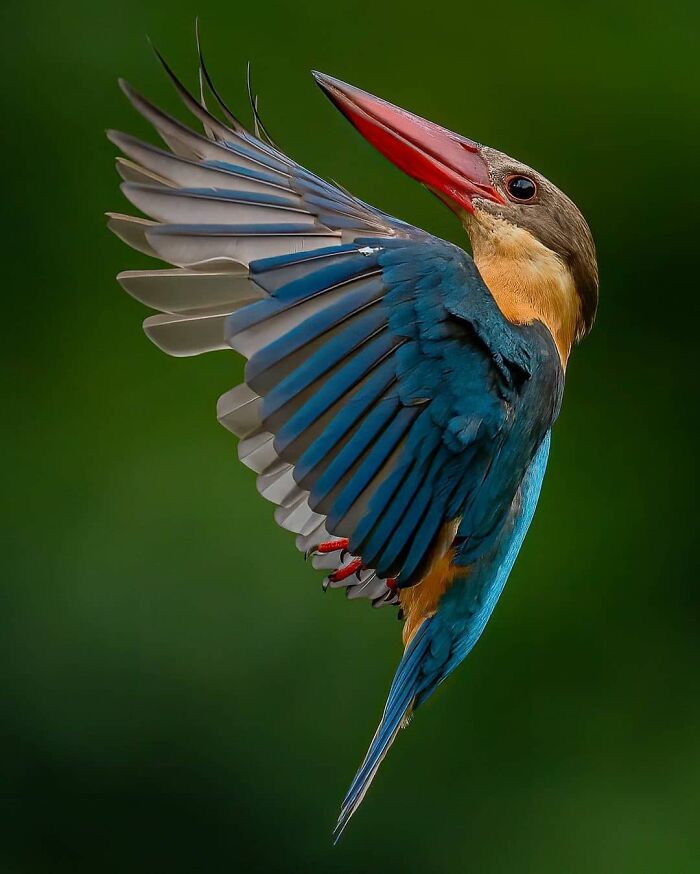
The Common Kingfisher (Alcedo atthis), also known as the Eurasian Kingfisher, is a small, dazzlingly bright bird widely distributed across Eurasia and North Africa. Renowned for its spectacular diving technique and striking colors, this sparrow-sized bird is a master fisherman of calm, clear freshwater habitats.
The kingfisher's back looks like a brilliant, metallic electric blue, but there is actually no blue pigment in its feathers! The color is entirely an optical illusion caused by structural coloration (specifically, the microstructures of the feathers scatter light in a way that reflects only iridescent blues and greens).
When hunting, a kingfisher sits patiently on an overhanging branch before plunging into the water like a missile. To enter cleanly, it closes its eyes and relies on a protective third eyelid (nictitating membrane) to see nothing at all, striking its prey blindly using precise muscle memory.
If you want to know if you are looking at a male or a female kingfisher, check the beak. Both have a sharp, dagger-like black bill, but females sport a bright orange patch on the base of the lower half—looking exactly like they are wearing a swipe of orange lipstick. Males have an entirely black bill.
Instead of nesting in trees, Common Kingfishers use their feet and bills to excavate long, horizontal tunnels into steep, sandy riverbanks. These burrows can be up to three feet long and terminate in a circular nesting chamber where they raise their young.
Once a kingfisher catches a fish, it carries it back to a perch and beats it against the wood to stun or kill it. It then flips the fish around in the air to swallow it headfirst. This ensures that the fish's sharp scales and fins fold down smoothly, keeping the bird from choking.
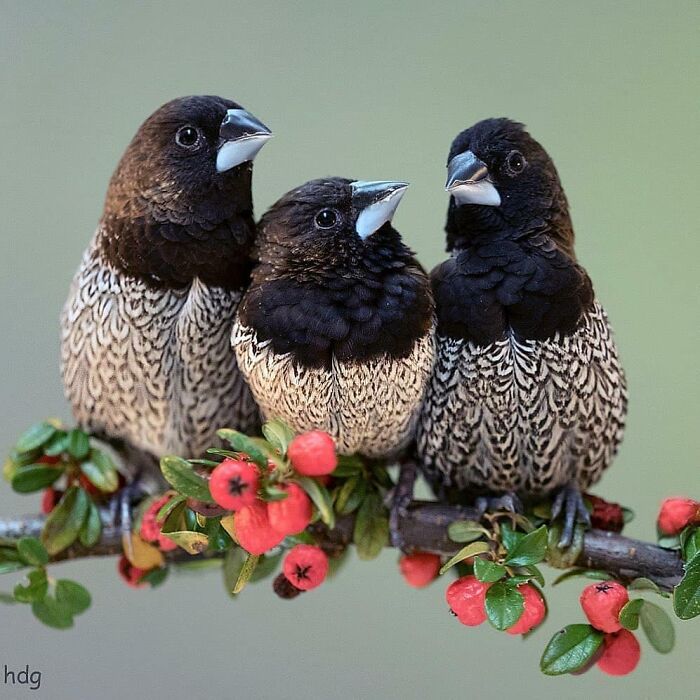
The Society Finch (scientifically classified as Lonchura domestica), also known as the Bengalese Finch, is a charming little songbird that holds a unique place in the avian world: it does not exist in the wild. It is a purely domestic species, deliberately bred by humans centuries ago.
The Society Finch was carefully cross-bred in Japan and China several hundred years ago. Its wild ancestor is primarily the White-rumped Munia (Lonchura striata), but because it was bred entirely in captivity, it has evolved into its own distinct, docile species.
They completely live up to their name. Unlike many territorial finch species, Society Finches are incredibly gentle, peaceful, and highly social. They love nothing more than huddling tightly together on a perch in big groups to sleep.
They are famous for their intense parenting instincts. Aviculturists frequently use Society Finches as foster parents to hatch and raise the chicks of more finicky or delicate exotic birds, such as the Gouldian Finch, because they will readily care for almost any egg placed in their nest.
While wild bird songs are largely dictated by genetics, research has shown that male Society Finches learn and adjust their complex, rhythmic songs by listening to their fathers and neighbors. Because there is no wild standard to match, individual families often develop their own distinct musical "dialects."
Because they have been bred by humans for so long, they come in a vast array of feather patterns and colors that you won't see in the wild, including chocolate brown, fawn, pure white, mottled "pied" patterns, and even crested varieties with a tiny toupee of feathers on their heads.
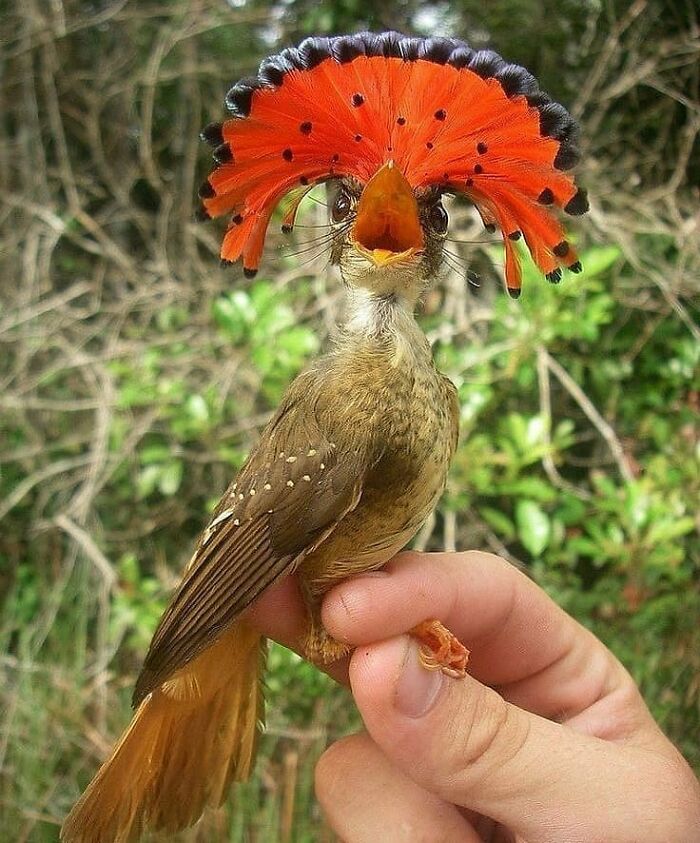
The Royal Flycatcher (genus Onychorhynchus) represents a group of four closely related bird species found throughout the dense, humid rainforests of Central and South America. While they look relatively plain at a casual glance, they hide one of the most spectacular, colorful secrets in the bird world.
For 99% of the day, the Royal Flycatcher looks like a modest, brownish-olive bird with a yellowish belly. However, it conceals a magnificent, fan-shaped crest that spans horizontally across its head. When opened, it reveals brilliant scarlet red (in males) or fiery yellow-orange (in females), completely decorated with steel-blue tips.
They don't walk around with their crowns open. Royal Flycatchers keep the crest fully flattened against their head, extending backwards. They only unfurl the display during intense courtship, while defending territory against rivals, or when handled by researchers (as a defense mechanism to startle predators).
True to their name, they are highly efficient aerial hunters. They sit quietly on shaded, lower-canopy branches before darting out in explosive bursts to snatch large insects, such as dragonflies, beetles, and cicadas, right out of mid-air.
Their nesting habits are just as dramatic as their crowns. Instead of a standard cup nest, they construct massive, narrow, woven structures out of plant fibers, moss, and twigs that can measure up to 6 feet long. These nests hang suspended from branches directly over forest rivers or streams, keeping eggs safe from climbing predators like snakes and monkeys.
Ornithologists typically divide them into four distinct geographic species: the Northern, Amazonian, Pacific, and Atlantic Royal Flycatchers. The Atlantic Royal Flycatcher, native to Brazil's rapidly shrinking coastal forests, is currently classified as vulnerable due to habitat loss.
Showgirl/Flapper attire, a male, though. Females have yellow or orange crests
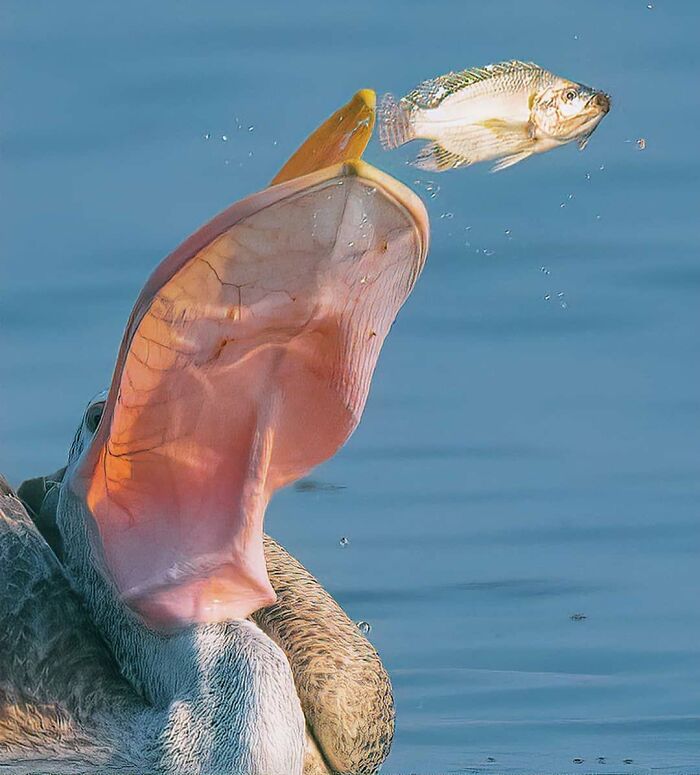
The Pelican (Pelecanus) is a massive, ancient lineage of waterbirds found across warm regions globally, favoring coastlines, lakes, and rivers. Belonging to a family that has remained largely unchanged for tens of millions of years, they are among the heaviest flying birds on Earth and are instantly recognizable by their prehistoric silhouettes.
Their appearance is defined by an enormous bill equipped with an expandable, leathery throat sac called a gular pouch. While their body plumage varies by species from snow-white to mottled gray-brown, many develop beautiful ornamental crests and vibrant yellow, pink, or deep orange coloration on their bills and bare facial skin during the breeding season.
They are cooperative, highly strategic hunters that primarily feed on fish. Most pelican species hunt in synchronized groups, swimming in a crescent shape to herd schools of fish into shallow water before dipping their massive pouches like dip-nets to scoop them up, draining the water out of the corners of their mouths before swallowing the catch whole.
The iconic throat pouch is often misunderstood as a storage tank for long-term food, but it actually functions primarily as an active fishing net and a vital cooling mechanism. On hot days, pelicans will flutter their pouch skin rapidly—a behavior called gular fluttering—to evaporate moisture and lower their core body temperature, much like a dog panting.
They are surprisingly graceful gliders, utilizing their massive wingspans—which can exceed nine feet in larger species—to effortlessly ride warm air currents. They frequently travel in long, single-file lines or precise V-formations close to the water's surface, using an aerodynamic phenomenon known as ground effect to coast on a cushion of air and save valuable energy.
Beyond their ecological significance as top aquatic predators, pelicans have captivated human imagination since antiquity. They feature prominently in global folklore, ancient Egyptian religious texts, and medieval European heraldry, where they were deeply revered as powerful symbols of self-sacrifice, devotion, and nurturing protection.
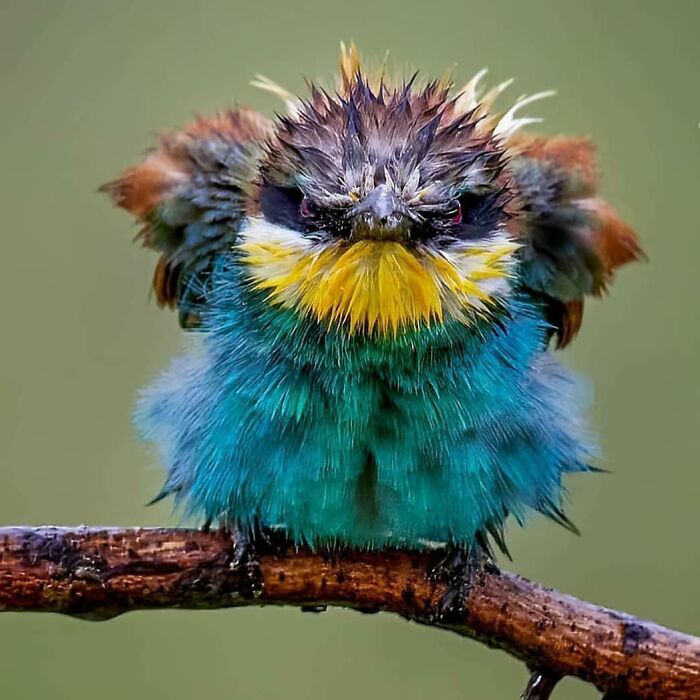
The Eurasian Bee-Eater (Merops apiaster) is a slim, richly colored bird that breeds across southern and eastern Europe, western Asia, and parts of North Africa. Renowned for its unparalleled aerial agility, this striking species is widely regarded as one of the most vibrant birds on the European continent.
Their plumage is a breathtaking, kaleidoscopic patchwork of rich colors. They sport a brilliant golden-yellow throat, a rich chestnut crown and back, a turquoise-blue belly, and a stark black eye-stripe that cuts through their face like a sleek mask, making them instantly recognizable even from a distance.
True to their name, they have a fascinatingly specialized strategy for hunting stinging insects like bees and wasps. They snatch their prey mid-air in lightning-fast, acrobatic loops, then carry it back to a perch where they repeatedly beat the insect against a branch and rub its abdomen down to safely discharge the venomous stinger before swallowing.
They are highly gregarious, nesting in bustling, noisy colonies of up to several hundred pairs. Instead of building nests in trees, they use their sharp beaks and clawed feet to excavate long, horizontal tunnels—sometimes reaching over three feet deep—into steep sandbanks, river cliffs, or quarry walls.
They are strongly migratory, traveling immense distances twice a year to escape the changing seasons. As autumn approaches, European populations gather in massive flocks to fly across the Mediterranean Sea and the Sahara Desert to spend the winter months basking in the warmth of tropical Africa.
Beyond their ecological role as master insect hunters, these birds are deeply admired by wildlife photographers and birdwatchers for their synchronized, gliding flight patterns. Their soft, rhythmic, and liquid "pruup" calls are an iconic, cheerful soundtrack of the Mediterranean summer.
The Lilac-breasted Roller (Coracias caudatus) is a medium-sized, strikingly beautiful bird widely distributed across sub-Saharan Africa and the southern Arabian Peninsula. Thriving in open woodlands, bushy savannas, and agricultural lands, this vibrant creature is highly celebrated for its spectacular colors and holds widespread recognition as an unofficial national symbol of Kenya and Botswana.
Their plumage is a breathtaking, kaleidoscopic masterpiece featuring roughly eight distinct colors. They sport a pastel-purple or lilac breast that gives them their name, a turquoise-blue underbelly, a greenish-olive crown, and a rich cinnamon patch on their back. When they take flight, their wings reveal a dazzling flash of brilliant royal blue and bright azure, beautifully accented by two long, black, wire-like tail streamers.
The name "Roller" comes from their breath-taking, acrobatic courtship displays. To impress a mate or defend territory, a male will launch himself high into the air, dive sharply down in a rapid zigzag pattern, and twist and roll side-to-side along his longitudinal axis while emitting a loud, harsh, and rattling cry to ensure all eyes are on him.
They are fearless, solitary hunters that utilize a "sit-and-wait" predatory strategy. Perched prominently on high tree branches, telephone wires, or the backs of large mammals like elephants, they watch the ground intently. When they spot prey—ranging from large beetles and grasshoppers to small lizards, scorpions, and rodents—they dive-bomb to snatch it, often battering larger catches against a branch to break it apart before swallowing.
They share a fascinating, highly opportunistic relationship with natural African wildfires. While most animals flee the advancing flames, Lilac-breasted Rollers will actively fly directly toward the edges of a bushfire to capture the mass exodus of panicked grasshoppers, insects, and small animals trying to escape the smoke and heat.
Beyond their magnificent appearance, they are aggressively territorial birds that will boldly defend their nesting cavities against much larger intruders. They do not build nests of their own, choosing instead to take over old woodpecker holes or natural hollows in dead trees, where both parents work tirelessly to incubate their eggs and raise their highly demanding chicks.
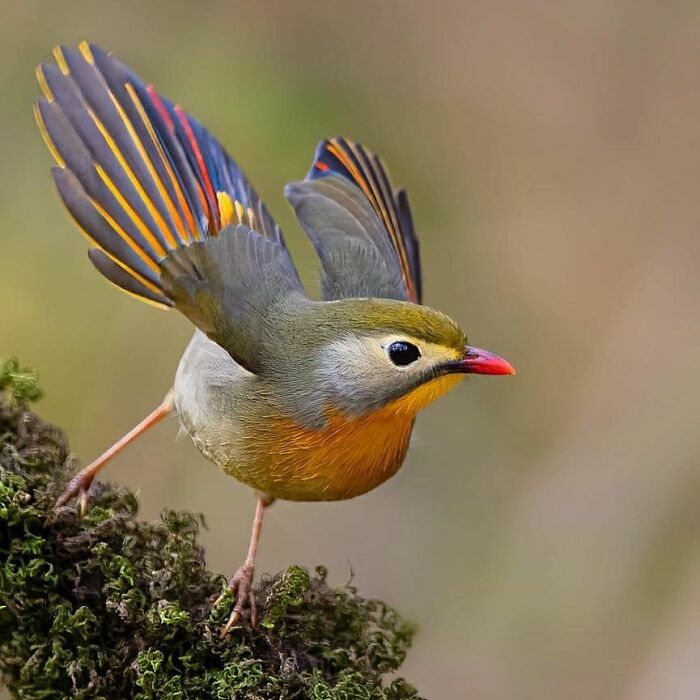
The Red-billed Leiothrix (Leiothrix lutea) is a small, enchanting songbird native to the subtle hill forests and dense mountain jungles of the Indian subcontinent, southern China, and Southeast Asia. Belonging to the laughingthrush family, this highly energetic bird is universally adored for its jewel-like plumage, intensely social demeanor, and incredibly rich vocal talents.
Their plumage is a striking, sun-kissed arrangement that glows brightly against the dim forest undergrowth. They feature an elegant olive-green body, soft yellowish rings around their dark eyes, and a brilliant, glowing golden-yellow throat that blends smoothly into an orange breast. Their most dramatic accents are their bright, coral-red bill and a vivid slash of crimson and yellow across their wing feathers, making them appear almost tropical in design.
They are incredibly expressive and gifted musicians, possessing a sprawling repertoire of vocalizations. The males sing a remarkably loud, varied, and beautiful melody consisting of clear, flute-like whistles that mimic the complex songs of true thrushes, while both sexes maintain a constant, cheerful chattering of scolding and buzzing calls to keep track of each other as they move through thick brush.
They are intensely gregarious and affectionate creatures, especially when it comes to their life partners. Historically nicknamed "Pekin Robins" or "Lovebirds" in the pet trade, a mated pair will spend hours sitting tightly pressed together on a branch, gently preening each other's heads and necks. If separated, they will call out in frantic, high-pitched notes until they are reunited, displaying a profound psychological bond.
They are highly active, ground-loving foragers that prefer the safety of dense secondary growth, bamboo thickets, and forest edges. They spend their days hopping rapidly through the leaf litter and low branches, using an opportunistic, omnivorous strategy to hunt down small insects, spiders, and caterpillars, which they supplement heavily with wild berries, small fruits, and seeds.
Beyond their native Asian borders, these birds have proven to be exceptionally rugged and successful global travelers. Due to their immense historical popularity as caged songbirds, escaped individuals have established thriving, permanent wild populations in far-flung subtropical and Mediterranean climates, including the Hawaiian islands, Japan, Réunion Island, and parts of southwestern Europe like France and Italy.
The Western Grebe (Aechmophorus occidentalis) is a large, elegant waterbird native to North America. Famous for its striking black-and-white appearance, long swan-like neck, and piercing red eyes, it is best known for performing one of the most spectacular, complex courtship rituals in the entire animal kingdom.
During the breeding season, pairs engage in a mind-boggling display called "rushing." They turn side-by-side, lunge forward, and literally sprint across the water's surface for up to 65 feet. They are the largest animals on Earth capable of running on water, taking up to 20 steps per second with their uniquely lobed feet to stay afloat.
If the rushing goes well, the pair moves on to the next stage of dating: the weed dance. They dive to the bottom of the lake, grab mouthfuls of aquatic vegetation, swim toward each other, and rise vertically out of the water chest-to-chest, swaying back and forth.
Western Grebes build floating nests out of rushes and reeds, anchoring them to living vegetation in shallow lake waters. Because these nests float, they rise and fall naturally with water levels, protecting the eggs from flooding.
Once the chicks hatch, they don't spend much time in the nest. They immediately climb onto their parents' backs. The adults swim around with the fluffy chicks safely tucked into their back feathers—even while diving underwater for fish—for the first few weeks of life.
They look almost identical to the Clark's Grebe. The easiest way to tell them apart is by looking at their eyes: the black cap extends down past the bright red eye on a Western Grebe, whereas a Clark's Grebe has white feathers surrounding its eye.
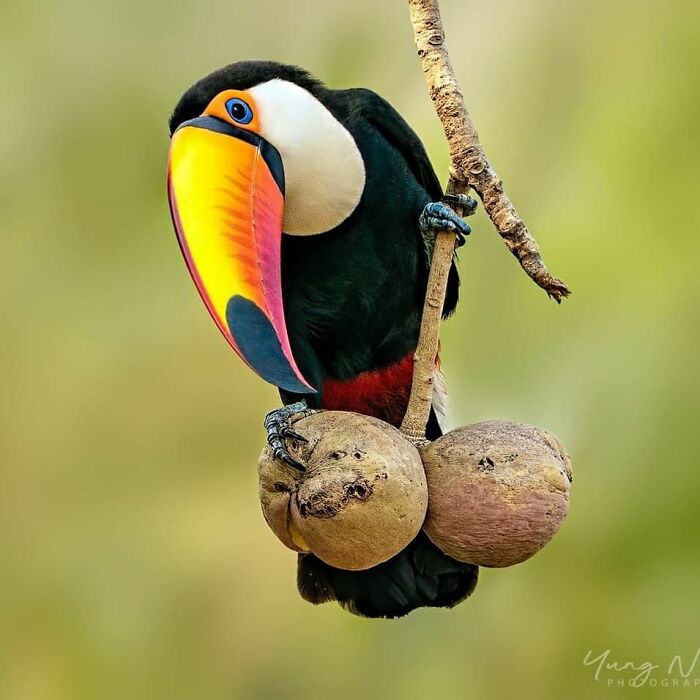
I love toucans. I was probably exposed to Guinness adverts at a tender age

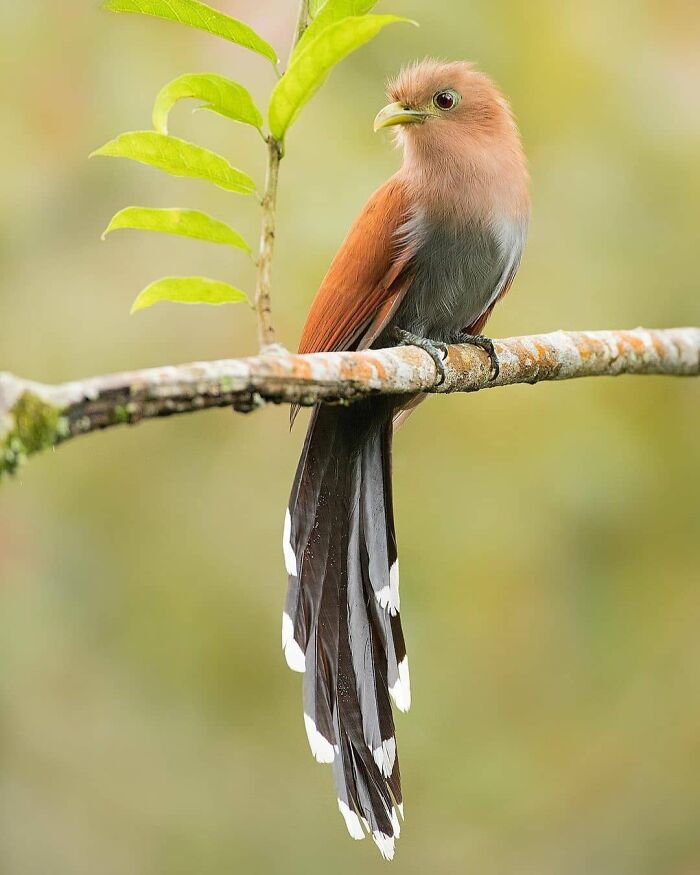
Squirrel cuckoo haha fun name and it does kinda remind me of a squirrel. Want a peanut birdy?
The Bald Eagle (Haliaeetus leucocephalus) is a massive bird of prey native strictly to North America, spanning from the wilderness of Alaska and Canada down through the contiguous United States and northern Mexico. As a true apex predator of the skies, this sea eagle is globally celebrated for its imposing strength and famously holds distinction as the national bird and symbol of the United States.
Their mature plumage is an iconic masterclass in stark contrast. While their massive body and wings are wrapped in deep chocolate-brown feathers, their head and tail are a brilliant, snowy white—a striking feature that only develops fully once the bird reaches adulthood around five years of age. This contrast is sharply punctuated by a massive, hooked yellow beak and piercing, pale yellow eyes that grant them legendary, razor-sharp vision.
They are opportunistic carnivores heavily specialized in fishing, typically establishing territories near large, open bodies of water like coastlines, lakes, and rivers. They hunt by soaring high or watching from a prominent perch, then diving down at speeds up to 100 miles per hour to snatch fish right out of the water with their powerful, curved talons, though they will also aggressively steal catches from smaller raptors like ospreys.
Their nesting habits are an incredible feat of lifelong animal architecture. Mating pairs build massive stick platforms—called eyries—high up in sturdy old-growth trees or on rugged cliffsides, returning to the exact same spot year after year to add more branches, moss, and feathers. Over time, these nests can grow to truly staggering dimensions, sometimes measuring over ten feet wide and weighing up to two tons, making them the largest tree nests built by any animal.
Despite their intimidating appearance and massive size, their vocalizations are surprisingly modest. Rather than a fierce, echoing scream, they communicate using a series of weak, high-pitched whistling chirps and chattering giggles; in Hollywood films, their actual call is famously dubbed over with the piercing cry of the much smaller Red-tailed Hawk to sound more cinematic.
Beyond its modern patriotic status, the Bald Eagle holds a deeply sacred, spiritual significance across many Native American cultures and First Nations communities, where its feathers and image symbolize courage, wisdom, and a direct connection to the creator. Having made a miraculous recovery from the brink of extinction due to chemical poisoning in the mid-20th century, it stands today as one of the greatest success stories in the history of wildlife conservation.

Beautiful, regal creatures. My dad is Tlingit, our family is from the Eagle clan. Feels magical when I see one flying overhead in my neck of the woods (Pacific Northwest US). The US is kind of a shíthole right now, but the nature is lovely! 😅🥲💀
The Common Green Magpie (Cissa chinensis) is a medium-sized, breathtakingly beautiful member of the crow and jay family (
Their standard appearance is a vivid, high-contrast spectacle. They sport a brilliant lime-green body, a long cascading tail with black and white tips, and rich chestnut-red wings. A broad, jet-black "bandit mask" runs from the base of their bill completely through their eyes to the back of the neck, creating a striking contrast with their bright coral-red bill, legs, and fleshy red eye-rings.
They possess a fascinating, chameleon-like vulnerability regarding their color. Their intense lime-green feathers are not created by blue structural colors like most jays, but rather by fragile yellow carotenoid pigments derived from their diet, laid over a blue structure. Because solar radiation destroys this yellow pigment, green magpies exposed to prolonged, direct sunlight in captivity or open areas often fade over time, turning a completely uniform, bright sky-blue.
True to their corvid nature, they are highly intelligent, highly active, and aggressive carnivores. They spend their days hunting through the middle and lower canopies, foraging for a wide variety of prey including large beetles, grasshoppers, mantises, small lizards, frogs, and the nestlings of other birds. They are also known to readily feed on fresh carrion when available.
They are incredibly expressive and versatile vocalists. While they frequently emit a piercing, metallic, and harsh whistling call—often described as a sharp "peep-peep"—they are also highly accomplished mimics. They easily replicate the songs of other birds and even mammalian sounds to communicate with their flock or confuse potential predators.
Despite their brilliant coloration, they are remarkably secretive and difficult to spot in the wild. They prefer the thickest cover of bamboo groves, deep ravines, and tangled evergreen foliage, where they move in small, noisy family groups. Their incredible intelligence, bold hunting tactics, and jaw-dropping appearance make them one of the most highly sought-after encounters for wildlife photographers exploring the dense jungles of Asia.
The Red-whiskered Bulbul (Pycnonotus jocosus) is a sleek, lively songbird native to the tropical regions of South and Southeast Asia. Renowned for its bold personality and expressive behavior, it is an iconic species that has adapted incredibly well to living alongside human environments.
Their plumage features a smart, high-contrast palette that makes them instantly recognizable. They sport a dark brown back, a clean white belly, and a dramatic, tall black crest that tapers to a sharp point on top of their head. Their namesakes are the vivid splash of crimson feathers located just behind their eyes, resembling bright red whiskers, which pair beautifully with a matching red patch under the base of their tail.
They are highly energetic and opportunistic foragers, making them a common sight in gardens, orchards, and urban parks. They split their time between flitting through fruit trees to feed on berries, figs, and nectar, and performing quick aerial sweeps to snatch flying insects mid-air, often hunting in small, cheerful family groups.
Their nesting architecture is remarkably clever and compact. Working together, a breeding pair weaves a neat, cup-shaped nest out of small twigs, roots, and grasses, frequently strengthening the exterior with spider silk. They are notoriously bold parents, often building these nests in low bushes, garden shrubs, or even on sheltered windowsills and porches very close to human activity.
They are incredibly expressive communicators, using both sound and body language to interact. When excited or defending territory, they will rapidly snap their crest up and down while letting out a loud, cheerful, and musical three- or four-note whistling call that sounds like a bright, bouncing bounce through the trees.
Beyond their native Asian range, these birds are famous for their remarkable survival skills as an introduced species. Escaped cage birds have successfully established permanent, thriving wild populations in warm regions all over the globe, including parts of Australia, southern California, Florida, and the Hawaiian islands.
The Eurasian Penduline Tit (Remiz pendulinus) is a tiny, energetic songbird found across a massive range spanning from western Europe all the way across Russia to China. Thriving in wetlands, marshes, and riverbanks dense with reeds and willows, this diminutive creature is globally renowned not for its size or song, but for being one of the most sophisticated master architects in the entire animal kingdom.
Their appearance is remarkably smart and resembles a tiny, feathered bandit. They feature a light-grey head dramatically punctuated by a thick, jet-black "Zorro mask" across their eyes, contrasting beautifully against a rich chestnut-brown back and a pale, cream-colored underbelly. Their slender bills are sharp and needle-like, perfectly evolved to perform delicate, intricate movements.
The name "Penduline" directly refers to their incredible, pendulum-like nesting habits. Using their fine beaks, a breeding pair weaves a complex, hollow pouch that hangs suspended from the very tips of thin, drooping tree branches over water. The nest is an engineering marvel constructed out of soft animal hair, wool, and fluffy tufts of willow and reed seeds, woven together with spider silk so tightly that it resembles thick, sturdy felt fabric.
To protect their young from clever predators like snakes and larger birds, the nest features a highly specialized security design. It is built with a false entrance on the side that leads into a dead-end chamber to confuse intruders. The real entrance is an elongated, downward-pointing tube located higher up, which collapses shut under its own weight whenever the parents leave, acting as a soft, self-closing security door.
Their social lives are defined by a fascinating and highly chaotic mating strategy known as sequential polygamy. A male will start building an elaborate nest and sing to attract a female; once they pair up and finish the nest together, one partner will frequently desert the other to find a new mate and start a second nest elsewhere. This leaves either the mother or the father to raise the chicks entirely alone, and sometimes, if both try to desert at the same time, the nest is abandoned completely.
They are highly agile foragers, spending their days acrobatically clinging upside down to reed seed-heads and slender twigs. They rely on an insectivorous and granivorous diet, expertly prying open plant stems to find hidden aphids, small caterpillars, and spiders, or plucking tiny seeds during the cold winter months when they join up in small, nomadic family groups.
The Long-tailed Tit (Aegithalos caudatus) is a tiny, exceptionally endearing songbird found across the temperate woodlands, shrublands, and gardens of Europe and Asia. Affectionately compared to a flying lollipop or a cotton ball on sticks, this hyperactive little bird belongs to its own unique family, completely separate from the true tits of the northern hemisphere.
Their appearance is entirely dominated by their striking, oversized tail, which makes up over half of their total 14 cm (5.5-inch) body length. They sport a fluffy, rounded body wrapped in a delicate palette of snow-white, soft pink, and deep blackish-brown feathers, finished with a pair of tiny, dark eyes and a remarkably short, stubby beak perfectly suited for precise tasks.
They are master weavers who construct one of the most complex nests of any European bird. Working together over several weeks, a pair builds a flexible, dome-shaped pouch hidden in the fork of a thorny bush or tree trunk, constructed out of moss, animal hair, and spider silk; the spider silk allows the nest to elasticly stretch and expand to accommodate the growing family of up to a dozen chicks, which they camouflage by perfectly tiling the exterior with thousands of individual flakes of lichen.
Their social lives feature a heart-warming, highly cooperative behavior known as "helper altruism." If a breeding pair's own nest fails due to predators or bad weather, they don't give up; instead, they immediately select the nest of a close relative and spend the rest of the season working tirelessly to help feed and protect that relative's demanding chicks, vastly improving the family's survival rate.
They are intensely gregarious and are almost never seen alone, moving through the woods in highly synchronized, noisy family flocks of 20 to 30 birds. Because their tiny bodies lose heat rapidly during cold winter nights, the entire flock will gather on a single branch and tightly squeeze together into a single, shivering row—constantly shuffling positions so that the birds on the cold outer edges get a turn in the warm center.
They are restless, acrobatic foragers that survive almost entirely on a diet of tiny insects, spiders, and moth eggs. They move through the canopy with a bouncing, undulating flight pattern, often hanging completely upside down on the very tips of slender twigs to glean hidden pests that heavier birds cannot reach, all while maintaining constant, high-pitched contact calls that sound like a rhythmic "sri-sri-sri" echoing through the trees.
The Eastern Bluebonnet (Northiella haematogaster) is a medium-sized, strikingly distinct parrot native to the arid and semi-arid woodlands, mallee scrublands, and open interior plains of southeastern Australia. Highly resilient and uniquely adapted to life in the harsh Australian outback, this nomadic bird stands out among Australian parrots for its bold personality and fascinating color variations.
Their appearance is a beautifully complex mosaic of subtle earth tones and explosive accents. They feature a primarily soft, olive-brown upper body and breast that blends into an unmistakable, brilliant purplish-blue "bonnet" mask across their face and forehead. Their lower underparts feature a striking, vibrant red patch on the belly that shifts into a bright yellow vent, while their wings flash brilliant patches of turquoise, deep blue, and red when fanned.
They are largely ground-feeding parrots, perfectly suited for scavenging in arid landscapes. They spend the cooler hours of the morning and late afternoon walking briskly through low grass and saltbush, foraging for a varied diet of native seeds, herbaceous plants, wild berries, and small insects. Because water is scarce in the outback, they are highly mobile and will fly great distances to gather around remote livestock watering holes and farm dams.
Despite their delicate beauty, Bluebonnets are widely famous among aviculturists and field biologists for their incredibly fiery, pugnacious temperaments. They are intensely territorial, aggressively defending their feeding grounds and nesting sites from other birds. During the breeding season, a mated pair becomes fiercely protective, and males will boldly confront rivals with flared wings, raised crown feathers, and a series of sharp, rapid chattering calls.
Their nesting strategies are heavily reliant on the sparse timber of the Australian interior. They seek out natural hollows deep within old, decaying eucalyptus trees, often selecting holes with remarkably narrow entrances close to the ground to keep larger predators out. The female cleans the hollow and lays her eggs directly onto a bed of decaying wood dust, remaining inside for weeks while the male diligently brings her food.
Beyond their ecological role as tough survivors of the bush, Eastern Bluebonnets are highly prized by experienced bird enthusiasts for their intelligence and active nature. In the wild, their swift, undulating flight and explosive chattering calls are an iconic, spirited element of the quiet Australian interior, showcasing nature's ability to paint vivid pops of color onto an otherwise dusty landscape.
D'Arnaud's Barbet - A Tanzanian bird. This one was new to me. Mesmerizing.
Absolutely loved this post/article! I know that I commented on quite a few, but I couldn't help myself. I've had a deeply rooted love and interest for nature and all nature's creatures since childhood, and I've picked up a little bit of info here and there over the years. A big thank you, to Hidrėlėy and Gabriela 🌞

Absolutely loved this post/article! I know that I commented on quite a few, but I couldn't help myself. I've had a deeply rooted love and interest for nature and all nature's creatures since childhood, and I've picked up a little bit of info here and there over the years. A big thank you, to Hidrėlėy and Gabriela 🌞








































 No fees, cancel anytime