Get Premium
Dark mode theme is available exclusively for premium users. Learn more about the benefits of subscribing.
No fees, cancel anytime.

 Dark Mode Ad-Free Browsing Unlimited Content
 Ad-Free Browsing Unlimited Content Dark Mode
Join 1.2 million Panda readers who get the best art, memes, and fun stories every week!
It can be rather daunting to realize just how massive the world is. The overwhelming amount of things, facts, details there are to learn. It can help to break down information into much more approachable and bite-sized pieces.
So we’ve gathered some of the most interesting posts from an Instagram page dedicated to cool facts and photos that should help you learn more about the world. Get comfortable as you scroll through, upvote your favorites and be sure to share your own examples below.
More info: Instagram
This post may include affiliate links.
Learning something new can feel like being handed an ocean and told to memorize it wave by wave, and your brain has a real reason for reacting that way. Working memory, the mental space you use to juggle information, can only hold a handful of things at once. Psychologist George Miller mapped this out in 1956, finding that most people can hold roughly seven items in mind before things start slipping, an idea that grew into what is now called chunking.
That is why phone numbers get broken into small groups instead of one long string of digits. Once you realize your brain cannot hold an entire subject at once, feeling overwhelmed stops seeming like a personal failure and starts looking like basic biology.
This idea has an official name in education circles too, cognitive load theory, developed largely by researcher John Sweller. It explains why cramming ten new concepts into one sitting tends to backfire so badly. Give your working memory too much at once and something gets pushed out, usually your ability to remember any of it later. The fix is refreshingly simple. Break big topics into smaller pieces and let each one settle before adding the next. Picture it less like drinking from a fire hose and more like sipping from a cup you can actually finish.

A lady in Ireland did the same thing! She made a good profit.
Timing matters just as much as sizing. Back in 1885, German psychologist Hermann Ebbinghaus ran memory experiments on himself, memorizing meaningless syllables and tracking exactly how fast he forgot them. What he mapped became known as the forgetting curve, and it shows that without review, new information fades shockingly fast, often within days. The encouraging part is that reviewing information at spaced intervals resets the clock and slows that fading down.
That is the whole idea behind spaced repetition, and it explains why flashcard apps built around the concept have become popular with language learners and medical students alike. You are not doomed to forget everything you pick up, you just need to revisit it before it slips away.

There is also a mindset shift that changes how all of this feels day to day. Stanford psychologist Carol Dweck spent decades studying what she called a growth mindset, the belief that abilities can be built through effort rather than being fixed traits you either have or do not.
This is on a temporary support and not fully suspended. An earthquake cracked its original suspension in 1839, and it was finally resuspended using scㅤrew jacks in 1896. It was originally suspended using water and earth, with the original canals being filled in in the process.
People who treat a rough first attempt as part of the process, rather than proof they are simply bad at something, tend to keep going long after others quit. That distinction matters more than it sounds. Confusion during the first few days of learning anything, whether it is a language, an instrument, or a brand new hobby, is not evidence you took a wrong turn. It is usually a sign you are exactly where you are supposed to be.
Curiosity turns out to be a surprisingly effective shortcut through all of this too. Economist and psychologist George Loewenstein proposed what he called the information gap theory, the idea that curiosity kicks in the moment we notice a gap between what we know and what we want to know.

If only all wars were as short and also had minimal loss of life.

That gap feels uncomfortable enough that our brains actively push us to close it, which is one reason a good question pulls people in far more effectively than a dense textbook chapter ever could. If a subject feels dry, try hunting for the one strange question hiding inside it. Curiosity about space rarely starts with orbital mechanics. It usually starts with something like why the sky is blue or how astronauts manage to sleep while floating.
One more trick is worth borrowing from a Nobel laureate. Physicist Richard Feynman believed that if you could not explain an idea in plain language, you probably did not understand it as well as you thought. The method built around that belief, now known as the Feynman technique, asks you to explain a new concept as though you were teaching it to a curious twelve year old. Wherever your explanation stumbles is exactly where your understanding has a gap worth filling.
None of this makes a subject smaller. The world is still enormous and wonderfully strange, and it always will be. What changes is your approach to it. Break things down, space them out, keep your curiosity switched on, and give yourself credit for every small piece you manage to pick up along the way. That is really all learning ever is anyway, one interesting piece at a time.

You can also just watch SNL from when it began to now to get a good snapshot of the last 50 years
Wear your seatbelts people! Whether it’s on a plane or in the car!

Encephalitis lethargica is characterized by high fever, sore throat, headache, lethargy, double vision, delayed physical and mental response, sleep inversion and catatonia.[5][10] In severe cases, patients may enter a coma-like state (akinetic mutism).[citation needed] Patients may also experience abnormal eye movements ("oculogyric crises"),[11] Parkinsonism, upper body weakness, muscular pains, tremors, neck rigidity, and behavioral changes including psychosis.[citation needed] Klazomania, a vocal tic involving compulsive screaming, is sometimes present. (from Wikipedia)

I live in Huntington Beach, which is about 50 miles/1-hour drive south of Pacific Palisades. We got tons of ashfall and the sky was smoky even where I lived :(
There is no sound that instruments CAN'T record, although it may be difficult to get a given microphone to pick up a given frequency. If the sound truly cannot be detected by instrumentation, then the sound is originating inside the people hearing it. ie. some form of tinnitus
My great-grandmother was born in 1899. She was alive to hear about the Wright Flyer, two world wars, the Moon landing, and the dissolution of the Soviet Union before dying at age 101 having seen the turn of two centuries. Emigrated from Sweden to New Zealand with her family at a young age.(I forget exactly when)
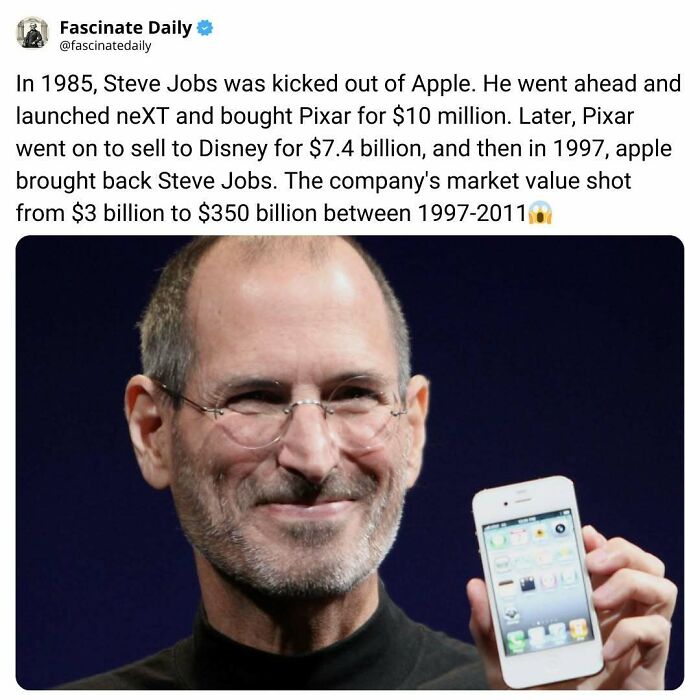
It also helped that Microsoft made a $150 million investment in Apple non-voting stock in August 1997, to rescue it from near-bankruptcy. Even Gates didn't want a monopoly. It gave Jobs some breathing room.




































 No fees, cancel anytime