Get Premium
Dark mode theme is available exclusively for premium users. Learn more about the benefits of subscribing.
No fees, cancel anytime.

 Dark Mode Ad-Free Browsing Unlimited Content
 Ad-Free Browsing Unlimited Content Dark Mode
Join 1.2 million Panda readers who get the best art, memes, and fun stories every week!

A visible disability can become the first thing people notice about someone, but it should never become the measure of what they are capable of. Still, assumptions creep in, especially when someone looks different from what we expect. And sometimes, people take those assumptions so far that they start treating a perfectly capable person as though they have something to prove.
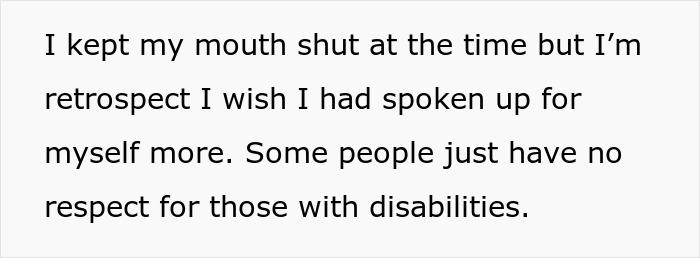
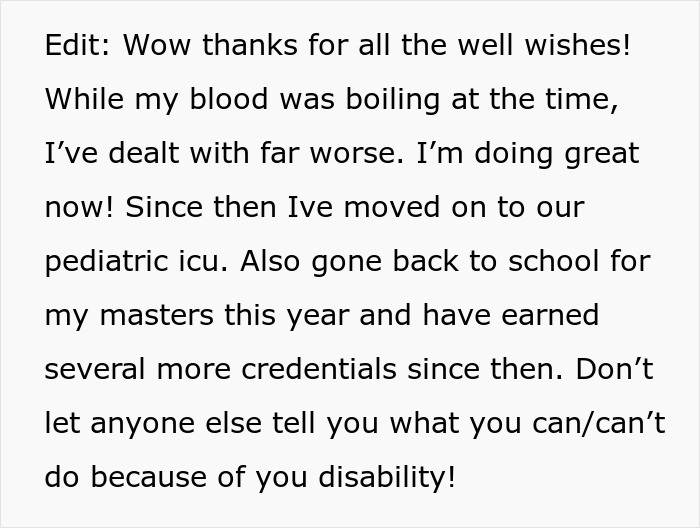
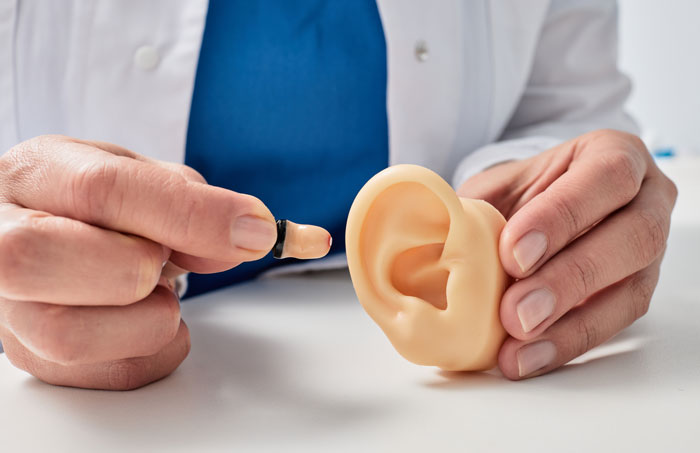
A 24-year-old medical worker shared how he was assigned to perform an EKG on an 8-year-old patient. The kid’s mom became fixated on his prosthetic ear, calling it inappropriate for a children’s hospital, and asked him to remove it. The dad joined in by questioning his qualifications, and the encounter only got worse. Read on to see how the parents treated him because of his disability.
For many people with disabilities, the challenge is not doing the job well but being given the chance to do it at all. The World Health Organization notes that stigma and discrimination can create barriers to employment, while people with disabilities are often denied opportunities that others take for granted.
An OECD report found that people with disabilities continue to face significant employment gaps compared with people without disabilities. In the survey conducted in 2019, it was revealed that people with disabilities were about 40% less likely to be employed. The report also shows that improving education alone has not been enough to close that gap, noting that having the skills for a job does not always mean getting the same opportunities to use them.
Additionally, the International Labor Organization found that differences in employment and wages cannot be explained by education, experience, or occupation, pointing instead to factors such as discrimination and a lack of workplace accommodations. These factors can still leave qualified people with disabilities at a disadvantage, even when they have the skills needed to do the job.
A person may have the training, experience, and credentials for a job, yet still find themselves having to prove that they can do it because someone has decided their disability must say something about their ability. In this medical worker’s case, that assumption showed up almost immediately, before he even performed the EKG he was more than qualified for.
The U.S. Equal Employment Opportunity Commission explains that disability-related harassment can come from co-workers, supervisors, or even people outside the organization, such as clients or customers. Offensive comments about a disability can cross the line into unlawful harassment when they become severe or frequent enough to create a hostile work environment.
There is a line between being curious about someone’s disability and making their disability your business. Cleveland Clinic’s guidance on disability etiquette advises against invasive questions about a person’s condition, appearance or how they manage everyday life. For example, the dad’s questions about whether the medical worker was qualified suggested that his disability made his competence questionable.
An important part of disability etiquette is knowing when not to make someone’s disability the center of the interaction. Guidance from Understood recommends focusing on the person rather than assuming what they can or cannot do. In the workplace, that means focusing on someone’s skills and experience instead of deciding what they can do based on how they look.
A systematic review of research on healthcare providers with disabilities found that ableism can show up through negative attitudes, bullying, harassment, and unsupportive work environments. So while hospitals are places where people go for care, disabled professionals can still encounter the same prejudices they face elsewhere.
This is why broader representation matters. Research on disabled health and human-service professionals has found that they remain underrepresented in these fields. Having professionals with disabilities in healthcare can help create a workforce that better reflects the people it serves, rather than treating disability as something that automatically disqualifies someone from the profession.
At the end of the day, the medical worker was there to care for a child, not defend his appearance or prove that his disability did not make him less capable. People with disabilities deserve to be treated with the same respect and consideration as anyone else.
If you were in his shoes, would you have spoken up when the parents questioned you, or kept your cool and walked away? Tell us how you would have handled it in the comments.






















By entering your email and clicking Subscribe, you're agreeing to let us send you customized marketing messages about us and our advertising partners. You are also agreeing to our Privacy Policy.
Thank you! You've successfully subscribed to newsletters!

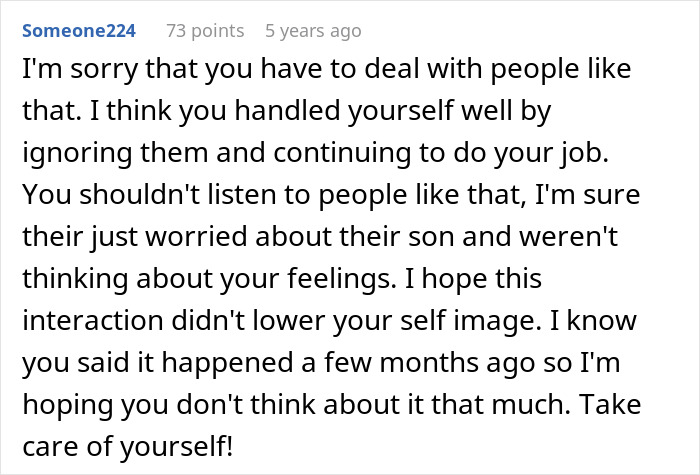
It's important to speak up and call out prejudice, but it's also ok if you let one slide sometimes. An 8 year old getting an EKG means whatever is going in in the background is stressful on the family, and bigoted people are the most likely to be violent, so adding some stress or perceived humiliation to a stressful situation isn't good for the kid. It's also not part of your job, so if you can't do your job and confront AHs, sometimes at work you need to focus on your job, your life, your health. It's always ok to call this s**t out, but it's also ok to choose when you want to spend energy on AHs. If you aren't happy how you handled things, think through why and do it differently next time, but there's no reason to feel guilty.
Yes, it's true that you sometimes have to make tough choices about when to let things slide, especially when speaking up will have other repercussions such as frightening a young child (though for older kids, it's probably worthwhile for them to witness a counterpoint to the prejudice they may not yet realize their parents are ignorantly showing) or even just making the entire interaction take longer and be even more stressful. However, there's a big gray area between something that is truly not big enough to make a fuss over (especially if it's possible to interpret it as a misunderstanding) and something that is so egregious that it cannot be ignored; and many of us (especially bystanders) are sometimes guilty of "small" letting things slide because it's so much *easier* not to call them out, even though it would be ethically better to do so.
Load More Replies...
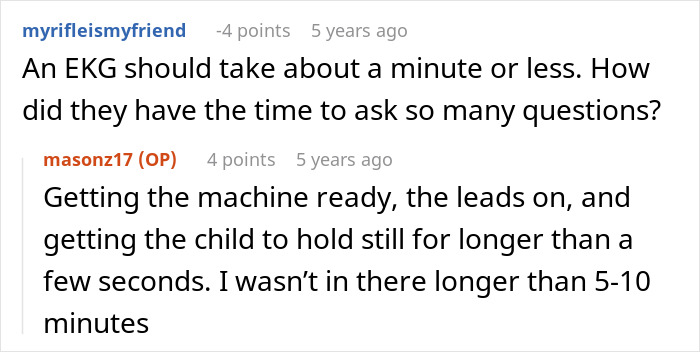
Someone questioned why the OP had to be in the room for long enough for the father to ask so many questions, because "an EKG should take a minute or less". Well, I would bet dollars for donuts that that commenter has learned a *little* bit of medical information (whether in formal training or just as trivia), but aren't as knowledgeable as they think when it comes to how theoretical facts translate to real world situations. They have the *knowledge* that an EKG is an extremely simple test that takes the machine like 30 seconds to run; but they clearly have never actually *had* an EKG or even seen one performed. (details next)
They are not accounting for the length of time it takes to locate and place all the conductive patches around the chest and on the left arm and right leg (which may require extra time to remove sleeves or roll up trousers, and may even occasionally require literally shaving small patches of chest hair), and THEN you still have to sort out the 12-15 leads (12 for adults, 15 for kids) and clip each one to the correct patch, waiting a moment for the machine to confirm it is getting a good signal (and fixing patches if not), then 30 seconds for the reading, possibly taking a second reading if the first one isn't clear, and then, finally, unclipping all the leads and peeling off all the patches. I get EKGs a lot, and inevitably I or the technician make a comment about how the test itself is anticlimactically short compared to the whole process.
Load More Replies... It's important to speak up and call out prejudice, but it's also ok if you let one slide sometimes. An 8 year old getting an EKG means whatever is going in in the background is stressful on the family, and bigoted people are the most likely to be violent, so adding some stress or perceived humiliation to a stressful situation isn't good for the kid. It's also not part of your job, so if you can't do your job and confront AHs, sometimes at work you need to focus on your job, your life, your health. It's always ok to call this s**t out, but it's also ok to choose when you want to spend energy on AHs. If you aren't happy how you handled things, think through why and do it differently next time, but there's no reason to feel guilty.
Yes, it's true that you sometimes have to make tough choices about when to let things slide, especially when speaking up will have other repercussions such as frightening a young child (though for older kids, it's probably worthwhile for them to witness a counterpoint to the prejudice they may not yet realize their parents are ignorantly showing) or even just making the entire interaction take longer and be even more stressful. However, there's a big gray area between something that is truly not big enough to make a fuss over (especially if it's possible to interpret it as a misunderstanding) and something that is so egregious that it cannot be ignored; and many of us (especially bystanders) are sometimes guilty of "small" letting things slide because it's so much *easier* not to call them out, even though it would be ethically better to do so.
Load More Replies... Someone questioned why the OP had to be in the room for long enough for the father to ask so many questions, because "an EKG should take a minute or less". Well, I would bet dollars for donuts that that commenter has learned a *little* bit of medical information (whether in formal training or just as trivia), but aren't as knowledgeable as they think when it comes to how theoretical facts translate to real world situations. They have the *knowledge* that an EKG is an extremely simple test that takes the machine like 30 seconds to run; but they clearly have never actually *had* an EKG or even seen one performed. (details next)
They are not accounting for the length of time it takes to locate and place all the conductive patches around the chest and on the left arm and right leg (which may require extra time to remove sleeves or roll up trousers, and may even occasionally require literally shaving small patches of chest hair), and THEN you still have to sort out the 12-15 leads (12 for adults, 15 for kids) and clip each one to the correct patch, waiting a moment for the machine to confirm it is getting a good signal (and fixing patches if not), then 30 seconds for the reading, possibly taking a second reading if the first one isn't clear, and then, finally, unclipping all the leads and peeling off all the patches. I get EKGs a lot, and inevitably I or the technician make a comment about how the test itself is anticlimactically short compared to the whole process.
Load More Replies...

































 No fees, cancel anytime









70
11