Get Premium
Dark mode theme is available exclusively for premium users. Learn more about the benefits of subscribing.
No fees, cancel anytime.

 Dark Mode Ad-Free Browsing Unlimited Content
 Ad-Free Browsing Unlimited Content Dark Mode
Join 1.2 million Panda readers who get the best art, memes, and fun stories every week!
Once we were traveling around the magical Curonian Spit, we couldn’t bypass such a wonderful place as the ornithological station Fringilla. It’s a stationary field base of the Zoological Institute of the Russian Academy of Sciences, where bird migration routes are studied. It is located in the right place: the migration routes of millions of migratory birds during spring and autumn lie there on the spit.The giant nets are built there to trap the birds. And then they get into the safe hands of ornithologists, who weigh and study them, ring them and release them back into the wild.
The Curonian Spit is a nearly 100 km long curved thin sand-dune foreland that separates the Curonian Bay from the Baltic Sea. Part of it lies in Kaliningrad Region of Russian Federation and another part is located within Lithuania. It’s acknowledged as a UNESCO World Heritage Place.
Fringilla is translated from Latin as “chaffinch”. These small nimble birds are the most common in Europe. The huge Fringilla traps are designed specially for such small birds. Every year on their way from Europe to the countries of Asia and Africa they stop at the Curonian Spit to rest and feed themselves before a long journey. And the scientists are waiting for them to study the quantity of birds, their routes and to receive other data for further analytics. Sometimes larger and even predatory specimens — cuckoos, owls, and even hawks are also being trapped, but it rarely happens.
In our tour around the Curonian Spit we could not miss such an interesting place. You can take a paid tour here and, under the guidance of a specialist, bypass the entire territory of the station, see how the birds are caught and studied, take pictures and listen to interesting facts about the station itself, its inhabitants and wards. By the way, you can volunteer here for the summer season, if you are interested in. And it’s really a great idea for a vacation in the warm season. Magic nature, ecologically clean nature reserve, extensive forests, the Baltic Sea on one side and the Curonian Bay on the other, a huge quantity of different animals: roe deers, moose, wild boars, foxes and many others. And the birds, of course.
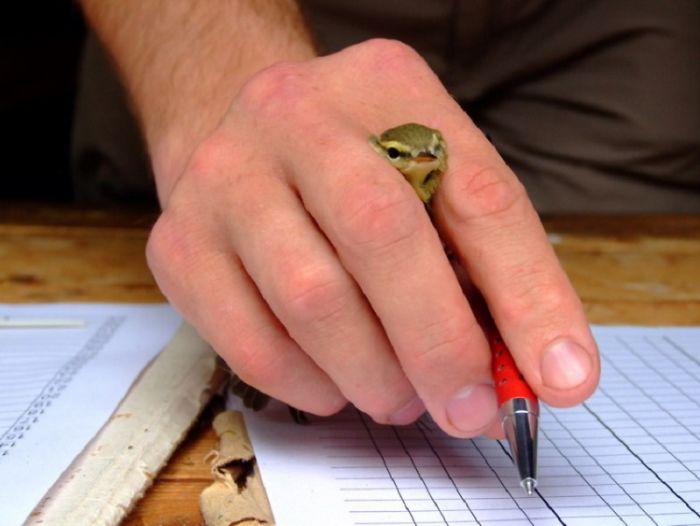
The excursion for us was conducted by a huge brutal ornithologist named Arseny. Despite the external severity, he turned out to be a very interesting and knowledgeable guide: he led us to all the corners of the station, told us all the most fascinating details. He showed us how they took the birds out of the traps, weighed, classified, studied, ringed. It was a little scary to see a tiny ball of feathers in his huge hands. But he treated his wards very gently. It is evident that the man really loves nature and is used to treating all the creatures with care. And, of course, it is obvious that he is a fan of his job and a “mad scientist” in a good sense of the word.
Half a day at the station flew so fast. We had plenty of time to walk, to breathe in the fresh sea and forest air, to take a lot of photos, which I gladly share with you. It was time to move on, look at other sights of the spit — so called Dancing (drunk) Forest, the Dunes, the Museum of Russian Superstitions. I will tell more about that in the following articles, if it’s interesting for you.
109views
Share on Facebook




































 No fees, cancel anytime






2
0