Get Premium
Dark mode theme is available exclusively for premium users. Learn more about the benefits of subscribing.
No fees, cancel anytime.

 Dark Mode Ad-Free Browsing Unlimited Content

 Ad-Free Browsing Unlimited Content Dark Mode

Join 1.2 million Panda readers who get the best art, memes, and fun stories every week!
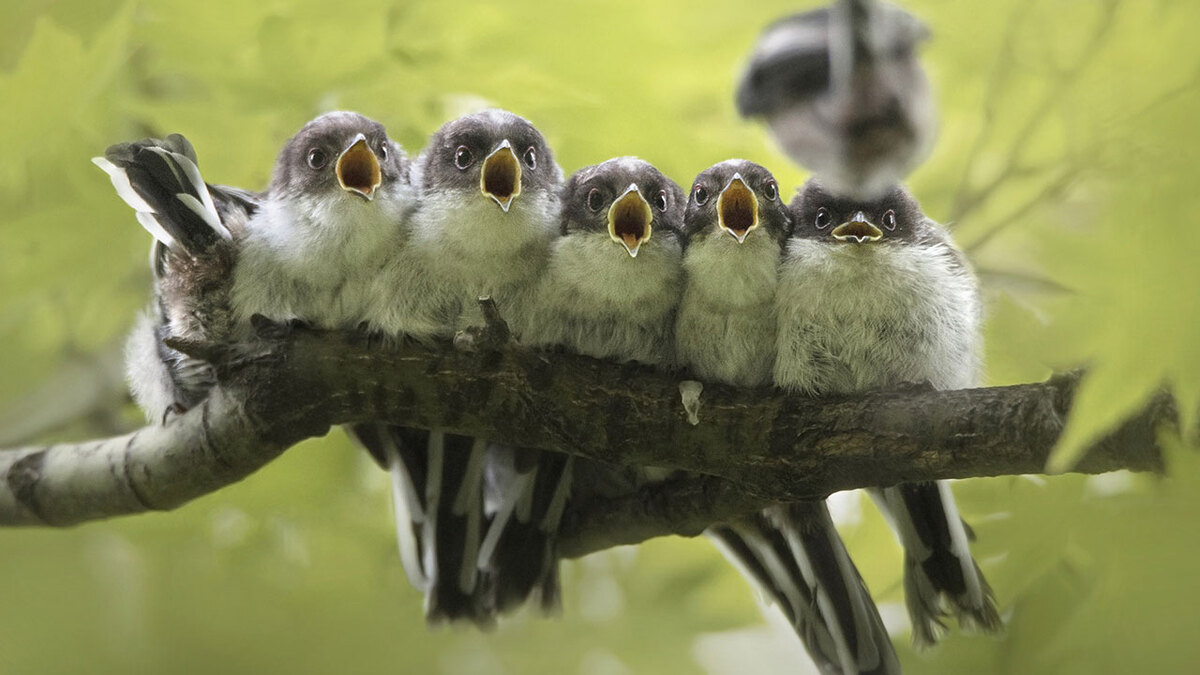
Photographing wildlife takes patience, a good eye, and often a lot of luck. The Nature Photographer of the Year (NPOTY) contest brings together photographers who manage to capture fascinating moments in the wild, showcasing the beauty and diversity of the animals and environments that make our planet so special.
While we wait for this year's winners to be announced, we thought it would be a good time to look back at some of our favorite wildlife photos that made the finalists' lists between 2016 and 2025. Earlier, we also shared a selection of photos from the contest's People's Choice Award, so make sure to check out that post if you haven't already!
Now, scroll down to revisit some of our favorite wildlife photography moments from the past ten years. Which one stands out to you the most?
More info: naturephotographeroftheyear.com | Instagram | Facebook
This post may include affiliate links.
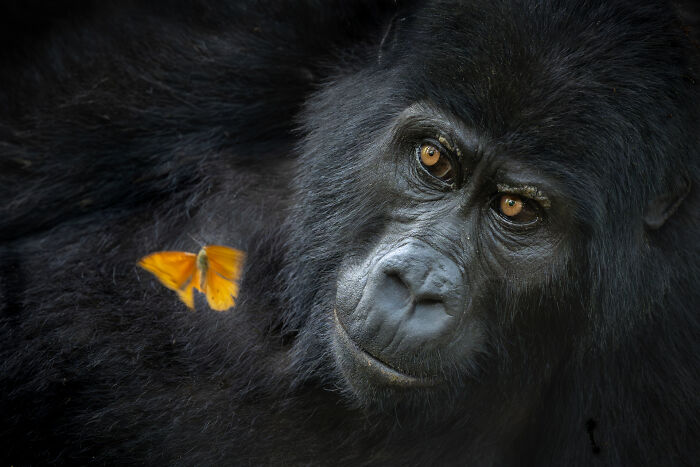
Beneath the lush canopy of Bwindi Impenetrable Forest in Uganda, I observed a young female mountain gorilla from the Binyindo family gently nestled against the protective bulk of a silverback. The atmosphere was serene, filled with the soft sounds of the forest, until a sudden burst of delicate color broke through the calm.
An unexpected visitor, a vibrant butterfly, appeared out of nowhere, fluttering through the air. Captivated, the young gorilla’s eyes widened, and a beautiful interaction began to unfold. I held my breath, waiting for the butterfly to drift closer, knowing the image would only hold its power if the two were captured together. Patiently, I tracked its graceful movements until, at last, it entered the same frame as the gorilla’s face. In that fleeting alignment, where wild strength met fragile beauty, I pressed the shutter. My heart raced quietly as I realized how rare and precious the moment was, an instant that united them in a shared world of curiosity.
As the butterfly circled the gorilla, it seemed to embody the delicate balance and fragile interconnectedness of our natural world. This photograph captures not just the gorilla’s gentle curiosity but also a brief moment where two creatures paused, noticing each other, bound by wonder and discovery.
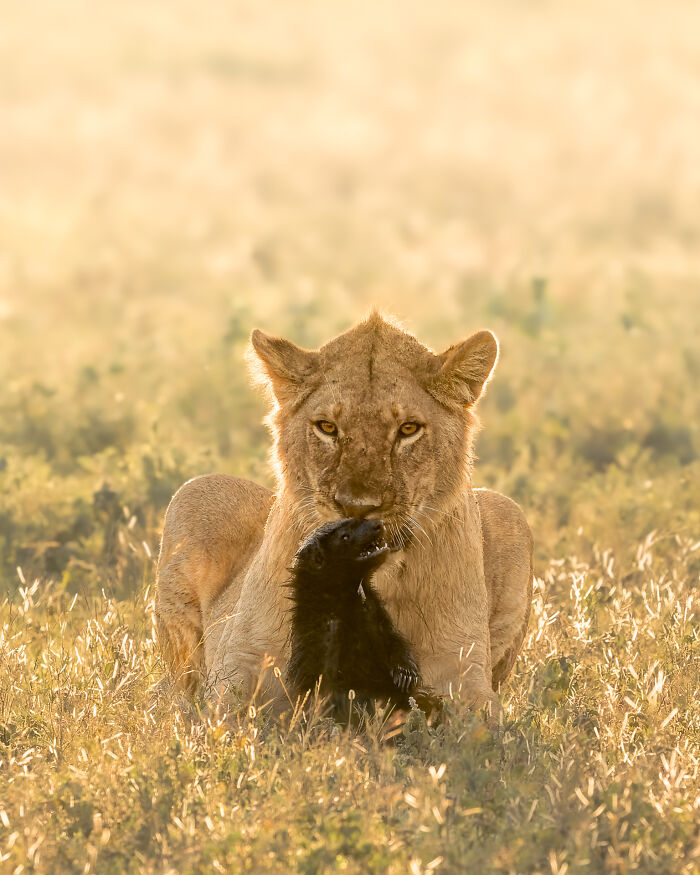
Some of Africa’s most fascinating animals are not its largest, but its smallest warriors. Among them, the honey badger (Mellivora capensis) has earned a reputation for unmatched courage and determination. Despite its modest size, this fearless predator can fend off much larger adversaries, often attacking with surprising aggression and stamina. Protected by exceptionally tough skin and a natural resistance to bites and stings, honey badgers have the tools to survive encounters that would doom most other animals. Yet, as with all creatures, youth and inexperience can tip the scales, making young individuals especially vulnerable to apex predators such as lions.
It was early one morning on the open plains near Lake Ndutu, in the southern Serengeti ecosystem, that I witnessed a dramatic and rare confrontation between these two iconic species. A young lion, full of energy and curiosity, had managed to corner a honey badger. At first glance, the scene appeared almost playful: the lion pawing, circling, and testing its opponent, as if enjoying a game. But for the honey badger, the reality was far from a game. Exhausted, breathing heavily, and with limited options for escape, it summoned all its strength and ferocity in a desperate attempt to resist.
Watching the two locked in this uneven battle was a stark reminder of the harsh realities of the natural world. The honey badger’s legendary reputation for fearlessness was on full display; it snapped, lunged, and refused to submit, even in the face of overwhelming odds. The young lion, however, held the advantage in both size and stamina, gradually wearing its opponent down. This time, the outcome was clear: the lion prevailed, asserting dominance over one of Africa’s most resilient fighters.
Encounters like this highlight the constant struggle for survival on the savanna, where even the fiercest spirit cannot always overcome sheer strength. In the end, the bravery and tenacity of the honey badger serve as a powerful symbol of wild resilience, but they also remind us that courage alone is not always enough to defeat a much stronger adversary.
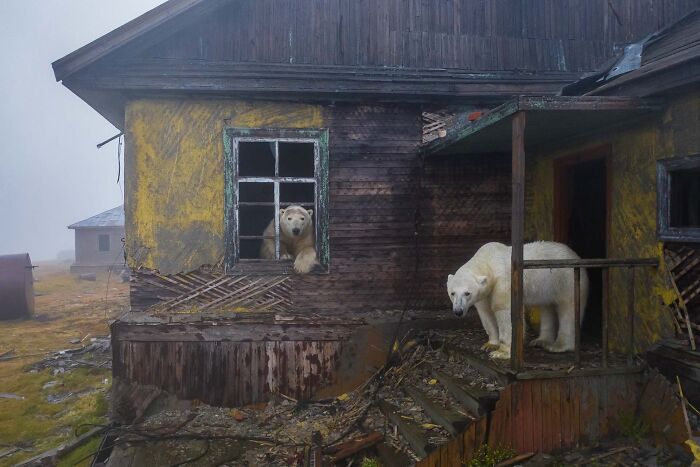
In September ’21 we went on a long-awaited trip to Chukotka and Wrangel Island. We sailed along the coast and covered more than 1200 miles of untouched landscapes, villages lost in time, spots with various fauna, and seas full of life. One day, bad weather was expected, so our captain approached a small island, Kolyuchin, to take shelter from the storm. Kolyuchin is known for the polar weather station that operated on it in Soviet times. Though the station was closed in 1992, the abandoned village still stands on the island. The stormy wind, rain, and neglected buildings on the rocky shores all made everything appear super surreal. Suddenly, we noticed movement in the windows of the houses. Someone took out some binoculars and we saw the heads of polar bears!
The fog, a place long deserted by people, and polar bears was the perfect setting. Bears are very curious by nature so they walked around houses, and checked every door, window, nook, and cranny. There were about 20 animals inside at the same time, mostly males. The females kept to the side with their cubs, closer to the shores of the island. The bears may look calm and sweet in these photos, but one must not forget that they are smart and incredibly powerful animals! As they probably thought the drone was some sort of bird, they did not let it out of their sight. Never one to miss a meal, they were probably ready to strike at any moment, even when seemingly chilling out on the grass!
I shot from a drone equipped with low-noise propellers to not disturb them. I was very careful and very patient, and let the bears slowly get used to the drone so that eventually I was able to get closer and closer. Bears are very curious and were probably intrigued by this ‘”weird-looking bird”, which was amazing for me as they looked right into the camera. I think that these images of the polar bears on Kolyuchin island are very timely, they are like snapshots of a premonition reflecting what could be in our not-so-distant future. The world as we know it is very fragile, and the current state of the world – from political conflicts and nuclear tension to the climate crisis – means that the end could very well be nigh. These things are real, and if they continue as they are, the outcome will be catastrophic.

It's only fair, we're taking their habitat so now they're taking ours.
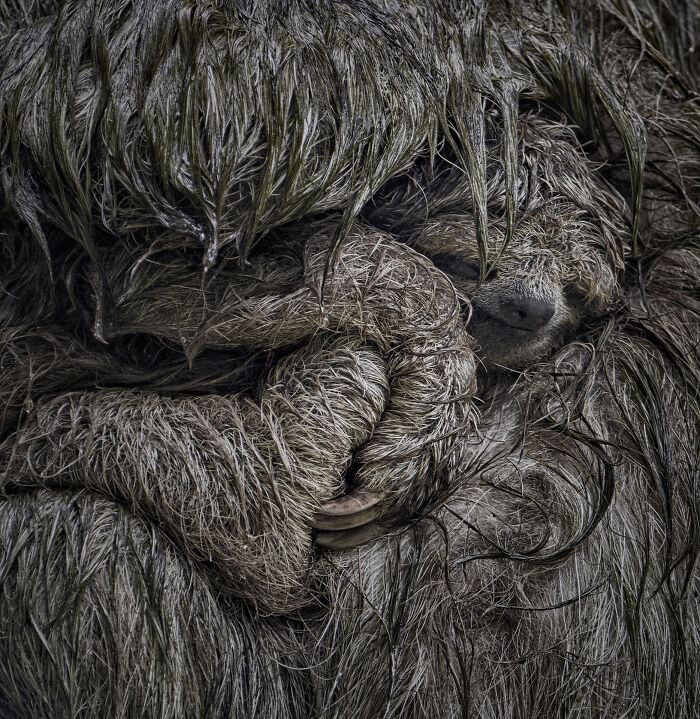
The image was captured at the La Selva Biological Research Station in Costa Rica. It is part of a series of photographs I took of this mother and her offspring, a Three Toed Sloth. I spent a week with the pair as they moved from tree to tree, about one tree per day, capturing thousands of images in different weather and circumstances.
In this moment, a rain shower had just begun, and the mother covered her baby as it slept, cradled safely in her embrace.
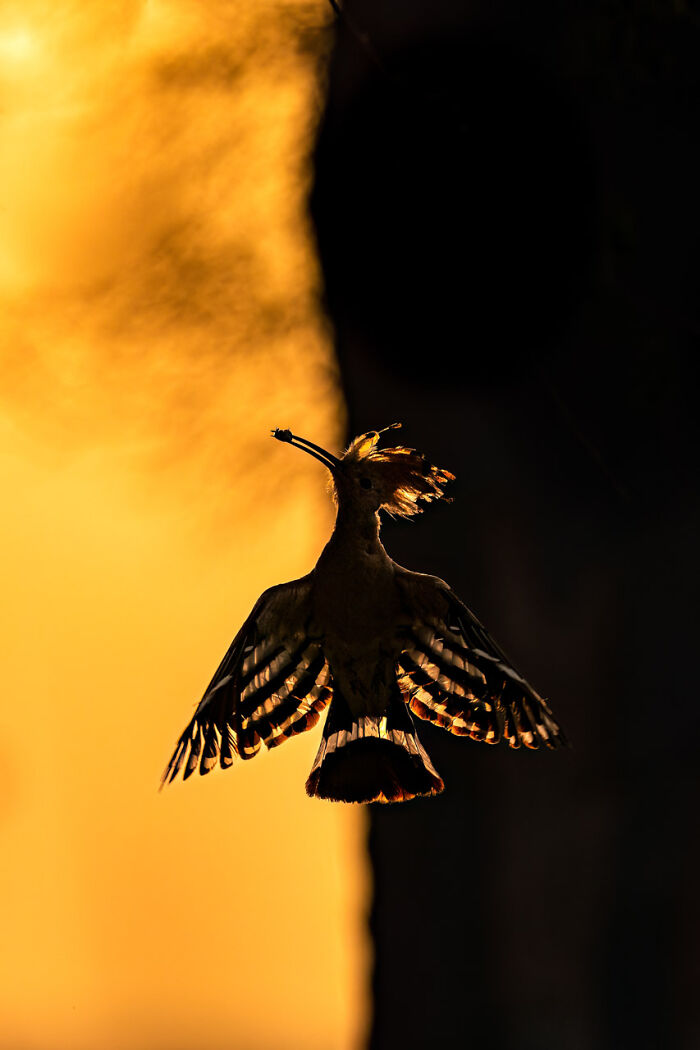
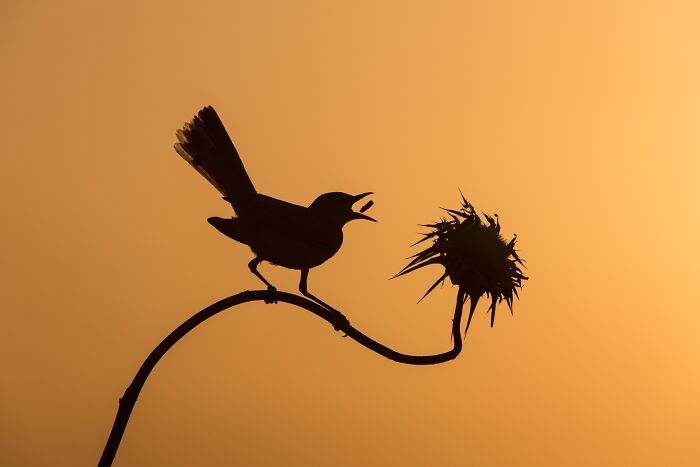
This picture of Hoopoe was taken in Dubai from Al Qudra Lakes. I spend most of my weekends taking pictures of the birds in Al Qudra Lakes. I wanted to test my new Nikon Z8 camera. So, my friend and I traveled to the lake where I noticed a Hoopoe occasionally catching its prey in the air and at other times on the ground. Additionally, I observed that each time it caught a prey, it flew in the same direction to a nearby tree. I spent a few days photographing this bird, and when I got home and looked over the pictures, I got the idea to photograph the bird against a background with light and dark sides to represent the dark and light sides of existence. The following day, I arrived a little earlier at the same location and waited for the ideal shot to occur.
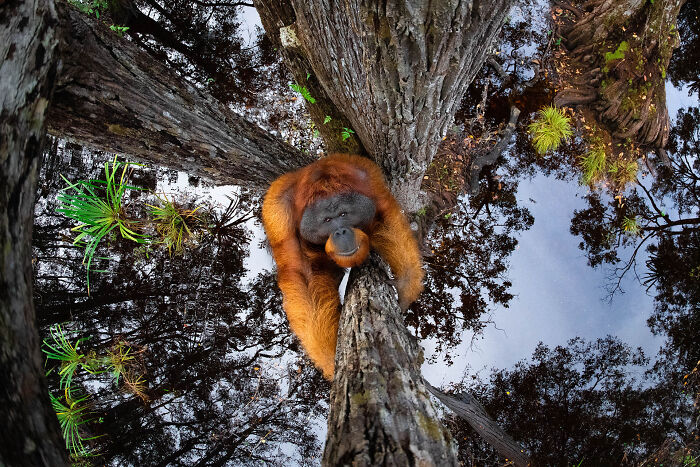
After spending few days in Borneo, I got this frame stuck in my mind. Firstly, to get this shot, I selected a tree that was located in the water so that I could get a good reflection of the sky and its leaves on the tree on the water surface. It created a mirror effect that made the photo look upside down. Then I climbed up on the tree and waited for hours. This is a regular path for the orangutans to cross to a small island on the other side. I was sure to get this frame if I would wait patiently. Hence I waited and waited for a long time and finally, I got this beautiful frame. This frame confuses the viewer at the first glance and that makes the photo unique. It was indeed a tough task but the end result paid it off in double fold.
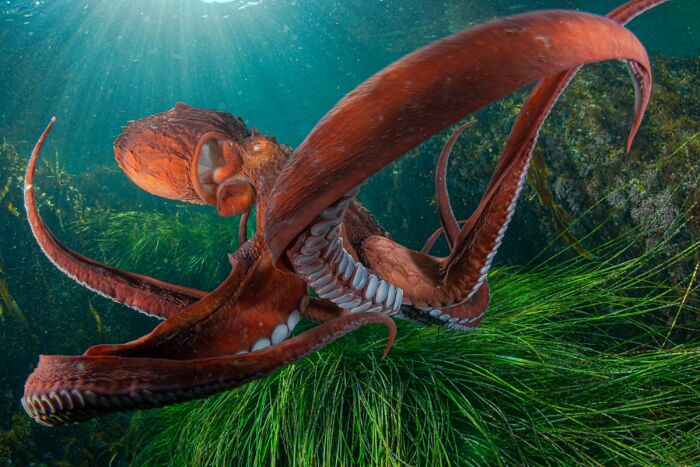
Sea of Japan. Russia. North Primorye. Rudnaya bay.
The Giant Pacific Octopus (Enteroctopus dofleini) stands out strikingly from other octopus species. It is highly intelligent and almost person-like in its behavior. Underwater, I’ve encountered both aggressive octopuses that attempted to defend their territory and sociable ones that even demonstrated their hunting techniques.
Once, at a depth of 20 meters, I encountered an octopus lying calmly on the seabed. It noticed me, seemed to realize that I had seen it as well, and began to swim toward the surface. Naturally, I didn’t follow it.
In this instance, the reef wasn’t particularly deep, and the octopus wasn’t especially large, about 1.5 meters in arm span and weighing around 5-7 kg. During the day, they often attach themselves to the reef wall, blending in by mimicking its color, and they rest while occasionally snacking on leftovers from their nighttime hunts. On this occasion, upon noticing me, the octopus decided to flee, swimming away while I managed to capture a few photos.
I had originally hoped to return to South Africa in 2023 for another safari, but that didn’t pan out. However, a friend invited me to join her family in the Seychelles for a couple of weeks. Having never been before, I wasn’t quite sure what to expect in terms of wildlife photography. I reached out to the ICS (Island Conservation Society) team on the island and mentioned that I would be on Desroches Island for a couple of weeks. I offered to provide any photography services and get involved with any conservation projects while I was there. After working with the Giant Aldabra Tortoises, I was invited to join an early morning beach patrol to monitor bird species and track where turtles had come from the sea overnight to lay their eggs on the beach.
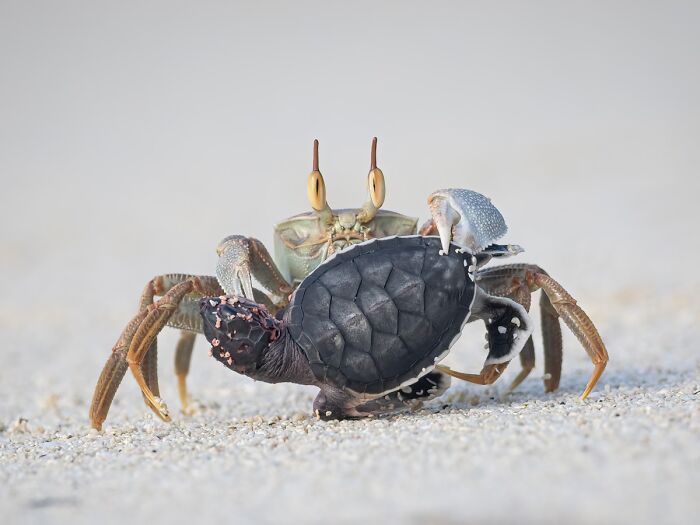
I had hoped to witness and photograph turtle hatchlings making their way to the sea as the sun rose. The hatchlings instinctively wait until the sand cools, indicating nighttime, when there’s less risk of predation. As the sun rises, they use its light to guide them to the sea and as far away from shore as possible, where predation is highest. Unfortunately, only around 1 in 1000 hatchlings survive to adulthood. Once they leave the nest, predators such as birds, ghost crabs, and fish pose a significant threat.
Ghost crabs are abundant on the beach, scavenging anything from fallen fruit and plants to decaying animals—and unfortunately, live turtle hatchlings. As I walked along the beach, I spotted several horned ghost crabs. One of them had something in its claws, and I realized it had caught one of the stragglers on its first journey to the sea. I immediately lay flat on the sand and switched my lens to a 300mm (600mm equivalent) prime. The crab was scuttling along the beach, dropping its prize and picking it up again. I waited patiently until it turned to face me, capturing the shot. Though it’s difficult to identify the species of the turtle, it was likely a critically endangered Hawksbill, which can be found around this remote island.
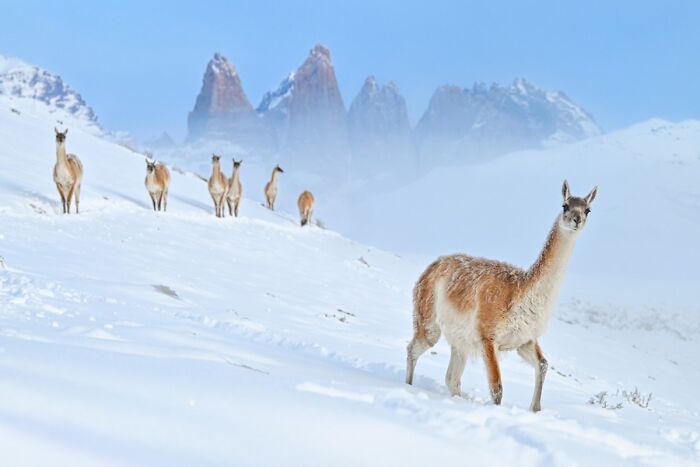
It was -20C, so cold that we were engulfed in dense frozen fog. We were driving to find a puma to photograph in a private ranch near Torres del Paine National Park in Chile. I asked our guide to stop at a beautiful vista of the famous Towers (Torres). We got out and I set up to photograph the dramatic spires nestled in frozen fog. When I was just about to take my landscape photo, a guanaco (Lama guanicoe) appeared over the crest of the hill, intruding on my pristine setting.
I waited for a few minutes to see if the animal might leave, but soon another one appeared, and then several more. Making a virtue of necessity, I thought about how the guanacos could complement the landscape. Zooming out to include the foreground, I took a series of pictures as the guanacos approached.
I had owned several llamas (the domesticated descendants of guanacos), so I was familiar with their behavior. I could tell that the animals were not stressed as we stayed still on the road. Indeed, the lead animal showed all the signs of being curious, just like llamas. As it approached, I waited for the moment that it balanced the rest of the scene and took this picture.
As often happens with wildlife photography, the moment was a mixture of preparation and luck (good and bad). The bad luck was that the previous day, I had dropped my main camera and fancy telephoto lens on the road, rendering both of them useless. I was prepared for such an event, with a backup camera body and a mid-range (70-200mm) lens. Unable to take closeup portraits or even detailed behavior images, I started to imagine compositions where the animal was a small part of a wider landscape. Having practiced this enforced perspective for a day, I was better prepared to react to the good luck of guanacos ‘spoiling’ my landscape photo.
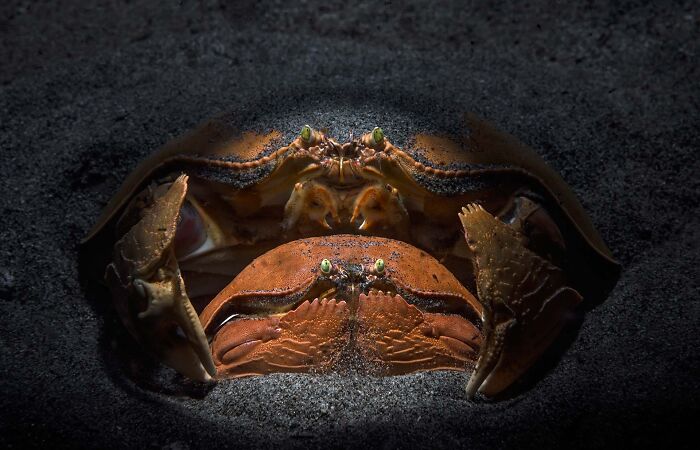
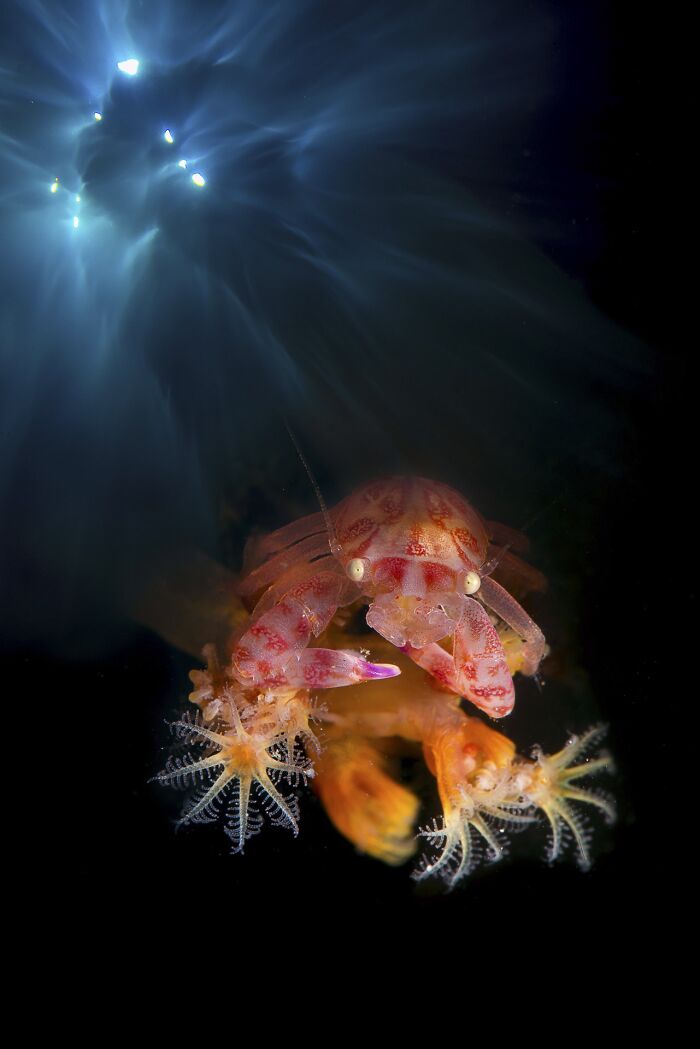
The photo was taken during a night dive almost near my house – this place is called Malatapay (Negros Island, Philippines). I was on my way back when I spotted a pair of Shy Crabs during mating season. The depth is only 3 meters but the tank was almost empty and I had to save air. A pair of crabs formed an almost perfect circle with their bodies and my idea was to use optical snoot to highlight them without getting light on the bright sand, which in turn is backlit from behind. The crabs were not very willing to pose and were moving fast, but I still managed to capture the shot just as they started to burrow into the sand. I often shoot these funny crabs because their body shape and face are very expressive. That day I took my best shot.
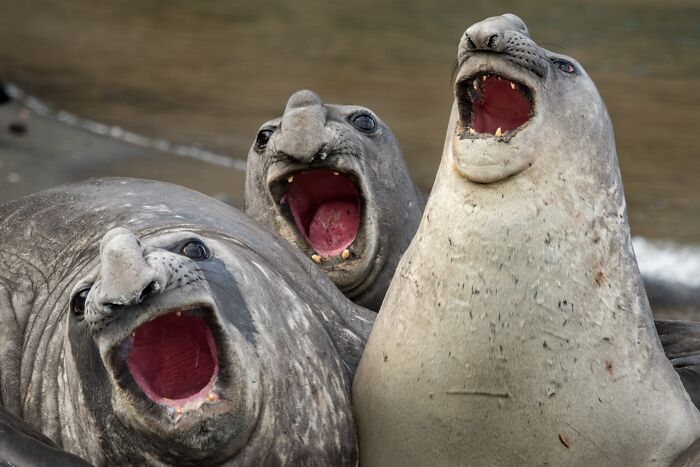
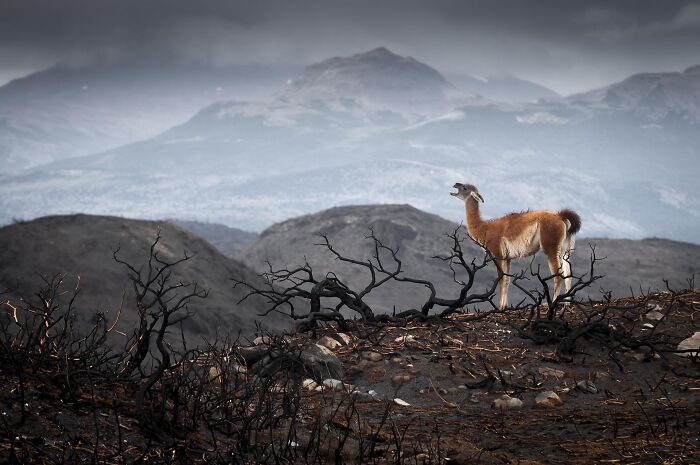
I made this picture on early morning in Torres del Paine National Park in Chile (chilean Patagonia, Magallanes and Chilean Antarctica region). The Scream of Pain is a testament of how human carelessness can destroy an environment, even a protected one. In 2011 due to the negligence of a tourist, a fire started and 17,600 hectares were burned.
As a freelance photographer, I traveled to Chilean Patagonia to do some reports on the fire, I toured the Park, shocked seeing the devastation. I was surrounded by the silence between ashes and the remains of some dead animals. On a slope I felt the cries of a guanaco (Lama guanicoe, characteristic animal of the area). Withy my camera in my hand I hurried to discover what was happening and there it was; a guanaco shouting to the horizon in search of his family or herd, a cry that never got answered.
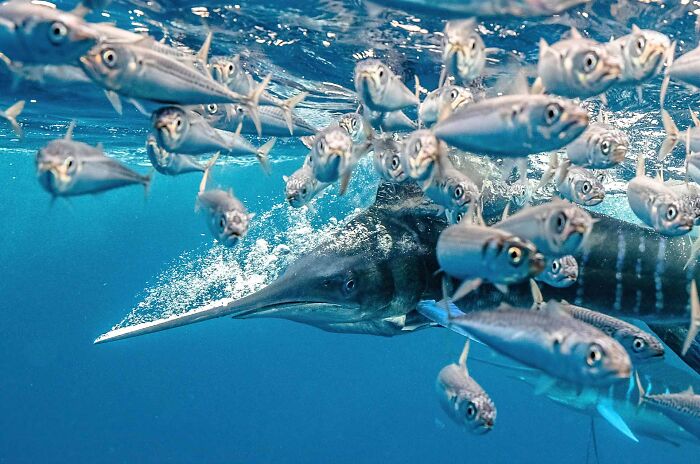
A terrifying scene for the small fish, fleeing for their lives as a striped marlin hunts them. Here, the slightest mistake means life or death as the marlin’s bill slices through the water during a high speed hunt. These fish have very little respite, as birds try to hunt from above and more than a dozen other marlin and sea lions all attacking the same small ball of fish. Marlin are one of the fastest fish in the world, a terrifying predator for a small fish in the great blue desert.
I took this photo in the Pacific Ocean off the coast of Baja, California, Mexico. A friend of mine had told me about the marlin aggregation where Marlin and Sea lions hunt together, bringing small fish up from the depths and corralling them into a ball near the surface. The marlin can turn their stripes on and off, which might be used to communicate when hunting. These bait fish stand very little chance of survival as more marlin and sea lions join the feast picking them off one by one. Watching animals hunt is one of the greatest spectacles in nature, as the line between life and death comes down to millimeters and fractions of seconds.
I spent 3 days to document these hunts and capture the visceral realities of life in the ocean. During my time in the water I watched many little mackerels and sardines being hunted, and even speared by the marlin’s bill. From afar, this struggle can look serene and peaceful as the baitfish move like a river, so I wanted to show the intensity up close, and to try and capture the relationship between the predator and the prey. This meant I had to get a little closer without getting in the way, and be ready if the opportunity came about. When I was close I could really feel the panic of these little fish, desperate to survive. If I got too close for too long, the fish would seek protection from me. To avoid this and not disturb the natural behavior, there were a a couple times that I had to dive down and away from the bait ball. Typically, there was no hope for these little fish, and every last one of them would be hunted. When it was all done, all that would be left were shiny scales as the Marlin and Sea lions disappeared back into the blue.
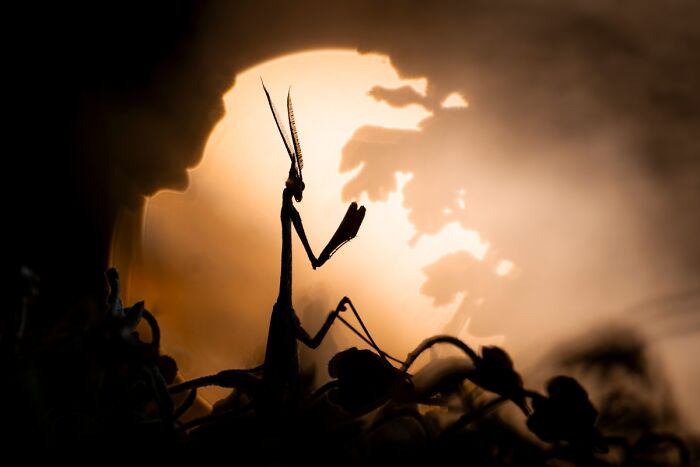
Less than 5 kilometers from my home in Toulouse, France, I am fortunate to encounter one of the most fascinating insects in our local fauna: the Empusa pennata. Throughout the year, I observe it in its larval form, watching its slow and discreet movements among the grass and branches. The camouflage it uses to blend with its surroundings is remarkable, making each sighting feel like a small triumph. Its stick-like body and subtle, calculated motions allow it to stay hidden from predators and human eyes alike, making it a challenge to spot, but a rewarding experience when found.
But when May arrives, an even more extraordinary spectacle takes place: the emergence of adult empuses. My attention turns to the males, unmistakable with their feather-like antennae. These antennae are more than just an adornment; they are highly specialized sensors, capable of detecting female pheromones in the air, essential for the species’ reproduction and survival. The beauty of their interaction, largely unseen by most, is captivating. As I document these insects, I am struck by how their delicate existence goes unnoticed in our rapidly changing environment.
For this image, I positioned myself where the sun was just rising on the horizon, casting a golden glow across the landscape. I used the soft morning light to emphasize the silhouette of the Empusa pennata, capturing a shadow that feels both majestic and slightly eerie. Its slender, elongated body is sharply outlined against the backdrop, evoking a sense of both fragility and strength, a reminder of the uniqueness of this species. No special techniques were used; this is a single exposure.
Empuses, though present even in urban settings, prefer untamed wastelands. Sadly, these spaces are increasingly disappearing due to urban sprawl. Through my photography, I hope to raise awareness of the need to protect these vital habitats.
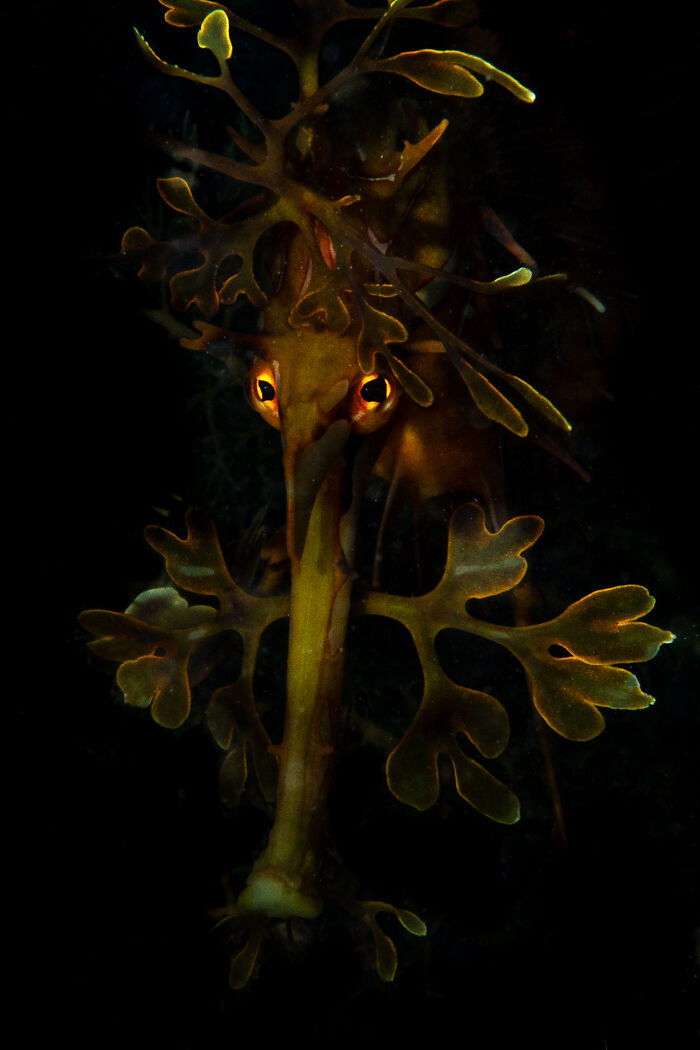
In a Covid year it has been difficult for many nature photographers to get out in the environment and continue their work. Australia is an amazing place and I think Covid has taught me that I live in one of the most incredible natural places in the world. As a nature photographer, Australia’s coast, deserts, reefs, and rainforests hold a plethora of subject matter to photograph and discover, not to mention the diversity of wildlife above and below the surface. I am passionate about the ocean and its inhabitants, and a lot of my work is centred around conservation and protection of various marine species. But I am a little obsessed with seadragons. With this image of the endemic leafy seadragon, I wanted to create something that really captured the essence of these delicate vulnerable species which are found only in the southern parts of Australia. The more we understand the ocean and its inhabitants the more people will feel connected and take action to protect our ocean creatures.
It was just after Covid was announced in March 2020, our year long journey around Australia was interrupted and my wife and I were forced into lockdown for 6 weeks in a small campground on the Fleurieu peninsula in South Australia. Because we had no fixed address, we were considered refugees and the campground owner allowed us to stay in the campground, which had only one other family for the duration of the lockdown. This ended up being a blessing in disguise, we could still exercise, and diving was allowed. I had the opportunity to dive regularly, becoming familiar with the terrain, and getting to know the dive site, I explored more and more each dive and managed to spot a few individual seadragons that I could easily identify. After several encounters with one specific seadragon, it appeared to be unperturbed by my presence. I was able to compose a shot that tightly captured its eyes, features and appendages. In the end I took only one frame when the seadragon turned towards me for just a moment. All the elements aligned and it culminated in the portrait of this beautiful creature.
This photo was taken at dusk and shot with strobes to light the subject, as the afternoon light turning into night. The image was shot with a wide fisheye lens with close focus.
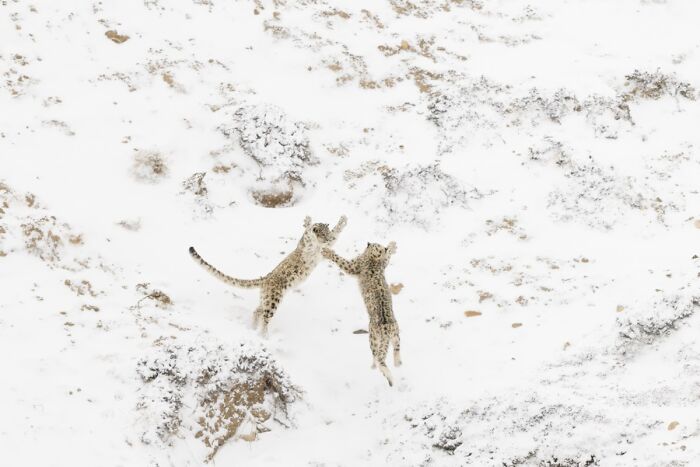
In northern India lies Spiti Valley, a land of rugged beauty and home to one of the most elusive creatures on Earth: the snow leopard. For me, this journey has been a lifelong dream, as the snow leopard has always been my favorite wild animal.
This year, my dream came to life during an unforgettable encounter with a pair of sub-adult snow leopard siblings. I had the privilege of observing and photographing them at various moments in their lives, capturing their grace and playfulness through my lens.
The pinnacle of this extraordinary adventure came on the first of February. Achieving the image I had envisioned was no easy feat. I waited for over six hours at the edge of a canyon, braving temperatures plummeting to -25°C and a relentless snowstorm that chilled me to the bone. The two siblings had been resting in a cave, and I could only hope they would eventually emerge.
When the storm subsided and calm returned, they began to stir. What unfolded next was beyond my wildest imagination. They climbed upward, chasing each other along snowy slopes, playing with a joy and vitality that left me awestruck. I remember whispering to myself repeatedly, “This can’t be real, it’s too incredible to be true!”
And then came the moment. A frame so perfect, so alive, that even in my wildest dreams, I couldn’t have imagined capturing it. This image, and the experience behind it, will forever remain etched in my memory as one of the most magical days of my life.
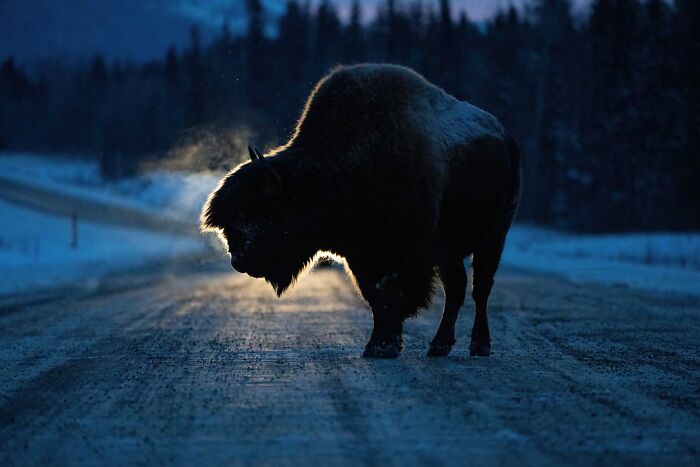
Every year a small herd of the threatened wood Bison in northern British Columbia suffer from road collision. When winter arrives, sometimes the snow is so deep the Wood Bison herds that inhabit the forest along the Alaska Highway tend to use the free-of-snow highway to move from one grazing area to another. Their journey is difficult, and many bison will succumb to the traffic. Records show that annually about 15 percent of the population in the region dies as a result of these collisions. Throughout my journeys into northern Canada, I encountered numerous distressing roadkill incidents as I ventured along this same highway. The devastating fate suffered by these magnificent creatures deeply saddened me and sparked a profound reflection, prompting me to return to this region with a renewed purpose – to intimately document the impact of this highway on this wood bison population. To capture the incredible story of the bison while ensuring their welfare and my safety, I implemented a variety of techniques. Remote triggering allowed me to photograph the bison from a safe distance without disturbing their behavior. In addition, motion sensor-triggered cameras were placed in key locations. I also utilized a drone for aerial perspectives.
Spanning more than 8,000km, the Andean Mountain range occupies more than a quarter of the land surface in Ecuador. Rich in biodiversity, it’s also home to a unique species called the Spectacled bear. Until planning this trip, I knew nothing of them. But as a certified bear guide, I was excited to expand my knowledge and understanding of a new species and to compare behavior and their interactions to those of our grizzly, polar, black, and brown bears.
As we drove from Quito to the Andean mountains, through villages and farming communities, the extraordinary conditions and fertility of this land were inescapable. Hours of winding roads and stunning landscapes later, we pulled into a small community where we were greeted by a local farmer/guide. A gentle-natured man who’s worked tirelessly for decades to observe, learn, and advocate for this endangered species. His family’s hospitality reaching far beyond opening his home, opened a door to a whole new world.
For 11 days at roughly 8,000 feet above sea level, we hiked vertical paths up and down the canyon walls, trekking through creeks, ducking out of torrential downpours, and often clambering through mud to observe these beautiful bears. In their natural habitat and with our guide’s intimate knowledge of each bear, we were quickly accepted by them. We kept a respectful distance to ensure their comfort and it paid off in spades. They would nurse, fall asleep, cuddle, forage, and play, seemingly more oblivious to our presence with each passing encounter.
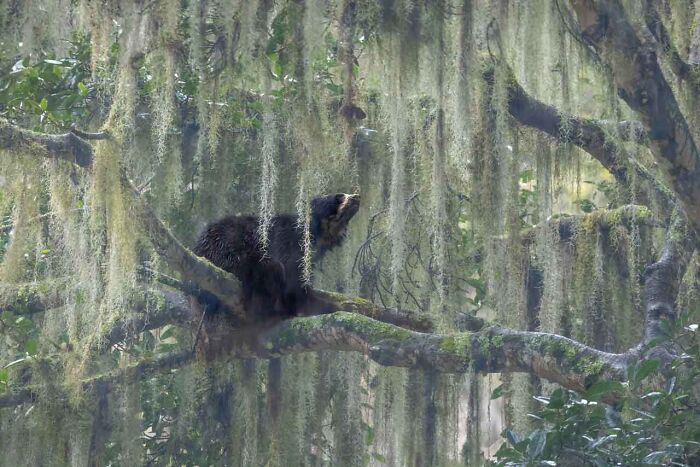
In this image, Tony (a large male spectacled bear), and frequent traveler through these parts had climbed into a century-old fig tree seeking refuge from the midday sun. It was draped in Spanish moss, gently swaying with each breath inhaled and exhaled by the canyon walls. He sauntered effortlessly across a burly branch and sat peacefully against the tree’s trunk. When a gentle rain began to fall across the valley, he stood and turned to look up as though embracing the cool moisture on his speckled face. And for a fleeting moment, the warmth of muted sunlight falls across his face as ‘He Looks to the Heavens’.
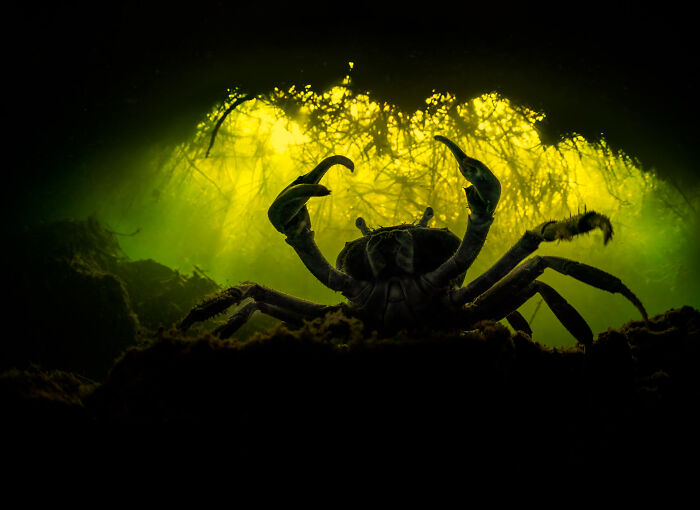
In the last couple of years, I have been fortunate to photograph over 200 different cenotes of the Riviera Maya in Mexico, capturing their surreal environments and the unexpected diversity of its caves. Looking for unique photographic opportunities of light and textures in the transition area between cave and cenote or light and darkness. During a traverse cave dive connecting seven different cenotes, we passed by this strange figure of a blue cave crab standing on a rock while fishing in the cave current, perfectly define against the background. This menacing silhouette looked like a Samurai with shiny blue armor, perfectly centered by the natural vignetting offered by the light fall-off of the cave, standing against the mangrove texture and green light of the sun passing through the tannic acid present on the surface. I got as close as possible to the subject to make him the hero of the scene and balance the elements of a perfect representation of the mangrove ecosystem .
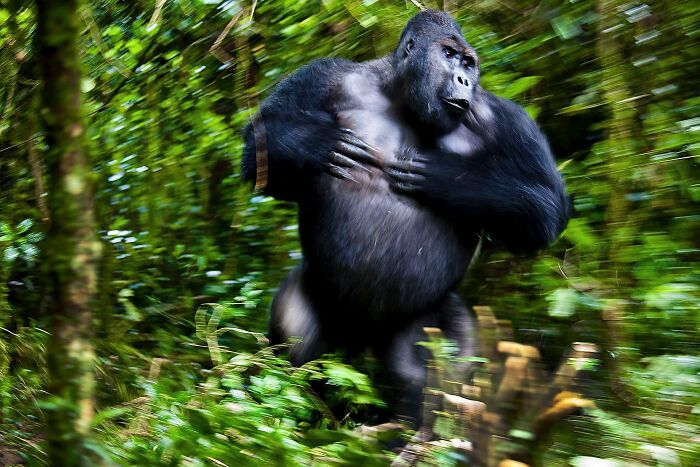
The photo was taken in the Kahuzi-Biega National Park in the DR Kongo, close to Kivu Lake. There are two habituated groups of eastern lowland gorillas in the park. Chimanuka is the silverback of one group with about 20 individuals. He is now about 35 years old and his weight is more than 240 kilos. In October 2007 I visited with a small group The Kahuzi-Biega National Park and the Chimanuka group for my second time.
After about two hours of hard walking in the dense jungle, we arrived together with the National Park Rangers in the later morning. The females were eating in the bushes out of the sight of Chimanuka. Suddenly he came out of the bush about 5 meters in front of me, drumming on his breast and showing his impressive behavior. I was frightened and fell back in a bush. While falling I took the picture, so it is blurred because of the movement. Chimanuka stopped in front of our group and nothing happened. Then he turned off and climbed up a tree for a better view on his females and children.
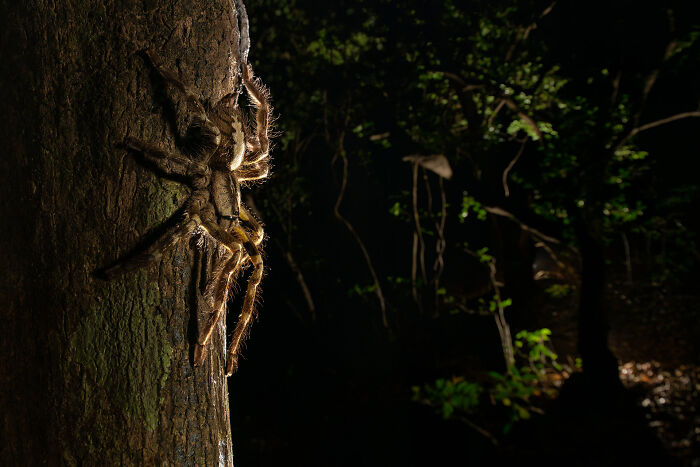
The Indian Ornamental Tarantula (Poecilotheria regalis) is a species of arboreal tarantula and is found in parts of India. The common name for this spider is Indian ornamental tree spider. It is a pretty big Tarantula with a leg span exceeding 7 inches sometimes. Poecilotheria regalis is a popular pet among tarantula enthusiasts. Despite its speed and potent venom, this tarantula is often sought for its distinctive appearance. As with most other tarantulas in captivity.
I was on a night trip with my friends and fellow photographers to a place called Matheran near my home. Due to the Corona pandemic, I was restricted to travel only a few kilometers from home and this place is very near to where I stay. Previously I have observed a good population of this Tarantula here. So I was consciously looking to spot one, which I did in the next couple of hours after I reached there. These huge spiders live on trees at a height of 7-10 feet from the ground in natural burrows. I wanted to showcase the habitat along with this beautiful spider, but the extremely dense coverage made it impossible to light up the background properly. I took this image with the ICDE (In Camera Double Exposure) technique by first taking an image of the Tarantula with 2 flashes and then taking a wide image of its habitat lighting it up with 4 flashes.
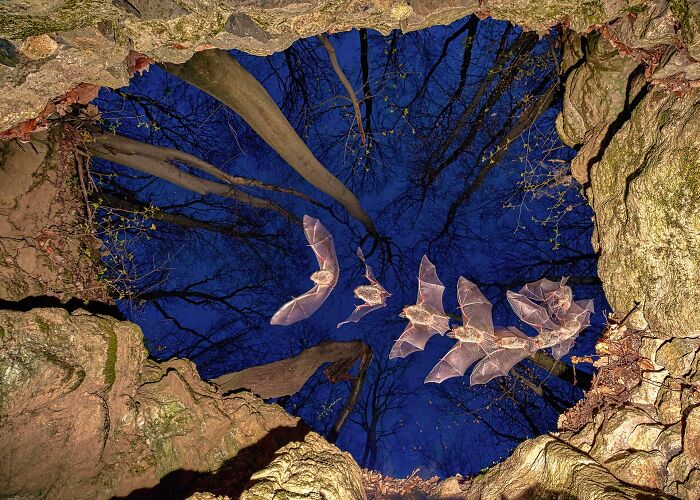
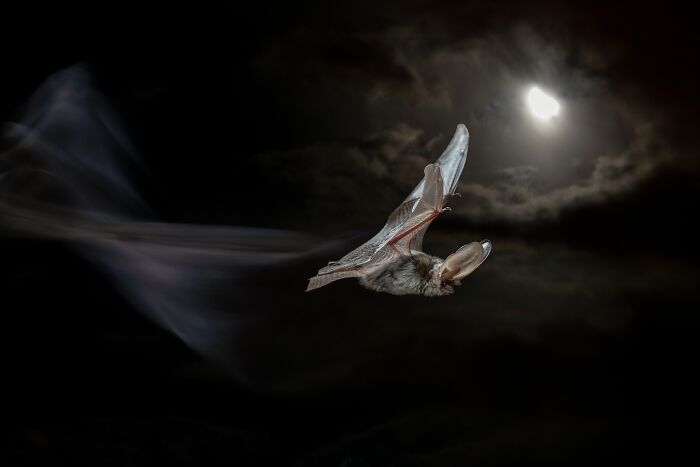
Near my place of living there is a karst mountain range called Mecsek with numerous sinkholes and caves. During one of my trips in the mountains I came across this small dolina. There and then I could see the photo in my mind’s eye.
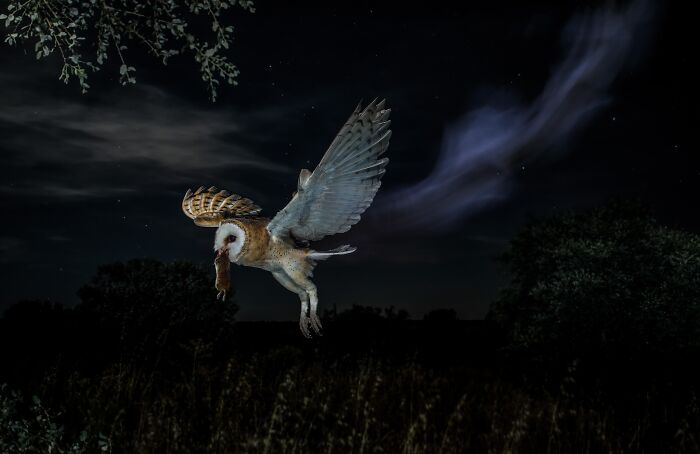
I usually take photos in springtime before trees start leafing out. I assemble and set the equipment before sunset, take up position at the mouth of the cave and upon hearing the sound of bats I know they are about to leave their nest to hunt one by one. It is an incredible experience literally feeling the wind stirred by the flapping of their wings as they fly by me. As the bats begin their hunt, I normally wait for about two hours at the scene because later on their level of activity decreases.
Though I remain invisible to them, they can feel my body temperature when they leave the cave. Some bats are more cautious and return to the cave at first. However, when they realise I do not harm them they also fly out. Since they are an endangered species I only disturb their life cycle for two to three days in spring.
I have observed the individuals of two species so far:
1. lesser horseshoe bat (Rhinolophus hipposideros)
2. greater horseshoe bat (Rhinolophus ferrumequinum)
The photo was taken from the mouth of a karstic mountain sinkhole. Due to the long exposure time I placed the camera on a beanbag. The exposure was controlled via a wifi network by using a cell phone. I used a flash for the light source which was set in strobe mode with manual flash.
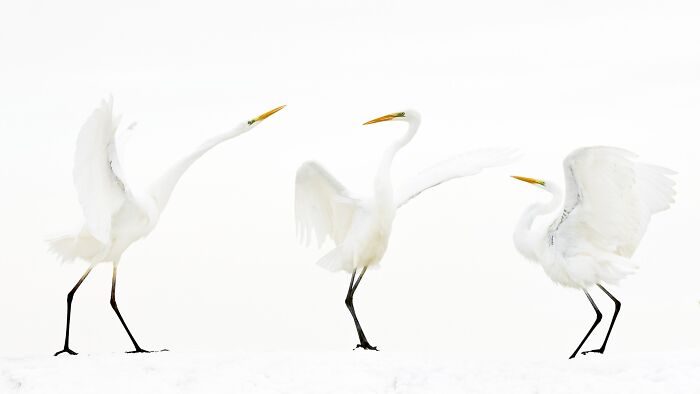
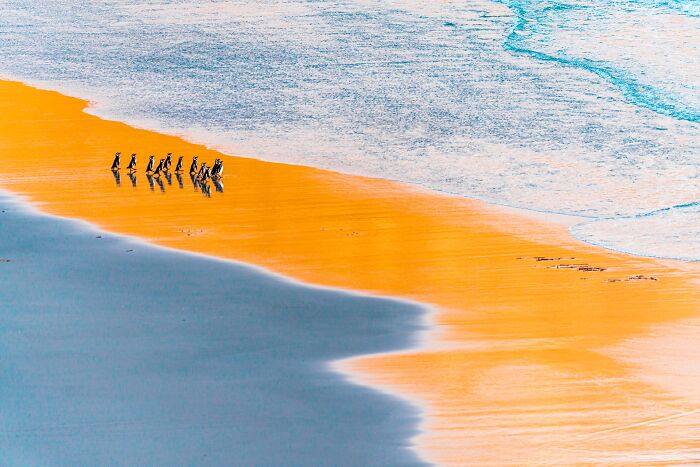
A group of Magellanic penguins (Spheniscus magellanicus) head out to sea in the early morning, just as the sun rises over the horizon. They will spend the whole day fishing and eating in the sea. When they return they will have to feed their hungry young, that will wait for them on the beach.
The image was taken in The Nec – Saunders Islands – Islas Malvinas, where for five days I was isolated with a small group of photographers, only with the company of penguins and oysters, species of birds and mammals.
Since the best light was at sunrise, I stood on a small hill at five in the morning and waited for the penguins to appear in groups as they usually do. The light and the surroundings did the rest.
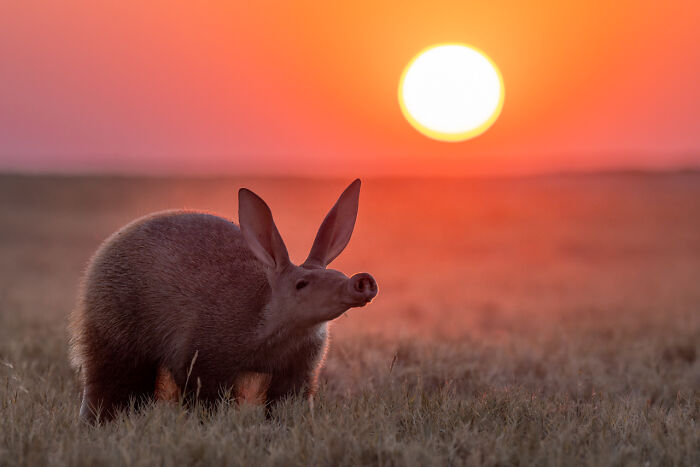
One of the rarer African finds and a lifelong dream for many is seeing an aardvark. These nocturnal creatures are notoriously difficult to spot and even rarer to photograph, as they emerge under the cover of darkness to search for ants, of which they can eat up to 50,000 in one night. Feeding at night allows them to feel safer, as they are harder to spot by predators, against whom their only defence is a quick retreat into their burrow or a battle with their very sharp claws.
Aardvarks, however, are very sensitive to the cold, feeding in bursts and returning to their burrows to both digest and keep warm. On this particular visit to the Makgadikgadi Pans, a sudden cold snap in the central Kalahari meant that night-time temperatures plummeted well below zero, lower than what the aardvark can comfortably handle. This meant its night-time feeding schedule was not long enough to meet its food requirements.
As a result, on this rare occasion, a sunset aardvark existed on Earth. He left the burrow before dark to lengthen the time he had to feed, and you can imagine my joy as I was able to spend time watching this curious-looking creature, digging for termites and using those long ears to listen intently to their underground activity. It was a truly special experience to observe an aardvark out in the open, calmly feeding and completely relaxed in our presence. It was also a once-in-a-lifetime opportunity to showcase this rare species and to see, in such sunlit detail, all that makes up one of Africa’s most remarkable mammals.
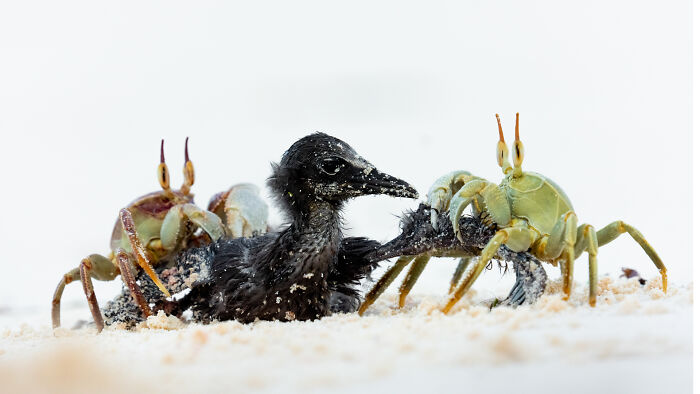
I am grateful for every moment my work allowed me to spend on Bird Island, part of the Seychelles, a tiny island of two kilometres in width made of coral sand. Its wildlife, atmosphere, and overall essence were so vastly different from what I was accustomed to back home that I felt as if I had stepped into a parallel world.
The island is privately owned, and thanks to the dedicated efforts of its caretakers, the last rat, introduced by humans, was eradicated in the 1980s. Combined with controlled vegetation management, this has allowed the island to become home to more than seven hundred thousand pairs of sooty terns today. However, I arrived outside their breeding season and saw only a handful of individuals, though other bird species were still nesting, even in November.
While waiting to photograph white terns, I suddenly heard a distress call. Not far from me, an adult brown noddy was tormenting a helpless chick of its own species for reasons I could not understand. Within moments, the struggling chick, now lying defenseless on the ground, was swarmed by crabs that began devouring it alive. It was heartbreaking to witness, but I chose not to interfere with the natural order.
In no time, nearly ten crabs had surrounded the chick, dragging it into the bushes, one of nature’s rawest moments, a silent scream lost in the vastness of the island.
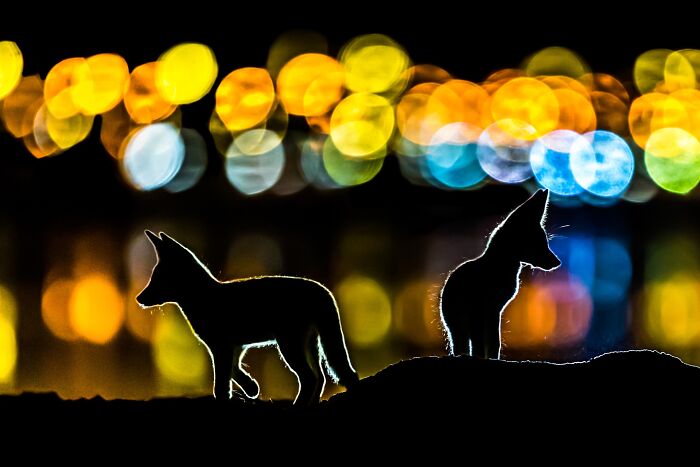
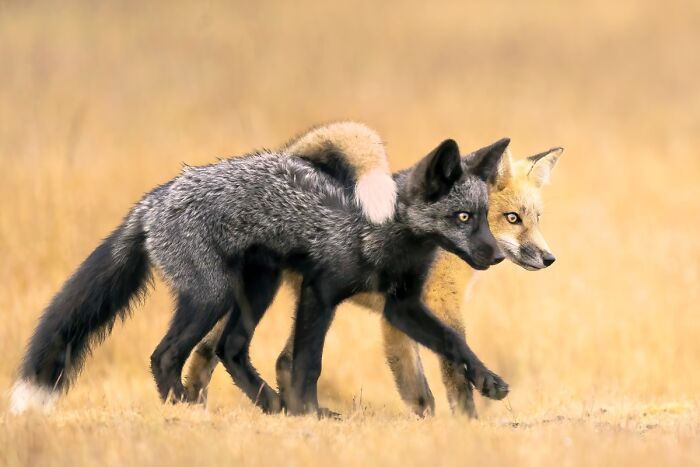
Vulpus Vulpus, Red Fox Kit Siblings
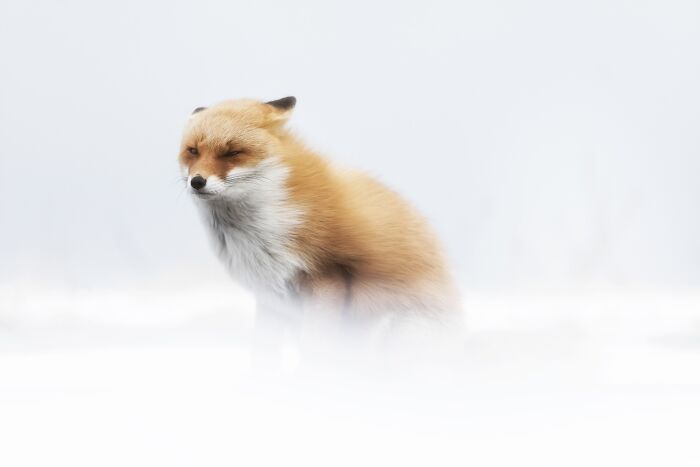
These spring fox siblings were walking together side by side in the evening. It was quiet, just these 2 fox kits and myself. I stayed at a low level. They slowly moved closer to each other. As they were walking, the tawny male kit threw his tail over the back of the female silver-phase kit. He then gently pulled her towards him using his tail. I can only think of this behavior as a show of affection. It lasted for less than a minute. They then slowly separated and continued to walk together.
I have been observing and photographing Red Foxes for 13 years. I enjoy capturing images that show their essence and their different behaviors. My goal is that the images are impactful to those who see them. This particular behavior is one that I have not seen prior or since this day. I have seen them since, on rare occasions, flip their tails over another fox but more as a playful gesture and not what I observed here, it looked to me like an affectionate hug.
Image was taken in NW Washington State.
For eight months, from November 2023 to July 2024, I lived in the heart of the Peruvian Amazon rainforest in Madre de Dios. Volunteering with tourist lodges and conservation NGOs allowed me to immerse myself in this incredible ecosystem, documenting its wildlife and experiencing unforgettable moments. One of those moments came after a grueling nine-hour trek outside the Tambopata National Reserve.
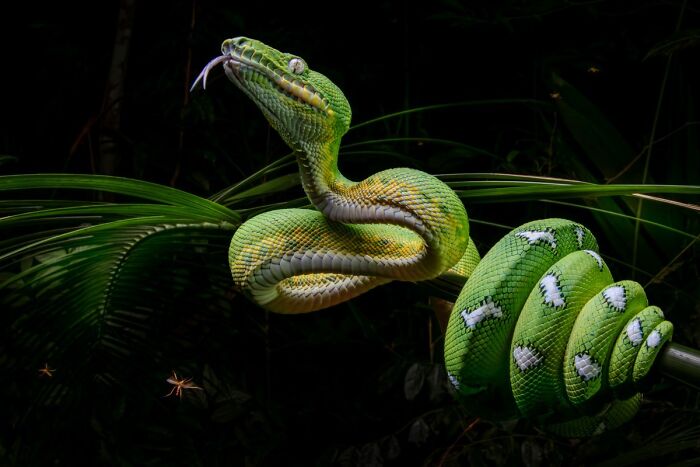
As the day ended, I climbed a canopy tower to witness a breathtaking sunset over the endless expanse of jungle. Once the sun dipped below the horizon, fatigue and dehydration began to set in, and I was eager to return to camp. But as I walked along the trail with my headlamp on, a flash of vivid green about five meters away stopped me in my tracks. The intensity of the color seemed almost unreal. Intrigued, I moved closer, and my heart raced as I realized what I was seeing: an emerald tree boa, the snake of my dreams.
For five months, I had searched for this arboreal jewel during countless night walks. And here it was, just 1.5 meters above the ground, low enough to allow for perfect photography. My exhaustion was replaced by a rush of adrenaline and pure joy. This was my moment.
Despite feeling dizzy and drained after 10 hours of trekking without water, I knew I had to make the most of this opportunity. I pulled out my camera and flash, ready to capture this rare sight. The jungle had other plans, though: mosquitoes descended upon me in relentless swarms. Over 40 minutes, I amassed more than 150 bites across my body, including my face, lips, and ears. The discomfort was extreme, but I hardly cared. I had just found the treasure of the rainforest. In fact, I grew to appreciate the mosquitoes, as they added a sense of authenticity to the image.
Using a 15mm fisheye lens and an off-camera flash, I worked carefully to avoid disturbing the snake. Instead of setting up a tripod, which might have shifted vegetation and startled the boa, I handheld my camera and flash. I clipped a small torch to a nearby plant to aid with focusing in the pitch-black jungle. Then came the waiting game: I wanted to capture the snake in its natural environment, its tongue flicking out, with mosquitoes in flight around it.
Patience paid off. Eventually, I captured the perfect shot, an emerald tree boa with its tongue extended, framed by two mosquitoes in the foreground and two in the background. It was a rollercoaster of a night, but one I’ll never forget.
In post I made a mask and increased the exposure on the mosquitoes to make them more visible. More generally I increased the exposure of the whole photo as my flash didn’t fire at the correct power when I took the photo.
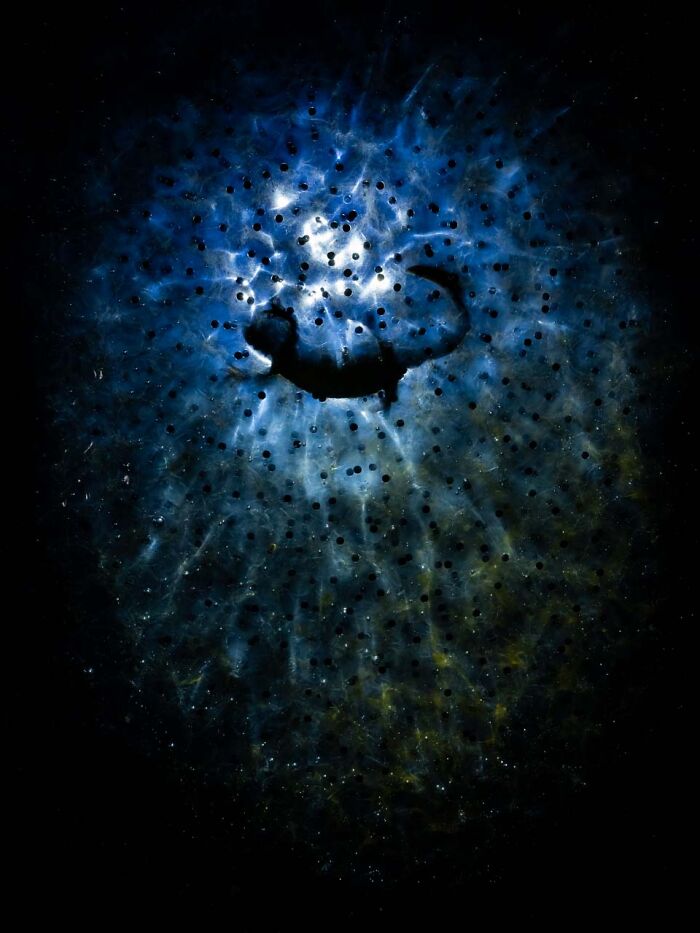
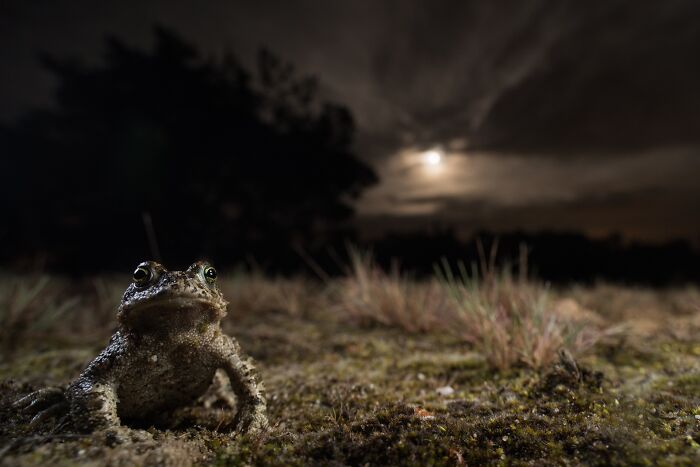
In Germany, where I live, there are many clean and slow-flowing streams nearby, which provide excellent habitat for Alpine newts. For years, I have been observing their lives closely, and this year was no exception. As soon as the frogs lay their eggs, a few days later, at dusk, the newts appear and feast on them throughout the night. Sometimes multiple newts compete for the same prey. I attempted to capture this moment underwater this year. To do this, I placed my camera in an underwater housing, secured it with weights, and positioned it beneath the frog eggs. At first, I was a bit nervous because I wasn’t sure if the underwater housing (Ewa Marine) was completely waterproof. But I thought that if no bubbles appeared, my camera would remain dry. I manually set the focus on the lens beforehand and relied on luck to ensure everything was in the right place. I waited nearby for it to get dark, and when the first newt appeared, I illuminated it with an LED lamp while exposing the shot. I initiated the camera using a homemade wired remote release. I spent four evenings with them this year, trying to capture the best possible shots. Unfortunately, there weren’t more days available because all the frog eggs were consumed, resulting in only 1-2 sharp images.
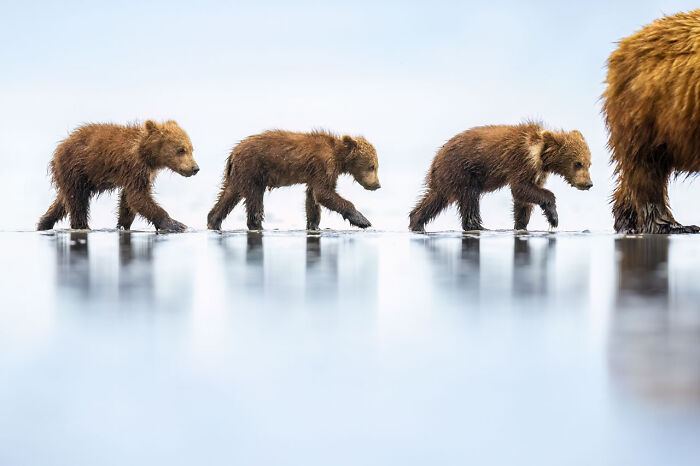
Mother coastal brown bears (Ursus arctos gyas) and cubs are constantly on the lookout for male bears that will kill the cubs to mate with the mother to pass on their own genes. To see a bear cub is special, but to see THREE with one mother is extra special. I had the privilege to encounter these three little ones in Lake Clark National Park and Preserve in Alaska, USA. While with a professional bear guide, I followed them with their mother on the mudflats as they dug for clams, hoping to catch them in a line. For several days, I trudged through the thick, sticky mud in hopes of this shot. On the last day, I saw the cubs start to line up. I dropped to one knee into the mud and hovered my massive lens over the mudflat to blur out the foreground, creating an other-worldly feel. Patience can pay off, and I was thrilled to capture this behavior, especially with all three in step with one another. Back home and ecstatic to have achieved my goal, I, unfortunately, heard that all three cubs didn’t survive the upcoming weeks. Heartbroken to hear this, it reminded me to never take anything for granted and to enjoy nature’s beauty as much as possible in that moment because you never know what happens next.
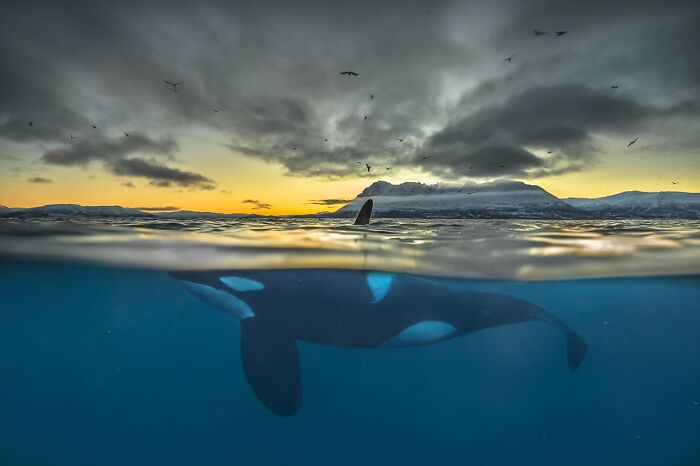
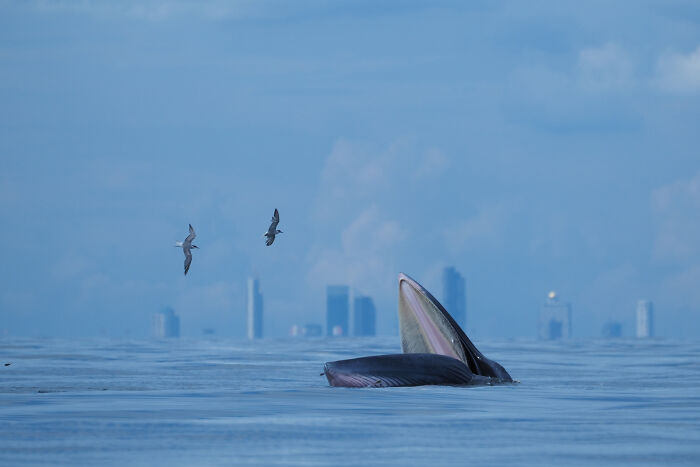
I had been at sea for 10 hours looking for the whales. It was raining and cloudy. Everything was quiet and there were no whales. When I was leaving, the rain stopped, the sea calmed and this Bryde’s whale appeared near my boat. It was a special moment. The sea was calm, the light was perfect and I hardly used any special effects. I was trying to get the camera as close to the sea surface as possible. Bryde’s whales are eating small fish by opening their mouths to let the fish in. And use the baleen to filter the fish. I took this image in the shallow waters of the Gulf of Thailand (Samut Sakhon Province in Thailand). The background is a tall building located in Bangkok, the capital city of my country.
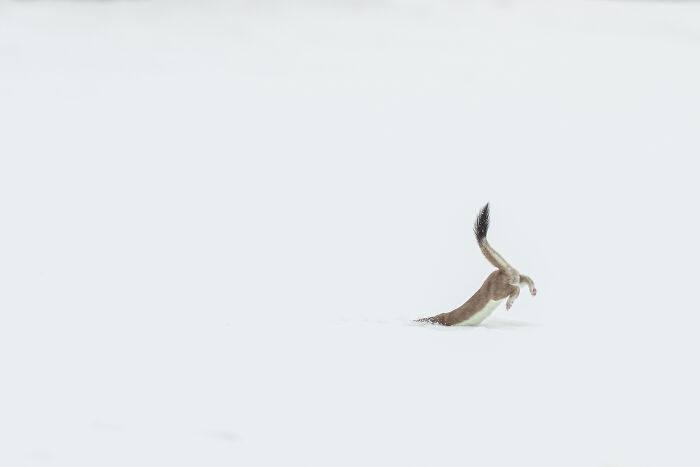
Near the town where I live, La Chaux-de-Fonds, situated in the Swiss part of the Jura mountain range, there are pastures at one-thousand meters high where some ermines, also named stoats, live. Their scientific name is Mustela erminea. Their coat changes from brown to white at the arrival of winter and becomes brown again in spring. One winter I spotted one, there had been a warm spell that had melted the snow, so its white coat contrasted completely with the green grass. After that, I went back several times to its territory, very often without seeing this beautiful animal. A few weeks later, with the arrival of spring, the ermine’s coat had turned brown. But at the end of March, the stoat was surprised by the late snow that covered the fields with white. Thanks again to this contrast, this time reversed, that I spotted the little mammal more easily.
This is also a time of vulnerability for them and they become more cautious as well. I was able to observe it from a distance before approaching it with velvet steps once it had dived into one of its prey’s galleries. I lay down in the snow, behind a small pile to remain hidden, my lens placed on a small sandbag. I then waited, staying still, for about an hour until the stoat came out and started running, diving, and jumping around again. This is how ermines hunt, non-stop for several minutes. So I stood there and photographed it in all sorts of extraordinary positions. After a good hour of activity, the stoat returned to his holes under the snow. I took the opportunity to leave.
A few days later, the snow had disappeared and the brown ermines became more difficult to observe. During this photographic experience, I was able to observe a small predator that when hunting pays little attention to anything other than its prey and potential dangers. This is why I was able to photograph it without frightening it, but I kept a certain distance so as not to disturb it in its search for food. Since then, every year I return to these fields to observe and try to photograph the ermines around my town.
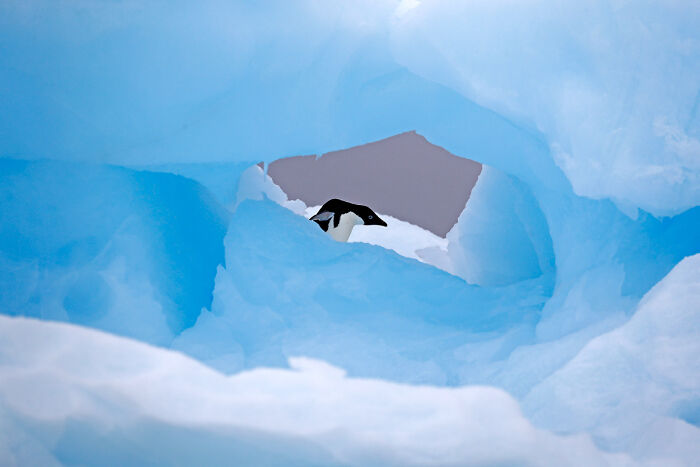
I took this photo of the Adelie penguin portrait in the Antarctica Peninsula in January 2020. It was summertime in Antarctica and all the penguin adults are busy eating krill in the sea and returning back to feed their chicks on land. This Adelie penguin was resting on one big blue iceberg while we were approaching it on a zodiac. The penguin was hiding behind and looked very curious about us tourists on a zodiac, but it did not escape. I had two lenses at that time, 500mm and 100-400mm, and I chose a 100-400mm lens to include more iceberg background and took this photo at 241mm. The blue iceberg looked like a huge fortress for the penguin and this “Host” looked at us through a big hole as a “window”.
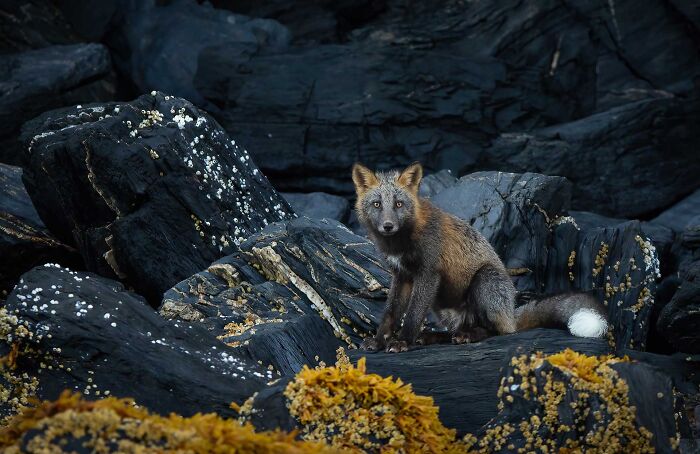
I captured this image of a cross fox handheld from a rocking boat in a remote area on Kodiak Island, Alaska. Red foxes are native to Kodiak Island and the Kodiak red fox belongs to a separate subspecies, Vulpes vulpes harrimani. There are three common color variations of them: red, silver/black, and cross, the latter with a black/brown cross on the back and shoulders. In the mornings, we went out on the boat towards the ocean to look for whales and some animals on the shore. We photographed bald eagles, black-tailed deer, and red foxes along the way. All of a sudden, we spotted a cross fox on some huge, beautiful black rock formations further away from the beach. We approached the fox slowly so that we don’t disturb him or scare him away. Luckily, he stayed on the seaweed covered rocks and I could take some shots while he was sitting in a great spot and he even looked straight into my camera for a brief moment. Looking at the scene with this beautiful cross fox in the perfect landscape made me feel like I was looking at a painting. In Alaska, foxes prefer to eat voles but they also hunt for squirrels, rabbits, or other small mammals. This cross fox was down at the beach digging for worms, fish, or sea urchins during the low tide which is normal behavior for the Kodiak foxes, especially in the morning or evening.
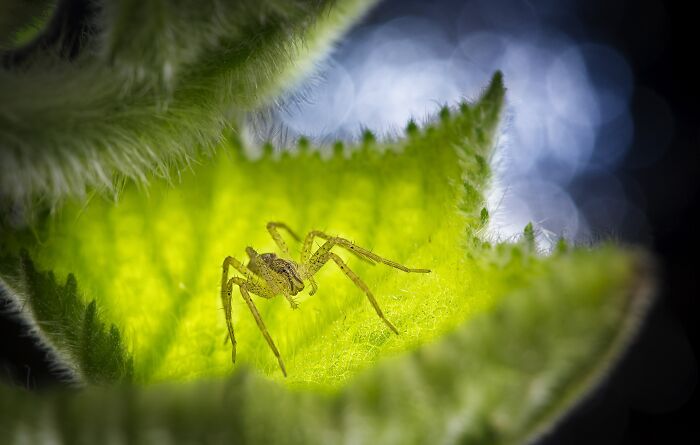
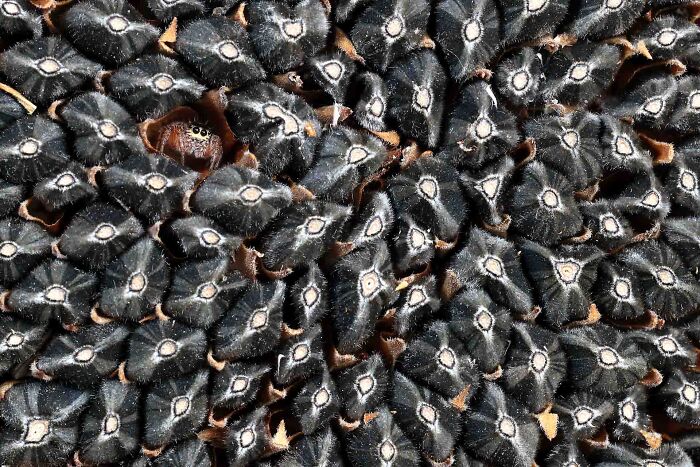
The photograph was taken in a field of sunflowers in Guadalajara, Spain, very close to my house. The objective of those days was to photograph birds feeding and bathing among the sunflowers. This little jumping spider was found, day after day, on the same sunflower. She watched me a bit strangely while I worked with the birds. When the ripe sunflower, some seeds fell. The spider took refuge in the hole, using it as a hunting ground, and that’s when this photo was revealed in front of me. This shows a natural simile. Regarding the confinement that we all suffered and that kept us in our homes, with the only connection to the outside through a tiny window.
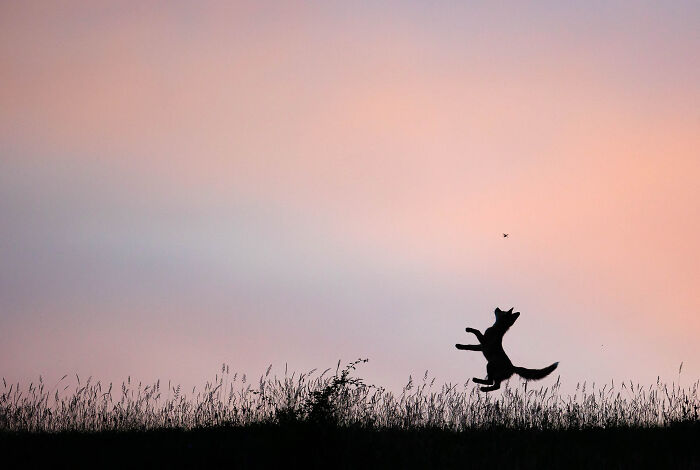
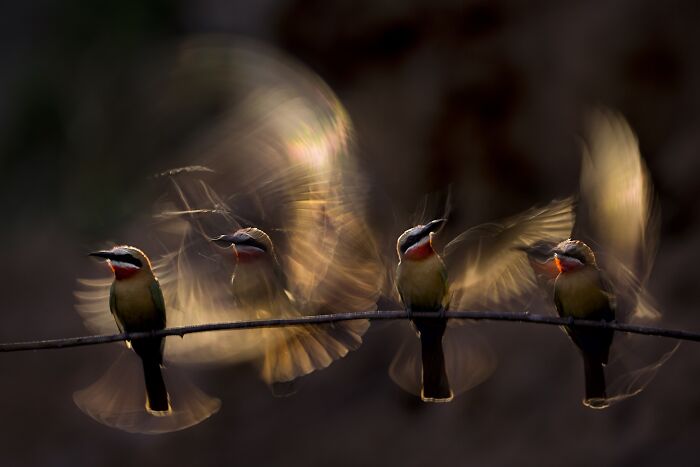
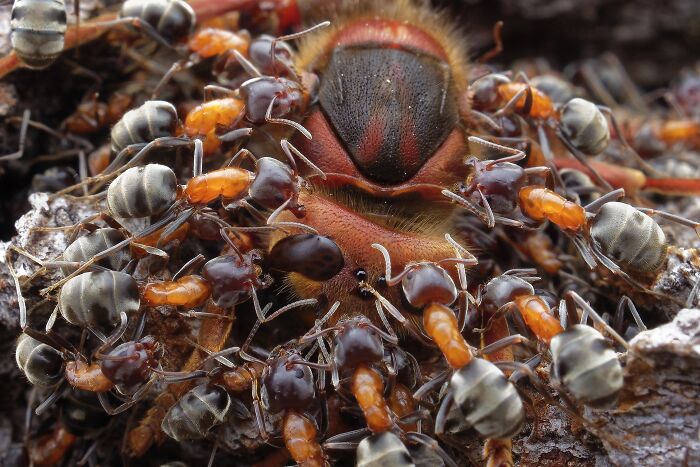
I’m working as a farmer, and luckily nature is my office. In the afternoons, after finishing my work, I spent a lot of time nearby Cernat village, taking pictures of bee-eaters and foxes. In my imagination, I have already taken several pictures, mostly of bee-eaters, as my main goal was to capture the life of our colorful little birds. Unfortunately, I didn’t manage to capture anything for a long time, but finally, my patience paid off. I set up my hide on a field next to the loess wall (where the bee-eater’s nest was), and I also managed to have a good view of the red fox family’s life. I could say it was a coincidence, but I don’t believe in coincidences. That’s the reason why the autofocus of the camera was on the fox, my finger on the shutter button, and my eye on the camera viewfinder before the jump. The scab beetle migration is a natural phenomenon that can be seen every four years in our country. I managed to catch a moment I have never seen before. The little fox showed me interesting and special behavior. That was an amazing day.
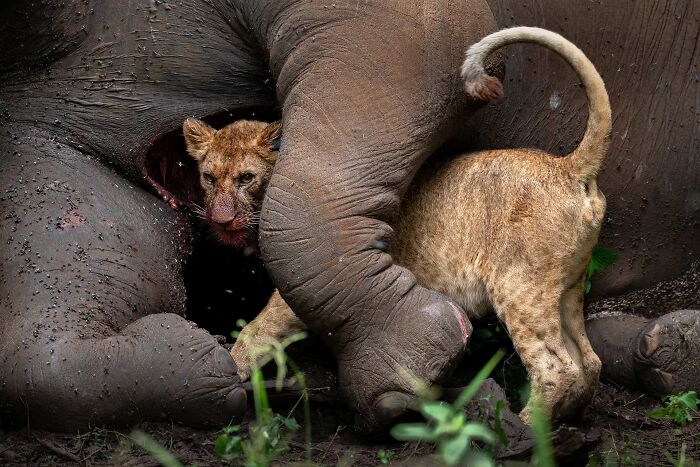
A female African elephant has died of natural causes, mainly old age. A pride of lions have found her and enjoyed the big feast. Suddenly, a young lioness, only 7 months old, came to the elephant and started working her way around her, moving between the elephant’s front legs, in a way that resembles a hug.
One of the things I like about the image, besides the composition and lighting, is the viewer’s experience with the image, which is a bipolar one. I like to watch people’s reaction to this, when they first respond with “awww, they are hugging” and after a few seconds they realize that something else is going on. This kind of engagement creates an interesting relationship with the frame.
This image was taken in Tarangire National Park, Tanzania.
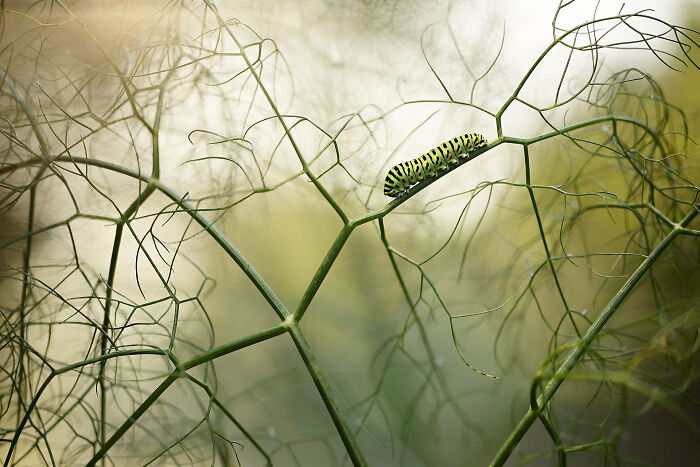
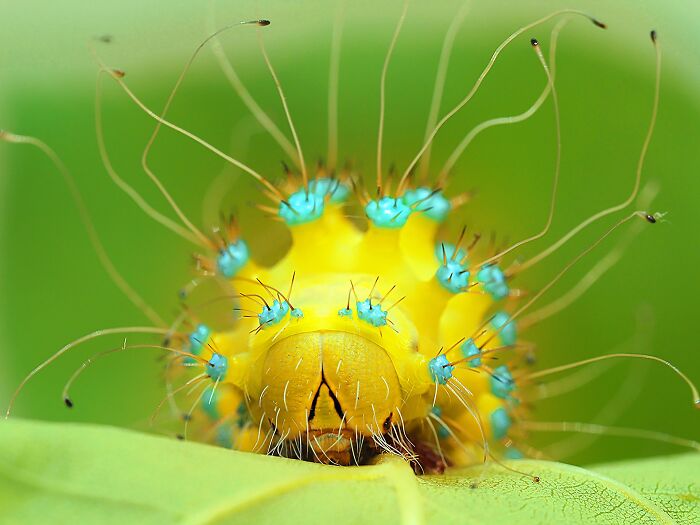
The machaon butterfly is one of the most beautiful diurnal butterflies in Europe. They have a large wingspan in relation to other butterflies within Europe. Unfortunately, a consequence of its beauty is that the species are very popular by collectors.
The caterpillar of this butterfly, the one that appears in the photo, is also very striking because of its color in green and yellow with black stripes and orange points. These caterpillars are very common to be found among fennels (Foeniculum vulgare) and they love to feed on this plant.
When I found this little machaon caterpillar it was already a little late and the sun was beginning to set. On the horizon were a few trees where the sunlight was shining through, creating a beautiful background between their leaves. To illuminate and give volume to the caterpillar I used a small led panel and with combining natural and artificial light I created this image. The photo was taken on a hot summer afternoon in mid-August in Ares – Coruña – Spain.
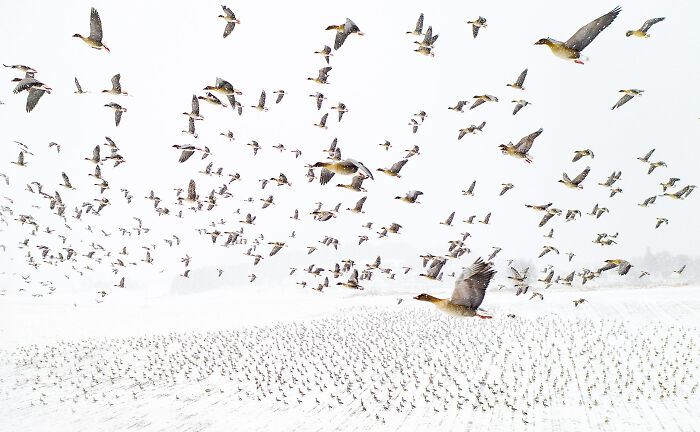
I’m priviliged enough having thousands of Pink-footed Geese litterally in my garden several months a year. More than 80.000 make a stopover here in the Trondheim fiord wetland system on their way between the wintering grounds in Denmark and Netherlands and the breeding grounds in Spitsbergen every spring and autumn and the whole scenario is simply spectacular. I have been photographing them for more than 20 years, and at at one point I kind of ran out of ideas and got the feeling that «everything» with geese was already done. So what now?!
Thanks to the amazing drone technology the element of air opened up a few years ago, and the wet dream of photographing the geese as being on of them, a part of the flock, up in the air actually became possible. Dozens of failed attempts during the last years, partly because of fragmented landscapes, disturbing buildings, human artifacts and messy backgrounds. But during the strange and rare events of blizzards and heavy snowfalls in late April 2020, I realized that the photos of my dreams were within reach; photographing the geese from the air against a pure and clean snowy landscape. I positioned myself close to a field where I knew that the geese would feed regulary and waited for them there. As soon as I heard incoming geese, I took off with the drone and waited for them in the air. Most of the shots did as always have something inperfect to them; like being too far away, being unbalanced, having a wing or a head cut or some birds overlapping wrong. But this particular one I`m very happy with. And I`m very happy that the jury of the NPOTY 2021 liked it too!
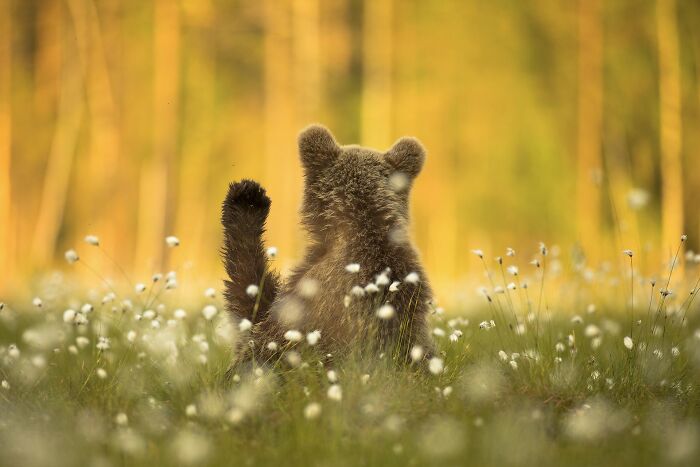
This image was taken in east Finland. Every early summer some small, unremarkable brown and green flowers develop distinctive white bristle-like seed-heads that resemble tufts of cotton. I planned my photography project to be there at the right time for the bloom. Peak flowering lasts only two weeks a year and varies from year to year depending on the weather.The bears in this area are pretty shy and afraid of people so they are mostly active at dusk and dawn. I spent a few days laying down in a tiny claustrophobic one person hide, hoping for something to come out to an open wetland.
One evening I was fortunate to witness a beautiful family of mother and triplet Eurasian Brown Bears stepping out of the forest and playing in the beautiful golden light. When one of the cubs got tired of playing he left his siblings and sat down to rest in a special way with his leg lifted up.
He seemed enjoying the moment watching the beauty of his environment while the golden rays of the sun painted the forest in gold. I liked the way he was sitting with his back to me like someone who has no worries in the world and shooting from this angle tells his story with the environment in an unconventional way.
As photographers we are often fixated on photographing the animal looking at us and not away from us. So it is good to try and think out of the box sometimes. There is always a surprise in a bear and I think this is why so many people including myself feel a special connection with this animal and a strong need to protect them in order to make sure they stay on our planet for good.
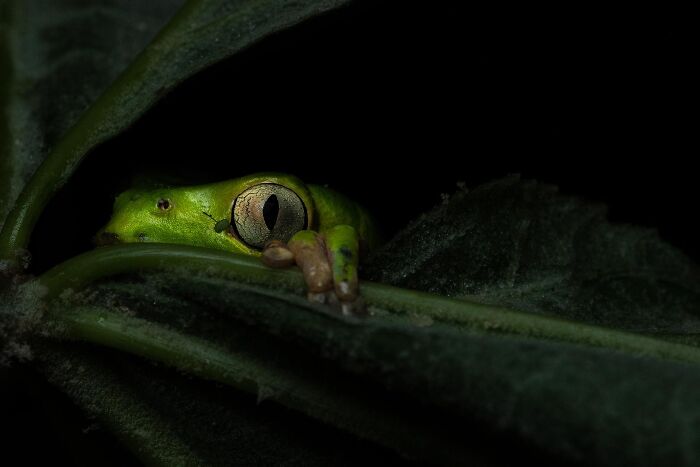
Frogs are commonly associated with tales of witches and curses, and this makes us look down on them. Children are told: “if you touch a frog, your hands will be covered in warts …”. This creates a sad myth generation after generation that promotes its contempt, abuse and annihilation that this especies. Today around the world, the number of frogs is decreasing alarmingly and that must change. These beautiful beings, so important in our ecosystems, must be dignified. Through photography I seek to dignify them, that they look almost human, that their image impacts, that people fall in love with them. In my photo, my frog just shyly appears on the scene, even in fear of being destroyed, hoping that we will finally start loving it. We must love all living beings, they are all masterpieces of nature that must be respected and loved as much as we love ourselves.
This photo was taken in october, in Misiones (NE of Argentina), one night in spring when they planned to mate. The Missionary Monkey Frog (Phyllomedusa tetraploidea) is a tree frog that moves very slowly. This female carried the male on her back, that made her even slower. It only took a flash to illuminate her slightly as she moved very slowly through the vegetation. This allowed me to generate a climate of intimacy, mystery and fragility where I show her scared and afraid of being seen.
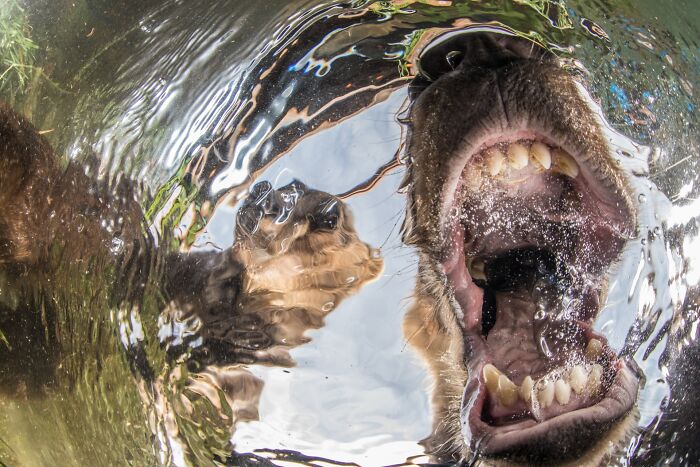
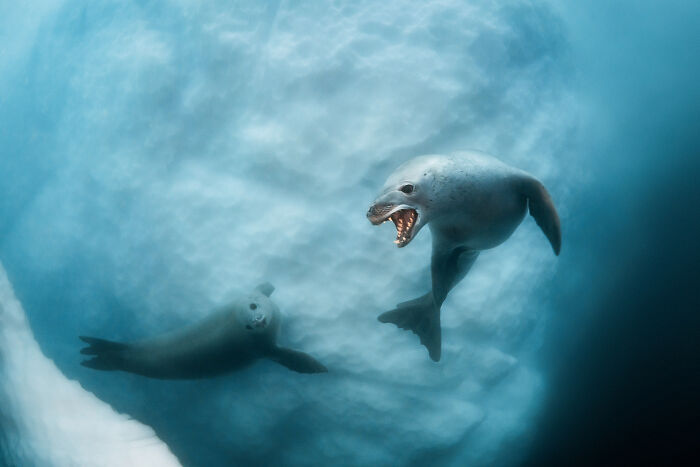
One fine day of our Antarctica trip we were diving next to a beautiful iceberg. Our expedition was coming to an end, and we already made nice leopard seal’s shots, which was our main target. I didn’t expect much from this dive – the weather got worse and there were no animals around. So, our plan was just to make some underwater pictures of each other next to an intricate ice formation.
In the middle of the dive my strobes ran out of batteries, and I switched to static lights. Just minutes later I saw two Crabeater seals making circles around us and coming closer and closer. They were in very playful and curious mood and I’m very sure they were attracted with those lights. Then one of the seals showed me teeth, it looks a bit scary on the picture, but I’d consider this gesture as a sign of curiosity and excitement.
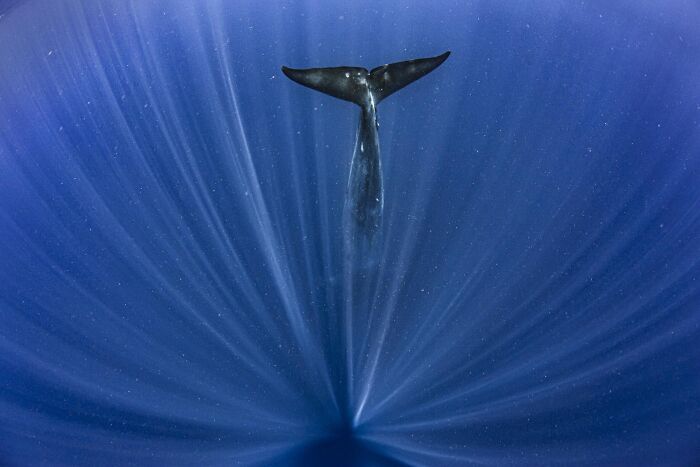
This image was taken in the East Coast of Trincomalee Sri Lanka. I have guided several wildlife tours to Sri Lanka in the past but my colleague in Colombo had mentioned this East Coast swimming tour to me and it became a staple for a few years. The subjects are super-pods of sperm whales and the occasional blue. There are days with no whales and you are many nautical miles from shore looking for distant blows. It is a long and often hot quest but with small boats and very good local guides.
You also need to be a strong swimmer, something I had trained for, as well as most of my clients. It is critical to be sensitive in the water. Too much splashing and bubbles scares the cetaceons and this is exactly the reason that no oxygen tanks are permitted, fortunately. That morning we first spotted this Blue whale and during the second dive I was determined to get something special in front of my lens.
There is something humble, enchanting and also terrifying about such a huge mammal the size of six double decker buses, when it passes below you. But I pulled myself together, took a deep breath and followed it down. Not easy when the camera housing is acting as a life jacket! My ears were protesting as were my lungs and I pointed the rig down and squeezed off a couple of images as the leviathan dropped vertically into 3000 feet of deep blue.
Just being in the water with whales is something close to maritime witchcraft, but when it is a Blue it takes some recovery time, in this case physically and mentally!
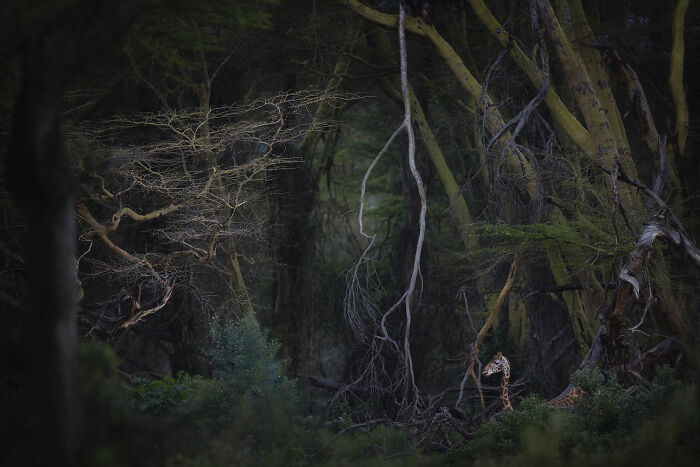
I took this photo in Nakuru National Park, Kenya. To have a better chance of finding good light I went on a deliberately organized safari during the rainy season. Just before sunset my friends and I noticed a group of giraffes passing in front of the forest. With a long lens (600mm) I found a magnificent glimpse into the forest that stroke me a lot. So instead of taking pictures to the giraffes passing by, I kept my post still hoping for a glimpse of the giraffes walking past at that point. The angle was narrow, there was a lot of vegetation in the foreground that could damage the image. So I used an aperture as wide as possible.
In the end, I was rewarded by my stubbornness: the giraffes passed exactly in the right place. The scene reminded me of a Jurassic landscape, with a herbivorous dinosaur in the same position as the giraffe.
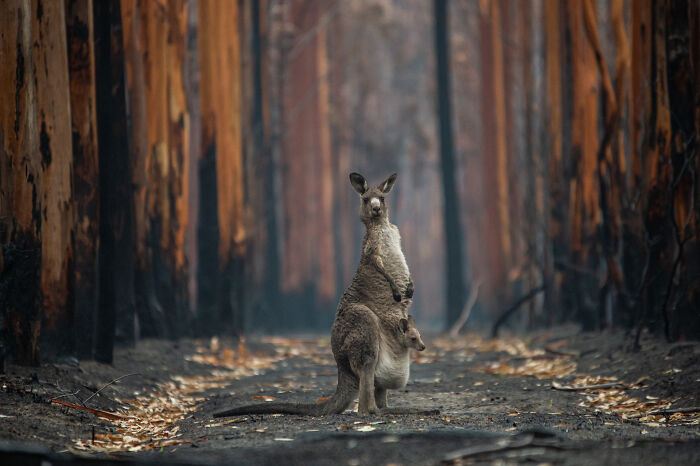
As the Australian climate fires raged, I knew that it was a story that I had to document. Specifically the stories of the animals, both domestic and wild, who were suffering and dying as a result of the fires. When the decision was made, I was on a plane less than 24 hours later.
Flying in over Australia, I could see a continent smothering in smoke. I spent two weeks working very long hours with a wonderful team to gain access to the burn sites, the rescues, the veterinary missions. It was an honour and pleasure to partner with the organization Animals Australia, who were instrumental in providing access to where I needed to be.
This photo was taken in Mallacoota, Victoria. Interestingly, this is the very small town where my father, an Australian, was raised. I even met one of his childhood friends, who was helping provide space for wild animal feed which was being delived to animals in the area who were at risk of starvation during this catastrophe.
When I saw this Eastern Grey kangaroo and her pouched joey, I was abut 100 feet away from where I knew I’d be able to get a fantastic photograph. Any photographer can imagine how long those moments were, as I walked slowly to the spot I knew I needed to be, in order to get this shot. I walked slowly and she watched me. I prepared my camera with the settings I wanted and finally reached my spot. I took a few photos. Then I had time to crouch down and take this photo, the one I had envisioned. Then…she hopped away into the burned eucalyptus plantation. She was one of the lucky survivors. An estimated 3 billion animals died from these cataclysmic fires.


















 No fees, cancel anytime