Get Premium
Dark mode theme is available exclusively for premium users. Learn more about the benefits of subscribing.
No fees, cancel anytime.

 Dark Mode Ad-Free Browsing Unlimited Content
 Ad-Free Browsing Unlimited Content Dark Mode
Join 1.2 million Panda readers who get the best art, memes, and fun stories every week!
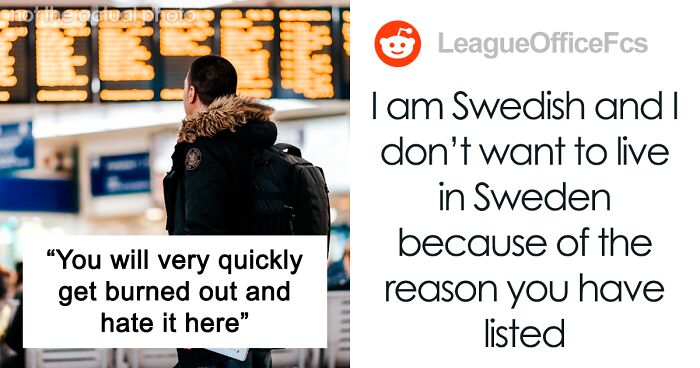
As an American, I’ve always viewed Scandinavia through rose-colored glasses. The home of gorgeous scenery, excellent education and healthcare, and systems that seem to work efficiently and actually benefit taxpayers, who wouldn’t want to move there?
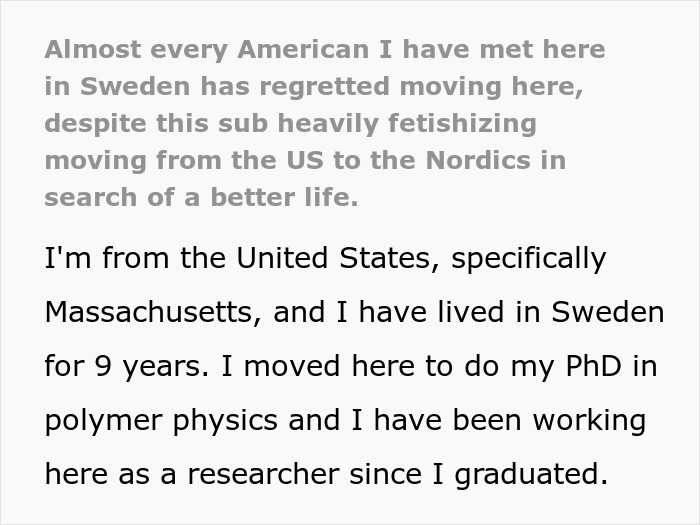
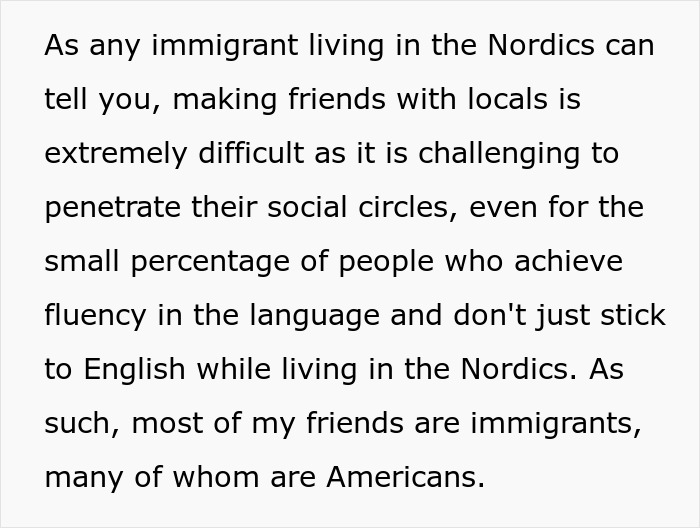
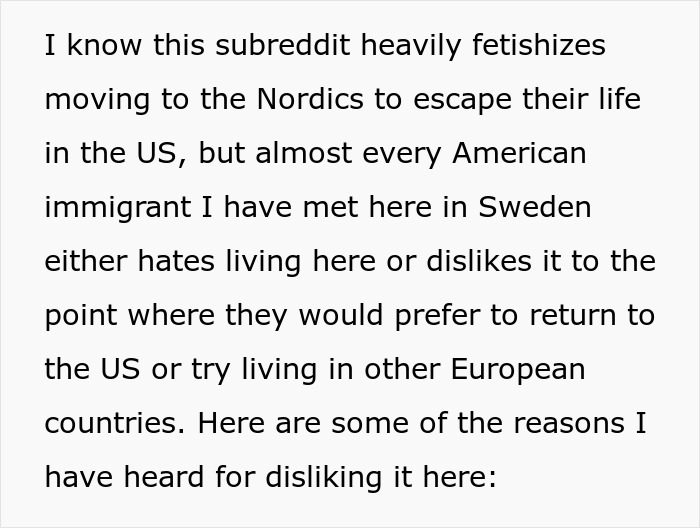
However, there are pros and cons to living anywhere, so one expat who moved to Sweden nearly a decade ago recently detailed on Reddit why the land of pop music and IKEA might not be right for every American. Keep reading to find their thoughts, as well as a conversation we were lucky enough to have with Meagan Nouis, another American who calls Sweden home.
Image credits: Anete Lūsiņa (not the actual photo)
Image credits: Catalina Johnson (not the actual photo)
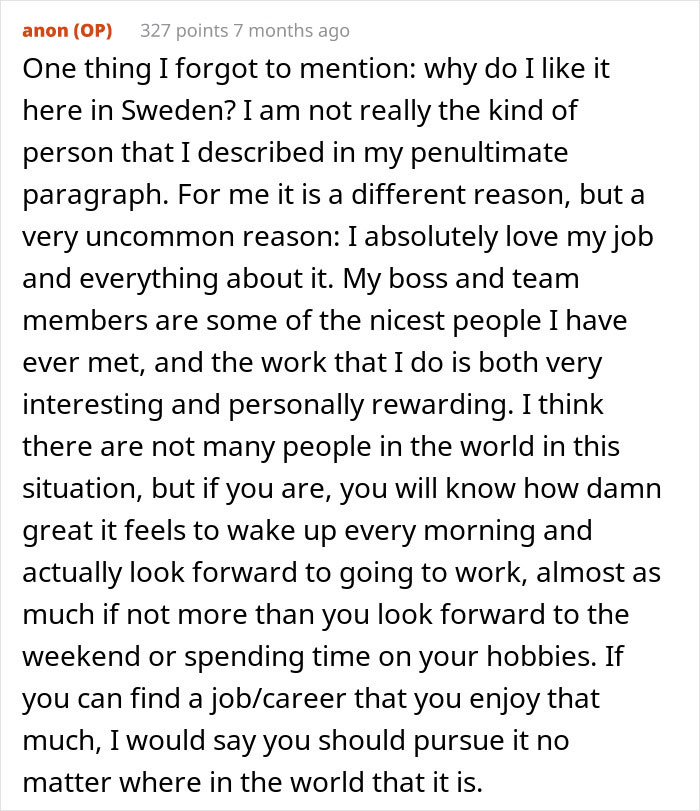
Image credits: anon
To learn more about what it’s like to live in Sweden as an American, we reached out to YouTuber Meagan Nouis, who was kind enough to have a chat with us about her life in this beautiful country. First, Meagan shared what inspired her to make the move to Scandinavia. “When I was studying abroad in Rome, Italy in 2012, I used my free time to travel around Europe,” she told Bored Panda. “I visited Stockholm during this time, and I felt an overwhelming sense of belonging. Think ‘Disney movie’ moment where I realized my dream was to live here! Since that one visit, I studied the language and decided the best way to live here was to study for my master’s degree.”
Meagan went on to explain that her experience in Sweden has become much easier over time, as her understanding of the culture has deepened. “You can find plenty of articles and videos talking about ‘what to expect in Sweden,’ which are broader descriptions of the culture, but it’s the small stuff like how to make a doctor’s appointment, doing self-checkout at Pressbyrån, and getting your American phone to work that are much harder to learn until you have to do it for the first time,” she explained.
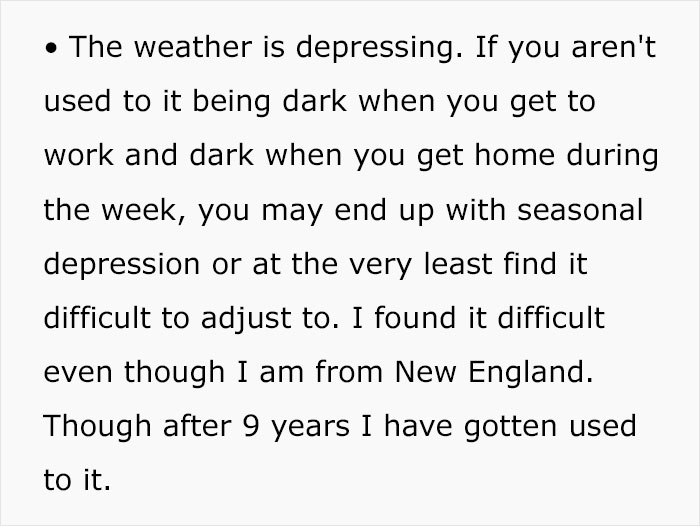
Meagan also opened up about some of the most challenging aspects of living in Sweden. “Everyone says it, but the winter darkness and the weather are some of the hardest parts,” she shared. “Coming from Minnesota, I thought I’d prefer the Swedish darkness over the freezing cold weather in Minnesota (we’re talking over a month straight below 0° F). I was wrong. The darkness is miserable and really wears you down after months and months of it!”
Image credits:Erik Odiin (not the actual photo)
“Of course, I miss family and friends the most, but I’m grateful that it’s so easy these days to stay in touch with Facetime and family group chats,” Meagan added. “Culturally, I miss the efficiency of customer service [in the United States]. Typically, the first person you talk to will do everything they can to assist! I also miss how easy it is to joke around with complete strangers.”
And as far as Meagan’s favorite parts about living in Sweden, she says there are plenty of them. “The people are incredibly nice. Even if Swedes are typically reserved, they are so friendly once you get to know them!” she told Bored Panda. “I also love the efficiency of paying for things with Swish and using Band ID to make logging into accounts easy. The Swedish summers are beautiful. The coffee is so good and so cheap!”
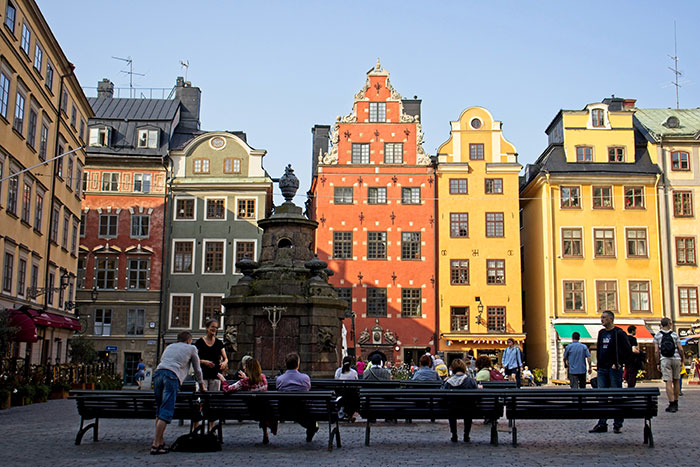
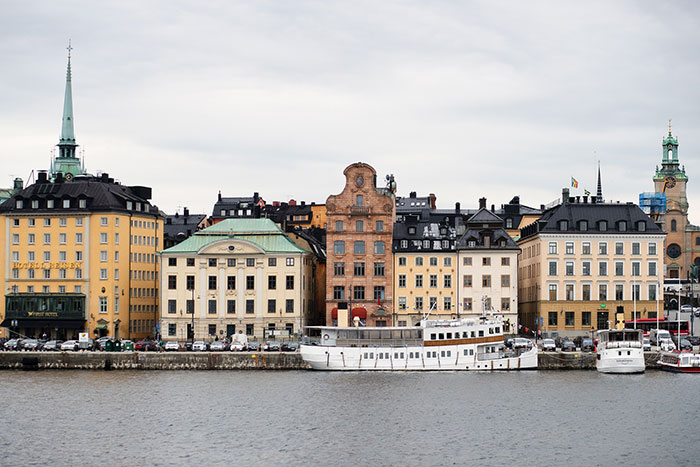
“In Stockholm, one of my absolute favorite parts is how beautiful the city is,” Meagan added. “I will never get tired of seeing all of the boats on the water and Nordic architecture along the island coasts!”
Meagan also shared that she has learned a lot through her journey of trying to move to Sweden, which included being kicked out by Migrationsverket at one point, and then moving back again. “Here are my tips for Americans who want to move here, and what I wish I had known ahead of time,” she told Bored Panda. “Hands down, the easiest way to initially move here is through studying at a university. If this is what you want to do, save as much money as you can. Not only do you have to pay tuition (which is still MUCH cheaper than tuition in the States), but you need to prove to the migration office that you have enough money saved or that you earn a stable income. It’s easiest when you have the required amount already saved.”
“If you study, do a two-year degree,” Meagan continued. “One of the most essential things you’ll need to even function in daily Swedish society is a personnummer. I found out the hard way that a one-year master’s program was technically only nine months, and the migrations office won’t give you a number if your visa is for less than a year. If you do a two-year program, you’re guaranteed a personnummer right away. Save yourself the headache!”
Image credits: Quintin Gellar (not the actual photo)
Meagan also warns readers to be prepared for lots of frustration trying to settle in and adjust to Swedish life. “The biggest thing that will help is getting a personnummer,” she says. “From there, I recommend getting a Swedish/European phone that can use a Swedish SIM card since you’ll be using apps for everything! Also getting a Swedish bank account (but you’ll need the personnummer first).”
Despite all of the frustration Meagan has faced, however, she loves living in Sweden. “Sweden is amazing, and the more you learn about the intricacies of the culture, the more you’ll appreciate it! You’ll be frustrated with some of the differences, but that’s true no matter where you go in the world,” she told Bored Panda, adding a few recommendations for those who visit or move to Sweden. “Make sure to try pizzasallad. Drink lots of coffee (with milk, not creamer!). Go berry and mushroom picking. Swedish ‘miles’ are 10 kilometers and not the same as US miles. Never forget to take a queue ticket at the post office, pharmacy, and doctor’s office!” If you’d like to learn more about Meagan’s adventures in Sweden and check out some of her informative and hilarious videos, be sure to visit her YouTube channel right here!
We would love to hear your thoughts on this post in the comments, pandas. Have you ever lived in Sweden? Have you ever wanted to? Feel free to share about your own experiences in the birthplace of IKEA and countless pop songs, and then if you’re interested in reading another Bored Panda article discussing cultural differences an American mother noticed after moving to Denmark, you can find that story right here!
Image credits: Jon Flobrant (not the actual photo)

I think that people in general really overestimate what it takes to emigrate anywhere. They just have no concept how different things AND people are elsewhere. They totally ignore the fact that the difference isn't just a different language and a few cultural quirks. It's going deeper. Between countries with different languages it's an often vastly different way of thinking, different values and different preferences far above regional differences. I'm not saying this in a judgemental way. I'm not judging other cultures. I'm just saying expect huge differences and prepare to be open for new ideas that are going much deeper than you expect.

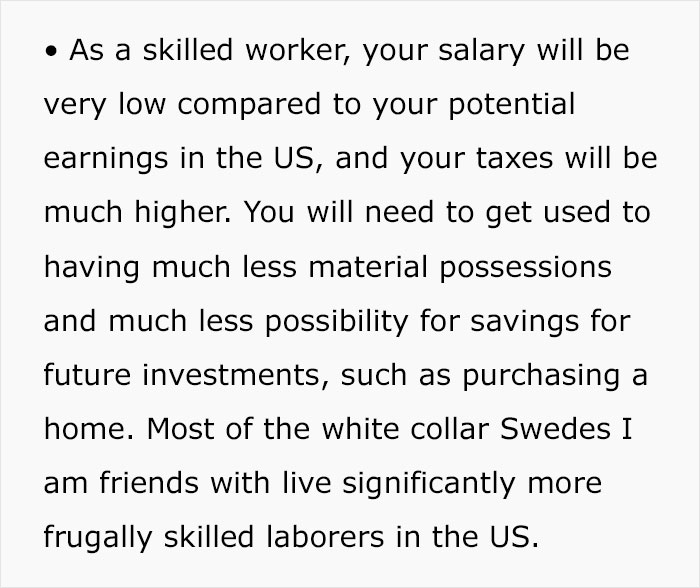
I think the problem with this example is that he would be well paid in the US, which covers a lot of his complaints. The costs, the wage, the tax, the housing. But if he was a POOR person in the US vs a poor person in Sweden, that would be an interesting comparison. Not many people would argue againt the fact that being rich in the US would be awesome.
Load More Replies...
Lesson no. 1 when moving abroad: you're not in your home country anymore, so don't expect to be able to live like you are. That said, it's fully valid to dislike the way of living in another country.
I also emigrated to Sweden (from another EU country, but a more southern one). I absolutely love it here. I made a lot of friends, get invited over a lot (for lunch, dinner, fika) and can't see the reserved people comment. That said, I learned to speak Swedish and try my best. It isn't fluent, but I try real hard. I also plunged myself into everything this town has to offer. Football club, folketshus (village home), I help at the church, museum and am a member of the sports club. I jumped in. I have little contact with other immigrants from my country. So the stereotype? That's on you. They are awesome friendly humans and very willing to meet new people. Just leave your home country at the border, where it belongs.
I think that people in general really overestimate what it takes to emigrate anywhere. They just have no concept how different things AND people are elsewhere. They totally ignore the fact that the difference isn't just a different language and a few cultural quirks. It's going deeper. Between countries with different languages it's an often vastly different way of thinking, different values and different preferences far above regional differences. I'm not saying this in a judgemental way. I'm not judging other cultures. I'm just saying expect huge differences and prepare to be open for new ideas that are going much deeper than you expect.
I think the problem with this example is that he would be well paid in the US, which covers a lot of his complaints. The costs, the wage, the tax, the housing. But if he was a POOR person in the US vs a poor person in Sweden, that would be an interesting comparison. Not many people would argue againt the fact that being rich in the US would be awesome.
Load More Replies... Lesson no. 1 when moving abroad: you're not in your home country anymore, so don't expect to be able to live like you are. That said, it's fully valid to dislike the way of living in another country.
I also emigrated to Sweden (from another EU country, but a more southern one). I absolutely love it here. I made a lot of friends, get invited over a lot (for lunch, dinner, fika) and can't see the reserved people comment. That said, I learned to speak Swedish and try my best. It isn't fluent, but I try real hard. I also plunged myself into everything this town has to offer. Football club, folketshus (village home), I help at the church, museum and am a member of the sports club. I jumped in. I have little contact with other immigrants from my country. So the stereotype? That's on you. They are awesome friendly humans and very willing to meet new people. Just leave your home country at the border, where it belongs.

























 No fees, cancel anytime


























44
122