Bored Panda works better on our iPhone app
Continue in app Continue in browser

The Bored Panda iOS app is live! Fight boredom with iPhones and iPads here.

Single Picture Explains How Aperture, Shutter Speed, and ISO Work In Photography
User submission
83.5K

Single Picture Explains How Aperture, Shutter Speed, and ISO Work In Photography

214

ADVERTISEMENT

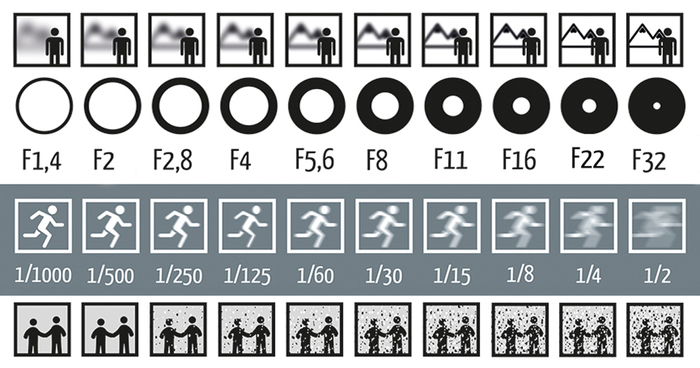
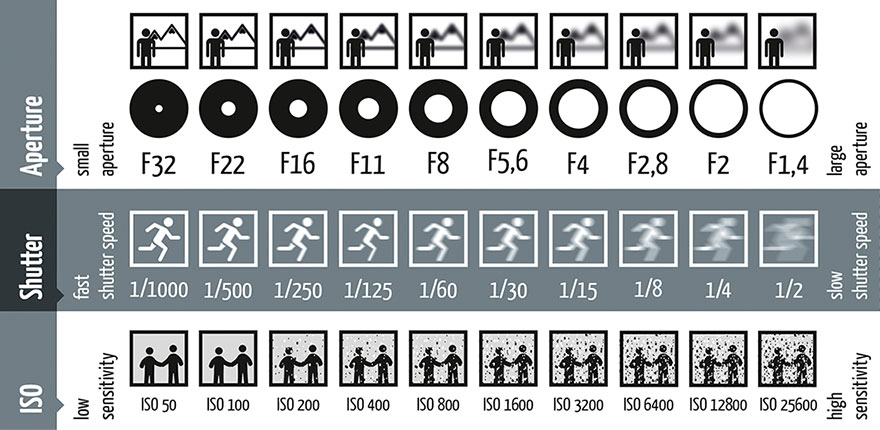
If you’re a beginner photographer, it can be helpful to have a simple guide that helps you understand the different settings that you can toggle on your DSLR camera. While this helpful exposure chart by Daniel Peters at Fotoblog Hamburg won’t explain HOW the optics of photography work, it will show you exactly what happens when you tweak your camera’s settings.

The three settings in this chart are part of what photographers like to call the exposure triangle. ISO is the digital camera sensor’s sensitivity to light. The aperture is a structure in your lens that works much like the iris in our eyes. It opens and close to let more or less light in, and also changes the depth of field, or how many different objects can remain in focus in the shot at the same time. Last is the shutter speed, which controls how much time the camera’s shutter remains open when taking a photo. A longer shutter opening will let in more light but may also cause blurring if any motion occurs while the photo is being taken.

You can download Peters’ chart here.

More info: hamburger-fotospots.de | Facebook | Twitter (h/t: petapixel)
RELATED:

    photography-shutter-speed-aperture-iso-cheat-sheet-chart-fotoblog-hamburg-daniel-peters

    photography-shutter-speed-aperture-iso-cheat-sheet-chart-fotoblog-hamburg-daniel-peters
    ADVERTISEMENT

    1.1Mviews

    Share on Facebook

    Explore more of these tags

    Dovas

    Dovas

    Author, Community member

    Read more »

    There is a beast with heart of cold stone that dashes like lightning, shreds flesh from bone. // Bewitched by this beast, I fell to my knees. My mouth babbled madness and mumbled soft pleas. // I stared down the ravenous, gnashing dark maw of a cute cuddly kitten with yarn in its paw

    Read less »
    Dovas

    Dovas

    Author, Community member

    There is a beast with heart of cold stone that dashes like lightning, shreds flesh from bone. // Bewitched by this beast, I fell to my knees. My mouth babbled madness and mumbled soft pleas. // I stared down the ravenous, gnashing dark maw of a cute cuddly kitten with yarn in its paw

    What do you think ?
    BobGilchrist
    Community Member
    9 years ago Created by potrace 1.15, written by Peter Selinger 2001-2017

    Good start but this will confuse the uninitiated. It is also a missed opportunity to show the relationship in exposure between the aperture, shutter speed and ISO. People will assume some vertical correspondence in a chart such as this. Reversing the Aperture row would at least indicate that large apertures are related to fast shutter speeds and high ISO settings.

    RonYorgason
    Community Member
    9 years ago Created by potrace 1.15, written by Peter Selinger 2001-2017

    Possibly, but the left side is entirely related to less light / less sensitivity, while the right side is all related to more light / more sensitivity. That seems to make pretty good sense to me.

    Load More Replies...


    ADVERTISEMENT
    David Damico
    Community Member
    8 years ago Created by potrace 1.15, written by Peter Selinger 2001-2017

    Hi and thank you for this pocket chart. I am a career teacher for 11 and 12th grade high school students. Is there a poster sized version of this pocket card? I think hanging it on a wall would be fantastic.

    AbdullahalMamunTusher
    Community Member
    9 years ago Created by potrace 1.15, written by Peter Selinger 2001-2017

    Informative post for the beginner stage photographer.

    CharlieSawyer
    Community Member
    9 years ago Created by potrace 1.15, written by Peter Selinger 2001-2017

    Nice teaching tool but they missed key elements that could/should have been shown: All three of these parameters have other important effects. f32 (smaller hole) lets in less light so resulting exposure is relativly darker than f1.4; Shutter speed of 1/1000 of a second likewise lets in less light so image is relatively darker than 1/2 second; and small ISO (say, 100) needs more light for a good exposure than large ISO number (say, 1000, which allows pix in less available light while increasing graininess). These effects are integral to understanding this.

    DavidStotz
    Community Member
    9 years ago Created by potrace 1.15, written by Peter Selinger 2001-2017

    I think this page shows an incorrect version of the image. I landed here from a post on facebook and oddly, the thumbnail in the facebook post has the aperture row reversed. It makes much more sense that way and would be much more useful to the beginning photographer, as it demonstrates reciprocity - a fundamental concept in understanding how your camera works.

    ShanePinnegar
    Community Member
    9 years ago Created by potrace 1.15, written by Peter Selinger 2001-2017

    any chance someone can make one of these for shooting bands in dark venues? I always struggle with the light and am in no way a skilled photographer!

    StephGoralnick
    Community Member
    9 years ago Created by potrace 1.15, written by Peter Selinger 2001-2017

    It's the same chart, it's just that the limitation of low light leaves you with fewer choices. Cover the first seven squares in each row, this is the chart you're now working with.

    Load More Replies...
    ThomasHoe
    Community Member
    9 years ago Created by potrace 1.15, written by Peter Selinger 2001-2017

    Thiss is super useful!! Thanks!!!

    GabrielLandry
    Community Member
    9 years ago Created by potrace 1.15, written by Peter Selinger 2001-2017

    Extra credit: do you know what the F64 club was and what the 64 was for?

    Load More Comments
    BobGilchrist
    Community Member
    9 years ago Created by potrace 1.15, written by Peter Selinger 2001-2017

    Good start but this will confuse the uninitiated. It is also a missed opportunity to show the relationship in exposure between the aperture, shutter speed and ISO. People will assume some vertical correspondence in a chart such as this. Reversing the Aperture row would at least indicate that large apertures are related to fast shutter speeds and high ISO settings.

    RonYorgason
    Community Member
    9 years ago Created by potrace 1.15, written by Peter Selinger 2001-2017

    Possibly, but the left side is entirely related to less light / less sensitivity, while the right side is all related to more light / more sensitivity. That seems to make pretty good sense to me.

    Load More Replies...
    ADVERTISEMENT
    David Damico
    Community Member
    8 years ago Created by potrace 1.15, written by Peter Selinger 2001-2017

    Hi and thank you for this pocket chart. I am a career teacher for 11 and 12th grade high school students. Is there a poster sized version of this pocket card? I think hanging it on a wall would be fantastic.

    AbdullahalMamunTusher
    Community Member
    9 years ago Created by potrace 1.15, written by Peter Selinger 2001-2017

    Informative post for the beginner stage photographer.

    CharlieSawyer
    Community Member
    9 years ago Created by potrace 1.15, written by Peter Selinger 2001-2017

    Nice teaching tool but they missed key elements that could/should have been shown: All three of these parameters have other important effects. f32 (smaller hole) lets in less light so resulting exposure is relativly darker than f1.4; Shutter speed of 1/1000 of a second likewise lets in less light so image is relatively darker than 1/2 second; and small ISO (say, 100) needs more light for a good exposure than large ISO number (say, 1000, which allows pix in less available light while increasing graininess). These effects are integral to understanding this.

    DavidStotz
    Community Member
    9 years ago Created by potrace 1.15, written by Peter Selinger 2001-2017

    I think this page shows an incorrect version of the image. I landed here from a post on facebook and oddly, the thumbnail in the facebook post has the aperture row reversed. It makes much more sense that way and would be much more useful to the beginning photographer, as it demonstrates reciprocity - a fundamental concept in understanding how your camera works.

    ShanePinnegar
    Community Member
    9 years ago Created by potrace 1.15, written by Peter Selinger 2001-2017

    any chance someone can make one of these for shooting bands in dark venues? I always struggle with the light and am in no way a skilled photographer!

    StephGoralnick
    Community Member
    9 years ago Created by potrace 1.15, written by Peter Selinger 2001-2017

    It's the same chart, it's just that the limitation of low light leaves you with fewer choices. Cover the first seven squares in each row, this is the chart you're now working with.

    Load More Replies...
    ThomasHoe
    Community Member
    9 years ago Created by potrace 1.15, written by Peter Selinger 2001-2017

    Thiss is super useful!! Thanks!!!

    GabrielLandry
    Community Member
    9 years ago Created by potrace 1.15, written by Peter Selinger 2001-2017

    Extra credit: do you know what the F64 club was and what the 64 was for?

    Load More Comments
    You May Like
    Related on Bored Panda
    Popular on Bored Panda
    Trending on Bored Panda
    Also on Bored Panda
    ADVERTISEMENT