Get Premium
Dark mode theme is available exclusively for premium users. Learn more about the benefits of subscribing.
No fees, cancel anytime.

 Dark Mode Ad-Free Browsing Unlimited Content
 Ad-Free Browsing Unlimited Content Dark Mode
Join 1.2 million Panda readers who get the best art, memes, and fun stories every week!
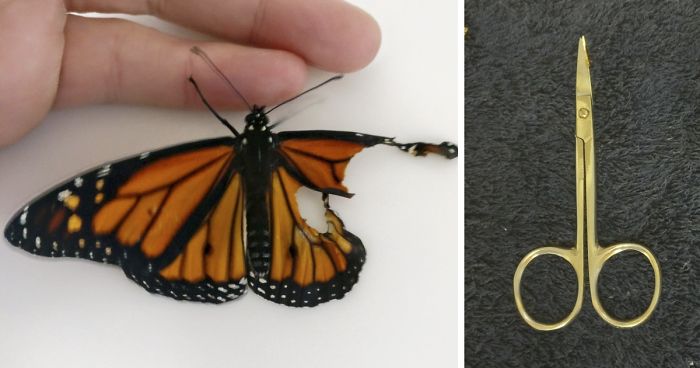
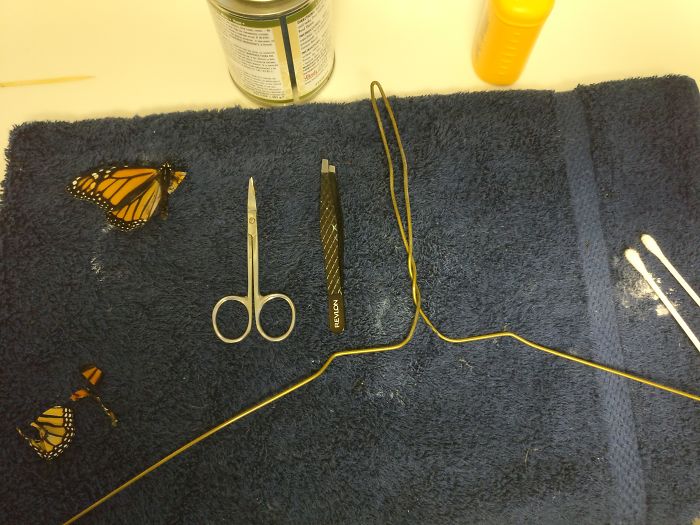
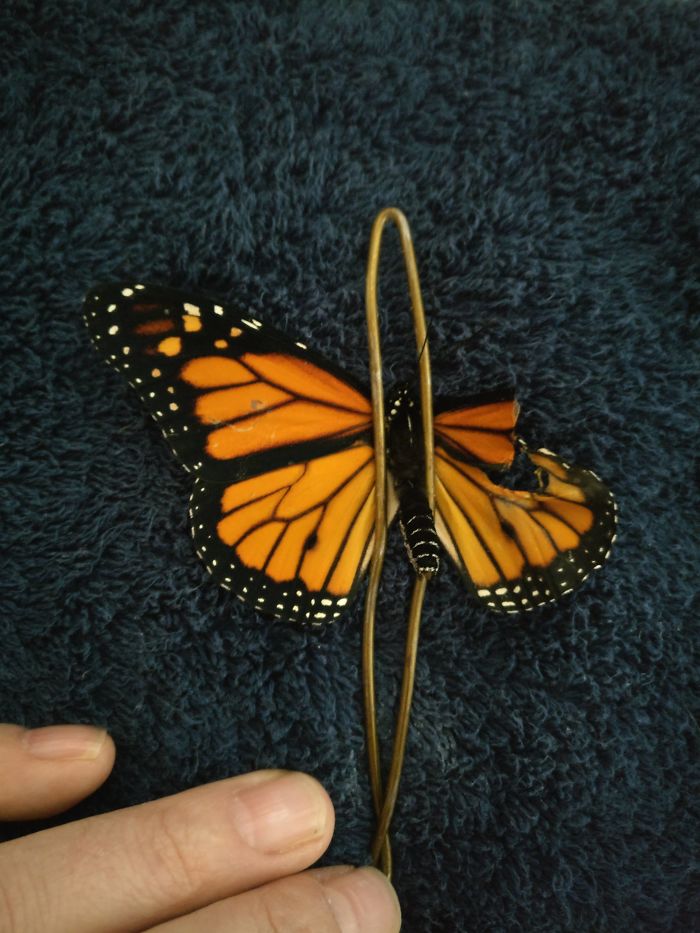
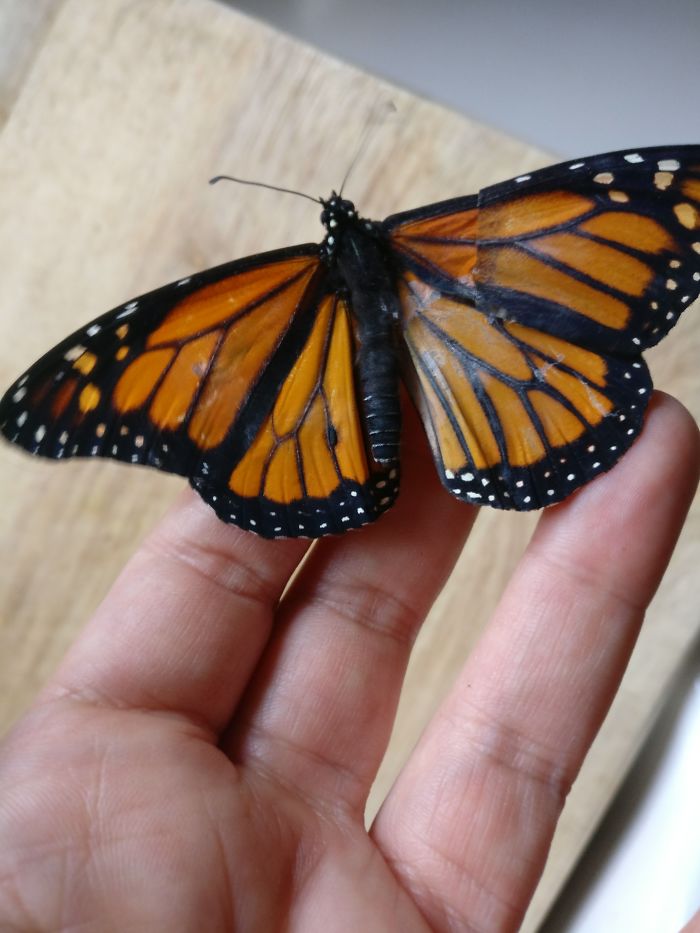
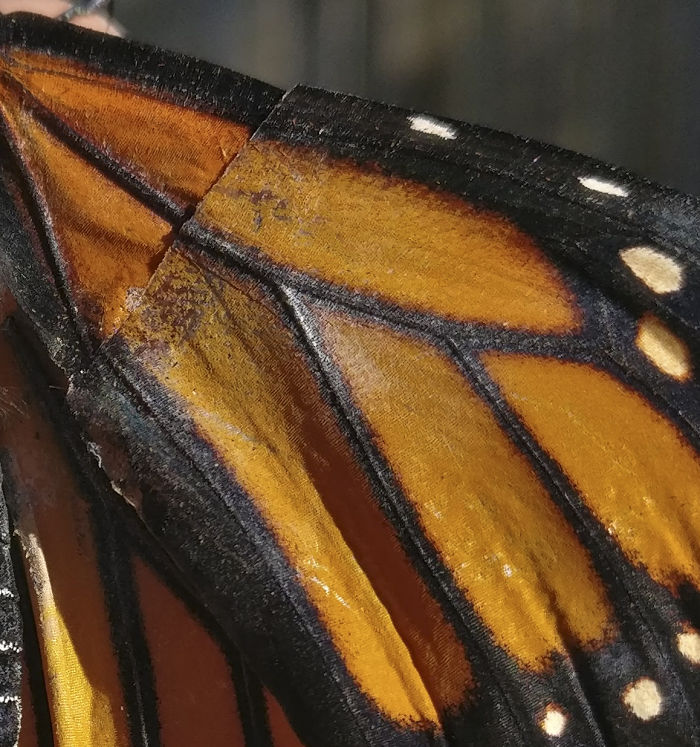
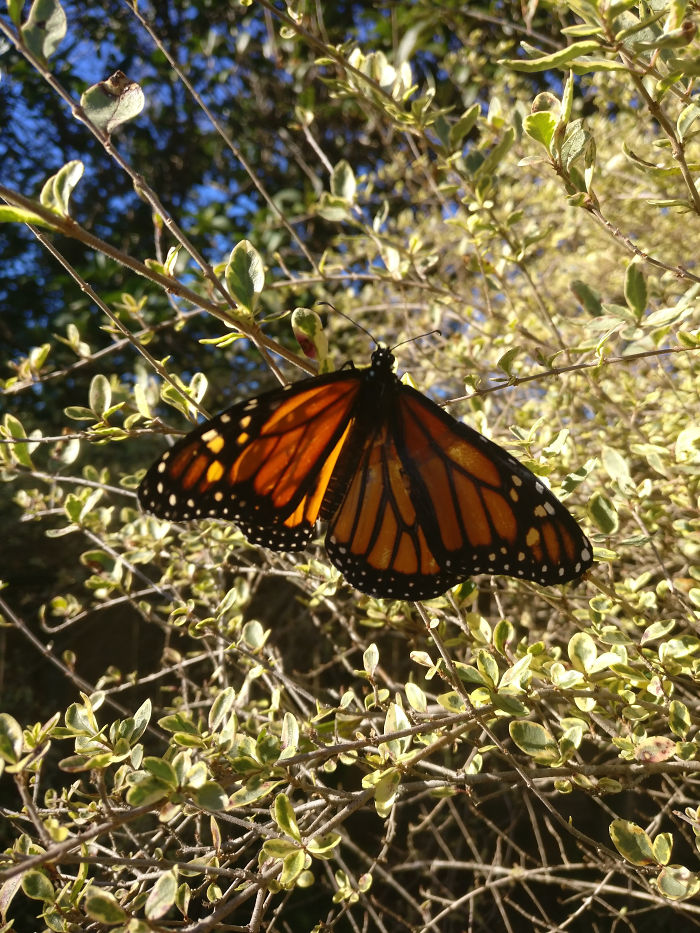
Depending what time of year they’re born, Monarch butterflies can live from 2 weeks to about 5 months, but this guy’s time was threatened to be cut even shorter. Luckily, Romy McCloskey was there to help. “I fell into raising butterflies by accident when I found 3 caterpillars on a bush in my front yard,” she told Bored Panda. So after one of her darlings got injured, Romy knew she had to help. McCloskey turned her home into an operating room and used common household items to perform a wing transplant.
“I have always had a love for butterflies,” she said. “They have a very personal meaning to me. Before my mother died, almost 20 years ago, she said to me, ‘Romy, whenever you see a butterfly, know that I’m there with you, and that I love you.'”
Romy McCloskey is a professional costume designer and master hand embroiderer, so this was right up her alley. Her supplies included a towel, a wire hanger, contact cement, a toothpick, a cotton swab, scissors, tweezers, talc powder, and an extra butterfly wing from one of her little girls that died a few days before.
According to McCloskey, there’s no need to drug the butterflies when performing such a procedure. She compared their wings to human nails or hair: “They do not have pain receptors.”
“[P.S.] I feel it is important to note that the butterfly sustained his injury during pupating into his chrysalis. It was not a genetic defect or deformity due to the Ophryocystis elektroscirrha (OE) parasite that fatally infect Monarchs. I did have a lot of people asking why I would ever introduce inferior or defective genes into the butterfly gene pool. I had to explain to many that I did not. In fact, any caterpillars or butterflies that are infected with OE or Tachinid fly (T-fly) larva must be euthanized to stop any further contamination in the Monarch population.”
Scroll down to check out how the surgery went!
More info: fadendesignstudios.com | Facebook | Instagram


this is the kind of story i go online to see. Thank you for being a great person.

Commendable patience and precision! Butterflies and moths and dragonflies and damselflies....so magical!
So true. Moths have always fascinated me. So beautiful. My favourite is an Ermine Moth.
Load More Replies... This is the sort of thing I absolutely love to read. Even the smallest creature deserve love and care.

a dead wing will wilt and will get stiff since the nerve is not connected with its own body, it wont get anything from the butterfly since it's only glued to him. however you give this butterfly the chance to fly and be free.... i like that =)

I was thinking same but also remember these Monarchs have to fly huge distances & stop only to feed/drink. Who knows if she extended the life of this creature but it still is awesome. Think how many get hit by cars on their journey. Sad
Load More Replies...

RE Bee rescue I've discovered that if they are pulled from a pool, you can use a blow dryer on low to warm them back up enough to make it home again...w/o that if hypo is setting in they don't recover on their own.
Load More Replies...
I don't know why but I found this absolutely fascinating! Wow, I did not know that they had no feeling receptors in their wings. Learn something new every day!

And the wisest part of compassion is truly understanding the creature. Its instinct would have it trying and trying to fly.....
Load More Replies...
I dearly wish there was a, "one million likes" button!! Such an amazing and beautiful story! ❤❤❤❤❤❤❤❤❤❤❤❤❤


She was one of my butterflies that had died a few days before. I am very happy that her life was not in vain.
Load More Replies... My wife and I were canoeing on a mountain lake in Pennsylvania and found a Monarch floating in the water unable to fly. We lifted him out with a paddle and let him sit in the sun to dry out. After an hour he was walking around the canoe and on our paddles and us before taking little test flights. When sure he was fine he flew away across the lake. About 30 minutes later we saw two Monarchs flying toward us from that direction. When they got to us they circled around our heads several times before flying back across the lake. It was like he had met his mate and brought her back to see where he had his close escape from drowning or being eaten by a fish. We could imagine him describing these creatures who helped him dry off and regain his flying ability.


The story is nice, but like many articles these days, the headline is misleading. I did not see that anything happened the next day that showed the butterfly thanking the caretaker in the coolest way, did you? I hate it when I am sucked in like that.




Wow that's incredible and then for it to be able to fly after just amazing.

I never knew you could do a wing transplant on a butterfly. So cool and wonderful. What a great person you are for doing this for this little guy.

I love this story but I can't resist thinking that it's better to be born beautiful. A cockroach would get no help. If you think of it, it applies to broader contexts. Some species extinct for the reason that they aren't beautiful/useful/charismatic for people. Some people don't get help on the street because they wear poor clothes.

Butterflies are beneficial to us by pollinating plants. Cockroaches are mostly detrimental to us, at least the typical house cockroach, by eating our food, eating our things, eating away at our home (including glues and other materials like wire coatings), spreading diseases as they go, taking over in swarms if they are able.
Load More Replies...
My wife raises monarchs here in FL and we now have over 100 crysilyses ready to pop! Anyway, love the article. May I asked...how do you make your homemade nectar and how do you give it to the butterfly?
Hi there Norman~ You can use very ripe bananas, mashed. You can soak cotton balls or a paper towel with a sugar water solution with a dash of soy sauce (salt that they need) , or raw honey and water with soy, or raw honey and Gatorade. I soak cottonballs in the solution and then skewer the cotton balls on bamboo sticks and put them in a jar. They mimic flowers. Remeber that newlt ecolsed butterflies do not need to eat for the first 24 hours. If you can release them before that, they will be fine in the wild. If they are inside longer, they will need to eat and may even need to be coaxed to do it by bringing them to the nectar and placing their feet in it ( so they can taste it.) If they do not begin to feed, you can take a toothpick and stick it thru the curled proboscis and help unfurl it gently, so that it finds the nectar. Best of Luck!
Load More Replies... 
What a wonderful person You are ... I don't even know You but I love You !


You did a fantastic job! I also learned something. I didn't know the spot on the wing means it is male. THANKS.

I know someone who saved a snail by using superglue to stick it's broken shell together again.


She had a butterfly die a couple days before, so she used that wing.
Load More Replies...
Where is the '...coolest way it surprises her' '..the next day'? I love what she did for this beautiful butterfly but I am getting so tired of these 'headlines' that lead us to believe there is more when there isn't...
This world is filled with extraordinarily bad people and extraordinary good; Romy is one of the REALLY good.

This woman´s a genius, her surgery for the poor monarch butterfly with the broken wing´s excellent, I´m so glad there´s so often someone who cares, also about the lil ones of God´s creatures, could´ve been me, when I was a child/teenie girl I once rescued a honeybee from drowning in a lake where we always went swimming in summer (Steißlinger See), the poor bee had fallen into the water in the middle of the lake, I took her onto my left hand and swam back to the shore, holding my left hand out of the water, then put the poor unlucky bee on a stone at the shore and kept on sitting next to her until her wings were dry and she finally flew away (into the other direction, off the lake, to the meadow)!!! Because #EveryLifeMatters 😲😲😲💖💖💖

Same question I have. Or did you have to make the spare wing? And with what?
It's said in the text that she had a wing from a butterfly that had died earlier
Load More Replies...
Will it last though or will the glue detach or the wing decay? I wonder if he would've been able to fly with the damaged wing.. Will he be able to mate or will females be put off by the scent or the appearance of his wing? Sorry for being a pessimist lol. I just always think about the bigger picture. Hope he's still out there living his best life!

This is fascinating. 2 different types of wing repair, and one is just like the story. https://youtu.be/ah0SBALIc0o

Amazing, thank you for giving him a great start, I love butterflies too.


Beautiful work, from a lovely person with not only a heart, but remarkable healing hands. Good work, and God bless you!


Plot twist: The effect of releasing this butterfly loose caused a Tsunami on the other side of the planet.



This reminded me of How To Train Your Dragon, when Hiccup fixed Toothless' tail fin :D

This is true magic! Thank you for your loving kindness and creativity in action! I protected a monarch which I found on the ground not moving and not flying away. Kept it in an open box, fed it nectar and prayed that it would gain enough strength to fly away. Sadly it died the next day. Your story reminds me of the connection I had with that beautiful little friend of mine. Thank you so much for sharing!

I had a similar experience a couple of years ago, when I came across a Monarch with a busted up wing in front of my home. I repaired his wing w/ that very light weight pink paper tape girls use to tape a curl into place. It worked pretty well & was light enough that it didn't throw it's balance off. I do wildlife rehab & have rescued plenty of insects from a variety of certain deaths, but this was my first insect "surgery"!



I learned something here with this story and that is great! Plus, very cool to help this little guy out. What a great ending!

It’s always recommended to try and test the tools before purchasing them, especially when you plan to invest your hard-earned money in a tool that is unfamiliar to you and completely new in the market.https://ltddeals.in/closerscopy-lifetime-deal/
Quality content isn’t something most people in the business world understand. They’re so busy focusing on the “means” of getting the job done, they don’t think about the “end” result. https://ltddeals.in/closerscopy-lifetime-deal/
Are you looking for the best cloud hosting for WordPress that you can buy in 2022? Then this detailed Cloudways Review will help you choose the best cloud hosting for WordPress – Cloudways.https://ltddeals.in/closerscopy-lifetime-deal/


She should not have released him. He was born with a defect that may or may not be genetic. If it is and he breeds he could pass o. This defict to his offsping. Monarchs are already stuggling to survive as a species to allow a male with amounts to a fatal defect to breed. She should have kept him as a pet. Made a little outdoor enclosure for him or something but definitely not released him


Beautiful rescue story... the new wing looked awesome..So worth the outcome... Blessings to you for a tedious, precious job well done !!


Most times people use the internet to b***h and moan. Not here. More of this!


I was actually at camp Hiawatha once and I did this with a lady bug that i hadfound in the bathroom!






Amazing person! Amazing surgery! Amazing butterfly! A story to warm your heart!

Where is the rest of the story. How did the butterfly surprise her the next day.



how do you know it doesn’t hurt them? just thinking about cutting his wing...makes me sad :( i know you had a human intentions and thank you for that but i personally, would never, ever dare to cut his wings :( just because they do not scream, doesn’t mean they do not feel. maybe i am wrong- there are people who are much smarter and know what they are talking about but...that is my opinion.
I appreciate your opinion, however, the fact is, butterflies do not have a complex nervous system that contain pain receptors as humans do.
Load More Replies... 





This is very cool. I dont know where she got an "extra butterfly wing!" ?? Lol. Also remember never to touch butterfly wings with your fingers..the oils from our skin get on theire wings and then they can't fly.
Give the article a read ;) I happened to have had a butterfly die a few days before. I used her wings as donor wings :) Also, it is a myth that butterflies will not be able to fly if you touch them because of the oils on your hands.
Load More Replies...
where did you get the extra butterfly wing? is it possible it could reject the transplant?


How do you make the butterfly not move or stay put for the procedure? Why does it look so sedated?

That's what the hanger was for. It holds the butterfly down, and makes it very imobile.
Load More Replies...
Neat, but still clickbait. How did it surprise her "in the coolest way?"







We have them in Australia, no quarantee in the old days. They don't feed on milkweed here, but plants from South Africa & other places around the world. Commonly called a flying weed, as they compete against the native butterflies for necture.
This is now my favorite post out of all of the posts and sites I visit in a day.



You are an awesome human being! We help butterflies as well, we don' use any pesticides on our farm which allows the milkweed to grow. So we get lots of monarchs in our farm. Thank you!

wow wonderful how di you learn this as I gather you have done it before , one saved from a cats breakfast


good idea we can help wild life but this is real great job unpai person needs recognised for work




I don't see the surprise here. The Butterfly flying - wasn't that intended? Very cool and skillfull though! Extremly impressing.

The surprise here is that the surgery worked. She attached the missing part of the wing from a "dead donor", and someone may think it wouldn't work, as the attached part can be recognised as a "foreign body" by the butterfly's biological mechanism, but here we see that's not the case. The butterfly recovered and is using that wing as its own. This post was pretty educational to me.
Load More Replies... Those black lines on the wings are veins, a butterfly wing is far from being like a hair or a nail. Glueing a wing on a butterfly has the same effect as glueing an arm on a human, it's a damn daft idea. That butterfly is going to die.
The black lines are *not* veins. Gluing the wing on is *not * like gluing a human arm to a body. Butterfly wings do not have blood, veins, a musculature system, or ligaments as a human arm. You are very misinformed.
Load More Replies... 
But if it had hatched with a genetically deformed wing, would its descendants have the possibility of deformed wings??
“[P.S.] I feel it is important to note that the butterfly sustained his injury during pupating into his chrysalis. It was not a genetic defect or deformity due to the Ophryocystis elektroscirrha (OE) parasite that fatally infect Monarchs. I did have a lot of people asking why I would ever introduce inferior or defective genes into the butterfly gene pool. I had to explain to many that I did not. In fact, any caterpillars or butterflies that are infected with OE or Tachinid fly (T-fly) larva must be euthanized to stop any further contamination in the Monarch population.”
Load More Replies... 
Where did they get the other wing? Such an incredible thing to do though, I'm glad the butterfly is okay


great until, you realize its a bug.. which is food for bird .. contact cement will kill the bird..who gets eaten by a cat.. who gets eaten by a predator.. you are poisoning the food chain way to go. When you get a new rare disease you cant figure out how or why it happened think bout how you did this.. how many others do stuff (that they think helps) but that they don't think of how their actions have an affect.

I'm not convinced that extensive research has been carried out in to the pain receptors of butterfly wings, but great effort either way. No pain, no gain.... innit

Where did she get the "extra butterfly wing"? Did she kill another butterfly to get it?
READ the intro. It explains where the wing came from.
Load More Replies...
wow. I had one who's wings were deformed. just a little and the deformity matched. I put him on flowers, made him nector, but all he did was try and fall. he broke my heart. I had nothing I could do but put him out of his misery it was getting colder. )-: I made him a grave, laid him under a milkweed leaf and killed him as fast as I could. he is under my bedroom window with the cats I have lost.

Wing deformities upon eclosion are often the result of OE, a protozoan parasite that adult butterflies spread on milkweed leaves and that unwitting caterpillars ingest. These butterflies should not be released to the wild, as they can spread the disease. If the infection is not too great, you can isolate the butterfly and feed it daily until it dies, later sterilizing its enclosure. If the infection is very bad, the accepted method for euthanizing it is to slip the butterfly into a ziplock bag and put it in the freezer. Best of luck to you in your future Monarch rearing.
Load More Replies... 

If youd take the time to read the actual article rather than treating bored panda like a 'pretty picture book' you'd see the wing came from one of her girls who had passed away early
Load More Replies...
If you took the time to read the actual article as oppose to treating bored panda like a 'pretty picture book' youd know that the wind came from one of her girls who had died early. A butterfly doaner if you like
Load More Replies... 
I got to read good comments by the normal people of the earth, but now come the haters so I'm finished reading comments.
Load More Replies...


this is the kind of story i go online to see. Thank you for being a great person.
Commendable patience and precision! Butterflies and moths and dragonflies and damselflies....so magical!
So true. Moths have always fascinated me. So beautiful. My favourite is an Ermine Moth.
Load More Replies... This is the sort of thing I absolutely love to read. Even the smallest creature deserve love and care.
a dead wing will wilt and will get stiff since the nerve is not connected with its own body, it wont get anything from the butterfly since it's only glued to him. however you give this butterfly the chance to fly and be free.... i like that =)
I was thinking same but also remember these Monarchs have to fly huge distances & stop only to feed/drink. Who knows if she extended the life of this creature but it still is awesome. Think how many get hit by cars on their journey. Sad
Load More Replies... RE Bee rescue I've discovered that if they are pulled from a pool, you can use a blow dryer on low to warm them back up enough to make it home again...w/o that if hypo is setting in they don't recover on their own.
Load More Replies... I don't know why but I found this absolutely fascinating! Wow, I did not know that they had no feeling receptors in their wings. Learn something new every day!
And the wisest part of compassion is truly understanding the creature. Its instinct would have it trying and trying to fly.....
Load More Replies... I dearly wish there was a, "one million likes" button!! Such an amazing and beautiful story! ❤❤❤❤❤❤❤❤❤❤❤❤❤
She was one of my butterflies that had died a few days before. I am very happy that her life was not in vain.
Load More Replies... My wife and I were canoeing on a mountain lake in Pennsylvania and found a Monarch floating in the water unable to fly. We lifted him out with a paddle and let him sit in the sun to dry out. After an hour he was walking around the canoe and on our paddles and us before taking little test flights. When sure he was fine he flew away across the lake. About 30 minutes later we saw two Monarchs flying toward us from that direction. When they got to us they circled around our heads several times before flying back across the lake. It was like he had met his mate and brought her back to see where he had his close escape from drowning or being eaten by a fish. We could imagine him describing these creatures who helped him dry off and regain his flying ability.
The story is nice, but like many articles these days, the headline is misleading. I did not see that anything happened the next day that showed the butterfly thanking the caretaker in the coolest way, did you? I hate it when I am sucked in like that.
Wow that's incredible and then for it to be able to fly after just amazing.
I never knew you could do a wing transplant on a butterfly. So cool and wonderful. What a great person you are for doing this for this little guy.
I love this story but I can't resist thinking that it's better to be born beautiful. A cockroach would get no help. If you think of it, it applies to broader contexts. Some species extinct for the reason that they aren't beautiful/useful/charismatic for people. Some people don't get help on the street because they wear poor clothes.
Butterflies are beneficial to us by pollinating plants. Cockroaches are mostly detrimental to us, at least the typical house cockroach, by eating our food, eating our things, eating away at our home (including glues and other materials like wire coatings), spreading diseases as they go, taking over in swarms if they are able.
Load More Replies... My wife raises monarchs here in FL and we now have over 100 crysilyses ready to pop! Anyway, love the article. May I asked...how do you make your homemade nectar and how do you give it to the butterfly?
Hi there Norman~ You can use very ripe bananas, mashed. You can soak cotton balls or a paper towel with a sugar water solution with a dash of soy sauce (salt that they need) , or raw honey and water with soy, or raw honey and Gatorade. I soak cottonballs in the solution and then skewer the cotton balls on bamboo sticks and put them in a jar. They mimic flowers. Remeber that newlt ecolsed butterflies do not need to eat for the first 24 hours. If you can release them before that, they will be fine in the wild. If they are inside longer, they will need to eat and may even need to be coaxed to do it by bringing them to the nectar and placing their feet in it ( so they can taste it.) If they do not begin to feed, you can take a toothpick and stick it thru the curled proboscis and help unfurl it gently, so that it finds the nectar. Best of Luck!
Load More Replies... What a wonderful person You are ... I don't even know You but I love You !
You did a fantastic job! I also learned something. I didn't know the spot on the wing means it is male. THANKS.
I know someone who saved a snail by using superglue to stick it's broken shell together again.
She had a butterfly die a couple days before, so she used that wing.
Load More Replies... Where is the '...coolest way it surprises her' '..the next day'? I love what she did for this beautiful butterfly but I am getting so tired of these 'headlines' that lead us to believe there is more when there isn't...
This world is filled with extraordinarily bad people and extraordinary good; Romy is one of the REALLY good.
This woman´s a genius, her surgery for the poor monarch butterfly with the broken wing´s excellent, I´m so glad there´s so often someone who cares, also about the lil ones of God´s creatures, could´ve been me, when I was a child/teenie girl I once rescued a honeybee from drowning in a lake where we always went swimming in summer (Steißlinger See), the poor bee had fallen into the water in the middle of the lake, I took her onto my left hand and swam back to the shore, holding my left hand out of the water, then put the poor unlucky bee on a stone at the shore and kept on sitting next to her until her wings were dry and she finally flew away (into the other direction, off the lake, to the meadow)!!! Because #EveryLifeMatters 😲😲😲💖💖💖
Same question I have. Or did you have to make the spare wing? And with what?
It's said in the text that she had a wing from a butterfly that had died earlier
Load More Replies... Will it last though or will the glue detach or the wing decay? I wonder if he would've been able to fly with the damaged wing.. Will he be able to mate or will females be put off by the scent or the appearance of his wing? Sorry for being a pessimist lol. I just always think about the bigger picture. Hope he's still out there living his best life!
This is fascinating. 2 different types of wing repair, and one is just like the story. https://youtu.be/ah0SBALIc0o
Amazing, thank you for giving him a great start, I love butterflies too.
Beautiful work, from a lovely person with not only a heart, but remarkable healing hands. Good work, and God bless you!
Plot twist: The effect of releasing this butterfly loose caused a Tsunami on the other side of the planet.
This reminded me of How To Train Your Dragon, when Hiccup fixed Toothless' tail fin :D
This is true magic! Thank you for your loving kindness and creativity in action! I protected a monarch which I found on the ground not moving and not flying away. Kept it in an open box, fed it nectar and prayed that it would gain enough strength to fly away. Sadly it died the next day. Your story reminds me of the connection I had with that beautiful little friend of mine. Thank you so much for sharing!
I had a similar experience a couple of years ago, when I came across a Monarch with a busted up wing in front of my home. I repaired his wing w/ that very light weight pink paper tape girls use to tape a curl into place. It worked pretty well & was light enough that it didn't throw it's balance off. I do wildlife rehab & have rescued plenty of insects from a variety of certain deaths, but this was my first insect "surgery"!
I learned something here with this story and that is great! Plus, very cool to help this little guy out. What a great ending!
It’s always recommended to try and test the tools before purchasing them, especially when you plan to invest your hard-earned money in a tool that is unfamiliar to you and completely new in the market.https://ltddeals.in/closerscopy-lifetime-deal/
Quality content isn’t something most people in the business world understand. They’re so busy focusing on the “means” of getting the job done, they don’t think about the “end” result. https://ltddeals.in/closerscopy-lifetime-deal/
Are you looking for the best cloud hosting for WordPress that you can buy in 2022? Then this detailed Cloudways Review will help you choose the best cloud hosting for WordPress – Cloudways.https://ltddeals.in/closerscopy-lifetime-deal/
She should not have released him. He was born with a defect that may or may not be genetic. If it is and he breeds he could pass o. This defict to his offsping. Monarchs are already stuggling to survive as a species to allow a male with amounts to a fatal defect to breed. She should have kept him as a pet. Made a little outdoor enclosure for him or something but definitely not released him
Beautiful rescue story... the new wing looked awesome..So worth the outcome... Blessings to you for a tedious, precious job well done !!
Most times people use the internet to b***h and moan. Not here. More of this!
I was actually at camp Hiawatha once and I did this with a lady bug that i hadfound in the bathroom!
Amazing person! Amazing surgery! Amazing butterfly! A story to warm your heart!
Where is the rest of the story. How did the butterfly surprise her the next day.
how do you know it doesn’t hurt them? just thinking about cutting his wing...makes me sad :( i know you had a human intentions and thank you for that but i personally, would never, ever dare to cut his wings :( just because they do not scream, doesn’t mean they do not feel. maybe i am wrong- there are people who are much smarter and know what they are talking about but...that is my opinion.
I appreciate your opinion, however, the fact is, butterflies do not have a complex nervous system that contain pain receptors as humans do.
Load More Replies... This is very cool. I dont know where she got an "extra butterfly wing!" ?? Lol. Also remember never to touch butterfly wings with your fingers..the oils from our skin get on theire wings and then they can't fly.
Give the article a read ;) I happened to have had a butterfly die a few days before. I used her wings as donor wings :) Also, it is a myth that butterflies will not be able to fly if you touch them because of the oils on your hands.
Load More Replies... where did you get the extra butterfly wing? is it possible it could reject the transplant?
How do you make the butterfly not move or stay put for the procedure? Why does it look so sedated?
That's what the hanger was for. It holds the butterfly down, and makes it very imobile.
Load More Replies... Neat, but still clickbait. How did it surprise her "in the coolest way?"
We have them in Australia, no quarantee in the old days. They don't feed on milkweed here, but plants from South Africa & other places around the world. Commonly called a flying weed, as they compete against the native butterflies for necture.
This is now my favorite post out of all of the posts and sites I visit in a day.
You are an awesome human being! We help butterflies as well, we don' use any pesticides on our farm which allows the milkweed to grow. So we get lots of monarchs in our farm. Thank you!
wow wonderful how di you learn this as I gather you have done it before , one saved from a cats breakfast
good idea we can help wild life but this is real great job unpai person needs recognised for work
I don't see the surprise here. The Butterfly flying - wasn't that intended? Very cool and skillfull though! Extremly impressing.
The surprise here is that the surgery worked. She attached the missing part of the wing from a "dead donor", and someone may think it wouldn't work, as the attached part can be recognised as a "foreign body" by the butterfly's biological mechanism, but here we see that's not the case. The butterfly recovered and is using that wing as its own. This post was pretty educational to me.
Load More Replies... Those black lines on the wings are veins, a butterfly wing is far from being like a hair or a nail. Glueing a wing on a butterfly has the same effect as glueing an arm on a human, it's a damn daft idea. That butterfly is going to die.
The black lines are *not* veins. Gluing the wing on is *not * like gluing a human arm to a body. Butterfly wings do not have blood, veins, a musculature system, or ligaments as a human arm. You are very misinformed.
Load More Replies... But if it had hatched with a genetically deformed wing, would its descendants have the possibility of deformed wings??
“[P.S.] I feel it is important to note that the butterfly sustained his injury during pupating into his chrysalis. It was not a genetic defect or deformity due to the Ophryocystis elektroscirrha (OE) parasite that fatally infect Monarchs. I did have a lot of people asking why I would ever introduce inferior or defective genes into the butterfly gene pool. I had to explain to many that I did not. In fact, any caterpillars or butterflies that are infected with OE or Tachinid fly (T-fly) larva must be euthanized to stop any further contamination in the Monarch population.”
Load More Replies... Where did they get the other wing? Such an incredible thing to do though, I'm glad the butterfly is okay
great until, you realize its a bug.. which is food for bird .. contact cement will kill the bird..who gets eaten by a cat.. who gets eaten by a predator.. you are poisoning the food chain way to go. When you get a new rare disease you cant figure out how or why it happened think bout how you did this.. how many others do stuff (that they think helps) but that they don't think of how their actions have an affect.
I'm not convinced that extensive research has been carried out in to the pain receptors of butterfly wings, but great effort either way. No pain, no gain.... innit
Where did she get the "extra butterfly wing"? Did she kill another butterfly to get it?
READ the intro. It explains where the wing came from.
Load More Replies... wow. I had one who's wings were deformed. just a little and the deformity matched. I put him on flowers, made him nector, but all he did was try and fall. he broke my heart. I had nothing I could do but put him out of his misery it was getting colder. )-: I made him a grave, laid him under a milkweed leaf and killed him as fast as I could. he is under my bedroom window with the cats I have lost.
Wing deformities upon eclosion are often the result of OE, a protozoan parasite that adult butterflies spread on milkweed leaves and that unwitting caterpillars ingest. These butterflies should not be released to the wild, as they can spread the disease. If the infection is not too great, you can isolate the butterfly and feed it daily until it dies, later sterilizing its enclosure. If the infection is very bad, the accepted method for euthanizing it is to slip the butterfly into a ziplock bag and put it in the freezer. Best of luck to you in your future Monarch rearing.
Load More Replies... If youd take the time to read the actual article rather than treating bored panda like a 'pretty picture book' you'd see the wing came from one of her girls who had passed away early
Load More Replies... If you took the time to read the actual article as oppose to treating bored panda like a 'pretty picture book' youd know that the wind came from one of her girls who had died early. A butterfly doaner if you like
Load More Replies... I got to read good comments by the normal people of the earth, but now come the haters so I'm finished reading comments.
Load More Replies... 














 No fees, cancel anytime













1416
189