Get Premium
Dark mode theme is available exclusively for premium users. Learn more about the benefits of subscribing.
No fees, cancel anytime.

 Dark Mode Ad-Free Browsing Unlimited Content
 Ad-Free Browsing Unlimited Content Dark Mode
Join 1.2 million Panda readers who get the best art, memes, and fun stories every week!
A lot of personal, and household devices are running on AA , AAA, and CR2032 batteries. These can be used one-time : discharges, and you dispose it to a battery collector bin (they are containing dangerous materials). But what if you do not need to purchase batteries, and do not need to dispose – this is even better for you, and Earth too. OK, lithium is also not so nature friendly, but a device can consume a lot of alkaline batteries during the time it’s used with ine lithium cell.
First of all : do not ever short or damage a lithium battery! This is easy to avoid, but you need to know.
This can be done if you run the device from a rechareable battery – but charging and managing AA/AAA batteries is a tie-consuming stuff, and they are running empty always at the wrong moment.
So it’s better to use li-ion cells, because they are not sensitive forcharging period, and are available in many sizes, capacity… the only problem is the voltage : a lithium cell has approximately the voltage of 3 alkaline battery (in fact, 4-4,2V)
But there is a solution : using voltage regulators, you can precisely set the voltage what you need if your device is powered by 1 or 2 alkalines. This can be done with
– 78R33 or 78L33 IC’s (for fixed 3,3V )
– diode series (each diode drops 0,5-1V)
– LM1117-XX IC’s for different fixed voltages
– Voltage divider
– cheap adjustable step-down or step-up modules from eBay/ Aliexpress…
There are also cheap lithium cell sources :
– old phone batteries in good condition
– old notebook batteries, where you can get useable 18650 cells for “free”
– “bag” cells available from eBay
– AA/AAA sized , bag-like or 18650 cells from eBay
It’s worth to inspect the device’s power input : sometimesyou find a stabilizer right after the power connector, so you don’t need to apply it.
And if the device runs from 4 alkalines, you can use a step-up module, to boost the 4V cell to the level you need. or can use 2 cells in series, but this solution needs a special BMS (battery management) circuit, which is also not expensive.
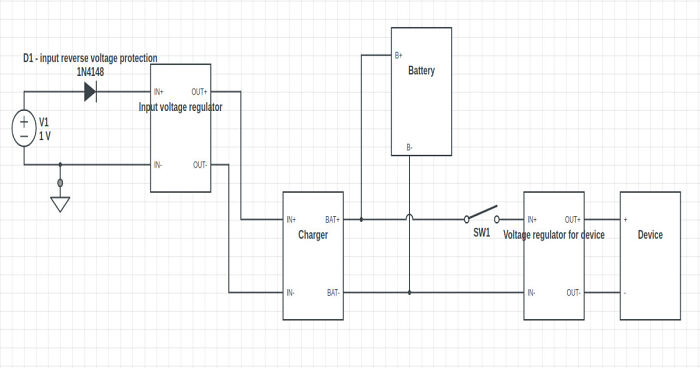
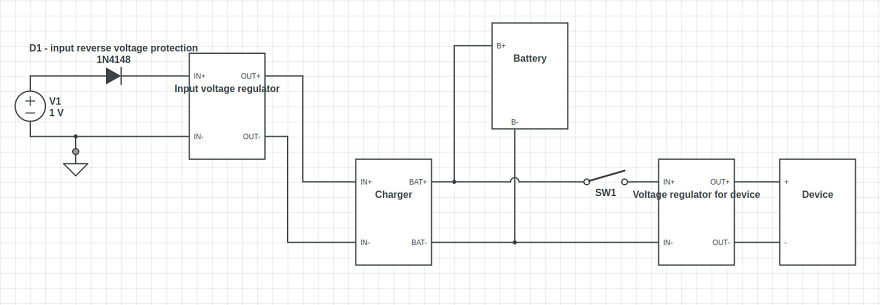
There are cheap battery charger modules available on eBay, Aliexpress, and so. They accept 5V (also have a micro USB connector) and from their output, you can charge the battery cell, and run the device together. If the USB is disconnected, the power is not interrupted.
The charger module also has soldering points for external power, so you can charge the device from any power souce – if it is higher than 5V, just need to stabilize it to 5V. (A protection diode can also be useful, to avoid damages if a power source with reverse polarity is connected.)
It’s useful to have a small switch after the charger module, which you can disconnect the device; in this state, you can charge the device while it’s powered off, and it does not
consuming the battery unnecessarily.
Converting an alkaline-powered device to lithium is not a hard task – below i show some examples, and schematic :)
Parts for the conversion :
Cheap modules for charging :
https://www.ebay.com/sch/i.html?_from=R40&_nkw=li-ion+charger&_sacat=0&_sop=15
Step-down regulators :
https://www.ebay.com/sch/i.html?_from=R40&_trksid=p2334524.m570.l1313&_nkw=step-down&_sacat=0&LH_TitleDesc=0&_sop=15&_osacat=0&_odkw=li-ion+charger
Lithium cells :
https://www.ebay.com/sch/40700/i.html?_from=R40&_nkw=liPo&LH_TitleDesc=0&_sop=15
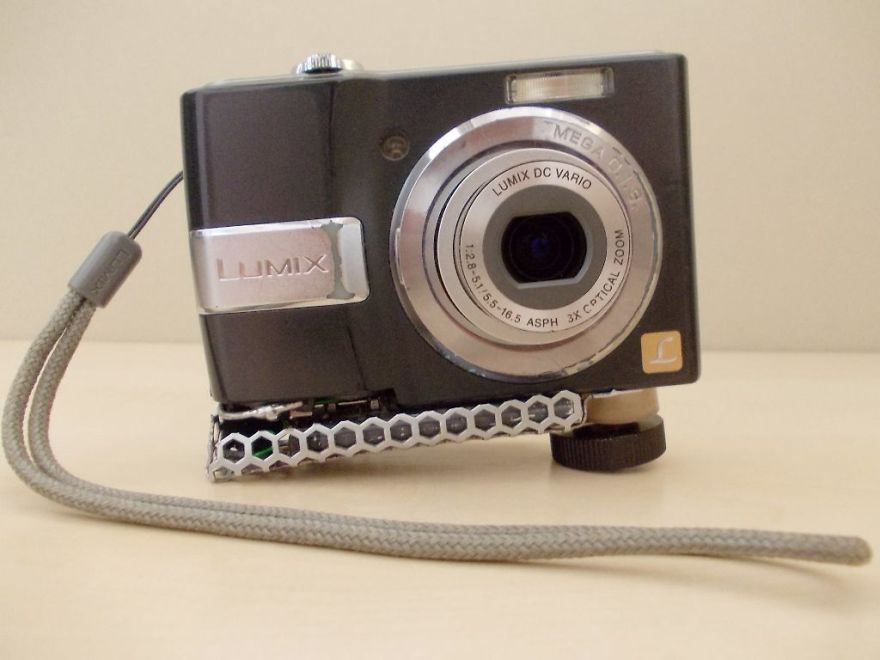
This item has a fault, as it exhausts a CR2032 cell in some minutes – but from rechargeable battery, it runs fine.
It’s a Panasonic DMC-LS80. The battery door was damaged, this gave me the idea to build an external power source.
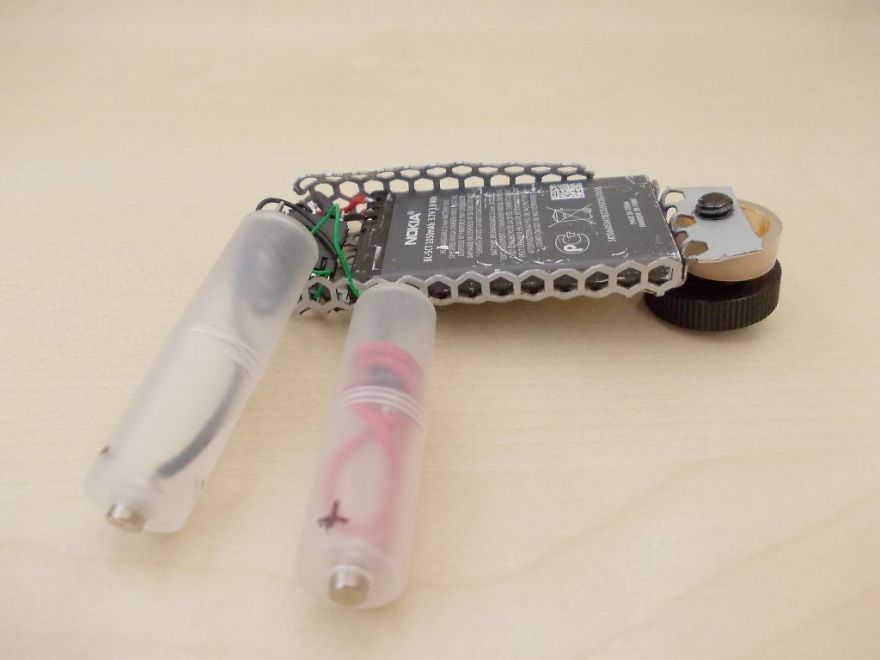
Some days later i added a charger module, so i don’t need to remove the pack for charging. One diode was needed (hidden int the fake AA battery) to lower the 3,8V output to 3,2V.







































 No fees, cancel anytime
 then open in external browser


 and click "Open in External Browser"







0
0