Get Premium
Dark mode theme is available exclusively for premium users. Learn more about the benefits of subscribing.
No fees, cancel anytime.

 Dark Mode Ad-Free Browsing Unlimited Content
 Ad-Free Browsing Unlimited Content Dark Mode
Join 1.2 million Panda readers who get the best art, memes, and fun stories every week!
If you love art that’s atmospheric, emotional, and a little mysterious, 'Dark & Gloomy' is a page you’ll want to explore. Their Instagram feed is full of hauntingly beautiful pieces – from moody portraits to dramatic, almost dreamlike scenes – that grab your attention and linger in your mind long after you scroll.
The page celebrates art created across centuries that embraces the darker side of expression, showing how shadows, contrast, and emotion can tell stories just as powerful as any bright, colorful painting.
In this post, we’ve gathered some of the most striking pieces shared by this community, so scroll down to explore them and get lost in the beauty of the shadows.
Click here & follow us for more lists, facts, and stories.
This post may include affiliate links.
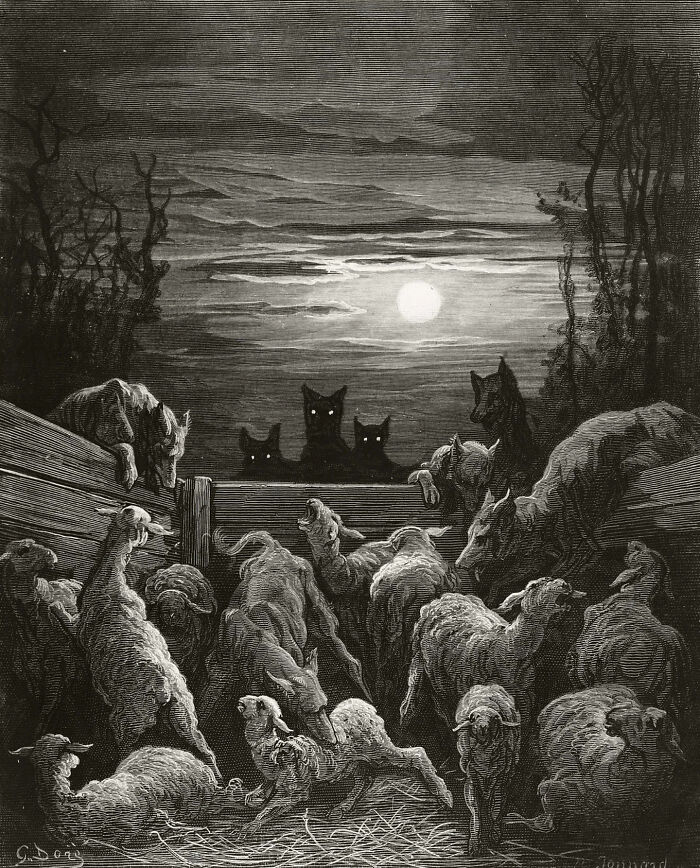
This finely detailed illustration presents a nocturnal pastoral scene charged with restrained dramatic tension. A dense flock of sheep occupies the foreground, rendered with tactile precision, while beyond a simple wooden barrier a pack of wolves emerges from the shadows, their watchful eyes punctuating the darkness. Doré’s commanding use of chiaroscuro and meticulous engraving transforms a familiar fable into a sober moral allegory, exploring themes of vulnerability, latent threat, and the fragile boundary between safety and danger.
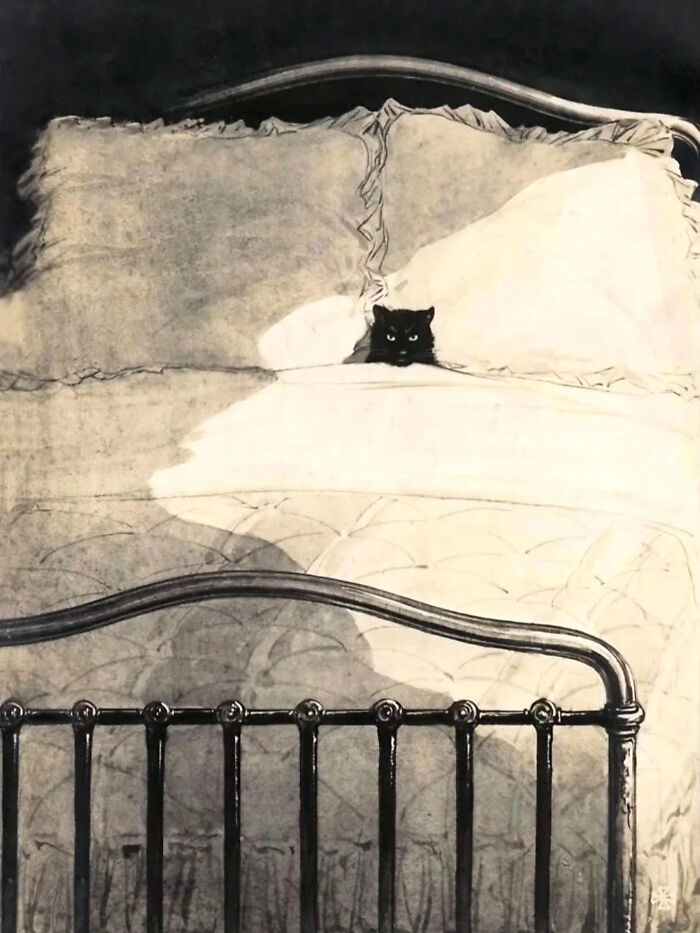
A grumpy black cat peers out from beneath pale bedcovers, its bright eyes fixed in the dim, shadowy room. The stark contrast between the dark iron bedframe and the soft, rumpled pillows creates a quiet, slightly eerie mood. Simple yet expressive, the illustration captures a moment of nocturnal stillness tinged with feline suspicion and charm.
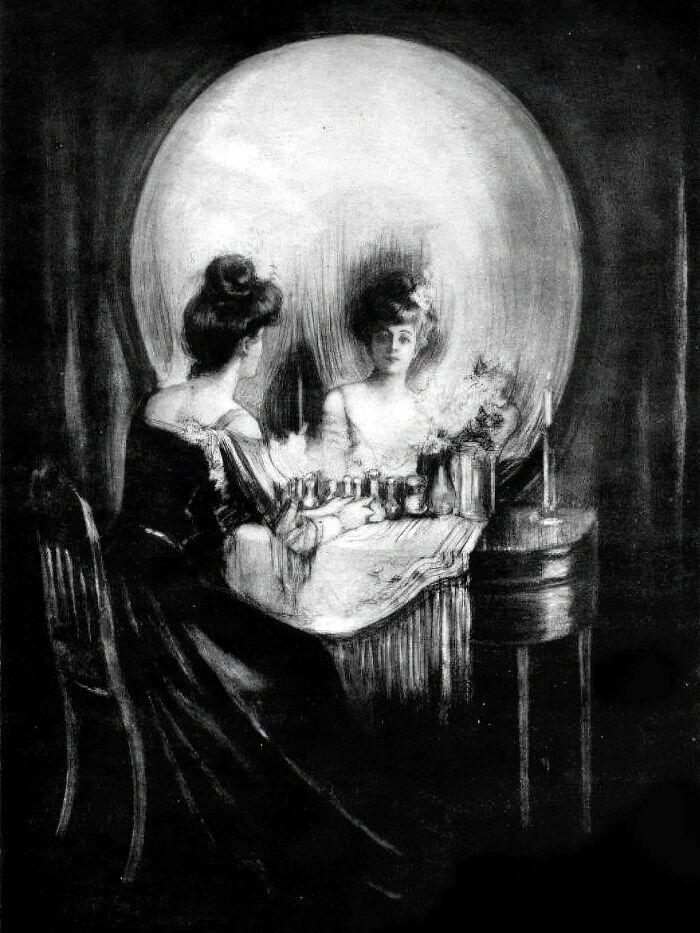
This is an iconic trompe-l’œil composition that deftly unites themes of beauty, illusion, and mortality. Depicting a woman seated at her dressing table, the drawing’s refined arrangement of mirror, furnishings, and reflections simultaneously forms the image of a skull—an elegant memento mori concealed within an everyday domestic scene. Executed with meticulous tonal control and a keen understanding of visual perception, Gilbert’s work stands as one of the most celebrated examples of late-Victorian symbolism, inviting reflection on the transience of youth and the deceptive nature of appearances.
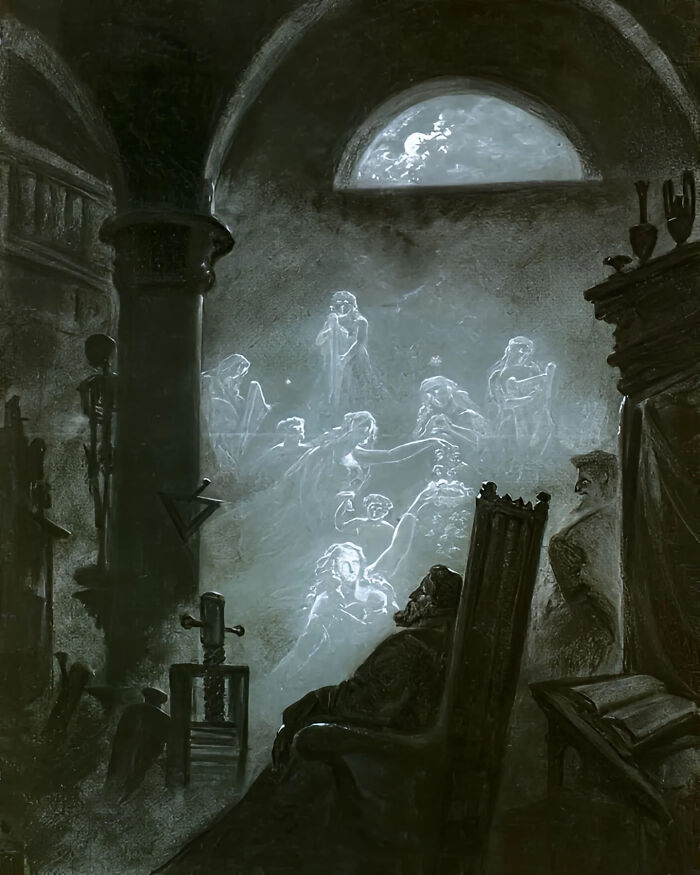
This haunting Romantic vision by Carl Gustav Carus depicts Faust in a shadowed chamber, drifting into a dream state as ghostly, luminous figures materialize from the darkness. Rendered in a restrained monochrome palette, the scene captures the threshold between the physical and the spiritual, a central theme in Carus’s work. The spectral apparitions—ethereal women and symbolic forms—hover in a misty radiance before the slumbering scholar, evoking the profound introspection, yearning, and metaphysical inquiry at the heart of Goethe’s Faust. Rich in atmosphere and psychological depth, the painting exemplifies Carus’s ability to merge poetic mysticism with Romantic-era exploration of the inner self.
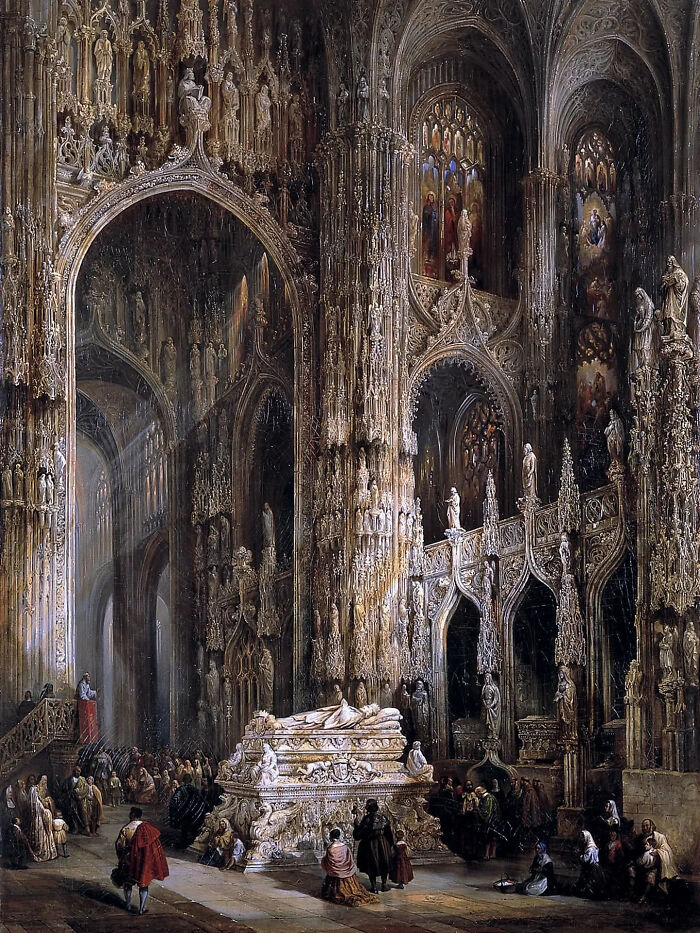
This work presents a richly detailed vision of Gothic architecture, where soaring arches, intricate carvings, and sculptural ornamentation dissolve into a vast, shadowed space. A cool, filtered light penetrates the darkness, illuminating the monumental tomb at the center and heightening the sense of solemnity and reverence. The painting’s deep shadows and towering verticals create a distinctly dark and Gothic atmosphere, transforming the cathedral interior into a dramatic meditation on faith, time, and the overwhelming power of sacred architecture.
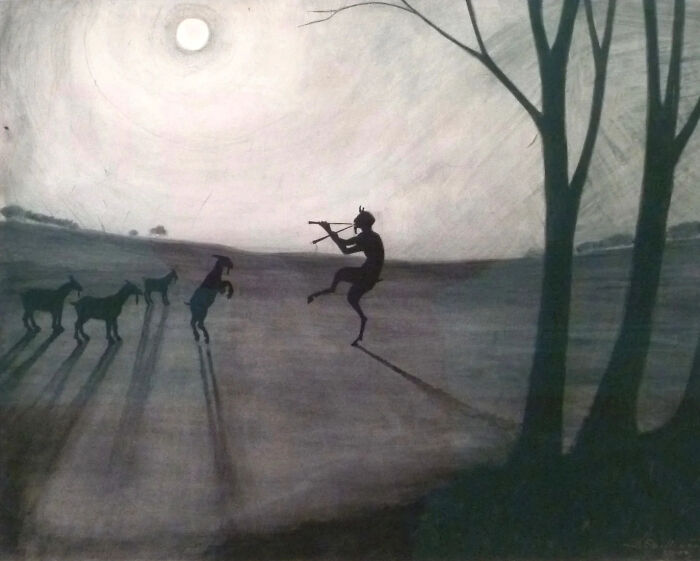
This haunting night scene shows a horned faun playing his pipe as he leads a small group of goats across a silent, empty landscape under a pale, watchful moon. The figures appear as dark, delicate silhouettes, and the long shadows and muted tones give the whole scene a deep sense of stillness and quiet unease. The world feels caught somewhere between reality and dream, where myth seems to wander into the countryside and moonlight turns an ordinary landscape into something strange, lonely, and otherworldly.
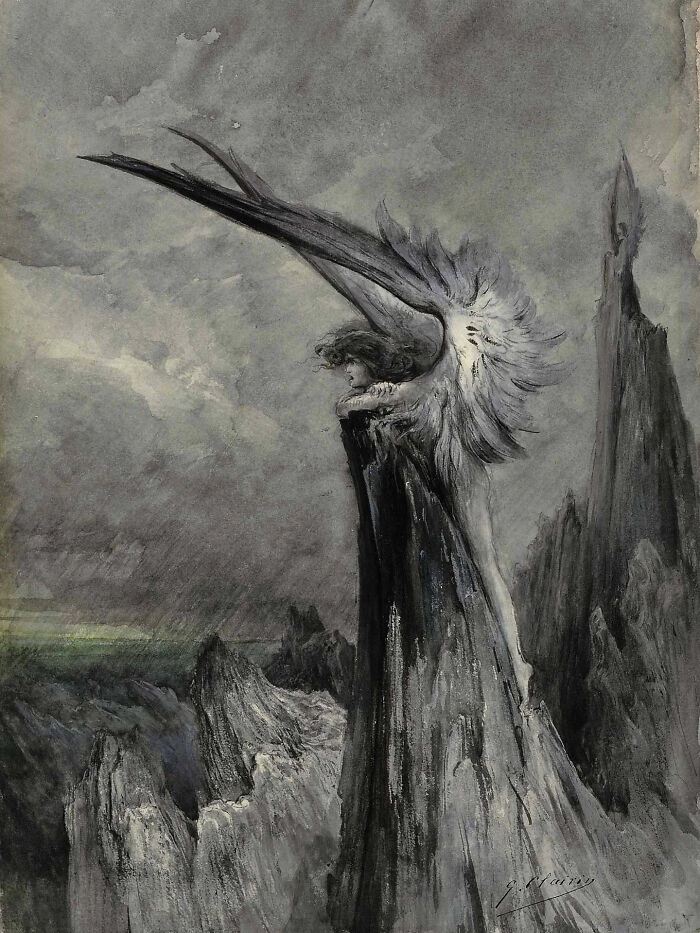
This outstanding work shows a solitary winged chimera poised high above the jagged cliffs of Port Cato on Belle-Île. Her dark, wind swept wings cut through a storm laden sky, while her slightly bowed head, feminine face and flowing form suggest melancholy rather than menace. Rendered in muted greys and blacks, Georges Clairin transforms the coastal landscape into a place of myth and inner turmoil, where the boundary between human emotion and supernatural presence quietly dissolves.
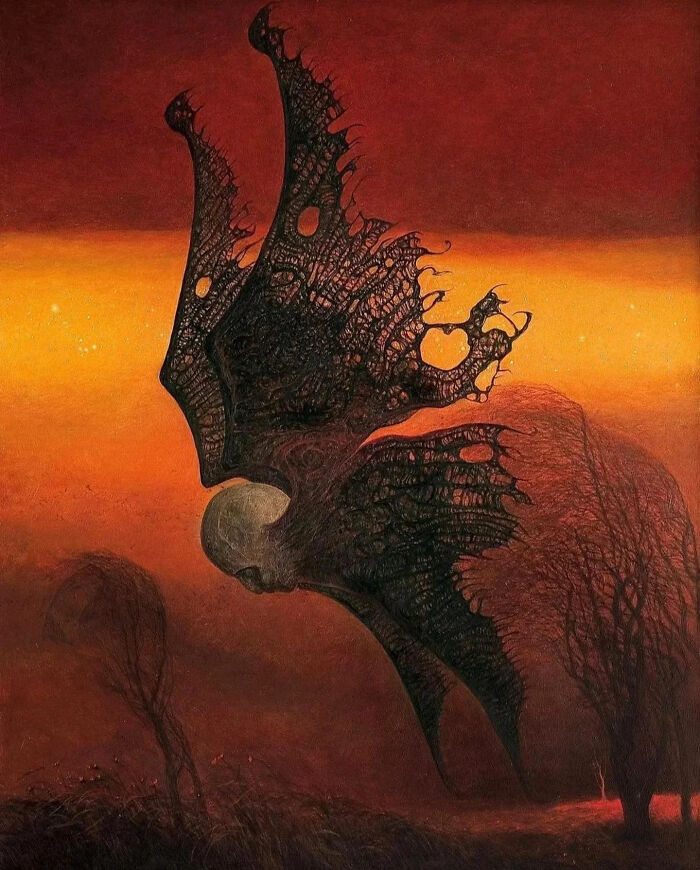
This painting shows a strange, angel-fish-like creature floating through a red, empty sky. Its dark, torn wings resemble rotting flesh, and at its centre is a human skull. The image feels silent and unsettling, blending ideas of death, decay, and flight in a bleak, dreamlike world.
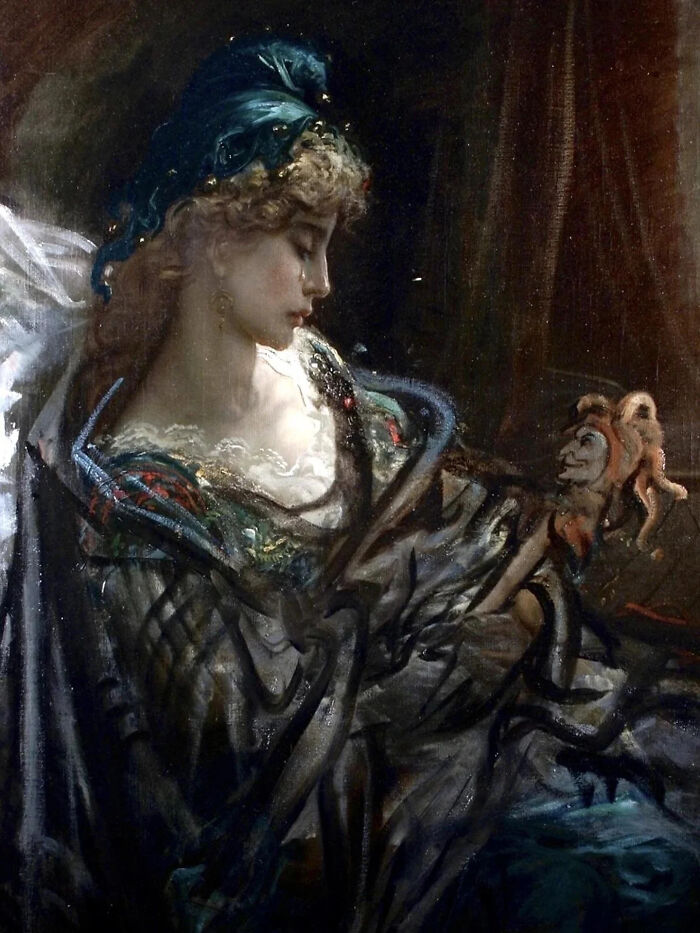
In this haunting late work, Gustave Doré portrays a young woman lost in quiet introspection, her pale face emerging from deep shadow as she studies a small jester figure in her hand. A single tear runs down her cheek, adding a note of sorrow that deepens the painting’s psychological intensity. The contrast between her delicate, luminous presence and the unsettling puppet suggests the fragile boundary between reason and madness. Dramatic light and fluid brushwork create an atmosphere of melancholy and emotional tension, transforming an intimate moment into a reflection on illusion, grief, and the human mind
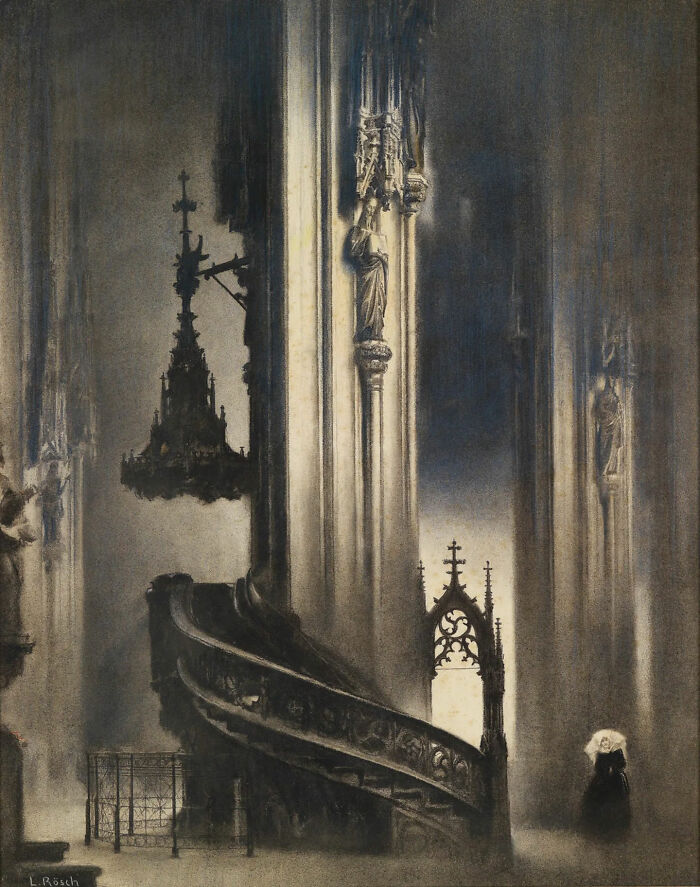
This atmospheric illustration shows the vast interior of a Gothic cathedral. Tall columns rise into shadow while a curved stone staircase leads up to the ornate Pilgrim Pulpit. Soft light filters through the arches, revealing carved statues and delicate Gothic details. Near the base of the pillars stands a solitary nun, her white headdress faintly catching the light. Her small figure emphasizes the immense scale of the cathedral, adding a quiet sense of devotion and stillness. Rösch’s muted tones and soft shading create a mysterious, almost dreamlike mood within the silent sacred space.
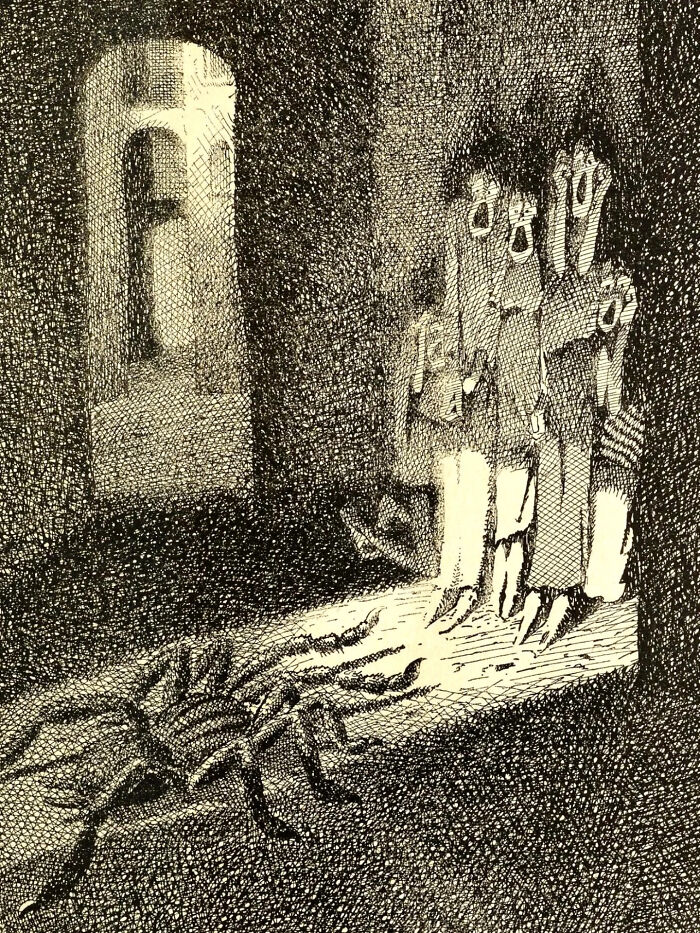
This stark, claustrophobic illustration presents a narrow interior crowded with mask like figures, their rigid postures and empty expressions creating an atmosphere of quiet dread. In the foreground, a skeletal body lies exposed, intensifying the sense of fear and unease. The compressed space and strong contrasts heighten the psychological tension, transforming the scene into a haunting image of anxiety and moral disturbance.
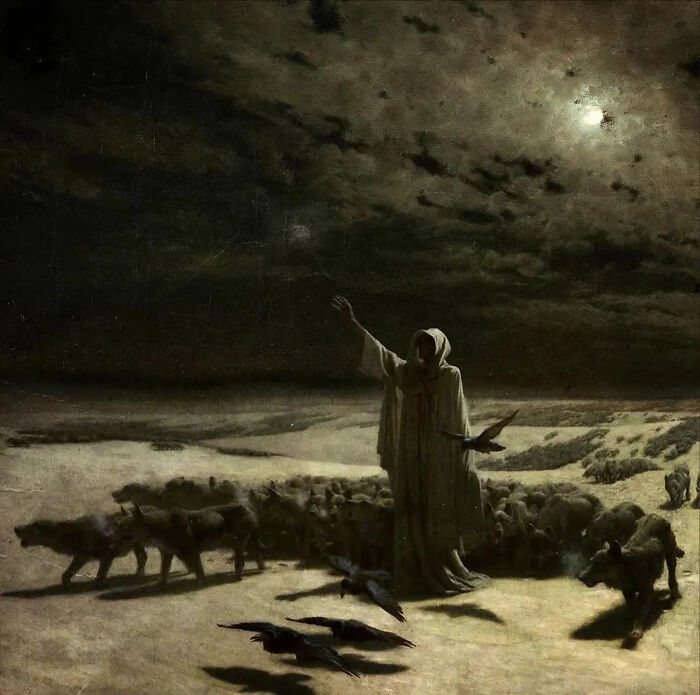
In "Famine", John Charles Dollman shows a dark, haunting night scene filled with silence and fear. Under a cold moon, a ghost like figure resembling "Death" leads a pack of wolves across a barren landscape, symbolising hunger and the approach of suffering. Deep shadows, empty space, and muted colours create a chilling atmosphere, turning the painting into a powerful image of survival, mortality, and nature at its most unforgiving.
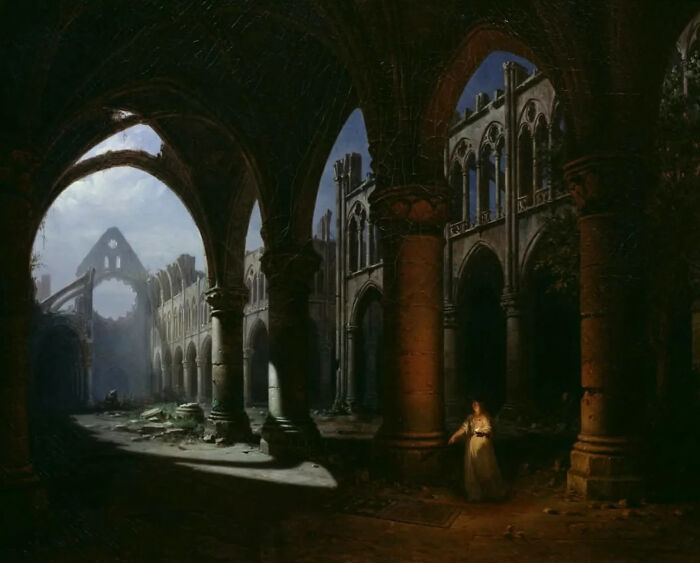
This atmospheric painting shows the shattered interior of a Gothic abbey, its towering arches and broken vaults opened to a pale, distant sky. Amid the vast ruin, a solitary woman holding a small light stands in the shadows, her fragile presence contrasting with the cold stone and silence around her. Sebron uses light and scale to evoke loss, time’s passage, and the quiet melancholy of faith and human life lingering within decay.
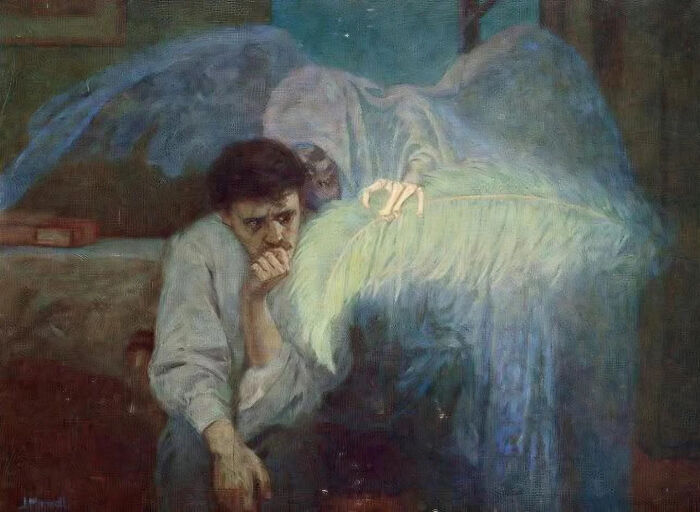
This haunting, dream like composition portrays a sorrowful, inward looking man whose drawn, shadowed face bears the marks of profound fatigue and despair. Next to him a spectral figure—often interpreted as an "angel of death"—inclines toward him, murmuring something into his ear. The luminous, flowing presence both envelops and oppresses him, heightening the tension between fragile human vulnerability and an inescapable spiritual force. Executed in subdued tones of blue and green with softly dissolving contours, the painting becomes a restrained yet deeply affecting meditation on grief, resignation, and the threshold between consolation and surrender.
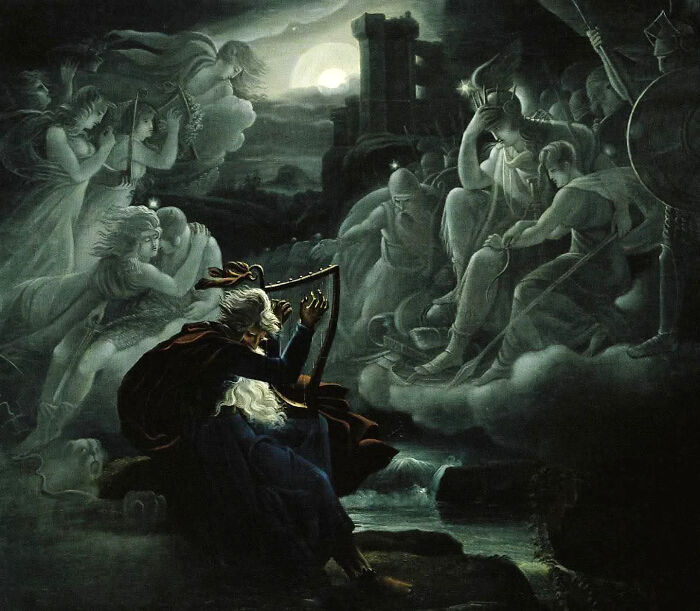
This work presents the legendary bard seated by a moonlit river, summoning spirits from the shadowed past. Draped in dark robes, Ossian bends over his harp as ghostly warriors and ethereal maidens emerge from mist and ruin around him. Bathed in a cold, silvery glow, the scene blends melancholy, memory, and myth, capturing the Romantic fascination with lost heroes and the haunting power of song.
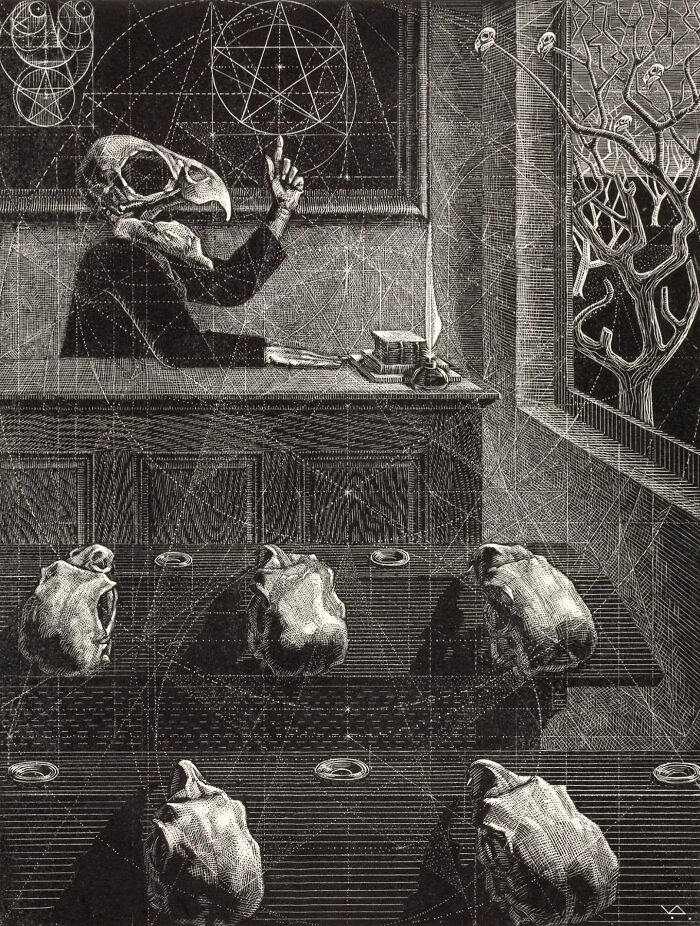
This work presents a surreal and unsettling classroom where human order has been replaced by something ritualistic and otherworldly. Rows of silent "students", reduced to bird-like skulls, sit facing a "teacher" who gestures toward a geometric, star-shaped diagram resembling an occult or satanic symbol drawn upon the board. The precise etched lines and cold, scientific setting contrast with the eerie figures, creating a disturbing fusion of reason and mysticism. Delhez transforms an ordinary place of learning into a dreamlike vision of forbidden knowledge, where education feels less like instruction and more like initiation into a dark, symbolic doctrine.
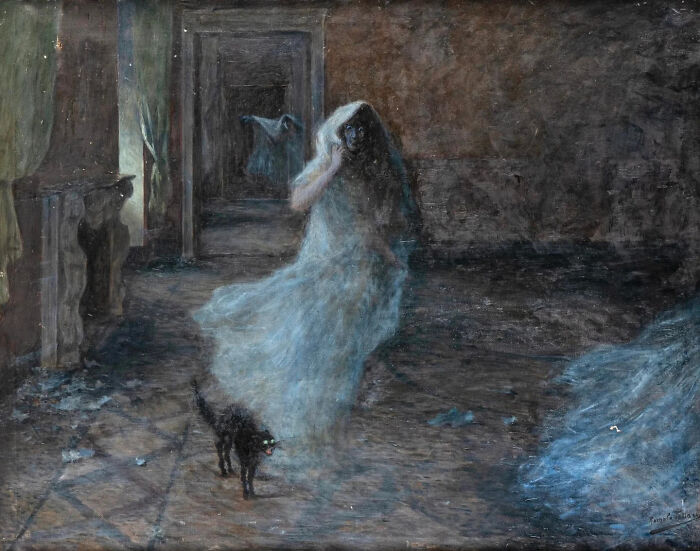
In this haunting meditation on decay and the supernatural, Tessari evokes the spectral poetry of an abandoned interior. A phantom like woman, draped in gauzy, diaphanous folds, glides soundlessly through the desolate hall, her form mirrored by distant apparitions dissolving into shadowed thresholds. A black cat, its eyes glinting with eerie luminescence, punctuates the scene with a note of living menace. Through his restrained palette and ethereal brushwork, Tessari transforms the derelict palace into a liminal realm where memory, melancholy, and the unseen converge.
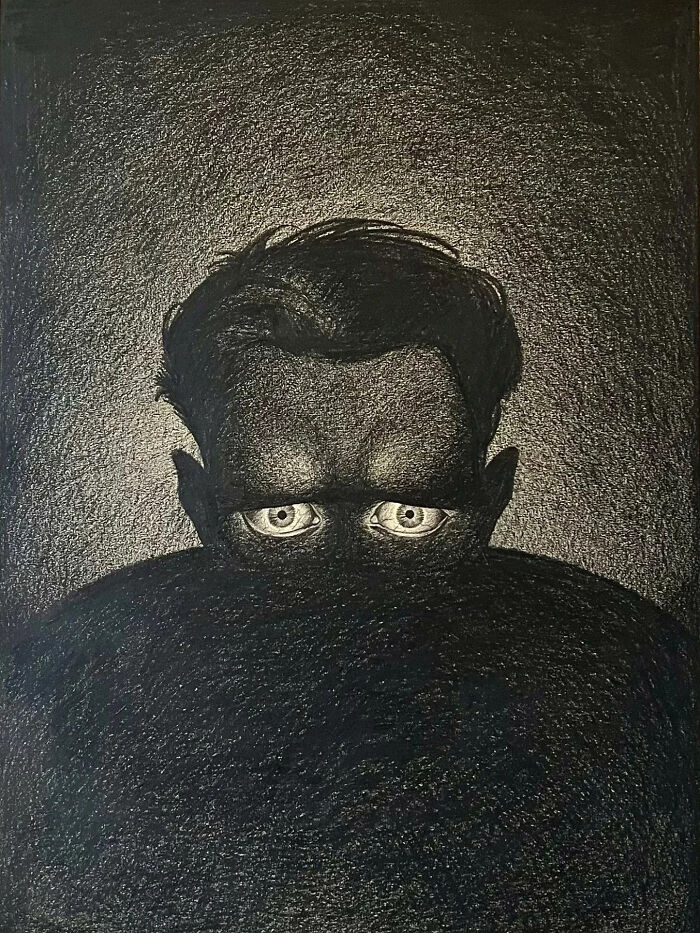
This striking drawing presents a solitary figure engulfed in shadow, his pale, unblinking eyes emerging from a void like darkness. Through intense chiaroscuro and refined tonal control, Goeller evokes a powerful sense of psychological unease and existential isolation, distilling mid-century anxieties into a stark, haunting vision.
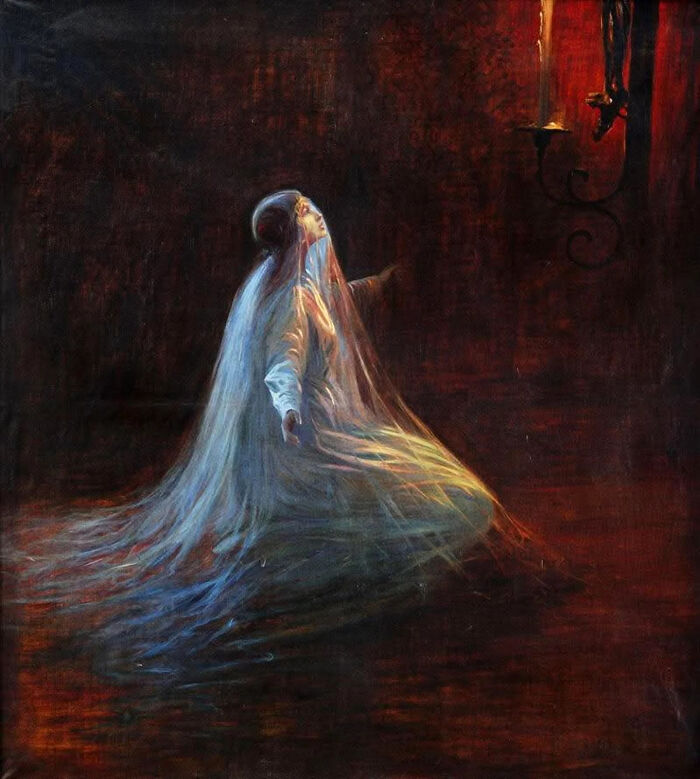
In this quietly luminous Symbolist work, a veiled female figure appears to crouch beneath a statue of Christ, her body turned upward in silent devotion. Soft, flowing brushwork and prismatic light dissolve her form into the surrounding darkness, heightening a sense of humility and inward reflection. The deep reds and cool blues create an atmosphere of spiritual stillness, suggesting a private moment of prayer and surrender before the sacred.
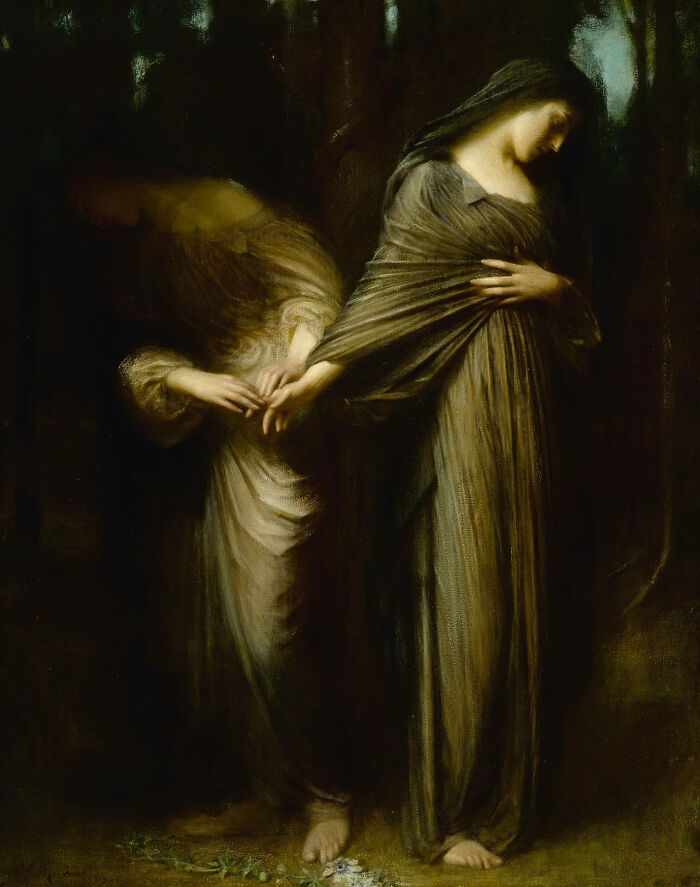
This painting presents a haunting, symbolist vision of parting and inner fracture. A solitary female figure appears doubled, her form dissolving into a ghostly echo that gently withdraws, suggesting the painful separation of self, memory, or love. Rendered in muted, shadowed tones and softened contours, the painting conveys an atmosphere of quiet sorrow and emotional suspension. Hacker’s subtle use of motion and blurred edges transforms the farewell into a psychological moment—intimate, dreamlike, and steeped in melancholy introspection.
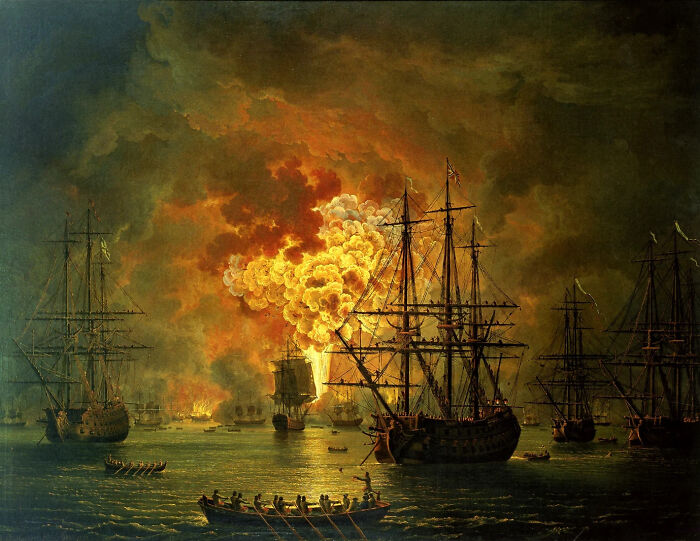
This dramatic painting depicts the catastrophic destruction of the Ottoman fleet during the Battle of Chesme in July 1770, a decisive naval victory for the Russian Empire in the Russo-Turkish War (1768–1774). Hackert captures the moment of chaos and annihilation as fire and explosions tear through the anchored Turkish ships, turning the night sky into a blazing inferno reflected on the water below. The towering plumes of smoke and flame, set against the dark silhouettes of warships and fleeing boats, convey both the scale of the disaster and the terrifying power of naval warfare in the age of sail. The scene stands as a vivid monument to one of the 18th century’s most decisive and destructive naval engagements.
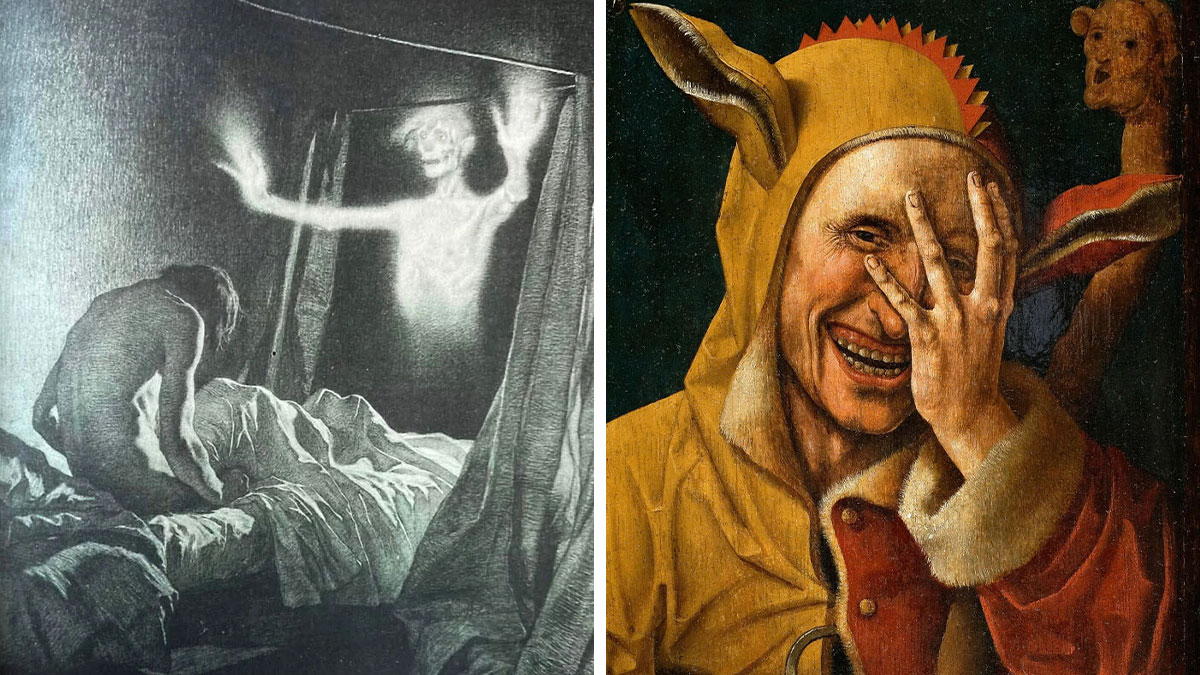
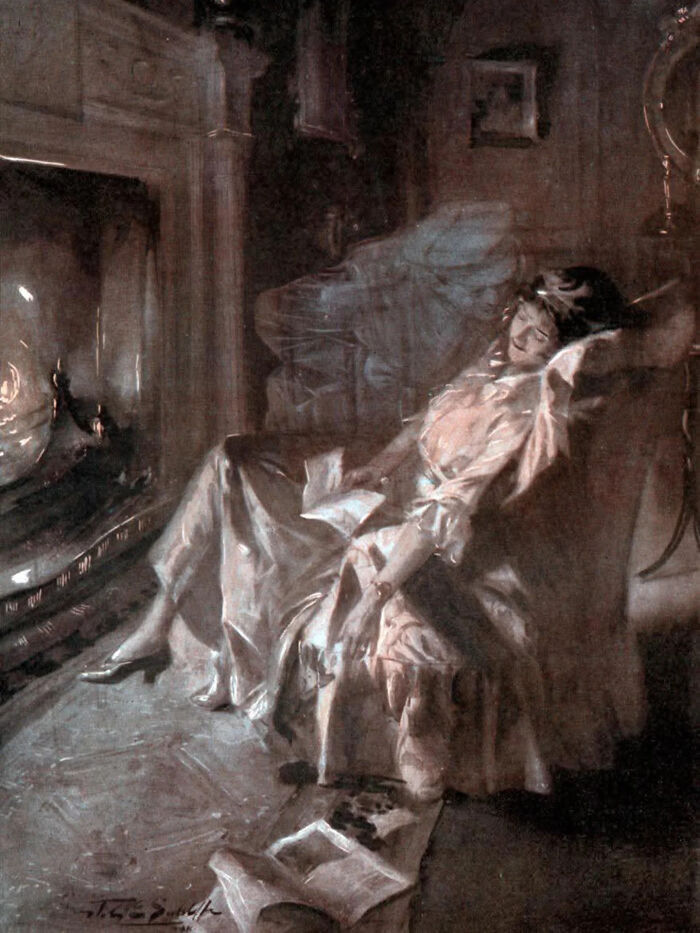
This is a quiet and deeply emotional scene shaped by the grief of the First World War. A woman sleeps peacefully beside a glowing fireplace, unaware as the ghostly figure of her husband — lost in the trenches — leans toward her to give a final, tender kiss. Rendered in soft tones and gentle light, the painting blends reality and memory, capturing the lingering presence of love beyond death and the haunting sorrow carried by those left behind.
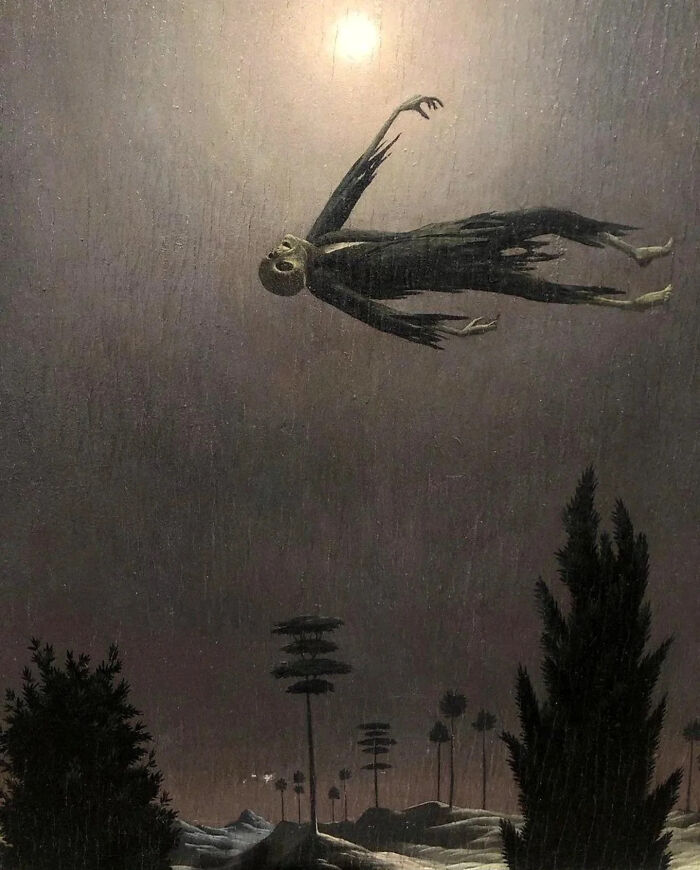
This painting presents a haunting, dreamlike vision of a spectral figure suspended in the night sky above a desolate landscape. Rendered in muted, atmospheric tones, the elongated form appears weightless and uncanny, its rigid posture and skull like face heightening a sense of unease. Below, sparse trees and a barren terrain recede into darkness, reinforcing the painting’s quiet isolation. Blending elements of New Objectivity and Surrealism, Sedlacek evokes a disturbing yet poetic meditation on the unknown, mortality, and the fragility of human presence.
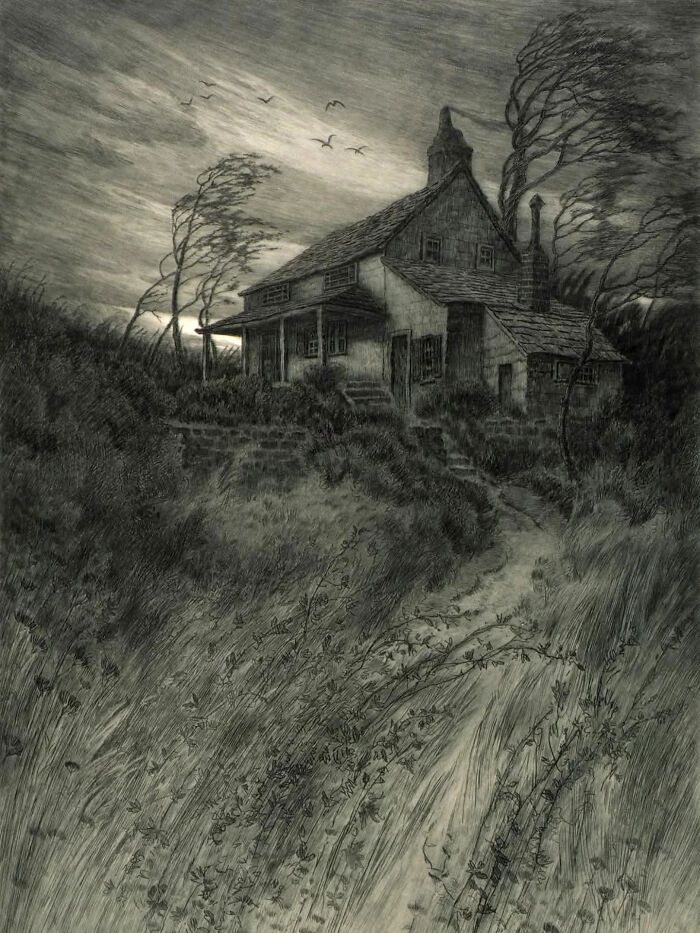
Mielatz’s etching presents a remote house caught in the grip of an unforgiving wind, its fragile silhouette barely holding its ground against the restless landscape. The sweeping movement of the grasses and the contorted trees fills the scene with a sense of tension and unease, as if the air itself were charged with quiet violence. Rendered in dark, searching lines, the house appears isolated and vulnerable, suspended between habitation and abandonment. The narrow path leading toward it invites the viewer forward, yet only deepens the feeling of solitude, turning this rural scene into a haunting reflection on exposure, persistence, and nature’s quiet dominance.
You Might Also Like: 30 Facts About Pandas To Confirm Their Cuteness



































 No fees, cancel anytime