Get Premium
Dark mode theme is available exclusively for premium users. Learn more about the benefits of subscribing.
No fees, cancel anytime.

 Dark Mode Ad-Free Browsing Unlimited Content
 Ad-Free Browsing Unlimited Content Dark Mode
Join 1.2 million Panda readers who get the best art, memes, and fun stories every week!
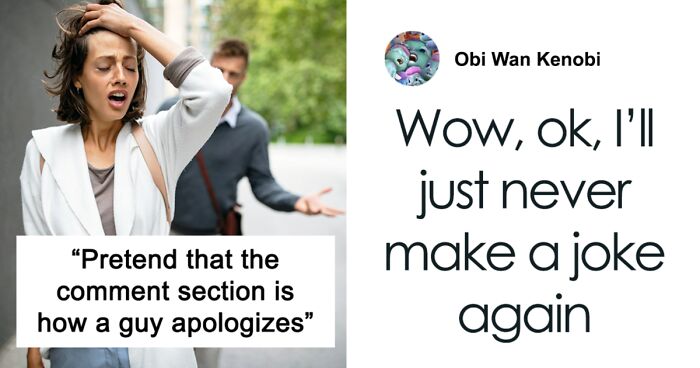


Nobody’s perfect, and everyone messes up from time to time—it’s only human. But a huge part of being a decent person is taking responsibility for your mistakes, learning from them, and also offering an apology if it’s needed. Though, truth be told, not everyone’s good at owning up to what they’ve done—they either get defensive or their ego gets in the way.
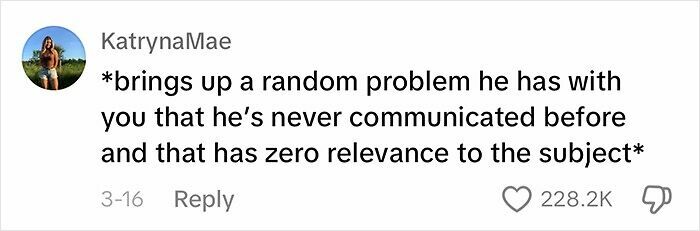
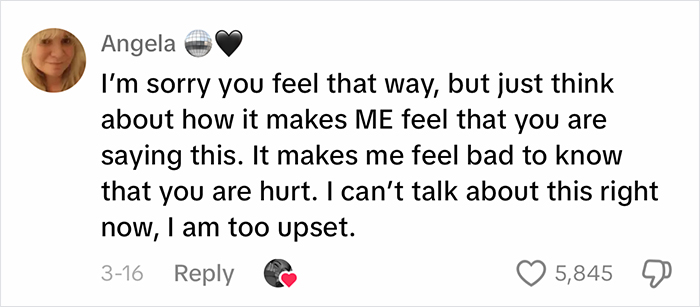
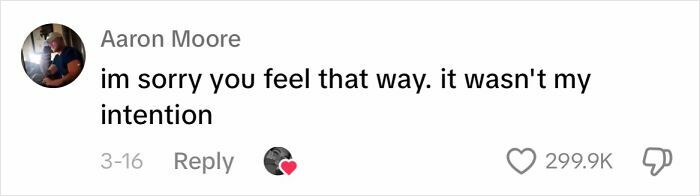
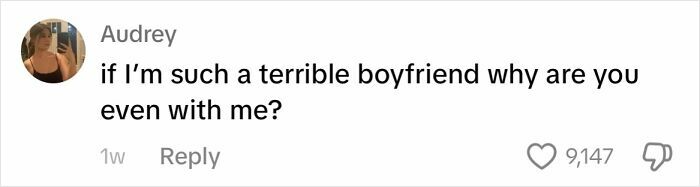
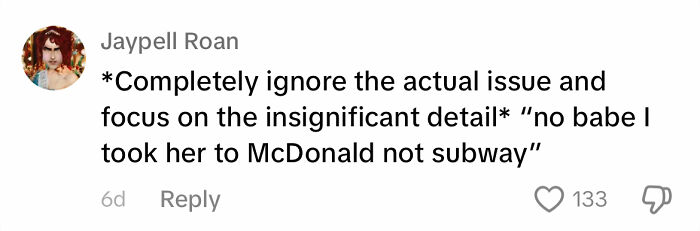
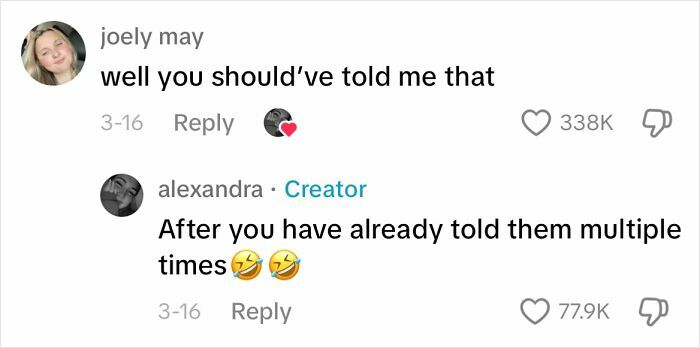
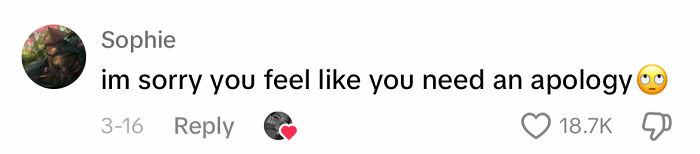
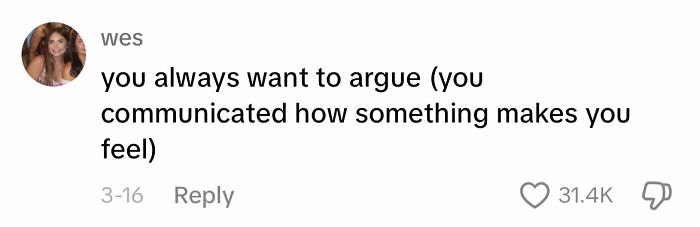
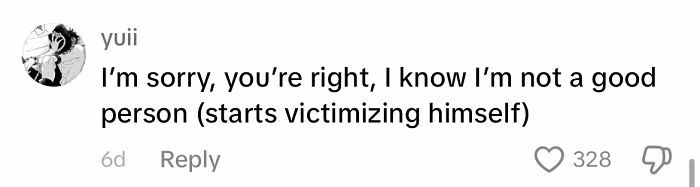
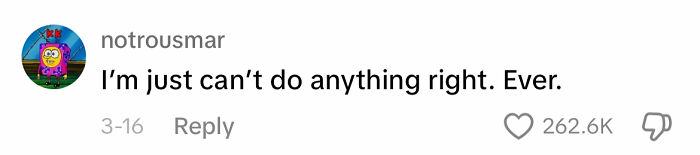
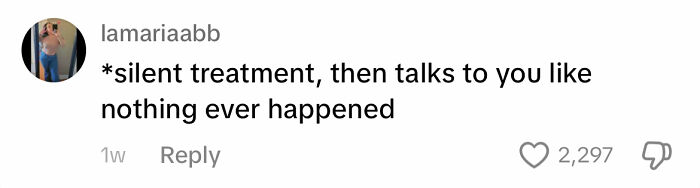
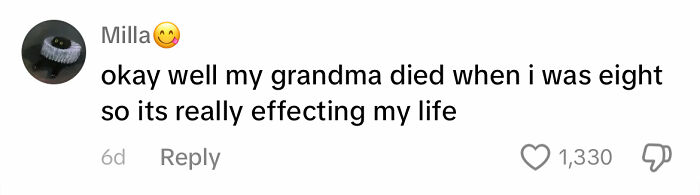
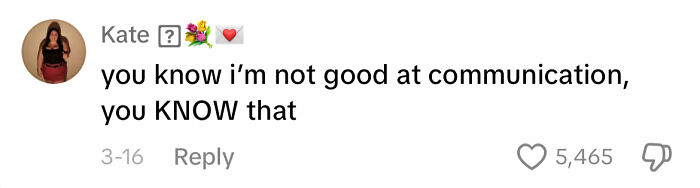
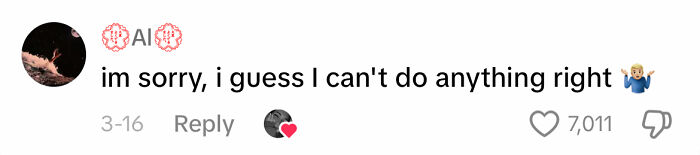
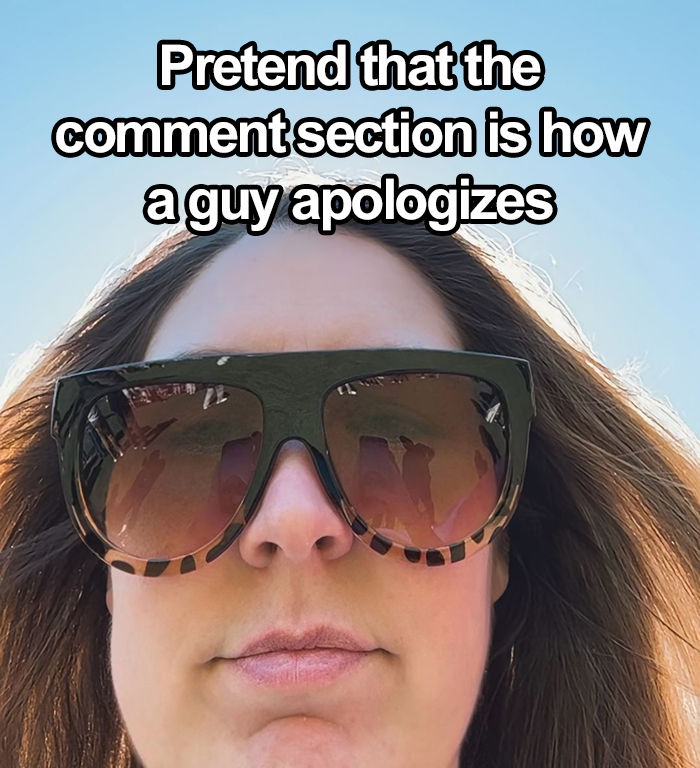
Internet user Alexandra (@alexccarterr) went massively viral online after inviting everyone to pretend that the comment section of her post is how guys apologize. Many of the responses she got were hilarious, frustrating, eerily accurate, and sparked a wider discussion about apologies in general. We’ve collected some of the best comments to share with you. Keep scrolling to read them.
Bored Panda reached out to Alexandra, who sparked the massive online discussion, and she was kind enough to share her thoughts on good and bad apologies with us. You'll find our full interview with her below.
This post may include affiliate links.
We were curious about what inspired Alexandra to make the post in the first place and whether she expected such a huge response to it. She told Bored Panda that the internet's response was a complete surprise.
"Honestly. It was a random post that I thought would maybe get my normal 300-view range. I did not expect it to get that much attention," she said.
"I already had a few comments that I knew someone would say. Like the 'idk what you want me to say.' I think it was just something a lot of people related to with men having a hard time expressing emotions and feelings," Alexandra told us.
We asked Alexandra for her perspective on what lies at the core of a proper apology. She was happy to share her thoughts on this.
"While saying 'sorry' is sometimes hard, I feel that a true apology is acknowledging that someone feels the way they do," she opened up to Bored Panda.
"You don’t always have to understand why someone may feel a certain way. You can say 'sorry' without downplaying or neglecting someone’s feelings just because you don’t understand why."
Alexandra also urged everyone to "always be kind," no matter what.
It would be an understatement to say that Alexandra’s post was popular. It was a huge success and literally reached millions of people around the globe. It just goes to show how much a relatable topic with room for humor really resonates with people.
At the time of writing, her post was viewed 17.7 million times on TikTok. What’s more, it got more than 1.9 million likes and 184.1 thousand comments. Bored Panda has reached out to Alexandra via Instagram for further comment about the popularity of her post, and we’ll update the article as soon as we hear back from her.
The Harvard Medical School notes that it’s still important to apologize when you’ve hurt or angered someone, even if you don’t believe what you said or did was bad. The same goes for situations where you believe you’re fully in the right and the other person is completely in the wrong: an apology can go a long way.
It’s also important to let go of your ideas about who’s right and wrong in the situation and to put yourself in the other person’s shoes. Understanding another person’s experiences is a core part of emotional intelligence, which, in turn, lies at the foundation of healthy and productive relationships.
Naturally, an apology doesn’t really matter if it’s not genuine. If you don’t mean it, why bother saying ‘sorry’ at all? When your apology is genuine, not only do you acknowledge your responsibility for your actions, but you also validate the other person’s (hurt) feelings.
In short, a real apology shows not only that you’re sorry and that you care about the other individual but that you’re also going to make amends and avoid similar mistakes in the future.
Psychiatrist and apology expert Dr. Aaron Lazare explained that good apologies have four elements.
First, you have to acknowledge the offense and confirm that your behavior was unacceptable. One potential pitfall to avoid here is the use of vague or evasive language. You should not word your apology in a way that minimizes your offense or the victim’s level of hurt.
Secondly, you should take the time to explain exactly what happened. However, you have to balance things delicately here. You want to offer an explanation without seeming like you’re excusing your behavior.
With that in mind, the Harvard Medical School points out that sometimes the best strategy is to say that “there is no excuse.”
The third element of a truly good apology is to express remorse. In short, if you really regret your decision and feel ashamed, you should speak up. The last element is offering to make amends.
This is fairly straightforward if you’ve physically damaged someone’s things or property; you offer to pay to get it repaired or replace the item. However, when you’ve hurt someone’s feelings, you should acknowledge the pain they felt while promising to do better moving forward.
Reporting on the book ‘Sorry, Sorry, Sorry: The Case for Good Apologies,’ by Marjorie Ingall and Susan McCarthy, NPR states that there are six and a half steps to making great apologies.
For one, you should say that you’re actually sorry, not that you’re devastated or that you regret something. Furthermore, you should be specific about what it is you’re apologizing for.
Next, you want to take ownership of your behavior, avoid making excuses, and explain why your mistake won’t happen again in the future. You should also make reparations for your mess-up.
The last (half of a) step when apologizing is to genuinely listen to the person you’ve hurt so they can have their say.
According to Ingall, using the word ‘regret’ is all about how you feel while ‘sorry’ is about how the other person feels. In other words, it’s vital to “keep the other person’s feelings at top of mind.”
A genuine apology can be very powerful even if it comes late, helping people heal and move on.
How good would you say you are at apologizing, dear Pandas? How often do you run into people who make half-baked apologies or try to twist the situation in their favor? What is the very best apology that you’ve ever received?
Why do you think people find it so difficult to take responsibility for their actions? If you have a free moment, share your thoughts in the comments below.

My ex-husband was a professional narcissist so obviously he was never ever wrong. Even when I could prove myself 100% correct he would twist things to make it look like I was in the wrong. He never said he was sorry (because in his mind there was nothing to say sorry about). His way of apologising was to buy me an expensive gift. Or when he'd finished shouting, stamping, throwing things around and smashing things up I would leave the room and then he would call out in a really cheerful voice, "Do you fancy going to the cinema?" Or "Shall we go out to a restaurant? I'll take you a club later."

I've heard every single one of these posts come out of a woman's mouth.
My ex-husband was a professional narcissist so obviously he was never ever wrong. Even when I could prove myself 100% correct he would twist things to make it look like I was in the wrong. He never said he was sorry (because in his mind there was nothing to say sorry about). His way of apologising was to buy me an expensive gift. Or when he'd finished shouting, stamping, throwing things around and smashing things up I would leave the room and then he would call out in a really cheerful voice, "Do you fancy going to the cinema?" Or "Shall we go out to a restaurant? I'll take you a club later."
I've heard every single one of these posts come out of a woman's mouth.
























 No fees, cancel anytime