21 People On Twitter Engage In A Viral Discussion Pointing Out How Having To Explain Resume Gaps In A Job Interview Is “Infuriating”
Job interviews are a stressful deal, especially when you’re going back to the workforce after taking a break, for whatever reason that may be. Now, we all have our struggles in life and no path is the same. The same goes for taking a gap from whatever activity in your life, be it university or a job—we all have our reasons, and they’re all valid.
Apparently, some people who are going to job interviews find the questions about resume gaps “infuriating.” The discussion began on Twitter when one young woman shared her opinion about the need to explain resume gaps in a job interview.
More info: Twitter
A thread on Twitter has gone viral where people point out that asking about resume gaps in interviews is unethical
Image credits: unknown
Assuming you have experience in attending job interviews (because not everyone does), which question do you find the most annoying? Unethical, maybe? Apparently, for some people, it’s the request to explain gaps in your resume.
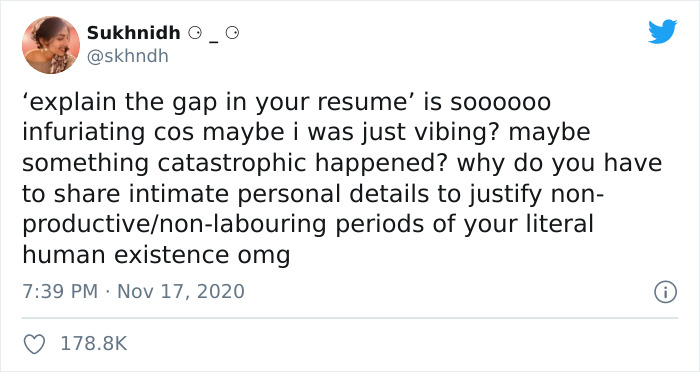
The now-viral discussion was sparked by a young woman on Twitter under the username @skhndh. In her tweet, she shared how she finds the request to explain the gap in her resume “infuriating.”
“Maybe something catastrophic happened? Why do you have to share intimate personal details to justify non-productive/non-labouring periods of your literal human existence,” her tweet continued. The post was met with wide approval, having amassed over 179k likes in just a few days.
The now-viral discussion began on Twitter
Image credits: skhndh
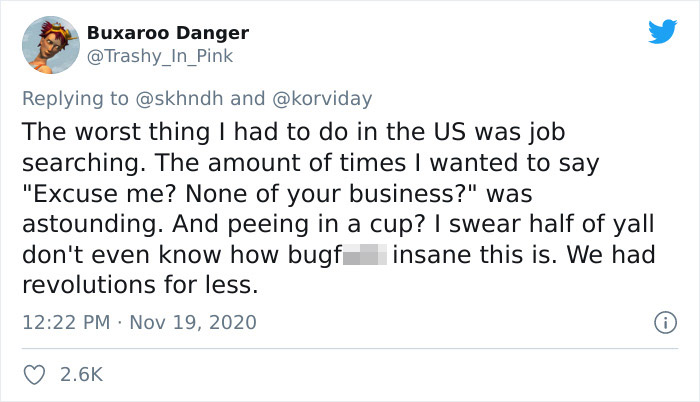
Many people were quick to agree with the original post
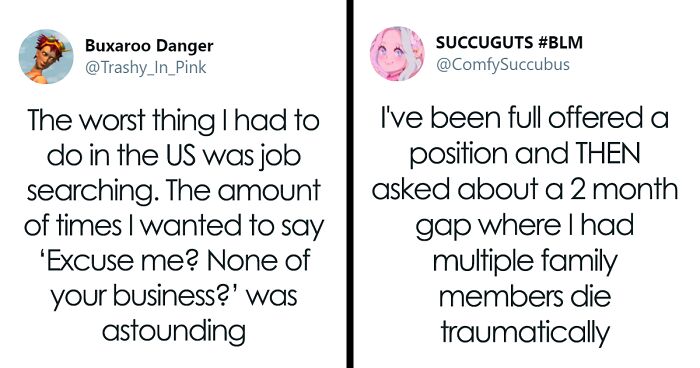
Image credits: Trashy_In_Pink
When discussing gaps in resumes, most people were on the same page—they felt like the question is not something they enjoyed answering due to their own, personal reasons.
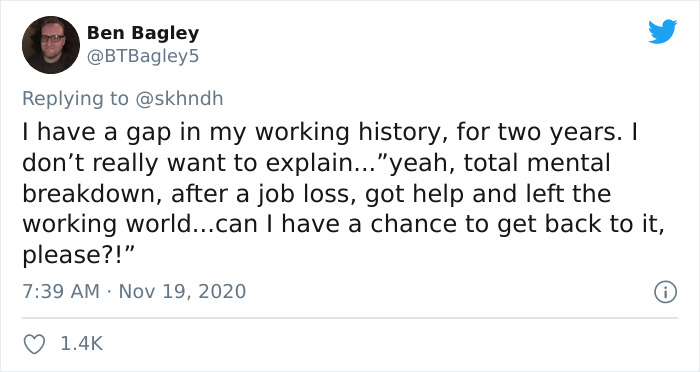
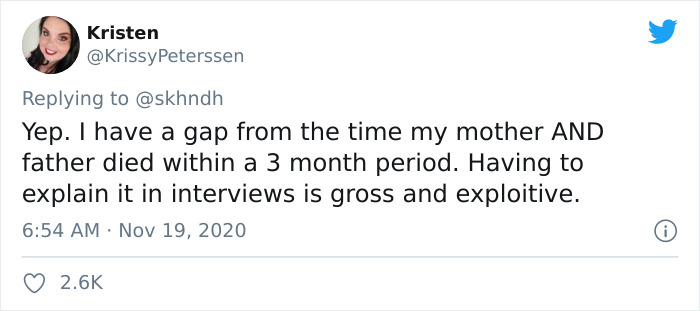
“I don’t really want to explain…” one Twitter user wrote, sharing how their resume gap was due to a “total mental breakdown.” Another woman shared how her gap came from the time her parents died within a 3-month period. According to her, having to explain it in interviews feels “gross and exploitive.”
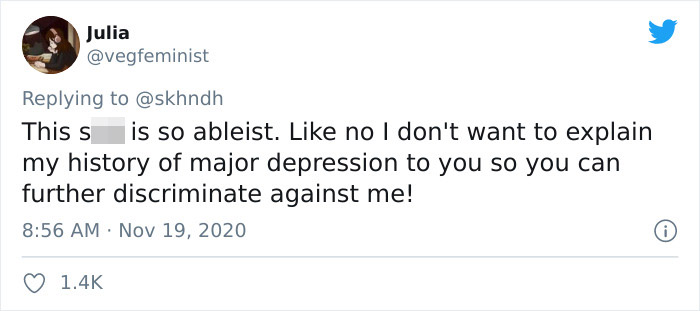
One Twitter user went even further and described the request to explain the gap as “ableist.” “Like no I don’t want to explain my history of major depression to you so you can further discriminate against me,” they continued in their tweet.
Image credits: BTBagley5
“Having to explain it in interviews is gross and exploitive”
Image credits: KrissyPeterssen
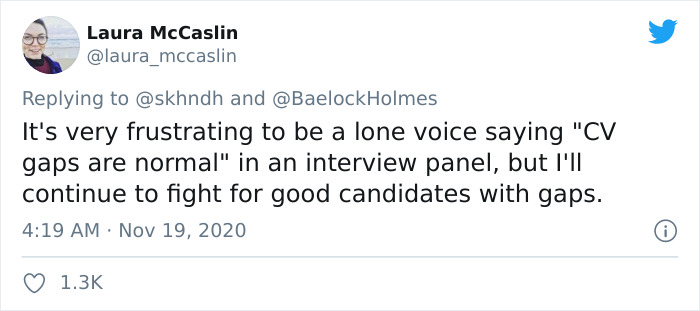
Image credits: laura_mccaslin
“This [crap] is so ableist”
Image credits: vegfeminist
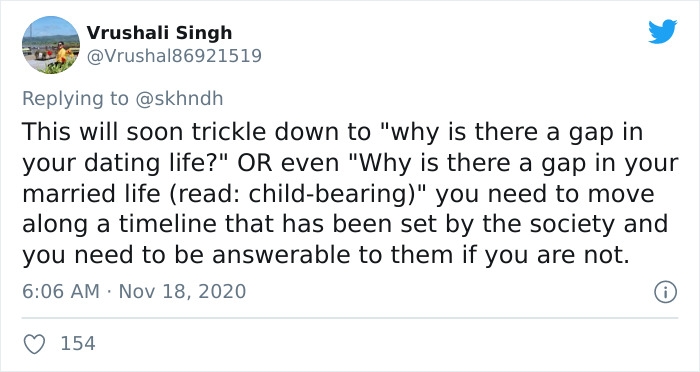
One Twitter user felt that the policing of personal lives in job interviews might go to even more extreme lengths. “This will soon trickle down to ‘why is there a gap in your dating life?’ OR even ‘why is there a gap in your married life (read: child-bearing)’ you need to move along a timeline that has been set by the society and you need to be answerable to them if you are not,” they wrote sarcastically.
Image credits: Vrushal86921519
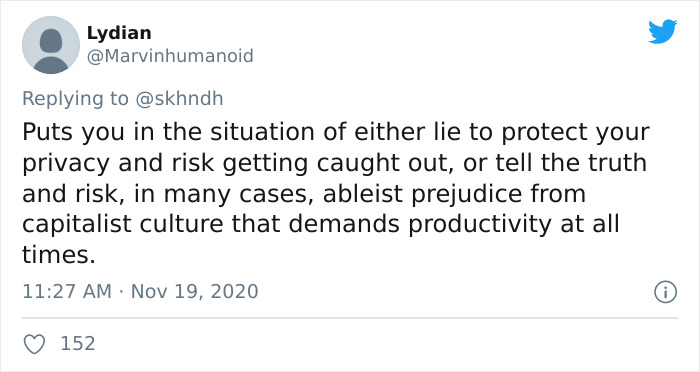
“Puts you in the situation of either lie to protect your privacy or tell the truth and risk prejudice”
Image credits: Marvinhumanoid
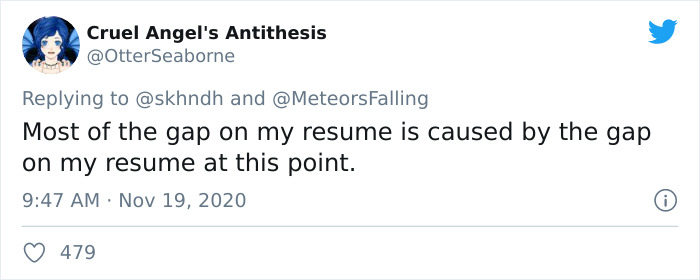
Image credits: OtterSeaborne
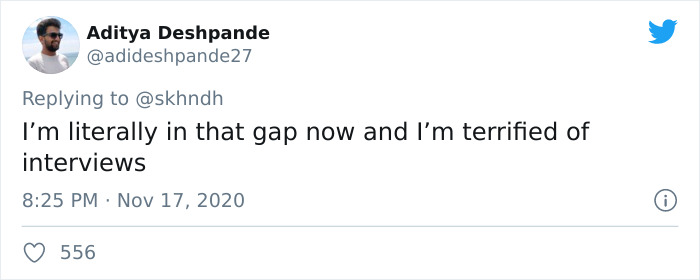
Image credits: adideshpande27
Others shared tactics on what to do when you’re told to explain the resume gap
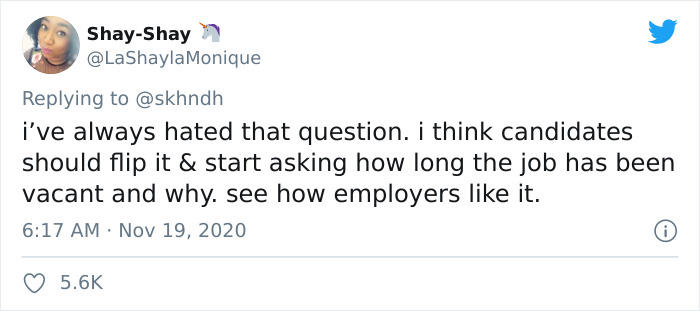
Image credits: LaShaylaMonique
Some people in the discussion had ideas about how to handle the “infuriating” question.
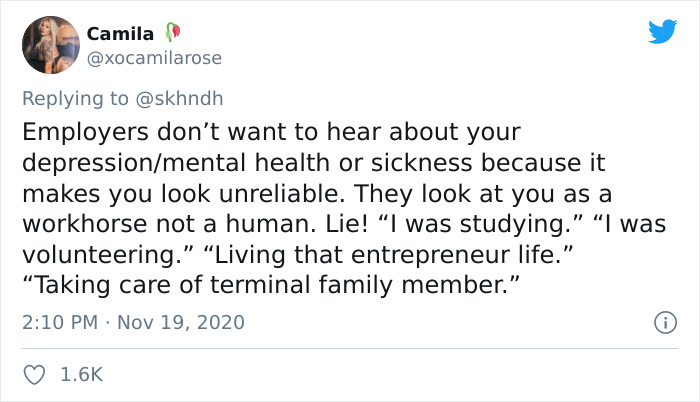
“I think candidates should flip it and start asking how long the job has been vacant and why,” one young woman tweeted. Another user was pretty blunt: “Lie!” they wrote. “Employers don’t want to hear about your depression/mental health or sickness because it makes you look unreliable.”
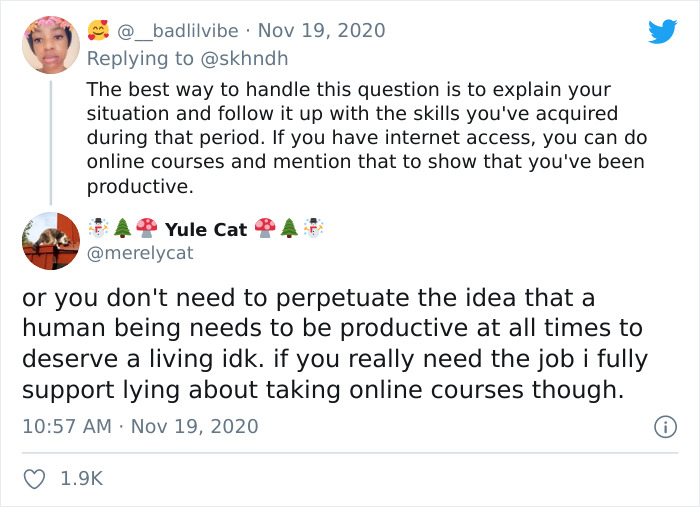
One young woman, however, had different ideas of how to go about the request to explain the gaps. “The best way to handle this question is to explain your situation and follow it up with the skills you’ve acquired during that period. If you have internet access, you can do online courses and mention that to show that you’ve been productive,” she wrote. Her thought wasn’t met very enthusiastically on the viral Twitter thread.
Image credits: xocamilarose
Image credits: merelycat
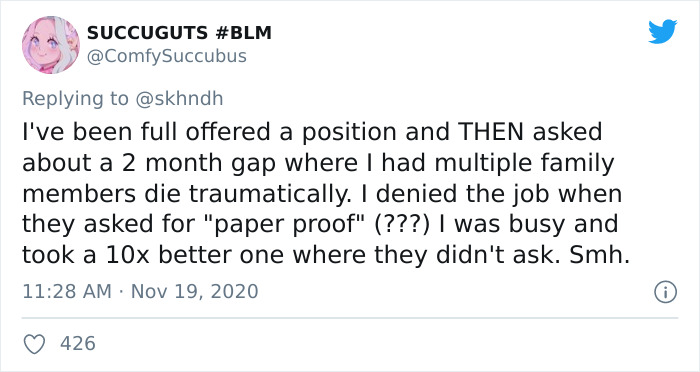
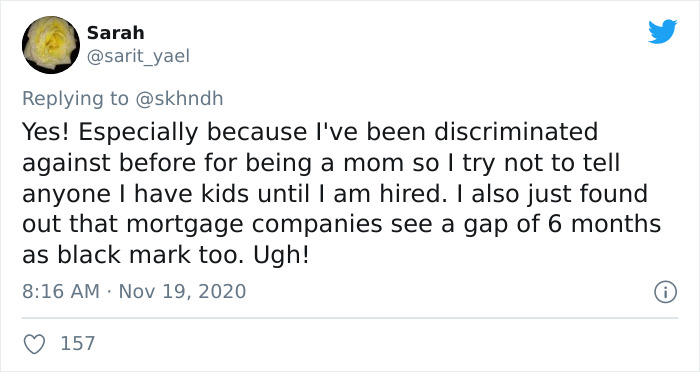
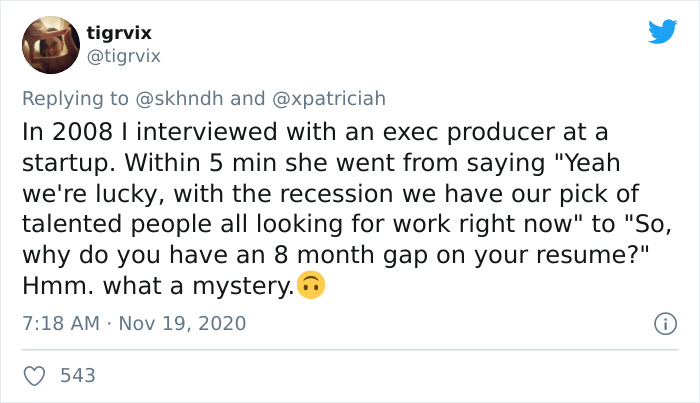
Some shared their sad experiences related to professional gaps
Image credits: ComfySuccubus
Image credits: sarit_yael
Image credits: tigrvix
Image credits: milleronthewall
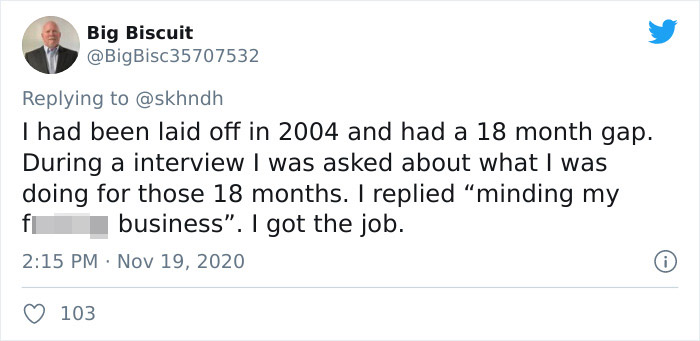
While some people shared how they handled the question previously in their lives
Image credits: BigBisc35707532
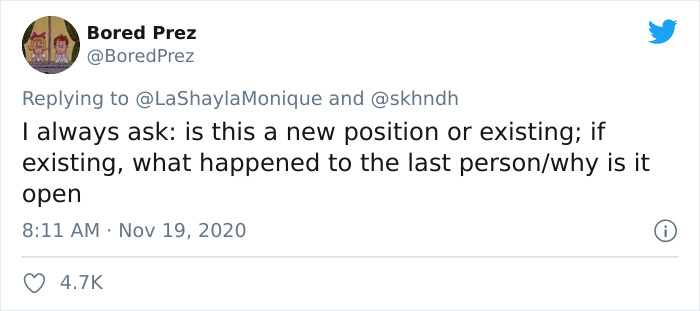
Image credits: BoredPrez
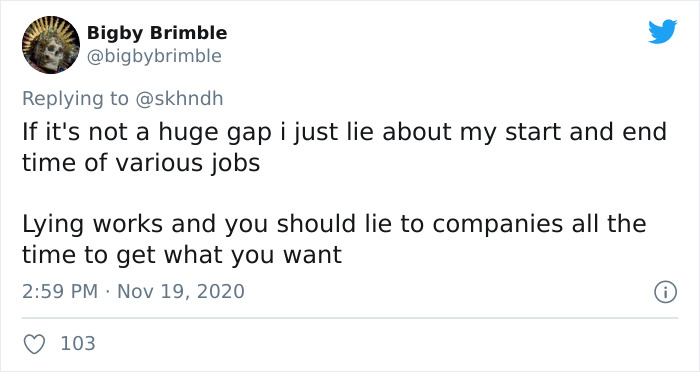
Image credits: bigbybrimble
What do you think? Do you find potential employers’ requests to explain gaps in your resume unethical or annoying? If so, how would you handle it (or maybe you have in the past)? Share in the comments down below!
94Kviews
Share on FacebookI do hate one question even more, "where do you see yourself in 5 to 10 years?"


Answer: "In a much better place than I am now."
Load More Replies...Why do they think they have to give intimate details? A gap could be explained as a personal or family matter. That's all. I don't think the interviewer really wants to hear details.


People are taking this waaaaay too seriously and personally. Maybe it was for personal issues or something you're not proud of, but that doesn't mean that the company is asking it BECAUSE they want to dig into your personal life or make you feel ashamed! Any decent company is empathetic to personal issues; family emergencies, layoffs, medical leave, moving for the sake of your spouse/family, taking a personal sabbatical, etc. This question (and the followup of what you did in that time) is mainly there to look for red flags such as really and truly doing nothing with themselves or showing no motivation to learn, or making up excuses/lies. It's not about what caused the gap, it's about how you handled it and made use of it. That's it, no reason to panic.
I think there seems to be a lack of knowledge on both sides of the table. Interviewers should keep their questions appropriate but asking about a gap isn't unreasonable. Expecting huge amounts of detail is. Questions should be based on skills, experience and knowledge that are relevant to the role. A few based on the persons CV or application where there are gaps or something unusual should be expected but people have lives, people sometimes don't need a job, or have families, travel, illness - none of these things should bar people from being employed & are sufficient answers in themselves. In the UK there are regulations around what people need to disclose and what can and can't be asked - regulations so no discrimination can take place. If someone has been in prison (if people are wondering if that's the gap) you only need to tell a future employer if the conviction is unspent or relevant to the job (because of children's safety - will get a criminal record check anyway).
Load More Replies...As an HR recruiter, I do this question and I am not ashamed of it: it is not done to discriminate not to put someone in an uncomfortable position, it is to better understand your path, progresses and you as a person because all these things are important in a work environment. It's important to know if those reasons might be in conflict with the potential job you're applying for or if, instead, they taught you something valuable that can be very useful for the position. We are not there to try to f**k you or to try to deny you the job, on the contrary we want to find the best fit and we want to know everything that might help us understand which one is THE one.
Agreed. As an executive recruiter; layoffs, leaving a role/culture that wasn't a fit, or leaving for personal/family reasons didn't stop me from exploring their candidacy further when the skills, experience, and leadership qualities were there. Even good leaders can have 3-18 month gaps. We need a picture of what happened. When people became uncomfortable or defensive to the question, their later interview responses often reveal even more about their emotional intelligence (EI), coachability, and ability to work well with/lead a team. I don't need your personal details and life story, but I do need to know the professional risks and if the new environment will be a better fit (or not). If you are not able to formulate a calm and coherent response, you might not be ready to step into the new role and it could lead to a misstep for all sides who are invested in a future together. Take the time to practice telling your story, without lying!!! Lies will always hurt you more later on.
Load More Replies...My gaps are because of mental health issues or times when I had money and felt like taking time off. I see no reason why I should explain.
@Aidan Sivits: My superior at one of my jobs is like 35. He is a bachelor who doesn't do a lot besides visit family and video game. As such, after working for a couple of years he had a fair bit stashed in the bank and "retired" for two years. He spent that two years taking it easy and just doing what he wanted. When he ran out of money he applied and got in at my company. I'd like to add that he has an emotional steadiness that has really served him well. I think his emotional steadiness came from all his "me" time. So no, not everyone has to work, not if you work a decent job. We are not a reflection of our jobs, before anything we are a whole, complete and emotionally complex human. And for someone to lord it over you that you took time off from working, because you needed to or just because you could. Is weird and wrong.
Load More Replies...When I eventually make it back to the working world, I will have a gap that is 10+ years long. I have no idea how to explain that I was in an abusive marriage and also had an injury that should have only lasted 3 years with 5 surgeries but due to the abuse, it lasted a hell of a lot longer. I get that I just told you all that but you aren't hiring me to do a job now are you?
Hi Mama Panda, so sorry you went through that. All a company wants to know is was the gap something that would affect your ability to do the job. If you told them what you've just told us, as someone who has hired a lot of staff, it wouldn't stop me employing you. I'd also not be worried if you'd said that you had no need of a job at the time. People don't always need a job. I didn't make people go into detail over their employment gaps. People travel, have familes, difficult lives. I even employed someone who knew they weren't getting a reference because they were blackmailed into embezzling money. Cue panic from HR but this man repayed me in loyalty a 1000 times over. All the employer wants to know is if you are reliable, hard working and can you do the job. Saying you had family problems that are over now would cover it and should discourage more detail being asked - if they're decent people. If not, think twice before working there! Hope you are okay now.
Load More Replies...I think that as a potential employer, it's reasonable to want to know about any gaps. It's their job to find the most suitable candidate and the reason for the gap might be the difference between hiring someone or not. As a potential employee, I can either sell myself and say I used the time to better myself or similar, or I can decline to answer the question. None of this presents a problem to me - we all have rights and we all make choices. Some choices lead to not getting a job.
1) Put the year starting to year ending of a job, not the year and month. At least where you can get away with that. That helps a lot. 2) Don't ever lie, but do learn how to tell the truth more creatively: 'There was a health crisis with a family member, and I took some time off because I was needed to help with it' (the family member was me - don't need to say that!). Or 'I needed to take some time to step in for a family member who was unable to care for themselves (haha - I had a baby!). Or 'I was doing the groundwork to launch a business, but in the end decided I prefer to be working as a team' (yeah, rite - I was job searching and looking for any way to make some extra bucks!) All are basically true. So don't lie, but do be creative.
YES!! I will say that online applications make it harder to eliminate the month from the timeline. But lying about the time spent in jobs is a bad idea. Basically, if a hiring manager calls your former workplace, the ONLY information the company can share is your dates of employment and (I think) your salary.
Load More Replies...the reason for the gap may actually be a reason to hire or not hire someone. you may have a gap to pursue education or training, or you may have been in prison or drug rehab. in a perfect world with perfect people, it would not matter. in the real world, you do not want a convicted armed robber working for a bank or a drug addict working in a pharmacy. our choices in life do have consequences, sometimes lifelong. other things, such as taking time to take care of the elderly or children shows responsibility and compassion, valued characteristics. health issues are different. mental health issues may affect employability depending on the job. and it is not necessarily discrimination. you would not hire a blind cab driver.
So drug dependence isn't a health issue? What neatly defined category would you place it in? A lifelong consequence of a person's choice to play the role of a hedonistic layabout? Get real. ...and the implication that a stint at an inpatient rehab should be considered a major red flag? "Let's see here, candidate K decided to take a massive step towards becoming a more productive human resource — er, I mean member of society — by seeking help for a private issue that is poorly understood and widely condemned by nearly everyone except the professionals who actually study addiction. Clearly her attempt at achieving sobriety is an indication that she is not to be trusted for the rest of her life! She should have kept that addiction private behind locked doors like the overwhelming majority of working addicts!" Again, get real.
Load More Replies...I do hate one question even more, "where do you see yourself in 5 to 10 years?"
Answer: "In a much better place than I am now."
Load More Replies...Why do they think they have to give intimate details? A gap could be explained as a personal or family matter. That's all. I don't think the interviewer really wants to hear details.

People are taking this waaaaay too seriously and personally. Maybe it was for personal issues or something you're not proud of, but that doesn't mean that the company is asking it BECAUSE they want to dig into your personal life or make you feel ashamed! Any decent company is empathetic to personal issues; family emergencies, layoffs, medical leave, moving for the sake of your spouse/family, taking a personal sabbatical, etc. This question (and the followup of what you did in that time) is mainly there to look for red flags such as really and truly doing nothing with themselves or showing no motivation to learn, or making up excuses/lies. It's not about what caused the gap, it's about how you handled it and made use of it. That's it, no reason to panic.

I think there seems to be a lack of knowledge on both sides of the table. Interviewers should keep their questions appropriate but asking about a gap isn't unreasonable. Expecting huge amounts of detail is. Questions should be based on skills, experience and knowledge that are relevant to the role. A few based on the persons CV or application where there are gaps or something unusual should be expected but people have lives, people sometimes don't need a job, or have families, travel, illness - none of these things should bar people from being employed & are sufficient answers in themselves. In the UK there are regulations around what people need to disclose and what can and can't be asked - regulations so no discrimination can take place. If someone has been in prison (if people are wondering if that's the gap) you only need to tell a future employer if the conviction is unspent or relevant to the job (because of children's safety - will get a criminal record check anyway).
Load More Replies...As an HR recruiter, I do this question and I am not ashamed of it: it is not done to discriminate not to put someone in an uncomfortable position, it is to better understand your path, progresses and you as a person because all these things are important in a work environment. It's important to know if those reasons might be in conflict with the potential job you're applying for or if, instead, they taught you something valuable that can be very useful for the position. We are not there to try to f**k you or to try to deny you the job, on the contrary we want to find the best fit and we want to know everything that might help us understand which one is THE one.

Agreed. As an executive recruiter; layoffs, leaving a role/culture that wasn't a fit, or leaving for personal/family reasons didn't stop me from exploring their candidacy further when the skills, experience, and leadership qualities were there. Even good leaders can have 3-18 month gaps. We need a picture of what happened. When people became uncomfortable or defensive to the question, their later interview responses often reveal even more about their emotional intelligence (EI), coachability, and ability to work well with/lead a team. I don't need your personal details and life story, but I do need to know the professional risks and if the new environment will be a better fit (or not). If you are not able to formulate a calm and coherent response, you might not be ready to step into the new role and it could lead to a misstep for all sides who are invested in a future together. Take the time to practice telling your story, without lying!!! Lies will always hurt you more later on.
Load More Replies...My gaps are because of mental health issues or times when I had money and felt like taking time off. I see no reason why I should explain.
@Aidan Sivits: My superior at one of my jobs is like 35. He is a bachelor who doesn't do a lot besides visit family and video game. As such, after working for a couple of years he had a fair bit stashed in the bank and "retired" for two years. He spent that two years taking it easy and just doing what he wanted. When he ran out of money he applied and got in at my company. I'd like to add that he has an emotional steadiness that has really served him well. I think his emotional steadiness came from all his "me" time. So no, not everyone has to work, not if you work a decent job. We are not a reflection of our jobs, before anything we are a whole, complete and emotionally complex human. And for someone to lord it over you that you took time off from working, because you needed to or just because you could. Is weird and wrong.
Load More Replies...When I eventually make it back to the working world, I will have a gap that is 10+ years long. I have no idea how to explain that I was in an abusive marriage and also had an injury that should have only lasted 3 years with 5 surgeries but due to the abuse, it lasted a hell of a lot longer. I get that I just told you all that but you aren't hiring me to do a job now are you?
Hi Mama Panda, so sorry you went through that. All a company wants to know is was the gap something that would affect your ability to do the job. If you told them what you've just told us, as someone who has hired a lot of staff, it wouldn't stop me employing you. I'd also not be worried if you'd said that you had no need of a job at the time. People don't always need a job. I didn't make people go into detail over their employment gaps. People travel, have familes, difficult lives. I even employed someone who knew they weren't getting a reference because they were blackmailed into embezzling money. Cue panic from HR but this man repayed me in loyalty a 1000 times over. All the employer wants to know is if you are reliable, hard working and can you do the job. Saying you had family problems that are over now would cover it and should discourage more detail being asked - if they're decent people. If not, think twice before working there! Hope you are okay now.
Load More Replies...I think that as a potential employer, it's reasonable to want to know about any gaps. It's their job to find the most suitable candidate and the reason for the gap might be the difference between hiring someone or not. As a potential employee, I can either sell myself and say I used the time to better myself or similar, or I can decline to answer the question. None of this presents a problem to me - we all have rights and we all make choices. Some choices lead to not getting a job.
1) Put the year starting to year ending of a job, not the year and month. At least where you can get away with that. That helps a lot. 2) Don't ever lie, but do learn how to tell the truth more creatively: 'There was a health crisis with a family member, and I took some time off because I was needed to help with it' (the family member was me - don't need to say that!). Or 'I needed to take some time to step in for a family member who was unable to care for themselves (haha - I had a baby!). Or 'I was doing the groundwork to launch a business, but in the end decided I prefer to be working as a team' (yeah, rite - I was job searching and looking for any way to make some extra bucks!) All are basically true. So don't lie, but do be creative.
YES!! I will say that online applications make it harder to eliminate the month from the timeline. But lying about the time spent in jobs is a bad idea. Basically, if a hiring manager calls your former workplace, the ONLY information the company can share is your dates of employment and (I think) your salary.
Load More Replies...the reason for the gap may actually be a reason to hire or not hire someone. you may have a gap to pursue education or training, or you may have been in prison or drug rehab. in a perfect world with perfect people, it would not matter. in the real world, you do not want a convicted armed robber working for a bank or a drug addict working in a pharmacy. our choices in life do have consequences, sometimes lifelong. other things, such as taking time to take care of the elderly or children shows responsibility and compassion, valued characteristics. health issues are different. mental health issues may affect employability depending on the job. and it is not necessarily discrimination. you would not hire a blind cab driver.
So drug dependence isn't a health issue? What neatly defined category would you place it in? A lifelong consequence of a person's choice to play the role of a hedonistic layabout? Get real. ...and the implication that a stint at an inpatient rehab should be considered a major red flag? "Let's see here, candidate K decided to take a massive step towards becoming a more productive human resource — er, I mean member of society — by seeking help for a private issue that is poorly understood and widely condemned by nearly everyone except the professionals who actually study addiction. Clearly her attempt at achieving sobriety is an indication that she is not to be trusted for the rest of her life! She should have kept that addiction private behind locked doors like the overwhelming majority of working addicts!" Again, get real.
Load More Replies...


157
166